
Sewage Treatment Plant Manufacturer: Limits, Flow and Build From China
 ·
Updated October 14, 2026
·
24 min read
A sewage treatment plant bought from a Chinese builder is sized by three effluent numbers, not by the tank volume someone writes on a drawing. The plant has to hold biological oxygen demand at or below 30 mg/l as a 30-day average, suspended solids at the same figure, and pH between 6.0 and 9.0. Those are the federal secondary treatment limits, and they are the same for a 20 cubic metre a day package plant and a municipal works. What changes is the flow you have to treat, the material the tank is built from, and whether the sludge leaving the plant has to meet the stricter of the two sludge classes. This guide walks through the numbers a supplier has to design to, the four questions that decide the equipment list, and the checks that stop a cheap tank becoming an expensive problem.
| Your situation | What decides the design | Where the cost sits |
|---|---|---|
| One factory, its own effluent | Peak flow and the pollutant load, not the headcount | Tank volume and the aeration blower |
| A housing or site development | Population equivalent plus a design flow per person | The tank shell material |
| Reuse on site, not discharge | Effluent quality far tighter than secondary | The membrane stack and its replacement cycle |
| Discharge to a river or drain | The permit limits your authority writes | Disinfection and monitoring |
| Sludge going to land or to a farm | Which sludge class your authority requires | Digestion and dewatering |
What a Sewage Treatment Plant Manufacturer Actually Sells You
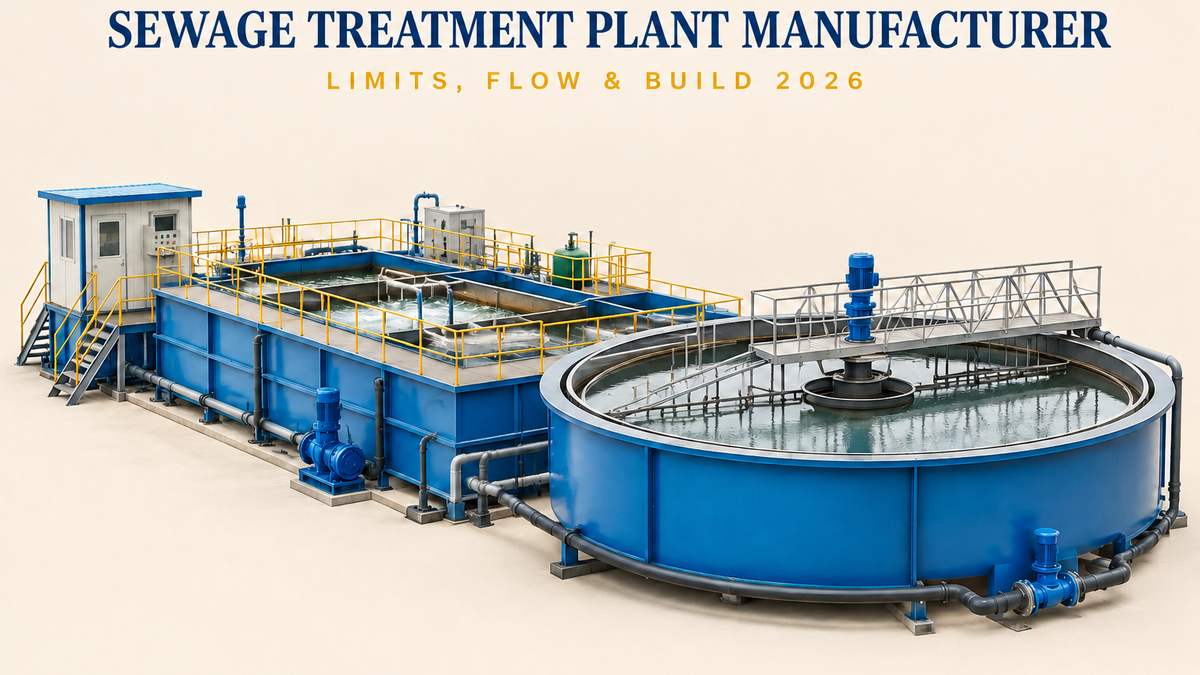
The phrase covers two very different businesses. One builds a steel box on a frame, drops a known process inside it, ships it on a truck and sends a technician to start it up. The other sells you a set of drawings and a list of equipment and expects a local contractor to pour concrete and assemble it. Both call themselves sewage treatment plant manufacturers, and the two quotations are not comparable at all.
Ask which one you are talking to before you compare prices. The question that settles it is what arrives at the port. A packaged plant arrives as tanks, usually in two or three sections that bolt together on site, with the blower, the pumps, the diffusers and the control panel already mounted and wired. A built-on-site design arrives as plate steel, pipe spools, loose equipment and drawings. If you have a contractor and a crane, the second can be cheaper. If you do not, the first is the only one that will actually work.
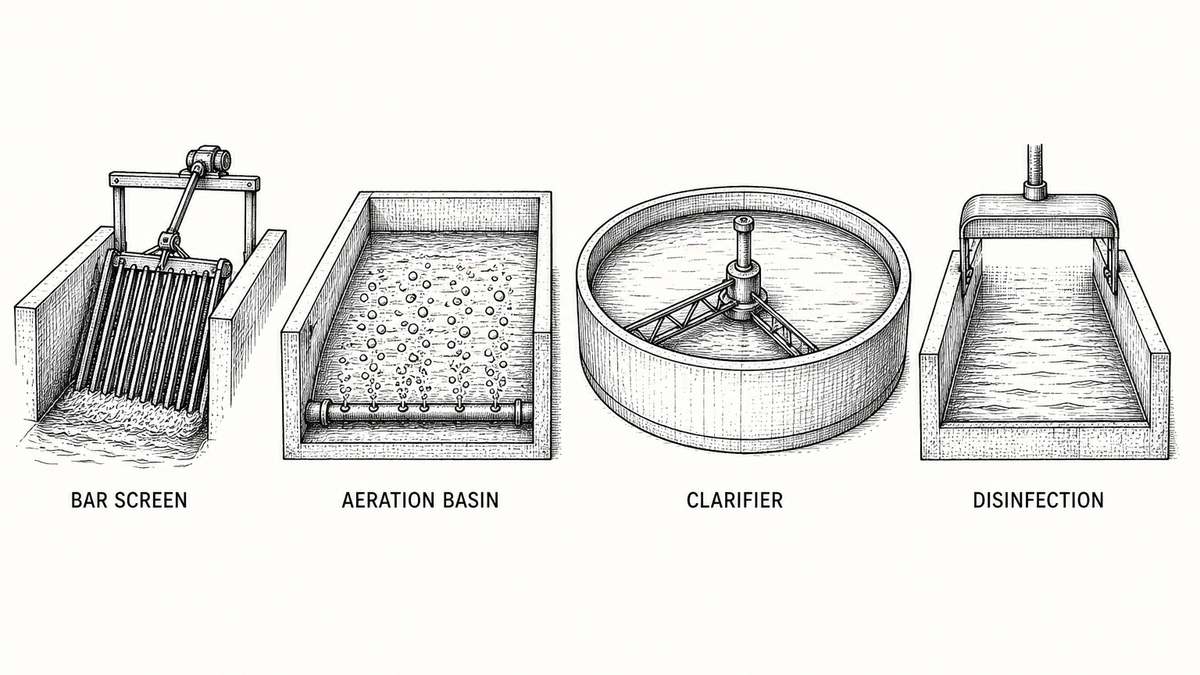
The process train itself is short and well understood. Screens take out what would jam a pump. An aeration basin grows the bacteria that eat the organic load. A clarifier lets the bacteria settle out so the water leaving is clear. Disinfection finishes the job before discharge. Almost every plant you will be quoted is some arrangement of those four stages, with the differences sitting in how the bacteria are held and where the solids are separated.
What you are really buying is the engineering behind those four stages. Anyone can weld a tank. Getting the volume right for the load, choosing an aeration system that will still be working in five years, and setting the return sludge rate so the clarifier does not carry solids over on the first cold morning, that is the part that separates a builder from a fabricator.
The Three Numbers That Fix the Plant Size
Start with the numbers your plant has to hit, because they are published and they do not move. Under the federal secondary treatment rule, BOD and suspended solids each have to average no more than 30 mg/l over any 30-day period, with a 7-day average no higher than 45 mg/l, and at least 85 percent of what comes in has to be removed. pH has to stay between 6.0 and 9.0.
The rule is written as the minimum level of effluent quality at 40 CFR 133.102, and it is worth reading once because it tells you what your supplier is designing against. It also offers a substitution that many buyers never ask about: the permitting authority may allow carbonaceous BOD instead of plain BOD, with a slightly tighter ceiling of 25 mg/l on the 30-day average and 40 mg/l on the 7-day average. If your permit uses that version, the plant can sometimes be smaller.
| Parameter | 30-day average | 7-day average | 30-day removal |
|---|---|---|---|
| BOD five-day | 30 mg/l | 45 mg/l | 85 percent |
| Carbonaceous BOD, where substituted | 25 mg/l | 40 mg/l | 85 percent |
| Suspended solids | 30 mg/l | 45 mg/l | 85 percent |
| pH | 6.0 to 9.0 | 6.0 to 9.0 | Not applicable |
Two things about that table trip buyers up. The first is the difference between a 30-day average and a 7-day average. A plant can look fine on a single grab sample and still fail a monthly average, because the average is what gets reported. That is why the aeration volume has to cover the bad week, not the typical day, and it is the main reason a plant quoted on the average flow alone comes back too small.
The second is that percent removal is measured across the plant, not at one point. An 85 percent removal duty on an influent of 250 mg/l means the outlet cannot exceed about 37 mg/l even though the concentration limit is 30, so the removal figure can bite before the concentration does. Tell your supplier both the concentration limits and the removal duty, and let them design to whichever binds first.
pH looks like the easy parameter and quietly is not. The rule allows a plant to run outside 6.0 to 9.0 only if it can show that no inorganic chemicals are added as part of the treatment and that industrial sources are not pushing the pH out of range. A plant treating mixed industrial effluent rarely qualifies, which means the neutralisation duty lands on the equipment list as dosing and mixing that nobody put in the original budget.
Design Flow Is Not the Number in Your Enquiry
Almost every badly sized plant in this category was sized from the wrong flow. Buyers send the average daily flow because that is the number they have. The plant has to be designed for the flow it will actually see, and for a sewage works that number is fixed by rule rather than by preference.
For a publicly owned treatment works, permit limits have to be worked out on the design flow. That is written into the rule on how permit conditions are calculated at 40 CFR 122.45, and it is the reason a supplier will not accept your average flow figure as the basis of design. Design flow is the flow the plant must be able to treat, and it has to take in the peak the works will see, not the mean.
Three things push the design flow above the average. Rainfall entering cracked pipes and joints, which can double the flow in a small network after a storm. Peak hourly flow from a working day, where everyone showers and every process drains within the same two hours. And future connections, since almost every authority writes a permit for a design life rather than for today.
Ask for the basis of design in writing. Two quotations for what looks like the same tank can differ by a large margin because one is built to average flow and the other to peak, and the drawings will not tell you which. The sentence you want from the supplier names the average flow, the peak factor applied, and the resulting design flow.
There is a second rule detail that shapes the equipment list. For a treatment works, limits are stated as average weekly and average monthly figures, while other dischargers get maximum daily and average monthly. That matters because weekly averaging lets a plant ride out one bad day, which changes how much equalisation volume you need. If your plant discharges in batches rather than continuously, the permit is written differently again, with limits on how often, how much and how fast each batch leaves. Tell your supplier which of the three you are, and the tank layout will change.
Packaged, SBR, MBR or Septic
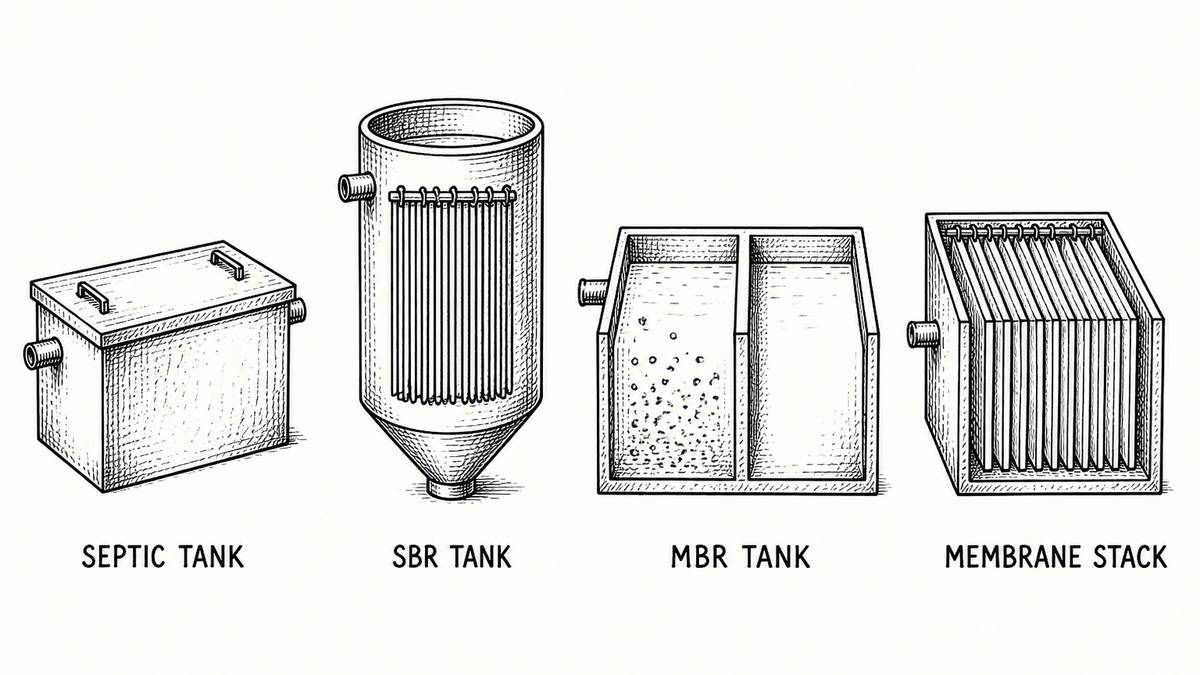
A septic tank is settling and anaerobic digestion in one box, with nothing to power and almost nothing to fail. It suits a single building with a light organic load and somewhere to send the liquid afterwards. It is not secondary treatment, so it will not meet a 30 mg/l limit on its own, and it is the wrong answer the moment a permit applies.
A sequencing batch reactor runs fill, react, settle, decant and idle in one tank on a timer. Because the cycle is controlled by time rather than by flow, it copes well with a site that is busy for eight hours and quiet for sixteen, which is most factories. One tank instead of three, and a level of treatment that meets secondary limits comfortably. The trade is that the valves and the timer are doing the work, so the control panel has to be good.
A moving bed biofilm reactor puts plastic media in the aerated tank and lets the bacteria grow on the media instead of in suspension. Flow is continuous rather than batched, the tank is smaller for the same load, and the process is steady because the biofilm does not wash out when the flow surges. It is a common choice where the site is already tight.
A membrane bioreactor separates the solids with a membrane instead of a clarifier. It gives the cleanest effluent of the four and the smallest footprint, and it is the only one of the four that reliably produces water good enough to reuse for irrigation or flushing. The catch sits in the running cost, because membranes have a life and a price, and a buyer comparing capital cost alone will be surprised in year five.
Choose by what the permit demands and what the site allows, not by what the supplier has on the shelf. If the only duty is meeting secondary limits on a site with room, a sequencing batch reactor does the job at the lowest total cost. If the plant has to fit in a corner, or the water has to be reused, the membrane route earns its keep. What you should not accept is a membrane plant sold on the promise of better water without a written membrane replacement price and interval.
What the Tank Is Made Of
Strength is rarely the limiting factor on a treatment tank. Corrosion is. Sewage is warm, mildly acidic, full of sulphates, and in an aeration basin permanently full of oxygen, which is close to the worst combination for ordinary steel. The wall thickness a supplier proposes is almost never the thing that ends the tank's life; the internal surface is.
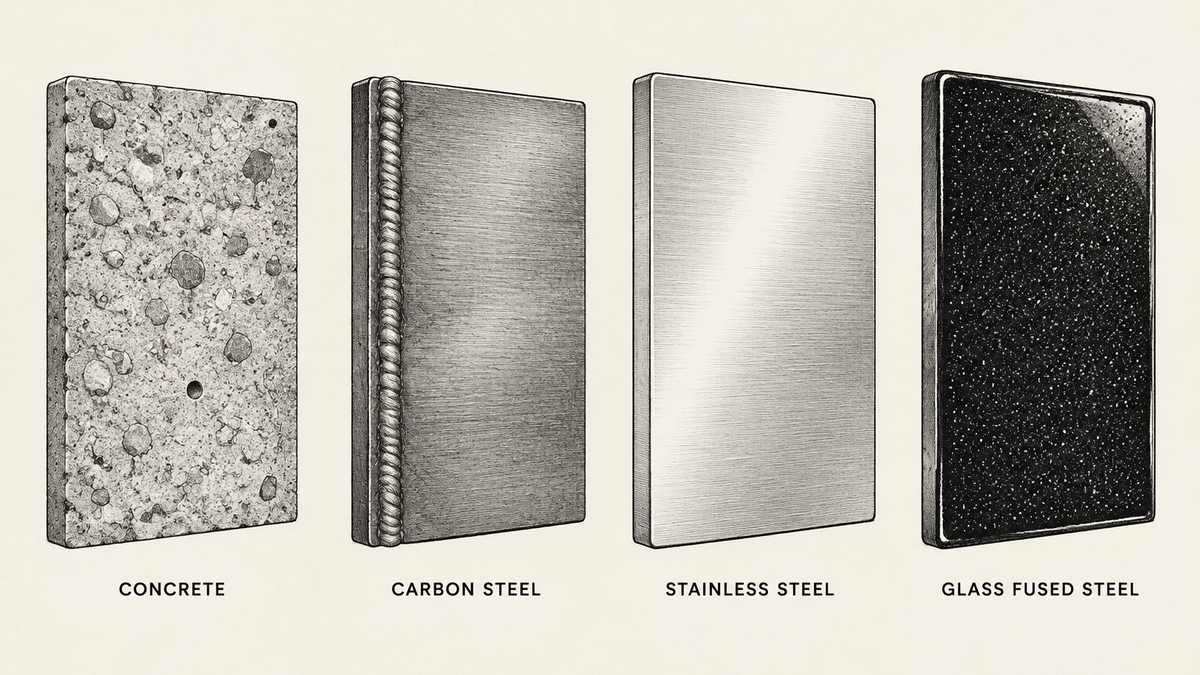
Concrete is the longest-lived option and the most awkward to buy from abroad, because it is normally cast on site by a local contractor rather than shipped. When you see concrete in a quotation from an overseas supplier, check what is actually being supplied. Usually it is the process equipment and the design, with the tank built by someone else. That is a perfectly good route, but it is a different contract and it needs to be priced separately.
Carbon steel with an internal coating is the common packaged plant material. It is strong, it welds well and it travels. Its service life is the life of the coating, which means the coating specification matters more than the steel grade. Ask for the system name, the number of coats and the dry film thickness in microns, and ask for the spark test report that shows the coating has no pinholes. A coated tank that was never spark tested will start rusting at a pinhole within a couple of years, and the failure will look like bad steel when it is really bad coating.
Stainless steel solves the corrosion problem and brings a new one. Chlorides pit stainless, and sewage contains them, so the grade has to be chosen for the chloride level rather than picked as the default. Ask the supplier which grade they propose and why, and be suspicious of a bare stainless quotation with no reasoning attached.
Glass-fused-to-steel panels are bolted together on site, which makes them fast to erect and easy to ship in a container. The enamel coating is hard and chemically resistant, and the places it fails are the cut edges and the bolt holes, where the coating is interrupted and the steel is exposed. If you go this route, ask how those edges are sealed and what the supplier does about field-cut panels.
The Parts That Decide Whether It Works
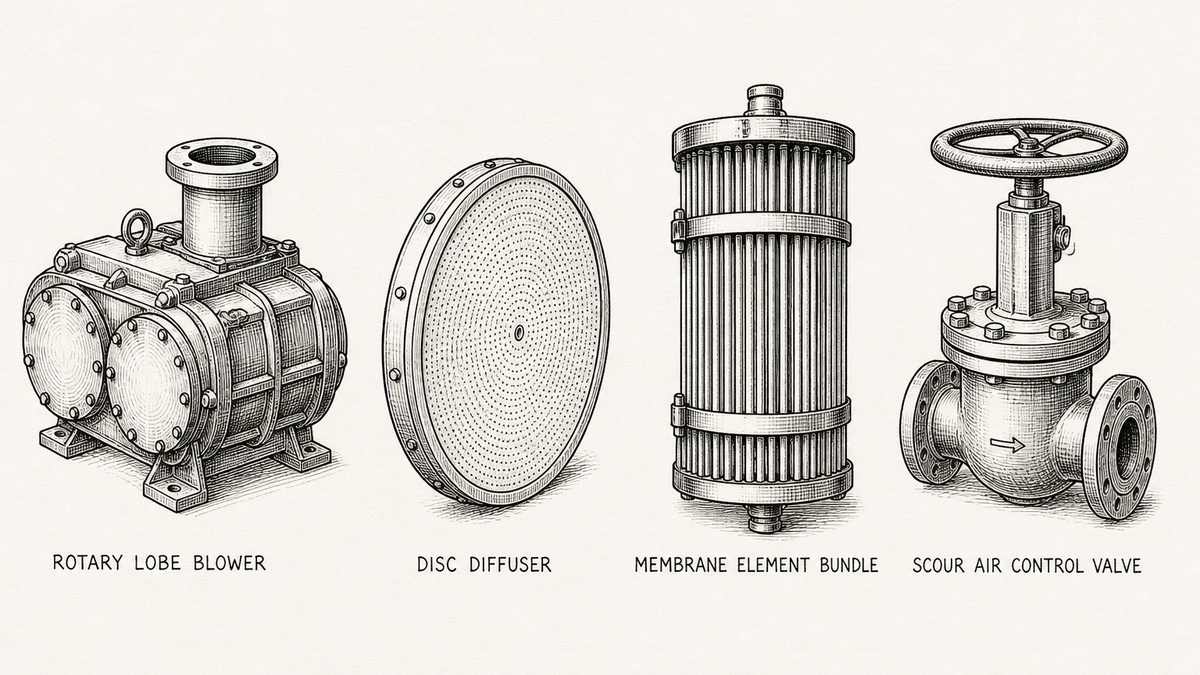
Most of the steel in a packaged plant is simple work. The parts that decide whether the plant performs and what it costs to run are bought in by the builder from someone else, and those are the parts worth naming in the enquiry.
The blower is the single largest electricity consumer on the plant, because aeration runs continuously and everything else runs occasionally. Ask which type is offered, what the motor rating is, and whether it is speed controlled. A blower running at fixed speed on a plant that only needs full air for part of the day is throwing money away, and a variable speed drive is one of the few options that pays for itself. Ask too about the noise figure, because a blower running day and night next to a boundary fence is a complaint waiting to happen.
The diffusers transfer that air into the water, and their efficiency decides how much air you have to pay for. Fine bubble diffusers are far more efficient than coarse ones, and they clog, which is why the membrane material and the replacement interval are the questions that matter. Ask what the diffuser membrane is made of and how long the supplier expects it to last in your water. A quotation that names a make and a model is worth more than one that says fine bubble diffuser.
On a membrane plant the membrane itself is the second largest cost after the tank, and unlike the blower it is a consumable. Ask for the element material, the flux it is rated at, the replacement interval, and the price of a replacement set in today's money. A supplier who cannot give you a replacement price is not offering you a plant you can own for ten years.
The air control valve and the return sludge pump are small line items that cause a lot of trouble. The return sludge rate has to be adjustable, because it is how you keep the clarifier from carrying solids over, and the valve that sets it has to stay free in dirty air. Ask for the valve type and whether it is designed for sludge service rather than general purpose, and ask for the pump curve rather than just the motor size.
One sentence in your enquiry handles all of this: require the make and model of every bought-in item, listed separately, with the country of origin. It costs you nothing to ask and it turns a vague offer into something you can compare with the next one.
Where the Sludge Goes Changes the Equipment List
This is the question almost nobody asks when they request a quotation, and it is the one that moves the price the most. Sludge leaving a treatment plant is regulated on its own, and which of the two classes your sludge has to meet decides whether you need digestion and pasteurisation equipment or just dewatering.
The rule is the pathogen requirements for sewage sludge at 40 CFR 503.32, and the difference between the two classes is large. Class A means the treated sludge carries fewer than 1,000 units of faecal coliform per gram of total solids, or fewer than three units of Salmonella per four grams, and it has to get there through one of several listed treatments. The two common ones are time and temperature, where sludge at seven percent solids or higher is held at 50 degrees Celsius or more for at least 20 minutes, and a high pH route, where the pH is raised above 12 and held there for 72 hours, with the sludge above 52 degrees Celsius for at least 12 of those hours, then air dried to more than 50 percent solids.
Class B is a much lower bar. The sludge is treated so that the geometric mean faecal coliform count across seven representative samples stays under 2,000,000 units per gram, or it goes through a recognised process that significantly reduces pathogens. No pasteurisation is needed, and conventional anaerobic digestion with dewatering will normally get you there.
Class B is cheaper to reach and it comes with conditions on how the sludge can be used. Land that receives it is restricted. Food crops whose harvested parts touch the sludge are kept out for 14 months. Crops harvested from below the surface are kept out for 20 months if the sludge stayed on the surface for four months or more, and 38 months if it sat for less. Food, feed and fibre crops wait 30 days, grazing waits 30 days, turf waits a year, and public access to high-exposure land is restricted for a year.
So the design question is simple to state. If the sludge is going to be given away or sold as a product, or applied to land you do not control, you probably need Class A and you need the equipment that gets you there. If it is going to a farm that can work within the waiting periods, Class B and a digestion and dewatering train will do. Put the intended sludge route in the enquiry, and the equipment list that comes back will be the right one.
What to Test Before It Leaves the Yard
A treatment plant is a process wrapped in a tank, and the two have to be tested differently. The tank can be proven at the works. The process usually cannot, because nobody wants to fill a new plant with real sewage in a factory yard, and the results would not mean much if they did.
What the tank and the equipment can be proven on before shipping is a short list, and every item on it is cheap to witness and expensive to argue about afterwards. A hydrostatic test of every compartment, held long enough to show no drop and no weeping at the seams. A dry film thickness survey on the coating, with readings taken at a set number of points per panel rather than one per tank. A spark test across the whole coated surface to find pinholes. A no-load and load run of each blower and pump. An insulation resistance test and a function test on the control panel. And a set of as-built drawings that matches what was actually built rather than what was quoted.
The two tests that cannot be repeated later are the hydrostatic test and the coating spark test, because once the plant is crated and shipped nobody is going to fill it or walk the surface with a probe again. Those are the two worth witnessing in person, and if you cannot travel, they are the two worth paying an inspector to attend. The same logic that applies to any pre-shipment inspection before the crate is closed applies here, with the added point that a tank test has to happen before the internals are covered up.
For the process itself, ask for a clean-water commissioning test that proves the pumps, the air distribution and the control sequence all work together, plus a written start-up protocol that says what has to be seeded, how long the plant takes to reach steady state, and what the operator should watch in the first month. A supplier who can hand you that document has commissioned plants before. A supplier who cannot has only built tanks.
The document set that should travel with the plant is worth listing in the order: tank test report, coating thickness and spark records, blower and pump test certificates together with the pump curves, panel test report and wiring diagram, a spare parts list with prices, and the commissioning protocol. Everything on that list can be produced by any competent builder, and its absence is the clearest signal you will get about how the rest of the order is going to go.
What Actually Moves the Price
Two quotations for the same daily flow can sit far apart, and the gap is almost never the labour rate in the workshop. It is a short list of decisions, and most of them were made before the price was written.
Tank volume is the biggest single line, and it is set by the design flow and the retention time rather than by the footprint the buyer had in mind. A plant designed on average flow will be visibly smaller and visibly cheaper than one designed on peak flow, and both will be offered to you as the same thing unless the basis of design is written down.
The number of process stages is next. A sequencing batch reactor does everything in one tank. A membrane plant adds a membrane stack, which is a capital item and a replacement item, but removes the clarifier and shrinks the footprint. Digestion and dewatering for the sludge are a separate train again, and whether you need them depends on the sludge class you are aiming at.
Material and coating come third. Carbon steel with a specified coating system, stainless steel, and glass-fused-to-steel panels land at three different prices, and the difference is mostly about how many years you intend to keep the tank. A coating system that has been spark tested costs a little more than one that has not, and it is the cheapest insurance on the whole order.
The aeration system is where running cost is set, and it is where a cheap quotation hides. A coarse bubble system with a fixed speed blower costs less on the day and more every month afterwards. Fine bubble diffusers with a speed controlled blower cost more up front and less to run, and on a plant that runs continuously the difference adds up quickly. Ask for the aeration system and the blower to be priced as a separate line, so you can see what the running cost is really made of.
Then the smaller decisions. The level of automation in the panel, which decides how many people have to watch the plant. The disinfection route, where dosing is cheap to install and UV is cheap to run in some sizes and not others. And the sludge handling equipment, where a filter press for the dewatered cake and a screw conveyor to move the sludge and screenings are usually quoted separately from the plant itself, which is exactly where a like-for-like comparison falls apart.
Freight is the line buyers over-worry about and under-plan. A packaged plant is bulky and awkward rather than enormously heavy, so the sea freight is rarely the problem. What catches people is the handling at both ends, because a two-part tank needs a crane and a permit at the destination port and again at the site.
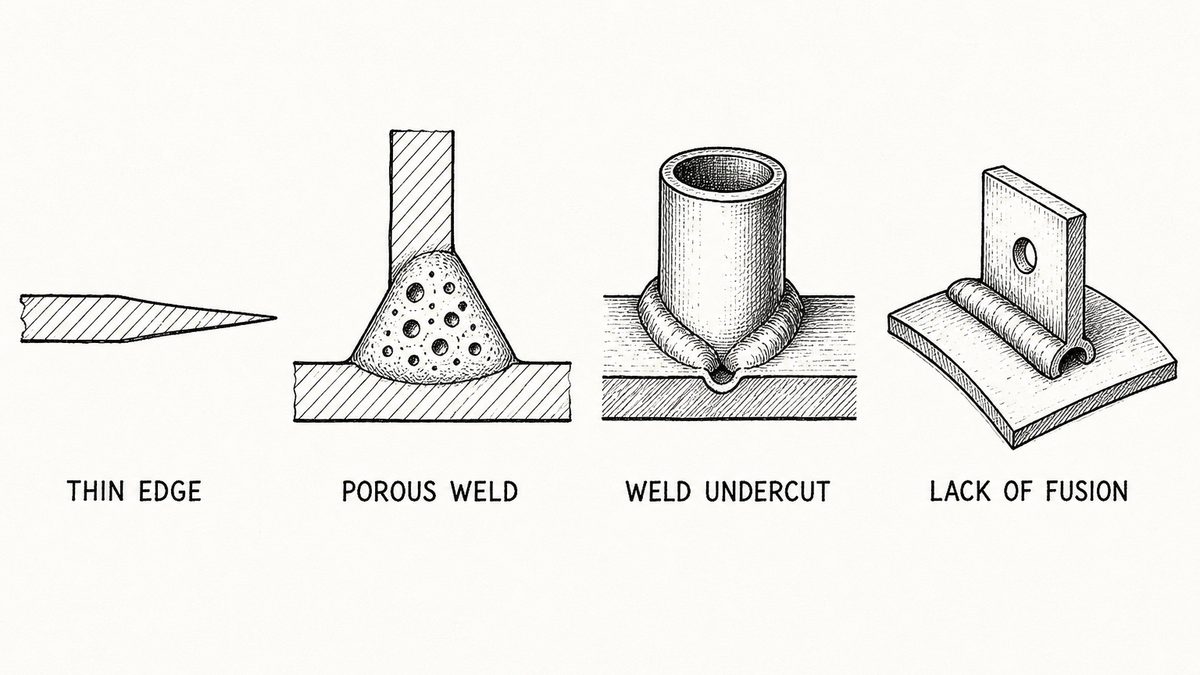
Four Ways a Plant Fails to Match Its Paperwork
The failures that hurt are not the dramatic ones. They are the small ones that pass a visual inspection, survive painting, and only announce themselves when the plant is full of water and the buyer is three thousand kilometres from the workshop.
The first is a thin edge. Plate is rolled to a tolerance, and the light end of that tolerance lives at the edge of the sheet. A wall quoted at eight millimetres can arrive at seven and a half at the edge of a rolled course, which is also the place where the seam is about to be welded. Nothing about the tank looks wrong. You find it with an ultrasonic thickness gauge, taken at the plate edges and at a set distance either side of every seam, and the result is worth having as a map rather than a single number.
The second is a porous weld. Gas trapped as the weld metal freezes leaves a chain of small holes through the joint, and the holes become leak paths and corrosion sites. A porous weld usually passes a quick look and fails a proper examination, which is why weld examination has to be a written requirement in the order rather than a promise. On a wastewater tank, dye penetrant on the inside face of the seams is the cheap check that finds them.
The third is undercut, a groove melted into the parent metal along the edge of the weld. It looks like a neat weld. What it leaves behind is a thin section exactly where the load and the corrosion both concentrate, and it is the classic starting point for a crack in service.
The fourth is lack of fusion, where the weld metal sits on top of the joint without bonding to it. This one is the most dangerous of the four when it happens at a support or a stiffener, because the connection looks complete and carries load until it does not. Ask for the support and stiffener welds to be included in the examination scope, not just the shell seams.
Beyond the four, the pattern that repeats is substitution. The blower arrives as a different make to the one quoted. The membrane area is smaller than the area specified. The coating thickness is thinner than the thickness agreed. None of it is visible from outside, and all of it is caught by the same habit: the bought-in items named in the order, the coating measured, and the industrial machinery library that holds these orders steady used to keep the enquiry consistent from one supplier to the next.
Questions Buyers Ask Before Ordering
How much does a sewage treatment plant cost?
There is no useful per-unit figure, because the price is set by the design flow and the sludge route rather than by a size you can look up. A small packaged plant for one building with light effluent and no digestion sits in a completely different band from a plant of the same footprint treating a factory's process water with sludge that has to reach Class A. The honest way to price an order is to fix three things first: the design flow including peak, the effluent limits your permit sets, and where the sludge is going. Any quotation that arrives before those three are settled is a guess, and the guesses are not comparable with each other.
What size plant do I need for my factory?
Two numbers decide it, and neither is the number of people on site. The first is the peak flow the plant will see, which depends on shift patterns and on how much rain gets into the drains. The second is the organic load, which depends on what the process actually discharges rather than on how much water it uses. Send the supplier the peak flow, the load in kilograms of BOD per day, and the effluent limits, and let them size the tank. If you send a tank volume instead, you have made the design decision yourself and the supplier will build to it, which is how undersized plants get built.
Is a septic tank enough, or do I need secondary treatment?
A septic tank settles solids and digests them anaerobically, and it does not meet secondary treatment limits on its own. If your discharge needs a permit, or your effluent goes anywhere other than a soakaway you control, a septic tank will not be enough. It is a legitimate answer for a single building with a light load and a suitable place to discharge, and it is the wrong answer the moment a limit of 30 mg/l on BOD or suspended solids applies to you. Deciding this before you ask for quotations saves a lot of wasted effort.
Can a Chinese manufacturer build a plant to my local permit?
Yes, and the practical limits are the ones you would expect. A builder can design to a set of effluent figures written in any language, and most of the equipment is commodity hardware. What the builder cannot do is know your local authority's preferred calculation method, your sludge disposal routes, or the inspection regime at the destination. So the work is on the buyer's side: translate the permit into a set of design figures, put the sludge route in writing, and agree the document set in the order. Where a plant is tied into pipework at the site, the bolted flange joint that has to match the pipe facing is the one interface worth fixing to a standard both sides already use.
What if the sludge has to be reusable?
Then you are designing to the stricter sludge class, and the equipment list grows. Reaching Class A means holding the sludge at a set temperature for a set time at a stated solids level, or taking the pH above 12 for 72 hours, and either route needs equipment that a conventional digestion and dewatering train does not include. That equipment has to be in the enquiry from the start, because adding a pasteurisation step after the tank has been built is not a small change. If land application under the Class B waiting periods is acceptable to your authority, the cheaper train is usually enough.
What is the biggest risk when buying a plant from overseas?
The single largest risk is not the steel, it is buying a process you cannot operate. A plant arrives, gets commissioned in a rush, and then runs for two years without anyone understanding what the return sludge rate does or why the blower speed matters. The fix costs nothing at the quotation stage and a great deal later. Ask for a written start-up and operating protocol, ask for the operator training to be part of the order rather than an extra, and ask what the plant does when the load triples for a week. Where odour is the local risk rather than the water, the abatement side is a separate item to buy too, and a wet scrubber working on the odour rather than the effluent is often what saves the permit on a site close to housing.
Get a plant sized on the right numbers
Send the design flow, the effluent limits your permit sets, and where the sludge has to go. We will put those on a datasheet, get comparable quotations from builders who actually run these plants, and hold the order until the tank test and the coating test are witnessed.
Request a Sewage Treatment Plant Quote
Questions & Comments
We read every one and reply within 24 hoursThe argument is almost never about the tank. It is about which flow the plant was sized on, which effluent limits the process has to reach, and where the sludge is allowed to go. Send us those three and we will settle them before a builder is asked to quote.