
Pressure Vessel Manufacturer: Stamps, Materials and Testing From China
 ·
Updated October 13, 2026
·
24 min read
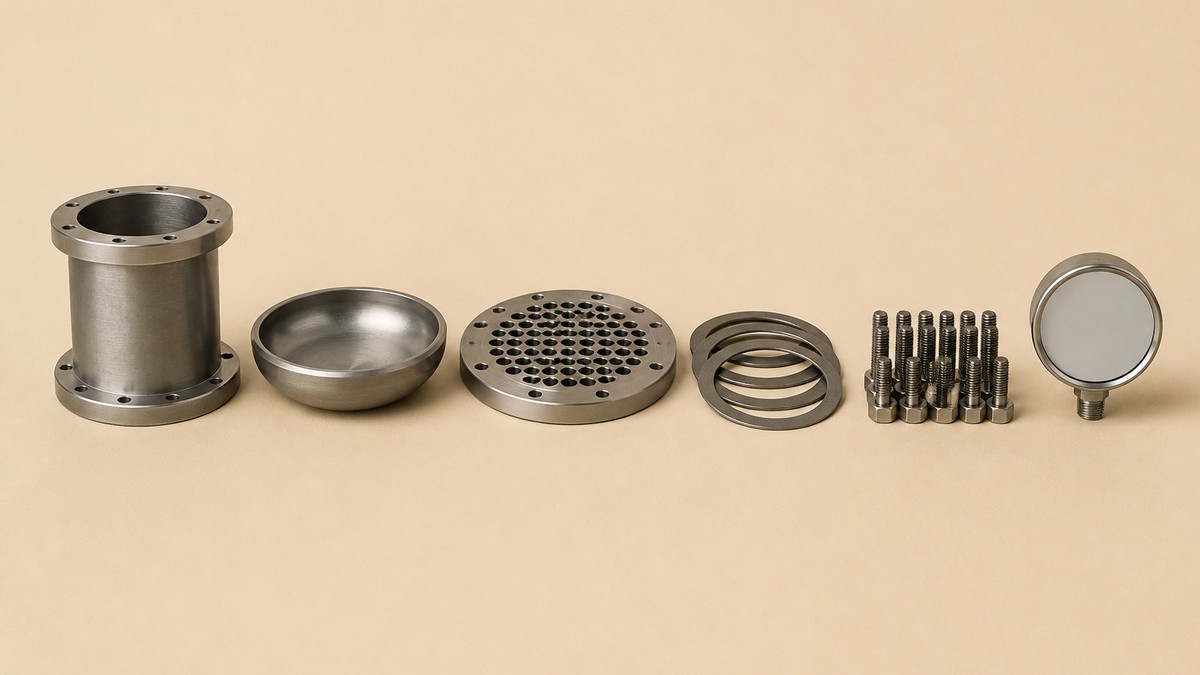
A pressure vessel is a shell built to hold pressure rather than to hold a product, and the whole commercial risk of buying one from China sits in a single question: what exactly is being stamped, tested and certified, and by whom. The word covers a huge range — from a small air receiver to a reactor several metres across — and the paperwork that comes with it is not a formality. It is the thing your own inspector, your insurer and your local authority will read. This guide walks the boundary that decides which rules apply, the figures a drawing has to carry before anyone can quote honestly, and the test intervals that start running the day the vessel is put into service.
Five Things a Pressure Vessel Order Has to Settle Before It Leaves China
| What has to be settled | Why it is easy to get wrong | The line that closes it |
|---|---|---|
| Whether it is legally a pressure vessel at all | The dividing line is a fixed pressure, not a description, and a vessel just under it follows a completely different set of rules | The design pressure as a number, against the line in the rule |
| Which code it is designed and built to | "Built to code" and "stamped" are two different claims, and only one of them gives you a document | The code and division named, with the stamp and the holder stated |
| The figures the drawing carries | A quotation without design pressure, temperature and corrosion allowance cannot be compared with the next one | A datasheet with the figures filled in before pricing starts |
| How the material is traced | Plate certificates can be genuine and still not belong to the plate in your vessel | Heat numbers on the certificate matched to heat numbers on the shell |
| How it is tested and who signs for it | The test is only as good as the instrument, the witness and the record kept | A named test, a named witness and a data report in the crate |
What the Rules Call a Pressure Vessel, and What They Do Not
The word is used loosely in quotations and precisely in law. United States labour rules sort storage shells into three classes by the pressure they are designed to work at, and the cut-offs are not opinions. An atmospheric tank is one designed to work from atmospheric pressure through 0.5 p.s.i.g. A low-pressure tank runs above 0.5 p.s.i.g. but not more than 15 p.s.i.g. And a pressure vessel is defined as a shell designed to work at pressures above 15 p.s.i.g. — that is the whole definition, quoted from the pressure line written into 29 CFR 1910.106.
Read that again, because it is the single most useful sentence in this article. A shell rated at 14 p.s.i.g. and a shell rated at 16 p.s.i.g. can look identical on a drawing, be built in the same workshop, and sit on opposite sides of a legal boundary that decides which standards apply, which inspector signs, and how long the paperwork stays valid.
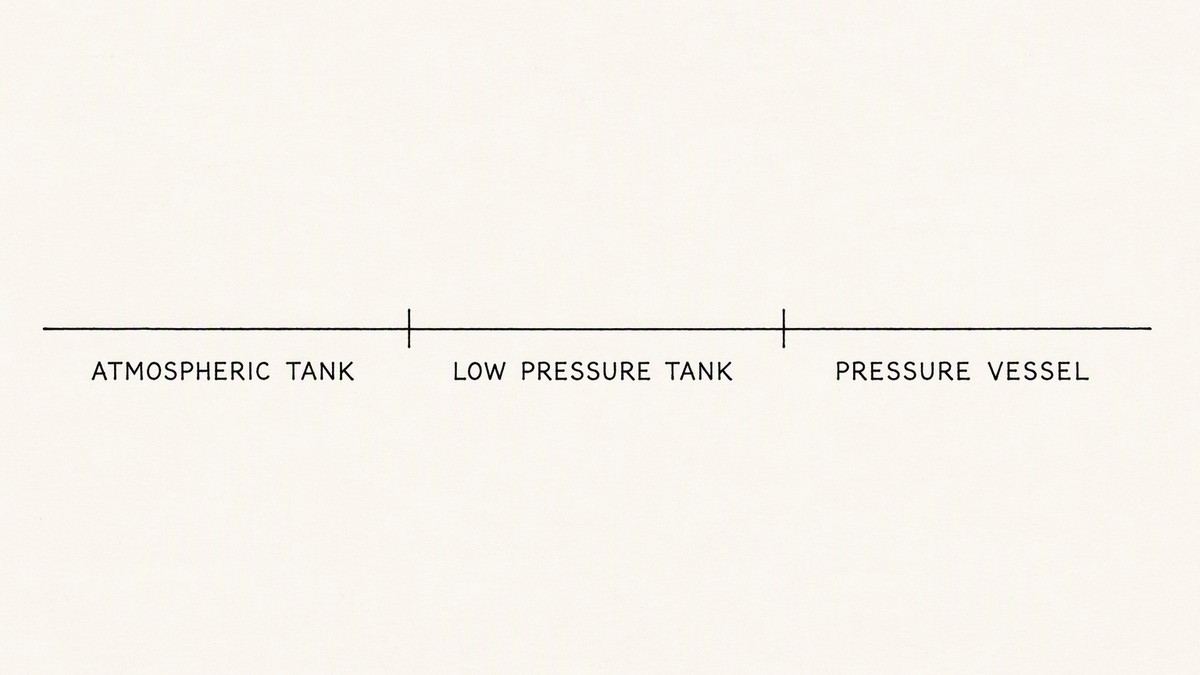
The class decides more than a label. Same rule, further down, sets out what an atmospheric tank may be built to — a list of agreed industry standards for welded steel tanks among them — and adds a condition that catches people out: an atmospheric tank may not be used to store a liquid at a temperature at or above its boiling point. A tank can be perfectly sound steel and still be the wrong class for the duty it is being asked to do.
Two boundary cases deserve their own line here, because both are quoted wrongly all the time. The first is a vacuum vessel. Its internal pressure is below atmospheric, so it does not cross the 15 p.s.i.g. line at all, and a supplier reading the definition literally can honestly say the rule does not apply. That is true of the pressure definition and false as an engineering statement, because a vacuum shell is loaded in the opposite direction and has to be designed for external pressure, which is a different and often harder calculation. Ask for the external pressure design case by name.
The second is a jacketed vessel. The inner shell may see modest pressure while the jacket sees steam at a much higher one, and the two numbers are not interchangeable. The number that decides the class is the highest pressure any part of the assembly is designed to work at. If a quotation states a single pressure for a jacketed vessel, ask which side of the wall it refers to.
The practical point is that the class is a buyer's decision, not a supplier's. The supplier will build to whatever the datasheet says. If the datasheet says 14 p.s.i.g. because that is the number somebody remembered, the vessel will be built and documented as a low-pressure tank, and the buyer who expected a pressure vessel will find out at the point where an inspector asks for a stamp.
Which Design Code the Vessel Is Built To
A code is the set of rules that decides how thick the shell has to be, how the head is shaped, how the joints are made and how much of the welding has to be examined. There is more than one accepted code in the world, and the buyer's job is not to pick the best one but to pick the one their own authority will accept.
In practice three families cover most enquiries into China. The American code for pressure vessels is what a United States buyer will usually be asked for, and it is the one that carries a stamp and a document set that American inspectors recognise. Chinese national standards for pressure vessels are what Chinese factories build to by default, and they are perfectly sound engineering; their weakness is not quality but recognition, because the documents are written to a different format and may not satisfy an inspector working from the American code. The European route is a different structure again, built around a directive rather than a single code, and it suits buyers inside Europe.
The distinction that causes the most trouble is the difference between designed to a code and stamped under it. A workshop can build a shell that follows the rules of the American code, calculate the thicknesses the same way, and produce sound work — and still not hold the certification that lets it apply the stamp. Only the second version produces the document your inspector will accept.
So the question to put in writing is not "do you build to code". It is three questions. Which code, and which division of it? Does the shop hold the certification needed to stamp work itself, or does the work get subcontracted to a shop that does? And whose name goes on the document — the workshop that made the shell, or the trading company that sold it to you?
The last of those three is the one buyers skip, and it is the one that bites. A trading company can quote, manage the order, arrange inspection and ship perfectly well. What it cannot do is hold a workshop certification in its own name. If the document that arrives names a workshop you have never heard of, that is not automatically wrong — but you should have known it would, and you should have checked that workshop before the plate was cut rather than after the crate was opened.
Where a vessel is the last item in a train of connected equipment, one more question belongs here. A vessel rarely stands alone: it has pipe bolted to its nozzles and, on the lines running away from it, the bolted flange joint that has to match the nozzle facing is already fixed by the vessel drawing. Getting the vessel right and the jointing wrong is a common and entirely avoidable way to hold up an installation.
The Figures the Drawing Has to Carry First
A vessel enquiry that goes out as a size and a pressure comes back as a price. One that goes out as a filled-in datasheet comes back as something that can be compared with the next quotation line by line. The difference is not extra work for the buyer; it is the same list written down once instead of being settled by email after the price is agreed.
The reason this matters more on a vessel than on most machinery is that almost every figure on the list changes the thickness of the steel. Raising the design pressure adds wall thickness. Raising the design temperature lowers the allowable stress and adds wall thickness again. Adding corrosion allowance adds thickness a third time. Thickness changes the weight, the weight changes the freight, and the examination level changes the labour. A quotation given before these figures exist is a guess that will be revised upwards.
Twelve Lines a Pressure Vessel Enquiry Has to Carry
| What to send | Why the factory cannot price it without the answer |
|---|---|
| What the vessel does, by name | A separator, a receiver, a reactor and a column carry different internals and different openings |
| Design pressure, inside and in any jacket | It sets the wall thickness directly and it decides which class and which code apply |
| Design temperature, highest and lowest | Allowable stress falls as temperature rises, and the lowest figure decides the impact-test duty |
| Corrosion allowance | It is added to the calculated thickness, so it changes weight and therefore freight |
| Material grade for shell, heads and nozzles | Grade decides allowable stress and weldability, and a substitution changes the whole calculation |
| Internal and external finish or lining | Lining and surface treatment are separate scope items with their own lead time |
| Nozzle list: size, rating, facing, position | Each opening adds a reinforcing calculation and a weld that has to be examined |
| Required examination level for the seams | Full examination of every seam can multiply the inspection cost of the shell |
| Whether a third-party inspector is to witness | It decides the schedule, because the witness has to be booked before the test, not after |
| Support type and any lifting points | Skirt, saddle and leg designs load the shell in different places and add local calculations |
| What is inside the scope besides the shell | Internals, insulation, cladding, valves, gauges and painting move between quotations |
| The document set required with the vessel | It is the last line to be priced and the first to be cut when a quotation has to be trimmed |
Two of those lines deserve a warning. The lowest design temperature is not a formality, because it decides whether the plate has to be impact tested for brittle fracture, and impact testing is a material order and a lead time rather than a line on an invoice. And the document set has to be named before pricing, because "certificates included" means very different things to different suppliers. Ask for the document list as a list, and price against it.
Where the vessel is a machine rather than a container — a dryer, a blender, a filter — the datasheet is only half the enquiry, and the other half is the process duty, because the shell is sized around what happens inside it. Buyers moving in that direction will find that a specification sheet a factory can actually build from needs the same treatment: the figures first, the price second.
Materials, Certificates and Heat Numbers
A material certificate is a piece of paper that says a particular batch of steel met a particular standard. The most common failure in Chinese vessel sourcing is not a fake certificate. It is a genuine certificate for a genuine batch of steel that is not the batch in your vessel.
The link between the two is the heat number, a code that identifies the batch of steel from the furnace. It is on the plate certificate, and it is supposed to be on the plate itself, or on a drawing that maps each course of the shell back to the plate it came from. On a small vessel with a single course, checking this takes two minutes. On a tall vessel built in several courses there should be a plate map, and asking for one is a reasonable request that a serious workshop will not blink at.
There are two grades of mill certificate in normal use. One is issued by the steel mill's own inspection department, and the other is the same certificate countersigned by an inspector who does not work for the mill. The second is obviously stronger and it costs more. Ask which one the price includes rather than assuming, because the answer is a real difference in what you can prove later.
For stainless and alloy vessels there is one check worth insisting on even though it adds a day to the inspection: a chemical check on the finished shell, taken with a hand-held analyser. It takes minutes, it does not damage anything, and it closes the one gap a certificate can never close, which is whether the steel that actually got welded into your vessel is the grade the certificate describes. Mixed plate is a real risk in any workshop holding several grades at once, and it is the kind of mistake that is honest, silent and expensive.
Two more material decisions sit behind the price and are worth naming separately. Thickness tolerance is one: plate is ordered to a permitted range, and a shell built on the light end of that range costs less steel and passes a calculation more easily than a buyer might expect. Ask for the actual measured thickness on the certificate rather than only the ordered figure. The other is the filler metal, which has to match the plate grade and not merely be a similar product; on stainless work the wrong filler leaves a weld that looks fine, passes a visual check, and starts to corrode along the seam.
Welding, Examination and Heat Treatment
The seams are where a vessel is weakest and where almost all of the examination money is spent. Three documents sit behind every seam, and a buyer who does not ask for them is trusting a workshop to remember something that cannot be seen once the vessel is painted.
- The welding procedure
- The written method for a particular joint in a particular material at a particular thickness, with the current, the filler and the preheat it calls for. It is qualified by test before it is used in production.
- The qualification record
- The evidence that the procedure was actually tested and passed on a sample joint, with the test results attached. Without it, the procedure is only an intention.
- The welder's own qualification
- The record that the person who made your seam is qualified for that position and that thickness. Welders are qualified for what they can reach, and a vertical or overhead seam is a different qualification from a flat one.
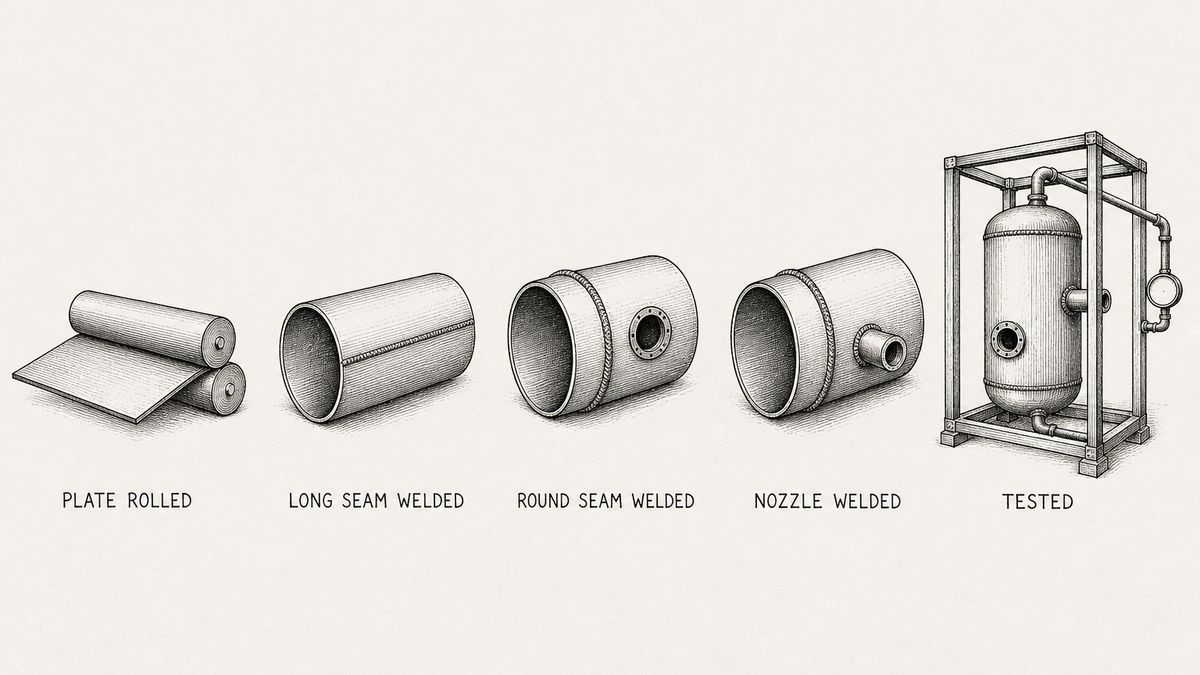
Then there is the part of the process that leaves no visible trace at all. After welding, many vessels have to be heated to a controlled temperature and cooled slowly, because the weld and the plate beside it have been stressed by the heat of welding and would otherwise be more likely to crack in service. This is done in a furnace before the vessel is finished, and once the vessel is painted there is nothing on the outside to show whether it happened.
There are two practical answers. The first is documentation: the heat treatment chart with the temperature and the time recorded, signed, and dated to match the vessel. The second is measurement, because a weld that has been through the treatment reads differently on a hardness gauge than one that has not. A hardness reading on the seam takes minutes and is the cheapest way to find out whether a step that was paid for was actually carried out.
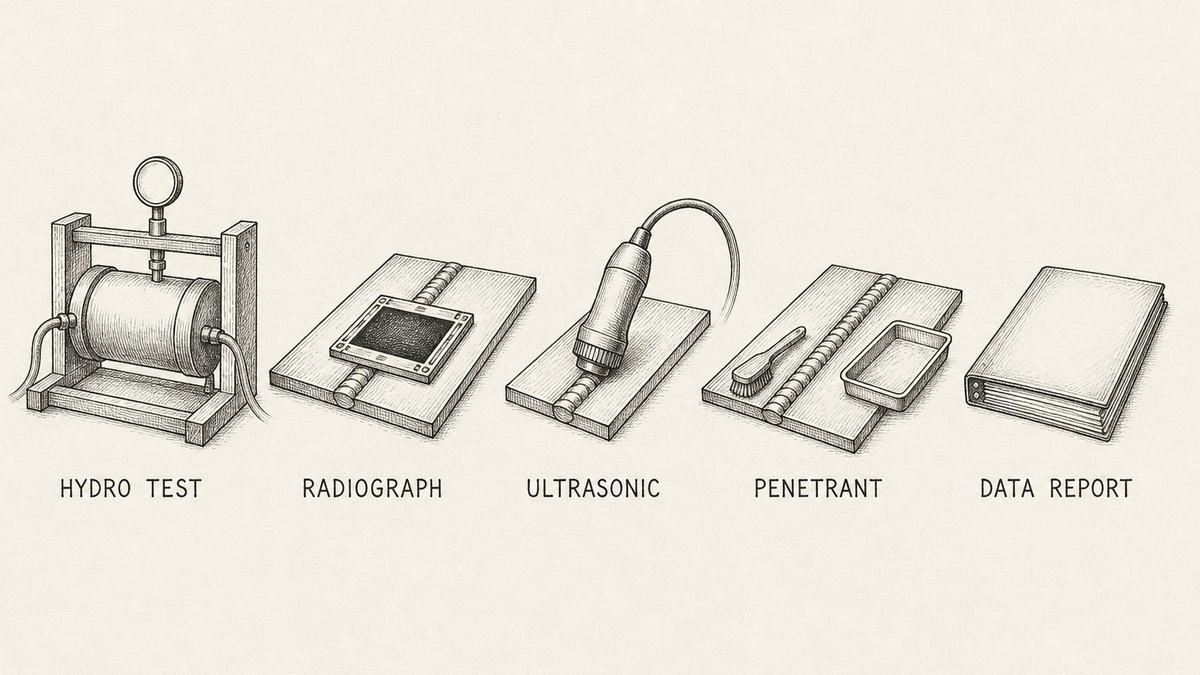
Examination follows the same logic, and the buyer's real decision is how much of it to buy. A surface check finds cracks and undercut that reach the surface. A volumetric check by radiography or ultrasound looks through the seam and finds what is buried inside it, and it is the only way to find internal lack of fusion. A penetrating check finds surface-breaking flaws on stainless work where a magnetic method cannot be used. The level bought is a line on the datasheet, and the honest reason to buy more of it is the consequence of a leak, not the reassurance of a thicker report.
The seams are also the reason a vessel is not a one-off order in the same way a bracket is. Once a workshop has qualified a procedure and a welder for a material and a thickness, the second identical vessel is genuinely cheaper to make, and a buyer ordering a spare is better off repeating the same drawing than improving it. Changing the plate grade to save a little on steel can wipe out that advantage and add a fresh qualification to the schedule.
The Pressure Test, and What It Does Not Prove
The pressure test is the one event in the whole order that a buyer can picture, and it is also the most over-trusted. Filling a vessel with water, raising the pressure and watching for a drop proves something real and quite narrow: that the shell and its seams held at that pressure on that day, and that no joint leaked while they did.
It does not prove the grade of the steel. It does not prove that the heat treatment was carried out. It does not prove that the thickness matches the certified figures, or that the design calculation was right in the first place. A vessel made of the wrong plate, welded to a correct drawing, will pass a pressure test cheerfully.
One principle appears twice in the American rules, in two different parts, which tells you how firmly it is held. In the section covering cargo tanks, it reads: “Except during a pressure test, a cargo tank may not be subjected to a pressure greater than its design pressure or MAWP.” In the section covering portable tanks, the same sentence appears with the same exception. The legal window in which a vessel may be taken above its rated pressure is the test itself — which is exactly why the test pressure, the hold time and the instrument that recorded it all have to be written down. A test with no record is indistinguishable from an overload.
The same rule set names who may do the work. A test or inspection has to be carried out or witnessed by someone holding the qualifications the rules prescribe, and a vessel that fails is dealt with in one of two ways: it is repaired and retested, or it is taken out of service and its identification plate is removed, covered or obliterated. There is no quiet middle option where a failed vessel is tidied up and shipped.
Two practical choices sit behind the test and both are worth settling in writing. The first is the medium. Water is the normal choice because a vessel full of water holds very little stored energy even at high pressure, so a joint that lets go does so quietly. Air or gas does the opposite: it stores a great deal of energy, and a failure is violent. If a supplier proposes a pneumatic test because the vessel cannot be dried afterwards, that is a real reason, but it belongs on the drawing as a deliberate decision rather than a convenience.
The second is the instrumentation. Two separate gauges, one on the vessel and one on the pump, a hold long enough to let temperature settle, and a chart that keeps the record. A test that is watched on a single gauge by the person running the pump produces a number and no evidence.
Third-Party Inspection and the Data Report
Third-party inspection exists because the buyer is not standing in the workshop. A named inspector attends at agreed points, watches what happens and signs for it. That is the whole idea, and most of the value is lost by booking them at the wrong moment.
The moment to book is before the first plate is cut, not after the vessel is painted. This is not about goodwill, it is about physics. Some things can be examined at any time, and some things cannot be examined at all once they are covered up. The back of a root pass disappears under the fill. An internal surface disappears under a lining. A heat treatment leaves no trace once the vessel is finished. A surface that should have been examined before priming cannot be examined cheaply afterwards. An inspector who arrives for the final test is confirming a result and cannot check a process.
So the useful arrangement is a short list of hold points rather than a single visit. A reasonable set for a vessel is: agreement of the drawing and the material certificates, review of the procedures and the welder qualifications, presence at the examination of the first seams, presence at the heat treatment if there is one, and presence at the pressure test. Whichever points are chosen, they should be written into the order with dates, because an inspector's calendar is the constraint and a rushed visit is a wasted one.
The document that comes out of all this is the one the buyer actually keeps. It is the paper that ties the design figures to the material certificates, the seam examinations to the welds on the drawing, and the test to the instrument that recorded it, and it carries the marks and the signatures that make it usable by somebody who was never there. When it arrives, read it against the drawing before the vessel is installed, because a mismatch found in the crate is a conversation and a mismatch found in service is a shutdown.
One more point that saves argument later. A vessel that holds pressure is a source of stored energy, and the fittings that protect it from overpressure are a separate item to buy with its own certification. On many vessels that duty falls to a rupture disc set below the vessel rating to burst before it, and the two items have to be ordered against each other rather than separately. A vessel rated at one figure and a disc set above it is a system that will not protect anything.
What Applies Once It Is in Service
Buyers spend all their attention on the delivery and almost none on the years afterwards, which is where the rules actually bite. A vessel that moves — a portable tank, a cargo tank on a vehicle — enters a system with fixed test intervals, and those intervals start on the day it enters service rather than on the day somebody remembers.
The table in the American rules for cargo tanks is worth reading as a buyer, because it tells you what you have just taken on. An external visual inspection comes every year, and every six months on a vessel loaded by vacuum with a full-opening rear head. An internal visual inspection comes every five years on most vessels, but every year on an insulated vessel or one carrying a cargo that corrodes the shell. A leakage test comes every year, and every two years on vessels in chlorine service. A pressure test comes every five years. On an unlined vessel carrying something corrosive, a thickness test comes every two years. Those are the intervals written into the test and inspection schedule at 49 CFR 180.407.
Two conditions in the same section are easy to miss and both cost money. A vessel that has been out of service for a year or more has to be pressure tested before it is used again, so a spare sitting in a yard is not automatically ready. And a vessel whose test has fallen due may not be filled and put back into service until the test has been completed successfully — the clock, not the calendar convenience, decides.
Before each filling there is also a short physical check that a technician can work through with a torch in ten minutes, and it is a good model for any vessel. Look at the shell, the piping, the valves and the fittings for corroded areas, dents, defects in welds, and gaskets that are missing, damaged or weeping. Look at every bolted connection and every blind for missing or loose nuts and bolts. Look at the safety devices for corrosion or distortion that could stop them working. Check that every required marking on the tank is still readable. And check that the device holding the manhole cover is present, working and able to prevent a leak — those five points are the pre-filling check set out in the pre-fill checks at 49 CFR 173.32.
Two of those five deserve emphasis on a Chinese-built vessel. The markings matter because a vessel arrives with its identification legible and leaves a paint shop with it painted over, and a plate that cannot be read is treated as a plate that is not there. The cover device matters because a manhole that weeps at the gasket is the most common leak on a used vessel, and it is nearly always the tightening device rather than the gasket.
If the vessel never moves — a stationary reactor, a receiver on a plant floor — none of those transport intervals apply to it, and the equivalent schedule comes from your own local rules and your insurer instead. The principle carries across even so. A vessel has a service life that is managed by inspection, and the paperwork from the factory is the baseline that every later inspection is measured against. Keep it somewhere that outlives the project engineer.
What Actually Moves the Price
Vessel prices are compared as if they were quotes for a commodity, and they are not. Two quotations for the same size can differ by half, and the difference is almost never the quality of the welding. It is a short list of decisions, and every one of them was made before the price was written.
The first group is thickness. Design pressure, design temperature and corrosion allowance all push the wall up, and the wall decides the weight of steel. Because the allowable stress of most steels falls as temperature rises, a vessel designed for a hot duty is thicker than the same vessel designed cold, even at a lower pressure. Buyers who state a temperature a little higher than they need, as a safety margin, are buying steel they will never use.
The second group is examination and treatment. Full examination of every seam instead of a sample, a heat treatment, a higher examination level on the nozzle welds — these are labour and time rather than material, and they are the easiest lines to quietly reduce when a quotation has to come down. They are also the lines that produce the paperwork, which is why the cheapest offer on a vessel is very often the offer with the smallest document set.
The third group is scope. Internals, trays or baffles, a lining, insulation and cladding, valves and gauges, painting and the crate itself all move between quotations. So do the fittings around the vessel: on the pipe running away from a nozzle, the expansion joint that absorbs the movement between two fixed points is a separate item with its own lead time, and it is regularly left out of the first budget and added later.
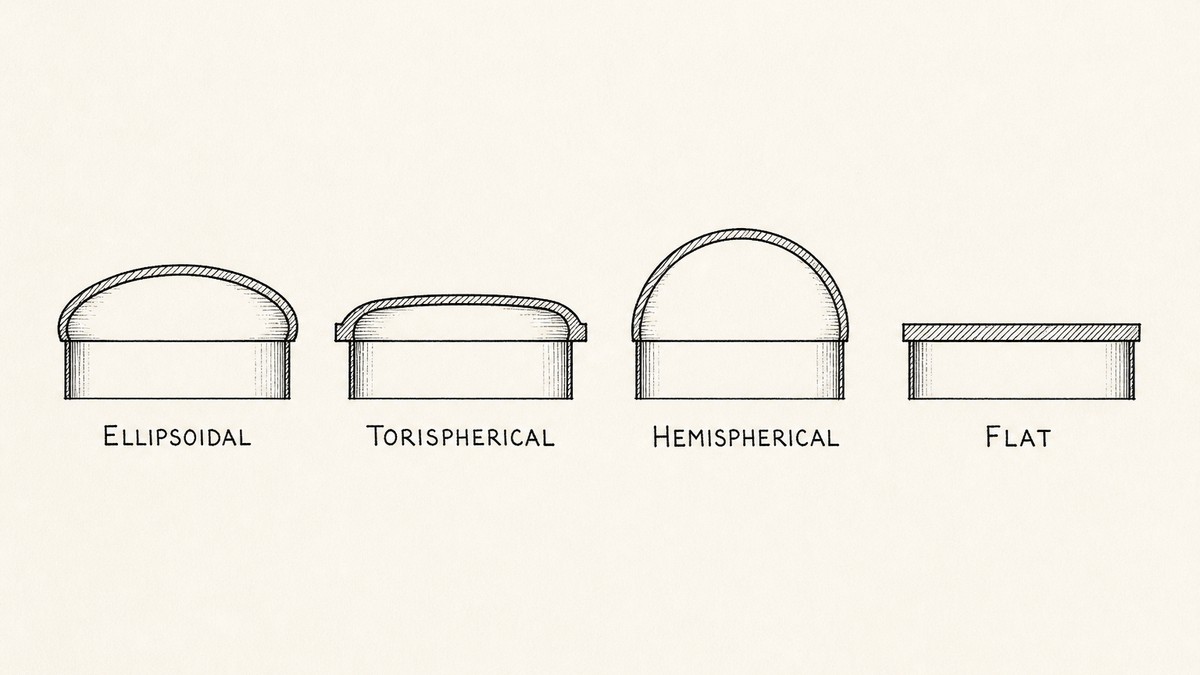
The fourth group is shape. A vessel with a dished head costs more than a flat-ended one and holds far more pressure for the same thickness. Nozzles cost more than they look, because each one is a reinforcement calculation and a weld that has to be examined. And a very wide or very heavy vessel stops being a fabrication question and becomes a transport question, where the freight can exceed the price of the steel.
What to do with all of that is unglamorous. Ask for the quotation split across material, forming, welding, examination, treatment, finishing and the document set. Split that way, three offers stop being three numbers and become three positions that a buyer can actually move. The one that looks cheapest on the document line is usually the one that is cheapest overall for a reason the buyer will not enjoy discovering.
Six Ways a Vessel Fails to Match Its Paperwork
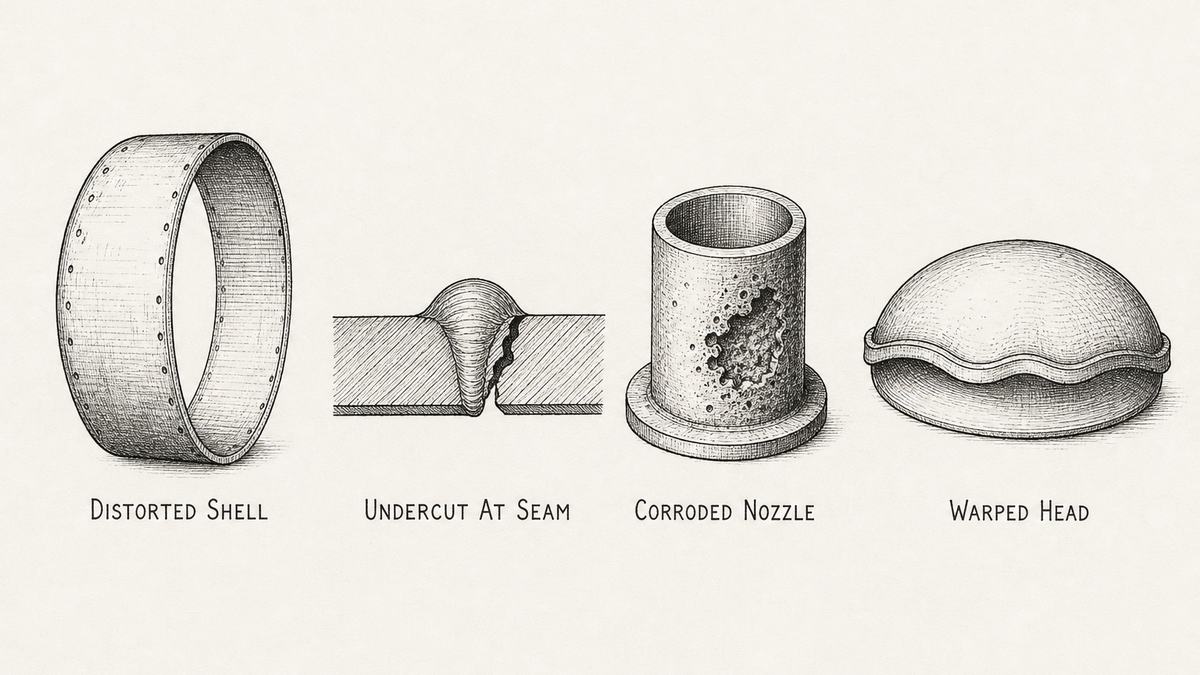
None of the following is exotic. All six turn up regularly on vessels sourced from China and elsewhere, and each one is cheaper to catch before the crate is closed than after it lands. The order is roughly by how often they appear.
- A thickness short of the certificate
- Plate is ordered to a permitted range, and a shell built at the light end of that range is legal and thinner than the buyer assumed. Compare the measured figures on the certificate against the calculated figures on the drawing.
- The wrong grade in one course
- A workshop holding several grades can put the wrong plate into one course of a multi-course shell. A certificate cannot catch this. A hand-held chemical check on the finished shell can.
- Heat treatment that never happened
- The chart is missing, or the dates do not fit the production sequence. A hardness reading on a seam settles it, and it is the cheapest single check available on a vessel.
- A repaired seam with no new record
- A flaw is ground out, re-welded and the vessel ships with the examination report from before the repair. Ask for the re-examination record of the repaired length by its weld number.
- Facing and bolt circle that do not match
- The nozzle is correct in size and pressure rating and wrong in facing or hole spacing, so nothing in your plant will bolt to it. Check the facing and the bolt circle against the standard, not against the drawing alone.
- The identity painted over
- Markings and the identification plate are the vessel's identity for the whole of its service life and every later inspection. Photograph them before the paint shop, and check them again on arrival.
All six are found by the same method, which is why the method matters more than the list. Check the paperwork against the object while both are in front of you, at the workshop, before the vessel is finished — and if you are not there yourself, have somebody there who photographs what they check. A pre-shipment inspection of the finished vessel is worth doing for the same reason a first-article check is: the cost of a correction falls steeply once the crate is closed.
On a vessel where the drawing will be repeated, there is a stronger version of the same idea. Put the first shell through a full document and dimensional review — a first article inspection that pins the dimensions and the records on the first unit — and the later units only have to be confirmed against it. On a one-off, the same review happens once and has to be thorough. On a repeat order it becomes the cheapest quality control a buyer can own, because it converts an argument into a comparison.
Finally, place the vessel in its family. It is not a machine that makes a product; it is a shell that contains a process, and it is usually bought in the middle of a plant project alongside equipment that feeds it or draws from it. If the family question is still open, the machinery sourcing hub that groups this equipment into families is the place to start, and the same three questions carry across: what class is it, what code is it built to, and what documents come with it.
How much does a pressure vessel cost?
There is no useful average, because the price follows the design figures rather than the size on a drawing. A shell two metres across rated for a modest pressure can cost less than a shell one metre across rated for a hot, high-pressure duty, because the second one carries far more steel and much more examination. The lines that move the number most are design pressure, design temperature, corrosion allowance, the material grade, the level of seam examination, whether heat treatment is required, and how much of the surrounding equipment is inside the scope. The workable approach is to fix the figures first, ask for the price split across material, forming, welding, examination, treatment, finishing and documents, and then compare the positions. An offer that is much cheaper than the others is nearly always cheaper on one of those lines rather than on the welding.
What is the difference between a pressure vessel and a storage tank?
It is a pressure figure rather than a shape. In the American labour rules a storage shell designed to work from atmospheric pressure up to 0.5 p.s.i.g. is an atmospheric tank, one designed above 0.5 p.s.i.g. and up to 15 p.s.i.g. is a low-pressure tank, and one designed above 15 p.s.i.g. is a pressure vessel. Two shells of identical size and appearance can sit on opposite sides of that line, and the class decides which standards they are built to, which inspector signs for them and how they are documented. In everyday buying, the word tank is used loosely for anything cylindrical, which is exactly why the class has to be stated as a number in the enquiry rather than as a description.
Do I need a stamped vessel, or will a Chinese-standard vessel do?
That is decided by the authority that will inspect the vessel where you are going to use it, not by the factory. A Chinese-standard vessel is sound engineering, and the difficulty is recognition: the documents are written to a different format and may not satisfy an inspector working from the American code. If your local rules or your insurer will be reading the paperwork, the safe course is to name the code and the stamp you need at the enquiry stage, ask whether the workshop holds the certification to stamp work itself, and confirm whose name will appear on the document. Ask those three questions before pricing, because adding a stamp to an order already in production is a rebuild rather than a fee.
What documents should arrive with a pressure vessel?
The set should let somebody who was never in the workshop check the vessel against its design. Expect the design datasheet with the pressure, temperature and allowance figures; the material certificates with heat numbers; the welding procedures and the qualifications of the people who welded it; the records of the seam examinations with each result tied to a weld number; the heat treatment chart if treatment was required; the pressure test record; and the data report that gathers all of it under one identity. Ask for the list in writing before pricing, because the document set is the first line to be trimmed when a quotation has to come down, and a missing record cannot be reconstructed once the vessel has left.
Can a Chinese factory build to an American code?
Yes, and some do it routinely. The distinction that matters is between a workshop that can build a shell following the rules of a code and a workshop that holds the certification needed to stamp the finished vessel itself. Only the second produces a document your inspector will accept without argument, and the certification belongs to the workshop rather than to the trading company managing your order. So ask which code and division, whether the work is stamped in the workshop's own name or subcontracted, and whose name goes on the finished document. If a name appears that you have never seen before, check that workshop before the plate is cut rather than after the vessel is delivered.
What is the most common defect on an imported pressure vessel?
On the vessels that turn up problems, the most common single defect is thinner steel than the certificate implies, because plate is ordered to a permitted range and a shell at the light end of it is legal and lighter than the buyer assumed. The next most common is documentation rather than hardware: a heat treatment that cannot be evidenced, a repair on a seam that was never re-examined, or markings that were legible at the works and painted over before shipping. Both are cheap to catch and expensive to resolve. Compare the measured thickness on the certificate against the calculated figure on the drawing, take a hardness reading on a seam, and photograph the markings before the paint shop.
Send the figures, not just the size — the class decides everything after it
Tell us what the vessel does, the design pressure and temperature, and the code your authority will accept. We will put the figures into a datasheet, find workshops that hold the certification in their own name, and book the witness at the right hold points.
Request a Pressure Vessel Sourcing Quote
Questions & Comments
We read every one and reply within 24 hoursThe argument is almost never about the welding. It is about which class the design figures put the shell in, which code it is stamped to, and which records travel with it. Send us those three and we will settle them before a workshop is asked to quote.