
Magnetic Drive Pump Manufacturer: Fluid, Duty and Package Rules From China
 ·
Updated October 14, 2026
·
19 min read
A magnetic drive pump keeps the fluid inside a closed shell. Nothing turns through the casing, so there is no seal to wear or drip. That one change decides who can build the pump and how you should buy it. Three things separate a good order from a bad one. The fluid you pump decides which rules your supplier has to meet. The duty you give decides the motor, the bearings and the materials. The package you accept decides who owns the baseplate, the flanges and the paperwork. Suppliers quote very different machines under the same words. This guide covers the parts, the fluids, the failure modes and the checks that tell a real maker from a trader. It ends with a list you can put beside a quotation.

| Your situation | What decides the choice | Where the cost goes |
|---|---|---|
| Pumping a fluid you cannot spill | Whether the law lists that fluid as a hazard | The containment shell and the relief parts |
| Pumping a hot fluid | The magnet grade, and how heat leaves the pump | The magnets and the bearing material |
| Pumping a thin, clear fluid at low flow | Your duty point, and the impeller trim | The motor, not the pump end |
| Replacing a pump that keeps leaking | Which joint failed, not which brand you buy | A new casing joint, or a new build |
| Buying for a plant that runs nonstop | The spare parts, and the duty you wrote down | A spare rotor, or a second pump |
What a Magnetic Drive Pump Is, in Plain Words
Start with an ordinary pump. A motor turns a shaft. The shaft runs from the motor into the pump casing, and it turns an impeller inside. The impeller pushes the fluid out. For that to work, the shaft has to pass through the casing wall, and that leaves a gap to close. A seal closes it.
The seal is a wearing part. It rubs on the shaft the whole time the pump runs. Many fluids also need a flush line to keep the seal cool and clean. Even then, most seals drip a little at some point. A drip of water is easy to live with. A drip of ammonia is not.
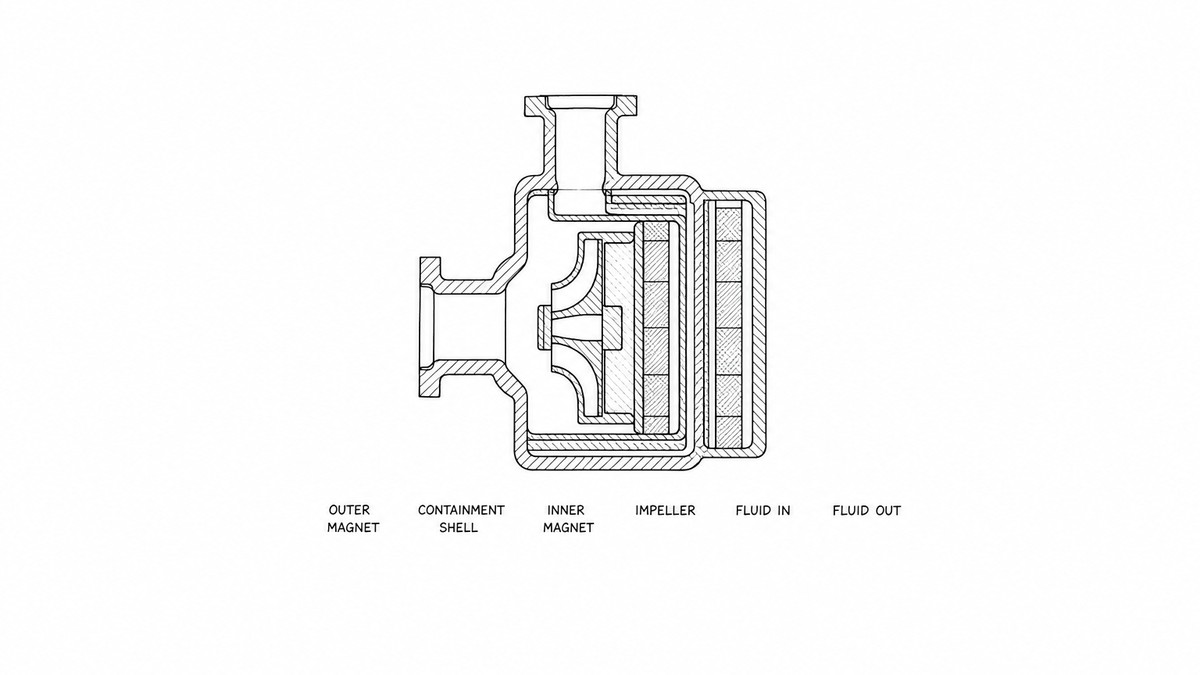
A magnetic drive pump removes the shaft from the fluid side. The motor turns a ring of magnets outside the casing. A thin wall sits between those magnets and the fluid. That wall lets the magnetic field pass through. The outside magnets pull a second ring of magnets that sits in the fluid. The inner ring turns the impeller.
That thin wall has a name. It is the containment shell. It is usually a metal or ceramic sleeve. It is the only part standing between your fluid and open air, so read the word carefully in every quotation. The shell is where the engineering sits.
So the pump has no seal. It has no packing. It needs no flush line. Nothing rotates through the casing. That is the whole idea, and it is worth saying plainly, because a long part list can hide it.
One more point saves confusion later. A magnetic drive pump is not a separate kind of pump. It is an ordinary pump design, such as a centrifugal pump, built with a different drive. The hydraulics are the same. Only the way the motor reaches the impeller changes.
That matters when you compare prices. A supplier who treats the magnetic drive as a new machine will charge for a new machine. A supplier who knows the pump end is standard will price the change, not the whole pump.
When You Need One, and When a Sealed Pump Is Enough
The question is not which pump is better. It is whether a leak is acceptable at that point in your plant. Answer that, and the rest of the choice follows.
Choose a magnetic drive pump when the fluid is toxic, flammable, corrosive, costly or has to stay pure. Choose it when a leak would trigger a report, an alarm or a cleanup. Choose it when the fluid is a refrigerant and the plant cannot afford to lose it. Choose it when a seal flush would cost more than the pump itself.
A sealed pump is often enough for water, weak fluids and normal temperatures. It is also the calmer choice at very high flow and pressure, because a seal wastes less power than a pair of magnets does. And it takes fluids that carry solids, because the seal can be flushed and the bearings sit outside the flow.
Then look at the limits, because they decide whether the pump survives on your line. A magnetic drive pump loses some power in the magnets. It cannot run dry for long, because the fluid itself lubricates the bearings. And there is a ceiling on how much turning force the magnets can pass across. Push past that ceiling and the inner ring slips. The motor keeps turning and the impeller stops.
Each limit is a question you can ask before you order. How much power is lost at my duty point? What happens if the line empties? Where is the slip point? A supplier who answers all three has built these pumps before.
The same reasoning runs through any engineered package. Deciding what the supplier owns, and what your site owns, is how an engineered machinery package is normally divided.
The Three Builds You Will Be Quoted
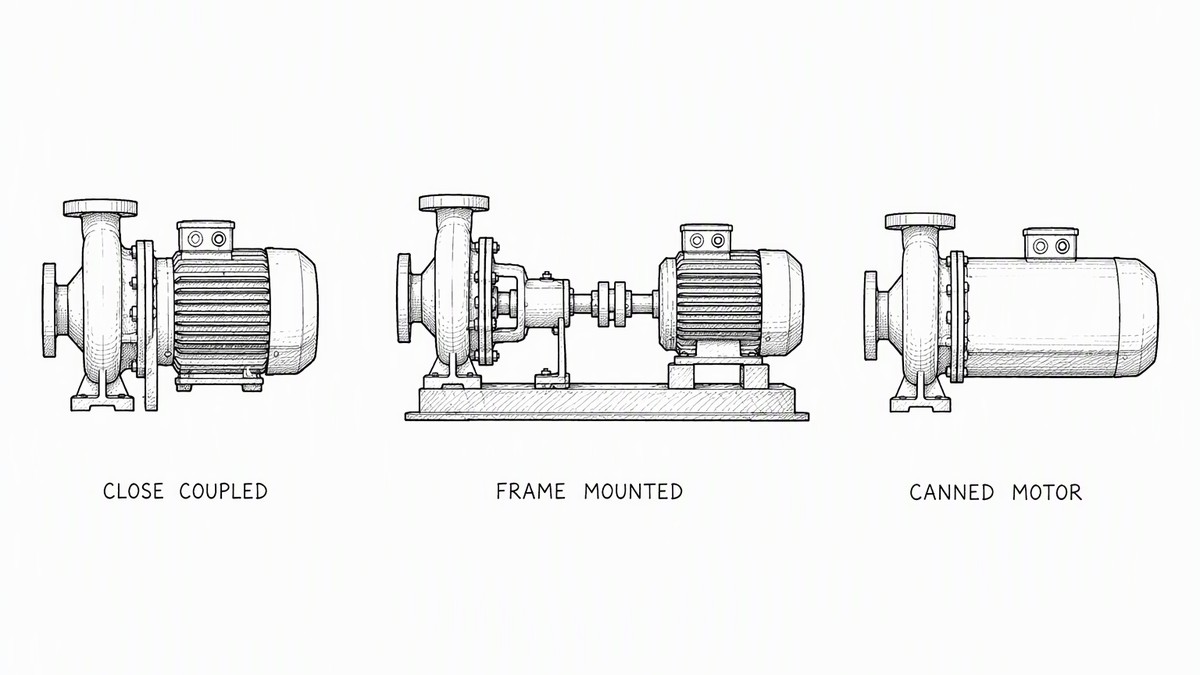
Suppliers use three arrangements. They are not equal, and the price gap between them is bigger than the gap between brands. Ask which one you were quoted before you compare anything else.
The close-coupled build. The motor flange bolts straight onto the pump bracket. The outer magnet ring sits on a stub of the motor shaft. So the pump has no shaft of its own and no coupling to align. It is compact and the cheapest of the three. The trade is heat. Motor heat travels into the pump bracket, and the pump depends on the motor bearings. For cool fluids and modest duties, that is fine. For a hot fluid, it is the wrong build.
The frame-mounted build. The pump sits on its own bearing frame, and a coupling joins it to a standard motor. The outer magnets run on the pump's own shaft. This build handles heat better, because the frame can be cooled or fitted with a heat barrier. It also lets you change the motor without touching the wet end. It costs more, takes more floor space, and needs the coupling aligned on site. Most hot-fluid and heavy-duty orders use this build.
The canned motor build. This one is not a magnetic drive pump at all, and you should know that before you compare it. The motor rotor itself turns inside the fluid, inside a thin can. There are no magnets to slip, so it passes more force and handles higher pressure. It also puts the motor windings next to the fluid, which changes the repair plan and the spare parts list.
Whichever build you are quoted, four details decide whether it fits your line. The bearing arrangement, because the bearings run in the fluid. The way heat leaves the pump, because trapped heat destroys magnets. The shaft and magnet materials, because they must survive the fluid. And the support plan for the motor, because a close-coupled build loads the motor bearings with the pump's weight.
A quotation that names the build and all four details is worth reading closely. A quotation that only names a model number is a starting point, not an answer.
The Fluid Decides Which Rules Apply
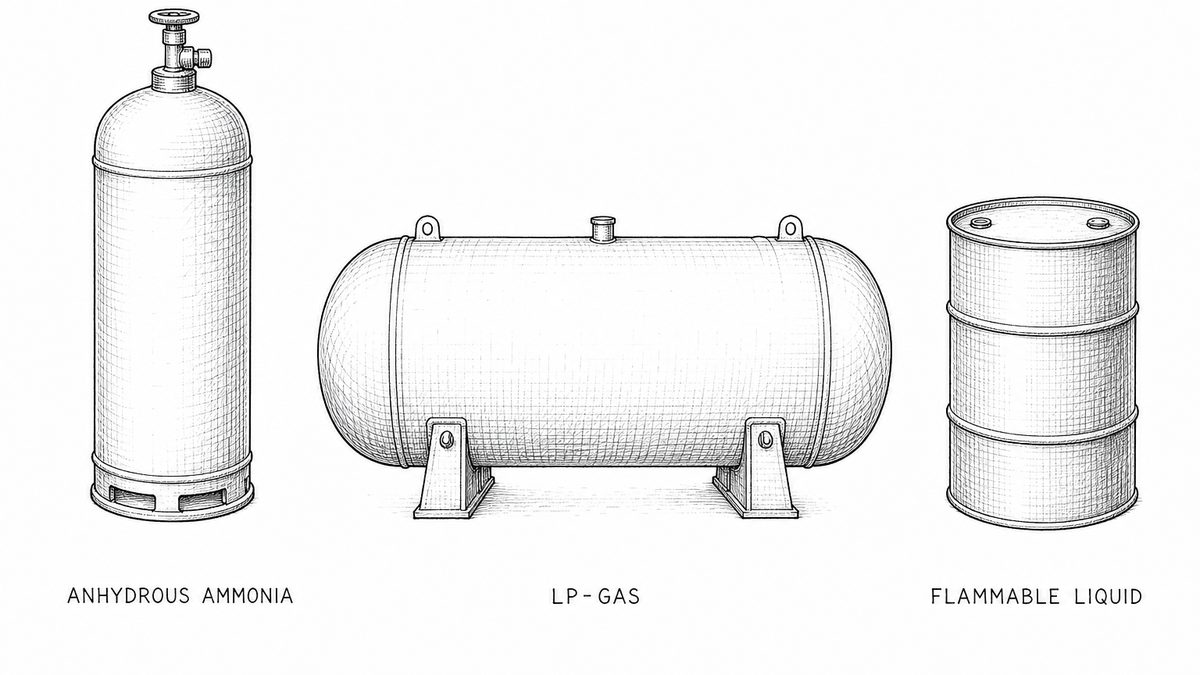
You pick a magnetic drive pump because of one fluid. So the fluid's hazard class drives the whole order, and in the United States two fluids carry pump rules written into labour law. Those rules do not describe a brand. They describe what the pump has to be, and who has to sign for it.
Anhydrous ammonia. Section 1910.111 of the United States labour rules starts by naming a pump as an appurtenance. The definition covers all devices such as pumps, compressors, safety relief devices, liquid-level gauges, valves and pressure gauges. So a pump is inside the rule, not beside it.
That produces four approval routes, and any one of them has to be met. The first is that the unit was installed before 8 February 1973 and was approved under the older ammonia standards of the day. The second is that a nationally recognised testing laboratory accepts, certifies, lists or labels it. The third is that a federal, state or local authority inspected it and found it safe.
The fourth route is the one buyers miss. A custom-designed and custom-built unit can be accepted if the employer keeps a document on file that states it is safe. That document has to be signed by a registered professional engineer, or by someone with the training to hold that opinion. It has to set out the test bases, the test data, the results and the qualifications of the person who signed it.
So there is a question you can ask any supplier of an ammonia pump. Which of the four routes does this unit fall under, and who signs the document? If nobody can answer, the paperwork does not exist.
The same section then sets out what the pump must be. A pump used to transfer ammonia has to be made for that duty. It must be designed for at least 250 p.s.i.g. working pressure. On the discharge side, before the relief valve line, there must be a pressure gauge graduated from 0 to 400 p.s.i. And the plant piping must carry shutoff valves set as close as practical to the pump connections.
One line in that list is worth reading twice. A positive displacement pump must have a constant differential relief valve off the discharge port, discharging back into the pump suction. The line has to carry the full capacity of the pump at the relief setting. The setting and the installation follow the pump maker's instructions. If you are buying a centrifugal magnetic drive pump, that specific clause does not apply to your pump. If you are buying a positive displacement unit, it does. A supplier who never checks which one you are buying has not read the paragraph.
The section also draws a boundary that changes the order. It does not apply to ammonia manufacturing plants, and it does not apply to refrigeration plants that use ammonia only as a refrigerant. So the same fluid, ammonia, can sit outside the pump rules above, depending on what your plant does with it. Ask which side of that line your site is on before you let a supplier quote against it.
LP-Gas. Section 1910.110 of the same part is built the same way. It states that all pumps and accessory equipment must be suitable for LP-Gas service. They must also be designed for not less than the maximum pressure they may meet. Accessories must carry a minimum rated working pressure of 250 p.s.i.g. A positive displacement pump must have a pressure-actuated bypass valve. It lets flow run from the pump discharge back to the storage container or the pump suction.
It goes further on systems. Where a positive displacement pump is used, the system needs a recirculating device that limits the differential pressure to the pump's rated maximum. The discharge must be protected so the pressure cannot exceed 350 p.s.i.g. If the recirculation line contains a manual shutoff valve, a second safety path is required. It must have no way of being switched off. Those manual valves are to stay open, except during an emergency or a repair.
Then comes the part that reaches your motor. The standard places pumps, compressors, gas-air mixers and vaporisers in a hazard class of their own. A pump indoors without ventilation puts the whole room in the higher class. Adequate ventilation drops it one class. A pit or trench under the pump, without mechanical ventilation, sits in the higher class as well. That classification decides which motor and which wiring you are allowed to use. It is settled by where the pump stands, not by what the pump is.
Two more clauses close the loop. A hydrostatic relief valve is required between each pair of shutoff valves on liquid piping. If it sits on the pump discharge, its setting must be above the maximum pressure the recirculation device allows. A pump used to transfer LP-Gas must give you control of the flow. It must also prevent leakage or accidental discharge. A manual shutoff valve and an excess flow check valve are fitted downstream of the pump.
| The fluid | The rule that names it | What it forces on the pump |
|---|---|---|
| Anhydrous ammonia | 29 CFR 1910.111 | A pump built for ammonia, rated 250 p.s.i.g., with a 0 to 400 p.s.i. gauge before the relief line |
| Ammonia used only as a refrigerant | Outside 1910.111, which exempts refrigeration plants | The refrigeration rule set for your site, not this section |
| LP-Gas | 29 CFR 1910.110 | A pump rated 250 p.s.i.g. with a pressure-actuated bypass, and a classified motor area |
| Other flammable liquids | Their own storage and handling rules | The area class for the motor, and the bonding and earthing plan |
| A corrosive or high-purity fluid | No named section. Your own specification decides | Shell material, bearing material and the cleaning records |
What a Quotation Has to Show
A pump quotation is not a price. It is a set of promises, and most of the risk in an order lives in what the quotation never says. Here is what has to be on the page before you compare two offers.
The duty point. Flow and head belong together, because a pump moves a small flow to a great height or a large flow to a small height. Head means the height the pump can lift the fluid to, and it is quoted in metres or feet. A quotation with one number and no head is not a quotation.
The duty point also needs the fluid name, the concentration, the temperature, the density and the viscosity. Viscosity means how thick the fluid is. Then it needs the suction conditions, because a pump that cannot draw fluid properly will cavitate. Cavitation is the fluid boiling at the impeller, and it eats metal.
The build and the materials. Which of the three builds, and then a material named for every wetted part. The casing, the impeller, the containment shell, the magnets, the bearings and every O-ring. A phrase such as suitable for corrosive fluids is not a material.
The motor. Power, voltage, frequency, phase, enclosure, insulation class, and the area class if the fluid is hazardous. The area class is the one buyers forget, and it is also the one that changes the price most.
The package. Baseplate, coupling, guard, flange standard, connection sizes, drain and vent points, and the relief parts. Overpressure protection is bought separately, and it follows the same reasoning as choosing a rupture disc for a pressure vessel.
The documents. Start with a performance curve and a general arrangement drawing. The drawing carries the dimensions and the weights. Add a materials certificate, a pressure test record, a test report at the duty point, and a spare parts list with part numbers.
| What the quotation says | What it usually means | What to ask next |
|---|---|---|
| Suitable for corrosive fluids | No material was named | Give me the grade of the shell, the impeller and the O-rings |
| Motor: as required | No area class was chosen | Which class and division does my site need, and what is marked on the motor |
| Capacity: 10 cubic metres per hour | Flow was quoted without head | Give me the full duty point, flow and head together |
| Relief valve: optional | Nobody checked your fluid against the rule | Which clause applies to my fluid and my pump type |
| Delivery: 30 days | The clock starts somewhere vague | What starts it: the deposit, the approved drawing, or the material |
| Warranty: 12 months | The start date is undefined | Does it run from dispatch or from commissioning |
Materials, Magnets and Temperature Limits
Three material families decide whether the pump survives, and they fail in different ways. Ask about all three before you sign.
The wet end metals. Cast iron, ductile iron, stainless steel 304 or 316, duplex stainless, alloy 20 and the nickel alloys all appear. The fluid picks the one. Cast iron is common for water and some oils. Stainless covers a wide band of weak acids and clean fluids. Duplex and the nickel alloys enter where chlorides or strong acids are present.
The non-metals. O-rings and gaskets are the smallest parts on the pump and often the first to fail. EPDM, FKM, PTFE and the perfluoroelastomers each resist a different list of fluids and a different temperature band. Ask for the O-ring material by name, because a pump with a correct casing and a wrong O-ring still leaks.
The containment shell. This part has a real choice inside it. A metal shell can be thin, and it handles thermal shock and mechanical knocks. It also sits in a turning magnetic field, which drives small electric currents through the metal and heats it. That loses power and adds heat to an already warm fluid. A ceramic shell avoids those currents and is very hard, but it dislikes a sharp shock. So the shell material is not a detail. It decides efficiency, heat and how carefully your team has to handle the pump. The shell is a pressure part. It is proved the same way as the wall thickness and test records of a code-built pressure vessel.
The magnets. Three grades cover almost every order. Ferrite magnets are cheap and weak, so the pump needs more magnet material and more space. Neodymium-iron-boron magnets are strong and compact, but they lose strength when they get hot, and the material corrodes unless it is coated. Samarium-cobalt magnets cost more and hold their strength at higher temperatures. Ask which grade, and then ask the maximum fluid temperature that grade allows.
The bearings. The bearings run inside the fluid, so the fluid is the lubricant. Silicon carbide, carbon and graphite, and PTFE-lined bearings cover most duties. A thin fluid with poor lubricity changes the bearing choice, and a fluid that runs dry for a few seconds can destroy them.
Now put the three families side by side. The pump's real temperature limit is the lowest of three numbers: what the magnets allow, what the O-rings allow, and what the bearings allow. A quotation that gives one temperature without saying which part sets it has not been checked.
How to Check a Supplier Before You Pay
This keyword attracts a lot of pages that list companies and never build anything. That makes the first check simple. Ask what the company makes, and ask for evidence that it makes it.
One: does the supplier publish a pump curve? A performance curve shows flow against head, with the efficiency and the power drawn at each point. A maker can produce one for your duty. A trader can only forward one.
Two: does the supplier ask about the fluid? A catalogue seller will quote from a table. A maker needs the fluid, the concentration and the temperature before choosing a single material. If nobody asks, nobody has engineered the pump.
Three: can the supplier name the shell material and its thickness? This is the part that carries your containment. A vague answer here is a warning.
Four: does the factory have a test stand? Ask what is measured, at which points, and who signs the report. Ask before you order, not after.
Five: which documents arrive before manufacturing? A general arrangement drawing for your approval, a materials list, and the painting and packing standard. Ask for these in writing, and treat the approved drawing as the contract.
Six: what happens when the pump fails inside the warranty? Ask where the spare rotor comes from, how long it takes to arrive, and who pays the freight. A supplier who cannot answer is selling a pump, not supporting one.
Most disputes start with a vague enquiry and end in a long argument about who said what. They stop when you spend one hour on writing the duty point onto one specification sheet. Everything after that is a comparison against a fixed target.
Inspection and Paperwork Before Shipment
A magnetic drive pump cannot be judged by looking at it. The parts that matter are sealed inside, so the inspection has to be a set of measurements and a test, with numbers written down.
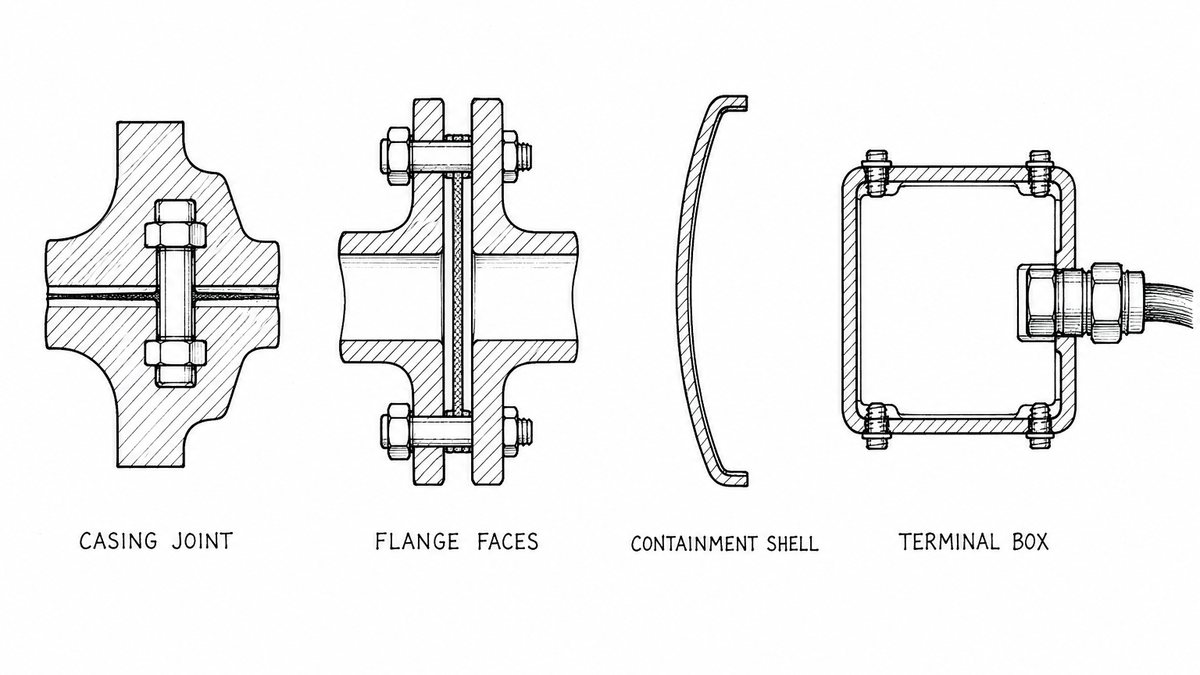
Measure the parts you cannot see later. Ask the inspector to record the containment shell thickness, the bearing clearances, the casing joint bolt torque, and the O-ring material against the approved list. Measure the flange bolt holes against the standard you ordered. Check the terminal box marking against the area class on your drawing.
Run the pump, and write down what it did. The test should run at the rated point and at your duty point. Record the flow, the head, the current drawn and the vibration reading at each point. Then lay those numbers beside the curve the supplier promised you. That comparison is the whole point of the test.
Check the relief parts as separate items. If your fluid rules require a relief device, a bypass or a recirculating line, those parts are not accessories. Count them, check their settings, and check that the settings match the document.
Look at the packing. The pump and its baseplate should be fixed to the crate, not resting in it. Flange faces need covers. The terminal box needs a cover and a desiccant bag. The crate should carry the pump's model, weight and lifting points.
Then collect the file. It holds the test report, the materials certificate, the outline drawing and the operation manual. Add the spare parts list with numbers, and the packing list. Before the balance is paid, a pre-shipment inspection with a witnessed performance test settles more arguments than any email.
How These Pumps Fail, and Why
These pumps have almost nothing to adjust, so when one fails the cause is usually in the system around it. Learn the six common failures, because five of them are prevented by parts you buy separately.
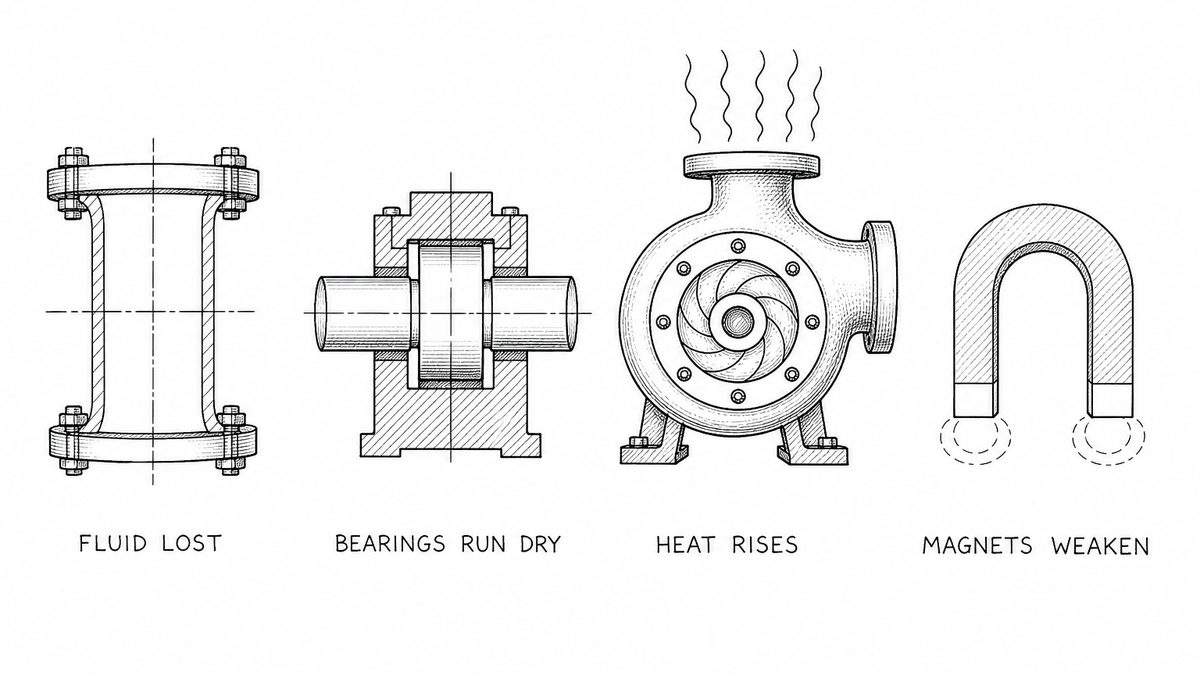
Running dry. The fluid lubricates the bearings and carries heat away. A few seconds with no fluid can score the bearings, and a longer run can overheat the magnets until they lose strength. The usual causes are an empty suction line, a closed valve upstream, or a failed foot valve.
Slip between the magnets. Push the differential pressure past the magnet's limit and the inner ring stops while the outer one keeps turning. The motor sounds normal. Nothing leaks. The flow simply drops, and the first suspect is usually the wrong part.
Solids in the bearing gap. The bearings are rinsed by the fluid, and the channels are narrow. Scale, sand or process debris blocks them, and the pump seizes.
Heat with nowhere to go. A closed discharge valve, a stopped flow, or a metal shell picking up current all add heat. The magnets are the part that suffers, and the damage is not reversible.
Cavitation. Wrong suction conditions, a clogged strainer or too much suction lift. The fluid boils at the impeller and the bubbles tear metal away.
Chemical attack. Usually it is the O-rings or the shell, not the casing. This is why the smallest part deserves the most careful material choice.
The practical lesson is the same in all six cases. Do not rely on the pump to protect itself. Fit a flow switch that stops the motor when flow stops, a temperature sensor in the pump, and a strainer on the suction line. Those three items cost very little beside a failed pump and a lost batch.
Where the Price Difference Comes From
Two offers can carry the same model number and differ by forty per cent. The gap is almost never the paint or the nameplate. It sits in six decisions, and you are allowed to ask about every one of them.
The magnet grade. A ferrite magnet set is cheap and bulky. A neodymium set is compact and strong. A samarium-cobalt set costs more again and keeps its strength when hot. The grade changes the size of the pump and the temperature it can take.
The containment shell. A thin metal shell costs less. A ceramic shell costs more and removes the current losses. This single choice changes both the price and the power bill.
The wet end metal. Cast iron, stainless, duplex and the nickel alloys sit far apart on price. The fluid decides which one you are allowed to use, so this is not a place to save money.
The motor. A standard motor and a hazardous-area motor with the right marking are not the same item to buy. So are a standard efficiency class and a higher one, which pays back over years of running.
The test and the documents. A short spin test costs almost nothing. A witnessed performance test with a recorded curve costs more. So does a materials certificate and a full drawing set. That package is what you are really buying.
The package around the pump. Baseplate, coupling and guard, relief parts, instrumentation, a spare rotor and the commissioning visit. Rotor balance and vibration limits are not pump topics alone. They are the same as the balance and vibration questions you ask about a centrifugal fan.
So compare on total cost, not unit price. A very low offer can be a fair deal for water. For ammonia it is a liability. The relief parts, the gauge and the approved document are exactly the items that were left out to reach that number.
Questions Buyers Ask Before Ordering
What is the difference between a magnetic drive pump and a canned motor pump?
Both remove the shaft seal, and they do it in different ways. A magnetic drive pump turns the impeller with two sets of magnets separated by a thin shell. The motor stays outside, dry. A canned motor pump puts the motor rotor itself inside the fluid, inside a thin can. The canned motor type passes more force and handles higher pressure, because there are no magnets to slip. It also puts the windings next to the fluid, which changes the repair plan and the spare parts list. Ask which one you were quoted, because the prices differ and the two are not interchangeable.
Can a magnetic drive pump run dry?
No, not for more than a few seconds. The bearings sit in the fluid, and the fluid is their lubricant. It also carries heat out of the pump. With no fluid, the bearings score and the magnets heat up. Heat is what does the lasting damage, because a hot magnet loses strength and does not get it back. The fix is not a better pump. It is a flow switch that stops the motor when flow stops, plus a level or pressure check on the suction side.
What is the containment shell made of?
It is usually a thin metal sleeve or a ceramic sleeve, and the choice matters more than the price suggests. A metal shell takes knocks and thermal shock well. It also sits in a turning magnetic field, which drives small currents through it and heats it. A ceramic shell avoids those currents and is very hard, but it dislikes a sharp shock. Ask for the material by name and for the wall thickness in the quotation, then keep the number in your inspection file.
Does a magnetic drive pump need a relief valve?
It depends on the fluid and on the pump type, not on the brand. United States labour rules name pumps directly for two fluids. For anhydrous ammonia, a positive displacement pump must have a constant differential relief valve off the discharge port, and a pressure gauge graduated 0 to 400 p.s.i. before that relief line. For LP-Gas, a positive displacement pump must have a pressure-actuated bypass valve. A centrifugal unit is treated differently from a positive displacement unit under both. Ask which clause applies to your combination.
How do I tell a manufacturer from a trader?
Ask for a pump curve, and ask what happens before the curve is drawn. A manufacturer needs the fluid, the concentration and the temperature before choosing any material. A trader quotes from a catalogue and never asks. Then ask for the containment shell material and its thickness, and for the format of the test report. Finally ask what happens inside the warranty when a pump fails, and where the spare rotor comes from. Four questions, and the answers separate the two kinds of company.
What information do I need for a usable quotation?
Six things, and each one changes the price. The fluid, with its concentration. The temperature it runs at. The flow you need. The head you need, meaning the height the pump must lift the fluid to. The suction conditions, so the pump does not cavitate. And the area class where the motor will stand. Add the voltage and frequency, the connection sizes and the flange standard. With those, two suppliers can be compared on the same job. Without them, every offer describes a different pump.
Write the duty point before you compare prices
Send the fluid, the concentration, the temperature, the flow and the head. We will turn that into one specification sheet and put the hazard rules beside it. We will ask the factory which build it quoted, what the shell is made of, and who signs the test report.
Request a Pump Quote
Questions & Comments
We read every one and reply within 24 hoursTell us the fluid, the concentration, the temperature, the flow and the head. A magnetic drive pump is chosen for one fluid, so the fluid decides the materials, the shell and the rules that apply. Send the duty point and we will answer before anyone quotes. Questions about the shell, the magnets or the relief parts are welcome here.