
Jaw Crusher Manufacturer: Throughput, Guards and Wear Parts From China
 ·
Updated October 14, 2026
·
18 min read
A jaw crusher manufacturer sells you a machine that is judged on three things: whether it makes the tonnage you asked for, whether its guards and access survive a site inspection, and what its wear parts cost you per thousand tonnes. The first is a specification conversation. The second and third are where a cheap quotation turns expensive, because a crusher that loses its guards in the first month and eats a set of jaw plates every six weeks was never cheap. This guide covers the four numbers that size a jaw crusher, where it sits in a plant, the wear parts and how their life is really priced, the two rules that decide whether the guards are legal or decorative, how a blocked crusher is meant to be cleared, what the access and dust rules require, and how to compare two quotations line by line.
| Your job | What decides the machine | Where the cost sits |
|---|---|---|
| Blasting rock down to a shippable size | Feed opening and the largest lump | The frame and the jaw plates |
| Feeding a cone crusher behind it | The setting you need to hold | The toggle plate and the adjustment |
| Hard abrasive rock, high tonnage | How fast the plates wear | Wear parts, month after month |
| A site that gets inspected | Guards, access and blocking | The parts nobody quotes by default |
| An existing plant being extended | The power and the height you have | The drive and the structure |
What a Jaw Crusher Is, and the Four Numbers That Size It
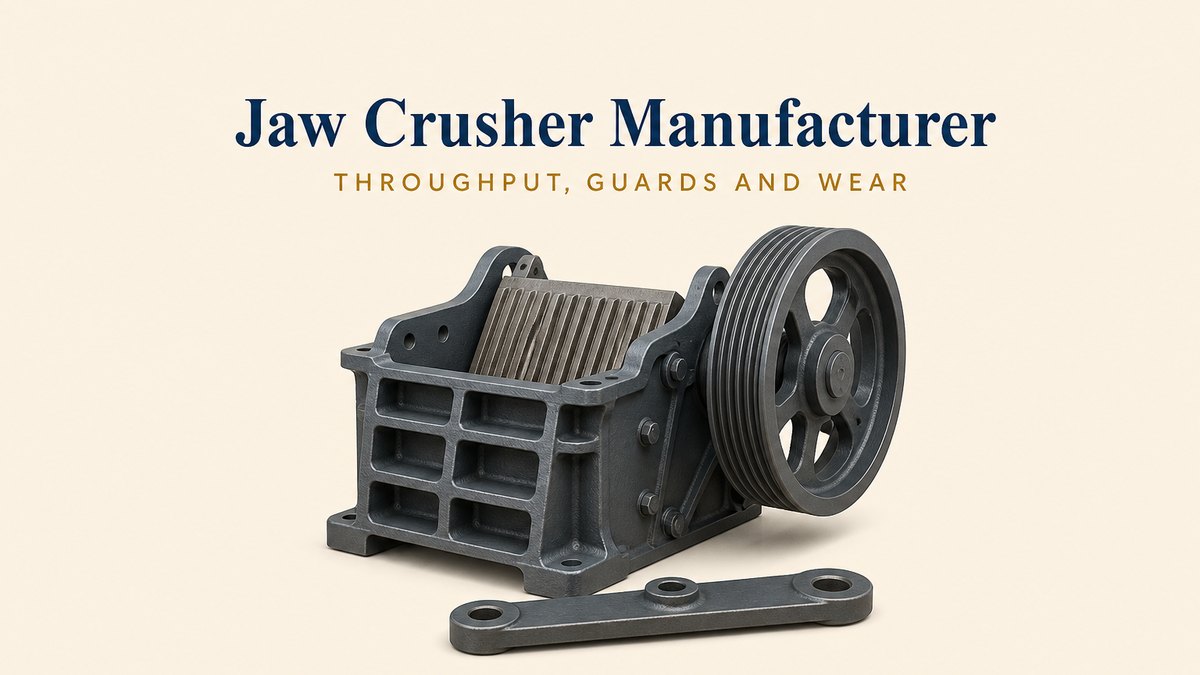
A jaw crusher breaks rock between two plates. One plate is fixed to the frame and the other swings, driven from below by a pitman through a toggle plate, and rock that falls into the gap at the top leaves through the gap at the bottom once it is small enough to pass. That is the whole machine. Everything a supplier quotes you is an answer to four numbers, and a quotation that does not state all four is not a quotation.
The first is the feed opening, given as width by length, because it sets the largest lump the machine will take. The rule of thumb is that the largest lump should be no more than about four fifths of the opening width, and suppliers quote the opening rather than the lump because the opening is what they build. The second is capacity, in tonnes per hour, which is meaningless without the third number and the material. The third is the closed side setting, the narrowest gap between the plates when the machine is at rest, because that is what decides the product size and the tonnage at the same time. The fourth is the power available and the drive arrangement, because a machine rated for more tonnage than its motor can drive is a machine that stalls.
Two habits save a lot of arguing. Never accept a capacity figure without the setting, the material and the bulk density it was measured on, because a jaw crusher that makes three hundred tonnes an hour in one rock may make one hundred and fifty in another. And never compare two suppliers on the opening alone, because a larger opening with a shorter stroke can produce less than a smaller machine. Ask each supplier for the same four numbers on the same material and the comparison becomes real. Setting those numbers down in writing before you ask is the same habit as the specification sheet that stops a factory guessing.
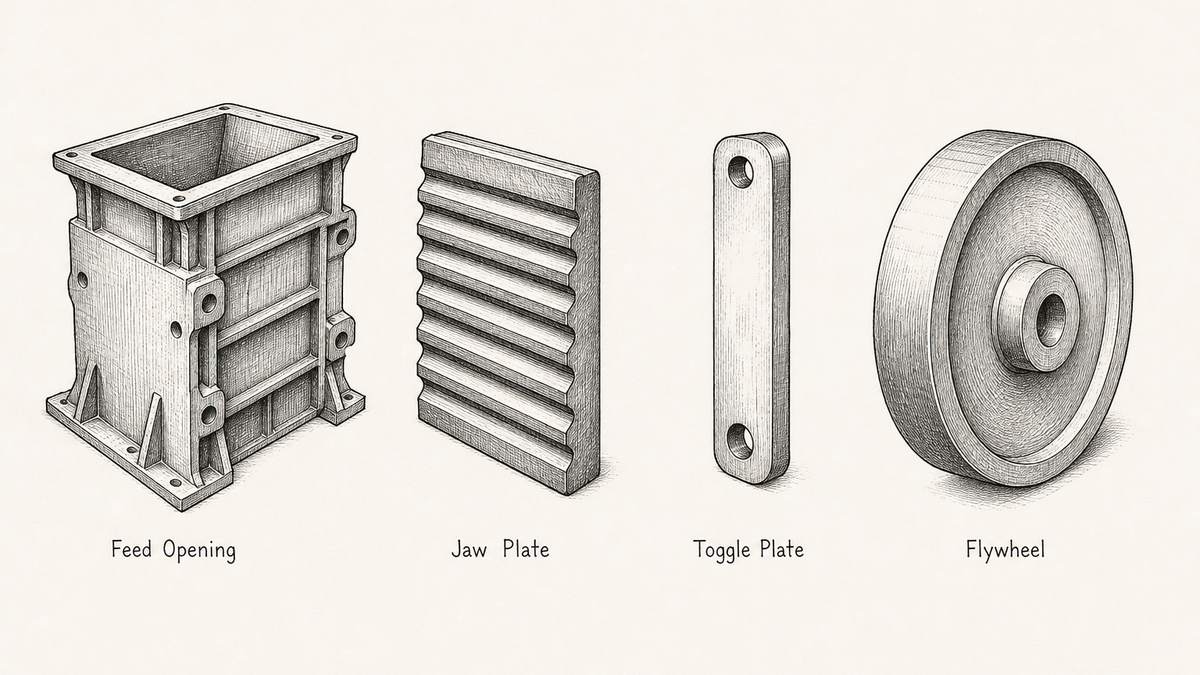
One part deserves attention before anything else is agreed, because it is the cheapest and the most important. Between the pitman and the frame sits the toggle plate, and it is designed to break before anything expensive does. When something unbreakable enters the chamber, the toggle gives way and the machine stops without cracking the frame. That makes the toggle a wear item with a deliberate short life, and it makes the question worth asking: what does a replacement cost, and how long does it take to arrive. A supplier who treats the toggle as an afterthought has not thought about the owner.
Where the Jaw Sits in a Crushing Plant
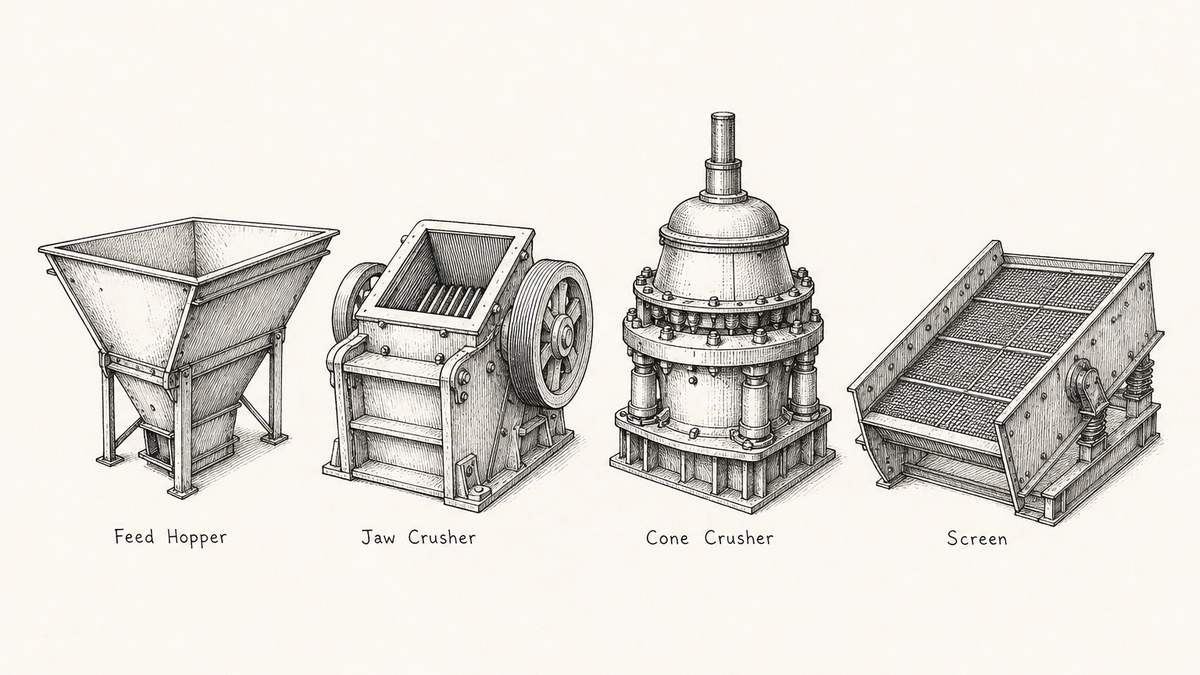
The jaw crusher is almost always the first machine in the line, and that position is what causes most of the trouble it has. It is fed directly from the blast, so it receives the largest and the most awkward rock, which means it takes the widest range of lump sizes and the most abuse of any machine in the plant. It is usually fed by a vibrating grizzly feeder that drops the fines out before they reach the chamber, and it usually discharges onto a belt that carries the product to a cone crusher or a screen.
Because of where it stands, the jaw is the machine that decides whether the rest of the plant runs. If it stalls on an oversized lump, everything behind it starves. If its setting drifts, everything in front of it is either over-crushed or over-loaded. That is why the useful questions at this stage are about the line rather than the machine. What feeds it, what takes its product, and what happens in the two minutes after it stops are all part of what you are buying, even though none of them appears on a crusher quotation.
The belt that takes the output deserves its own attention, because a crusher is only as good as the conveyor under it. The habit of specifying the discharge route at the same time as the machine is the reason it is worth thinking about the conveyor belt that carries the crushed rock away before the plant drawing is fixed, rather than after the crusher has arrived and the structure is already welded.
Jaw Plates, Toggles and the Wear You Pay For
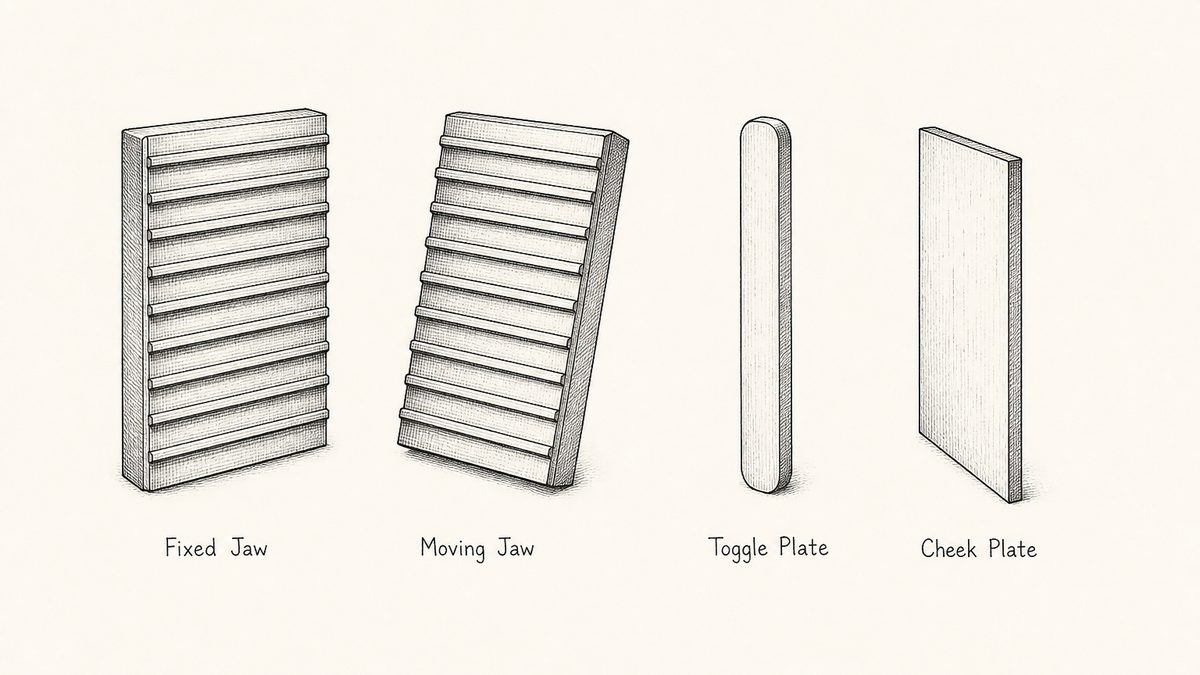
The asking price of a jaw crusher is the smaller half of what it costs. The larger half is the wear, and wear on a jaw crusher is concentrated in four places. The fixed jaw plate and the moving jaw plate are the two surfaces that do the crushing, and they are replaced several times over the life of the machine. The cheek plates line the sides of the chamber and take the sideways scuffing. The toggle plate is the sacrificial part. Everything else, including the frame, is meant to outlast all of them.
Plate life is decided by two choices, and both can be seen on the drawing. The first is the alloy. Manganese steel is the normal choice because it work-hardens under impact, which means the surface gets harder as it is hammered and stays tough underneath. Higher manganese grades and alloyed variants buy more life in abrasive rock at a higher price per set. The second is the profile, because a smooth plate crushes differently from a corrugated or toothed one. A toothed profile bites better on large slippery rock and produces a more cubical product, while a smooth plate suits finer settings. The profile is not a cosmetic choice, and a supplier who offers only one profile is offering a compromise rather than a design.
How you compare wear quotations matters more than the price of a set. Two suppliers will quote different prices per set and different claimed lives, and neither number is comparable as given, because one may be quoting a plate weight and the other a plate thickness. Ask each supplier for the plate weight, the alloy designation, and the tonnage they expect per set in your rock. Then divide the set price by the expected tonnage and compare cost per thousand tonnes. That single number is the only honest comparison, and suppliers who know their product will give you the figures to work it out.
Three practical details decide whether the wear cost lands where you expect. Ask whether the plates are reversible, because a plate that can be turned end for end gives two lives for the price of one. Ask what holds the plates in and whether that arrangement needs to be replaced with them, because a wedge and bolt system that seizes is a day of work every change. And ask for the wear limits: at what thickness does the plate have to come out, and how is that measured on site. A supplier who can answer those three has owners in mind. One who cannot has only ever shipped a machine.
Guards: The Rule Most Buyers Never Read
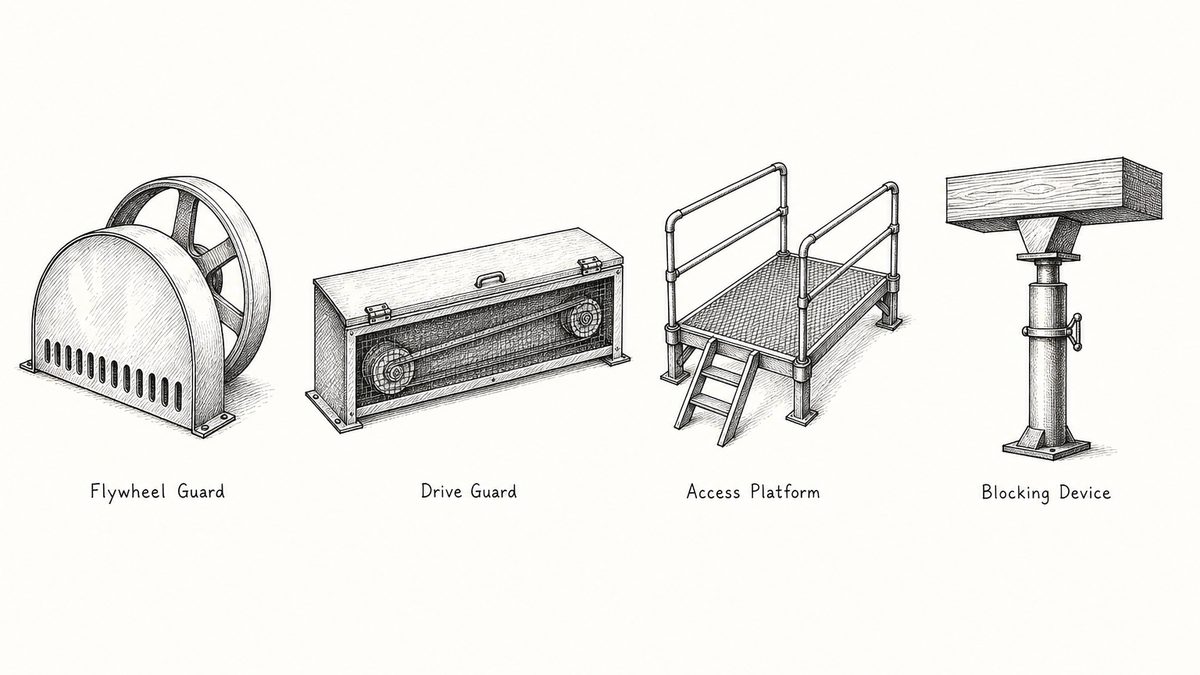
A jaw crusher is a collection of large rotating and reciprocating parts at waist height, and the rule that governs them is short and specific. Moving machine parts have to be guarded so that people cannot reach gears, sprockets, chains, drives, pulleys, flywheels, couplings, shafts, fan blades and similar parts that can cause injury. That is 30 CFR 56.14107 on moving machine parts, and a jaw crusher has almost every item on that list. The same paragraph adds the exception that matters commercially: guards are not required where the exposed parts are at least seven feet away from walking or working surfaces.
That seven foot exception is why crusher layouts differ so much, and why a buyer should read it rather than take a supplier's word. A crusher mounted so that its flywheel sits high, well clear of the platform, needs less guarding than one mounted low. The cheaper layout is the one that raises the drives out of reach and reduces the guard count. The more expensive layout is the one that keeps everything accessible at working height and then has to guard all of it. Neither is wrong, but only one of them is honest about which approach was taken, and you should ask which it is.
The second rule is the one that decides whether the guards will still be there in a year. Guards have to be built and kept in a condition that lets them survive the vibration, shock and wear of normal running, and that does not itself create a hazard; and they have to be securely in place while the machine is running, except when testing or making adjustments that cannot be done with the guard fitted. That is 30 CFR 56.14112 on the construction and maintenance of guards.
Read together, those two paragraphs tell you exactly what to check, and it is not the shape of the guard. Vibration is the killer on a jaw crusher, so a thin folded sheet guard will crack at its fixings within weeks and then be removed by an operator who is tired of it rattling. Ask for the guard thickness, the material it is made from, and how it is fixed. Ask whether the fixings are captive, because a fastener that falls into the drive is its own hazard, which is what the rule means when it says a guard must not create a hazard by its use. And ask whether the guard can be removed without tools. If it can, it will be, and a guard that is off is a guard that is not guarding.
One more paragraph is worth knowing even though it is about a different failure. Where a defect makes continued operation unsafe, the equipment has to be taken out of service and either placed in a designated area or tagged so it cannot be used until it is fixed. That is 30 CFR 56.14100, and it is the reason a crusher should arrive with a documented way to lock it out and tag it. The same guarding logic applies to any enclosed handling machine, and it is worth comparing notes with the way the same rule is applied to a bucket elevator, where the moving parts run inside a casing rather than in the open.
Clearing a Blocked Crusher
A blocked jaw crusher is the situation that kills people in crushing plants, and it is the one the rules address most directly. The governing paragraph is blunt: repairs or maintenance of machinery or equipment may only be done after the power is off and the machinery is blocked against hazardous motion. Motion or activation is allowed only to the extent that an adjustment or a test cannot be carried out without it, and only where people are effectively protected from that motion. That is 30 CFR 56.14105 on procedures during repairs or maintenance.
The reason that paragraph exists is a specific habit. A crusher stalls with rock jammed in the chamber, an operator reaches in with a bar while the machine is still live, or stands under the moving jaw, and the machine moves. Electricity off is not enough on its own, because a loaded toggle, a raised jaw or stored energy in the drive can still move the machine when the power is cut. That is why the rule says the machine must be blocked as well as isolated, and it is why the word appears twice in one sentence.
So the question to ask a supplier is not whether they comply, which is not a useful question. It is what they provide so that you can. A crusher should come with a defined isolation point that can be locked, a method for mechanically blocking the jaw against movement, an access platform that lets a person clear a blockage from outside the chamber rather than inside it, and a written procedure that tells an operator what to do at three in the morning. Ask to see the procedure as part of the quotation. A supplier who has one is selling you a machine you can operate. A supplier who does not have one is selling you a machine you will have to design the safety around yourself.
It is also worth knowing that the crusher type itself changes the risk. A jaw crusher grips and crushes, while an impact machine throws material, and the blocked-chamber situation is different in each. If your rock is softer and you are weighing a jaw against another type, the comparison is worth making on more than throughput, which is why it is worth reading how a hammer mill handles the same feed with a different mechanism before the machine type is fixed.
| Item | What it must do | What to ask for |
|---|---|---|
| Isolation point | Let the power be locked off | The lockout point on the drawing |
| Blocking device | Stop the jaw moving after isolation | How the jaw is blocked and by what |
| Access platform | Let a blockage be cleared from outside | The platform drawing and the reach from it |
| Written procedure | Tell the operator what to do | The procedure as a document, not a briefing |
Platforms, Ladders and the Hopper Above
The access rules around a crusher are short, and they cover two situations that kill people: falling, and entering a confined space. Where people work where there is a danger of falling, safety belts and lines have to be worn, and where bins, tanks or other dangerous areas are entered, a second person has to tend the lifeline. That is 30 CFR 56.15005 on safety belts and lines.
Notice what that paragraph assumes. It assumes that people will be working at height and that they will be entering the feed hopper and the discharge chute, and it does not ask them to avoid it. So the useful design move is to reduce how often anyone has to. A crusher with a platform on both sides of the chamber means plate changes and blockages can be handled from a standing position rather than from a ladder. A handrail with a toe board, adequate width and a proper step-over stops the slow accumulation of near misses that ends in a fall.
The hopper is the part buyers forget, and it is the most dangerous. Material bridges in the hopper above a jaw crusher constantly, and clearing a bridge from the top means standing on a pile of loose rock above a running machine. Ask what the supplier provides for that: a grizzly that keeps the largest lumps out, an inspection hatch that lets the bridge be seen without being entered, and a documented procedure that forbids anyone standing on the material. Ask for the access route on a drawing, not in a description, and check the platform heights against the parts that actually have to be reached for maintenance.
Dust, and What the Supplier Should Offer
The dust from crushing is a regulated exposure rather than a housekeeping problem, and the reason is the rock itself. Crushing silica-bearing rock produces fine particles that reach deep into the lungs, and the exposure limit is not a number a supplier can set. The rule works by reference: exposure to airborne contaminants must not go above the exposure limits adopted by the American Conference of Governmental Industrial Hygienists, and where an airborne contaminant carries a ceiling value and that value is exceeded, workers have to be withdrawn from the area. That is 30 CFR 56.5001, and the practical point for a buyer is that the limit is written by reference to an external table rather than stated in the rule itself.
That section is also a reminder to check rather than assume. The eCFR text read in October 2026 carries a cross-reference note that an amendment published in 2024 has been delayed indefinitely, so the version in force should be confirmed against the current text before a number is relied on. A supplier who quotes a dust limit confidently, without saying where the number came from, is doing the opposite of what the rule does.
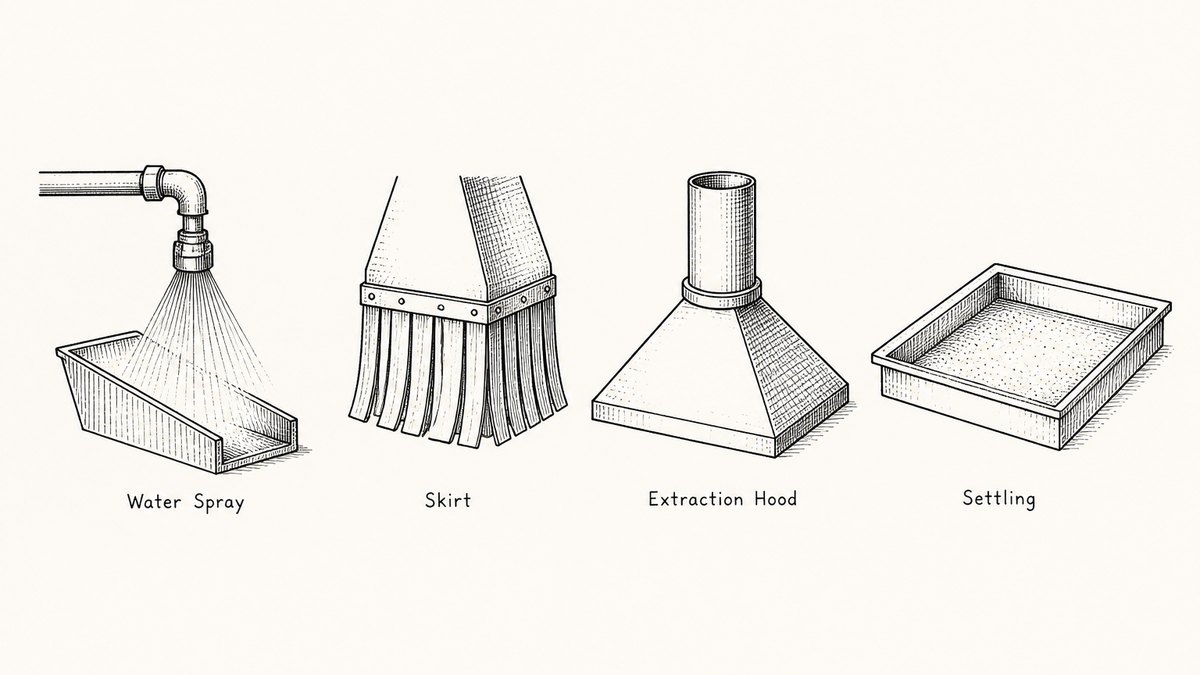
The useful question is not about a limit but about the machine. A jaw crusher is usually less dusty than the cone or the screen behind it, because it is fed through a hopper and the fines are often taken out before the chamber. The dusty points are the feed, the discharge and every transfer between them. So ask what the supplier provides at each: a water spray or a dust suppression arrangement at the feed, an enclosure or a skirt at the discharge, and a connection point for extraction if your site has a system. Ask for the water and air demand of any suppression system, because it has to be supplied by you and it is easy to leave out of the plant services budget.
Dust is rarely a crusher-only question, and that is worth remembering while the plant is being drawn, because the answer usually belongs to the wider industrial machinery category these machines belong to rather than to the crusher supplier. If your site already has extraction, the machine only has to connect to it. If it does not, the scope is larger than a crusher order and it should be priced before the plant is fixed.
What to Put on the Enquiry
Most disappointing crusher orders trace back to an enquiry that described the rock and left out the conditions. A supplier can size a machine from four numbers, but it cannot price a plant from them. The enquiry that gets an answer worth comparing carries five groups of information, and none of it is difficult to write down.
The material: what the rock is, its bulk density, its compressive strength, and whether it is abrasive. If the rock is a blend, say so, because the hardest component sets the wear. The numbers: the largest lump you will feed, the tonnage you need per hour, and the product size you need out. The site: the power available and its voltage and frequency, the altitude, the ambient temperature range, and whether the machine will be indoors or outdoors. The scope: whether you want a bare machine or a package including the feeder, the discharge conveyor, the guards, the platforms, the dust suppression and the steel structure. And the commercial conditions: the destination port, the standards or inspection regime your site has to satisfy, and whether you need a factory test before dispatch.
Two of those deserve emphasis because they change the price more than the machine does. The scope question decides whether the quotation is comparable at all, since a bare crusher and a crusher package are different products that happen to share a name. And the destination rules decide what has to be documented and verified before the machine leaves, which is not a detail that can be added later. Writing those down before you ask is the difference between three quotations you can rank and three quotations you can only read.
How to Compare Two Crusher Quotations
Two crusher quotations cannot be compared unless they describe the same machine and the same scope, and the fastest way to find out is to ask both for the same lines. Everything else on the page is presentation.
Start with the machine: feed opening, capacity at a stated setting and material, motor power, and total weight. Then the wear package, with the alloy, the plate weight, the profile and the expected tonnage per set, so that cost per thousand tonnes can be worked out. Then what is included: the feeder, the discharge conveyor, the guards, the platforms and ladders, the dust suppression, and the structure. Then the safety scope, which is where a low price usually hides: whether the isolation point, the blocking method, the access platform and the written procedure are all supplied or are assumed to be your problem. Then the documentation and the testing, including whether a factory test before dispatch is included. Then the spares, the packaging, the destination and the point at which the risk in the machine passes to you. The habit of putting those lines down before you ask is what turns a quotation into a comparison, and it is the same discipline that makes a pre-dispatch check worth more than a repair after arrival.
| Line on the quotation | What good looks like | Why it matters |
|---|---|---|
| Machine | Opening, capacity at a stated setting, power, weight | A capacity with no setting and no rock is a guess |
| Wear package | Alloy, plate weight, profile, tonnage per set | Cost per thousand tonnes is the only real price |
| Scope | Feeder, conveyor, guards, platforms, dust, structure | A bare machine and a package are different products |
| Safety items | Isolation, blocking, access and the written procedure | This is where a low quotation hides its cost |
| Testing | A factory test before dispatch, with records | Faults found at the works cost the supplier, not you |
Questions Buyers Ask Before Ordering
What size jaw crusher do I need?
Sizing starts with the largest lump you will feed, not with the tonnage. The feed opening has to take that lump, and the usual guide is that the largest piece should be no more than about four fifths of the opening width, so a lump of four hundred millimetres points at an opening of around five hundred. Then the closed side setting is chosen to give the product size you need, and the capacity follows from the setting, the material and the bulk density together. Never accept a capacity figure that is not tied to a setting, a rock and a density, because the same machine gives very different tonnage in different rock.
How long do jaw plates last?
There is no useful answer in time, and any supplier who gives one in months is guessing. Plate life is measured in tonnes crushed, and it depends on how abrasive the rock is, how hard the material is, how fine the setting is and how well the machine is fed. That is why the honest comparison is cost per thousand tonnes: take the price of a set, divide it by the tonnage the supplier expects from that set in your rock, and compare that number between suppliers. Ask for the plate weight and the alloy as well, because a cheap set that is thinner and lighter is not cheaper per tonne, only cheaper on the invoice.
Why did the toggle plate break?
It is designed to. The toggle plate sits between the pitman and the frame and is deliberately the weakest part in that path, so that when something unbreakable enters the chamber the toggle gives way instead of the frame cracking. A broken toggle is usually the machine doing its job rather than a fault, and the right response is to find out what went through it. The exception is repeated breakage without a cause, which points at a worn or wrongly set toggle seat, an overloaded machine, or a feed that is consistently larger than the opening is meant to take. Ask what the replacement costs and how quickly it can be supplied, because it is a wear item.
What guards does a jaw crusher need?
Moving parts have to be guarded so people cannot reach gears, sprockets, chains, the drive, pulleys, flywheels, couplings, shafts and similar parts that can cause injury, unless the exposed parts are at least seven feet away from any walking or working surface. A jaw crusher has almost all of those parts, so the seven foot exception is really a layout decision: mount the drive high and you need fewer guards, mount it at waist height and you guard all of it. The guards then have to survive vibration, shock and wear without creating a hazard of their own, and they have to be securely in place while the machine runs. Ask for the thickness, the material and the fixing method, not a photograph.
How do you clear a blocked jaw crusher?
With the power off and the machine blocked against movement, and not before. Repairs and maintenance may only be done after the power is isolated and the machinery is blocked against hazardous motion, and the machine may only be moved for an adjustment or a test that cannot be done without it, and only with people effectively protected. Isolating the power is not enough on its own, because a loaded toggle or a raised jaw can still move. So a crusher should arrive with a lockable isolation point, a mechanical way to block the jaw, an access platform that lets the blockage be cleared from outside the chamber, and a written procedure. Ask for the procedure with the quotation.
What is the biggest risk when buying a jaw crusher from China?
The risks are the items a bare quotation leaves out. A quotation that prices a machine and not a package will usually also leave out the guards, the platforms, the isolation point, the blocking method, the dust suppression and the steel structure, and those are exactly the parts that turn a cheap machine into an expensive installation. The second risk is wear priced without tonnage, so a low plate price hides a short life. Write the scope down before you ask, require capacity at a stated setting and rock, and require cost per thousand tonnes for wear. Then test the machine at the works before it is packed.
Price the wear, not just the machine
Send the rock, the largest lump, the tonnage and the product size. We will ask for the capacity at a stated setting, the plate weight and the tonnage per set behind the wear price, and the isolation, blocking and access items that a bare quotation leaves out, then compare cost per thousand tonnes.
Request a Crusher Quote
Questions & Comments
We read every one and reply within 24 hoursA jaw crusher is judged on three things that a quotation rarely shows: the capacity at a stated setting, the guard and access package, and the cost of wear per thousand tonnes. Send us the rock, the tonnage and the product size, and we will price all three before anyone ships a machine.