
Instagram Dropshipping: The Content Clock and the Restock Clock
 ·
Updated October 14, 2026
·
15 min read
Selling on Instagram is usually described as a content problem, and the content half is real: posts have to keep appearing, and that costs money to make rather than to publish. What the description leaves out is that two clocks are running at the same time. A post can put an offer in front of a large audience within hours, and the orders arrive in a spike. Supply runs on a different clock, where lead time is measured in days or weeks and grows with the quantity ordered. When the first clock is faster than the second, the outcome is not a sale that failed to happen but a sale that happened and could not be served. This guide sets out both clocks, the rule that decides which content you may actually reuse, and what to build so the two do not collide.
1. Two Clocks Running at Different Speeds
The first clock is the demand clock, and it is fast. A post that finds an audience can put an offer in front of more people in one afternoon than a storefront sees in a season, and the orders come in a rush rather than a trickle. That speed is the whole attraction of the channel, and it is also the source of the problem, because it is a property of the audience rather than of the business.
The second clock is the restock clock, and it is slow in a way that is easy to underestimate. Producing goods is a batch operation: material has to be ordered, a run has to be scheduled, goods have to be made, checked, packed and moved. Each of those steps takes time, and the total grows as the quantity grows, so the lead time for a large order is longer than the lead time for a small one. This is the opposite of what a seller naturally assumes, because a bigger order feels like a more important order and ought to be faster. In practice the opposite is true more often than not.
The third clock is quieter and it belongs to the content itself. Posts have to keep appearing for an account to keep working, which means a pipeline of material has to exist before the posting happens, and the cost of that pipeline is paid in making rather than in publishing. A seller who has not built one ends up producing content to a deadline, which is the most expensive way to make anything.
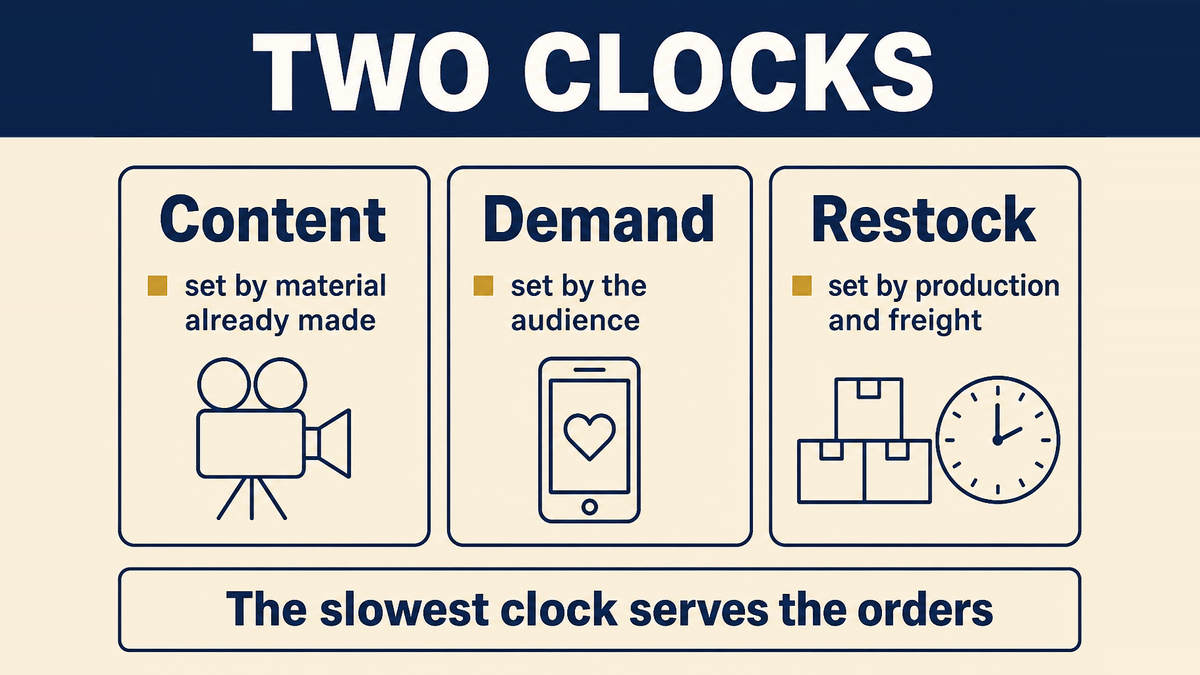
Read together, the three clocks explain a failure that looks like bad luck and is really arithmetic. The product sells, the demand arrives, and the supply cannot follow at the speed required, so the orders that arrived are the problem rather than the prize. The table below sets out what sets each clock and what it charges.
| Clock | Set by | What it charges you |
|---|---|---|
| Content | How much material you have already made | The cost of making, paid before you know demand |
| Demand | The size and mood of the audience | Nothing directly, and it arrives faster than supply |
| Restock | Production and freight, and the quantity ordered | Lead time, which grows with order size |
What this guide covers
2. The Content Clock: What Consistent Posting Costs
Publishing on this channel costs nothing, which is why the cost of content is so often reported as zero. The making is where the money goes, and it divides into three parts that behave differently. There is the setting: a surface, lighting, a background that does not embarrass the product. There is the object: the item itself, in the colour that photographs well rather than the colour that sells best. And there is the work: filming, cutting, writing, and doing all of it again in a form that fits the next post.
The useful way to cost this is not per post but per usable piece of material. A single session in front of a good surface can produce enough raw footage for a month of posting, and the cost of that session does not change when it is cut into twenty clips rather than one. That is why the accounts that post consistently are not the ones with the largest budgets. They are the ones that shoot in batches and reuse what they shot, and the reason is arithmetic rather than discipline.
The trap follows from the same arithmetic. Material made before demand is known is money spent on a guess, and a seller who produces a full library for a product before the supply side is settled has paid the content cost and taken the restock risk at the same time. If the product cannot be resupplied quickly, the content is not an asset, it is a sunk cost attached to a product that cannot be sold again. The order of decisions matters here, and it is the same order that governs how a product trend should be read before acting on it.
It is worth separating two things that get called content. The first is a post, which is consumed and gone. The second is the raw material behind it, which keeps its value because it can be cut again for a different format, a different offer or a different season. A store that treats the second as the asset will spend less every month for the same output, and a store that treats each post as a fresh project will spend the same amount forever and end up with nothing left over. What the material is worth also depends on whether it is the store's to use, which is not a marketing question at all.
3. The Rule That Decides What You May Reuse
Every account that sells on this channel ends up with a library of images and clips, and the working assumption is usually that the ones showing your own product belong to you. That assumption is wrong in a specific and useful way, and the rule that governs it separates two things sellers treat as one.
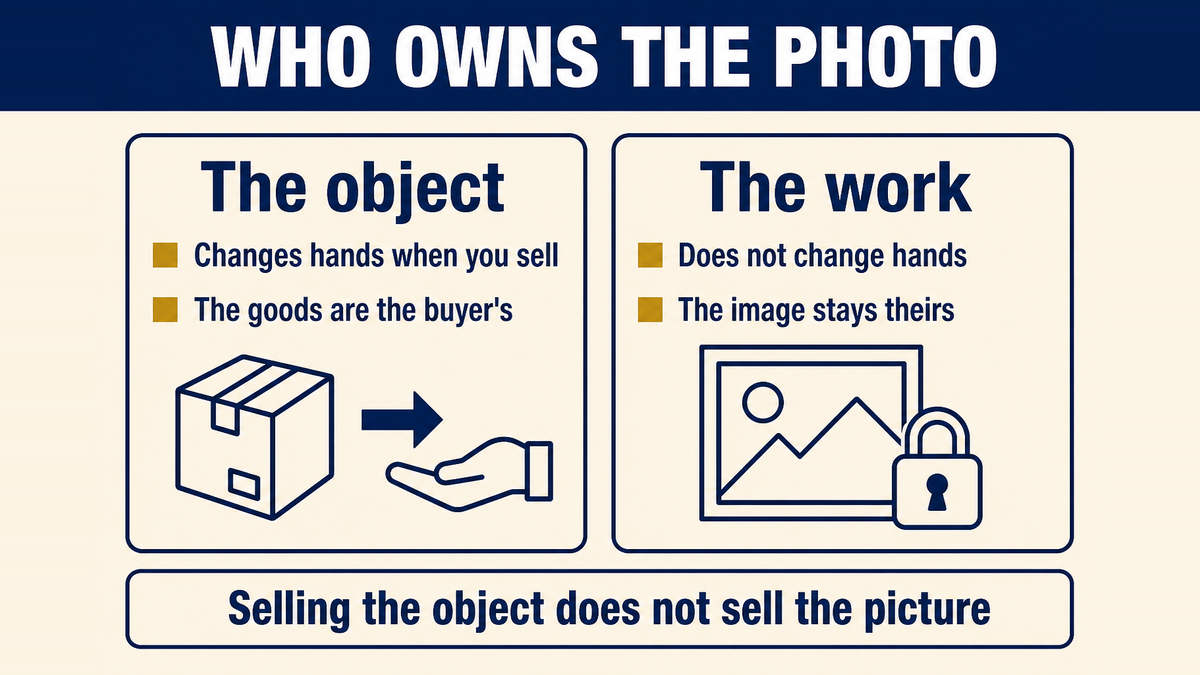
Ownership of a copyright, or of any of the exclusive rights under a copyright, is distinct from ownership of any material object in which the work is embodied. Transfer of ownership of any material object, including the copy or phonorecord in which the work is first fixed, does not of itself convey any rights in the copyrighted work embodied in the object…
17 U.S.C. § 202, via Cornell Law School, Legal Information Institute (read 14 October 2026)
The rule is about objects and works being two different things. The photograph is the work, and owning the thing photographed is owning an object. A buyer who receives your product and takes a picture of it owns that picture, and the fact that the product came from you changes nothing about the image, because the sale transferred goods rather than rights in a photograph that did not exist at the time. This is where most stores' reposting practice stops being a courtesy question and starts being a permission question: the material is good, it shows the product in use, and it belongs to the customer until they agree otherwise.
The same split applies to material that arrives from the supply side. Product images supplied by a factory were usually made by the factory or by a photographer it hired, so the store is using them with permission rather than by right, and the permission is often implicit and revocable. Those images also tend to be shared with every other seller of the same item, which is a commercial problem before it is a legal one, because a store whose entire visual identity is the factory's catalogue looks exactly like its competitors.
The practical fix is a record rather than a rule, and it is small enough to keep. For each asset in the library, note who made it, what the store is allowed to do with it, where it may appear and for how long. An asset with no entry is one you cannot safely reuse, and the number of those grows quietly. Keeping the record is also what makes a paid collaboration worth more than a free one, because the fee is where a licence gets written down rather than assumed. The general principle, that permission is granted to a described use rather than to a product, is the same one covered in choosing how a mark is applied to goods.
4. What Fair Use Does and Does Not Settle
There is a belief that runs through content advice on this channel, which is that reusing somebody's material is acceptable if it is short, or transformed, or credited to the owner. Some of those factors matter and none of them is a permission. What the position amounts to is described plainly by the office that maintains the record of how the question has been decided in court.
…presenting a searchable database of court opinions, including by category and type of use… The Fair Use Index tracks a variety of judicial decisions to help both lawyers and non-lawyers better understand the types of uses courts have previously determined to be fair—or not fair… Although the Fair Use Index should prove helpful in understanding what courts have to date considered to be fair or not fair, it is not a substitute for legal advice. Fair use is a judge-created doctrine…
U.S. Copyright Office, Fair Use Index (read 14 October 2026)
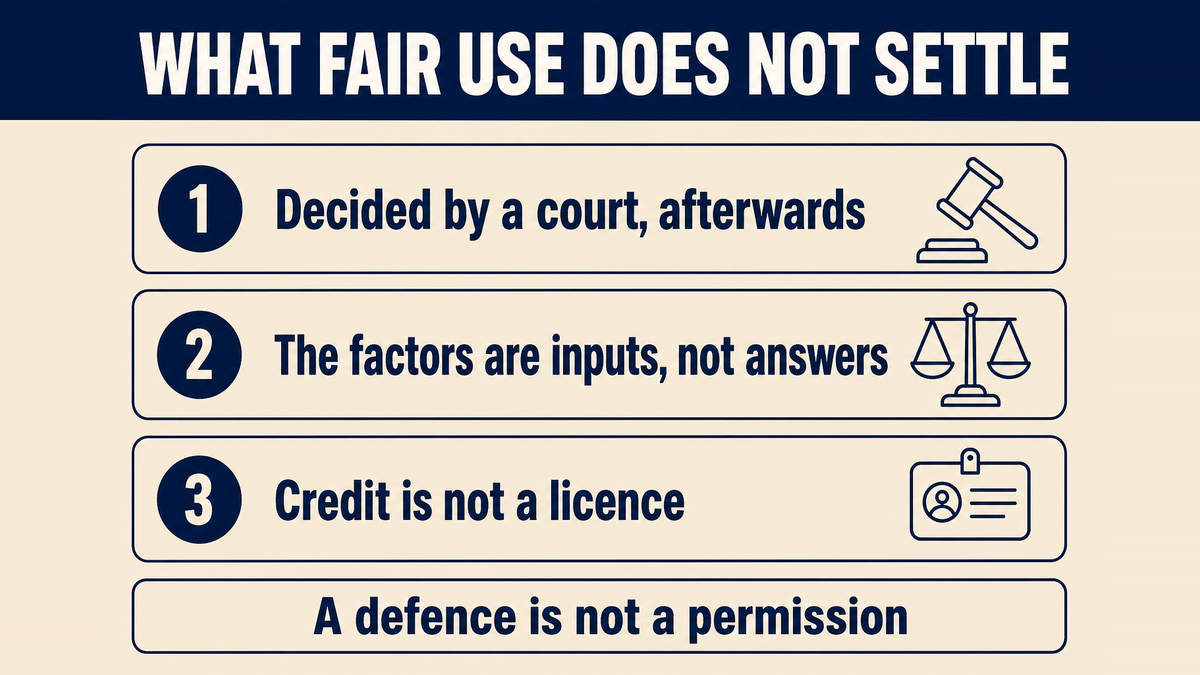
Two things follow from that description. The first is that fair use is decided by a court looking at the facts of a particular case, which makes it a defence raised after the fact rather than a permission granted before it. A store cannot decide in advance that its use is fair in the way it can decide in advance that it holds a licence, because the only body that settles the question is one that gets involved afterwards, and only if somebody objects.
The second is that the factors people cite are inputs rather than answers. Length, transformation and purpose all feature in how these questions are argued, and none of them produces a result on its own, which is the reason the office maintains an index of decisions rather than a list of permitted uses. Credit belongs in the same category. Naming the owner is decent practice and it is not a licence, because a licence is something granted and attribution is something added.
For a working store the conclusion is not restrictive so much as clarifying. A library built from material the store made, or licensed in writing, or holds a record of, does not depend on any of this. A library built by saving other people's posts does, and the exposure arrives at the least convenient moment, which is when a product is selling well. Producing more of your own material is the cheapest way to reduce the risk, and it is also the way to make the content clock cheaper, because original material can be cut again and borrowed material cannot.
5. The Restock Clock: Why a Spike Outruns a Supply Chain
The reason the second clock is so often underestimated is that lead time is treated as a fixed property of a supplier, when in fact it is a function of quantity. A factory that can turn a hundred units around in a few days needs considerably longer for a thousand, because material has to be bought in, a production slot has to be booked, and the run has to be scheduled around other orders. The number a seller usually has is the one that applies to the quantity they last ordered, and that is precisely the quantity a spike will exceed.
This is why the mismatch is structural rather than a matter of poor planning. The demand arrives in a shape that nothing in the supply chain expects, and the lead time that applies to that shape is the longest one rather than the shortest. A seller who asks what a large order takes, and asks it before the post goes out, is doing the one piece of research that changes the answer, and it is a question rather than an order.
The cost of getting this wrong also lands in a place sellers rarely look, which is the returns line. An order taken during a spike and then delayed is a buyer who has been given a reason to cancel, and an order that is cancelled or returned has cost the store the unit, the freight both ways and the time spent on the conversation, with no sale at the end of it. That is a different and larger figure than an order that simply never happened, and it is the reason a stock-out is more expensive than it looks from a demand chart. The arithmetic of the round trip is set out in what a return actually costs.
There is a second feature of this channel that makes the problem worse than the same spike would be in a storefront. A post keeps working after the stock runs out. Content that found an audience continues to be shown, saved and shared for weeks, and every viewer who arrives after the stock is gone is a person who has been offered something that cannot be bought. Their experience is not a sale that failed to happen; it is a queue that formed and was sent away, and the reviews that follow are written by people who were told about a product by the seller rather than discovering it themselves.
The response is a buffer, and the useful way to size it is to look at it as coverage rather than as stock. A buffer exists to cover the orders that arrive during the time it takes to resupply, so its size is the daily order rate multiplied by the lead time at that quantity, and not the amount that feels prudent. Sellers who calculate it that way often find the number is larger than they expected, which is the point of calculating it rather than guessing. Where holding goods is not workable, the same problem is addressed by shortening the lead time instead, which is the trade covered in what holding stock actually requires.
6. Designing for the Mismatch
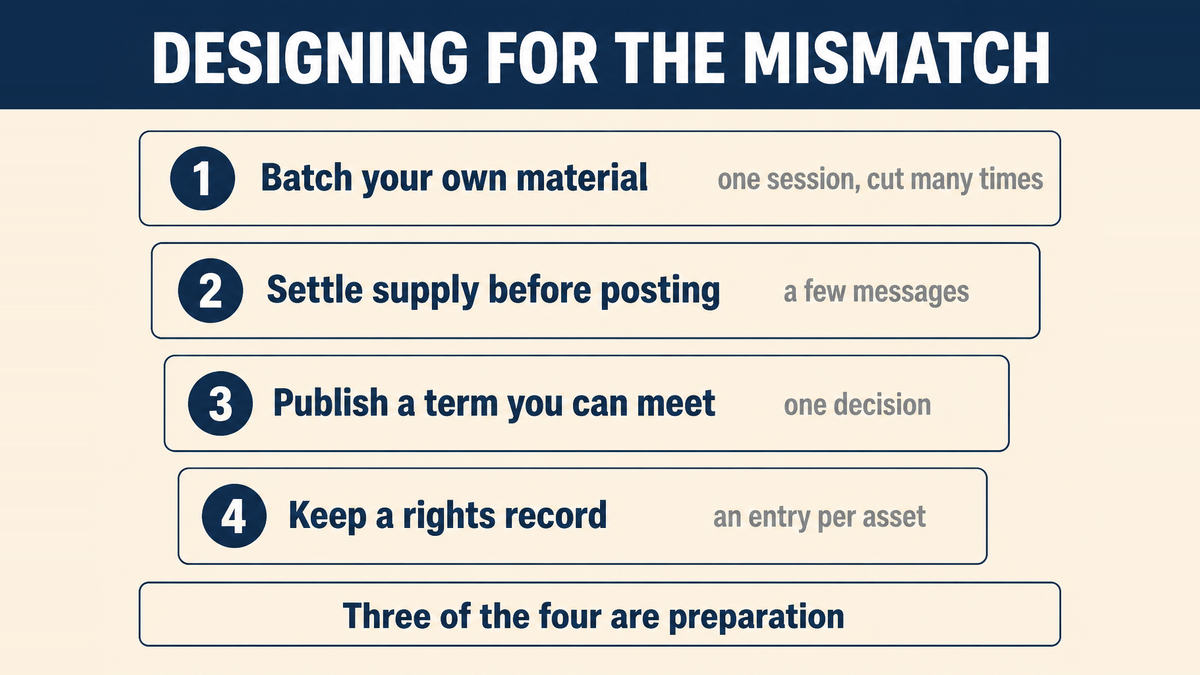
Four moves reduce the collision between the clocks, and the useful thing about them is that three are preparation rather than spending. They also reinforce each other, which is why they work better as a set than as separate habits.
| Move | What it costs | What it prevents |
|---|---|---|
| Batch your own material | One session, cut many times | Paying for content you cannot legally reuse |
| Settle supply before posting | A few messages about lead time | Content attached to a product you cannot resupply |
| Publish a term you can meet | One decision, written down | A queue of buyers entitled to walk away |
| Keep a rights record | An entry per asset | Reusing something you were never granted |
The first move is the one that pays for itself soonest, because material you made can be cut again for a different format, a different offer or a different season, while material you borrowed can be used once and then sits in the library as a liability. Shooting in batches is what makes an account look consistent without a large budget, and it is also what makes the store's appearance its own rather than a copy of the factory catalogue.
The second and third moves belong together. Settling supply first means the content is only made for a product that can be resupplied at the speed the channel implies, and publishing a term you can meet means the promise made to buyers is one the business can keep when a post performs. Neither costs money, and both remove the failure mode where a good post becomes the worst event of the quarter.
The fourth is the quietest and it is the one that keeps the other three safe. A library with a record attached can be reused for years, and a library without one is a set of decisions that will be re-examined at the worst possible moment. Keeping the record is also the reason a paid collaboration is worth more than a gifted one: the fee is where the licence gets written down, and a licence written down is what turns a piece of content from a temporary favour into a permanent asset. When a post has to be made before the supply side is ready, the sensible answer is to make it with material you own and to hold the supply question until it is settled, which is the same discipline as checking goods before they ship rather than after.
Put plainly, the channel rewards speed of attention and it punishes speed of supply. The two clocks cannot be synchronised, and they do not need to be. What a store can do is know both of them, make its content in batches it owns, and only point an audience at a product it can still sell next week. That is a smaller ambition than going viral, and it is the one that leaves a business standing afterwards.
7. Frequently Asked Questions
Is Instagram good for dropshipping?
The channel is good at creating demand and indifferent to whether you can serve it. A post can put an offer in front of a large audience within hours, while production moves in batches whose lead time grows with the quantity ordered. That makes the platform excellent for a product you can resupply quickly and hazardous for one you cannot, which is a supply question rather than a marketing one.
Can I repost a customer's photo of my product?
Not by right, and it needs permission. Ownership of a copyright is separate from ownership of the object the work shows, so selling someone the product does not transfer any rights in the photograph they took of it. Most customers are happy to be asked, and the request is also what gives you a record that the permission exists.
Is it OK to use someone's video if I credit them?
Credit is decent practice and it is not a licence, because a licence is granted and attribution is added. Whether a particular reuse is permitted is decided by a court looking at the facts of that case, which makes it a defence raised afterwards rather than a permission held beforehand. Building a library you made or licensed avoids needing to rely on that argument at all.
How do I stop selling out when a post goes viral?
Size a restock buffer as coverage rather than as a comfortable amount, which means multiplying the daily order rate by the lead time at the quantity a spike implies. Lead time is usually longer for larger orders, and that version of it is the one worth asking a supplier for. Where holding goods is not workable, shortening the lead time addresses the same gap from the other side.
How much content do I need before I start?
Enough raw material for several weeks of posting, made in one or two sessions and shot so it can be cut more than one way. The point of batching is that the cost of the session does not change with how many clips come out of it, so the same spend produces far more posts. It also means the material is yours, which borrowed material never is.
What You May Repost, and What You May Not
We return the reuse rule applied to your own footage and to supplier clips, plus the restock days a spike demands.
Rule My Reuse
Questions & Comments
We read every one and reply within 24 hoursUnsure whether you can repost a customer's photo of your product, trying to work out how much stock a good post would actually need, or building a content library and wondering which pieces you are allowed to keep using? Tell us the product and the quantity you are aiming at, and our team will help you check both the supply side and the rights.