
Dropshipping Returns: The Rate to Plan For, and What You Can Cut
 ·
Updated October 13, 2026
·
15 min read
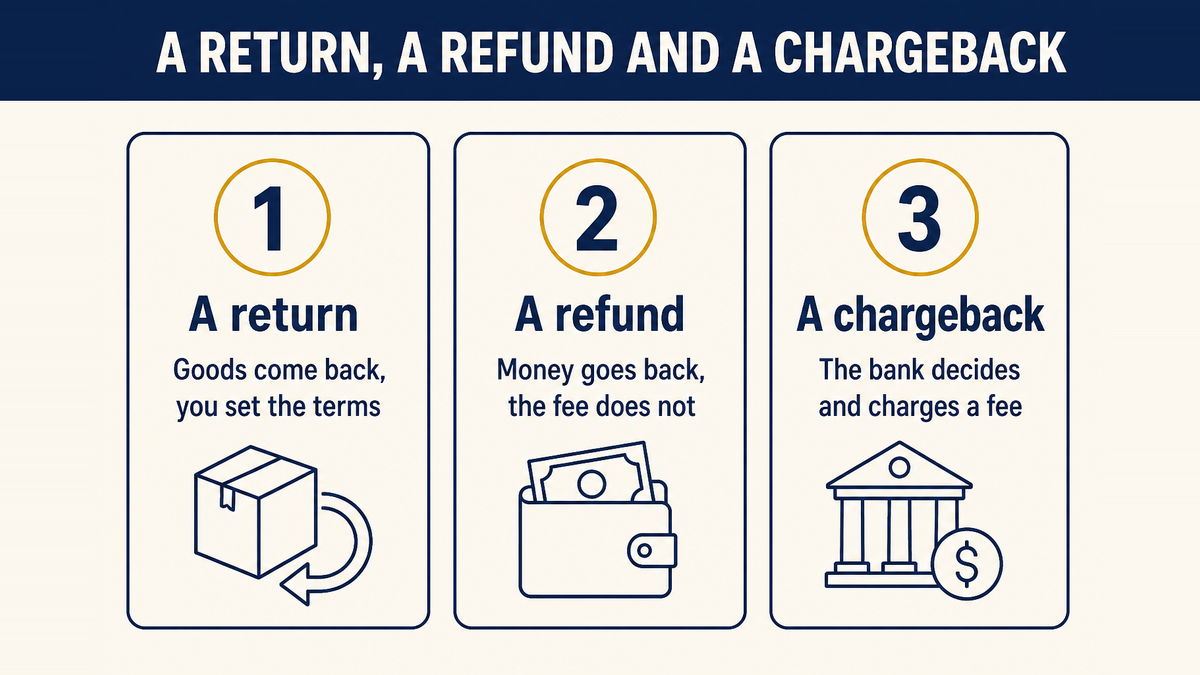
A return is not one event. It is up to three, and they cost different amounts. The goods coming back is a return. The money going back is a refund, and it can happen without anything moving at all. A payment reversed by the customer's bank is a chargeback, which is a dispute rather than a request. Stores that treat all three as the same thing usually end up paying the most expensive version of each.

Three Events, Three Costs
| Event | What it costs | Who decides it |
|---|---|---|
| A return | Return freight, handling, and whatever value the item loses on the way. | You, through your published policy. |
| A refund | The price, plus the payment fee that is not handed back. | You, and it can happen with no goods moving. |
| A chargeback | The price, a dispute fee, and the goods if the customer keeps them. | The bank, not you. |
What this guide covers
1. What Rate Should You Plan For?
Start with the industry figure rather than with zero. The 2025 returns research published by the National Retail Federation with Happy Returns puts the numbers plainly.
Total returns for the retail industry are projected to reach $849.9 billion in 2025. An estimated 19.3% of online sales will be returned in 2025. 82% of consumers say free returns are an important consideration when shopping online. Return fraud is an ongoing concern - the report found 9% of all returns are fraudulent.
NRF and Happy Returns, 2025 Retail Returns Landscape
Two things follow from that. The first is that a return rate is a normal part of selling online, not a sign that something has gone wrong, and a plan that assumes none is a plan with a hole in it. The second is that free returns are close to an expectation rather than a perk, which is worth knowing before you build a margin on the assumption that nobody will send anything back.
The size of the hole is easy to see once you put the rate against contribution. Take a hundred orders each leaving twelve dollars, which is 1,200 dollars of contribution. At the online rate, nineteen of those orders come back. They lose their own contribution, and each one also carries a handling cost of roughly ten dollars in freight and lost value. That leaves 81 orders earning 972 dollars, less 190 dollars of return cost, or 782 dollars. Returns have just removed about a third of what the month was planned to produce.
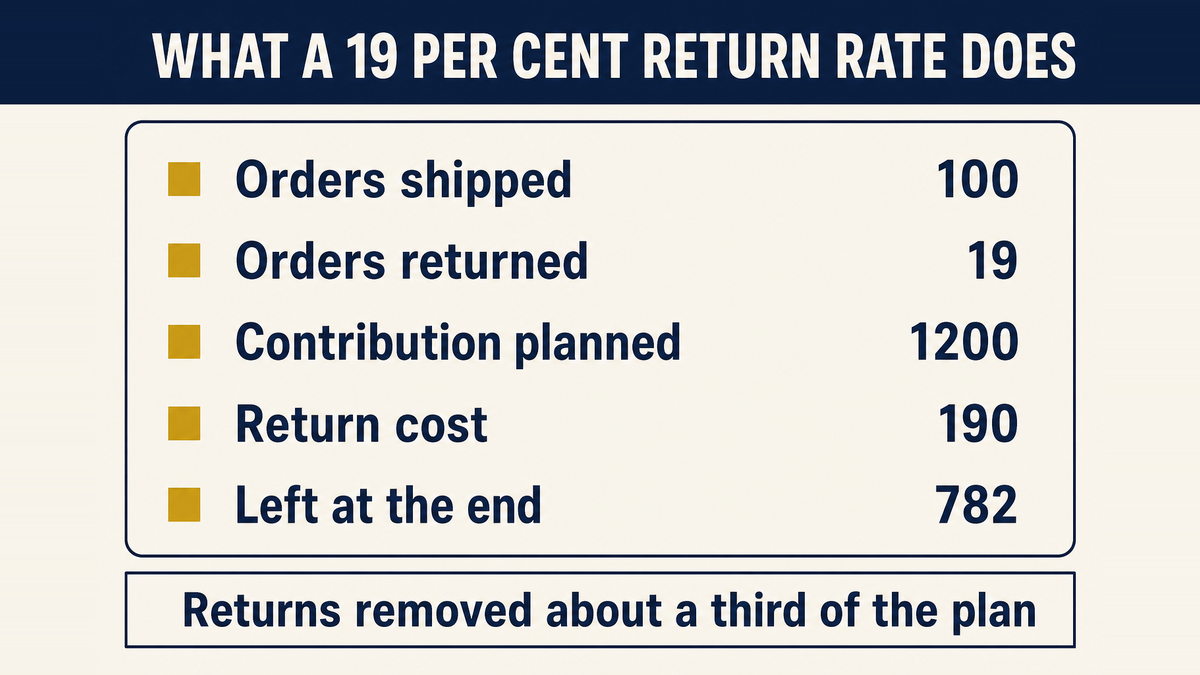
Do not set a target return rate of zero, because you will not hold it and you will not be able to see what is normal. Set the rate you expect, watch the gap between it and the rate you get, and treat a widening gap as the signal that something in the product or the description has changed.
Measuring your own rate is simpler than it sounds. Count the orders that came back in a period, divide by the orders shipped in the same period, and keep the two figures side by side so you can see which one moved. A rate that jumps in a single week is noise. A rate that has drifted up over three months is a specification that changed, and reading the reasons on the returned orders is usually enough to say which one it was.
2. Why Do a Return, a Refund and a Chargeback Differ?
Because the three events move different things, and only one of them is under your control. Keeping them separate in your accounts is what makes the numbers actionable.
A return is physical. Goods come back, and the cost is the freight to bring them, the handling to receive and check them, and whatever value they lose in the process. A used item that cannot be sold again has lost its whole value, not part of it. This is the event your published policy governs, and it is the only one of the three where you set the terms.
A refund is financial. The money goes back and the goods may or may not follow. The price is the obvious part; the less obvious part is that the payment fee charged when the order was placed is generally not handed back when you refund, so you pay to process a sale you never kept. Refunding without asking for the item is a legitimate choice, and for cheap items it is often the cheapest one available, which is the subject of the next section.
A chargeback is a dispute. The customer goes to their bank rather than to you, the bank decides, and the money is taken from your account while the decision is pending. It carries a separate dispute fee, it usually costs you the goods as well, and unlike the first two events it is not something your policy can prevent. The practical defence is the documentation you kept at the time: a delivery confirmation, a description that matched what was sent, and a record of any communication.
Documentation is the part of chargeback handling that is decided long before any dispute is raised. A delivery confirmation, a listing that described the item accurately, and a record of anything the buyer wrote are what the bank will look at, and none of them can be produced after the event. Keeping them is a habit rather than a policy, and it costs nothing while it is being kept.
3. When Is Refunding Without a Return Cheaper?
Whenever the cost of bringing the item back is higher than what you could recover from it. That is the whole rule, and it turns on two numbers rather than on how generous you feel.
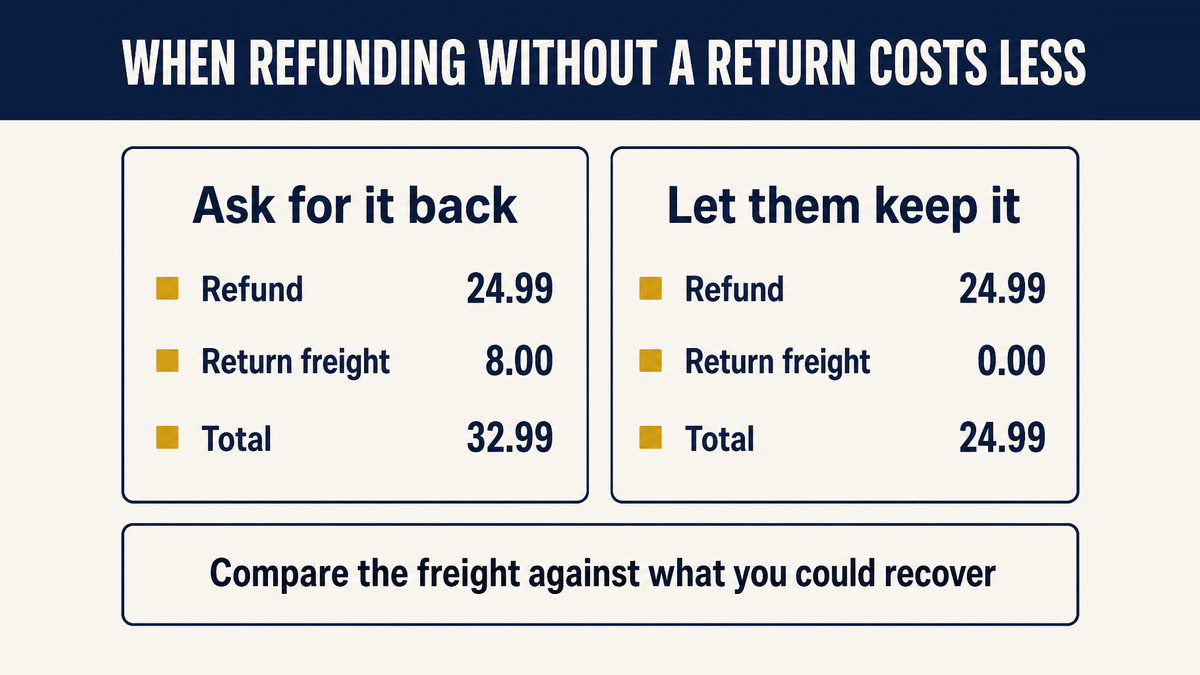
Take an item selling at $24.99 that costs $6.00 to buy, where the customer would send it back at a freight cost of $8.00 that you cover, and where an opened unit cannot be resold. The return path costs the refund of $24.99 plus $8.00 of freight, with nothing recovered, so $32.99. The returnless path costs the refund alone, so $24.99. Asking for the parcel back makes the event eight dollars more expensive for no benefit, because the unit that arrives is worth nothing.
Now suppose the same item could be resold once checked, with a net recovered value of $6.00 after cleaning and relisting. The return path is then $24.99 plus $8.00 less $6.00, or $26.99, against $24.99 for the returnless refund. Asking for it back is still the more expensive choice by two dollars, because the freight is larger than the value recovered.
That comparison is the decision rule. Freight against recovery. On cheap goods, and on anything that cannot be resold once opened, the freight almost always wins, and a store that insists on the parcel back is paying to make its own return rate worse.
Set the line in advance rather than deciding each time. A rule as simple as refunding without a return on any item whose cost falls below the return freight takes the emotion out of the decision and removes the handling work as well. On higher-value items the return is usually worth having, and that is where the condition of the goods and the inspection record start to matter, which is what our guides to sorting defects by severity and to rework and compensation after a failed inspection are for.
4. Which Causes Can You Actually Cut?
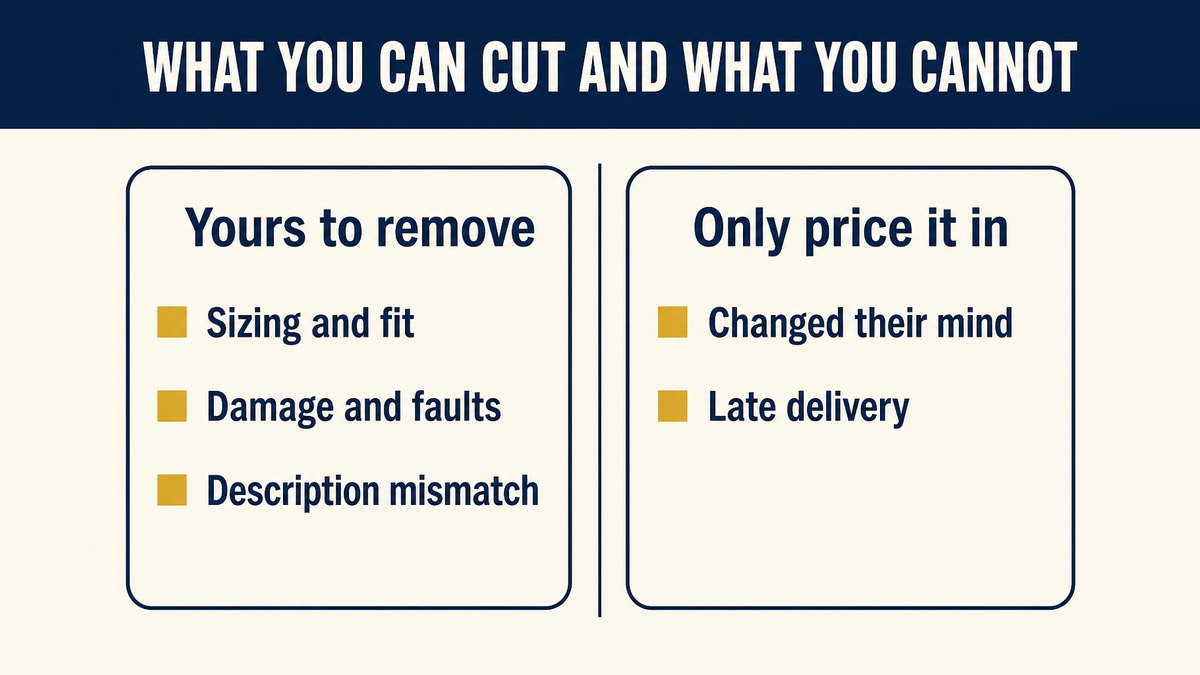
Sort the reasons customers send things back into the ones the product decides and the ones the customer decides. The first group is yours to remove; the second can only be priced in.
| Cause | Can you cut it? | Where the fix sits |
|---|---|---|
| The size did not fit | Yes, almost entirely | Measure the sample and write the guide from those numbers, as our size conversion guide sets out. |
| The item arrived damaged | Yes, mostly | Packaging and handling. Our guides to drop testing a carton and to checking a batch before it ships cover the two levers. |
| It was faulty out of the box | Yes, mostly | The batch you buy. Checking every piece costs more and removes far more of this. |
| The description did not match | Yes | Your listing and the specification you ordered. The two should describe the same object. |
| It arrived later than promised | Partly | The route and the cut-off time. This one is a delivery promise problem rather than a product problem. |
| The customer changed their mind | No | Nothing. It can only be planned for, and the returnless refund question above is how. |
The useful conclusion is that most of a dropshipping return rate is a sourcing problem wearing a customer service costume. Sizing is a measurement question, damage is a packaging question, and faults are a batch question. None of them is fixed by writing a better reply, and all of them are cheaper to fix before the parcel leaves than after it comes back.
The unfixable half is a cost rather than a failure, and the honest way to handle it is to put it into the price. A store that budgets for the industry rate and charges for it is not losing to returns; it is selling at a price that already includes them. A store that assumes none and meets them later has priced every item too low, and it usually finds that out during its busiest month rather than its quietest.
5. What Must You Do When the Parcel Never Arrives?
The opposite case has its own rule, and it is worth knowing because in a per-order model a parcel that does not arrive is far more common than one that comes back. When a seller cannot ship within the time the rule allows, the choice stops being theirs.
Where a seller is unable to ship merchandise within the applicable time set forth in paragraph (a)(1) of this section, to fail to offer to the buyer, clearly and conspicuously and without prior demand, an option either to consent to a delay in shipping or to cancel the buyer`s order and receive a prompt refund.
16 CFR 435.2(b)(1), Mail, Internet, or Telephone Order Merchandise Rule
Two lessons sit inside that sentence. The first is that the offer has to be made without the buyer asking for it, which means a store that waits for the complaint has already missed the point. The second is that this duty does not come from your returns policy, so a policy that says something different does not replace it.
This is the distinction worth holding on to throughout the category. Your returns policy is a set of terms you choose, and it governs goods that arrived and that the customer no longer wants. The shipping rule is a duty you carry, and it governs goods that have not arrived at all. They cover different situations, and the second one cannot be opted out of by the first.
Watch the promise you make at checkout more closely than the policy you write afterwards. A delivery window that the route cannot keep turns a normal order into the case this rule covers, and it does so at the point of sale rather than at the point of complaint. If you are ordering per parcel from China, our guide to moving to stock held closer to the customer covers what changes when the transit time stops being the variable you cannot control.
There is also a commercial reason to act before the deadline rather than at it. A buyer who is told the parcel is late, given a new date and offered the choice to cancel will often stay. A buyer who hears nothing, and then works out that the parcel is lost, will dispute the payment instead. The second path costs the dispute fee, whatever happens to the goods afterwards, and the customer.
6. Frequently Asked Questions
What is a normal return rate for an online store?
The industry figure to plan around is 19.3% of online sales, from the 2025 returns research published by the National Retail Federation with Happy Returns. That is the share of online sales expected to be returned, so it is a starting point rather than a target.
Is a refund the same as a return?
No, and the difference matters because the costs are not the same. A return means the goods come back and you may recover part of their value. A refund means the money goes back whether or not the goods do, and a chargeback is a dispute raised with the bank rather than a request made to you.
When is it cheaper to refund without asking for the item back?
When the cost of sending it back is higher than what you could recover from it. For a cheap item, or one that cannot be resold once opened, the recoverable value is close to nothing, so paying the return freight is a straight loss on top of the refund.
Do I have to refund an order that never arrived?
Yes. Under the rule covering mail, internet and telephone orders, a seller who cannot ship within the applicable time must offer the buyer the choice of agreeing to a delay or cancelling and receiving a prompt refund. That duty comes from the rule rather than from your own returns policy.
Which returns can I actually prevent?
The ones caused by the product or the description. Sizing that is measured rather than copied, a specification that is written down, and an inspection before the batch ships remove most fit and fault returns. Returns caused by a customer changing their mind cannot be removed, only priced in.
Which Returns You Can Cut, and Which You Cannot
We return the causes split into fixable and structural, the cost of refunding without a return, and the chargeback handling path.
Split My Causes
Questions & Comments
We read every one and reply within 24 hoursNot sure whether to ask for a parcel back, working out what your return rate is actually costing, or hitting a run of the same complaint? Post the item, the selling price, the return freight and the reason it came back, and our team will help you work out whether the fix belongs in the order or in the policy.