
Facebook Ads for Dropshipping: Why Spend Cannot Outrun Fulfillment
 ·
Updated October 14, 2026
·
15 min read
Advertising advice for a dropshipping store usually arrives as a budget question: how much should you spend testing, when do you raise the budget, how do you find the winning creative. The part that decides the outcome is not in that list. Two numbers sit under every ad, which is what one order costs to obtain and what one order leaves behind after everything is paid, and when the second is smaller than the first, increasing spend does not grow a business, it multiplies the same loss more quickly. There is a second ceiling too, and it is written in regulation rather than in a dashboard: an ad makes a shipping promise, and a promise has a deadline attached to it whether or not the seller ever wrote one down. This guide takes both, in order.

1. The Deadlock: What an Order Costs Against What It Leaves
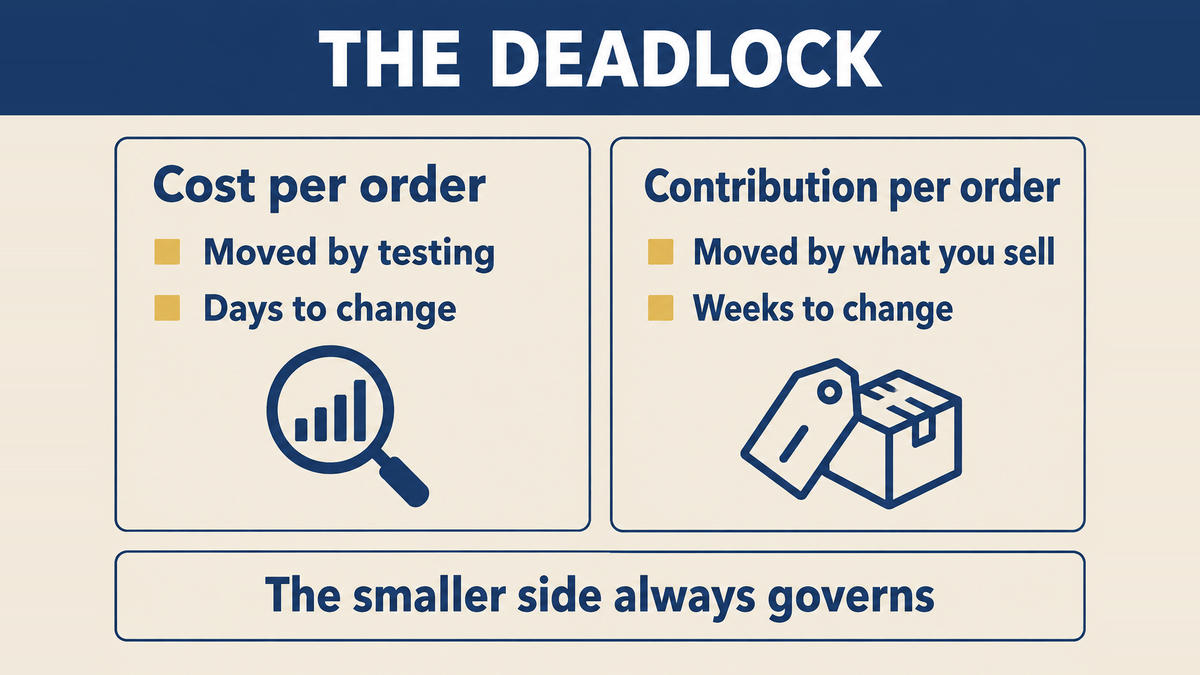
Advertising is described in the language of traffic, audiences and creative, and it settles in the language of two figures. The first is the cost of acquiring one order, which is the amount spent divided by the number of orders that came from it. The second is what one order contributes, which is the sale price minus the product cost, the shipping, the fees charged on the payment, and an allowance for the share of orders that come back. Both numbers are ordinary and neither is hidden. The difficulty is that they are usually calculated in different places, by different tools, and never placed on the same line.
Placed on the same line, they form a deadlock that no amount of testing resolves. When the contribution per order is below the cost of acquiring one, every additional order removes money, and the arithmetic is not subtle about it: twice the spend produces twice the shortfall. This is why two sellers can run identical campaigns with the same creative, the same audience and the same product, and report opposite results. The difference is not the campaign. It is that one of them was contributing more per order than the ad cost, and the other was not, and no optimisation inside the ad account can move that relationship.
The instinct under pressure is to treat the acquisition cost as the problem, because it is the number the ads interface shows and therefore the number that feels controllable. It can be improved, and it is rarely improved enough to close a gap that comes from the other side. A store selling a low-priced item with a thin margin can spend months testing creative and arrive at the same conclusion a calculation would have produced in twenty minutes.
Two lines inside the contribution figure deserve naming because they are the ones omitted in a hurry. The first is the fee charged on the payment, which is a percentage of the sale plus a fixed amount, so on a small order the fixed part is a larger share of the price than the percentage is. The second is the allowance for orders that come back, which is not the refund itself but the whole cost of the round trip: the goods out, the goods back, the replacement out, and the time spent on the conversation. A contribution calculated from the sale price and the product cost alone will always be higher than the real one, and it is the difference that decides whether an ad cost looks affordable or ruinous. The return side is set out in what a return actually costs.
| Number | What moves it | How fast it can move |
|---|---|---|
| Cost per order | Creative, audience, offer, season | Days, by testing |
| Contribution per order | Price, product cost, freight, fees, returns | Weeks, by changing what you sell |
What this guide covers
- The deadlock: what an order costs against what it leaves
- Your ad writes a deadline you may not have noticed
- What a late order obliges you to do
- Why scaling multiplies whichever sign you started with
- Where the ceiling actually sits
- The order of operations for a store that wants to scale
- Frequently asked questions
2. Your Ad Writes a Deadline You May Not Have Noticed
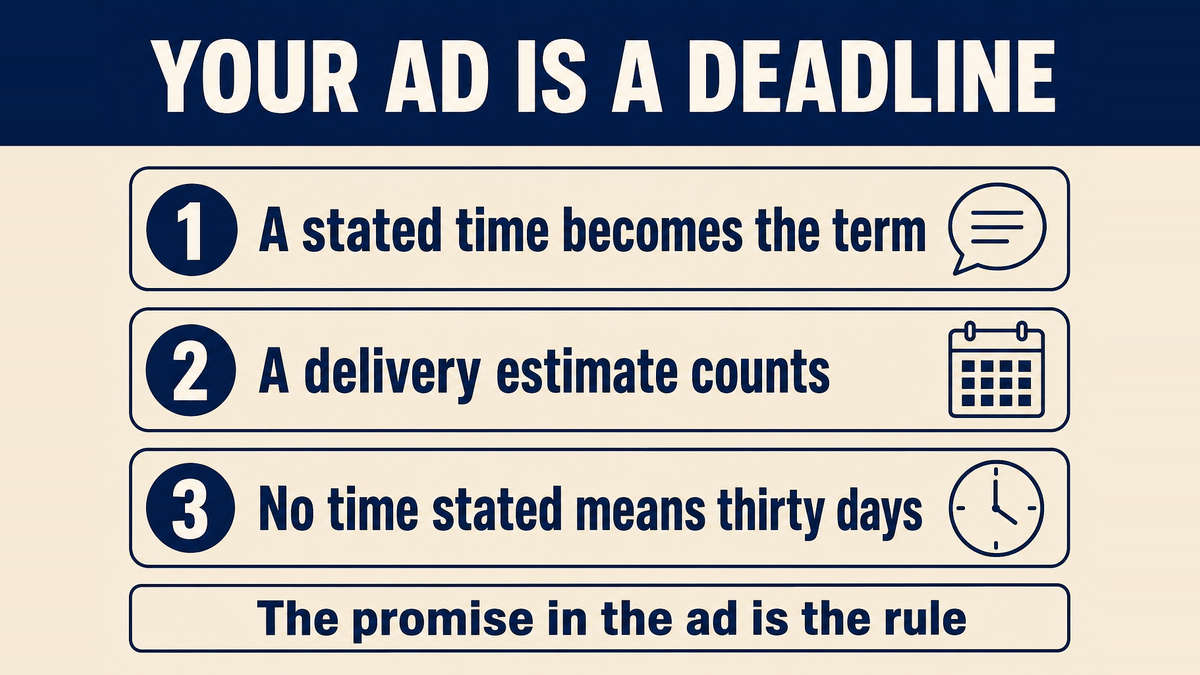
The second ceiling is not in the ad account, and it is the reason a campaign that is working can still be the wrong decision. Advertising produces orders, and orders carry a promise about when they will be sent. That promise is not only a marketing question. It is a term with a fixed meaning and a fixed consequence, and the rule that sets it describes both the statement and the default when no statement was made.
…the seller must be able to ship any ordered merchandise to the buyer: (i) Within that time clearly and conspicuously stated in any such solicitation; or (ii) If no time is clearly and conspicuously stated, within thirty (30) days after receipt of a properly completed order from the buyer.
Federal Trade Commission, 16 CFR 435.2, Mail, Internet, or Telephone Order Merchandise Rule (read 14 October 2026)
Read the two limbs together and the arrangement is clear. A stated time becomes the obligation, and the statement does not have to be a formal shipping policy to count. A line on a product page, a note in the checkout, a claim in the ad itself and a delivery estimate shown by a platform all say something about when the goods go out, and what is said becomes the term. Where nothing is said, the rule supplies a figure instead of leaving a gap: thirty days after a properly completed order, with a longer period available where the buyer has applied to the seller for credit.
This is what makes advertising decisions and fulfilment decisions into a single decision. Increasing spend increases the number of orders arriving per day, and it does nothing to the deadline, which is a date rather than a volume. A store that can dispatch fifty orders a day and advertises until it receives two hundred has not scaled a business, it has scheduled a hundred and fifty late orders, and the lateness is measured against a term the store itself published or the rule supplied.
The routes available for goods also enter here, because they set the earliest date a promise can honestly name. An air option and a sea option differ by weeks, and a seller who has quietly moved to a slower route while keeping the same delivery estimate is relying on a term that no longer describes what happens. The comparison is set out in how the two main freight modes differ, and the question of whether goods are held at all is the subject of what holding stock actually requires.
3. What a Late Order Obliges You to Do
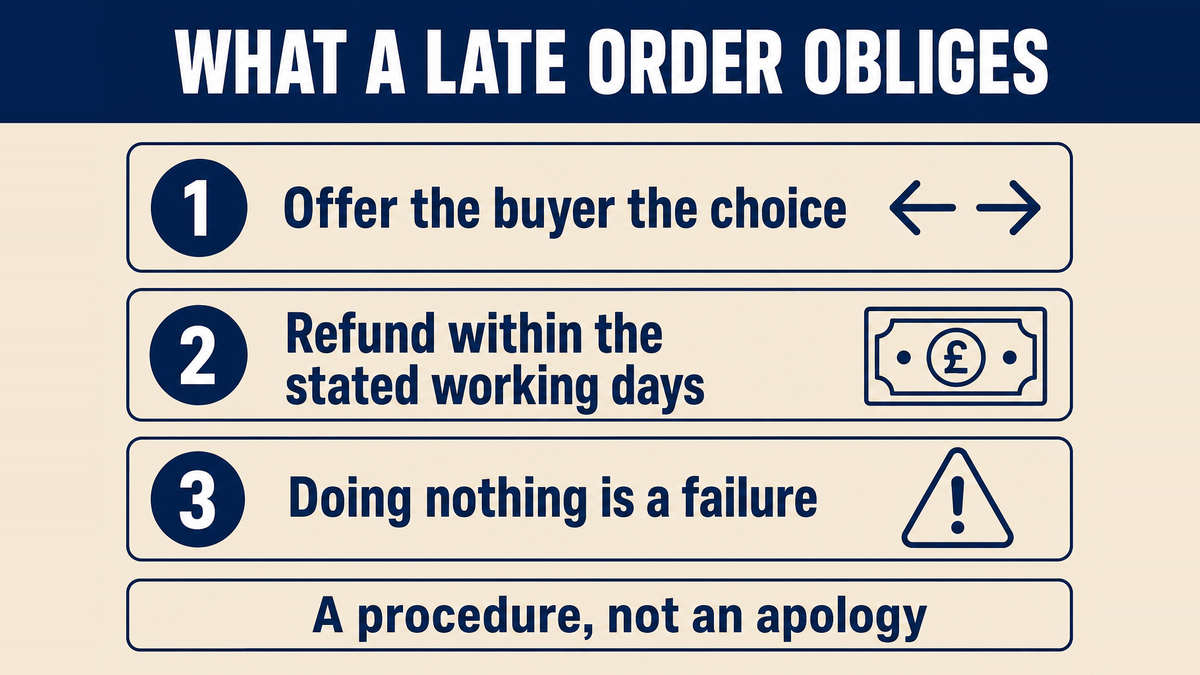
The rule does not stop at setting a date. It also describes the procedure for missing one, and this is the part that turns a fulfilment backlog into an administrative task rather than something to apologise for later. Where the seller cannot ship within the stated time, the rule provides for the buyer to be offered the choice, and for a refund where that choice is taken.
…a refund sent by any means at least as fast and reliable as first class mail within seven (7) working days of the date on which the buyer's right to refund vests under the provisions of this part.
Federal Trade Commission, 16 CFR 435.1, definition of prompt refund (read 14 October 2026)
Two details inside that definition change how a delay is handled in practice. The first is that a refund has a deadline of its own, expressed in working days from the moment the buyer becomes entitled to it, so the clock does not wait for the seller to finish investigating. The second is that the rule treats doing nothing as a failure in its own right rather than a neutral outcome, which means a backlog left to resolve itself is not a slower path to the same place. A seller who has no procedure for delays does not have a delay problem; they have a standing problem that only becomes visible when a buyer complains.
There is an enforcement dimension as well, and it is worth knowing that a rule of this kind is not advisory. The statute that provides for civil actions for violations of rules sets out that where a party has engaged in an unfair or misleading act or practice in violation of the relevant section, the Commission may bring a civil action for relief in a United States district court, which is the mechanism by which a consumer redress claim reaches a seller rather than staying inside a customer service queue.
The practical conclusion is that the delay procedure belongs to the setup, not to the recovery. It needs to exist before the first campaign, because the moment it is needed is the moment there is least time to invent it. What the buyer is told, and when, is the same subject as how to handle a complaint directly, and the arithmetic of putting a delayed order right is covered in what a return actually costs.
4. Why Scaling Multiplies Whichever Sign You Started With
Scaling is multiplication, and multiplication does not change a sign. If an order contributes more than it costs to obtain, more orders produce more of that difference, and the decision is easy. If an order contributes less, more orders produce more of the shortfall, and increasing the budget is a decision to lose money at a faster rate rather than a decision to grow. The same button produces both outcomes, which is why the advice to keep testing has no fixed answer attached to it.
The delay penalty is the term that usually gets left out, and it is the one that grows faster than the other two. At low volume, a supplier's dispatch time absorbs your orders comfortably and no delay appears at all, so the test period shows a clean result. At higher volume the same supplier reaches its own limit, orders begin to slip past the published term, and each slipped order adds a refund, a replacement, the freight in both directions and an administrative cost that no earlier calculation contained. That is the point at which a test that looked successful turns into a business that is losing more the harder it pushes.
This is the argument for treating the fulfilment ceiling as part of the test rather than as something to be discovered after it. The question worth answering before a budget is raised is not whether the ad converts at a small spend, but what volume the supply side can dispatch while remaining inside the term the store publishes. Where those two figures are far apart, the campaign is ahead of the business, and the gap will be paid for in refunds rather than in media cost.
The figure the ad account reports is also not the figure that matters, which adds to the confusion. A platform attributes an order to a click or a view under its own rules, so some orders the store receives are credited to no campaign at all, and others are credited on the basis of a view that happened days earlier. The reported cost per order is therefore an estimate with a direction, and on a store with repeat buyers it tends to look better than reality, because those orders would have arrived without the campaign. Reconciling the platform's number against the store's own order total is the step that turns an estimate into a figure a budget can be set against.
It also follows that the useful place to spend effort first is the contribution side, because that is where the relationship is decided. Raising the price, changing to a product with a better cost, moving to a lighter or smaller unit that costs less to send, and reducing the share of orders that come back all move the number that has to exceed the ad cost. None of those is an advertising task, and all of them are the reason some stores can afford to bid where others cannot. The way that number is built is set out in how a margin is actually built, and the full cost from quoted price to delivered order is assembled in how a landed cost is put together.
5. Where the Ceiling Actually Sits
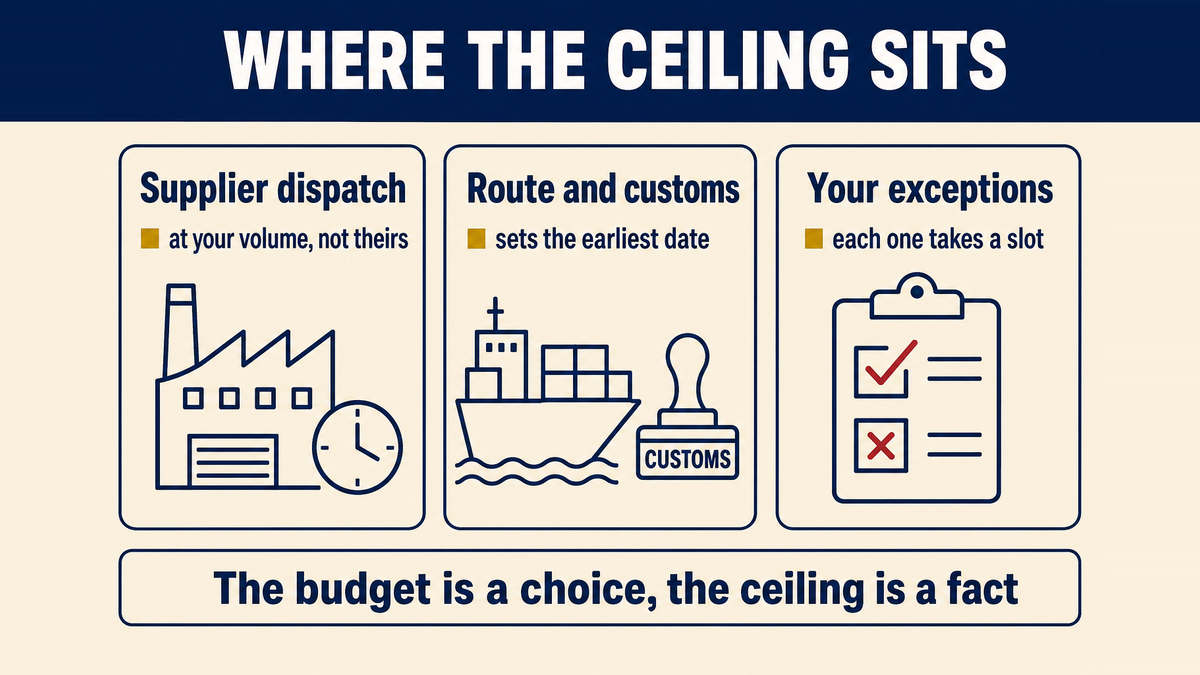
The ceiling is not the daily budget in the ad account, because a budget is a limit on what you choose to spend rather than on what you are able to deliver. It is the number of orders per day that can be dispatched while staying inside the term the store publishes, with the exceptions included. That figure is usually lower than sellers expect, and it sits in three places that a dashboard does not show.
The first is the supplier's dispatch time at your volume rather than at their brochure figure. A factory that ships a sample in two days and a hundred units in a week is not being dishonest; lead time is a function of volume, and the number that matters is the one that applies at the size of order you will now be placing. Asking for that figure directly, and asking what it becomes at several times the current quantity, is the cheapest research available and the one most often skipped.
The second is the route, which puts a floor under the earliest honest delivery estimate. A fast option and a slow option differ by weeks, and customs handling adds its own variable that cannot be estimated away. The third is your own handling of exceptions, which is the part sellers control and the part that quietly consumes capacity: an address that needs correcting, a payment that needs review, a unit that has to be replaced before it ships. Every exception takes a slot that a normal order would have used, so the real daily capacity is the headline figure reduced by the exception rate.
The reason to establish this before raising a budget is that the two limits are not comparable in cost. Discovering a media limit costs money and can be corrected inside a week. Discovering a fulfilment limit costs refunds, replacements and the fulfilment of promises made to people who have already paid, and it damages the account's own record in a way that a paused campaign does not. Testing the ceiling first is therefore the cheaper order, not the more cautious one.
6. The Order of Operations for a Store That Wants to Scale
The sequence below is not the one most sellers follow, and the difference is that four of its five steps involve no spending at all. Doing them in this order means the campaign is only ever asked a question the business is able to answer, which is the whole practical content of this page.
| Step | What it produces | What it costs |
|---|---|---|
| Work out the contribution | What one order leaves after cost, freight, fees and returns | An hour |
| Set the ad ceiling | The highest cost per order that still leaves something | Nothing |
| Test against the ceiling | Evidence on whether the ad can reach it | The test budget |
| Establish the dispatch limit | The volume that stays inside the published term | A few messages |
| Write the delay procedure | What a buyer is offered and when | One page |
The order matters because of what happens when a step is skipped rather than because the steps are difficult. A store that tests an ad before working out its contribution learns whether the ad can hit a number it has not defined, and interprets the result against a feeling about what is normal. A store that raises a budget before establishing its dispatch limit converts a working campaign into a queue of late orders, and the cost of that mistake appears as refunds, disputes and a damaged record rather than as a line in the ad account.
When the two ceilings conflict, the honest answers sit on the fulfilment side and they cost money rather than testing time. Goods can be held closer to the buyer, which turns a per-order dispatch time into a same-day one at the price of capital and storage risk. A second supplier can be added, which buys capacity and costs consistency, since two factories rarely make the same item identically. Or a slower promise can be published, which relieves the pressure by lowering what is offered rather than by raising what is possible. Each is a real answer, each belongs to a different budget from the advertising one, and that is the reason a campaign plan which does not name its capacity plan is only half a plan.
Read that way, the two ceilings stop looking like separate subjects. Advertising and fulfilment are one decision with two limits, and the smaller of the two always governs. A campaign is only as good as the orders arriving, and an order is only as good as the parcel that keeps the promise the ad made, which is why the useful question before any budget increase is not how well the ad is performing but how many more orders the business can take without breaking its own published word.
7. Frequently Asked Questions
How much should I spend testing Facebook ads for dropshipping?
Enough to learn whether the ad can reach the cost per order your margin allows, and no more. That ceiling is a calculated figure rather than a usual amount, so it should be worked out before the campaign exists. Once you know the highest cost per order that still leaves a contribution, the test has a pass or fail result instead of an impression.
Why does my campaign stop working when I increase the budget?
Sometimes the acquisition cost rises as spend rises, and sometimes the fulfilment side reaches its limit and the delays begin. In the second case the campaign has not failed; the business has run out of capacity, and the extra spend is producing orders that cannot be sent inside the term the store published. Splitting the two effects is the point of measuring contribution and dispatch capacity separately.
Is there a legal deadline for shipping an order?
Yes. The seller has to be able to ship within the time clearly and conspicuously stated in the offer, and where no time is stated the rule supplies thirty days after a properly completed order, with a longer period where the buyer has applied for credit. A delivery estimate in an ad or a product page counts as a stated time, so the promise in the marketing becomes the deadline in the rule.
What happens if I cannot ship in time?
The rule describes a procedure rather than leaving it to goodwill. The buyer is offered the choice, and where a refund is due it is to be sent within a defined number of working days from the point the entitlement arises, by a method at least as fast and reliable as first class mail. Failing to act is treated as a failure in itself, so a backlog left to resolve on its own is not a neutral waiting period.
Should I test more products or fix the margin?
Fix the margin first, because it sets what the advertising is allowed to cost. A product with a thin contribution can be tested indefinitely without producing a workable campaign, since the constraint is the relationship between contribution and acquisition cost rather than the creative. Raising the price, lowering the landed cost or cutting the return rate moves the number that everything else depends on.
A Memo on What Fulfilment Can Absorb
Orders per day, the crew behind them, and the day the queue breaks, written so a media buyer can read a ceiling off it.
Write My Capacity Memo
Questions & Comments
We read every one and reply within 24 hoursTrying to work out what one order actually leaves you before the ad cost, unsure how much volume your supply side can dispatch inside the delivery estimate you publish, or dealing with a backlog that arrived faster than your capacity? Send us the product, the destination and your current daily order count, and our team will help you find both limits.