
Dropshipping Customer Service: The Duty to Tell Them First
 ·
Updated October 13, 2026
·
15 min read
Most advice about customer service in this business is about tone. Be fast, be warm, be human, use templates. All of that is fine and none of it is the problem. The problem is that you are being asked questions you cannot answer, about goods you never held, on a shipment whose pace somebody else sets. Service here is an information problem wearing a language problem's clothes. And there is a duty attached to it that most sellers find out about only when it is too late to comply.

What You Can and Cannot Answer
| The question | Why it is hard here |
|---|---|
| Where is my order? | You may not have the tracking number at the moment you are asked. |
| When will it arrive? | The date is set by a supplier who is not obliged to your customer. |
| Can I cancel? | You may already have paid for goods that are in transit. |
| Why did you not tell me? | This is the one with a rule attached, and it is an obligation to act first. |
What this guide covers
- Why this is an information problem, not a script problem
- The duty you have before the customer asks
- The records you are expected to hold
- Why the supplier's turnaround becomes your slowness
- What actually reduces the number of messages
- What to put in place before the first order
- Frequently asked questions
1. Why Is This an Information Problem?
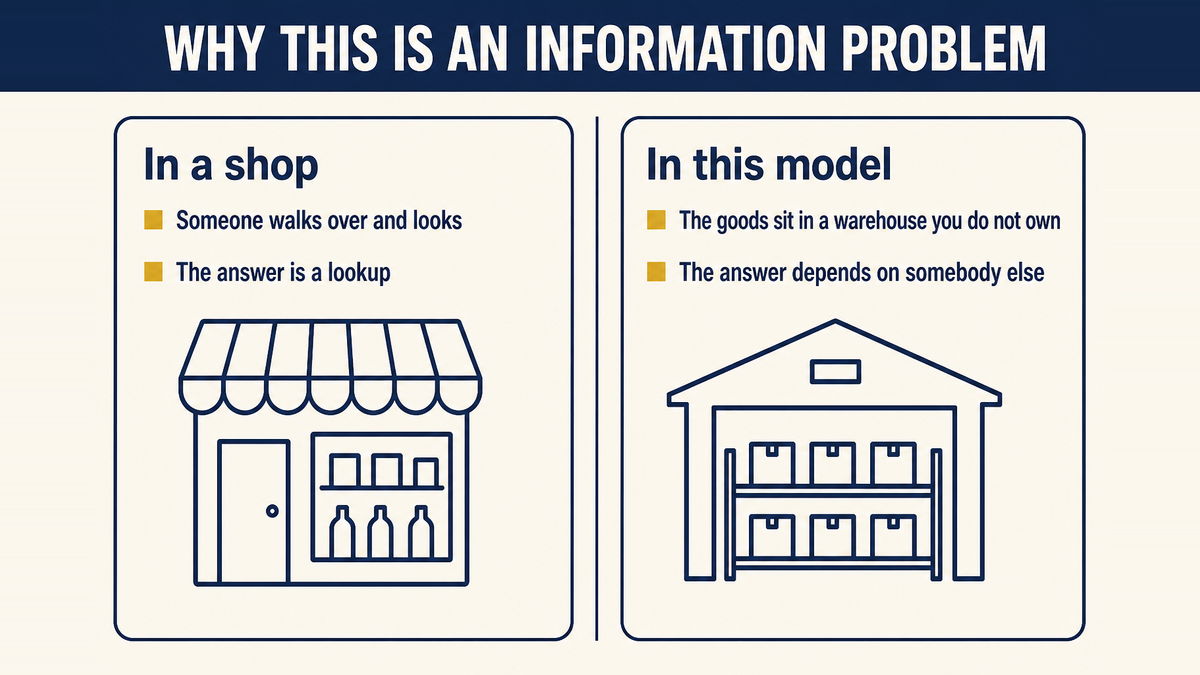
In a shop, the person answering the message can stand up and look at the shelf. They may not want to, but the ability exists, and it turns almost every question into a lookup. In this model nothing can be looked at. The goods are in a warehouse you do not own, the parcel is with a carrier you did not choose, and the answer depends on a production schedule you do not control.
That difference has a practical consequence. In a shop, the cost of a vague answer is a slightly annoyed customer. Here, a vague answer is the only honest answer available, which means the customer keeps asking, and the contact turns into a conversation rather than a resolution. Most of the frustration people describe about dropshipping service is this loop, not the language used inside it.
So the work that improves service is not writing better replies. It is arranging, in advance, to have something to say. That means knowing which supplier holds which order, having tracking that reaches you rather than only the buyer, and having decided what you will do when the answer is bad.
2. What Duty Do You Have Before the Customer Asks?
This is the part that surprises people, because it is not a service standard you choose. It is a legal duty to raise the problem yourself, and it starts running at the moment you realise you cannot meet the time you advertised.
Where a seller is unable to ship merchandise within the applicable time set forth in paragraph (a)(1) of this section, to fail to offer to the buyer, clearly and conspicuously and without prior demand, an option either to consent to a delay in shipping or to cancel the buyer's order and receive a prompt refund. Said offer shall be made within a reasonable time after the seller first becomes aware of its inability to ship within the applicable time set forth in paragraph (a)(1) of this section, but in no event later than said applicable time.
16 CFR 435.2(b)(1), Mail, Internet, or telephone order sales
Read the four conditions inside that sentence, because each one removes a defence. The offer must be made to the buyer, so silence does not meet the requirement. It must be clear and conspicuous, so a note buried in a footer does not count. It must be made without prior demand, which means you cannot wait to be asked. And it must be made no later than the time you had advertised, which means the deadline for telling the customer is the same as the deadline for shipping.
The two options you have to offer are also fixed. The buyer either consents to a delay or cancels and receives a prompt refund. You do not get to offer a discount instead, or an apology and a new estimate, unless the customer agrees to take that in place of the choice you were required to give. The same paragraph details what the offer must contain, including a definite revised shipping date where you have a reasonable basis for one, and an honest statement that you cannot estimate the delay where you do not.
Notice what this means for the ordering of your work. The notification is not part of the conversation that follows a complaint. It has to happen before the complaint exists, which in practice means somebody needs to be watching the shipment timeline rather than the inbox.
The reason this catches small sellers is timing rather than intent. Nobody minds warning a customer; the failure is that the alert depends on noticing. If your only source of order status is the customer's own message, you will always learn about the delay after they do, which is precisely the situation the rule addresses. Our guide to keeping order status flowing between your store and the warehouse is the practical fix, and our notes on how late-production penalties and tracking are handled with a Chinese factory cover the supplier side of the same timeline.
3. What Records Are You Expected to Hold?
The second obligation is less visible and more uncomfortable, because it is about being able to prove something after the fact. It appears in the same section, and it is written about evidence rather than about behaviour.
In any action brought by the Federal Trade Commission, alleging a violation of this part, the failure of a respondent-seller to have records or other documentary proof establishing its use of systems and procedures which assure the shipment of merchandise in the ordinary course of business within any applicable time set forth in this part will create a rebuttable presumption that the seller lacked a reasonable basis for any expectation of shipment within said applicable time.
16 CFR 435.2(a)(4), same section
Plainly: if you cannot produce records showing that you had systems able to ship on time in the ordinary course, you are presumed to have had no reasonable basis for the delivery expectation you published. The burden shifts before anyone examines whether you were actually late.
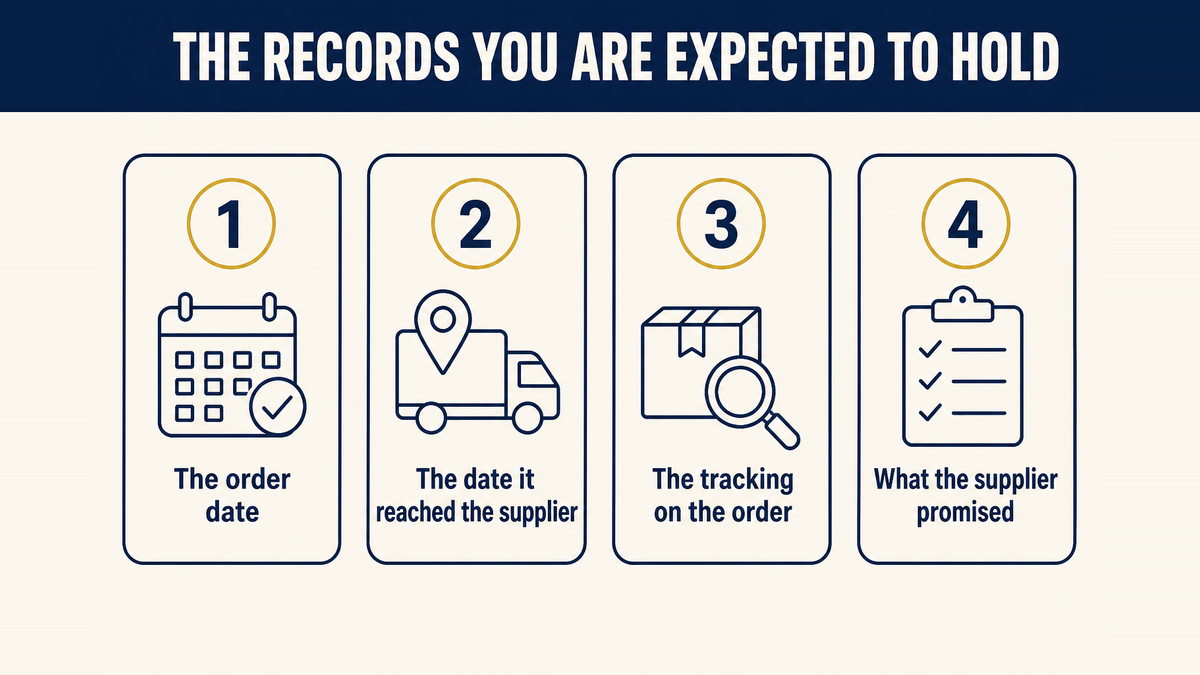
For a seller holding no stock, the honest reading is that the records are the process. A date on which the order was placed, a date on which it reached the supplier, a tracking number attached to the order rather than sitting in a supplier's message thread, and a record of what the supplier promised at the time of ordering. None of that is sophisticated. It is the evidence that you were running something rather than hoping.
Two habits make this harder than it needs to be. The first is keeping tracking information in the supplier's message thread rather than on the order, which means the evidence exists but is not retrievable when you need to answer a customer or a complaint. The second is a delivery window on the listing that nobody can support, because it turns every late parcel into a breach of a promise you chose rather than an ordinary delay. Our guide to how long a shipment from China realistically takes is the place to set that window from, and our notes on what common supplier promises really mean are worth reading before you write a number a customer will hold you to.
4. Why Does the Supplier's Turnaround Become Your Slowness?
Because the customer has one relationship, and it is with you. They paid you, they will ask you, and they will measure the answer from the moment they asked. Everything that happens between your reply and the supplier's reply is time the customer experiences as your inaction.
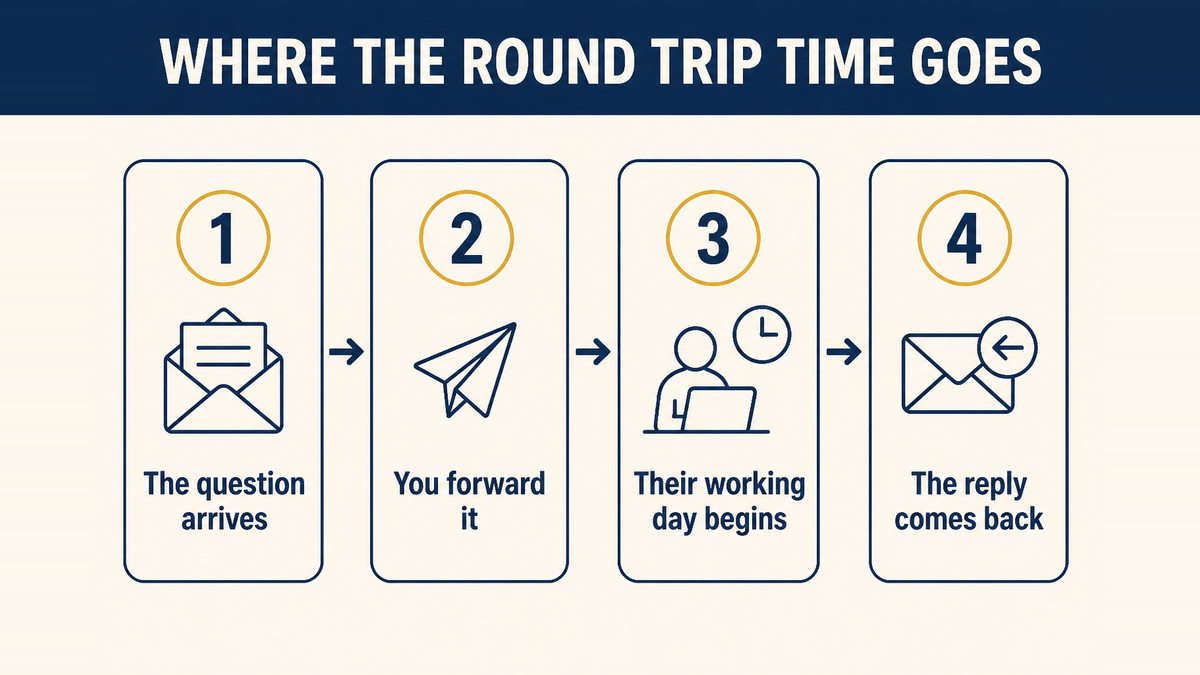
That round trip is the defining feature of service in this model, and it is worth being blunt about its shape. A question arrives. You do not know the answer. You send a message to a supplier in a different time zone and wait until their working day begins. They reply, possibly with a question of their own. You now have an answer, but the customer has been waiting through all of it, and the delay you spent was not spent on their problem. It was spent finding out what their problem was.
The financial version of this is a payment that can be reversed. Under the billing error rules, a charge for goods that were not delivered to the customer as agreed counts as a billing error, which means an unresolved delay can turn into the customer disputing the charge rather than continuing to wait. Our guide to rework, scrap and compensation after a failed shipment covers the supplier-side claim you are left with in that situation.
5. What Actually Reduces the Number of Messages?
Handling contacts well is the second-best outcome. The best one is not receiving them, and in this model the volume is driven by two things you control directly: how much information you publish before anyone asks, and how much of a gap there is between what you promised and what happens.
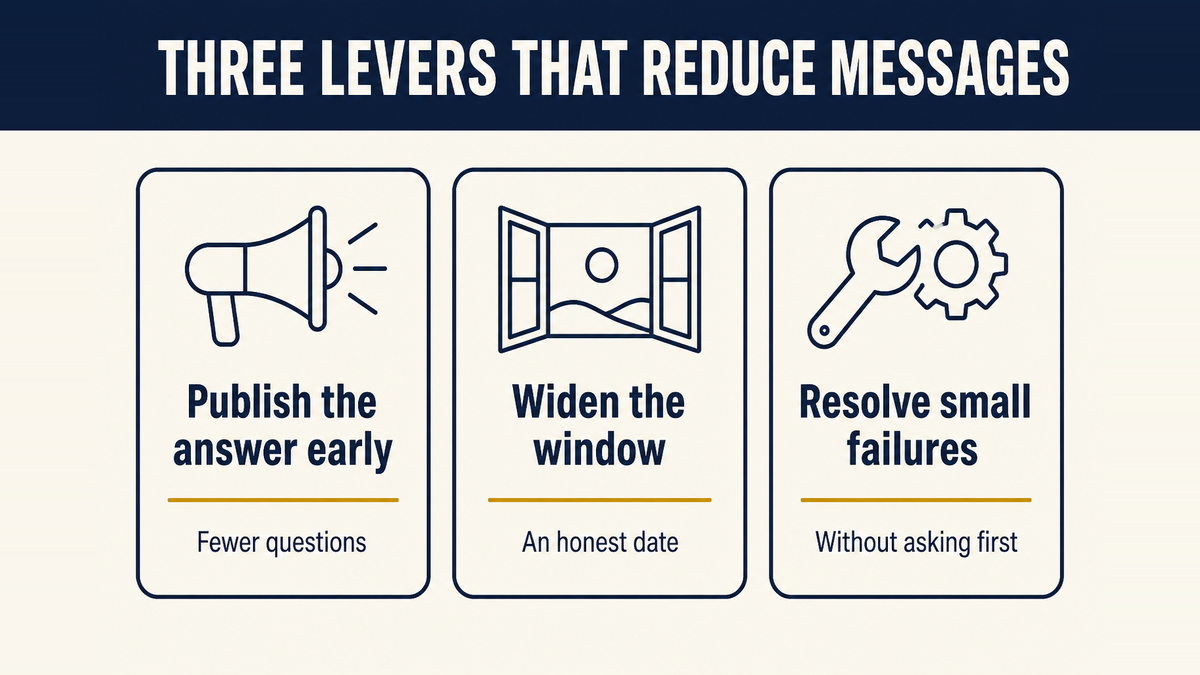
The cheapest contact is the one that never happens, and the way to prevent it is to answer the question at the moment it is formed rather than later. A tracking link sent when the parcel moves, a status line on the order page, and a delivery window that is honest all do the same job: they remove the need to ask. Sellers often treat these as nice-to-have features of a store theme. They are in fact the main lever available, because a customer who can see that the parcel is moving will wait, while a customer who cannot see anything will write to you.
The second lever is the size of the gap. Most messages of the where-is-my-order kind are not caused by a slow parcel. They are caused by a parcel moving at normal speed against a window that was set too optimistically at the listing stage. Widening that window by a few days reduces contacts without any change to your supply chain at all, and it is the single cheapest improvement available to a store that is drowning in status questions.
The third lever is deciding in advance which problems you will resolve without asking the supplier first. A missing tracking number or a small damaged item does not improve by being investigated. It improves by being replaced, and the cost of replacing it is usually lower than the cost of the days spent establishing who was at fault. Our guide to what an order really costs once it lands gives the figure to compare that decision against.
6. What Should You Put in Place Before the First Order?
Four things, none of which requires better writing. They are all about having something to say when a message arrives.
- A parcel status you can check yourself
- Tracking that reaches you, attached to the order, on the day the parcel moves rather than the day the customer complains. This is the single highest-value change and it makes the notification duty in section two achievable rather than theoretical.
- A delivery window you are willing to defend
- Set it from the slowest realistic transit rather than the fastest one you have seen. A longer honest window produces fewer contacts than a short one you keep missing.
- Decided answers for the three common failures
- Parcel late, item wrong, item damaged. Decide now whether you resolve each within a set value without consulting the supplier, because asking first costs days the customer spends waiting. Our guide to pre-shipment inspection is the piece that reduces how often the last two occur at all.
- A written brief for whoever answers
- If you outsource replies, the agent still cannot see the warehouse. Give them the status source, the windows, and the limits of what they may offer, or they will invent answers, and invented answers are worse than slow ones.
Two pieces to read alongside this one. Our guide to what a third-party warehouse charges to store, pick and send an order covers the arrangement that gives you a status you can actually check, and our notes on moving from per-order buying to holding stock cover what becomes possible once you can send a replacement yourself. If what you are really weighing is whether the supplier can be relied on at all, our guide to choosing a supplier you will not outgrow is the place to start.
7. Frequently Asked Questions
Why is customer service harder in dropshipping than in a normal store?
Because the bottleneck is information rather than scripts. In a normal store the person answering can walk over and look at the parcel. In this model you are answering questions about goods you do not hold, on a shipment you cannot inspect, using turnaround times somebody else controls.
Do I have to contact the customer if their order is going to be late?
Yes. Where you cannot ship within the applicable time, the rule requires you to offer the buyer the choice of consenting to a delay or cancelling for a prompt refund, clearly and without being asked, and within a reasonable time but no later than the applicable time itself.
What records should I keep for customer service?
Records that show you had systems capable of shipping on time. The rule says that in a Federal Trade Commission action, a seller who cannot produce records establishing such systems and procedures is presumed to have lacked a reasonable basis for expecting to ship on time. Order dates, tracking and supplier turnaround evidence are the practical version of that.
Can a customer get their money back if a parcel arrives late?
Yes. Under the billing error rules, a charge for property or services not delivered to the consumer as agreed counts as a billing error. That means the customer can dispute the charge after you have already paid your supplier, which is the outcome the notification duty exists to prevent.
Should I outsource customer service?
You can outsource the replies, but you cannot outsource the information. An agent answering for you is only as good as what they can look up, so the useful first step is a parcel status you can actually check and a delivery window you are willing to stand behind.
The Four Statements Sent Before Anyone Asks
We return the four pre-purchase statements, the record set worth keeping, and the wording that cuts where-is-my-order volume.
Draft My Disclosures
Questions & Comments
We read every one and reply within 24 hoursCan you tell a customer where their parcel is today, unsure how to word a delay notice, or wondering whether you would have the records to back up a delivery window you are advertising? Post your order flow, your tracking source and the window on your listing, and our team will help you find the gaps before a customer does.