
Dropshipping Trends 2026: Which Changes Actually Move Your Costs
 ·
Updated October 14, 2026
·
16 min read
Every January brings another list of dropshipping trends, and almost none of them change anything a seller can measure. A new platform feature, a new app, a new sales channel: these are additions, not shifts, and a seller who adopts them without changing a single cost has not caught a trend. A real trend does one of two things. It changes the structure of your costs, so the same order now costs a different amount. Or it changes the rules you trade under, so the same action is now allowed or forbidden. This guide separates the two for 2026, shows where each one is actually written down, and gives you a test you can apply to next year's list before you act on it.

1. Two Kinds of Change, and Only One of Them Moves Your Numbers
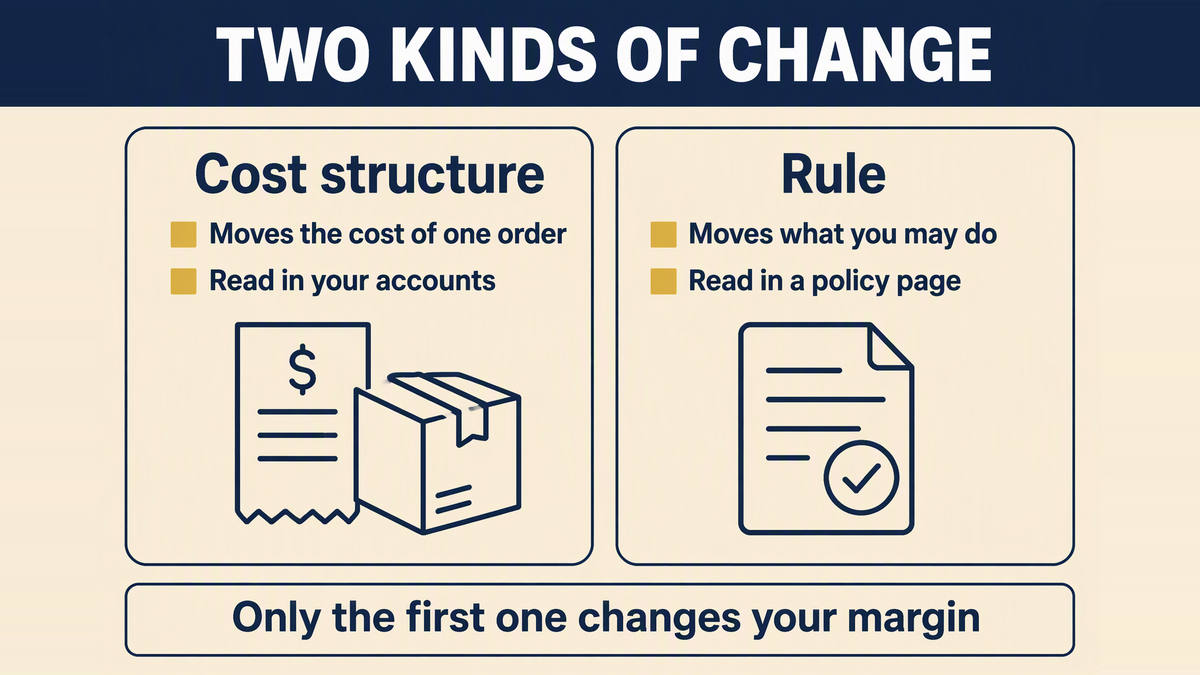
A cost-structure change alters the arithmetic of an order. What you pay per unit, per parcel, per payment, per returned item. Nothing about the product changes and nothing about the customer changes, but the gap between what you charge and what you keep is now a different number. These changes are usually quiet. They arrive as a line in a regulation or a fee schedule, they are read by almost nobody, and they show up in your accounts four weeks later.
A rule change alters the permission. What you may list, what you may claim, what a review may say, what a marketplace will tolerate. These changes are loud, because a platform announces them and a hundred articles summarise the announcement within a day. And they are invisible to you until something gets removed or fined, which is why they feel sudden even when the rule was published months earlier.
The confusion between the two is the reason so many trend articles are useless. A marketplace tightening how sellers describe a product is a rule change. A customs charge appearing on a parcel that used to clear free is a cost change. Reading them as one category leads sellers to spend a season reacting to announcements while the number that decides whether they make money moves unobserved. The table below is the distinction in its shortest form.
| Change | What it moves | Where it is written | How you notice |
|---|---|---|---|
| Cost structure | The cost of one order | Customs and transport rules, fee schedules | Your per-order cost changes without a price change |
| Rule | What you are allowed to do | Platform policies, federal rules | A listing, claim or review is no longer allowed |
What this guide covers
- Two kinds of change, and only one moves your numbers
- The cost-structure change: what happened to the parcel exemption
- What the postal exception still leaves open
- The rule change: what a review is allowed to say
- How to tell a real change from a loud one
- What this means for the products you sell
- Frequently asked questions
There is a third category that is not a trend at all, and it takes up most of the space in a typical list. A new tool, a new supplier, a new advertising format. These change what is available to you, never what your order costs or what you may lawfully do. They are worth knowing about and they are not worth reorganising a business around, because their effect on your margin is decided entirely by how you use them rather than by the announcement itself.
2. The Cost-Structure Change: What Happened to the Parcel Exemption
For a long time the small parcel was the quiet engine of direct shipping from China. A shipment of merchandise, imported by one person on one day, with a fair retail value not exceeding $800, could pass free of duty and tax. That number was the reason a single low-priced item could be posted to a customer in another country without a customs broker, an entry, or a duty line in the seller's accounts. The whole direct-ship model was built on top of it.
In 2026 the rule was changed in a way that matters to anyone shipping per order. The regulation no longer reads as a general exemption with an exception. It now reads the other way round. Paragraph (b) of 19 CFR 10.151 states it directly:
The exemption provided in paragraph (a) of this section is suspended for merchandise arriving via all modes other than through the international postal network until such time as CBP determines that the application of the exemption is no longer inconsistent with the purpose of 19 U.S.C. 1321(a), no longer jeopardizes the revenue, and no longer facilitates unlawful activity.
U.S. Customs and Border Protection, 19 CFR 10.151, Importations not over $800 (read 14 October 2026)
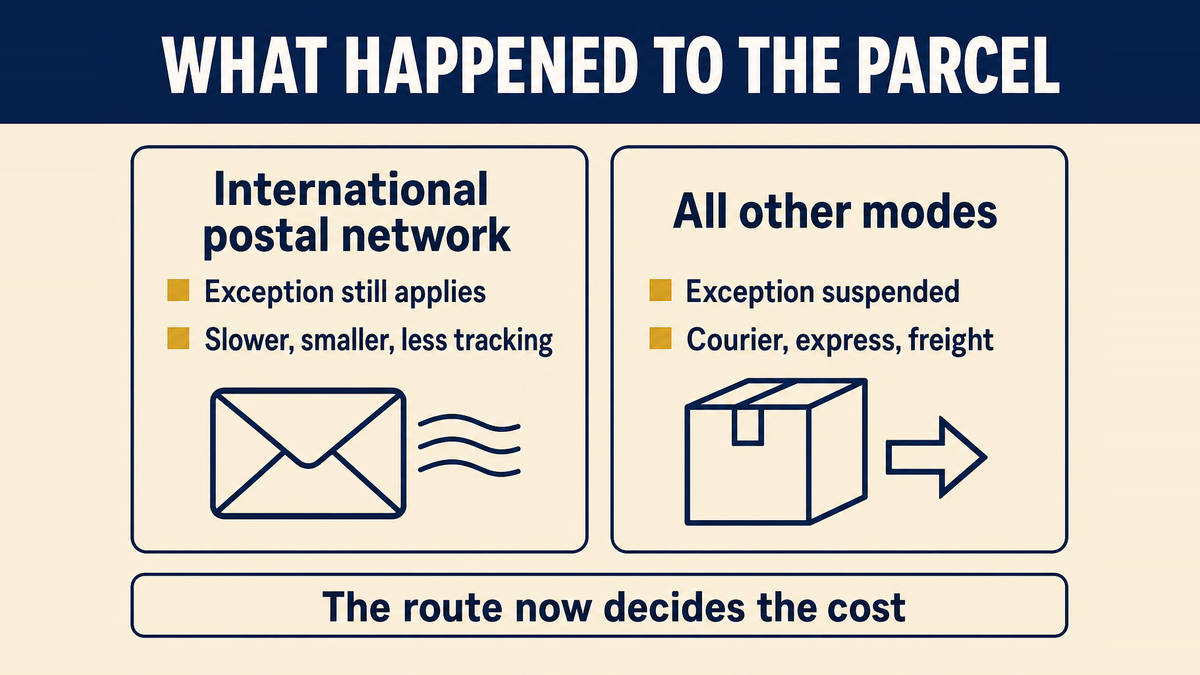
Read the paragraph again and the shape of the change becomes clear. It is not a lowering of the $800 figure. The figure is still there in paragraph (a). What changed is that the benefit no longer applies to the way most direct-ship parcels actually travel. A parcel sent by courier, by express consignment, or as freight on a commercial route now falls outside the exemption, while a parcel that moves through the international postal network does not. The same product, at the same price, from the same factory, now lands at two different costs depending on the route it was sent on.
The amendment carries a date, which is how you can tell it apart from the recycled summaries. The current text of the section records the change as [CBP Dec. 26-12, 91 FR 37800, June 24, 2026], and the suspension is written to last until the agency decides the conditions it lists have been met. A published end date is not offered, which means a seller planning next year's cost base should not assume the old arrangement returns.
3. What the Postal Exception Still Leaves Open
The exception is genuine, and it is narrower than the sentence suggests. The international postal network is built for letters and small packets, which means it comes with size limits, weight limits, slower transit and weaker tracking than a commercial courier. So the seller is not choosing between paying duty and not paying duty. The seller is choosing between two routes whose costs and service levels move in opposite directions, and the cheaper route is the slower and less visible one.
What follows from that is a change in the kind of question worth asking. A seller who used to ask "how much is this product" now needs the route to be part of the question, because the same unit price produces two different landed costs. The work of converting a quoted unit price into a landed cost is set out in what an order really costs once extras are included, and the part that has changed is the line that used to read zero. Two further pieces of the same arithmetic matter here: how volume decides what a parcel is charged, because a light item in a large box is priced by the space it takes rather than the weight it has, and how the two main freight modes compare once goods no longer travel as post.
It is worth being exact about what did not change, because the summaries circulating online are loose on all three points. The $800 figure was not lowered; it is still written in paragraph (a). The exemption was not abolished; it was suspended, and the suspension is worded to last until the agency decides otherwise. And nothing here makes direct shipping unlawful. What changed is that the cost advantage of moving one parcel at a time is now tied to a single route, and a seller who has not noticed this is carrying a duty charge they did not put in the price. When that charge has to be paid at the door, the customer is the one who discovers it, and the order that follows is a delivery dispute rather than a costing problem, which is a subject in its own right.
For a seller, the honest summary is that the exemption survived in a form that suits small, light, low-value items sent by post, and stopped applying to the routes a growing direct-ship business tends to migrate towards as volume rises. That is not a headline. It is a shift in the arithmetic, and the arithmetic is what this section is about.
There is a second consequence of turning the exemption into a route question, and it changes how a supplier's quote should be read. Two suppliers quoting the same unit price are no longer offering the same thing if one of them ships by post and the other sends by courier. The comparison used to be safe because the destination charge was the buyer's business and, on a small parcel, often zero. It is no longer safe, because the route a supplier habitually uses now decides whether that charge appears at all. The practical change is small and it is worth making: when you ask for a price, ask for the route in the same message, and treat a quote that does not name one as incomplete rather than cheap.
4. The Rule Change: What a Review Is Allowed to Say
The second kind of change moves the permission rather than the cost, and in 2026 the clearest case sits in the review section of a product page. Reviews carry more weight in dropshipping than in most retail, because a direct-ship listing usually has no brand, no storefront history and no manufacturer reputation to lean on. What buyers have instead is a set of reviews, and that is exactly why the rules around them have been written down at the federal level rather than left to platform policy.
The rule is published as 16 CFR Part 465, titled the Rule on the Use of Consumer Reviews and Testimonials. Its contents are short enough to read as a list, and the list is the most useful part of the whole document:
§ 465.2 Fake or false consumer reviews, consumer testimonials, or celebrity testimonials. § 465.4 Buying positive or negative consumer reviews. § 465.5 Insider consumer reviews and consumer testimonials. § 465.6 Company-controlled review websites or entities. § 465.7 Review suppression. § 465.8 Misuse of fake indicators of social media influence.
Federal Trade Commission, 16 CFR Part 465, Rule on the Use of Consumer Reviews and Testimonials (read 14 October 2026)
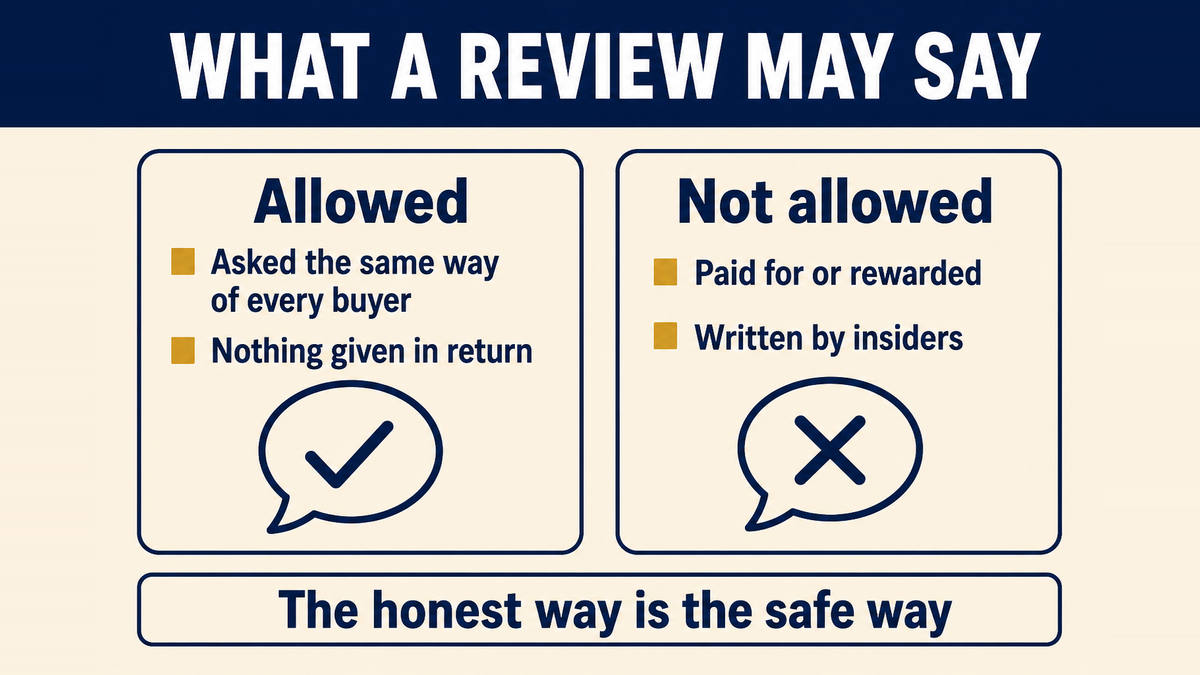
Read as a list of what is not allowed, four of those headings describe things a dropshipping seller can do almost by accident. Supplying a free sample in exchange for a review sits under the heading on buying reviews, because an incentive given for a review is treated as a payment for it. Asking a friend or a family member to leave one sits under the heading on insider reviews. Filtering out the two-star reviews before they reach the page sits under the heading on review suppression. And a page of comments that looks like social proof but is not arrives under the heading on fake indicators of social media influence.
None of this changes what a parcel costs, which is the point. It is a change of a different type, and it bites in a different place: not in your margin but in your right to keep the listing and to make the claim. The practical effect for a direct-ship seller is that the honest version of review collection is also the safe version, and it costs nothing. Ask every buyer the same way, send no incentive, publish what comes back, and the whole section stops applying to you. The parts of a store that do require an incentive, such as keeping a dissatisfied buyer from leaving a public complaint, belong to the way you handle a complaint directly rather than to the review page, and the refund side of the same conversation is covered in what a return actually costs you.
5. How to Tell a Real Change From a Loud One
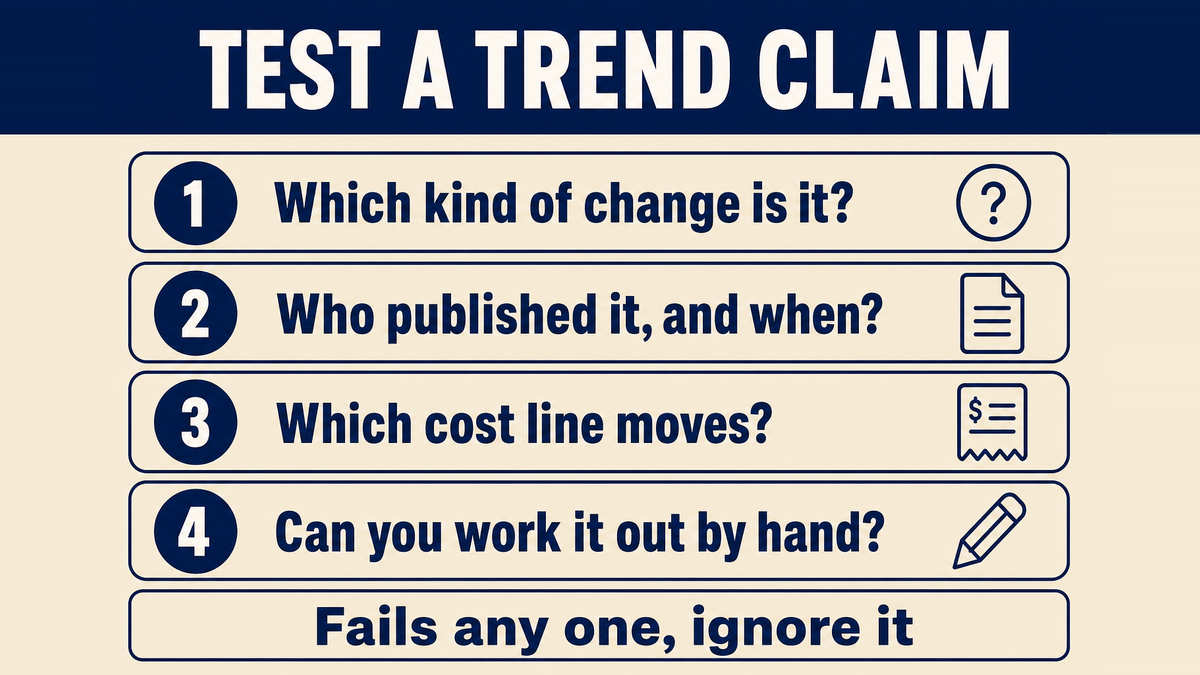
By this point the two 2026 changes have been separated and sourced, and the more useful result is the test that separated them. It takes four questions, and a claim that fails any of them is not something to reorganise a business around.
The first question is which of the two categories the change belongs to, cost or permission. This is not a matter of taste. If the claim cannot be written as a number that appears on an order, it is not a cost change, and if it cannot be written as something a seller is now allowed or not allowed to do, it is not a rule change. A claim that is neither is a tool announcement dressed up as a shift.
The second question is who published it, and on what date. The parcel change is verifiable because a regulation carries the date of its own amendment. The review change is verifiable because a federal rule carries a part number. An article that describes a trend without either is telling you what the writer noticed, which may be true and is not the same as being the rule. This distinction is not pedantry: a seller who cannot find the primary text cannot tell whether they are reading a new rule or a summary of last year's rule, and the second one costs nothing to obey because they are already obeying it.
The third question is which line of your accounts the change would move. A cost change has to land on a specific line: duty, postage, a processing fee, a return. A rule change does not land on a line at all, which is why it needs a different test. Ask instead which action you would have to stop taking. If no action changes and no line changes, the claim has no consequence for you, however widely it is being reported.
The fourth question is whether the effect can be worked out by hand. The parcel change can: take one order, price it on each route, and compare. If a claimed trend cannot be turned into a comparison of two numbers, the honest answer is that its size is unknown, and an unknown size cannot be used to set a price. The same discipline that keeps a margin calculation honest applies here, and the tax side of the same arithmetic is treated separately in what a seller actually owes.
Running the two 2026 changes through the test is a short exercise, and it shows how differently the two types behave. The parcel change concerns cost, it is published in a regulation that records the date of its own amendment, it lands on the duty line of an order, and the size of the effect can be worked out by hand for a single parcel. The review rule concerns permission, it is published as a numbered rule, it changes which actions a seller may take, and its effect can be stated with no number in it at all. A claim that survives none of the four questions is not wrong, it is simply unfinished, and an unfinished claim belongs in a reading list rather than in a pricing decision.
6. What This Means for the Products You Sell
A cost change does not apply to a category, it applies to a parcel. That is the reason the parcel change re-sorts products quietly rather than sweeping a sector away. An item that is small, light and cheap enough to travel as post keeps most of its old arithmetic. An item that is bulky, heavy, or valuable enough that posting it is impractical has moved onto a route where the exemption no longer applies, and its landed cost is now a different number that was not in last year's plan.
Read that against any list of trending products and the useful filter appears. The familiar list is a list of things people are buying, and it says nothing about which route those items can travel on. Two products with the same search volume and the same unit price can now have different economics purely because one fits through the postal network and the other does not. That is why a product list should be read as a starting point rather than an answer, which is the argument set out in how a product trend reaches a seller.
The second consequence is that the crossover point between buying per order and holding stock has moved closer. Holding stock has always been justified by a lower unit cost, and the argument against it has always been the capital and the risk. A duty charge on every direct-ship parcel weakens the per-order side of that comparison without changing the other side at all, so the volume at which local stock starts to win is now lower than it was. Sellers who were planning to hold stock in a year may find the same decision now points the other way, and what holding stock actually requires is the next thing to read before acting on it.
The rule change has a different kind of consequence, and it lands on channels that grow by borrowing trust. A store that earns attention through other people's posts, clips and recommendations depends on those people being free to say what they think. Arranging the praise and editing out the rest is no longer a grey area, so the cheapest-looking route to social proof is also the one with the clearest downside. The comparison in how a short-video channel differs from a store is a useful place to see which parts of that risk a seller actually controls.
Put together, the two changes point in one direction. The part of a direct-ship business that was carried by a rule is being narrowed, and the part that is carried by the product itself matters more. That is a slower story than a list of trends, and it is the one that decides whether the next twelve months produce a margin or a memory.
7. Frequently Asked Questions
Are dropshipping trends for 2026 worth acting on at all?
Most of them are not, because most of them change neither your costs nor your permissions. The useful distinction is between a cost-structure change, which moves the number on an order, and a rule change, which moves what you are allowed to do. A new tool or a new channel is neither. Apply that test to any claim before you change a price or a listing for it.
Did the $800 duty-free exemption end in 2026?
It was not ended and the $800 figure was not lowered. Under 19 CFR 10.151, the figure still stands in paragraph (a), but paragraph (b) suspends the exemption for merchandise arriving by all modes other than the international postal network. So a parcel sent through the postal network keeps it, and a parcel sent by courier, express or freight does not.
Does any of this apply if my supplier ships by post already?
It applies less, and the reason is worth understanding rather than assuming. The exception is written for the international postal network, so staying on that route keeps the exemption. What changes is the trade-off you are accepting in exchange, because postal service means tighter size and weight limits, slower transit and weaker tracking than a courier would give you.
Do the federal review rules apply to a small store?
They apply to reviews and testimonials used to sell goods, and size is not part of the test. The prohibited categories are worth reading as a list because most of them can be entered by accident: paying or rewarding a review, asking friends or family, hiding the negative ones, and presenting an invented following as real. Collecting reviews the same way from every buyer, with no incentive, keeps a seller outside all four.
What should a seller change first because of these two?
Recost a single order on both routes before changing anything else. That produces the only number that matters here, which is the difference between what you assumed a parcel costs and what it now costs, and it tells you which products have quietly changed category. The review rules cost nothing to meet, so the only work is checking that nobody on your side is buying, planting or filtering reviews.
A Table of What Each Change Costs You
One row per announcement, the cost line it reaches, and a column for the ones that reach nothing, signed and dated.
Fill My Exposure Table
Questions & Comments
We read every one and reply within 24 hoursWondering whether a change you read about this year actually reaches your orders, unsure which route your supplier is sending on, or trying to work out which products a duty charge has quietly made unprofitable? Tell us the item, the weight and where it ships, and our team will help you price the route rather than the headline.