
Dropshipping on Amazon: What the Policy Actually Requires
 ·
Updated October 13, 2026
·
15 min read
Most guides to dropshipping on Amazon answer a question nobody asked. They explain that it is allowed, which takes one sentence, and then move on to sourcing. The useful question is different. Amazon permits the model, but only on three specific terms, and each term lands on your supply chain rather than on your storefront. Whether you can dropship on Amazon is settled. Whether you can meet those three terms permanently is the whole problem.

The Three Requirements, and Where Each One Bites
| Requirement | What it demands of you |
|---|---|
| You are the seller of record. | A written agreement with your supplier, and responsibility for the sale, the price and the sales tax. |
| No third-party references. | Packaging, packing slips and invoices must carry nothing that identifies another business. |
| You handle returns and service. | Customer complaints, returns and refunds are yours, not something you forward. |
What this guide covers
- What Amazon allows, and what the policy actually controls
- Requirement one: you are the seller of record
- Requirement two: nothing in the parcel names a third party
- Requirement three: service and returns stay with you
- The delivery clock, and why your own words set it
- FBA or your own fulfilment
- Frequently asked questions
1. What Does the Policy Actually Control?
Amazon states its own position plainly, and it is worth taking from Amazon rather than from a blog summarising it. Two of its own seller pages set out both the permission and the conditions.
Dropshipping is allowed in the Amazon store. According to Amazon's Drop Shipping Policy, you can generally use a dropshipping service to sell products, as long as you're the seller of record.
Amazon, What is dropshipping?
So the question of permission is closed. What the policy regulates is the arrangement underneath the listing, and Amazon lists the conditions directly.
Requirements of the policy include: Have an agreement with your supplier identifying you as the seller of record, meaning you own the products before customers purchase them. As the seller of record, you're also responsible for setting the price, recording the purchase as revenue, and handling sales tax. Make sure products and other materials like packaging, packing slips, and invoices, are free of any references that identify a third party. Be responsible for accepting and processing returns, and providing customer service that meets or exceeds Amazon's policies.
Amazon, How to dropship on Amazon
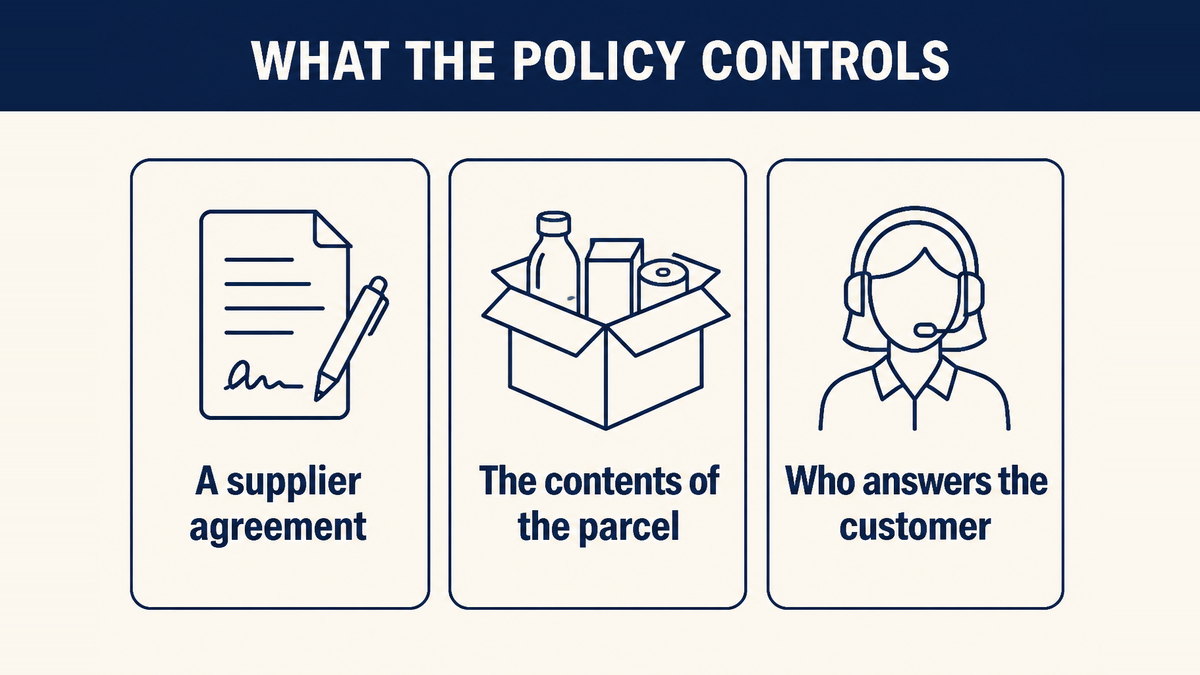
Three sentences, and none of them is about selling. The first is about a contract you need to have before you list anything. The second is about what physically travels inside the parcel. The third is about who answers when something goes wrong. A seller who reads only the headline — that dropshipping is allowed — has read the one sentence that imposes nothing.
There is also a reason Amazon gives for the second requirement, and it is worth quoting because it explains the logic rather than just the rule. Amazon notes that if a customer finds a reference to a third party other than the seller or Amazon, they may be confused about who to contact when something goes wrong. The rule exists to prevent a confused buyer, not to protect a brand.
2. Requirement One: You Are the Seller of Record
This phrase appears in almost every article about Amazon dropshipping and is explained in almost none of them, so it is worth unpacking as Amazon defines it. Being the seller of record means you own the products before a customer buys them, you set the price, you record the sale as your revenue, and you handle sales tax.
Read that list again and notice where it ends. The last item is not an operational task like packing or tracking. It is a tax position. So a decision that felt like a fulfilment choice — who ships the parcel — turns out to determine who remits tax on the sale, and it does so from the first order rather than at some later milestone.
The other half of the requirement is the agreement itself, and this is the part that quietly disqualifies the most casual setups. Amazon asks for an agreement with your supplier that identifies you as the seller of record. That is a document, not an understanding. If your arrangement is a message thread and a shared spreadsheet, you have the commercial relationship but not the evidence of it.
In practice this is a two-page document rather than a contract negotiation. It needs to name you and the supplier, identify you as the seller of record, state that the supplier will not include its own branding or invoices in the parcel, and set out the returns process between the two of you. Our guide to choosing a supplier you will not outgrow covers how to open that conversation, and our notes on when a domestic supplier is the better answer cover the case where the supplier is in your own country and the same three requirements still apply.
3. Requirement Two: Nothing in the Parcel Names a Third Party
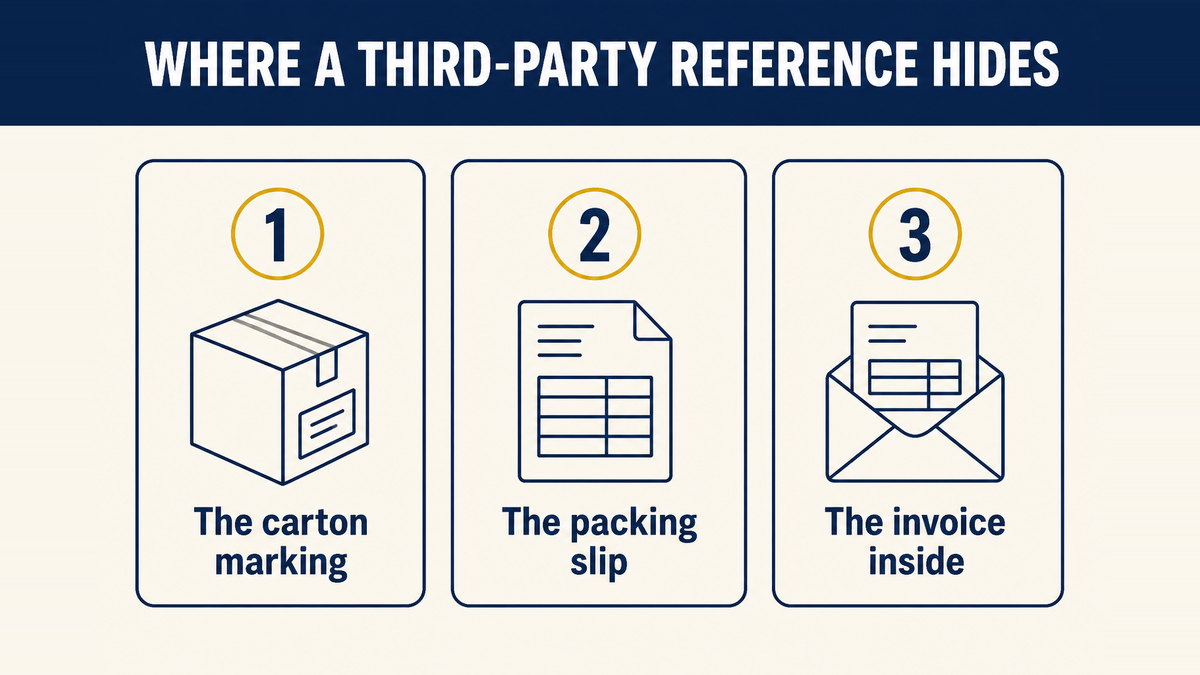
The requirement is specific about where it applies: products and other materials such as packaging, packing slips and invoices must be free of any reference that identifies a third party. Notice that this is a statement about the contents of the parcel, which means it cannot be solved from your seller account.
This is where most first attempts fail, and they fail in an understandable way. A supplier shipping to a normal wholesale customer has no reason to hide. Their carton carries their mark, their packing slip carries their company name, and their invoice is inside the box because that is what a supplier normally sends. None of that is hostile. It is simply the default, and the default breaks the requirement.
So the fix is a change at the supplier, agreed before the first order ships, and it involves three separate things because they happen at three different points in the process: the packaging you can specify, the packing slip you can replace with your own, and the invoice that has to be removed rather than rewritten. Our guide to blind dropshipping and removing supplier invoices covers how each of those is handled with a Chinese supplier, and our notes on what a packing list contains and who reads it explain why the document that causes the problem is a normal part of a normal shipment.
Do not treat this as a one-time setting. A supplier who removes their invoice for your first order may ship the second one to a different line, and the default reasserts itself the moment attention moves elsewhere. Our guide to shipping marks on export cartons sets out what legitimately belongs on the outside of a carton and what does not, which is the checklist to confirm against before a batch is packed. If your supplier also handles Amazon's own prep requirements, our guide to Amazon FBA inspection and labelling rules covers the separate set of standards that apply when the parcel is going to a warehouse rather than a customer.
4. Requirement Three: Service and Returns Stay With You
The third requirement is that you accept and process returns and provide customer service that meets or exceeds Amazon's policies. The wording matters: the standard is not your own policy but Amazon's, and "exceeds" sets the direction of travel.
What makes this requirement heavier than it sounds is that the two other requirements have already removed your excuses. You are the seller of record, so the customer's contract is with you. The parcel is anonymous, so the customer has no one else to contact even if they wanted to. And you have no stock, so you cannot simply send a replacement from a shelf when something arrives damaged. Every service promise therefore has to be delivered through a supplier who is several time zones away and not obliged to answer quickly.
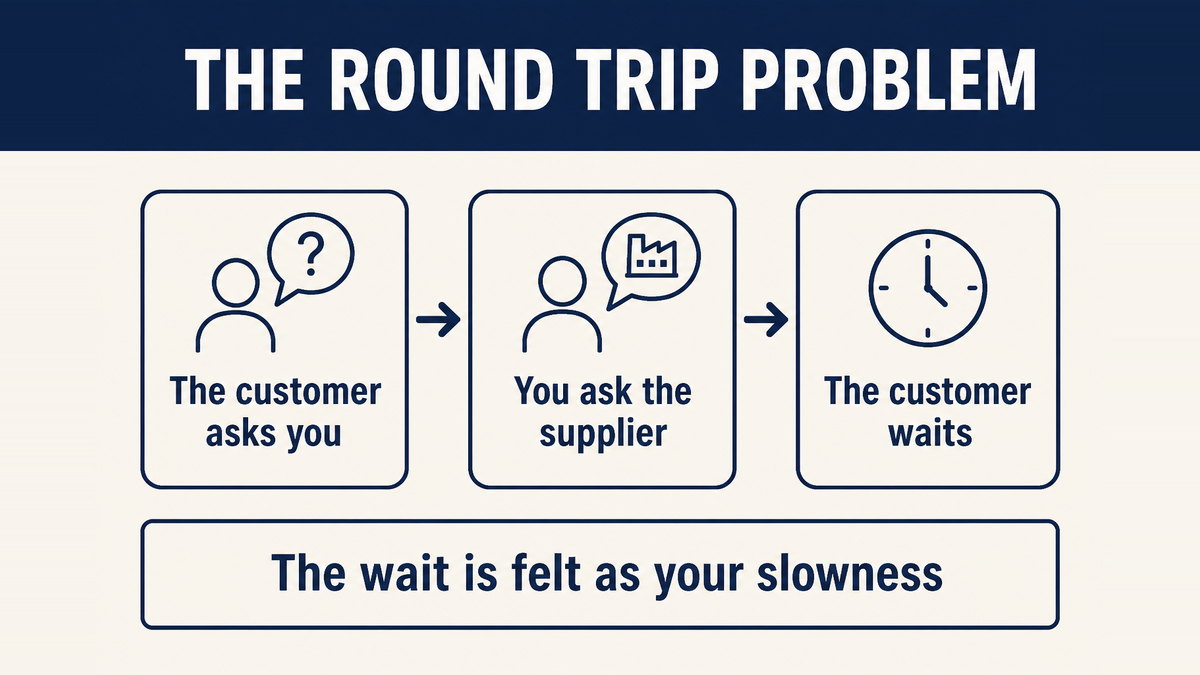
The three failures that follow are predictable. Late parcels where the customer asks for tracking before you have received it. Wrong items where you have to negotiate with the supplier before you can answer the customer. Damage claims where the customer wants a refund now and the supplier wants photographs first. In each case the delay is not caused by the supplier refusing to help. It is caused by the round trip, and the customer experiences that round trip as your slowness.
The practical answer is to decide in advance which problems you will solve without asking the supplier first. A missing tracking number, a two-day delay or a damaged unit below a set value are all cheaper to settle immediately than to investigate, and settling them inside Amazon's service expectations is worth more than the unit cost. Our guide to moving from per-order buying to holding stock covers how the calculus changes once you can ship a replacement yourself, and our notes on what a warehouse charges to pick and send one order give the per-order figure for doing that. Two related risks are worth knowing before they arrive: Amazon listings can be removed for reasons unrelated to fulfilment, which our guide to why Amazon products get removed sets out, and a complaint can escalate into a claim about the product itself, which is where our notes on handling a patent complaint become relevant.
5. The Delivery Clock, and Why Your Own Words Set It
There is a second rule that applies to the delivery promise itself, and it is not Amazon's. It is the federal rule for orders placed by mail, over the internet or by telephone, and its effect is to turn whatever you print on your listing into a deadline.
(a)(1) To solicit any order for the sale of merchandise to be ordered by the buyer through the mail, via the Internet, or by telephone unless, at the time of the solicitation, the seller has a reasonable basis to expect that it will be able to ship any ordered merchandise to the buyer: (i) Within that time clearly and conspicuously stated in any such solicitation; or (ii) If no time is clearly and conspicuously stated, within thirty (30) days after receipt of a properly completed order from the buyer.
16 CFR 435.2(a)(1), Mail, Internet, or telephone order sales
The structure is a choice between two defaults, and it is worth being precise about which one you have chosen. State a delivery time on the listing and that stated time becomes the deadline you are held to. State nothing at all and the outer limit is thirty days from a properly completed order, extended to fifty days where the buyer applied for credit.
For a dropshipper this inverts the usual instinct. The listing line that promises seven to fifteen days reads like a marketing claim that improves conversion. Under the rule it is a commitment, and it is the tighter of the two defaults. A seller who writes nothing is allowed thirty days. A seller who writes fifteen has chosen fifteen, and the promise is now measured against a supplier's production schedule, a consolidation window and an international transit time, none of which the seller controls.
- If your listing states a delivery window
- That window is the deadline. It is not a target and not an average, and a slow batch is not a defence.
- If your listing states nothing
- Thirty days from a properly completed order applies, and fifty days where the buyer applied for credit.
- Either way
- Amazon measures on-time delivery and valid tracking separately, so meeting the legal deadline does not by itself protect the account.
6. FBA or Your Own Fulfilment?
The comparison is usually presented as a cost question, and that is the wrong frame. FBA and seller-fulfilled orders differ first in who holds the delivery commitment, and the cost difference follows from that rather than the other way around.
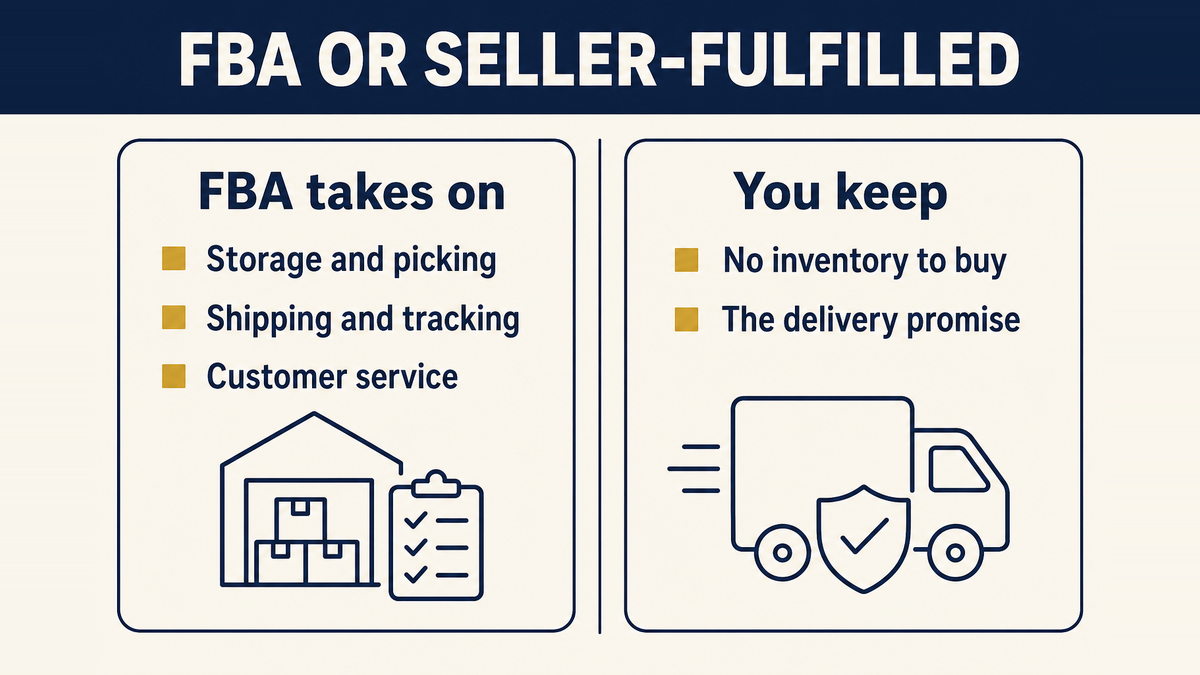
Send stock into FBA and Amazon stores it, picks it, ships it and answers the customer service. In exchange you have done the thing dropshipping was chosen to avoid: you have bought inventory before knowing whether it sells, and you now carry the cost of it sitting there. Keep fulfilment in your own hands and you preserve the no-inventory advantage, but the delivery promise on every single order is yours to keep, with the legal deadline above as the floor and Amazon's own metrics on top.
So the boundary is not a price comparison. It is a question about which risk you are better placed to carry. If your product sells steadily enough that stock turns over quickly, holding it is the cheaper arrangement and FBA removes the delivery commitment along with it. If you are still finding out whether the product works, holding stock converts a cheap test into an expensive one, and seller-fulfilled is the better trade even though it leaves the clock running. Our guide to picking a product that earns its own storage is the matching piece, and the full arithmetic of when holding stock starts to pay sits alongside it.
7. Frequently Asked Questions
Is dropshipping allowed on Amazon?
Yes. Amazon's own seller guidance says dropshipping is allowed in the Amazon store as long as you follow the Drop Shipping Policy and the applicable laws where you sell. What the policy controls is not whether you may dropship but on what terms.
What does it mean to be the seller of record?
It means you own the products before a customer buys them, you set the price, you record the sale as your revenue, and you handle sales tax. That last part is the one sellers most often overlook, because it turns a fulfilment arrangement into a tax position.
Why do packing slips matter so much?
Because the policy requires products and materials such as packaging, packing slips and invoices to be free of any reference identifying a third party. A supplier's own invoice in the parcel breaks that requirement, so the fix is a change at the supplier rather than a change to your listing.
How long do I have to ship an Amazon order?
Legally, whatever time you state at the point of sale becomes the deadline. If you state no time at all, the rule allows thirty days after a properly completed order, extended to fifty days where the buyer applied for credit. A listing promising seven to fifteen days has therefore adopted seven to fifteen days as its deadline.
Should I use FBA or ship orders myself?
FBA moves the delivery clock and the customer service to Amazon, and in return you must hold stock and send it in. Keeping fulfilment in your own hands preserves the no-inventory advantage but leaves you owning the delivery promise on every order. The choice is about who carries the shipping commitment, not about which is cheaper.
Three Requirements, Each With Its Evidence
We return the evidence for each requirement, the parcel insert rules, and the clock your listing promises against.
Prove My Three Requirements
Questions & Comments
We read every one and reply within 24 hoursTrying to work out whether your supplier can meet Amazon's three requirements, unsure what has to be removed from the parcel before the first order ships, or worried your stated delivery window is tighter than your lead time? Post the product, the supplier country and the delivery promise on your listing, and our team will help you check it before the first order goes out.