
Dropshipping Electronics: Batteries, Dead on Arrival and Who Owes the Warranty
 ·
Updated October 14, 2026
·
17 min read
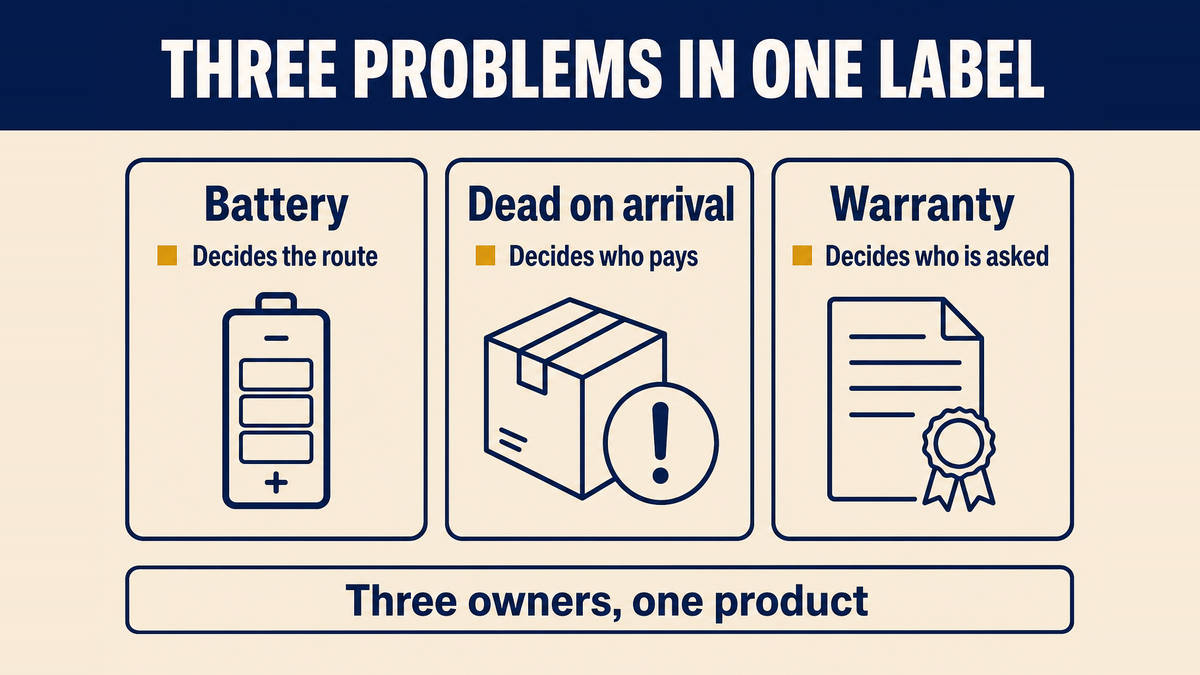
Electronics is usually presented as one category with one question attached: which gadgets sell best. In practice three problems arrive together, and none of them is about demand. The first is that many of these products contain a battery, and a battery decides which route the parcel may travel on. The second is that a device can arrive dead through no fault of the buyer or the seller, and somebody has to pay for that. The third is that a buyer whose device fails will come to the store that sold it, not to the factory that made it. This guide takes the three in turn, shows where each one is written down, and sets out what they do to a product choice before you make it.
1. Three Problems Wearing One Label
The reason electronics behaves differently from most categories is that its three failure points have three different owners. The route is governed by transport rules and belongs to the carrier and the regulator. The dead-on-arrival rate is governed by handling and testing and belongs to your own process. The warranty obligation is governed by consumer law and belongs to the buyer, who will use it against whoever they bought from. A seller who treats electronics as one decision ends up solving one of the three and discovering the other two later.
Demand is not the hard part. The products that sell are easy to identify, which is exactly why almost every guide stops there and produces a list of popular gadgets. A list can tell you what people buy. It cannot tell you that the model you picked sits 3 watt-hours above a transport limit, that its return rate is driven by a connector that works loose, or that publishing warranty terms in your own voice changes who is legally answerable when it fails.
What makes this tolerable is that each of the three constraints is checkable before you commit, and two of them are written in regulation rather than in opinion. The checks are not complicated. They are simply in a different place from the product research, which is why they get skipped.
| Constraint | Owner | What it decides |
|---|---|---|
| Battery | Transport rules | Which route the parcel may take |
| Dead on arrival | Your own process | Who pays when it arrives broken |
| Warranty | Consumer law | Who the buyer comes back to |
What this guide covers
2. The Battery Decides the Route
A lithium battery is not treated as a component of a product. It is treated as a regulated item in its own right, and that treatment follows the cell wherever it goes. The rule that governs it in the United States sets the entry condition in a single sentence that is worth reading as a requirement on your supplier rather than on your parcel.
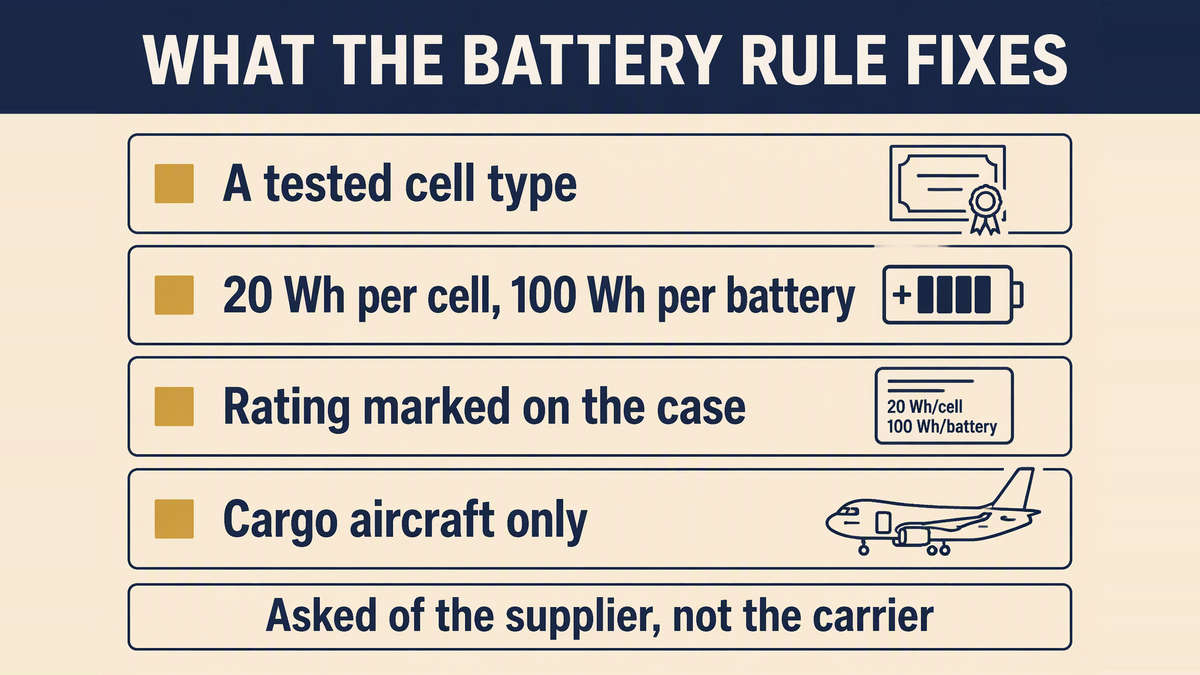
Each lithium cell or battery must be of the type proven to meet the criteria in part III, sub-section 38.3 of the UN Manual of Tests and Criteria.
U.S. Department of Transportation, 49 CFR 173.185, Lithium cells and batteries (read 14 October 2026)
That sentence turns a supply question into a paperwork question. A battery has to be a type that has been tested, and the evidence belongs to the cell type and to the party named on the document. When a supplier says a product ships with a lithium battery and nothing else, the useful follow-up is not whether it ships but whether the cell type has the test behind it and whether the summary can be produced.
The same section carries the numbers that decide which route the parcel can use, and they are concrete enough to check against a specification sheet. Under the small-cell provisions, the watt-hour rating may not exceed 20 Wh for a lithium ion cell or 100 Wh for a lithium ion battery, and each lithium ion battery must be marked with its watt-hour rating on the outside case. Above those limits the shipment moves into a different set of requirements entirely, and the route narrows.
The marking requirements then make the route visible on the outside of the box. Packages containing these cells must be marked with wording such as “LITHIUM ION BATTERIES—FORBIDDEN FOR TRANSPORT ABOARD PASSENGER AIRCRAFT” or carry a “CARGO AIRCRAFT ONLY” label, which is a direct statement that the cheap air lane most sellers assume is not available to that parcel. The test summary itself is also specified, and must identify the cell or battery, its mass, its watt-hour rating or lithium content, a physical description and the model number, along with the list of tests conducted and their results.
For a direct-ship seller the practical result is a short list of questions that belong in the first message to a supplier, not in the last: what chemistry the battery uses, what its watt-hour rating is, whether the rating is marked on the case, and whether the test summary can be sent. A product with a battery over the limit, or with no documentation behind the cell, has not failed on quality. It has failed on route, which is a different and earlier problem. How cells, capacity and shipping interact in one specific product group is worked through in what actually goes into a power bank.
3. Dead on Arrival: Who Pays
A device that reaches the buyer non-working is usually described as a defect, and that description hides the useful part. Three different causes produce the same complaint. The unit was faulty when it left the line. It was fine when it left and was damaged in transit. Or it works and the buyer has not yet discovered how to make it work, which on electronics is more common than sellers expect because of pairing steps, first-charge requirements and buttons that need a long press.
From the buyer's side those three are indistinguishable, and this matters because the response that fixes each one is different. A transit problem is answered by packing, a manufacturing problem by a supplier claim, and a setup problem by a reply. If the rate is never broken down, every returned unit is treated as a manufacturing defect and paid for at the most expensive rate of the three, which is how a workable product starts to look unprofitable.
The reason electronics produces more of these than most categories is mechanical. Devices have connectors that work loose, screens that crack along one edge, and batteries that arrive at a low charge and look dead. Each of those is a specific failure with a specific fix, and none of them is visible in a product listing, where the unit is photographed working and never shipped.
The cost of a dead unit is also larger than its price, which is the part that tends to be left out of the arithmetic. The loss is the unit plus the freight out plus the freight back plus the freight on the replacement, and then the time spent on the conversation, which on a technical product is longer than on a pair of socks. That total is why the rate matters more than the unit cost: a cheap device with a high rate can cost more per delivered order than an expensive one with a low rate. Building that total properly is the same exercise as building any landed cost, and how a landed cost is assembled applies without change, while the return side of it is set out in what a return actually costs.
Measuring the rate is a small piece of discipline that changes how a product gets judged. Count it per hundred orders that were actually delivered, rather than per hundred sold, because an order cancelled before it went out never reached anyone. Split it by cause, since the three causes need three different answers and only one of them is a conversation with a supplier. Then set a review window, so that a complaint arriving in the fourth month is handled as a warranty matter rather than folded back into the arrival rate, where it would make a workable product look unreliable and push you away from it for the wrong reason.
The lever that exists is inspection, and it works because a functional test finds the failures that a visual check cannot. A sample that is charged, switched on, paired and cycled catches the connector and the discharged-cell failures before a container does, which is the argument for a proper inspection rather than a photo of a box, covered in what a pre-shipment inspection should include. The reason a supplier's assurance is not a substitute is set out in what the usual assurances really mean. And because a share of units will still arrive faulty, the reply the buyer gets matters as much as the replacement itself, which is the subject of how to handle a complaint on a technical product.
4. Who Actually Owes the Warranty
The third constraint is the one sellers discover last, because it does not appear until something fails months later. The buyer's claim arrives at the store, and the store's instinct is that the factory should answer it. Whether that instinct is correct depends on a specific rule about who was making the promise, and the rule is narrower than most sellers assume.
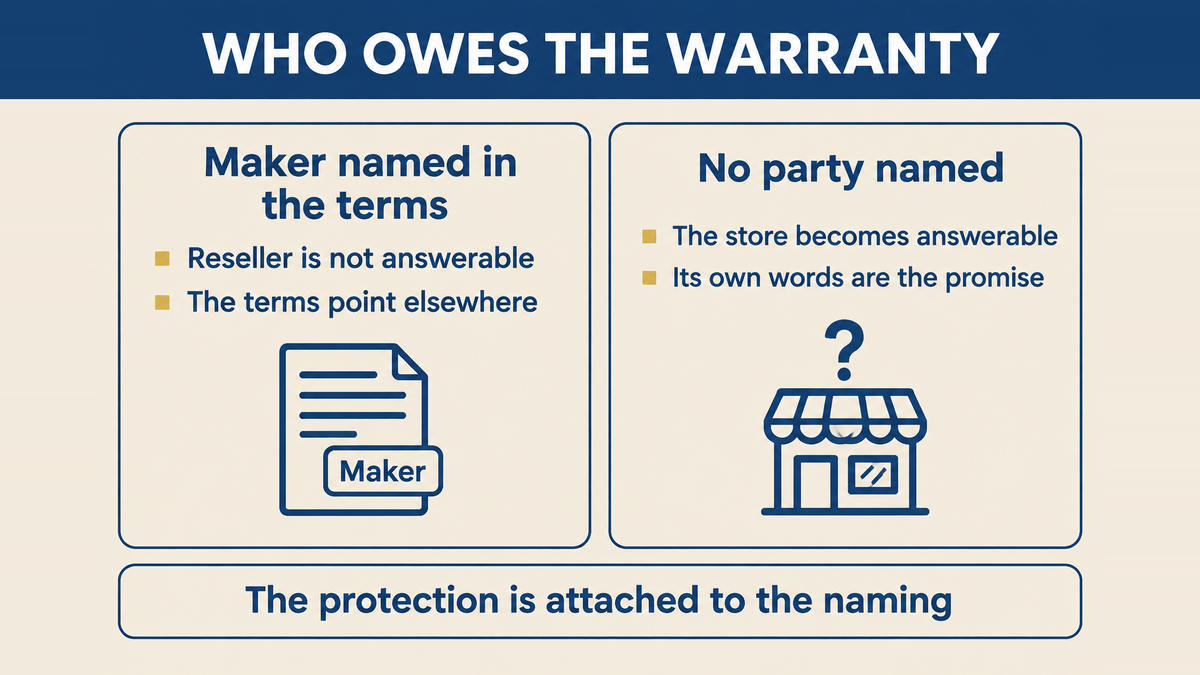
Section 110(f) of the Act, 15 U.S.C. 2310(f), provides that only the supplier “actually making” a written warranty is liable for purposes of FTC and private enforcement of the Act. A supplier who does no more than distribute or sell a consumer product covered by a written warranty offered by another person or business and which identifies that person or business as the warrantor is not liable for failure of the written warranty to comply with the Act or rules thereunder.
Federal Trade Commission, 16 CFR 700.4, Parties “actually making” a written warranty (read 14 October 2026)
Read the sentence closely and a condition appears inside it. A seller who only distributes is not answerable for a warranty offered by somebody else, but only where the document identifies that other party as the one giving it. The protection is attached to the naming, not to the reselling. A store that lifts the factory's warranty wording onto its own page without naming the factory has kept the promise and dropped the attribution, and on the wording above it is no longer clear that the second half of the condition has been met.
The same part of the rules also limits what a store may write if it does offer its own terms, and the headings alone are instructive. There is a section addressed to a warranty that makes the party giving it the final judge of whether a claim is valid, one on requiring a buyer to use specific parts or services as a condition of cover, and one on the duty to install where a full warranty is given. Those are not obscure corners; they are the three clauses most likely to be copied from an overseas supplier's template and pasted into an English listing.
The section titles in the same part of the rules also separate three things that sellers tend to treat as one. A written warranty sits in its own section, a statement of general policy sits in another, and a service contract or an insurance product sits in a third. That separation matters because the words on a page are what decide which of the three a buyer has been handed, and the three carry different duties. A sentence promising that problems will be sorted out reads like a general policy to the person who wrote it and like a promise to the person reading it. The gap is closed the same way as the naming question, by saying which one it is on purpose instead of leaving the phrasing to decide.
So the choice is worth making on purpose rather than by default. A seller is either passing through the maker's warranty with the maker named, or offering terms of their own and accepting the duties that come with them. Saying nothing is not a third option, because the buyer will still bring the claim to the store, and a vague answer at that moment costs more than a clear one written in advance. The separate question of what these goods must be tested for before they can be listed is covered in what electrical goods need before they can be listed.
5. What the Three Constraints Do to a Product Choice
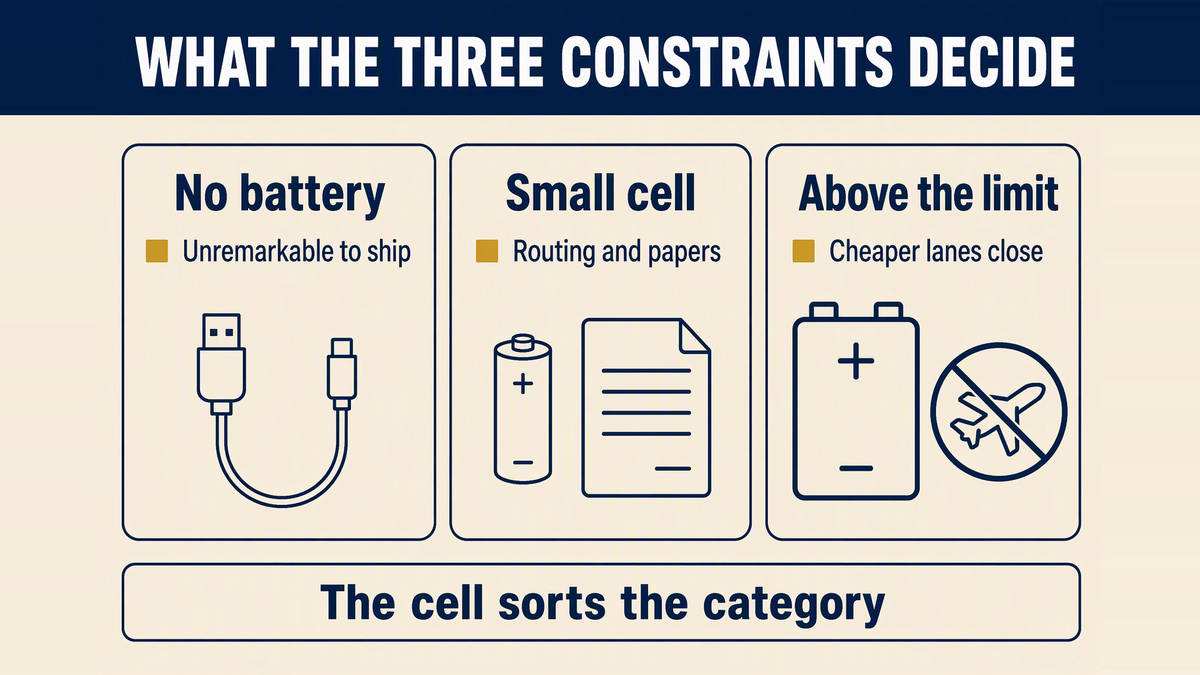
Taken together, the three constraints sort electronics into groups that behave very differently, and the sorting has nothing to do with how popular the products are. The first group is items with no battery at all: a cable, a stand, a case, a passive adapter. These are unremarkable to ship, and the route question simply does not arise. They are also the least exciting products in the category, which is precisely why the sellers who choose them often have the calmest operations.
The second group is the awkward middle, and it is where most of the market sits. A device with a small lithium cell inside is shippable, but only on routes that accept it and only with documentation behind the cell. The parcel carries a marking telling the carrier what may not happen to it, and the seller carries a responsibility to know the cell's rating. This group can be run well. It cannot be run by accident.
The third group is the one to be careful with: devices whose battery sits above the small-cell limits, or which have no test documentation at all. Nothing here is impossible, but the transport requirements change and the usable routes narrow, so the cheap air lane disappears from the plan. A seller who discovers that after the first order has already been placed is not solving a shipping problem, they are repricing a product.
The dead-on-arrival question then runs across all three groups independently, because it is driven by mechanical complexity rather than by whether there is a battery. A simple device with one moving part returns less often than one with several moving parts, and the difference shows up as a rate rather than as a single incident. Where the products are bought in bulk rather than shipped one at a time, the same three constraints reappear as questions about the batch, and the sourcing side of that is treated in how buying in the Shenzhen electronics market actually works.
| Constraint | What to check | What stops the product |
|---|---|---|
| Battery | Cell type, test summary, rating, case marking | No documentation, or a rating above the small-cell limit |
| Dead on arrival | Connectors, screen edges, first-charge behaviour | A measured rate you cannot recover in the margin |
| Warranty | Who the terms name as the party giving them | Terms copied without naming the maker |
6. Listing Electronics Without Inheriting All Three
The order in which the three are handled matters, and it is not the order they tend to be discovered in. Start with the warranty posture, because it changes the words on the page rather than the numbers behind it, and it is the one constraint that is settled by a decision rather than by a document. Writing down whose promise the buyer is relying on takes an hour and removes a whole class of argument later.
Then confirm the battery documentation, which is a request to the supplier rather than a piece of research. Ask for the cell's chemistry, its watt-hour rating, the evidence that the rating is marked on the case, and the test summary. A supplier who cannot produce those documents has told you something useful, and it is better to hear it before the listing exists than after the first order.
Last, set the handling protocol, which is where the dead-on-arrival rate is actually decided. Decide what a returned unit triggers, who checks it, and how the buyer is answered while that happens. On a technical product the reply is doing as much work as the replacement, because a connector that has come loose and a pairing step the buyer has missed look identical in a message and are solved in different ways. Treating them the same is what turns a cheap return into an expensive argument.
One further habit is worth carrying into this category. Electronics refreshes its models faster than most goods, so a page that was accurate when it was written can drift out of step with what the supplier now ships. A listing that promises a specification the current batch no longer meets creates the exact dispute the warranty question is about, and the cost of correcting the page is trivial next to the cost of honouring a claim for a product that was never delivered. Keeping the specification current is not a legal obligation in the same sense as the three constraints here, and it prevents more of their consequences than any single clause in a returns policy.
Read as a whole, the category is workable rather than dangerous. The sellers who struggle with electronics are usually not bad at selling. They chose a product on demand alone, and the three constraints then presented themselves one at a time, in the order that costs the most.
7. Frequently Asked Questions
Is dropshipping electronics profitable?
It can be, and the deciding factor is rarely the product price. Electronics carries three costs that most categories do not: a route restriction on anything with a battery, a dead-on-arrival rate that costs freight in both directions, and a warranty claim that may arrive months later. Products with none of those three are less exciting and usually more profitable per order.
Do I need a licence to sell electronics?
There is no single licence that covers the category, and the obligations differ by item. Electrical goods sold into some markets need certification, which is a separate question from the transport and warranty points on this page, and it attaches to the specific product rather than to the store. The practical step is to identify what your item needs before listing it rather than assuming a category-wide rule exists.
Can I ship a phone or a power bank by air?
Often yes, but not on the route most sellers assume. Lithium cells travel under transport rules that cap the small-cell provisions at 20 watt-hours per cell and 100 watt-hours per battery, require the rating to be marked on the case, and require packages to carry wording such as the passenger-aircraft prohibition or a cargo-aircraft-only label. That wording exists because the ordinary passenger air lane is not available to them.
What should my returns policy say for electronics?
It should be consistent with the warranty posture you have chosen. If you are passing through a maker's warranty, the terms should name that maker as the party giving it, because the protection for a seller who only distributes is attached to that identification. If you are offering your own terms, the policy is the promise, and the limits on what such a promise may say apply to it.
How do I stop dead-on-arrival units costing me money?
Measure the rate rather than reacting to single complaints, and split it by cause, because a transit fault, a manufacturing fault and a setup step that the buyer has missed need three different answers. Testing a sample before goods ship catches the failures a photograph cannot, and answers written in advance keep the conversation short when a unit does arrive broken.
Dead on Arrival, Priced Before You Launch
We return the dead-on-arrival assumption, who absorbs it under each delivery term, and the warranty length your marketplace enforces.
Price My DOA Terms
Questions & Comments
We read every one and reply within 24 hoursTrying to work out whether a device's battery sits inside the small-cell limit, dealing with a dead-on-arrival rate that will not settle down, or unsure whose name belongs on your warranty page? Send us the item and the destination, and our team will help you check the battery documentation and the warranty wording before the listing goes up.