
Power Bank Manufacturer Sourcing Guide: Cells, Capacity and Shipping Rules
 ·
Updated October 9, 2026
·
25 min read
A power bank is a battery with a plastic shell and a circuit board around it, and the battery is the only part that matters — which is why the two questions worth asking a supplier are what cell is inside and what the watt-hour rating is. Those two numbers decide your cost, your returns rate, whether your customer can carry it onto a plane, and which shipping rules your order travels under. This guide covers why a 10,000 mAh pack does not deliver 10,000 mAh to your phone, how the 100 watt-hour ceiling quietly caps the capacity you can sell, what the shipping rules require you to hold as the importer, and how to test a sample without a laboratory.
What to Specify, by What You Are Selling
| If you are making | Specify this | Because |
|---|---|---|
| A pocket pack for phones | The cell brand or grade, the rated capacity in watt-hours, and the output wattage | Rated capacity in watt-hours is the figure your customer can measure and the one the shipping rules use. Specifying capacity in milliamp-hours alone leaves the actual deliverable energy undefined. |
| A pack for laptops | The output wattage and voltage, plus the cable that can carry it | A high-capacity pack is useless if the port cannot deliver the wattage a laptop asks for, and the cable is often the quiet bottleneck rather than the battery. |
| Anything for air travellers | A watt-hour rating kept under the spare-battery ceiling, with the figure marked on the case | Spare batteries and power banks are capped for air travel, and the mark on the case is how the figure is checked. A pack above the ceiling is a pack your customer cannot fly with. |
| A cable to sell alongside | The current rating, the data speed, and whether it is charge-only | Cable prices differ enormously for reasons that are invisible on a product photo. A charge-only cable and a data cable look identical and are not the same product. |
| A wireless charging pad | The wattage, the coil, and the certification the electronics need | Wireless charging adds a transmitting coil and its own efficiency loss, so the delivered power is lower than the advertised figure. Ask for the wattage at the device rather than at the pad. |
| Anything shipped by air | The UN 38.3 test summary, in writing, before the order ships | The shipping rules require a manufacturer and each distributor to make a test summary available, and they specify what it has to contain. It is a document you can demand rather than hope for. |
1. What a Power Bank Quotation Actually Covers
A power bank is assembled from four bought-in pieces, and the price is driven by the first one almost entirely. Two quotations for an identical-looking case can differ by more than double, and the difference is always inside the shell.
- The cell
- The battery itself, and the largest line by far. Cylindrical cells and flat pouch cells are the two families, and within each there are grades. This is where a quotation is won or lost, and it is the part your customer cannot see.
- The circuit board
- The charging and output electronics, including the protection circuits. Cheap boards cut corners on protection and on efficiency, and efficiency is what decides how much of the stored energy actually reaches the phone.
- The housing and the port hardware
- The shell, the port connectors and the display. Tooling for a custom shell is a one-time cost, and the ports are bought-in components with their own quality range.
- Certification and testing
- Almost never in the unit price. Transport testing and safety testing are charged per model, which means they are a fixed cost you pay once per product rather than a cost per unit.
Two consequences follow, and both are commercial rather than technical. First, the certification is a per-model cost, not a per-unit cost, so adding a second capacity to your range adds a testing bill even if the shells are identical. Second, the cell is where a supplier will quietly economise if the specification does not name it, because nothing about the outside of the product changes when the inside does.
2. mAh, Wh and the Capacity Gap Customers Complain About
This is the single most common quality complaint in the category, and it is not usually a fault at all. A customer buys a 10,000 mAh pack, charges a phone with a 4,000 mAh battery, and finds it charges the phone about one and a half times rather than the two and a half times the arithmetic suggested. They conclude the pack is a fake.
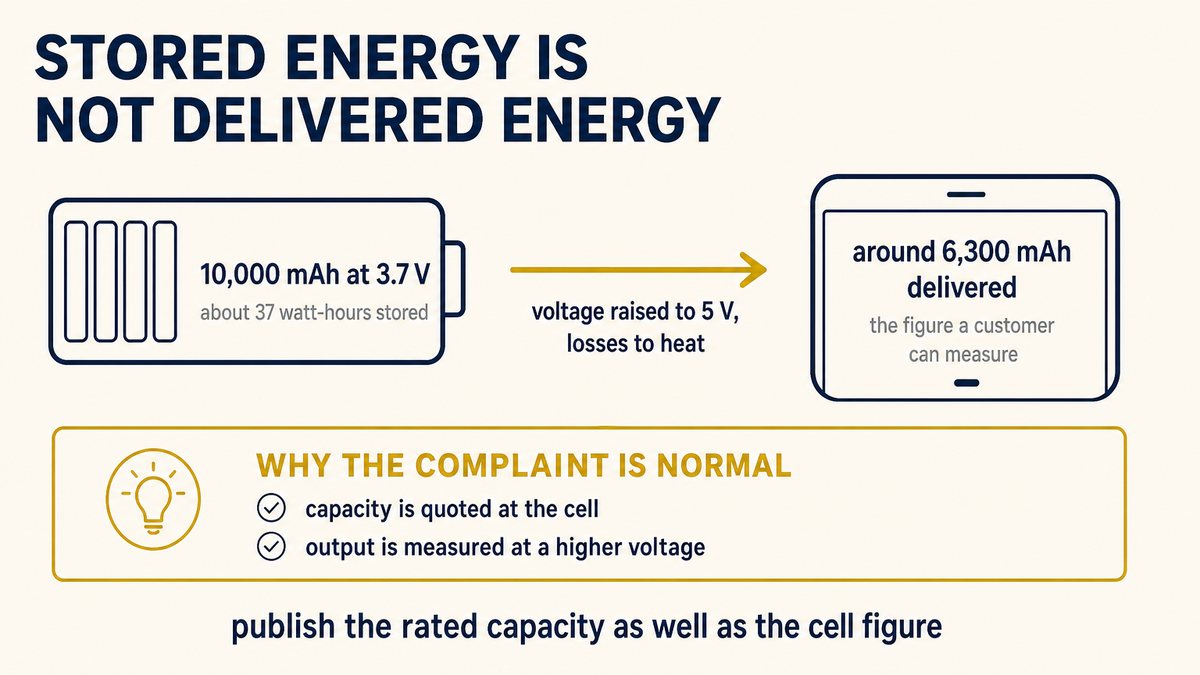
The explanation is that capacity is quoted at the cell and delivered at a higher voltage. The stored figure is milliamp-hours at the cell's rated voltage. The output figure is milliamp-hours at a raised voltage, and raising the voltage costs energy twice over: once in the conversion itself, and once because some is lost as heat.
You can work the arithmetic yourself, and it is worth doing before you write a product page.
Stored energy in watt-hours is the cell capacity in amp-hours multiplied by the cell voltage. A 10,000 mAh pack at 3.7 volts holds about 37 watt-hours. Delivered at 5 volts, 37 watt-hours is roughly 7,400 mAh before any losses, and conversion losses of around 15 percent bring it to something in the region of 6,300 mAh — which is the number a customer can actually measure. That is why the honest figure to publish is the rated capacity or the deliverable output, and putting a rated-capacity figure in the specification is the cheapest way to prevent a whole category of complaint. Ask your supplier what the rated capacity of the model is, and treat a supplier who has no answer as one who has never measured it.
Two habits follow from this, and both are about honesty rather than engineering.
- Publish the rated capacity as well as the cell capacity. Customers who understand the difference become loyal, and customers who discover it after buying become complaints. The brands that publish both are the ones that do not get accused of lying.
- Specify the conversion efficiency, not just the cell. A cheap board converts less efficiently, so two packs with identical cells and different boards deliver different amounts. Efficiency is invisible in a sample and measurable on a test bench, which makes it exactly the sort of thing to write into the specification.
3. The Cell: Where the Money and the Risk Sit
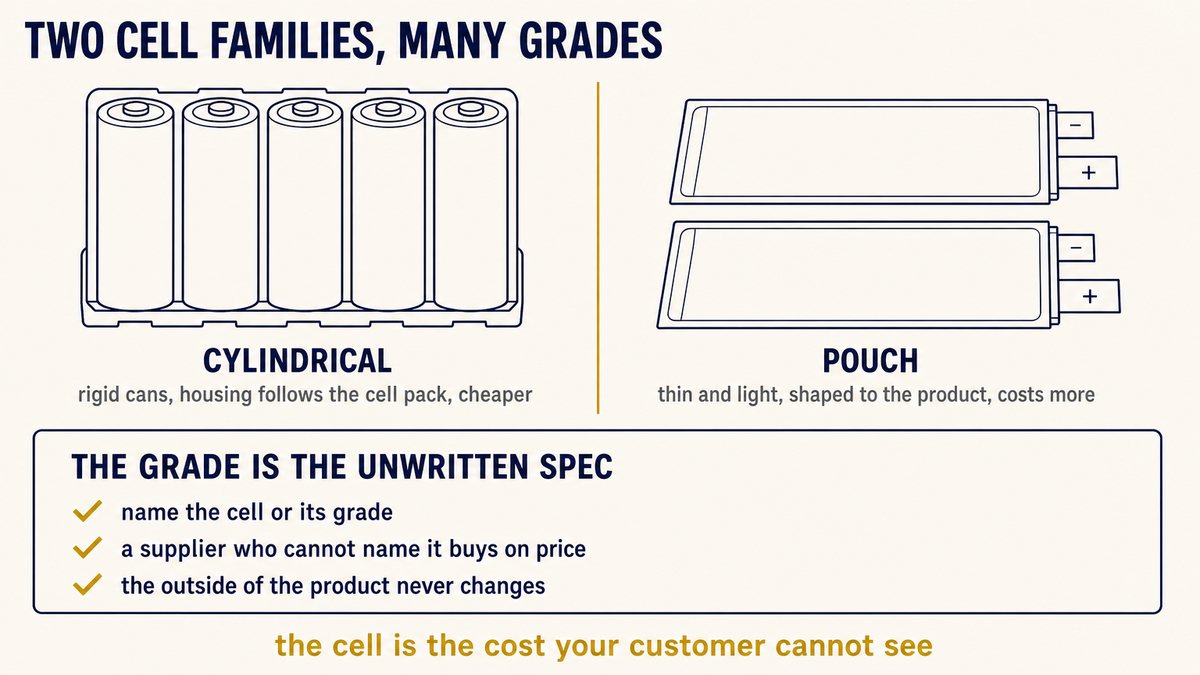
Everything else in a power bank is packaging around the cell. Two families dominate, and the choice affects the shape of the product, the cost, and what happens when it fails.
| Cylindrical cells | Flat pouch cells | |
|---|---|---|
| Shape | Rigid cans, packed side by side. | Flat laminated cells, built to almost any footprint. |
| What it means for the product | The housing follows the cell pack, so the product is chunkier and the case is simpler. Widely available in known sizes. | Thin and light, and the shape can be designed around the product rather than the other way round. Suits slim and unusual enclosures. |
| Cost | Generally cheaper for a given capacity, because the format is a commodity. | Costs more, and the tooling and assembly are less forgiving. |
| Where the risk sits | A single failed cell is more contained. | A pouch cell can swell, and swelling is the failure that deforms the housing and is visible to a customer. |
The grade is the specification you are not writing
Within either family, cells come in grades, and the grade is not something you can see or feel. The practical way to pin it down is to name the cell rather than describe it: ask for the cell manufacturer or the grade, and put it in the specification with the capacity and the watt-hour rating. A supplier who cannot name the cell they are using is buying on price that week, which means your second order may not match your first.
There is also a safety requirement that sits on the cell rather than on your product, and it is worth knowing because it is the thing that qualifies a cell to be shipped at all. Under the transport rules, each lithium cell or battery must be of a type proven to meet the criteria in part III, sub-section 38.3 of the UN Manual of Tests and Criteria, and the manufacturer has to create a record of that testing before offering the cells for transport, keep it while the design is in use and for a year afterwards, and produce it to a government representative on request.
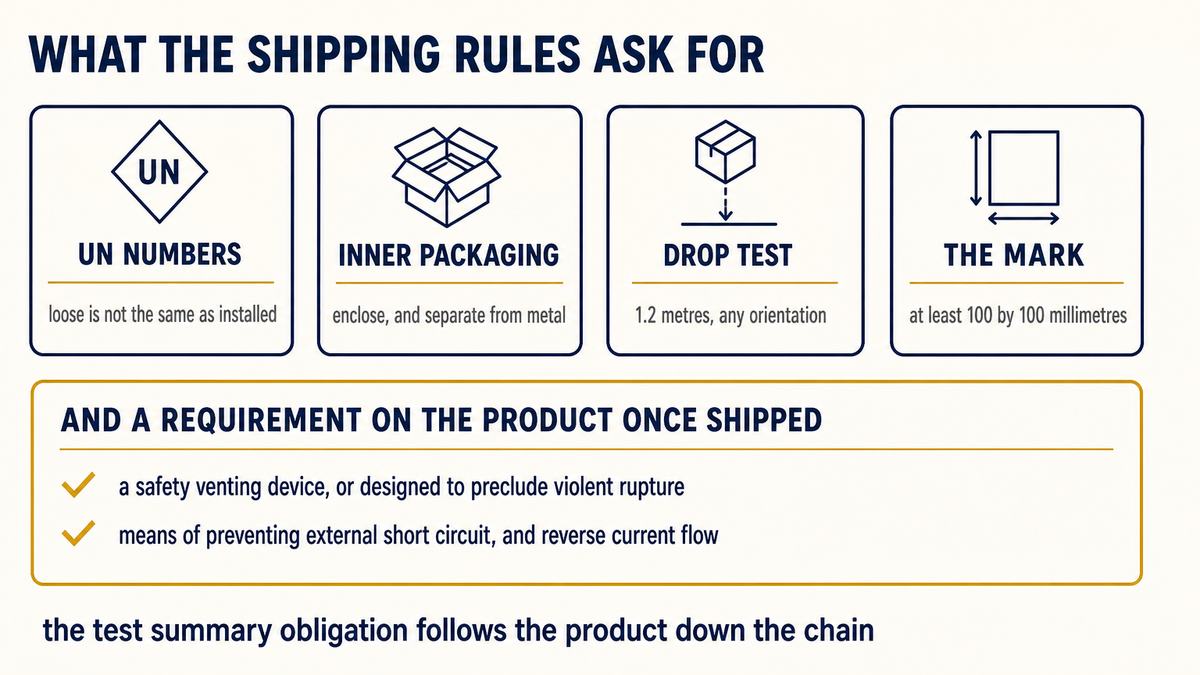
That is a test report that exists whether or not anyone shows it to you, which makes asking for it a reasonable request rather than an imposition. And the rule goes further, requiring each manufacturer and every distributor after them to make a test summary available — so the obligation follows the product down the chain, including to the party selling it to you.
4. Cables and Chargers: The Accessories That Fail the Bundle
If you sell a pack, you will probably sell a cable with it, and the cable is where the bundle quietly disappoints. Cables are also the cheapest part of the order to get wrong and the easiest to specify properly, because the differences are all measurable numbers that a supplier can state.
| What varies | Why it matters | What to ask |
|---|---|---|
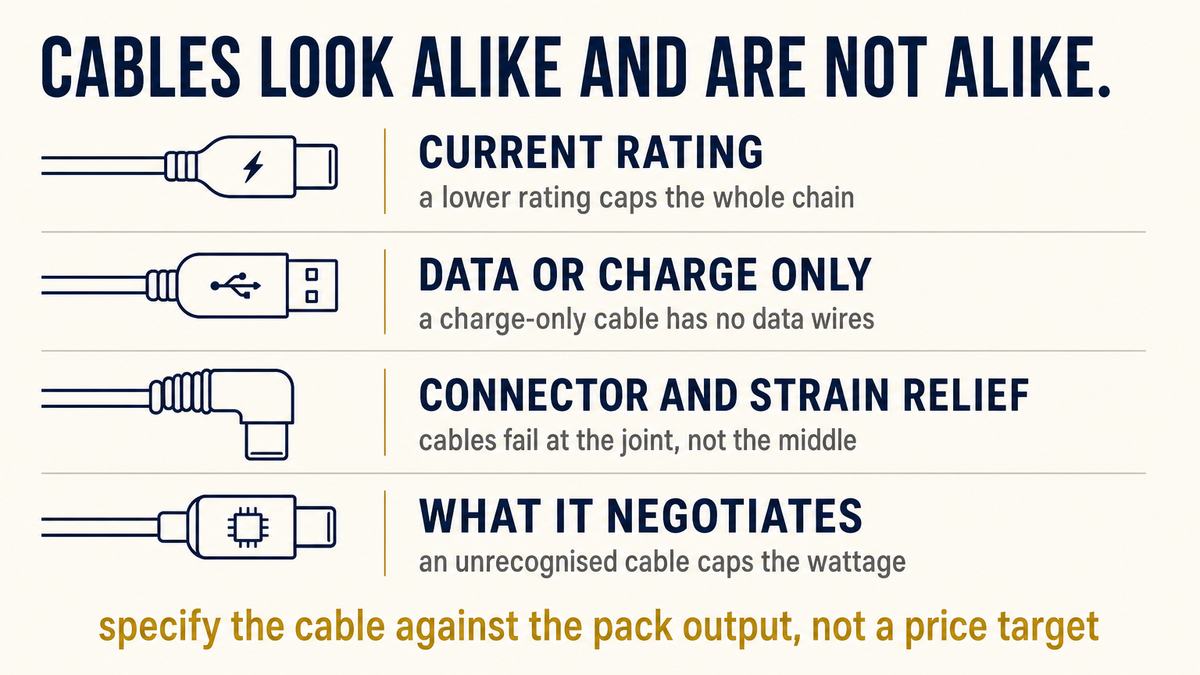
| Current rating | A cable rated for a lower current is the reason a fast charger charges slowly. The pack and the charger can both be capable and the cable still bottlenecks the whole chain. | The rated current in amps, as a number, with the wire gauge behind it. |
| Data or charge only | A charge-only cable has no data wires. It looks identical, costs less, and will not sync or transfer files. Selling one as a data cable is a complaint waiting to happen. | Whether it carries data, and at what speed. |
| Connector finish and strain relief | The connector is where a cable fails, and it fails at the joint between the plug and the cable rather than in the middle. Plating wears and the joint cracks. | How the strain relief is built, and how many bend cycles it is expected to survive. |
| What the cable negotiates | Higher-wattage charging needs the charger to ask the device for more power and needs the cable to be recognised as able to carry it. A cable that cannot be recognised caps the whole arrangement. | What the cable is rated to carry, and what it contains to allow the higher wattage to be negotiated. |
There is a design point here worth carrying into the product page. If a pack claims a high output wattage but ships with a cable that cannot carry it, the customer experiences the shortfall as a slow charge and blames the pack. Specify the cable against the pack's output, not against a price target, and check the pairing on a real device rather than reading two specification sheets side by side.
Wireless charging adds its own version of the same problem. A pad that advertises a high wattage delivers less than that at the device, because the coil loses energy in transmission and the phone will only accept what it is willing to accept. Ask for the delivered wattage rather than the advertised one, and if the supplier cannot distinguish between the two, you are reading a marketing number.
5. The Watt-Hour Line That Caps Your Product
This is the section that changes product decisions rather than documents them, and it starts with a number most buyers have never applied to their own range.
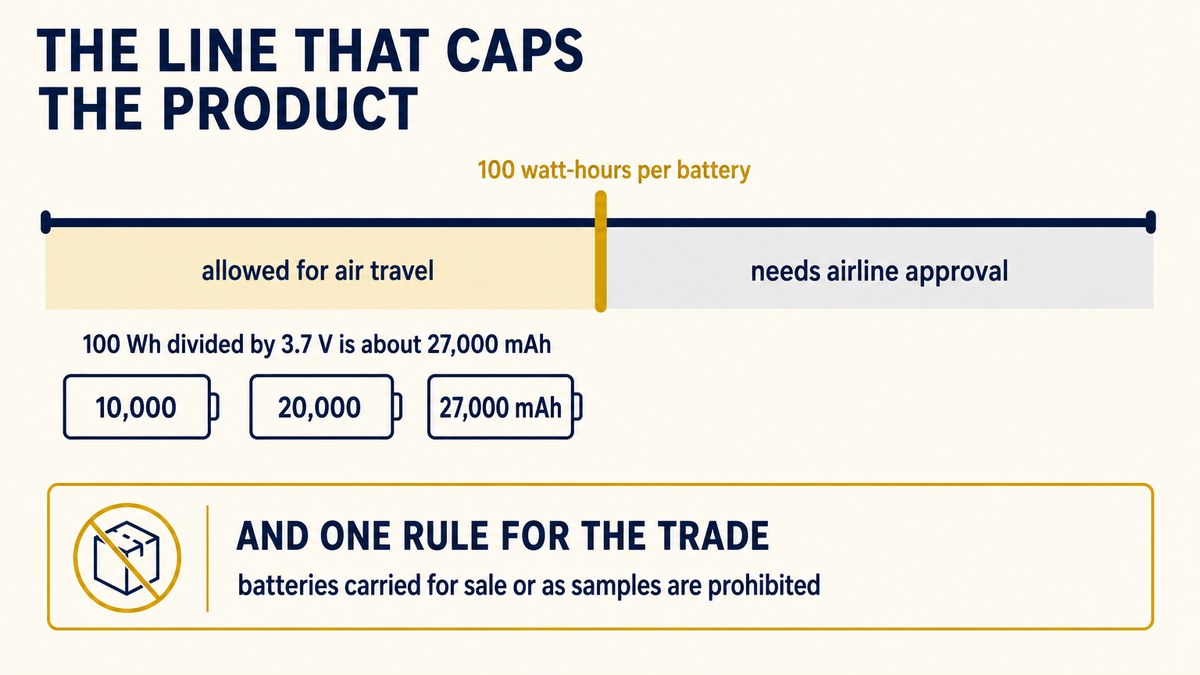
Spare lithium batteries, including power banks and portable rechargers, are treated as a separate category from batteries installed in a device, and the aviation rules cap them per battery. Lithium metal batteries are limited to two grams of lithium content each. Lithium ion batteries — which is what a power bank is — are limited to 100 watt-hours per battery. With airline approval a passenger may also carry up to two larger batteries in the 101 to 160 watt-hour range, and many airlines impose stricter limits of their own regardless of watt-hours, including how many power banks a passenger may travel with at all.
There is also a rule that matters specifically to anyone in this trade: batteries carried for further sale or distribution — vendor samples, for example — are prohibited, even though the same battery in the hands of a passenger who is using it is permitted. If you or your agent plan to carry samples of your own product in hand luggage, that rule is the one that applies to you.
The arithmetic that caps a single-cell-voltage pack
Watt-hours are calculated by multiplying the battery voltage by the amp-hours, which is the formula the aviation guidance itself gives. Turn that around and it produces a ceiling that most sellers never notice until a customer emails from an airport.
Take the 100 watt-hour limit and divide it by the cell's rated voltage. At 3.7 volts, 100 watt-hours is about 27,000 milliamp-hours. So a single-cell-voltage pack listed above roughly 27,000 mAh is over the per-battery limit for air travel, and your customer cannot legally carry it on a plane as a spare battery. Notice what this means commercially: the seductive move of winning a specification war by shipping a bigger number runs straight into a rule that makes the bigger number harder to sell. The three sizes that matter in this category — around 10,000, 20,000 and 27,000 mAh — are not arbitrary. They are the sizes that fly.
Two more details belong in the product file. The battery terminals must be protected from short circuit, which in practice means retail packaging, a protective pouch or taped terminals, and it is worth confirming how your packaging achieves it because the customer has to do the same thing when they travel. And since 10 May 2024, each lithium ion battery must be marked with the watt-hour rating on the outside case under the transport rules — so a pack that does not carry its watt-hour rating visibly is a pack that fails a rule as well as a customer check. A security officer reading a case with no watt-hour marking has nothing to compare against the limit.
6. What the Shipping Rules Require You to Hold
Power banks are dangerous goods when shipped, and this is not a formality — it decides how your order can travel, what the package must look like, and which documents you should be holding as the importer. The rules are detailed, and a few of the details are directly useful when you are briefing a supplier.
Every cell and battery carries a UN number, and the number changes with the situation. Loose lithium ion cells or batteries are marked UN3480, and lithium metal is UN3090. When the cells or batteries are contained in, or packed with, equipment, the number becomes UN3481 for lithium ion and UN3091 for lithium metal. So the same battery has a different marking depending on whether it is shipped loose or installed in the product, which is one reason a supplier shipping a sample pack and a finished product to you is shipping two different things.
Smaller batteries sit in an excepted category, and the thresholds are worth knowing. A package qualifies for the simpler route when the watt-hour rating does not exceed 20 watt-hours for a lithium ion cell or 100 watt-hours for a lithium ion battery, with separate limits for lithium metal by lithium content. Most consumer power banks fall inside that, which is why they can be shipped at all without a specialist freight arrangement — and it is another reason the per-battery ceiling shows up commercially as much as operationally.
Packaging is specified rather than described. Cells and batteries must be packed so they cannot short circuit, cannot be damaged by shifting, and cannot cause equipment to switch on accidentally. They go into non-metallic inner packagings that completely enclose them and separate them from other batteries, metal and equipment, and then into an outer packaging meeting defined performance requirements. The completed package has to withstand a 1.2 metre drop test in any orientation without damage and without its contents shifting into contact with each other, and one class of packages also has to survive a stacking load equivalent to identical packages stacked to three metres for 24 hours.
The mark itself has dimensions. The lithium battery mark is a rectangle or square with hatched edging, not less than 100 millimetres wide by 100 millimetres high, with the applicable UN number shown. A supplier shipping with a mark that is the wrong size is shipping with a non-conforming label, and it will be noticed.
And there is a design requirement on the product, not just the package. The rules require each lithium cell or battery to incorporate a safety venting device or be designed to preclude violent rupture under conditions normally incident to transport, to be equipped with means of preventing external short circuits, and — where a battery contains cells or series of cells connected in parallel — to be equipped with means of preventing dangerous reverse current flow, such as diodes or fuses. Those are all things a board design either does or does not include, which makes them worth confirming rather than assuming.
7. Certification: What to Ask For and What It Costs
Certification in this category is a fixed cost per model rather than a cost per unit, and that distinction should shape how you plan a range.
Transport testing follows the cell. The UN 38.3 testing described in the previous section is what makes a cell shippable, and it is per cell or battery type rather than per finished product. If you change the cell, you have changed the type, and any documentation that came with the old one describes a different product.
Safety testing follows the product. This is where the per-model cost lands, and where a range of four capacities and two shell colours can quietly become eight testing bills rather than two. The practical consequence is that a wide range is more expensive than it looks at the quotation stage, and that consolidating to fewer models is a commercial decision as much as a catalogue one.
Ask what your buyer will ask for. If you are selling to a retailer or a marketplace rather than direct, work out what that channel requires before you commission testing, because testing done for a channel you are not selling into is money spent twice. Ask the supplier which certifications their existing customers ask for, and treat the answer as market intelligence rather than as a sales pitch.
One habit saves real money here. Commission the testing on the model you intend to sell most of, get that product fully documented, and expand the range only once the first model is selling. Certification is the cost in this category that most often catches a first-time seller out, because it does not scale down with a small order the way the unit price does.
8. How to Test a Power Bank Sample
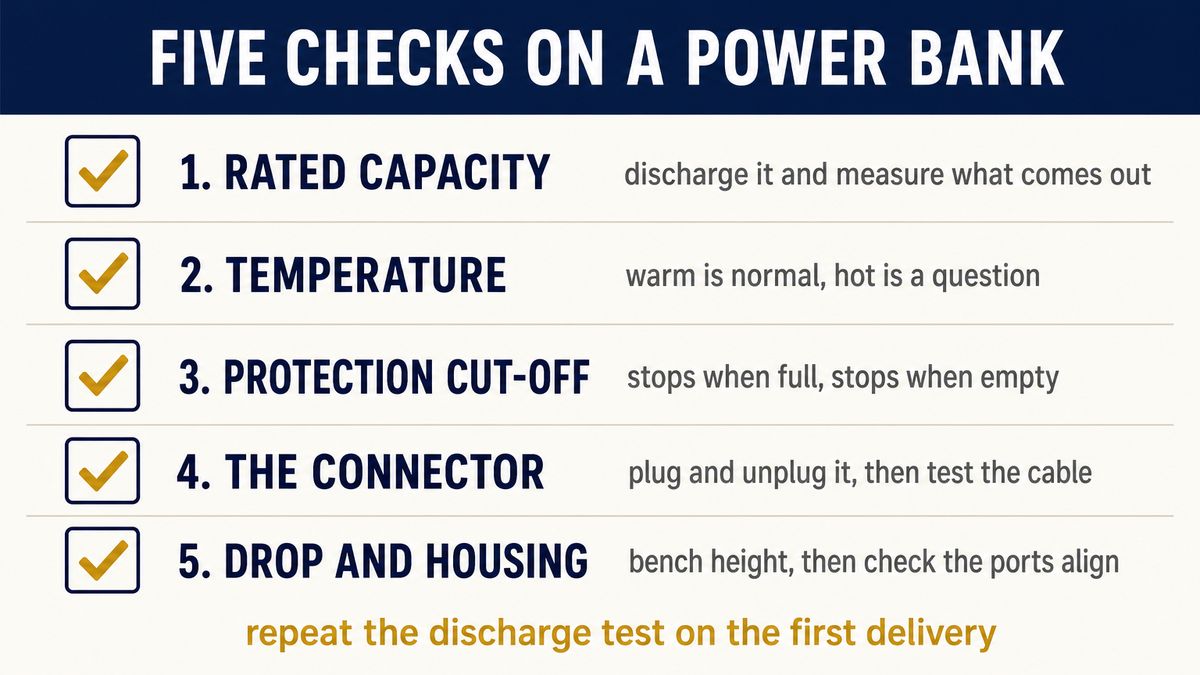
A power bank can be tested more thoroughly than almost any product in this project, because the thing that matters most is a number rather than an appearance. Five checks cover it, and only the first needs a measuring device.
- Rated capacity, by discharge. Charge the pack fully, then discharge it into a known load while measuring the energy delivered, and compare that with the rated capacity the supplier quoted. This is the test that answers the capacity question with a number instead of an argument, and it is the one customers cannot run themselves.
- Temperature rise under load. Feel the pack and the cable while discharging at the maximum rated output. Warm is normal; hot to the touch is a board and protection question, and it is worth stopping the test and asking the supplier before proceeding.
- Protection cut-off. Confirm the pack stops charging when full, stops discharging when exhausted, and does not allow the ports to output when it should not. Ask the supplier which protections the board includes, then check the two you can check by using the product.
- The connector, by use. Plug and unplug the cable repeatedly and check that the connection stays firm rather than loosening. Then check the cable against a real device at the pack's maximum output, because a bundled cable that cannot carry the wattage turns a good pack into a slow one.
- Drop and the housing. Drop the pack from bench height onto a hard floor, then confirm the housing has not split and the ports still align. A pack is carried in a pocket or a bag and will be dropped, and this is the check that finds a thin shell.
Then repeat the first check on the first delivery rather than trusting the sample, because capacity is the specification most likely to drift between batches when the cell being used changes. Our pre-shipment inspection guide covers how to write the brief so it comes back with measurements rather than an opinion, and our first article inspection guide covers agreeing the reference before production rather than after delivery.
9. Minimum Order, Tooling and the Private Label Route
Three things drive the minimum on a power bank order, and the first is not the one buyers expect.
What the supplier pays for cells sets the floor. Cells are bought in quantity and the supplier's buying minimum for a given grade is passed on to you. A standard capacity in a common cell size can be ordered in surprisingly small numbers because the cells are a stock item. An unusual capacity, or a named cell grade, may push you into a full carton of cells.
Tooling applies to the shell, not the electronics. A stock housing with your printing is a low entry point. A custom housing needs tooling before anything can be moulded, which is a one-time cost that belongs on the quotation as its own line — the same structure that applies to any moulded product, where the die is paid once and the unit cost falls as the run gets longer. Ask for the tooling drawing and for the ownership of the tool to be written into the agreement before the die is cut.
Certification is charged per model. As covered above, this is the cost that makes a wide range expensive, and it is the cost that does not fall with a smaller order. Budget it per model rather than per unit.
| Route | What you pay for | What it means |
|---|---|---|
| Stock pack, stock capacity, your printing | Print set-up, and the supplier's existing documentation | The lowest entry point, and the fastest to market. You are relying on the supplier's existing testing rather than your own, so ask to see it. You do not own the shell. |
| Stock pack, your own capacity and cell grade | A different cell plus printing, and testing for the new configuration | A middle step that changes the product rather than the label. Confirm what the capacity change does to the existing documentation before you commit. |
| Your own shell and board | Tooling, board development, and certification per model | The only route to a product nobody else sells. It also carries the fullest testing and documentation burden, so plan it as a project rather than an order. |
One point specific to this category, because it catches sellers out. The paperwork obligation does not end when the goods clear customs. Under the transport rules the test summary requirement runs down the chain through each distributor, and the records have to be kept for as long as the design is offered and for a year afterwards. So the documents belong in a file you keep rather than in an email you received once, and if you change supplier you need the documents for the product you are actually shipping.
10. A Five-Step Sourcing Roadmap
- Specify the cell and the watt-hour rating, not just the milliamp-hours. Name the cell or its grade, state the watt-hour figure, and treat a supplier who cannot name the cell as one who is buying on price this week.
- Publish the rated capacity, and check it by discharge. The stored figure and the delivered figure are different numbers, and the honest one prevents the complaint the dishonest one creates.
- Stay under the air travel ceiling unless you have a reason not to. About 27,000 mAh at 3.7 volts is the line, and a pack above it is harder for your customer to use and to travel with.
- Collect the test summary before the first shipment and check it against the required contents rather than filing it unread. Keep the records for the life of the product plus the period the rules require.
- Pair the cable with the pack and test the pairing on a real device. Then repeat the discharge test on the first delivery, because capacity is the specification most likely to drift.
Everything in this guide sits inside our Electronic Products sourcing hub, which collects the consumer electronics and accessory guides in one place.
11. Frequently Asked Questions
Why does my 10,000 mAh power bank not charge my phone twice?
Because the capacity is quoted at the cell and delivered at a higher voltage, and raising the voltage costs energy. The stored figure is milliamp-hours at the cell's rated voltage; the output figure is milliamp-hours at a raised voltage, and the conversion itself loses energy and produces heat. Take a 10,000 mAh pack at 3.7 volts: that is about 37 watt-hours stored. Delivered at 5 volts, 37 watt-hours is roughly 7,400 mAh before any losses, and conversion losses of around 15 percent bring it to something near 6,300 mAh — which is the number a customer actually measures. So the gap is normal rather than a fault, but it becomes a complaint when the product page only prints the cell figure. Publishing the rated capacity alongside it is the cheapest fix available.
Can I take my own power bank samples on a plane?
Not as samples for sale. Spare lithium batteries, power banks and portable rechargers are treated as a separate category from batteries installed in a device, and they must be carried in carry-on baggage rather than checked, with terminals protected from short circuit. On top of that, batteries carried for further sale or distribution — vendor samples, for example — are prohibited, even though a passenger can carry the same battery for their own use. So a trade sample in your hand luggage is a different matter from your own charger, and if you need to move samples across borders the answer is to ship them properly rather than carry them.
Is there a maximum size a power bank can be?
There is no general maximum, but there is a line that matters commercially. Lithium ion batteries are limited to a rating of 100 watt-hours per battery for passenger air travel, with up to two larger batteries in the 101 to 160 watt-hour range permitted with airline approval. Divide 100 watt-hours by the cell's rated voltage and you get about 27,000 milliamp-hours at 3.7 volts, so a single-cell-voltage pack listed above that is over the per-battery limit as a spare. Many airlines also set stricter limits of their own, including how many power banks a passenger may travel with regardless of watt-hour capacity. The practical result is that the popular sizes cluster just under the line, and that competing on a bigger number runs against a rule.
What documents should I hold for a power bank I import?
At minimum the test summary required by the transport rules, which each manufacturer and every distributor after them of lithium cells and batteries must make available for cells and batteries manufactured on or after 1 January 2008. The obligation follows the product down the chain, so it reaches whoever sells to you, and the rule sets out what the summary has to contain rather than leaving it to the writer. It should carry the cell, battery or product manufacturer's name and contact details, the test laboratory's name and contact details, a unique test report identification number, the report date, a description of the cell or battery including its chemistry, mass, watt-hour rating or lithium content and model number, the list of tests with a pass or fail result for each, a reference to assembled battery testing where applicable, the edition of the UN Manual of Tests and Criteria used, and the name and title of a responsible person. A one-page certificate missing the laboratory or the pass and fail list is not that document.
Which part of a power bank is most likely to be downgraded?
The cell, and it is the part your customer cannot see. Everything else in the product is either visible or measurable at the surface: the housing is visible, the ports are visible, the cable can be handled. The cell sits inside, and nothing about the outside of the product changes when a cheaper grade goes in. That is why the specification should name the cell or its grade rather than describing the capacity, and why the discharge test is worth running on the first delivery rather than only on the sample. A supplier who cannot tell you which cell they are using is buying on price each time, which means your second order may not match your first.
Are the cables in the box as important as the pack?
Yes, and they are the cheaper mistake to avoid. A cable has a current rating, and a cable rated below the pack's output caps the whole chain, so a capable pack with a weak cable charges slowly and the customer blames the pack. Cables also differ in whether they carry data at all: a charge-only cable has no data wires, looks identical to a data cable and costs less, so selling one as a data cable produces a complaint the moment somebody tries to sync. Ask for the rated current as a number, ask whether it carries data and at what speed, and ask what the cable contains to let the higher wattage be negotiated between a charger and a device. Then test the pairing on a real device, because two specification sheets read side by side will not tell you how they behave together.
Get the Cell, the Watt-Hour Rating and the Documents Specified Before You Order
Our team names the cell and its grade rather than just the capacity, keeps the watt-hour rating inside the air travel ceiling, pairs the cable with the pack's output, checks the test summary against what the rules require it to contain, and runs the discharge test on the first delivery.
Request a Power Bank Sourcing Quote
Questions & Comments
We read every one and reply within 24 hoursCOMMENTS INTRO FOR THIS ARTICLE — write a topic-specific question prompt here.