
Dog Harness Wholesale: Sourcing Walking Gear From China
 ·
Updated October 11, 2026
·
18 min read
A dog harness is the only pet product most buyers will ever source that is asked to hold a moving animal under load. That single fact reshapes the whole order. Webbing has a breaking strength, a D-ring has a rated load, and a row of stitching either spreads the force or concentrates it — and none of that is visible in a product photograph, which is exactly why two suppliers can quote the same-looking harness at prices that differ by half. This guide covers the three harness constructions and what each one asks of your customer, how harness fit is measured and why it is not the same as coat fit, where the load actually goes when a dog pulls, what a walking-gear specification has to state, how the price is built, what goes wrong, and how to check a supplier before the container leaves.
What You Are Buying, and the Line That Decides It
| If you want | What it means in practice | The line on your order that decides whether it works |
|---|---|---|
| A harness that fits a range of dogs | Every adjustment point is a place the harness can be got wrong | The girth range each size must cover, not a single chest figure |
| A harness that does not slip under load | The force goes through webbing, stitching and one metal part | The stitching pattern at the D-ring, and the load it was tested at |
| Hardware that survives weather and salt | Plated parts look identical to solid ones on a sample | The metal and the finish, named, with the corrosion test behind it |
| Colours that match across orders | Dyed webbing and dyed thread vary between lots | The dye lot rule — weaving and thread are dyed separately |
| A lead and collar that match the harness | Same webbing, same hardware, same factory, one order | That all three are cut from the same webbing lot |
What Are the Three Harness Constructions, and Which Should You Sell?
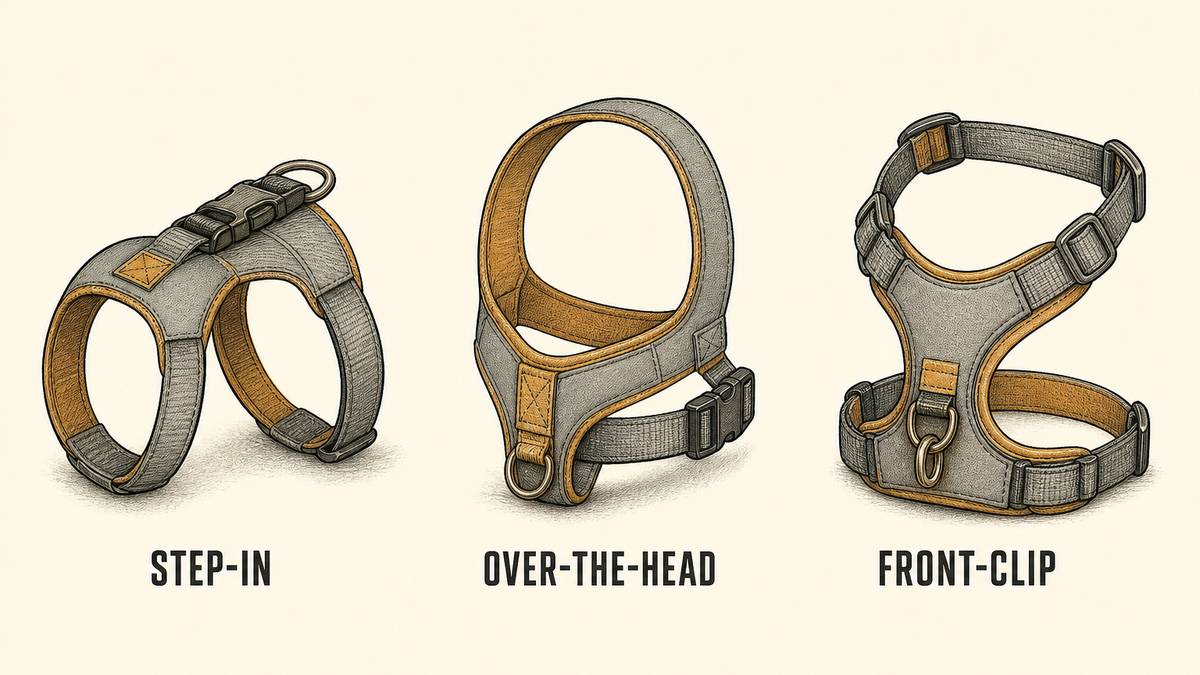
Almost every harness you will source is one of three constructions, and the choice decides your fit complaints, your return rate and your price point far more than the colour range does.
Step-in. The dog steps into two loops and the harness closes over the back, usually with a quick-release buckle. It is the easiest to put on and the most popular for small and medium dogs, and it is the construction most exposed to a sizing complaint, because the adjustment range is narrower than it looks. A step-in that sits slightly wrong slides into the armpit on a walk.
Over-the-head. The head passes through a fixed opening and the harness fastens at the chest and girth. The opening is not adjustable, so this construction lives or dies on the neck measurement, and the trade-off is that a dog with a wide head and a narrow neck is difficult to fit at all.
Front-clip no-pull. The lead attaches at the chest rather than the back, so a dog that pulls is turned rather than restrained. This is the construction that carries the highest load on a single point, which makes the D-ring, the webbing and the stitching around it the whole product. It is also the construction where a cheap version is most obviously cheap, because the failure is immediate and violent rather than gradual.
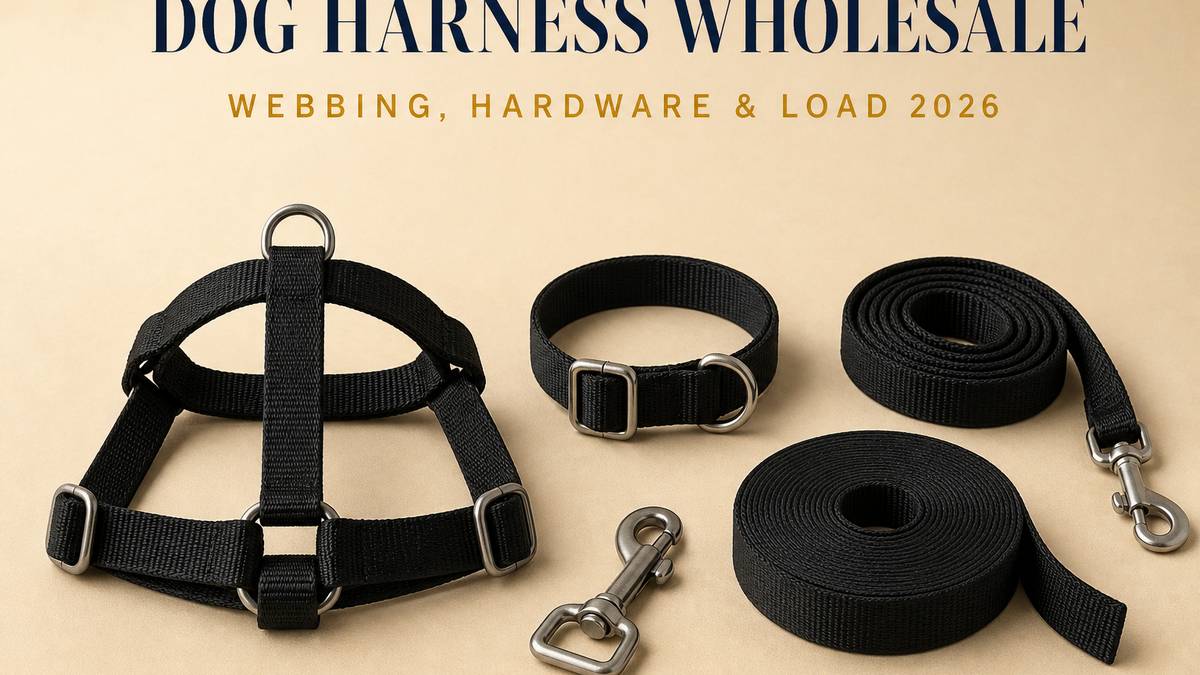
Two commercial points follow from the construction. First, the three do not share pattern pieces, so a supplier who makes one well is not automatically able to make the others — ask which constructions are actually on their line. Second, a collar and a lead are the natural companions to any harness: the same webbing, the same hardware and usually the same factory. Buying all three together is how most wholesale buyers in this category get their price, and it is also why the words collars, leads and harnesses appear together on the same supplier page.
How Is a Harness Measured, and Why Is It Not Coat Sizing?
Because a coat sits on a dog and a harness is pulled against one. A coat that is a centimetre out hangs slightly wrong. A harness that is a centimetre out either slides, or presses, or lets the dog back out of it under load. That makes the measurement points different and the tolerances tighter.
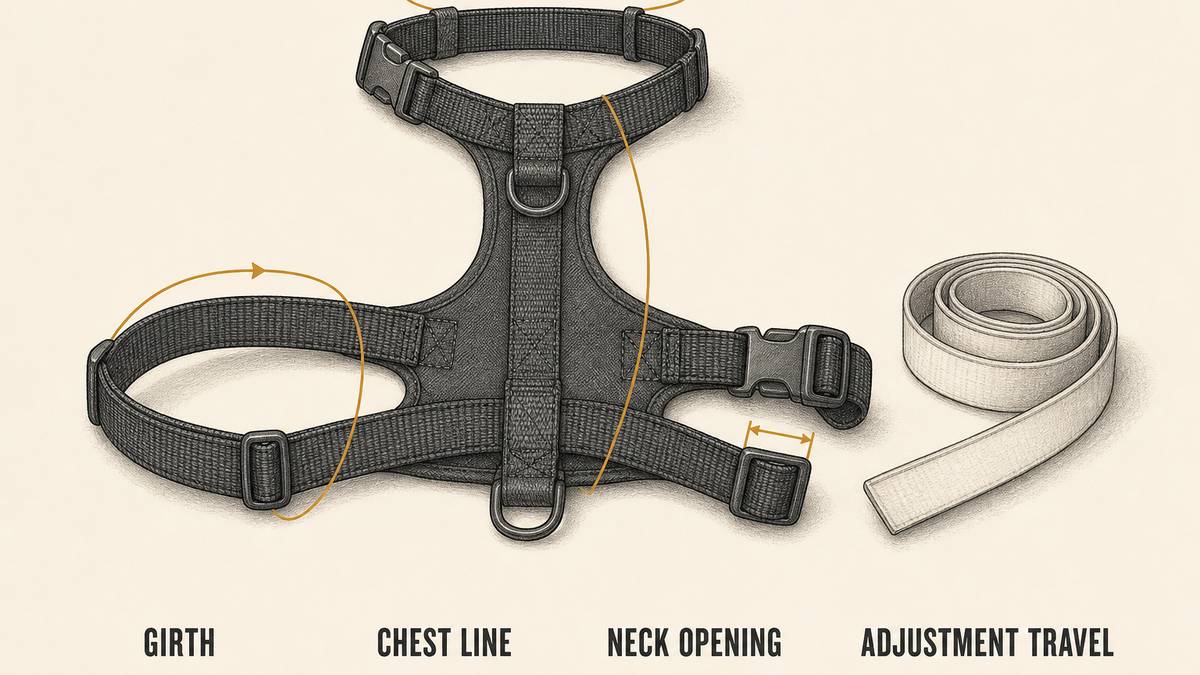
- Girth, behind the front legs
- The circumference at the deepest point of the ribcage, which is where the harness carries its load. This is the measurement every size is built around, and it needs a range rather than a figure, because it is the adjustment that has to accommodate the difference between one dog and the next.
- Chest line
- The distance along the dog's underside from behind the front legs forward to the base of the neck. This is what stops a harness rotating forward on a deep-chested dog, and it is the measurement buyers forget to state, which is why so many harnesses end up sitting on the throat.
- Neck opening
- Only truly fixed on the over-the-head construction. State it as a range even when the harness is adjustable, because a neck opening that is too generous is how a dog backs out of a harness.
- Adjustment travel
- How much webbing the slider can actually take up. Two harnesses carrying the same size label can differ by several centimetres of travel, and travel is the number that decides how many of your customers the size actually covers.
The practical consequence is that your size chart should be built from an adjustment range rather than from a middle figure with a tolerance. Write each size as the span it covers — say a girth band from one number to another — and then make the sample prove the two ends of that band rather than the middle. That is what the size-run arithmetic in the size chart for a dog harness in us sizes comes down to in practice, and it applies to a harness more strictly than it does to a garment, because a harness has no slack to give.
Where Does the Load Actually Go When a Dog Pulls?
Into one junction. A harness looks like a network of straps, but when a dog lunges, the whole force arrives at a single point — the D-ring or the front clip — and from there it is spread only by the webbing and the stitching immediately around it. Everything else on the harness is comfort.
That junction is built from four things, in order of how often they are under-specified:
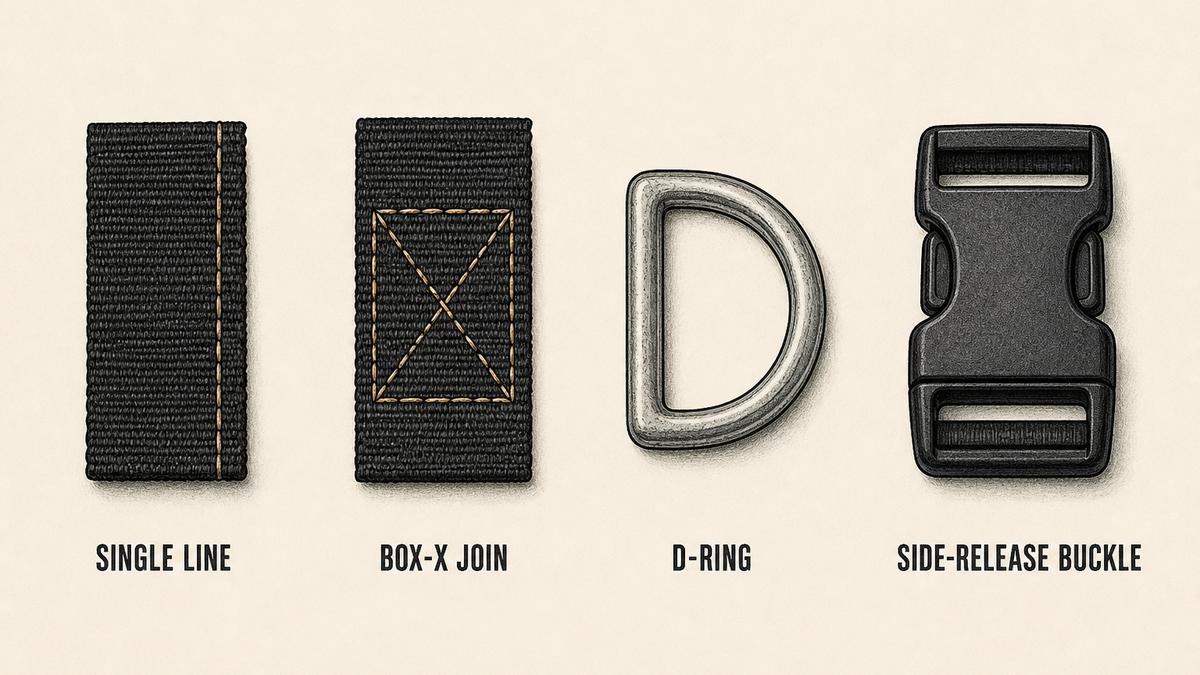
The stitching pattern at the load point. A single row of straight stitching along a webbing edge is the default because it is the fastest to sew. It also concentrates the whole load on one line of thread. A box-X pattern — a rectangle of stitching with two diagonals across it — spreads the same load over a larger area and adds a mechanical stop if a thread breaks. Bar tacks at the ends do the same job locally. This is the single cheapest upgrade on the whole product and the one most often left out of a quotation, because the difference between the three patterns is invisible at arm's length.
The webbing itself. Width and construction decide what the strap can carry. A narrower or more loosely woven webbing of the same colour and thickness carries less, and it also stretches more, which is what makes a harness feel like it is giving when a dog pulls. State the width in millimetres and the breaking strength, and say how it is tested, because a figure without a method is not a limit.
The metal part. A D-ring is not just a shape; it is a material, a gauge and a finish. Plated steel and solid stainless look the same on a sample and behave differently after a season of wet walks and road salt. Ask for the base metal and the finish by name, and ask what the corrosion test was.
The buckle or slider that takes the webbing. This is the part that fails quietly rather than loudly. A slider that grips well when new but loses tension after a few hundred adjustments lets the harness grow on the dog, and the customer experiences that as the harness slipping rather than as the slider wearing.
One point about standards, because it changes how you write the order. Pet harnesses and leads do not sit under a mandatory safety standard of their own, the way a child's product or a food-contact item does. There is no rule that tells a supplier what a D-ring must hold. That is not a reason to skip the specification — it is the reason the specification is the product here. If nobody is going to test it for you, the only thing standing between your brand and a failed harness is the number you wrote down and the sample you kept. What does apply to the shipment is ordinary import law, including country-of-origin marking under 19 CFR Part 134, and if the webbing or the thread will sit against skin and fur for hours, harmful-substance expectations are worth settling up front — the OEKO-TEX system at oeko-tex.com is the reference most webbing mills already understand.
What Has to Go Into the Specification?
Seven lines carry the risk on this product family. Four of them are about the load path, and three are about the parts of the order that get lost between the sample and the container.
- Webbing width and breaking strength, with the test method. Give the width in millimetres and a minimum breaking strength, then name how it is tested and on what length. A strength figure without a method is a number a supplier can agree to and then argue about.
- Stitching pattern, thread and stitch density. Name the pattern at every load point — box-X, bar tack, or plain — and the thread, because a strong pattern sewn in a weak thread is a strong pattern on paper only.
- Hardware, by material and finish. Base metal, finish, and gauge. Add the corrosion test you will accept. This is the line where a quotation most often goes quiet, and silence on this line is the answer.
- Buckle and slider performance. State what happens after repeated adjustment, not just at first use. A cycle figure or a stated holding force turns a vague worry into a limit a factory can test.
- Colour control across webbing, thread and hardware. Webbing is dyed, thread is dyed separately, and coated hardware is finished separately, so three lots have to agree. State the standard you approve against and what you do with a batch that is outside it.
- Reflective trim, by class and by placement. Where it is placed decides whether it does anything. A strip that only faces backwards is decoration; state the placement and the reflective performance separately.
- Labelling, packing and origin marking. Size marking that survives washing and wear, the care wording if you print one, the cartons, and the origin mark the shipment needs. The fibre-labelling rules that govern apparel for people — the textile rules in 16 CFR Part 303 — are not written for pet gear, which means the label is your choice rather than a legal floor. Most careful buyers label to a human-apparel standard anyway, because it costs little and answers the question before a retailer asks it.
If the walking gear carries a printed or embroidered brand mark, the way it is applied decides whether it survives a muddy season, and the trade-offs between the common methods are compared in embroidering a logo onto a dog harness. On webbing, the method that lasts is usually the one that goes through the material rather than onto it.
How Is the Wholesale Price Actually Built?
Walking gear is cheap per unit and expensive per order, and the arithmetic is unusual enough to be worth stating. Four things move the price.
- Hardware, by far the largest swing. The metal parts and the buckles are where a quotation is won or lost. The same harness with a zinc-alloy snap hook and with a stainless one are different products at different prices, and only one of them is a no-pull harness you can put your brand on.
- Webbing, bought by the roll. Webbing is bought in rolls and dyed in batches, so the cost per harness moves with the width and with how much of the roll your size run actually uses. Narrower webbing saves money and reduces the load rating, which is exactly the substitution to watch for.
- Stitching labour. This is the line that makes a cheap harness cheap. Box-X stitching at every load point takes measurably longer than a straight run, and it is the first thing removed to hit a target price.
- Minimums by colour and by hardware finish. Webbing has a dyeing minimum, and coated hardware has a finishing minimum, and the two are different. Four colours can mean four webbing minimums plus a hardware minimum that has nothing to do with colour, which is why a broad first range costs more than the work suggests.
One structural point that helps here: this is a small, light, high-margin-per-kilo product, so freight behaves the way it does for apparel and the opposite way to pet food. A carton of harnesses pays for volume rather than mass, which means the freight share of your landed cost is small and the hardware decision is large. The full method for that arithmetic is set out in what a dog harness order costs once it has landed.
What Goes Wrong?
Four failures account for most of what comes back from a walking-gear order, and three of them happen quietly before the customer notices the fourth.
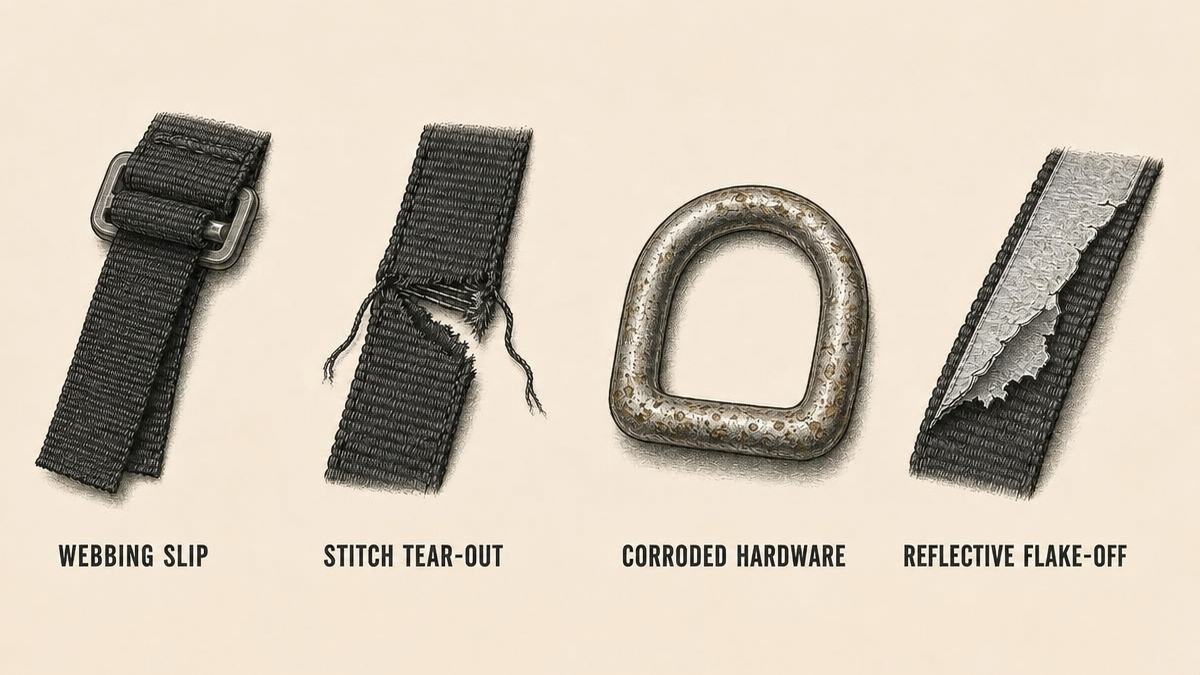
- The harness grew on the dog
- A slider lost its grip and the webbing slipped through it, so a harness that fitted in the shop no longer fits on a walk. It is the most common complaint in the category and it reads to the customer as a sizing failure, not a hardware failure.
- The stitching pulled out at the load point
- A single line of stitching on a webbing edge failed under load and the strap separated. This is the failure that becomes a safety incident rather than a return, which is why the stitching pattern belongs on the order rather than in a supplier's default settings.
- The metal corroded
- A plated part went dull and rough after a wet winter, and the roughness is what abrades the webbing running through it. A product that was fine on arrival starts eating itself in the second season.
- The reflective trim stopped reflecting
- A surface-applied strip flaked or dulled, so a product sold partly on being seen at night quietly stopped doing that. Nobody complains, which is why it is worth inspecting rather than asking about.
All four are settled by a line on the order and a sample you keep. The reason walking gear punishes a thin specification more than most categories is that the customer has no way to check any of this before buying — they can only find out by trusting your brand and walking the dog.
How Do You Check a Supplier Before You Commit?
Four checks, in order, each making the next cheaper. On this product they are unusually worthwhile, because the things that matter are the things a photograph cannot show.
Find out who is actually making it. Webbing, hardware and stitching are three different supply chains, and a trader can put a harness together from all three without owning any of them. That matters because the hardware is where your risk sits, and a trader who cannot tell you which mill the webbing came from cannot answer a question about corrosion. The general method is the same as any category, set out in whether a dog harness plant is a plant or a reseller.
Ask for the load point, specifically. Ask what stitching is used where the load arrives, and what it was tested at. A supplier who answers with a pattern and a figure is a supplier who has thought about it. A supplier who answers with “strong” has told you the specification does not exist yet.
Cut a sample open, or buy two and destroy one. This is the check that has no substitute. Put a sample in a vice or under a car jack and load the D-ring until something gives, and note what gave first — the stitch, the webbing, or the metal. Then check the certificate the supplier offered against the issuer's own record rather than trusting the scan, using the approach described in the dog harness certificate, checked in the certifier's own register.
Inspect before it ships. On walking gear the inspection is mostly about hardware and stitching rather than about webbing: that the load points are stitched to the agreed pattern, that the metal parts are the agreed material and finish, that the colour across webbing, thread and hardware actually agrees, and that the cartons and marks are right. None of that shows in a photograph, so loading a harness from the batch rather than flexing it is the check that counts, and the order size settles how many harnesses to test. Because the failures here are physical rather than visual, pull pieces and load them rather than lining them up for photographs.
Where Does a Cheap Quotation Get Its Money Back?
A cheap harness quotation is usually a real price for a different product. Five lines go missing, and on this product family they go missing in a consistent order.
- The stitching pattern. Straight stitching where the order asked for a box-X join. It saves minutes per piece, it is invisible on the finished harness, and it is the reason a cheap no-pull harness fails under exactly the load it was bought for.
- The webbing width or construction. Slightly narrower, or more loosely woven, at the same colour and the same thickness on the outside. It carries less and it stretches more, and neither shows up until the harness is on a dog that pulls.
- The metal. Plated instead of solid, lighter gauge, or a different alloy under the same finish. This is the substitution that costs the most later, because corrosion turns the hardware abrasive and the harness then damages its own webbing.
- The slider. A weaker grip that loses tension after repeated adjustment. Nobody tests it, because testing it means adjusting it hundreds of times.
- The trim. Surface-applied reflective tape instead of a woven or sewn reflective element, at a lower class. It looks identical in daylight and fails after a season.
The way to close those five lines is to put them on the enquiry rather than raise them later: ask for the stitching pattern, the webbing specification, the base metal and finish, the slider performance and the reflective class as part of the quotation. A supplier who can answer all five is quoting on your product. Walking gear is a good category to be in precisely because the customer cannot check any of it — which means a brand that does the work once owns something its competitors have to earn back. For contrast, the sibling categories in Pet Supplies carry completely different risks: pet apparel stands or falls on its size chart, which is what the guide to dog clothes wholesale works through, and the construction trade-offs that decide whether a toy survives its first week are covered in the guide to what goes into making a pet toy, while the import rules that a harness never has to clear are set out in private label pet food, from formula to bag.
Frequently Asked Questions
What is the minimum order for dog harness wholesale?
Two minimums apply and the larger one decides. Cutting and stitching set a minimum per style, and the webbing has a dyeing minimum per colour, while coated metal hardware can carry its own finishing minimum. Because the webbing minimum is usually the largest, a first order in one or two colours can start far smaller than the same order spread across five. Ask for the webbing minimum and the hardware minimum separately, since suppliers tend to quote only the bigger of the two.
Do dog harnesses have to meet a safety standard?
Not a mandatory one of their own. Unlike food-contact items or products for children, pet harnesses and leads are not covered by a rule that tells a supplier what the webbing or the D-ring must hold. What does apply to your shipment is ordinary import law, including country-of-origin marking. The practical consequence is that your specification is the quality floor: if you do not write a breaking strength, a stitching pattern and a hardware material, nobody else will.
Should I sell a step-in or a no-pull harness?
They do different jobs and they fail differently. A step-in harness is the easiest to put on and suits small and medium dogs, but its adjustment range is narrower than it looks, so sizing complaints are common. A front-clip no-pull harness puts the whole load on a single chest point, which makes the stitching and the hardware the entire product. If you sell a no-pull harness cheaply, you are selling the one construction where a thin specification becomes a safety incident rather than a return.
Why does the same harness size fit some dogs and not others?
Because a size is a girth range, not a girth figure, and the adjustment travel is what actually covers the difference. Two harnesses marked the same size can differ by several centimetres of travel. Build each size as the span it covers, then make the sample prove both ends of that span rather than the middle. Weight should not appear in the chart at all, since two dogs of the same weight can differ widely around the ribcage.
Can I order a harness, collar and lead as one matching set?
Yes, and it is usually the cheapest way to buy walking gear, because all three use the same webbing, the same hardware and often come off the same line. The one line to add to the order is that all three are cut from the same webbing lot, otherwise the collar and the harness can arrive in shades that were meant to match. The general framework for putting your own brand on an imported product is covered in how private label works on a dog harness order.
How do I stop the harness from slipping while the dog is wearing it?
Specify the slider rather than the harness. Slipping almost always comes from an adjuster losing grip after repeated use, not from the webbing being the wrong length, so the line that controls it is the holding force or the adjustment cycles the slider must survive. It is worth testing a sample by adjusting it many times before you commit, because this failure cannot be seen on a new product and it will not appear in a photograph.
Send the load point, not just the look
Tell us which construction you want — step-in, over-the-head or front-clip — the girth range each size must cover and the adjustment travel you will accept, the neck and chest measurements, the webbing width and the breaking strength with the test method, the stitching pattern you require at every load point, the base metal and finish of the hardware with the corrosion test behind it, the slider performance, the reflective class and placement, whether the order is a matching harness, collar and lead set, the colours and the minimums they imply, and your target volume. Those answers settle the load path and the hardware before a price means anything. We will come back with the construction we recommend and why, the specification with a method attached to every limit, the two minimums separated so you can see which one is actually binding, a sampling and testing plan that loads a sample rather than photographing it, and the webbing, hardware and stitching costs shown as separate lines.
Request a Walking Gear Sourcing Quote
Questions & Comments
We read every one and reply within 24 hoursComparing dog harness quotations, or looking at one that has already failed? Post the webbing width, the hardware, and the load path the supplier described, and we can usually say which lines are missing. If a harness has come back with a stitch line that pulled or a buckle that slipped, describe where it gave and we will narrow it down.