
Dog Bed Wholesale: Sourcing Pet Beds From China
 ·
Updated October 11, 2026
·
18 min read
A pet bed is the one pet product where the customer finds out whether you got it right three months later. Nothing breaks, nothing leaks and nothing fails an inspection — the foam simply flattens, the cover shrinks in the wash, and the bed that looked generous in a photograph turns out to be too small for the dog it was bought for. That is why a dog bed order is decided by three numbers that almost never appear on a quotation: the density of the foam, the size of the sleeping area rather than the footprint, and what the cover does after a hot wash. This guide covers the three bed constructions and what each one asks of your customer, how a bed is measured and why the inner area is the number that matters, how the layers are built and what each one is for, what a bed specification has to state, how the price is built, what goes wrong, and how to check a supplier before the container leaves.
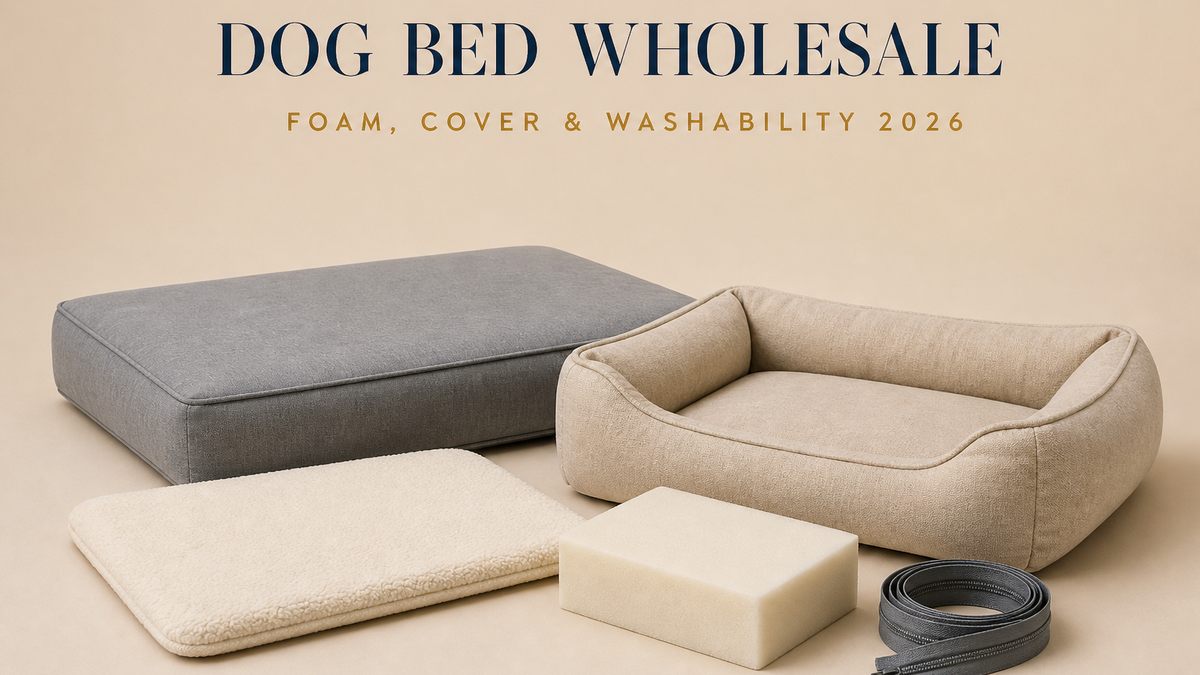
What You Are Buying, and the Line That Decides It
| If you want | What it means in practice | The line on your order that decides whether it works |
|---|---|---|
| A bed that still feels supportive next season | Support comes from foam, and foam is sold by density | The foam density, named as a weight per volume rather than as “high density” |
| A bed the dog actually fits on | Dogs sleep stretched out, and the rim eats the footprint | The sleeping area inside the rim, not the outside length |
| A cover that survives the customer's washing machine | Fabric moves in a hot wash and a tumble dry | The shrinkage limit together with the wash method it is tested to |
| A core that does not go mouldy | Foam is a sponge, and pet accidents happen | The waterproof liner, and whether the cover comes off at all |
| A bed that stays where it is put | Hard floors and a dog that circles before lying down | The non-slip base, specified by what it grips rather than by whether it exists |
What Are the Three Bed Constructions, and Which Should You Sell?
Almost every pet bed you will source is one of three builds, and the build decides your price point, your packing volume and your returns far more than the fabric pattern does.
Flat mat. A single padded layer with no rim, usually the cheapest and the easiest to ship. It is the build that lives or dies on the foam, because there is no structure doing any work — when the padding flattens, the product is finished. Mats are the build where a thin specification shows up fastest, and also the build that sells best as an add-on or a second bed.
Bolster bed. A mattress with a raised padded rim around the edge, which is what most customers picture when they hear “dog bed”. The rim gives the dog something to lean against and makes the bed look generous, and it is also where the sizing trap sits: the rim is part of the outside footprint, so a 70 cm bed can have a much smaller sleeping area than the number suggests.
Mattress style. A thick flat bed with no rim, built like a small human mattress, usually with a removable cover and a waterproof liner. This is the build that carries the highest material cost and the highest perceived value, and it is also the build where the layer construction is the product — get the support foam wrong and you have made an expensive mat.
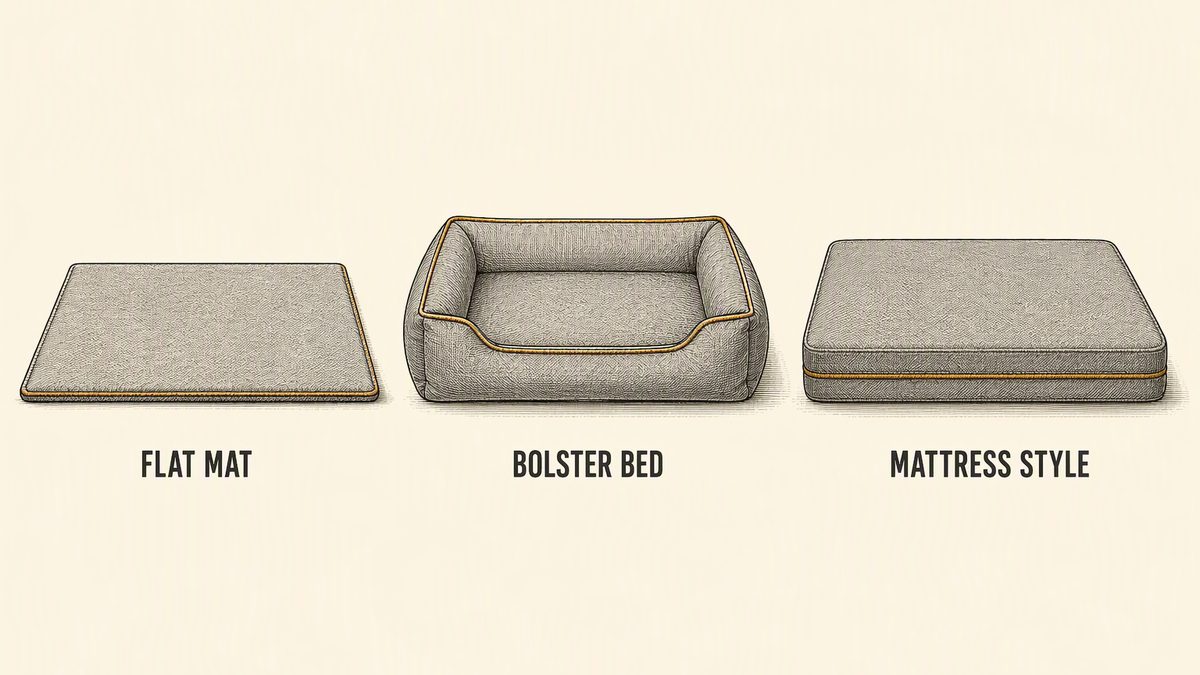
Two commercial points follow. First, the three builds do not share a pattern or a filler, so a supplier who makes mats well is not automatically set up for bolsters — ask which builds are actually on their line. Second, a bed is bulky rather than heavy, so it is one of the few pet products where packing volume drives your landed cost more than weight does, and the build you choose decides how many beds fit in a carton. The arithmetic for that is the same as for any volumetric product, set out in what a dog bed order costs once it has landed.
How Is a Pet Bed Measured, and Why Is the Outer Size the Wrong Number?
Because a bed is sold by its footprint and used by its sleeping area, and those two numbers are not the same. On a bolster bed the rim takes a bite out of all four sides, and on a mattress the gusset height decides whether the dog can lie on its side without hanging off the edge. The measurement that prevents a return is the one the dog lies in.
- Sleeping area
- The flat inner surface, measured inside the rim. This is the number that decides whether a dog can stretch out, and it is the number most quotations leave out. A bed described as 70 cm can offer a sleeping area several centimetres smaller on every side.
- Outer length and width
- The footprint, which decides how the bed looks in a room and how it packs. Useful for the customer, useless for the dog. Quote both, then make the sleeping area the headline figure in your own listing.
- Bolster height
- How tall the rim stands. Too low and it does nothing to lean against; too high and a smaller dog cannot step in. It is also the measurement that decides how the bed packs.
- Gusset or side height
- The thickness of the bed at the edge. This is where the layer count shows, and where the difference between a flat mat and a mattress is visible to a customer standing in a shop.
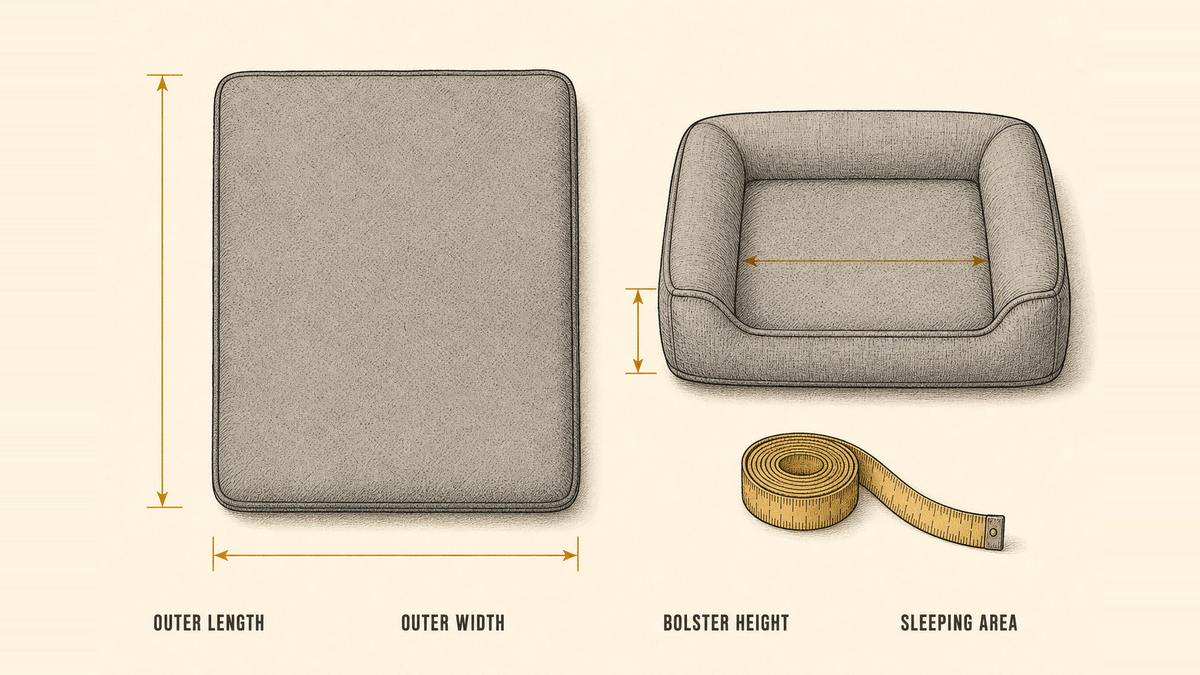
The practical consequence is the same lesson that catches sellers in every sizing category, and it is worked through in the size chart for a dog bed in us sizes: publish the number your customer will measure against, not the number that flatters your product. On a bed that means building your size chart around the sleeping area and treating the footprint as a secondary figure. Write the tolerance you will accept on each measurement into the order, because a bed that is two centimetres small is a bed that comes back.
How Are the Layers Built, and What Is Each One For?
A bed is a stack, and every layer answers a different complaint. Understanding which layer does what is what allows you to take cost out of the right place — and the reason a cheap bed feels wrong is almost always that the cost came out of the wrong layer.
From the outside in, the stack is usually five deep. The outer cover is what the customer sees and touches, and it is where the fabric decision lives. Under it, a waterproof liner protects the foam from accidents, and it is the layer most often left out of a cheap bed because you cannot see it and it costs real money. Then the comfort fill, a softer layer that gives the bed its initial feel and is often a low-density foam or a fibre. Under that, the support foam, which is what actually stops the dog reaching the floor and what decides whether the bed still works in six months. And at the bottom, a non-slip base, which is the cheapest layer to add and the one whose absence is most obvious in use.
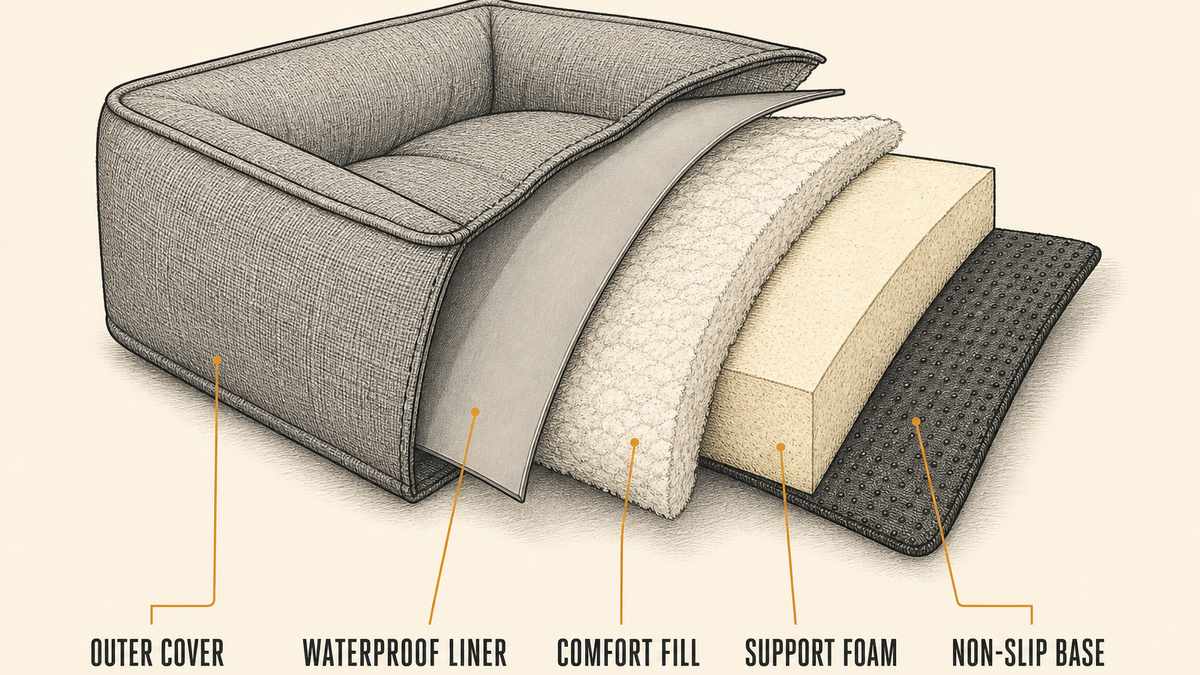
The trap is that the comfort fill and the support foam look similar in a sample and behave completely differently over time. A softer top layer feels better in a shop, so a supplier chasing a price point thickens the comfort fill and thins the support, and the bed feels wonderful for a month and then flattens. If you specify only one foam figure, specify the support layer.
What Has to Go Into the Specification?
Eight lines carry the risk on this product family. Four are about foam and construction, four are about the cover and the order.
- Foam density, as a weight per volume. “High density” means nothing and two suppliers will read it differently. Give a number in kilograms per cubic metre for the support layer specifically, and say what happens if a batch comes in under it. This single line is the difference between a bed and a mat.
- The layer stack, in order and in thickness. Name each layer and its thickness so the construction cannot be rebalanced later. A supplier who is allowed to decide the split will decide it in favour of the layer the customer can feel in a shop.
- The waterproof liner, and how it is tested. State that it must exist, what it is made of, and that it must stay waterproof after the cover has been washed. A liner that fails after a season protects nothing and gets blamed on the cover.
- The cover fabric, with the fibre and the weight. Name the fibre blend and the weight per square metre rather than describing the hand-feel. This is also where the harmful-substance question sits, and the OEKO-TEX system at oeko-tex.com is the reference most fabric mills already understand, which makes it a practical shortcut when you want evidence rather than an assurance.
- Shrinkage after washing, with the method. A removable cover that shrinks no longer fits the foam it was made for, so this line decides whether your washable feature survives its first wash. Give a maximum percentage and name how the cover is washed and dried, because a cold wash and a line dry is a different test from a warm wash and a tumble dry.
- The zip and the closure. A removable cover needs a zip that survives the same washing as the cover, with a slider that does not burst when the foam pushes outward. State the zip type and the pull force you will accept.
- The non-slip base, by what it grips. Not “anti-slip” as a word — the material and the coverage. A base that covers part of the underside behaves differently from one that covers all of it, and the difference shows on a hard floor.
- Sizes, tolerances, labelling and packing. The sleeping area and the footprint for each size, plus the tolerance on each, because a bed two centimetres small comes back. Add the care label wording and the export cartons, since packing volume is a real cost here rather than an afterthought.
One point about rules, because it changes what you have to prove. A pet bed looks like a mattress and is not one. The mattress flammability standards — 16 CFR Part 1632 for mattresses and mattress pads, and 16 CFR Part 1633 for mattress sets — are written for bedding used by people, so a dog bed is not automatically in scope. What is in scope on every shipment is ordinary import law, including country-of-origin marking under 19 CFR Part 134. None of that is a reason to ignore fire behaviour in a product that sits on a floor next to a socket, but it does mean the standard you build to is your decision rather than a legal floor — and a buyer who knows the difference can ask a factory a question its other customers never ask.
How Is the Wholesale Price Actually Built?
A bed is foam wrapped in fabric, and the price follows the foam far more than it follows the sewing. Four things move it.
- Foam volume and density together. This is the largest and least visible cost. A thicker support layer at a lower density can cost more than a thin layer at a high density and perform far worse, which is exactly why the two numbers have to be specified as a pair rather than as one.
- Cover fabric consumption and the gusset. A mattress with tall sides uses markedly more fabric than a flat mat of the same footprint, because the sides and the seams have to be cut, joined and seam-finished. A tall bed that looks like better value is genuinely more expensive to make.
- Zip and the making-up of a removable cover. A removable cover is not just a zip — it changes how the whole thing is cut, sewn and finished. This is where a large share of the labour sits, and where the difference between “washable” and “spot clean only” is actually paid for.
- Packing volume, and minimums by size and colour. Beds are bulky for their value, so carton efficiency matters more here than in almost any other pet product, and the size run multiplies the foam minimums. A wide size range on a first order is expensive out of proportion to the work, because each size is effectively its own cut.
What Goes Wrong?
Four failures account for most of what comes back, and none of them is visible on a new sample.
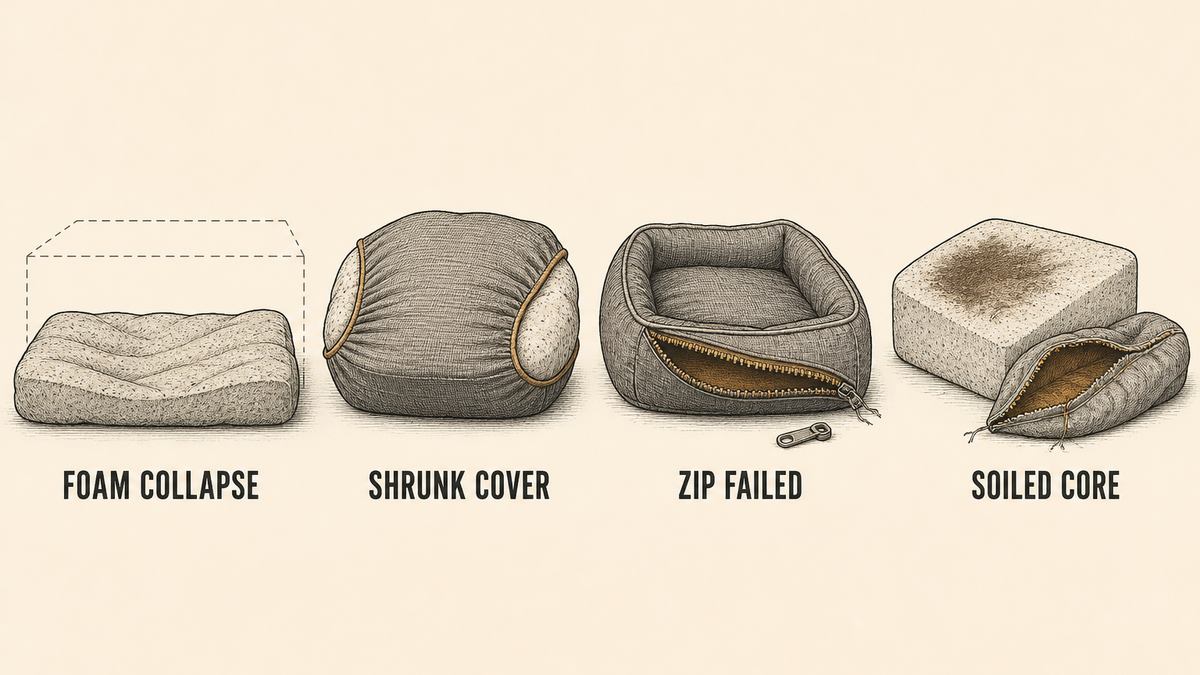
- The bed went flat
- The support foam was too soft, or too thin, or both, and it compressed permanently within a season. The customer experiences this as the bed being poor quality rather than as a density figure, but it is the density figure that caused it.
- The cover shrank and no longer fits
- The fabric moved in the wash, so the removable cover stopped accommodating the foam it was cut for. This one turns your best feature into a complaint, because the customer bought the bed partly to be able to wash it.
- The zip burst
- The foam pushed outward under a zip that was not specified for the load, or the slider lost its grip after washing. It is the failure that ends the product's life earliest, because a cover that will not close cannot be used.
- The core got wet and stayed wet
- No liner, or a liner that failed at a seam, and pet accidents do happen. Foam that absorbs liquid does not dry out in the middle, and the smell is what arrives next. It is the hardest failure to recover from and the easiest to prevent.
All four are settled by a number on the order, and three of them sit in the layer stack rather than in the fabric. That is the practical reason a bed specification should be written outside-in and inner-layer-first: the layers nobody sees are the ones that decide whether the bed is still a bed next season.
How Do You Check a Supplier Before You Commit?
Four checks, in this order, each making the next cheaper. On beds they matter more than usual, because the two things that decide the product — foam density and the liner — are both hidden inside a cover.
Ask who makes the foam. Foam is bought in blocks and cut, so the foam can come from a different supplier than the sewing. That matters, because a question about density is answered by whoever pours the foam and not by whoever sews the cover. The general method for finding out who is actually making your product is the same as in any category, set out in whether a dog bed plant is a plant or a reseller, and a supplier who can name the foam grade without checking is a supplier who has specified it before.
Take the bed apart. This is the check with no substitute on this product. Unzip the cover, lift it off, and look for the liner; feel the support layer and measure its thickness against the order; then weigh the foam if you can and compare it against the density you specified. A bed that has no liner was never going to survive an accident, and no photograph will ever tell you that.
Wash a cover and refit it. Take the cover off, wash and dry it by the method you wrote into the order, then try to fit it back over the foam. If it no longer goes on, your washable feature does not exist — and you found out for the price of one bed instead of from your customers.
Inspect before it ships. On beds the inspection is mostly measurement and construction rather than appearance: that the sleeping area and footprint are inside tolerance, that the layer stack is as ordered, that the zip and the base are as specified, and that the cartons use the pack you agreed. None of it can be judged from a picture, so washing and refitting a cover from the batch is the check worth doing, and the order size settles how many beds to open. Measure the beds rather than looking at them.
Where Does a Cheap Quotation Get Its Money Back?
A cheap bed quotation is usually a real price for a different stack. Five lines go missing, and on this product they go missing from the inside outward — which is why the customer cannot tell until the bed has been slept on for a month.
- The support foam. A softer grade at the same thickness, or the same grade at a thinner layer. Either way the bed feels right in a shop and flattens within a season.
- The waterproof liner. The cheapest line to leave out entirely, because nothing about the finished product reveals it. It is also the line that decides whether one accident writes the bed off.
- The non-slip base. Reduced to a few patches, or dropped. It costs very little to include and is very obvious to a customer on a hard floor when it is missing.
- The cover fabric weight. Lighter than specified at the same look and colour, which shows up as a cover that pills, stretches or tears at the seam rather than as anything visible on arrival.
- Packing. Beds compressed harder to fit more in a carton, which can leave a foam layer creased and slow to recover. The saving is real and the complaint arrives two weeks after delivery.
The way to close those lines is to put them on the enquiry rather than raise them after the sample: ask for the foam grade by density, the layer stack by thickness, the liner and its construction, the fabric weight and the base coverage as part of the quotation. A supplier who can answer all five is quoting on your product. If the bed carries your own brand on the cover or the care label, the wider question of how a private label order is put together is covered in how private label works on a dog bed order.
Pet beds sit in an unusual place in this category, which is worth stating plainly. Nothing in the product fails loudly, so the customer's judgement is formed slowly and is attributed to your brand rather than to a component. The contrast with the sibling articles in Pet Supplies is sharp: walking gear fails immediately and visibly at one stitched junction, pet apparel is settled by its size chart, the construction choices that decide a toy are covered in how a pet toy is made, and the import chain that a bed never has to clear is set out in the private label route in pet food. A bed is the one that punishes a thin specification most slowly.
Frequently Asked Questions
What foam density should I specify for a dog bed?
There is no single right figure, because density and thickness work together and a thick soft layer can perform worse than a thin firm one. What matters is that you specify the support layer's density as a weight per volume rather than accepting the words “high density”, and that you specify the layer stack thicknesses at the same time. Then test it by lying on the sample yourself, or by leaving a weight on it for a week, rather than by pressing it with a thumb in a showroom.
Why does a 70 cm dog bed look too small in person?
Because 70 cm is the outside footprint and the dog sleeps in the area inside the rim. On a bolster bed the rim takes space out of all four sides, so the usable area can be several centimetres smaller in each direction. Publish the sleeping area as your headline size and treat the footprint as secondary, and make the sample prove the sleeping area inside tolerance.
Do dog beds have to meet mattress flammability rules?
Not automatically. The mattress flammability standards for mattresses, mattress pads and mattress sets are written for bedding used by people, so a pet bed is not in scope by virtue of being bed-shaped. Country-of-origin marking does apply to the shipment, as it does to anything you import. In practice most careful buyers still specify something about fire behaviour for a product that sits on a floor, but it is a choice you make rather than a legal floor you inherit.
Is a washable cover worth the extra cost?
It usually is, provided you specify the shrinkage limit and the wash method alongside it. A removable cover means the bed can be cleaned instead of replaced, which is a real selling point, but it only works if the cover still fits the foam after the wash the customer will actually use. Without those two lines a removable cover is a feature that fails and takes the customer's goodwill with it.
How do I stop the bed sliding across the floor?
Specify the base by material and by coverage rather than by the word anti-slip. A bed that slides usually has a base covering only part of the underside, or a material that loses grip on a smooth floor once it has picked up dust. Asking for full-underside coverage in a specified material turns a vague wish into a line a factory can meet and an inspector can check.
What is the minimum order for dog beds wholesale?
Two minimums interact and the larger one binds. The foam has a minimum determined by the block or the pour, and the fabric has a dyeing minimum per colour, and a wide size run multiplies both because each size is effectively its own cut. That makes a first order in one size and one or two colours far more economical than the same total quantity spread across five sizes, which is the opposite of what a retail assortment usually wants.
Send the layer stack, not just the photo
Tell us which build you want — flat mat, bolster or mattress style — the sleeping area and footprint for each size with the tolerance you will accept, the side or bolster height, the support foam density as a weight per volume and the full layer stack with thicknesses, the cover fibre and weight per square metre, the shrinkage limit together with the wash and dry method you will test to, whether the cover is removable and to what zip specification, the liner and how it is seamed, the non-slip base material and coverage, the colours and the minimums they imply, and your target volume. Those answers settle the layer stack and the size chart before a price means anything. We will come back with the build we recommend and why, the specification written outer-layer and inner-layer together so nothing can be rebalanced quietly, the sleeping area and footprint quoted as separate figures, a sampling plan that takes a bed apart rather than pressing it, and the foam, fabric and making-up costs shown as separate lines.
Request a Pet Bed Sourcing Quote
Questions & Comments
We read every one and reply within 24 hoursComparing dog bed quotations? Post the foam density, the sleeping area, and the cover fabric the supplier named, and we can usually say which lines are missing. If a bed has already gone flat, or a cover has shrunk in the wash, describe what happened and how long it took, because the timing usually says whether it was the foam or the cover.