
Best Dropshipping Niches: Five Screens to Run Before You Commit
 ·
Updated October 14, 2026
·
16 min read
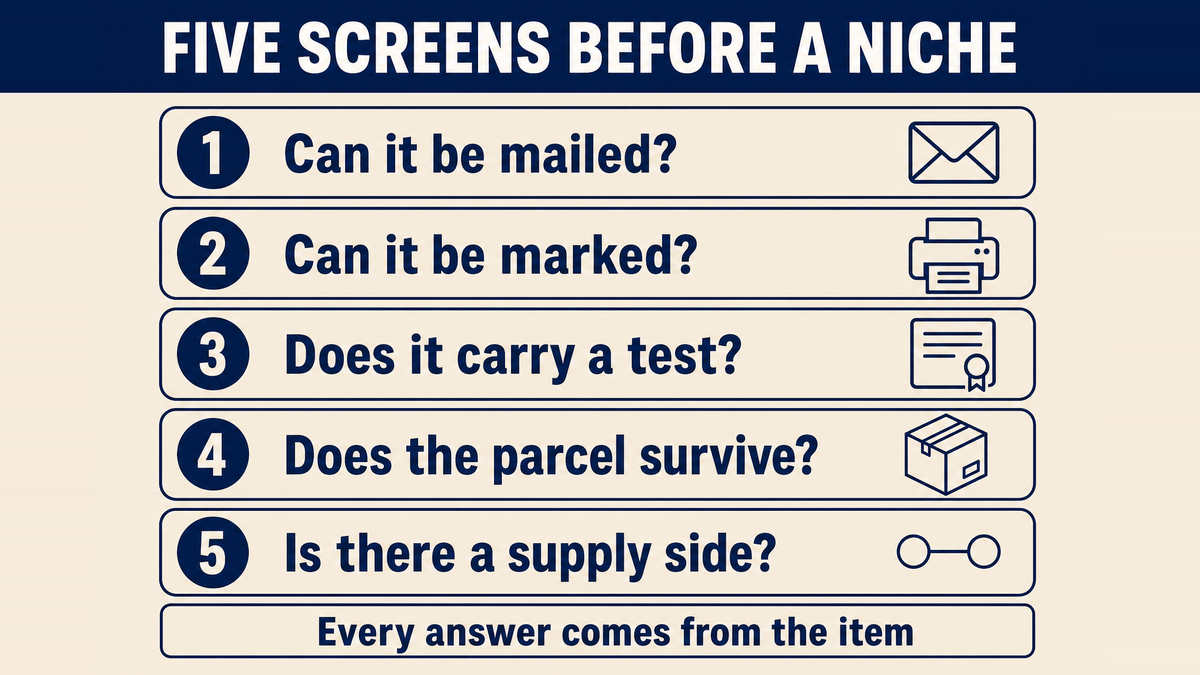
Search for the best dropshipping niches and you get a list of names. Pets. Beauty. Fitness. Home. A name is not a decision, because the checks that decide whether an order makes money are attached to the item, not to the category. Two products inside one name can pass or fail completely different screens. This guide replaces the list with five screens you can run against a specific product before you buy anything: can it be mailed, can it be marked, does it carry a safety test, does the parcel survive the trip, and is there a supply side you can reach. Every screen is checkable, and two of them are written in rules you can read for yourself.
1. Why a Niche Name Cannot Decide for You
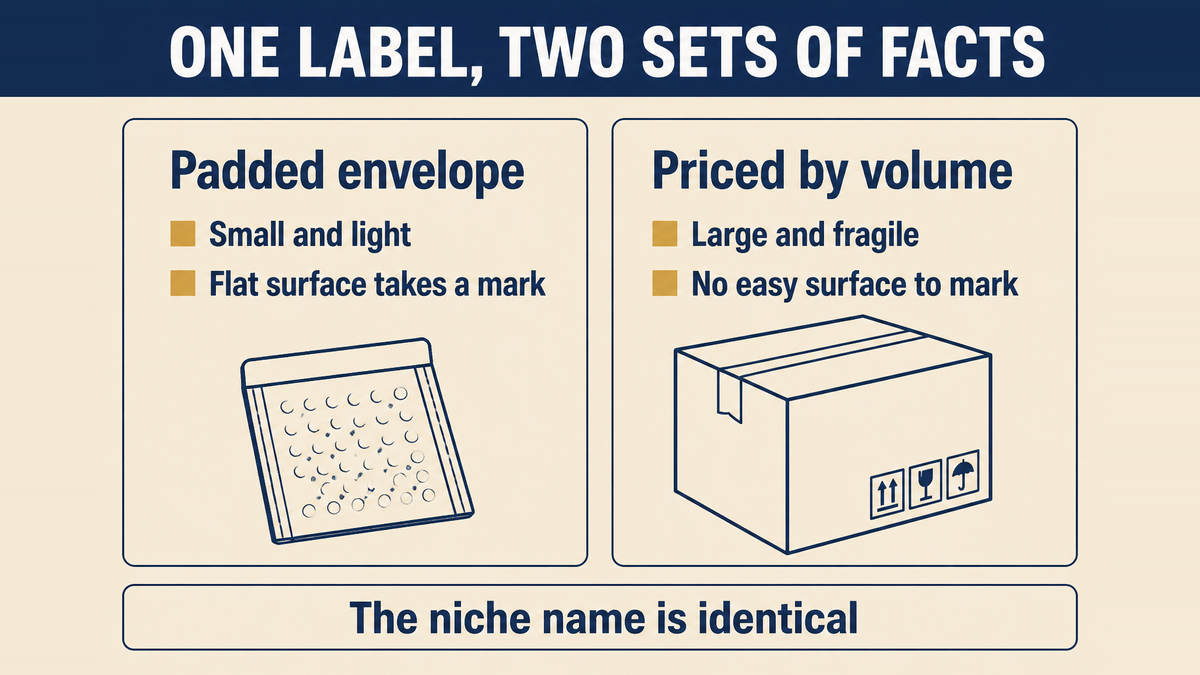
A niche is a label attached after the fact. Someone grouped a few thousand products by who tends to buy them, gave the group a friendly name, and the name then got treated as a decision. It is not one. "Pet products" covers a rubber chew toy that ships in a padded envelope and a twelve-kilo dog bed that is priced by the space it occupies and has a damage rate you will meet personally. Same label, and every screen below gives a different answer for the two items.
This is why a niche list is true and still cannot help you. The names on it are real categories that real sellers make money in, so nobody is lying. What the list cannot do is transfer the conditions the author was working under. The author may hold stock locally, live in a market with cheap domestic post, already own a workshop, or simply have tried the category at a moment when its supply and shipping costs were different. A recommendation is a conclusion with its conditions stripped off, and you are being handed the conclusion.
The difficulty, when you look closely, is never in the category. It is in the physical and legal facts of one product: whether it contains a battery or a liquid, how big and heavy it is, whether it carries a safety test, whether its surface can hold a printed mark, whether it breaks in transit, and whether more than one factory can make it. Every one of those is a property of the item. None of them is a property of the niche, which is why two sellers can report opposite experiences of the same category and both be telling the truth.
| What a niche list gives you | What actually decides the outcome |
|---|---|
| A category name | The item's size, weight and materials |
| A rough sense of demand | Whether the item may be mailed, and how |
| Someone else's result | Your shipping route, test costs and return rate |
The five screens
- Why a niche name cannot decide for you
- Screen one: can the item be mailed at all?
- Screen two: can the item be marked?
- Screen three: does the item carry a safety test?
- Screen four: does the parcel survive the trip?
- Screen five: is there a supply side you can reach?
- Running the five screens in order
- Frequently asked questions
There is also a reason the list feels authoritative even when it cannot be used. The categories on it are the ones still standing. Nobody publishes a guide to the niche they left after three months, and the sellers who did well are the ones who write about it afterwards. What survives into these lists is therefore selected by the outcome, which means the list describes where money was made rather than what made it possible, and the part that made it possible is exactly the part that has been dropped. A reader sees a result and mistakes it for a method.
2. Screen One: Can the Item Be Mailed at All?
The first screen is not about demand. It is about whether the thing can travel through the channel you plan to use, and the answer is not a matter of opinion. The postal service publishes the standards governing what may be mailed, and the publication is organised around exactly the split that ruins niche choices: matter that is ordinary, and matter that is hazardous, restricted or perishable. The table of contents reads as a warning list for anyone picking products from a trend page.
Publication 52 — Hazardous, Restricted, and Perishable Mail. Contents include: § 123 Mailability Premise § 211 General § 212 Mailer Responsibility § 216 Nonmailable Matter Found in the Mail § 223 Orientation Markings for Packages and Containing Liquids § 322 Postal Service § 323 Mailer Responsibility.
United States Postal Service, Publication 52, Hazardous, Restricted, and Perishable Mail (read 14 October 2026)
Two details in that list matter more than the rest. The first is the heading "Mailer Responsibility", which appears twice, once among the general guidelines and again inside the chapter on hazardous materials. Responsibility is placed on the sender, not on the platform and not on the supplier. The second is "Nonmailable Matter Found in the Mail", which describes what happens when the item is already moving. Neither heading leaves room for the belief that a marketplace, a fulfilment app or a freight agent is checking this for you.
That changes how a niche has to be screened, because in a direct-ship arrangement the parcel reaching the customer is yours. When a supplier says the item ships all the time, that is a sales claim and not a ruling on mailability, and the difference only becomes visible when a shipment is stopped. So the screen is mechanical: list what the item actually contains and whether it functions, and treat batteries, liquids, aerosols, magnets and anything that has to be declared as a finding rather than a detail. An item that clears this screen is one where the parcel is unremarkable, which is a much lower bar than being popular.
3. Screen Two: Can the Item Be Marked?
The second screen is written into customs law and is routinely discovered late, usually after a first shipment. An imported article has to show where it came from, and the rule says so in a sentence worth reading slowly, because the standard inside it is relative to the article itself.
Unless excepted by law, section 304, Tariff Act of 1930, as amended (19 U.S.C. 1304), requires that every article of foreign origin (or its container) imported into the United States shall be marked in a conspicuous place as legibly, indelibly, and permanently as the nature of the article (or container) will permit, in such manner as to indicate to an ultimate purchaser in the United States the English name of the country of origin of the article, at the time of importation into the Customs territory of the United States.
U.S. Customs and Border Protection, 19 CFR 134.11, Country of origin marking required (read 14 October 2026)
The phrase doing the work is "as legibly, indelibly, and permanently as the nature of the article will permit". The duty is fixed, but the way of meeting it is set by the item. A flat matte surface takes a printed mark without difficulty. A curved, glossy, fabric, mesh or loose-fill surface does not, and a very small item may have no usable surface at all. This is precisely the kind of fact a niche list cannot carry, because it varies item by item inside a category that sounds uniform.
For a direct-ship seller the consequence is a cost question with a deadline attached. A mark that the factory can apply during production is a line in the unit price. A mark that cannot be applied without changing the surface, adding a tag, or printing a bag instead means you are changing the product, and that is a different decision from choosing a category. Checking it early is cheap: ask the supplier to photograph the marking on a finished unit, and treat a photo of a bare product as an unanswered question. How the different marking methods hold up on different surfaces is compared in which marking method suits which surface, and the wider paperwork side of putting a name on goods is covered in what private label actually requires.
4. Screen Three: Does the Item Carry a Safety Test?
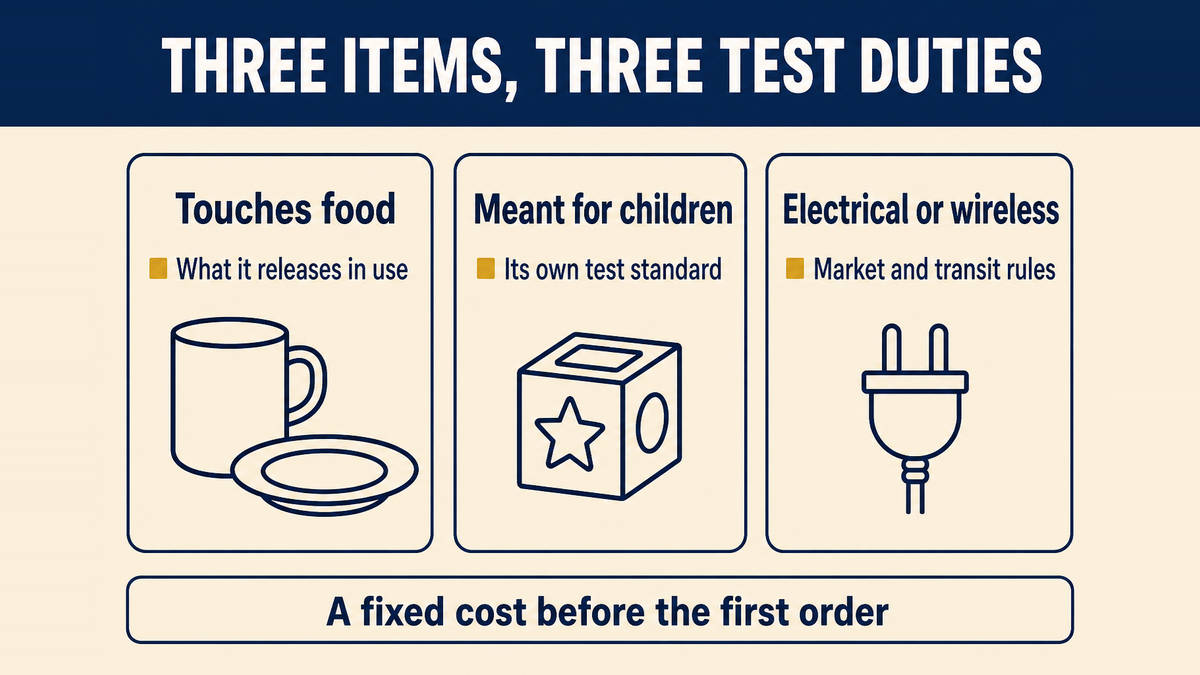
Some items may not be sold until they have been tested, and the obligation attaches to the item rather than to the shop selling it. Three groups come up constantly when a niche is being chosen, and each has its own set of rules and its own way of being checked.
Articles that touch food are tested for what they release when they are used, which is why a mug, a lunch box or a set of utensils carries a question that a phone case does not. The regime for those articles is set out in food contact testing for kitchenware and tableware. Items meant for children are a separate case with their own test standards and paperwork, covered in how toy safety testing works in practice. Electrical and wireless goods add a third set, both for the market they are sold into and for what travels with the parcel, set out in what electrical goods need before they can be listed.
What makes this a screen rather than a footnote is how the cost behaves. A test is a fixed cost that does not shrink when you sell fewer units, so it does not change demand at all; it changes the number of orders you must sell before the item is worth listing. A category can be genuinely popular and still be the wrong choice for a small seller, and the reason is not competition. It is that the test has to be paid for before the first order and recovered across whatever volume follows.
The way to read a test cost is as a number of orders rather than as a figure. Divide the cost of the test by the profit you keep on one delivered order, and the result is the number of orders that must be sold before the item has paid for its own permission to be listed. The same test against an item with a larger margin per order is a smaller fraction of the whole, and both items can sit in the same category. That is why two sellers can disagree about a niche and both be right, and why the disagreement is never resolved by arguing about demand.
5. Screen Four: Does the Parcel Survive the Trip?
This screen has two ways to fail and they are easy to confuse, because both appear on the same line of the accounts. The first is dimension. A light item in a large box is charged for the space it takes rather than the weight it has, so an item that sounds cheap by weight can be expensive by volume, and the gap widens as the box gets emptier. The second is breakage. A fragile item has a damage rate, and a damaged parcel turns a sale into a return plus a replacement plus the freight both ways, which is a much larger loss than the margin suggests.
Both failures land on one number, which is what a delivered order that stays delivered actually costs you. Building that number is not guesswork, but it does need the item's own measurements rather than the category's reputation. The volume side is covered in how volume decides what a parcel is charged, and the round trip is covered in what a return really costs. The full cost from quoted price to landed total is set out in how to build a landed cost you can price against.
The screen itself is one line of arithmetic. Take the item, add its packaging, work out the charged weight, add a damage allowance you have actually seen rather than hoped for, and compare the result with the price you can charge. If you cannot do that, the honest description of the item is that its cost is unknown, and an unknown cost cannot be priced. Heavy furniture is the clearest case of a category where this screen decides everything, which is why it is treated as its own subject in what sourcing furniture really involves.
6. Screen Five: Is There a Supply Side You Can Reach?
The last screen is the one a niche list treats as a footnote, and it is the one that decides whether the first four still hold in six months. The question is not whether the item exists. It is whether you can buy it in the quantity you need, from more than one place, at a quality you have checked, and again next season.
A thin supply side creates a single point of failure that sits under the whole store. If one factory makes the item, then every change that factory makes becomes your change: a different fabric, a slightly smaller size, a cheaper insert. You find out from a review rather than from a message, and by then the listing's history is already the problem. Checking quality before goods leave is the way this gets caught, and the process for that is set out in what a pre-shipment inspection covers.
Apparel is the clearest illustration, because it fails on supply depth and on the parcel screen at the same time. Sizes and colours multiply the number of variations you must stock or chase, the item is soft and hard to mark, and the return rate is high for reasons that have nothing to do with your supplier. That is why it is treated as a subject in its own right in what breaks most clothing stores. A narrow niche with three good suppliers will usually beat a broad one with a single source, and the difference shows up in the margin rather than in the catalogue, which is the arithmetic covered in how a margin is actually built.
Testing supply depth is a small exercise with a clear answer. Ask three or four suppliers for the same item against the same written specification, then compare what comes back: whether the dimensions, the material and the packing all match, and whether anyone answers the awkward question about the country of origin mark. A category where several suppliers converge on one description is a category where you can change source without changing the product. A category where each reply describes something slightly different is a category where every supplier is effectively selling you a new product, and the listing would have to be rewritten each time you moved between them.
7. Running the Five Screens in Order
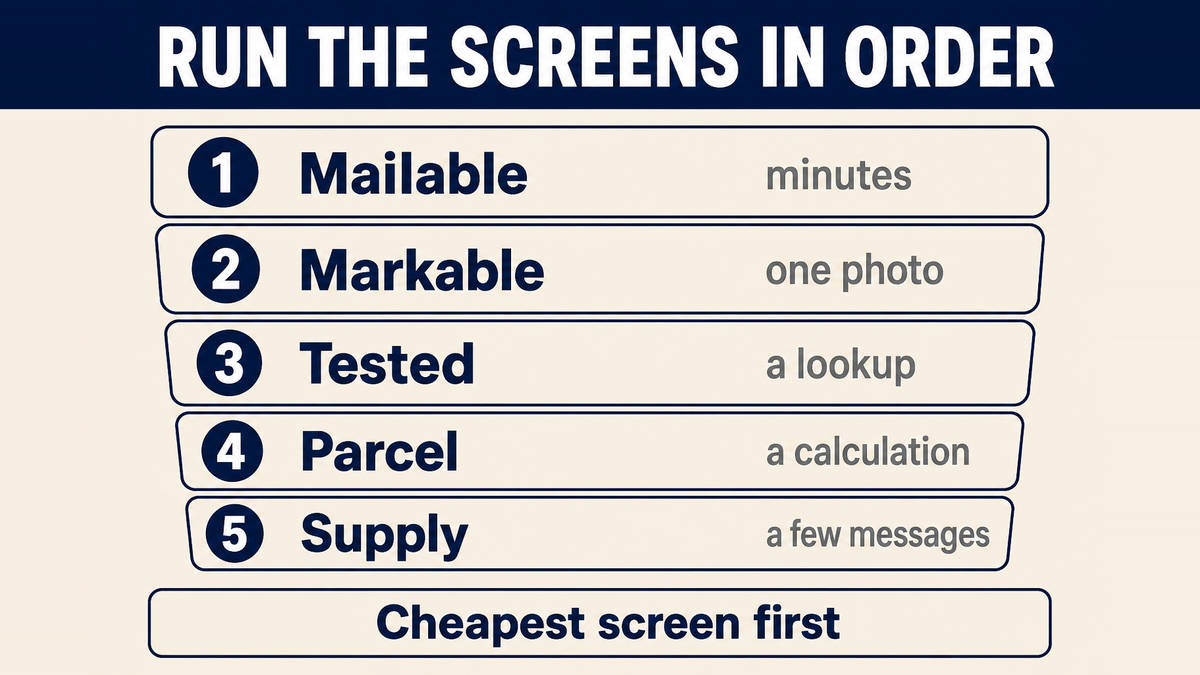
The order matters because the screens cost very different amounts of time, and a cheap screen that kills the item saves you the expensive ones. Mailability is minutes: list the contents and the function, and look them up. Marking is a photograph and one question to the supplier. Safety testing is a lookup that often ends the item immediately, because a fixed cost that cannot be spread is the most common reason a popular category does not work for a small seller. The parcel is a calculation from measurements you already have. Supply depth is a few messages and, in time, a sample.
Run them in that order and the result is not a ranking of categories. It is a short list of items that have cleared five specific questions, which is a different and more useful object, because you can act on it. The table below is the whole method in one place.
| Screen | What you check | What kills the item |
|---|---|---|
| Mailable | Contents and function against mailing standards | Battery, liquid, aerosol or a declaration you cannot make |
| Markable | Whether the surface takes a permanent origin mark | No usable surface without changing the product |
| Tested | Whether a test is required before sale | A fixed test cost you cannot recover at your volume |
| Parcel | Charged weight, packaging and damage rate | A delivered cost above the price you can charge |
| Supply | Fewer than two independent sources | One factory, so every change becomes yours |
A short example shows how differently the screens behave inside a single product type. Take three mugs. A plain ceramic mug has a flat surface that takes a permanent printed mark, no battery, no liquid and no safety test, so it clears the first three screens and comes down to its charged weight. A glass mug clears the same three screens in a different way and fails the fourth: the mark is harder to apply durably, and the breakage rate makes the parcel screen the deciding one, because a broken mug costs the freight twice and the replacement once. A printed mug carrying a well-known character never reaches the parcel question at all, because the artwork is not yours to print. Three items that a list would flatten into one word, and three different answers.
Read against a list of recommended niches, this method produces an uncomfortable but useful result: most items on the list fail, and they fail on facts that the list had no way to carry. That is not an argument against the categories. It is an argument against treating a category as the unit of decision when the items inside it differ on every screen that matters.
8. Frequently Asked Questions
What is the best dropshipping niche for a beginner?
There is no category that is best in the abstract, and the useful answer is a set of properties. For a first product, look for an item with no battery or liquid, a flat surface that can carry a permanent origin mark, no safety test required before sale, a small charged weight, and at least two factories able to make it. Items like that are unremarkable, which is the point: they clear the screens without costing you anything to clear them.
How many products should I screen in one niche?
Screen rather than commit, and expect the screens to be quick. Mailability and marking together take an afternoon for a shortlist of ten items, and they usually remove most of it. The point of screening ten is not to launch ten products, it is to find the one or two where no screen raises a question you cannot answer with the money and time you have.
Is a broad niche better than a narrow one?
Broad and narrow describe how a category is labelled rather than how easy it is to sell. A narrow niche can still contain an item that cannot be mailed, and a broad one can contain an item that clears every screen. What genuinely helps is narrow supply: a category where you can name more than one factory that makes the same item is safer than one where a single supplier is the only source.
Can I sell a product that needs testing if my supplier already tested it?
Ask what the report actually covers before relying on it. A test result belongs to the item it was run on and to the party named on the document, so a report for a similar product from a different factory does not answer the question for your item. The practical step is to ask for the report for the exact item and check that the item described in it is the item you are listing.
Do I need to register a trademark before listing a product?
Marking where goods were made and registering a brand name are two different duties, and the first applies whether or not you have a brand. Origin marking is required on imported articles unless they are excepted by law. A trademark protects the name you sell under and is optional at the start, which is why it is common to see sellers spend on a brand name while the marking question, which is not optional, goes unchecked.
Five Rows, Pass or Fail, No Opinion
We fill each screen with the answer that applies to your shortlist and mark the one that stops the item, so it gets dropped for a reason.
Screen My Shortlist
Questions & Comments
We read every one and reply within 24 hoursStuck choosing between two categories, unsure whether an item you like can legally be mailed or marked, or wondering whether a supplier's test report actually covers the product you are listing? Tell us the item and the destination, and our team will help you screen it before you commit rather than after the first shipment.