
Amazon FBA Inbound Shipping Cost From China: What You Pay in 2026

Amazon FBA inbound shipping cost has three parts, and three companies bill them. A forwarder moves the goods, a customs broker clears them, and Amazon charges a placement fee after the stock is received. A forwarder quote covers only the first part. This guide shows what each part costs in 2026, and where the math decides between one destination and five.
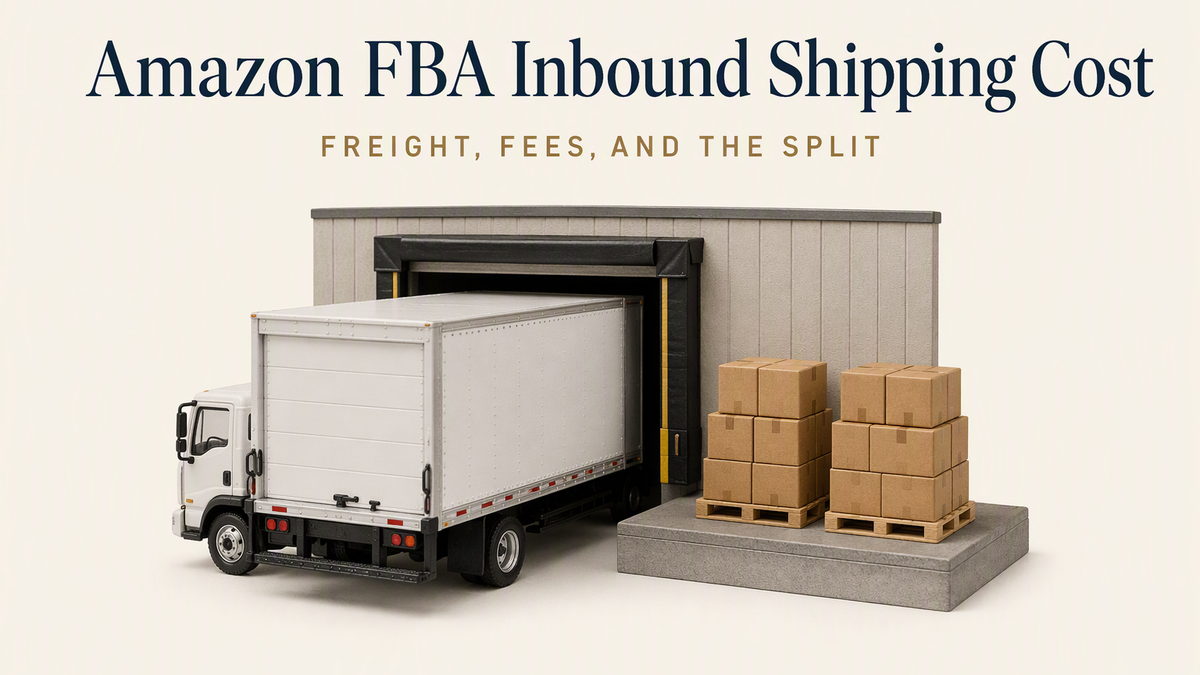
The three bills behind one pallet.
| Bill | Who sends it | Charged per | When |
|---|---|---|---|
| Freight and origin handling | Forwarder | Kilogram, cubic metre or container | Before loading |
| Duty and customs entry | Broker | Entry, plus duty on value | At clearance |
| placement fee | Amazon | Unit received | 45 days after receipt |
The four layers behind one quote
A quote that reads “China to Amazon, all in, $3.20 per kg” answers one question out of four. The other three decide whether the final invoice matches it.
The first layer is origin. It covers pickup at the factory, export clearance and terminal handling in Shenzhen, Ningbo or Shanghai. Most forwarders price this as a flat fee per shipment, so a small order pays nearly the same as a large one.
The second layer is the main carriage. Sea LCL bills per cubic metre or per tonne, the greater of the two. Sea FCL bills per container. Air bills per kilogram, but on a weight the airline works out, not the weight on your scale.
The third layer is the port and the truck leg. Drayage, the short truck move from the port to a warehouse, is priced per container or per load. It carries terminal fees, a chassis charge and often a waiting charge.
The fourth layer is the final drop into the fulfillment center. Some carriers drive straight to the dock. Others hand over at a transload site first. Either way, someone books a drop slot, and a missed slot costs money.
Amazon then adds a fifth bill that no forwarder quotes. It is the placement fee. It is charged per unit, after receipt, at rates set by size tier and by how many centers you agreed to ship to.
The four layers do not scale together. Origin fees are flat, ocean changes with volume, the truck leg changes with distance, and the final drop changes with how busy the warehouse is. A shipment twice as large does not cost twice as much.
Why the per-kilogram number cannot be compared
Two forwarders can quote $3.20 per kg and mean something else. One includes duty. One includes the truck leg. One prices a cubic metre at 1,000 kg; the other at 167 kg.
Ask for three things in writing: the divisor, the incoterm, and the full charge list. A quote with those answers can be compared. A quote without them is a headline.
The same discipline applies to the goods themselves. If the carton is oversized for what it holds, you pay for air on every leg. The carton size and flute choice is a cost choice, not a packing detail.
Three weights on the same carton
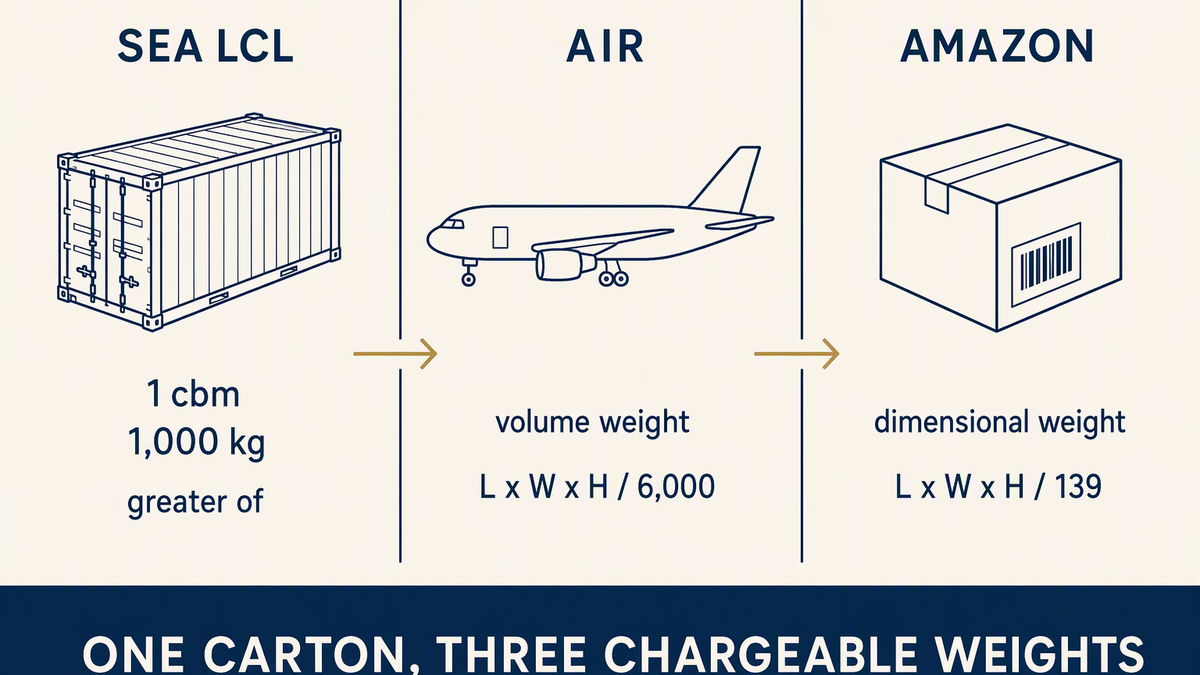
How a shipment is measured decides what you pay, and three parties measure it three ways. This is the single reason a final invoice rarely matches the quote.
| Who measures | Method | Who pays for space |
|---|---|---|
| Sea LCL carrier | Revenue ton: 1 cbm or 1,000 kg, whichever is greater | A light, bulky carton |
| Airline | Volume weight: length x width x height in cm, divided by 6,000 | A light, bulky carton |
| Amazon | Dimensional weight: length x width x height in inches, divided by 139 | A bulky unit, through a higher fee band |
Take a carton 60 x 40 x 40 cm that weighs 12 kg. Its volume is 0.096 cbm, so the sea carrier bills it as 96 kg. The airline divides 96,000 by 6,000 and bills 16 kg. Same carton, two numbers that do not match. Each business sells space in its own way.
Amazon measures the unit you sell, not the carton. A unit 35 x 25 x 12 cm has a volume of 10,500 cubic cm, or about 640 cubic inches. Divide by 139 and the dimensional weight is 4.6 lb, close to 2.1 kg.
If that unit weighs 800 g, Amazon uses the larger figure. The unit is billed at 4.6 lb, which puts it in the 3 to 5 lb band. Shrinking the pack by two cm on one side can drop it into the band below.
Note the exceptions Amazon publishes. Small standard units and extra-large units over 150 lb are billed on unit weight only. Everything else uses the greater of unit weight and dimensional weight.
That rule is worth one measurement check before you order tooling. If the packaging is a millimetre choice for the factory, it is a fee choice for you.
The Amazon fee that is not freight
The placement fee is a unit charge for putting your stock into the Amazon network. It is not a freight charge, it is not a storage charge, and it does not appear on any forwarder quote.
You choose one of three options when you create a shipping plan. With minimal shipment splits, you send to the smallest number of centers, usually one, and pay a fee. With Amazon-optimized shipment splits, you send to several centers yourself and pay no fee. A third option, partial shipment splits, exists only for bulky items and covers two or three centers at a reduced fee.
Amazon charges the fee 45 days after the shipment is received, on the units received. So the cash leaves later than the freight, which is why it drops off a first-order budget.
Minimal shipment splits, one center, from January 15, 2026.
| Size tier | Shipping weight | Fee per unit |
|---|---|---|
| Small standard | 8 oz or less | $0.14 to $0.32 |
| Small standard | 8+ to 16 oz | $0.16 to $0.32 |
| Large standard | 12 oz or less | $0.20 to $0.40 |
| Large standard | 12+ oz to 1.5 lb | $0.24 to $0.50 |
| Large standard | 1.5+ to 3 lb | $0.34 to $0.60 |
| Large standard | 3+ to 5 lb | $0.38 to $0.76 |
| Large standard | 5+ to 7 lb | $0.40 to $0.98 |
| Large standard | 7+ to 10 lb | $0.42 to $1.20 |
| Large standard | 10+ to 15 lb | $0.44 to $1.50 |
| Large standard | 15+ to 20 lb | $0.55 to $1.90 |
Two things changed on 15 January 2026. Standard size fees rose by an average of $0.05 per unit, and Amazon added five weight bands to Large standard between 3 and 20 lb. The old table had a single band from 3 to 20 lb, which hid the gap between a 4 lb item and a 19 lb item.
The no-fee option has a packing rule, not a volume rule. You need at least five the same cartons or pallets for each item. Every carton must hold the same quantity of every item and the same mix.
That rule is harder than it sounds for a first order. A factory that packs three SKUs across 40 cartons rarely produces five cartons with the same mix. Fixing the packing plan before production is cheaper than fixing it after arrival.
Split or single: where the fee flips
Splitting is not automatically cheaper. It removes a unit fee and adds a cost per shipment, and on a small shipment the second number is usually larger.
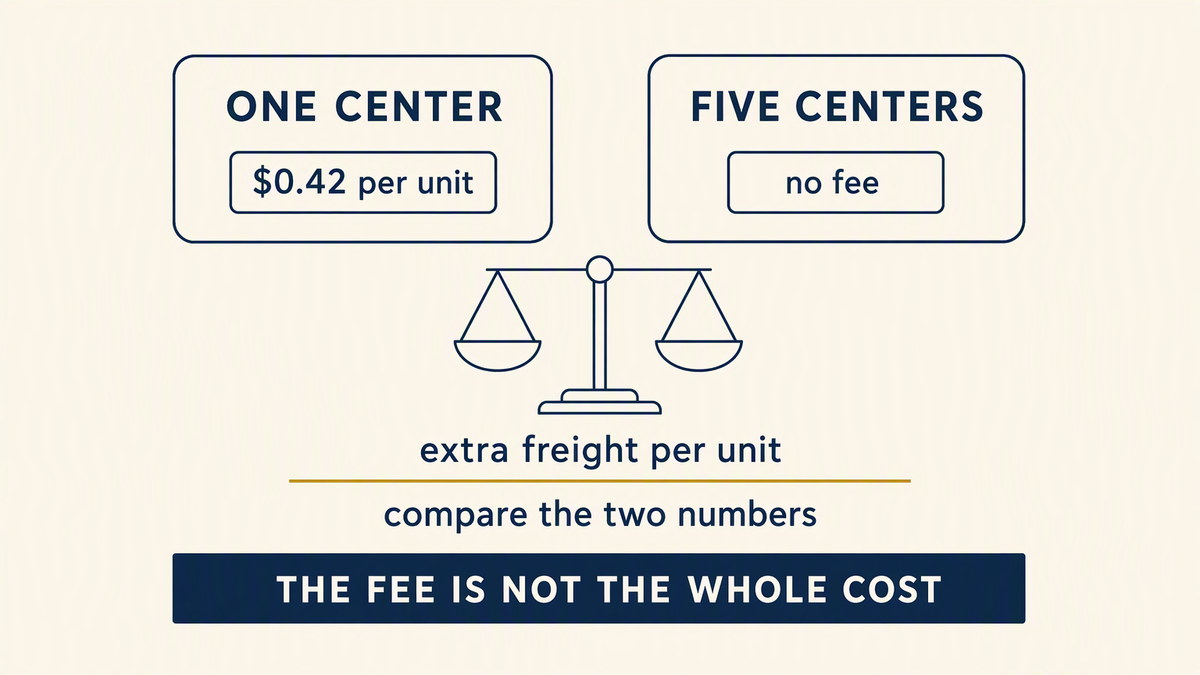
Amazon publishes a worked case. One hundred units of a 6 lb Large standard item, one center in the East region, is charged at $0.42 per unit. The total is $42.00.
That $42 is the entire prize. To earn it you must send four more shipments to four more addresses. Each one carries its own truck leg, its own drop slot and its own chance of a defect.
The test is a single division. Take the total placement fee and divide it by the units. Compare that number with the extra freight and handling per unit for the additional destinations.
| Shipment size | Placement fee at $0.42 per unit | What four extra deliveries must cost less than |
|---|---|---|
| 100 units | $42 | $42 in total |
| 500 units | $210 | $210 in total |
| 1,000 units | $420 | $420 in total |
| 5,000 units | $2,100 | $2,100 in total |
One extra drop slot, plus the truck time and the paperwork, usually costs more than $42. So a 100-unit shipment should normally go to one center and pay the fee.
At 1,000 units the fee reaches $420. That is enough to cover several extra truck runs, and splitting starts to pay. The turning point sits somewhere between those two sizes, and it moves with your freight rate.
Amazon also prices by region. The same page notes that fees may be higher for inbound centers in the West than in other parts of the country. Its own example uses $0.36 per unit for a West center on a 12 oz unit.
Two routes remove the fee without the packing rule. Amazon Warehousing and Distribution includes placement inside its own pricing, so no separate placement fee is charged. Amazon Global Logistics offers a flat per-shipment placement option on the same basis.
There is a second effect that rarely appears in a spreadsheet. Stock in one region sells faster in that region. Splitting improves speed to the buyer, which is the reason Amazon built the fee in the first place. A lower fee with slower speed is not always the cheaper outcome.
The defect charge that undoes the saving
Since 15 January 2026, a misrouted or incomplete shipment is charged a defect fee per unit instead of the old two-part charge. For the same 5 to 7 lb Large standard unit, that fee is $0.94.
Read that against the table above. The placement fee for that unit is $0.40 to $0.98. The defect fee is $0.94. One misrouted unit can cost more than the fee you were trying to avoid on the whole shipment.
| Size and weight | Placement fee, one center | Defect fee per unit |
|---|---|---|
| Small standard, 16 oz or less | $0.14 to $0.32 | $0.32 |
| Large standard, 12 oz or less | $0.20 to $0.40 | $0.38 |
| Large standard, 3+ to 5 lb | $0.38 to $0.76 | $0.74 |
| Large standard, 5+ to 7 lb | $0.40 to $0.98 | $0.94 |
| Large standard, 15+ to 20 lb | $0.55 to $1.90 | $1.74 |
The inbound defect fee covers four situations. They are a misrouted shipment, a deleted or abandoned shipment, an incomplete shipment, and a late arrival.
Late arrival is the part that matters on a China lane. The Amazon windows are 45 days from plan creation for domestic shipments and 75 days for international ones. In a multi-destination plan, the extra shipments must arrive within 30 days of the first arrival.
Seventy-five days sounds like a lot next to a 35-day transit. It is not generous once you add a missed sailing, a week at anchor and a chassis shortage at the port. The clock starts when you create the plan, not when the container loads.
Defect fees can be disputed within 90 days of the notification. Keep the drop slot confirmation and the drop-off receipt, because the dispute is decided on documents.
Duty, bond and the customs layer
Duty is charged on the customs value, not on the freight. That distinction decides whether a cheap freight quote actually saved you money.
An ocean shipment needs an Importer Security Filing before it loads. Under the Importer Security Filing rule, the filing is made 24 hours before loading at the foreign port. A late filing is a shipment that does not load.
A customs bond is also required for a formal entry. A single-entry bond covers one shipment. A continuous bond covers every entry for a year, which is usually cheaper from the second shipment onward.
Most DDP quotes fold duty into a per-kilogram rate. That is convenient, and it hides the effective rate. Ask for the entry summary after clearance and compare the duty paid with the declared value. If the rate looks wrong, the commodity code is the first thing to check.
Classification is where the money moves. Splitting a product into parts can change the rate on each part. The SKD and CKD duty gap is a legal structure, not a trick. It has to be designed before the factory builds the goods.
A worked cost for one carton
A worksheet beats a headline rate. The table below lists every line you need, where the number comes from, and one line we can compute from the published Amazon table.
The shipment is 180 units of a 6 lb item, packed three cartons of 60. The goods weigh 1,080 lb, or about 490 kg. Each carton is 60 x 40 x 40 cm, so the sea carrier compares 0.288 cbm against 490 kg and bills the larger figure.
| Line | Where the number comes from | In this example |
|---|---|---|
| Chargeable weight | The larger of actual kg or cbm x 1,000 | 490 kg |
| Freight | Forwarder rate x chargeable weight | Your quote |
| Origin and terminal fees | Flat per shipment | Your quote |
| Duty | Declared value x the rate for the commodity code | Your quote |
| Placement fee | Amazon table x units received | 180 x $0.42 = $75.60 |
| Defect exposure | Defect table x units at risk | 180 x $0.94 = $169.20 |
The last two lines carry a lesson. The placement fee on this shipment is $75.60. If every unit arrived at the wrong center, the defect fee would be $169.20. That is more than twice the placement fee the seller was trying to avoid.
Note what is missing from the table. There is no storage line, because storage depends on how fast the stock sells. There is no returns line, because returns are a separate fee. Both belong in a margin model, not in a freight check.
If you want to see the freight side at container level, the current China to US sea freight rates set out the dated ranges. If you are still deciding between a shared container and a full one, the FCL and LCL comparison explains where the turning point sits.
How to brief a forwarder
A forwarder cannot price what you did not describe. Six answers turn a headline into a quote you can audit.
| Ask this | A usable answer looks like |
|---|---|
| Which divisor do you use for LCL? | 1 cbm to 1,000 kg, stated in writing |
| Is duty inside your rate? | A clear no, with the broker fee listed separately |
| Who books the Amazon drop slot? | A named party, and the fee for a missed slot |
| What is the free time at destination? | A number of days, in writing |
| What happens if the dock refuses the load? | Redelivery cost and who pays it |
| Will you model the placement fee? | A unit estimate for your plan option |
The last question is the one most forwarders cannot answer. The placement fee belongs to Amazon, and the forwarder is not billing it. That does not make it someone else’s problem on a landed cost sheet.
Give the forwarder the carton dimensions and the unit dimensions separately. Carton size drives sea and air pricing. Unit size drives the Amazon fee band. A quote that mixes the two will be wrong on one side.
It also helps to send the packing plan, because the five-carton rule is decided there. If the factory can build five the same cartons per item, say so before the quote is written. If it cannot, the no-fee option is closed and the quote should assume the fee.
What to send in the first email
One email with six items removes most of the back and forth. Send the packing list, the carton size, the unit size, the declared value, the commodity code and the delivery window.
The declared value matters more than sellers expect. Duty is charged on it. A low value cuts duty and raises the risk of a border query. Both outcomes change the landed cost.
Write the delivery window as dates, not as weeks. A forwarder prices a firm window differently from an open one, because a firm window can be booked against a sailing.
Ask for the quote in two parts. One part gets the goods to the port of arrival. The other gets them from the port to the dock. One number hides the truck leg, and the truck leg is where surprise invoices come from.
Where the money leaks after arrival
Inbound cost does not stop at the dock. Three published charges move with timing, not with freight.
The low-inventory-level fee applies when stock falls below 28 days of supply. Shipping less often keeps freight per unit down and can trigger this fee instead. The two savings can cancel.
Peak fulfillment fees run from 15 October 2026 to 14 January 2027. The rates are higher than non-peak, and a unit ordered before the peak date but shipped after it is charged the peak rate.
The 3.5% fuel and logistics surcharge takes effect on 17 April 2026. It is added to the rates set out in the 2026 US FBA fulfillment fee changes. It applies to the fulfillment fee, not to your freight.
The January 2026 fee change matters here too. Standard-size items priced between $10 and $50 rose by an average of $0.08 per unit, and items above $50 rose by $0.31. Both are fulfillment fees, which are billed per sale, not per shipment.
None of these are inbound costs in the narrow sense. All of them land on the same margin line, which is why a landed cost sheet that stops at the dock flatters the result.
If you use Amazon Warehousing and Distribution, placement is included in that upstream storage programme. The unit placement fee does not apply on its own. That changes the turning point in section four, because there is no fee left to avoid.
Some sellers use a supplier to hold stock and ship on demand instead. That model uses the same math, and the full landed cost of an Alibaba order shows it from the unit price upward.
Will your plan trigger the placement fee?
Send the shipping plan, the carton dimensions and the quote you were given. We will check the chargeable weight on each leg, the placement fee your plan will trigger, and whether splitting goes your way. We answer by email within one working day.
Check My Inbound CostQuestions sellers ask
How much does it cost to ship from China to Amazon FBA?
There is no single rate, and any page that gives one number is guessing. Sea LCL is priced per cubic metre or per tonne, air per chargeable kilogram, and Amazon adds a unit placement fee after receipt. Ask for the divisor, the incoterm and the full charge list before you compare quotes.
What is the FBA inbound placement fee and when is it charged?
It is a unit fee for placing stock across the Amazon network. Amazon charges it 45 days after the shipment is received, on the units received. From 15 January 2026, Large standard units under 3 lb pay $0.20 to $0.60 per unit when sent to a single center.
Is it cheaper to split shipments across several fulfillment centers?
Only when the total fee is large enough to pay for the extra truck runs. Divide the fee by the units and compare it with the added freight per unit. The Amazon case is 100 units at $0.42, or $42 in total, which is usually less than one extra truck run.
What happens if my shipment arrives late or at the wrong warehouse?
You are charged an inbound defect fee per unit. For a 5 to 7 lb Large standard unit it is $0.94, which can exceed the placement fee you were avoiding. International shipments must arrive within 75 days of plan creation, and defects can be disputed within 90 days.
Does Amazon Warehousing and Distribution remove the placement fee?
Yes. AWD pricing already covers FBA inbound placement services, so no separate placement fee is charged. Amazon Global Logistics offers a flat per-shipment placement option on the same basis. Both change the split math.
How is dimensional weight calculated for Amazon fees?
Multiply length by width by height in inches and divide by 139. Amazon uses the larger of dimensional weight and unit weight for Large standard, Small Bulky, Large Bulky and extra-large units. Small standard and units over 150 lb use unit weight only.
Questions & Comments
We read every one and reply within 24 hoursTell us the unit weight, the carton size and how many units you plan to send. We will say which fee band the unit lands in, whether one destination or five is cheaper at that volume, and where the defect charge is most likely to appear.