
What is SKD vs. CKD? Semi Knocked Down Manufacturing & Duty Optimization (2026 Guide)
 ·
Updated September 30, 2026
·
17 min read
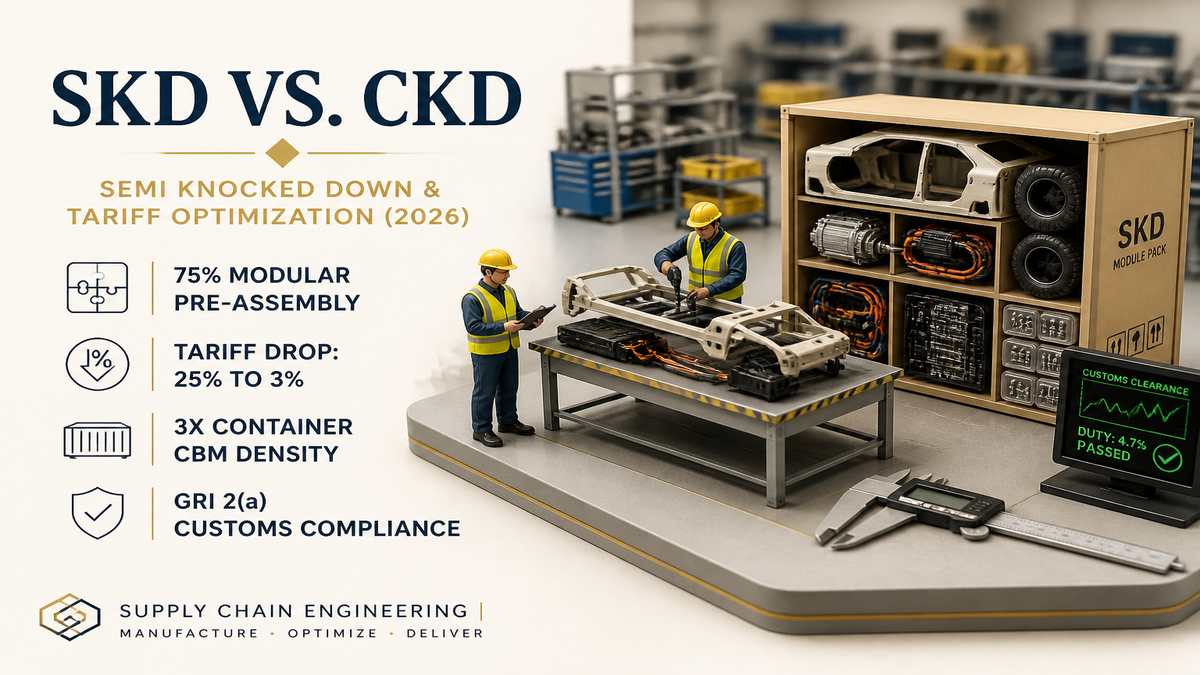
Direct Answer: SKD (Semi Knocked Down) and CKD (Completely Knocked Down) are modular export production methods where physical goods are shipped in parts rather than fully built units (CBU). Under SKD, the Chinese factory builds major sub-assemblies (e.g., bicycle frame with motor attached, TV chassis with display panel mounted) and ships them in compact modular kits. Destination warehouses only need basic hand tools and 5 to 15 minutes of labor to bolt parts together and complete retail packaging. Under CKD, products are shipped as 100% individual raw components requiring a full local manufacturing line with robotic welding, soldering, and testing. Sourcing products as SKD or CKD allows buyers to import goods under individual component classifications on customs tariff classifications and HTS codes, cutting import taxes from 25% down to 3% while tripling ocean container load capacity.
In global supply chains, importing completely finished consumer goods often wastes money. If you ship bulky finished products across the ocean, you pay thousands of dollars in freight charges just to ship empty air trapped between parts. Worse, international trade tariffs intentionally punish finished consumer goods with heavy customs duties (often 15% to 35%, plus punitive anti-dumping duties exceeding 60%), while raw components and sub-assemblies enter at minimal or zero tariff rates.
In this comprehensive guide, we compare CBU, SKD, and CKD manufacturing models, break down real tariff and freight cost savings across major industries, explain how to navigate the critical customs risk of General Rule of Interpretation 2(a) (GRI 2a), share factory-floor quality control and packaging blueprints, and provide an actionable 5-step SOP to establish a reliable overseas SKD assembly operation.
What Do CBU, SKD, and CKD Mean in Global Manufacturing?
In international sourcing and manufacturing, physical goods leave Chinese factories in one of three primary assembly states. Understanding the mechanical boundaries of each format determines your overseas labor costs, ocean freight volume, import tax rates, and local warehouse setup requirements:
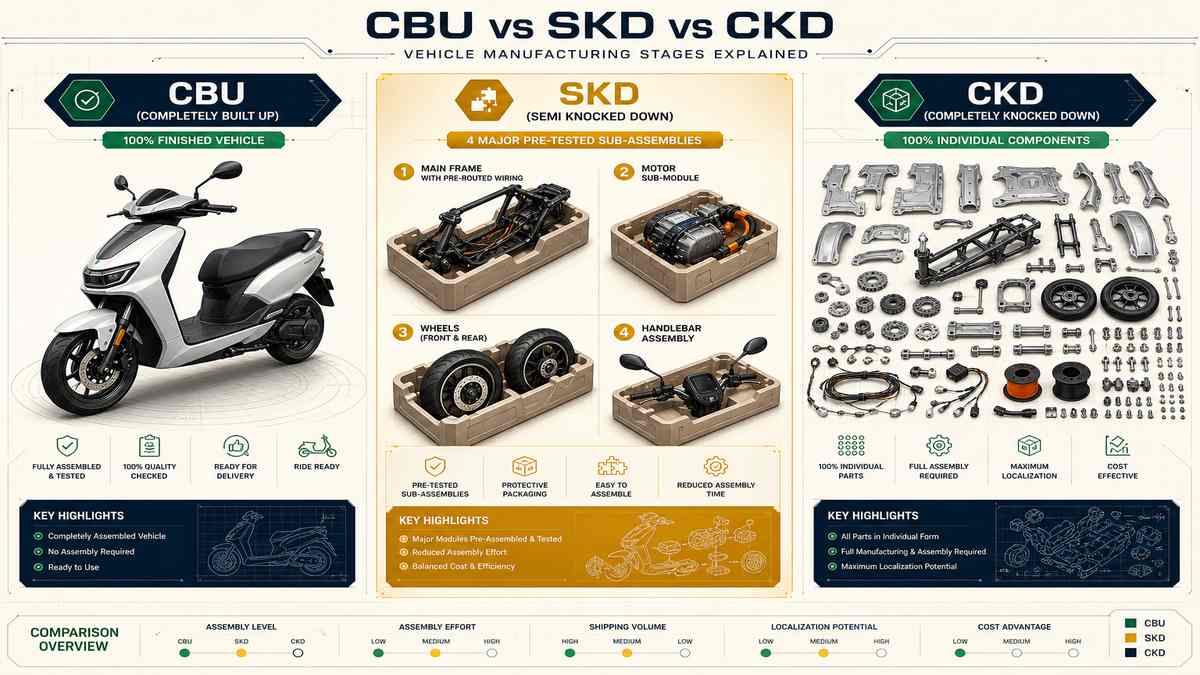
| Manufacturing Metric | CBU (Completely Built Up) | SKD (Semi Knocked Down) | CKD (Completely Knocked Down) |
|---|---|---|---|
| Assembly Depth in China | 100% Fully Assembled & Tested | 70% – 85% Modular Pre-Assembly | 0% – 20% (Raw Components Only) |
| Destination Labor Required | 0 minutes (Ready for Retail) | 5 – 20 minutes per unit | 1 – 4 hours per unit |
| Destination Tooling Needed | None (Box cutter only) | Basic screwdrivers & hand tools | Welding, painting, soldering lines |
| Container Packing Density | Low (Ships lots of empty air) | High (2x to 3x CBU volume) | Maximum (4x to 6x CBU volume) |
| Average Import Duty Rate | Highest (Finished goods tariff) | Low to Moderate (Parts tariff) | Lowest (Raw materials / parts rate) |
| Supply Chain Capital Risk | Lowest technical investment | Low (Small local assembly cell) | High (Full factory infrastructure) |
Why Global Importers Use SKD Sourcing from China
Switching from traditional CBU importing to modular SKD manufacturing delivers three powerful commercial advantages:
1. Tariff Classification & Duty Rate Arbitrage
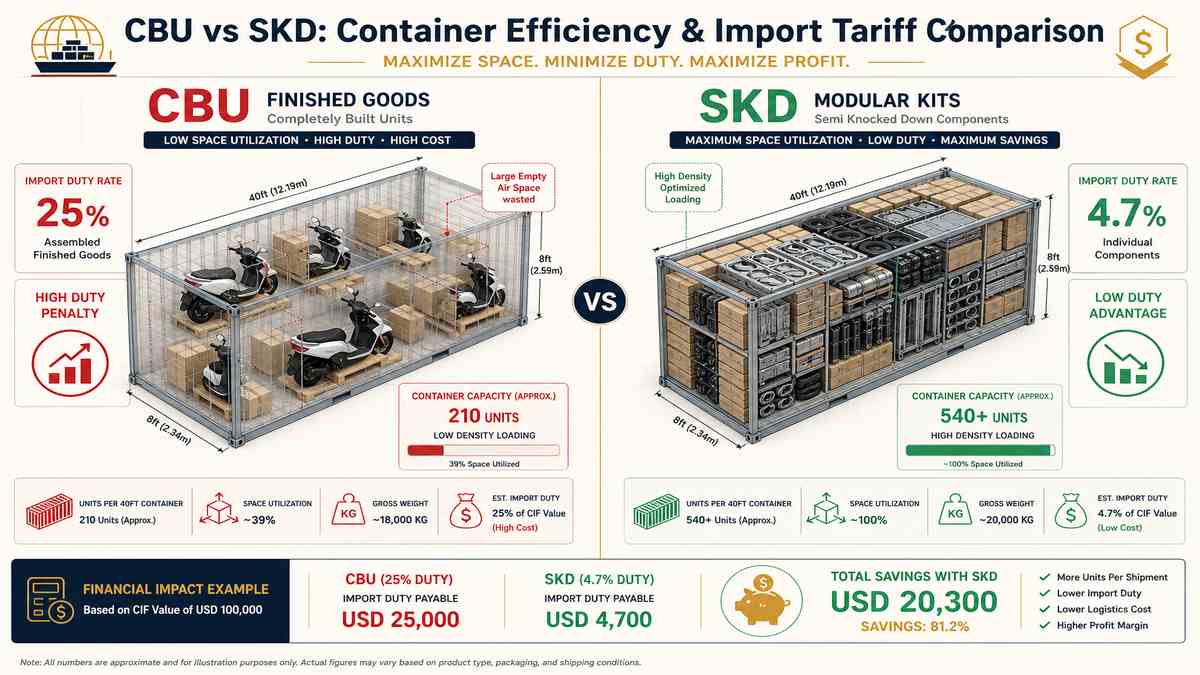
Governments across North America, Europe, and Asia set high tariffs on finished retail goods to protect domestic manufacturing, while setting low (0% to 5%) duty rates on raw components. By checking official schedules on the US International Trade Commission HTS database or the European Union TARIC customs duty portal, importers can legally classify SKD sub-assemblies at lower parts rates.
2. Ocean Freight & Container Volume Optimization (CBM Savings)
Finished goods waste enormous volume inside ocean shipping containers. A standard 40-foot High Cube (40HQ) container holding only 210 fully boxed electric bicycles or 95 treadmills can easily accommodate 540 to 650 nested SKD kits, slashing ocean freight costs per unit by over 60%.
3. Origin Labeling & Local Assembly Branding
Performing final technical assembly, functional calibration, and adding local components allows goods to meet domestic value-added rules for local origin labeling, avoiding trade disputes and opening lucrative government procurement contracts.
Common Product Categories Ideal for SKD and CKD Sourcing
SKD sourcing delivers the highest return on investment for bulky, heavy, multi-module products subject to steep finished-goods tariffs:
| Industry & Product Category | CBU Tariff & Shipping Drawbacks | SKD Breakdown Structure | Real Cost & Duty Savings |
|---|---|---|---|
| Electric Bicycles & E-Scooters | 80%+ Anti-Dumping Duty in EU; 220 units / 40HQ container. | Pre-painted frame with motor, battery pack in hazmat box, wheel kit, handlebar kit. | Tariff drops to 3% – 6%; loading density jumps to 580 units / 40HQ. |
| LED Televisions & Commercial Displays | 15% – 25% finished electronics duty; high screen crack risk during transit. | Open-cell LCD panel, mainboard kit, power board, back cover, plastic bezel, stand. | Avoids finished display duty; saves 65% freight volume; reduces transit damage. |
| Fitness Equipment (Treadmills, Rowers) | Heavy welded steel frame wastes 70% of container box space. | Main steel deck, console arm assembly, motor pack, roller belt, side rails. | Container load increases from 95 units to 240 units per container. |
| Air Conditioners & Heat Pumps | Refrigerant gas transport rules, high finished appliance tariffs. | Compressor sub-module, condenser coil, fan motor, outer metal cabinet, copper piping. | Local gas charging avoids pressurized gas shipping surcharges; 4% parts duty. |
| Solar Inverters & Power Stations | Heavy battery weight rules, high electronics trade penalties. | Metal chassis casing, power inverter PCB, battery cell packs, wiring harness. | Component-level customs entry; localized safety testing and packaging. |
Customs Risks: Navigating General Rule of Interpretation 2(a) (GRI 2a)
While SKD sourcing offers massive duty savings, doing it incorrectly can lead to severe customs penalties and retroactive duty audits:
The Legal Hurdle: Under international trade law governed by the World Customs Organization General Rules for the Interpretation (GRI 2a), any incomplete or unassembled article that possesses the “essential character of the complete or finished article” must be classified and taxed as a complete finished product.
If you import 100 frames, 100 motors, 100 batteries, and 100 wheels inside the exact same shipping container under one bill of lading, customs border officers will combine them into 100 finished units and charge full finished-goods tariffs!
How Experienced Importers Stay Fully Legal
- Split Bill of Lading Shipments: Import structural frames on one vessel voyage and electronic controllers or battery packs on a different vessel departing two weeks later. Because parts arrive under separate customs entries, they cannot be assembled at the border.
- Local Component Sourcing: Source critical sub-components locally in your domestic market (such as batteries, power cords, tires, or packaging). This proves the imported shipment lacks the complete essential character of a finished good.
- Substantial Local Transformation: Ensure your local assembly process involves meaningful technical labor (such as wiring, flashing custom firmware, soldering, testing, and calibrating) rather than a 60-second cosmetic snap-together action.
Quality Control & Packaging Blueprint for SKD Shipments
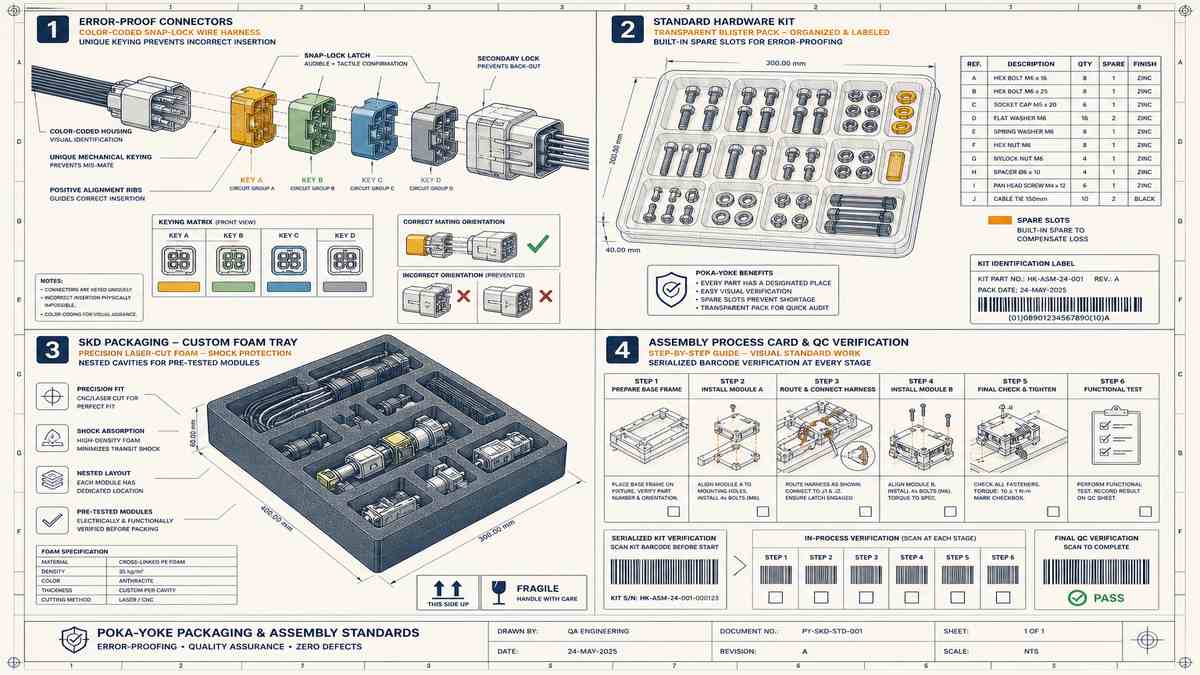
The single greatest risk in SKD manufacturing is opening a container at your local warehouse only to discover that 500 screws are missing, or a wire connector does not plug into the mainboard:
5-Step SOP: Setting Up an Overseas SKD Assembly Operation
Follow this standard operating procedure to build a reliable SKD pipeline:
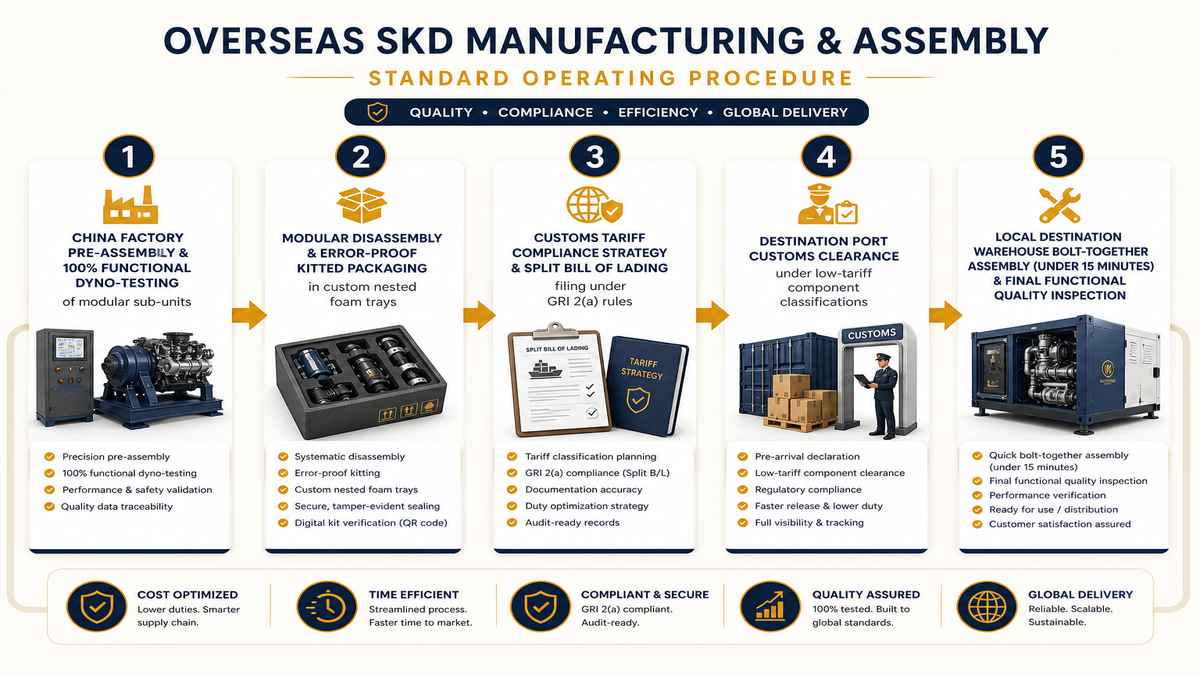
- Product Modular Breakdown & Engineering Design: Analyze 3D CAD models. Break the product down into 3 to 5 logical sub-modules that minimize shipping volume while keeping destination assembly time under 15 minutes per unit.
- Factory Audit & Supplier Capability Vetting: Conduct comprehensive factory audit checklists to verify that the Chinese supplier has accurate CNC machining fixtures, robotic welding jigs, and computerized parts-counting scales for kitting.
- Customs Classification & Tariff Binding Ruling: Consult with your licensed customs broker before shipping. File for an advance customs binding ruling with your local port authorities to confirm that your specific SKD bill of materials qualifies for low component duty rates.
- Export Documentation & Certificate of Origin: Ensure your export packing lists, commercial invoices, and official China Certificate of Origin documents declare the exact component names and itemized piece counts matching your customs filing.
- Local Assembly Cell & Final QC Testing: Set up a clean, ergonomic assembly workbench in your destination warehouse equipped with electric torque screwdrivers, safety test benches, retail packaging stations, and localized barcode label printers.
Illustrative Sourcing Scenario: European E-Bike Importer Slashes Costs by $145/Unit
To understand the financial power of SKD manufacturing, consider this real-world supply chain restructuring scenario:
A mid-sized urban mobility brand based in Germany was importing 6,000 fully finished electric bicycles per year from a manufacturing plant in Changzhou, China. Under standard EU customs classifications, fully built Chinese e-bikes faced a 6% basic customs duty plus an average 62.1% anti-dumping and anti-subsidy penalty tariff. In addition, ocean freight costs were crippling because each 40HQ container could only fit 210 fully boxed bikes.
Working with our technical supply chain team, the buyer restructured their product architecture into an optimized 4-part SKD kit:
- Module 1 (China): Pre-welded, heat-treated aluminum frame with mid-drive motor, internal bottom bracket, and brake cables pre-routed inside the frame tubes.
- Module 2 (China): Front fork, front wheel, rear wheel, and aluminum handlebar assembly packed in flat nested protective trays.
- Module 3 (Local EU Procurement): High-capacity lithium battery packs and smart chargers sourced directly from a certified European battery assembly plant.
- Module 4 (Local Packaging): User manual, local brand packaging box, and city-compliant reflective lights sourced locally.
In Changzhou, every frame and motor underwent a 100% computerized dyno-test before disassembly. In Hamburg, the importer leased a 400-square-meter warehouse section staffed by two full-time technicians using pre-set pneumatic torque wrenches. Assembly time was clocked at exactly 11 minutes per bike.
The Financial Result:
- Tariff Savings: By importing bike parts rather than finished bicycles and sourcing batteries locally, the shipment legally qualified for the standard 4.7% parts tariff rate, completely eliminating the 62.1% anti-dumping penalty.
- Container Freight Optimization: 40HQ container capacity skyrocketed from 210 units to 540 units, cutting ocean shipping costs from $38.50 per bike down to $14.90 per bike.
- Net Cost Savings: After paying local warehouse labor ($9.50/unit) and European battery assembly, the company achieved a net landed cost reduction of $145.60 per e-bike, generating over $870,000 in additional annual gross profit.
Frequently Asked Questions (FAQ)
What is the main difference between SKD and CKD?
SKD (Semi Knocked Down) means products are partially assembled into major sub-modules at the Chinese factory, requiring only simple final assembly (like screwing parts together) at the destination. CKD (Completely Knocked Down) means products are shipped as completely raw individual components that require full local assembly, welding, soldering, and testing lines.
How does SKD shipping save money on customs import duties?
Many countries charge high import duties (e.g., 20% to 35%) on fully finished consumer goods (CBU) to protect domestic manufacturing, while charging much lower duties (e.g., 0% to 5%) on individual parts and sub-assemblies. Importing as SKD allows buyers to pay the lower component tariff rates legally, provided the goods satisfy customs rules regarding substantial transformation.
What is the customs risk of General Rule of Interpretation 2(a) for SKD imports?
Under customs rule GRI 2(a), if all parts needed to make a complete finished product are shipped together in one single container and require only basic assembly, customs border officers can legally classify the entire kit as a complete finished product and charge full finished-goods tariffs. To avoid this, importers separate shipments, buy key components locally, or import parts across different bills of lading.
Which industries benefit most from SKD and CKD sourcing from China?
Industries with high freight volume costs, heavy finished-goods tariffs, or anti-dumping duties benefit most. These include electric bicycles (e-bikes), electric scooters, home appliances (TVs, air conditioners, washing machines), commercial fitness equipment, solar power systems, and electric utility vehicles.
How do you ensure quality control when parts are assembled locally from an SKD kit?
Factories in China must perform 100% pre-assembly and functional testing before disassembly and packaging. Every kit should use mistake-proof (Poka-Yoke) wiring connectors, color-coded harnesses, pre-packaged hardware blister packs, and step-by-step visual assembly work instructions.
Ready to Cut Landed Costs with SKD Manufacturing in China?
Our engineering team helps global buyers design modular SKD sub-assemblies, audit factory kitting lines, prevent GRI 2(a) customs classification risks, and establish error-proof assembly SOPs in 2026.
Schedule an SKD Sourcing Consultation
Questions & Comments
We read every one and reply within 24 hoursEvaluating whether to switch from CBU finished goods to an SKD modular supply chain, or wondering how to classify your components to satisfy customs GRI 2(a) rules? Post your product category, destination country, and manufacturing questions below — our technical sourcing engineers will answer within 24 hours.