
Shipping Routes From China to Canada: Which Port Fits Your Cargo

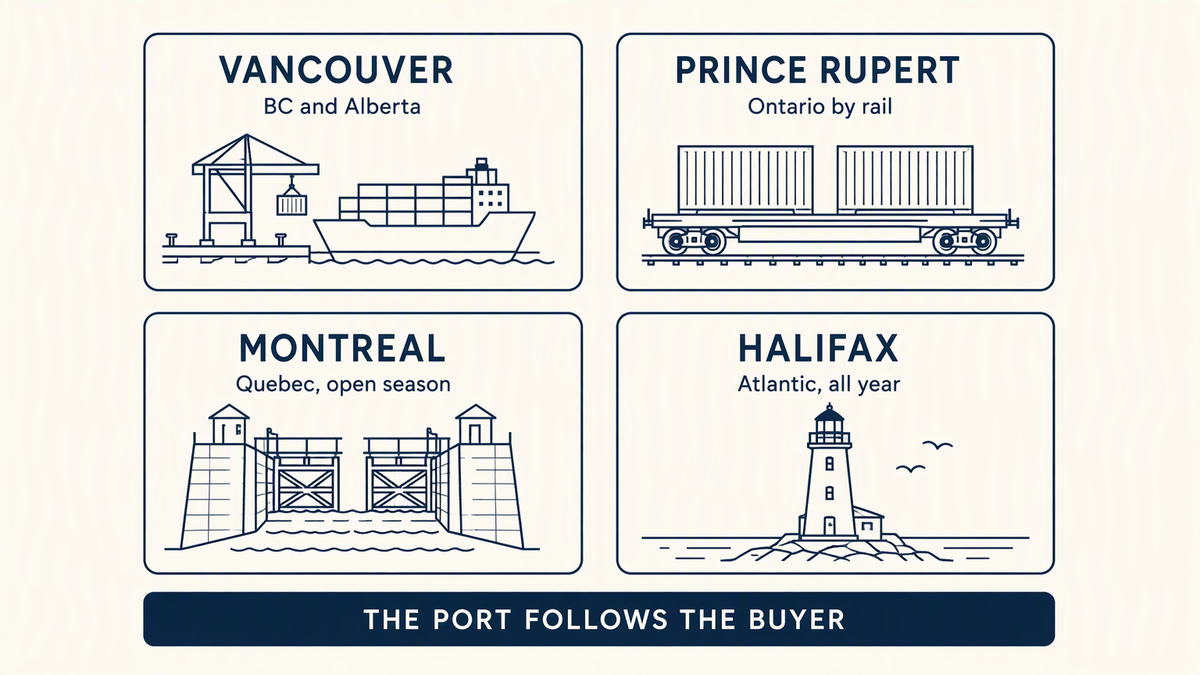
Most cargo from China to Canada enters through one of four ports. Vancouver and Prince Rupert serve the west and feed the rail network east. Montreal serves Quebec through the St. Lawrence Seaway, and it closes each winter. Halifax serves the Atlantic provinces and stays open all year. The right choice depends on where your buyer is, not on which ocean rate looks lowest.
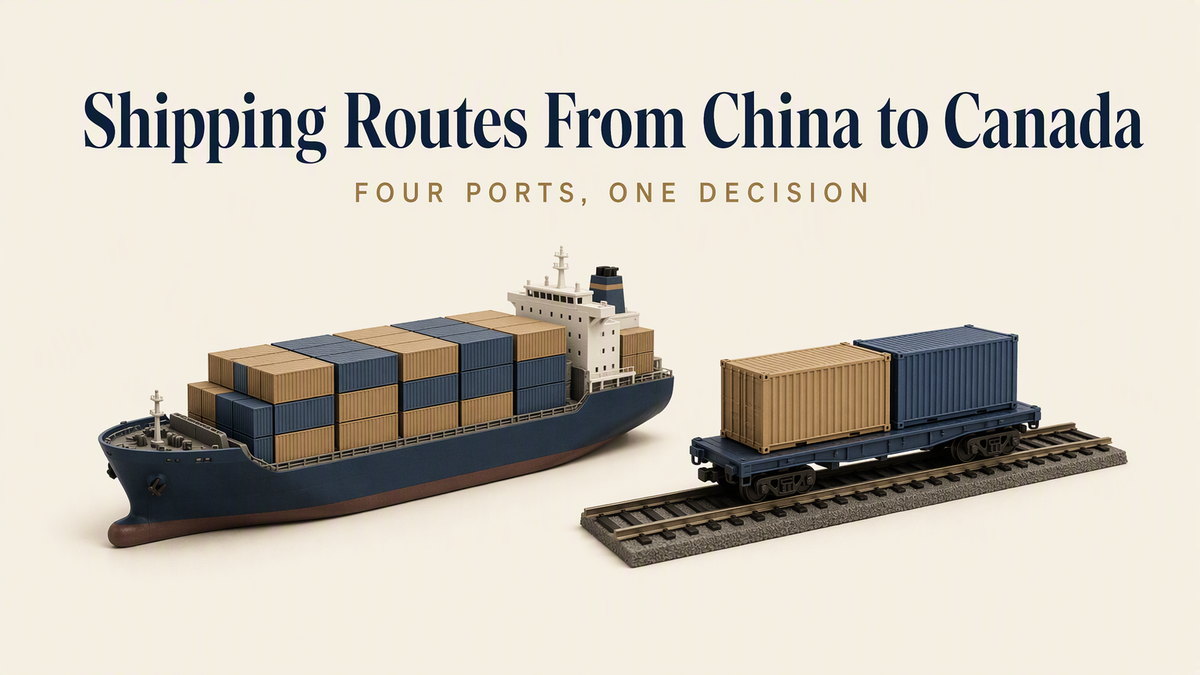
Four ports, four different jobs.
| Port | Best for | Inland leg |
|---|---|---|
| Vancouver | British Columbia, Alberta, and rail to Ontario | CN or CPKC rail, or truck for local delivery |
| Prince Rupert | Ontario and the US Midwest through on-dock rail | CN rail direct from the terminal |
| Montreal | Quebec and eastern Ontario, in the open season | Truck or short rail from the port |
| Halifax | Atlantic Canada and Quebec in winter | Truck or CN rail |
Pick the port by the buyer, not by the rate
A route quote is a door price. It ends at the buyer’s door, so the inland distance is inside the number. Two quotes for the same cartons can differ by a large amount because one lands in Vancouver and one lands in Montreal.
Start with a map question. Where does the buyer take delivery? A warehouse outside Toronto is a rail question. A store in Montreal is a seaway question. A distributor in Alberta is a truck question. Only after that does the ocean rate matter.
The ocean leg is often the part with the least spread. Carriers compete on the same water. What separates the quotes is the land side: rail distance, rail speed, and how many times the container is handled before it reaches the door.
This is also why a cheap port-to-port rate can lose. A low ocean rate into Vancouver still has to cross four provinces by rail if the buyer is in Ontario. The same cargo through Prince Rupert can stay on one rail line from the dock.
Where the port choice stops mattering
If the buyer is within a short drive of the port, the port is decided for you. Use the closest port and stop looking for a cheaper lane.
If the buyer is far inland, the rail rate is the number to compare. Ask both forwarders for the inland leg on its own, and you will see which port is actually cheaper for that address.
The four ports and what each one is for
Each port solves a different problem. Reading them as four equal options is the most common planning error.
Vancouver
Vancouver is the largest container port on the Canadian west coast and the default choice for British Columbia and Alberta. Two railways leave the port, CN and CPKC, so a container can go by rail to Toronto or by truck to a local warehouse.
Use Vancouver when the buyer is in British Columbia, Alberta, or when you want the widest choice of sailings. Its weakness is congestion at peak season, which shows up as rail dwell, not as a port delay.
Prince Rupert
Prince Rupert is a purpose-built intermodal port further north. Containers move from the ship to the rail line without a truck trip, which removes one handling step.
The port authority markets it on shortest sailing times, a deep natural harbour, and a rail route with a gentler grade. DP World, which runs the container terminal there, describes it as the shortest ship crossing from Asia to North America with the greenest rail connection. Those are the port’s own claims, and they are the reason a northern port can beat a larger one on time.
Use Prince Rupert when the buyer is in Ontario or the US Midwest and time matters more than the number of weekly sailings.
Montreal
Montreal is reached by river, through the St. Lawrence Seaway. For a buyer in Quebec or eastern Ontario, it is the shortest inland distance of the four.
The catch is the season. More on that in its own section below, because it changes booking dates.
Halifax
Halifax is an Atlantic deep-water port that stays open all year. For Atlantic Canada it is the natural entry, and in winter it is the alternative when the river route is closed.
Use Halifax for Nova Scotia, New Brunswick, Prince Edward Island and Newfoundland, and as the winter fallback for Quebec.
| Buyer location | First choice | Second choice | Why |
|---|---|---|---|
| British Columbia | Vancouver | Prince Rupert | Truck distance from the dock is short |
| Alberta | Vancouver | Prince Rupert | Rail or truck east from the coast |
| Ontario | Prince Rupert | Vancouver | One rail line from the terminal, no rehandle |
| Quebec, open season | Montreal | Halifax | Shortest inland leg |
| Quebec, winter | Halifax | Montreal by rail from Halifax | The river route is closed |
| Atlantic provinces | Halifax | Montreal | Closest Atlantic entry |
Transit is three legs, not one
A forwarder who says “30 days” is usually quoting the ocean leg. Your stock does not reach the shelf in 30 days. Three legs run one after another, and only one of them is at sea.
The first leg is the ocean crossing. The second is the rail or truck run inland. The third is the local delivery plus the wait for a receiving slot at the buyer’s warehouse.
The table below gives planning ranges, not quotes. They are wide on purpose. Use them to schedule, then confirm the real cut-off with the carrier booking.
| Leg | Typical planning range | What moves it |
|---|---|---|
| Ocean, China to Vancouver | 14 to 20 days | Sailing frequency, port congestion |
| Ocean, China to Prince Rupert | 14 to 18 days | Fewer services, longer feeder planning |
| Ocean, China to Montreal | 30 to 40 days | Routing, Seaway transit, season |
| Ocean, China to Halifax | 30 to 36 days | Routing through Suez or Panama |
| Rail, Vancouver to Toronto | 5 to 8 days | Rail dwell, weather, car supply |
| Rail, Prince Rupert to Toronto | 4 to 6 days | Single line, on-dock start |
Add the third leg before you promise a date. A rail arrival is not a warehouse arrival. The buyer still needs a truck, an appointment, and someone to unload.
This is the same arithmetic that decides between FCL or LCL on the water. A full container can go straight to the rail ramp. Loose cargo waits at a consolidation warehouse for the next group.
Why Prince Rupert is not a smaller Vancouver
The two ports look similar on a map and behave differently in a schedule. Vancouver is a large port with two rail operators and heavy local demand. Prince Rupert is a smaller port built around one job: moving containers from ship to rail.
Because the container terminal sits next to the rail line, a container does not need a drayage trip between the dock and the ramp. Every drayage move you remove is a move that cannot be late, damaged, or charged twice.
The port also argues that its rail grade is gentler and its approach is safer. Grade matters on a long climb through the mountains. A gentler line means fewer helper locomotives and fewer stalls in winter.
The trade is frequency. A smaller port has fewer weekly calls, so a missed sailing can cost a week. If your order is time-critical and small, check the sailing calendar before you choose the northern route.
The St. Lawrence Seaway closes every winter
The river route to Montreal is not open all year. The St. Lawrence Seaway is a managed waterway with locks, and it runs a defined season each year.
The operator publishes an opening and a closing date for every season. On 22 October 2026 the St. Lawrence Seaway Management Corporation posted Seaway Notice No. 9 covering the closing of the 2026 season, together with ice reports and freezing-degree data for the weeks before it.
For a shipper this is a booking constraint, not a news item. A container booked for Montreal in the last weeks of the season can be rolled into the next one. It can also be rerouted to Halifax at a higher inland cost.
Plan two things. First, get the closing date before you confirm a Montreal booking in the fourth quarter. Second, ask the forwarder what the fallback is, and what it costs, if the container misses the last sailing.
Winter does not stop Canadian imports. It changes the port. Halifax stays open, and the cargo moves by rail or truck from there.
The inland leg is where the plan breaks
The ocean crossing is the part everyone plans. The inland leg is the part that slips, and it slips for reasons that have nothing to do with the ship.
When a container leaves the vessel, it sits at the terminal until a rail car is available. That wait is charged. Most rates include a few free days, and after that the terminal bills per day per container. Ask what the free time is before you book, not after the invoice arrives.
The second charge is detention. That clock starts when you pick up the container and stops when you return it empty. If the buyer cannot unload quickly, the container sits on their yard and the meter runs.
The third is the chassis, the wheeled frame the container sits on. In some markets it comes with the container. In others it is a separate rental. A forwarder who quotes a door price should say which one applies.
The fourth is the receiving appointment. A warehouse that books slots two weeks out will not take your container on the day it arrives. The container waits, and the wait is billable.
Weather on the mountain passes
Rail from the west coast crosses high ground. In winter, avalanches and track closures can add days without warning. The railways plan for this and reroute, and the cargo still arrives, but the date moves.
This is why a rail arrival date is a range, not a promise. Build the range into the buyer’s launch plan and you will not be explaining a delay later.
What to put in the booking
Four numbers make the inland leg controllable. Free time at the terminal, free time on the container, the chassis arrangement, and the earliest receiving slot at the buyer’s warehouse.
Get those four in writing and the inland leg stops being a surprise. A forwarder who cannot give you four numbers is quoting a sea rate, not a route.
Two buyers, two routes
The same cargo can need two different routes. Here are two cases, using the planning ranges above. The point is the reasoning, not the price.
Buyer A: a distributor outside Toronto
The order is four pallets, about 3,000 kg, and the buyer needs it in seven weeks. Ontario is far from both coasts, so the inland leg decides.
Through Vancouver, the plan is 14 to 20 days at sea plus 5 to 8 days by rail. That is 19 to 28 days before the local delivery. The buffer is thin but workable.
Through Prince Rupert, the plan is 14 to 18 days at sea plus 4 to 6 days by rail. That is 18 to 24 days, and the container never needs a truck between the dock and the rail ramp.
For this buyer the northern port wins on time and on handling. The trade is sailing choice, so the booking has to be made earlier in the week.
Buyer B: a retailer in Montreal, shipping in November
The order is one container and the buyer wants it before a February promotion. Montreal is the shortest inland leg, so the first instinct is to route through the river.
The season changes that. The St. Lawrence Seaway closes for the winter, and a November booking sits close to the last sailings. If the container misses the final window, it can be rolled into the next season.
The safer plan is Halifax, then rail or truck to Montreal. The inland leg costs more and the total time is longer. What it buys is a route that does not stop in December.
That is the trade in one line. A shorter inland leg is worth less than a route that stays open when your stock is due.
When air or express changes the answer
Sea freight is the default for volume, and it stays the default for most orders. Two situations break it.
The first is a launch date. If a product has a fixed shelf date and the sea cut-off has passed, air is the only option. The second is a small, high-value first order, where the freight is small next to the value of the goods.
Air cargo does not use the four ports in the same way. It lands at an airport, usually Vancouver, Toronto, Montreal or Calgary, and clears there. The inland question becomes an airport question, and Calgary and Toronto matter more than they do for sea.
Express couriers are a third path. They suit samples and spare parts, and they price per parcel instead of per kilogram of chargeable weight. Above a few hundred kilograms the parcel price stops making sense.
Duties and the inland leg are priced line by line in shipping a container from China to Canada. This page is about which way the container travels, not what it costs.
Six questions that make two quotes comparable
A route quote you cannot compare is not a quote. Ask these six questions of both forwarders before you decide.
Six questions for each forwarder.
| Question | Good answer |
|---|---|
| Which port does this rate use? | A named port, plus the rail ramp if it is inland |
| Is the inland leg inside the rate? | Yes or no, with the leg priced on its own |
| Which railway moves it? | CN or CPKC, named |
| How many drayage moves are included? | A number, not a sentence |
| What is the winter plan for Quebec? | Halifax routing with the cost difference stated |
| What is excluded? | Duty, bond, exam fees and storage, listed |
Two more habits help. Ask for the transit as three numbers, not one. And ask which sailing the rate is based on, because a rate without a cut-off is a rate you cannot plan around.
Clearance is the other half of the route. A route that arrives on time but sits at the border is not a fast route. A customs broker who knows the entry type will save more days than a faster ship.
Tell us the delivery address and we will route it
Send the buyer’s city, the carton count and the cargo weight. We will name the port that fits and split the transit into ocean, rail and local delivery. We also flag the winter risk if the address is in Quebec. You get the inland leg priced on its own, so two quotes become comparable.
Check my routeQuestions shippers ask
What is the fastest shipping route from China to Canada?
For Ontario and the US Midwest, Prince Rupert is usually the fastest sea route. Containers move from the ship to the rail line without a truck trip, and the port positions itself on the shortest sailing time from Asia. Confirm the sailing date, because a smaller port has fewer weekly calls.
Does cargo from China to Canada go through the US?
Not normally. Sea cargo enters at a Canadian port and clears with the Canada Border Services Agency. Some inland routes pass near the border, and some rail lanes serve US destinations, but a Canada-bound container does not need a US entry.
Can I ship to Montreal in December?
Check the season first. The St. Lawrence Seaway runs a defined season each year, and the operator publishes a closing date. In 2026 the closing notice was posted on 22 October. A late booking can be rolled or rerouted to Halifax at a higher inland cost.
Which port is best for Alberta?
Vancouver, in most cases. The rail and truck distance east from the coast is shorter than any route through Ontario, and the port has the most sailings. Prince Rupert works when the inland rate is lower for that specific address.
How many days should I add for rail?
Plan five to eight days from Vancouver to Toronto and four to six from Prince Rupert. Add a day or two for the receiving appointment at the buyer’s warehouse. Rail dwell at peak season is the usual reason a plan slips.
Is LCL cheaper than a container on this lane?
It depends on volume, not on distance. LCL prices per cubic metre and adds handling at a consolidation warehouse. Above roughly half a container, the full container usually wins even when the ocean rate looks higher.
If the goods are still at the factory, the same cost logic runs one step earlier. The landed cost of an Alibaba order shows how freight, duty and handling stack before the container ever leaves China.
Questions & Comments
Tell us the buyer’s city and the carton count, and we will say which of the four ports fits. If the address is in Quebec, tell us the delivery month as well, because the river route has a closing date and that changes the answer.