
3PL Dropshipping: What Changes When Your Stock Sits in Someone Else’s Building
 ·
Updated October 14, 2026
·
13 min read
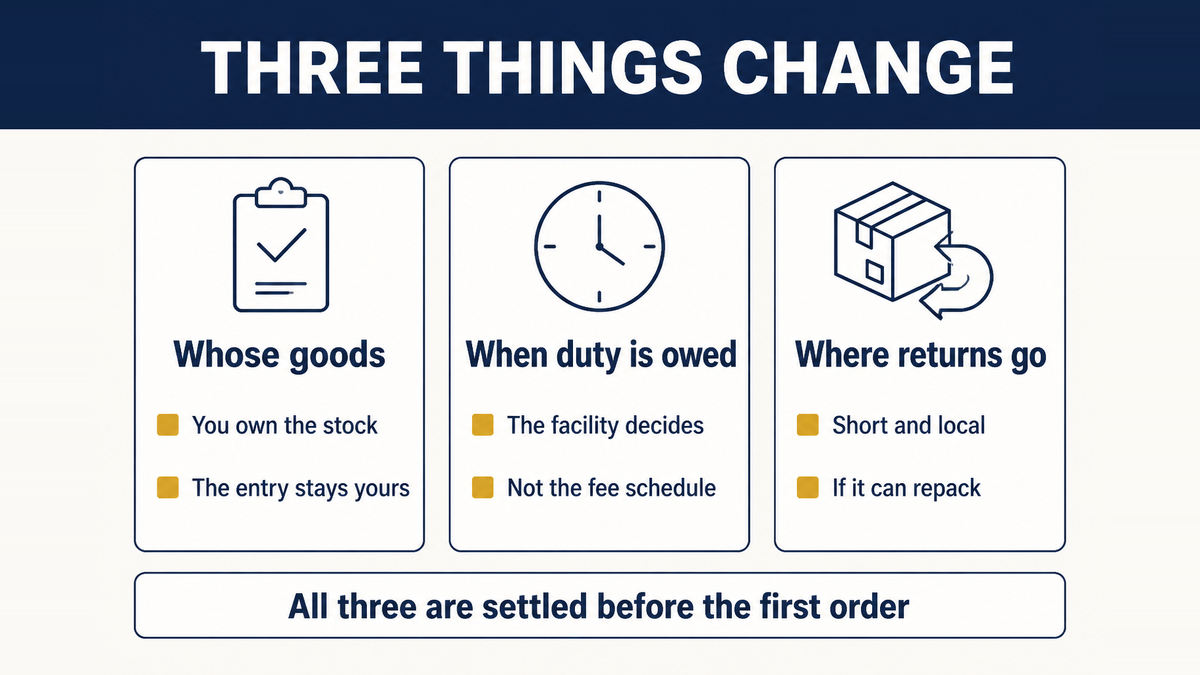
Moving from dropshipping to a third-party warehouse is usually described as a speed upgrade: faster delivery, better packaging, a real return address. That description is accurate and it is also the least important part of the change. Putting stock in someone else’s building alters who is answerable for it, when the duty on it is owed, and where a return has to travel, and those three things are decided by the type of facility rather than by the fee schedule you are quoted. This guide covers the three, and leaves the picking and packing side to the origin-side guide this one sits beside.
1. A 3PL Is Not a Faster Dropshipper
The sales pitch for a third-party warehouse is honest as far as it goes. Goods stored closer to the buyer arrive sooner, the packaging is under your control rather than the supplier’s, and the parcel leaves with a domestic return address instead of an international one. All three are real improvements and all three are about the customer’s experience of the parcel.
What a warehouse also does is move your business into a different set of rules. A dropshipped order is a sale you originate and somebody else ships from abroad. An order shipped from domestic stock is a sale you originate, out of goods you already own, already imported and already paid duty on, sitting in a building you do not control. Almost every question that follows from that change is settled before the first order, and most of the questions are not about fulfilment at all.
It is worth being precise about what the move buys, because the two models are often compared on the wrong axis. Dropshipping is a way of not buying inventory. A warehouse is a way of holding inventory. The choice between them is therefore not a choice between a slow method and a fast one; it is a choice between carrying stock and not carrying it, with delivery speed arriving as a consequence rather than as the point. Once that is clear, the questions that matter stop being about fulfilment and start being about money and paperwork: how much cash sits in goods, when duty leaves the account, and who holds the record of how those goods entered.
The one that surprises people first is that owning the stock does not mean owning the responsibility for how it entered the country. That duty stays where it was.
| The question | Dropshipped | Shipped from a 3PL |
|---|---|---|
| Whose goods | The supplier’s until the sale | Yours from the day they land |
| When duty is owed | On the import behind each parcel | Decided by the facility type |
| Where a return goes | Back across a border | Locally, into the warehouse |
| What is fixed | Almost nothing | Storage, charged monthly |
| What improves | Cash tied up | Delivery speed and return cost |
2. Whose Goods They Are, and Who Answers for the Entry
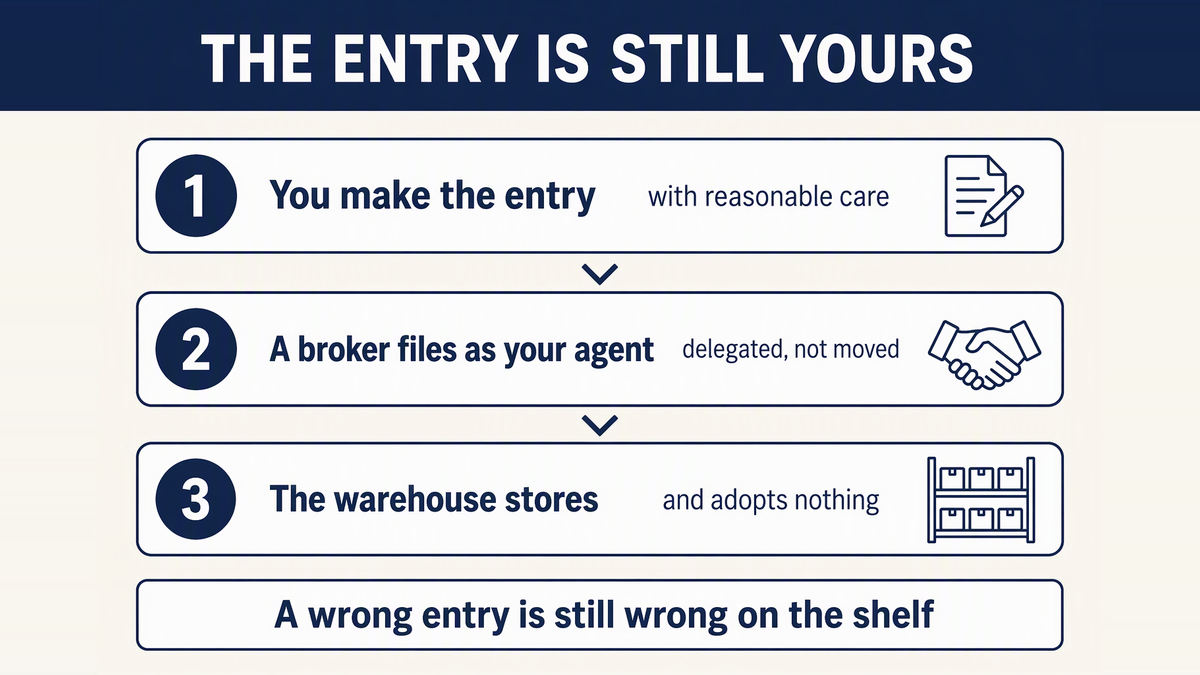
A warehouse stores goods. It does not adopt them. The obligation that comes with bringing merchandise into the country attaches to a person, and the statute puts that obligation on the party making the entry, who must act with reasonable care.
… either in person or by an agent authorized by the party in writing, shall, using reasonable care—(A) make entry therefor by filing with the Bureau of Customs and Border Protection such documentation or, pursuant to an authorized electronic data interchange system, such information as is necessary to enable the Bureau of Customs and Border Protection to determine whether the merchandise may be released from custody…
Tariff Act of 1930, 19 U.S.C. 1484, Entry of merchandise (read 14 October 2026)
Two details in that passage are worth carrying into a warehouse decision. The duty is performed by a person or by an agent authorised in writing, so the obligation can be delegated in its execution but not in its existence: a broker filing on your behalf is still filing as your agent, and the entry remains yours. And the standard is reasonable care, which is about the quality of the information behind the entry rather than about which building the goods end up in.
What that means in practice is that a third-party warehouse can be excellent at moving parcels and entirely outside the entry question. Choosing one does not transfer the entry to the warehouse, and moving goods into a warehouse does not restart the clock on anything that was already done incorrectly at import. If the classification or the declared value was wrong when the goods entered, they are still wrong while the goods sit on a shelf, and they will still be wrong when they come off it.
There is a second half to this that is quieter and more expensive. An entry is not a transaction that ends when the goods are released; it is a record that has to exist and be produced if it is ever questioned. The party making the entry is the party that has to be able to show what was declared, on what basis and from what information. A warehouse holding the goods has no reason to hold that file, and a supplier who shipped them has no obligation to reconstruct it later. So the practical question before choosing a facility is not only who files the entry, but where the entry file lives and who can produce it two years from now. Sellers who answer the first question and not the second have a business that runs perfectly until the day it has to explain itself.
3. When the Duty Is Owed Depends on the Type of Facility
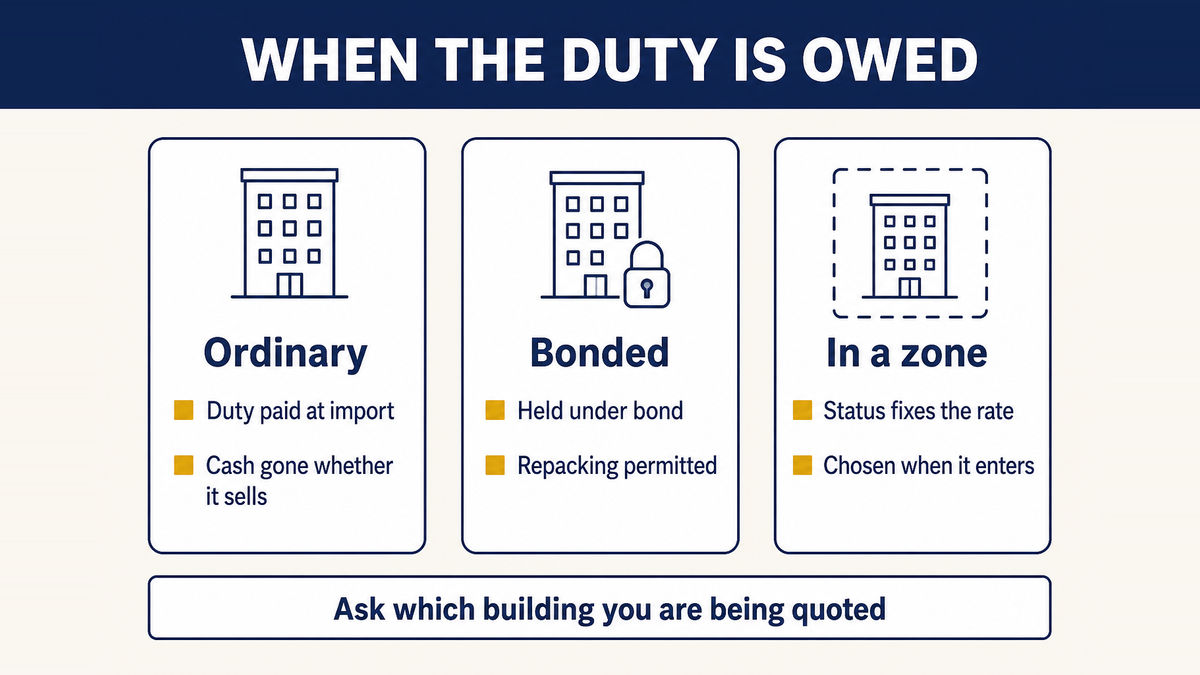
This is the part of a warehouse decision that carries money, and it is the part almost never discussed in a fulfilment quote. Three kinds of building can hold imported goods, and they do not share the same answer to the question of when duty is paid.
An ordinary commercial warehouse has no special status. Goods arrive, duty is paid at import, and the money has left the business whether or not the goods ever sell. That is the default, and it is the reason a slow-moving item in an ordinary warehouse is worse than the same item in a dropship arrangement: you have already funded the duty on every unit.
A bonded warehouse is a facility the customs authority has approved to hold imported merchandise under bond. The classes are set out in the regulations, and the two that matter here are the public warehouse and the one that exists to change the condition of goods.
Class 3. Public bonded warehouses used exclusively for the storage of imported merchandise… Class 8. Bonded warehouses established for the purpose of cleaning, sorting, repacking, or otherwise changing in condition, but not manufacturing, imported merchandise, under Customs supervision and at the expense of the proprietor.
U.S. Customs and Border Protection, 19 CFR Part 19, Customs Warehouses, Container Stations and Control of Merchandise Therein (read 14 October 2026)
The Class 8 wording is the one to read twice if you are considering a warehouse to do kitting or re-packing. The rule allows cleaning, sorting and repacking under customs supervision, and it stops at manufacturing. A fulfilment centre that assembles a gift set from parts is repacking. A centre that turns parts into a different product is somewhere else on the line, and the line is drawn by the regulation rather than by the contract.
The third kind of facility is a foreign trade zone, and it introduces a choice that a bonded warehouse does not. Merchandise in a zone can be given a status, and the status decides which duty rate applies to it later.
… tariff classification according to its character, condition and quantity, at the rate of duty and tax in force on the date of filing, in complete and proper form, the application for privileged status. Classification of merchandise subject to a tariff-rate import quota will be made only at the higher non-quota duty rate in effect on the date privileged foreign status was granted.
U.S. Customs and Border Protection, 19 CFR 146.41, Privileged foreign status (read 14 October 2026)
Read plainly, privileged foreign status fixes the duty at the rate in force on the date the status was applied for. Goods that do not take that status are treated differently, and the rate that eventually applies to them is the one in force when they leave the zone rather than the one in force when they arrived. That is a genuine decision with money attached, and it is available only inside a zone. It is also worth noticing what the same provision does with quota items: they are classified at the higher non-quota rate from the moment the status is granted, so the choice is not a free option in every case.
None of this is a reason to choose a zone. It is a reason to ask which of the three buildings you are being quoted, because the fee schedule is usually silent on it and the difference is the duty on the whole inventory.
The difficulty is that warehouses rarely advertise which of the three they are, and a fulfilment quote will describe services rather than status. The question that gets a clear answer is a direct one: is this building bonded, is it inside a foreign trade zone, or is it an ordinary commercial warehouse? A provider who operates a bonded facility will say so immediately, because the approval is a selling point. A provider who answers the question by describing their warehouse management software has answered a different question.
It is also worth separating two things that sound alike. Being near a port is not the same as having customs status, and a warehouse can sit a mile from a terminal and be entirely ordinary. What matters is the approval the building holds, not its postcode.
4. Where the Return Has to Travel
The third change is the one that shows up fastest in the numbers, because it is the one the customer experiences.
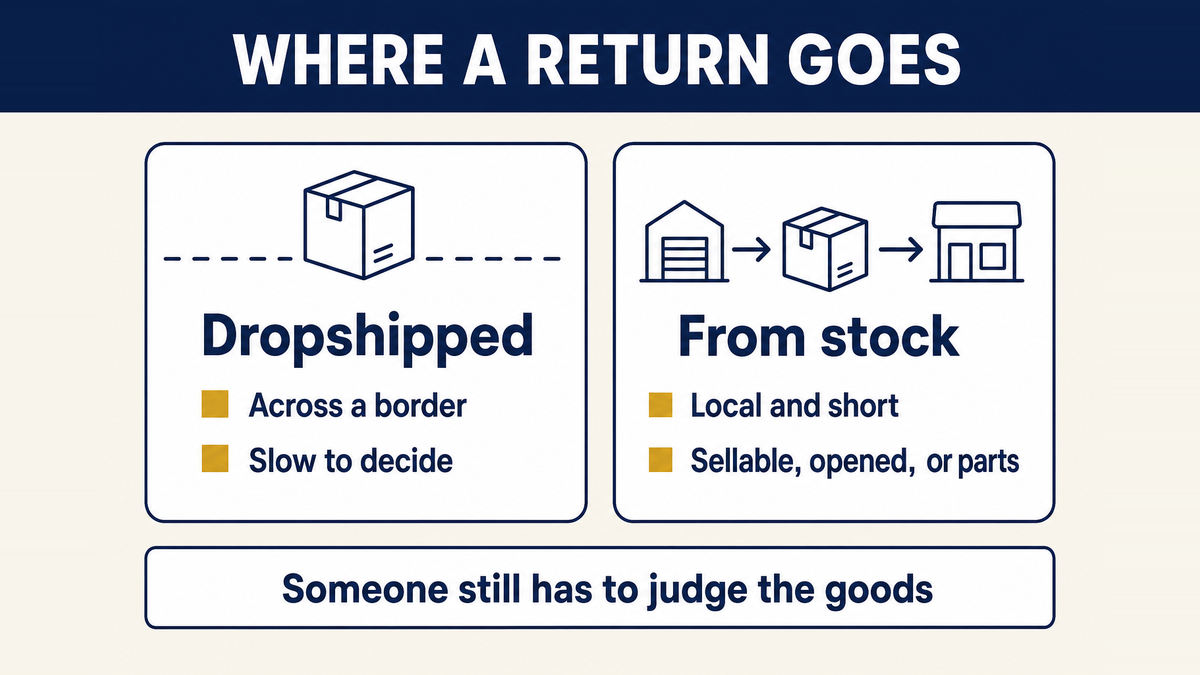
In a dropship arrangement a return is a long journey with a customs question attached to it. In a domestic warehouse it is a domestic parcel movement: the customer sends it back locally, the warehouse receives it, and whether the item can go back on the shelf or has to be written off is decided by its condition rather than by its paperwork. That is a real improvement in both cost and speed, and it is the main reason sellers move.
Two consequences follow that are easy to miss. The first is that a returned item which can be resold has to be physically put back into sellable stock, and that step does not happen by itself. A warehouse that receives a return and books it in is not the same as a warehouse that inspects it, repacks it and returns it to the pick face. The second is that the refund obligation still runs on the original schedule regardless of where the goods now sit. What a return costs per delivered order, and the rate to plan for, is set out in what a return actually costs.
The reason returns belong in this section rather than in a customer service section is that they are the one part of the change that is decided by the facility. A warehouse that can repack is a different building from one that can only store, in the same way that a bonded warehouse is a different building from an ordinary one. Both differences are worth more than a cent or two on the pick fee.
The decision that a returned item forces is the one nobody wants to own, and it is where a well-run arrangement separates from a badly run one. Someone has to look at the parcel and answer a commercial question: is this sellable as new, sellable as opened, or only useful as a part? A warehouse will not answer that question on its own, because the answer changes the value of your stock rather than theirs. If the answer is nobody, the default is that every returned unit is treated as a write-off, and the return rate you planned for then costs more than the return allowance assumed. Writing down who decides, and on what standard, is a paragraph of work that removes a permanent leak.
5. What It Does to the Numbers
Three cost effects decide whether the move pays, and they pull in different directions.
The first is duty as working capital rather than as a cost per sale. In an ordinary warehouse the duty is paid on the whole shipment when it lands, which means cash leaves the business on units that may sit for months. In a bonded warehouse or a zone the timing changes. Total duty is often similar and the amount of cash tied up at any moment is not, which is why the facility question is a cash question before it is a cost question.
The second is storage, which behaves like the fixed costs of the store. It is charged whether or not the goods move, so it belongs on the fixed side of the break-even rather than inside the contribution from a sale. How that division is set out matters more than the rate, because a storage charge filed as a per-order cost will make a slow month look better than it is.
The shift in break-even is the part that decides whether the move was worth making, and it is easy to read backwards. Storage is charged monthly on the space the stock occupies, so it behaves like a subscription: owed whether or not an order arrives. Putting it in the fixed column raises the order count the store has to reach before the month funds itself, which is the opposite of what a seller expects to hear when they are told the fulfilment cost per parcel will fall. Both statements can be true at once. The cost of one parcel can drop while the cost of running the month rises, and the honest reading of the change is that it converts a variable cost into a fixed one in exchange for speed and control. That trade is good at volume and poor below it, so the number worth checking before signing is the order count at which the new fixed costs are covered rather than the pick fee on the quote.
The third is everything that does not change. The unit cost is the same, the outbound freight is the same or slightly better, and the payment fee is unchanged. The move buys speed and control, and it pays for them with duty paid earlier, storage charged monthly, and a stock position that now has to be managed. A plan that expects the whole margin to improve is expecting the wrong thing; what improves is delivery time, return cost and, if the volume is there, the freight rate per parcel. If you are still deciding whether to hold stock at all, the sequence is covered in moving from dropshipping to wholesale, and the stock-control side in managing inventory.
6. What to Check Before Signing
Five questions, asked in this order, because the first two are the ones that cannot be fixed later.
- Is the building bonded, in a zone, or ordinary? Ask the question in those words. The answer decides when duty is paid, and a quote that does not contain the answer is incomplete rather than cheap.
- Who is the importer on the entry? Confirm in writing whose name is on the entry and who holds the reasonable-care duty. A warehouse filing as your agent is not the same as a warehouse importing on its own account.
- Can it repack, and can it kit? Repacking is permitted in a bonded Class 8 facility; assembly that changes the product is not. If the plan involves building sets, settle which side of that line the work falls on before the first pallet arrives.
- What happens to a return? Ask specifically whether returned goods are inspected, repacked and returned to sellable stock, or only received. The difference shows up as a slow leak rather than as a line item.
- Which side of the origin is the warehouse on? A warehouse in the producing country and a warehouse in the buying country solve different problems. The origin side, including picking, packing and courier rates, is covered in the China 3PL warehousing and order fulfilment guide; the destination side is the one described here.
A fulfilment quote tells you what the warehouse charges. It does not tell you when duty is paid, whose name is on the entry, or whether a return can go back on the shelf. Those three are settled by the type of facility, and they are worth more than the pick fee.
7. Frequently Asked Questions
Is a 3PL better than dropshipping?
It is faster and it gives you control of packaging and returns, and it also brings obligations that dropshipping does not. You own the stock, you fund the duty earlier, and you pay storage whether the goods move or not. Whether that is better depends on your order volume and your cash position rather than on which model sounds more professional.
Does using a 3PL make the warehouse the importer?
No. The duty to make entry with reasonable care attaches to the party making the entry, and a warehouse or broker acting on your behalf is doing so as your agent. Delegating the filing does not move the obligation, so the entry and the information behind it remain yours to get right.
What is the difference between a bonded warehouse and a foreign trade zone?
Both hold imported goods without duty being settled at once, and they differ in how the duty is later determined. A zone lets merchandise be given a status that fixes the duty at the rate in force on the date the status was applied for, whereas goods without that status are rated according to what is in force when they leave the zone. Quota items are classified at the higher non-quota rate once the status is granted.
Can a 3PL assemble gift sets for me?
Repacking is permitted in a bonded facility of the class established for cleaning, sorting and repacking, under supervision and at the proprietor’s expense. Manufacturing is not. Combining items into a set that is sold as a set is usually repacking; turning components into a different product is not. Settle which one your plan involves before the goods arrive.
Do I still need a returns process with a 3PL?
You need a better one, because returns become local and therefore visible. The warehouse has to receive the parcel, and somebody has to decide whether the item is sellable and get it back to the pick face. A facility that only receives returns leaves the resale value of every returned unit sitting in a corner.
The Entry File Comes Back With Your Name On It
We return the importer-of-record line, the duty trigger for your facility type, and the return address, written for your broker to read.
Draft My Entry Line
Questions & Comments
We read every one and reply within 24 hoursChoosing between holding stock at home and shipping from the supplier, unsure whether the warehouse you have been quoted is bonded or ordinary, or trying to work out who is on the entry when a broker files on your behalf? Tell us what you are shipping and where your buyers are, and our team will show you what changes on duty timing and what the return path costs in each arrangement.