
Oxygen Plant Manufacturer: Process, Purity and Site Rules From China
 ·
Updated October 14, 2026
·
18 min read
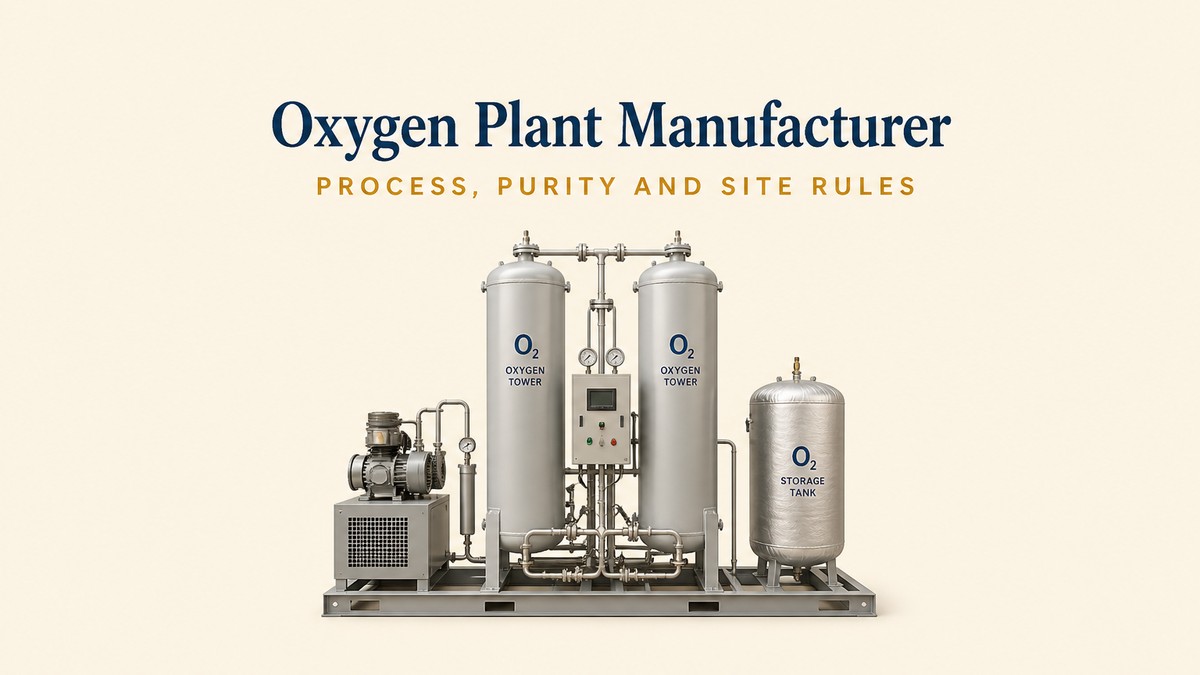
An oxygen plant makes the gas. The storage that holds it, and the pipes that move it, are a separate order. That order follows its own set of rules. If you treat both as one thing, you will have problems later. Four questions settle most of the project. Which process fits your purity and your volume? Where may the plant and its storage stand? How far must they be from other things? What happens to the metal when it touches oxygen? And which parts must you build yourself? This guide answers those questions one by one. It ends with a list you can use to read quotations.
| Your situation | What decides the choice | Where the cost goes |
|---|---|---|
| A workshop that buys gas in bottles | How many bottles a month, and the trip to refill them | Running cost, not the plant |
| A hospital that needs gas every day | Purity, a backup supply, and the delivery pressure | The purity grade and the spare capacity |
| A site that needs a lot of gas | Volume, and whether you also want liquid | Power, and the size of the plant |
| A site with no room outdoors | Whether the rules allow an indoor room | The air supply and the room itself |
| A site next to fuel storage | The distances the rules require | The layout, or a fire wall |
An Oxygen Plant Is Not a Bulk Oxygen System
Almost every enquiry mixes two things together. If you separate them, the rest of the project gets easier.
An oxygen plant takes oxygen out of the air. A bulk oxygen system holds that oxygen and sends it where you need it. The word bulk means a large amount. Different suppliers build them. Different trades install them. And in the United States, one rule does not cover both.
That last point changes what your supplier owes you. So read it slowly. Most buyers think one rule covers the whole job. That rule is 29 CFR 1910.104, the section on oxygen. The first line draws a line. The rule covers bulk oxygen systems on industrial and institutional consumer premises. It does not cover oxygen plants. It treats a plant as the gas supplier's own site.
Read that again, because it works in both directions. The rule that controls your site is not the rule that controls the plant you buy. A supplier who says the plant falls under it has not read the first line. Ask that one question, and you will learn a lot about a supplier.
The same section also sets a size limit. Write it down, because it decides what kind of project you have. A bulk oxygen system is a set of parts. The parts include storage containers, pressure regulators, safety devices, vaporizers, manifolds and the pipes that join them. It counts as bulk once it holds more than 13,000 cubic feet of oxygen that is connected and ready to use. If you keep spare oxygen on site that is not connected, the number changes to more than 25,000 cubic feet.
Below that number, the installation rules do not apply. Above it, they all apply. The layout. The distances. The materials. And the ground under the storage. If you size a reserve just over the limit by accident, you get a project with a fire review.
The split also tells you who is responsible for what. Your supplier owes you a plant that makes the purity and flow you asked for. That plant has its own pressure rating and its own materials. Your project owes the site. That means the foundation, the power, the vents and the distances. If you mix those up, you end up with a plant on site and nobody responsible for the storage. Naming who supplies what is what makes an engineered order work. The same idea runs through industrial machinery packages in general.
PSA, VSA, Cryogenic or Membrane
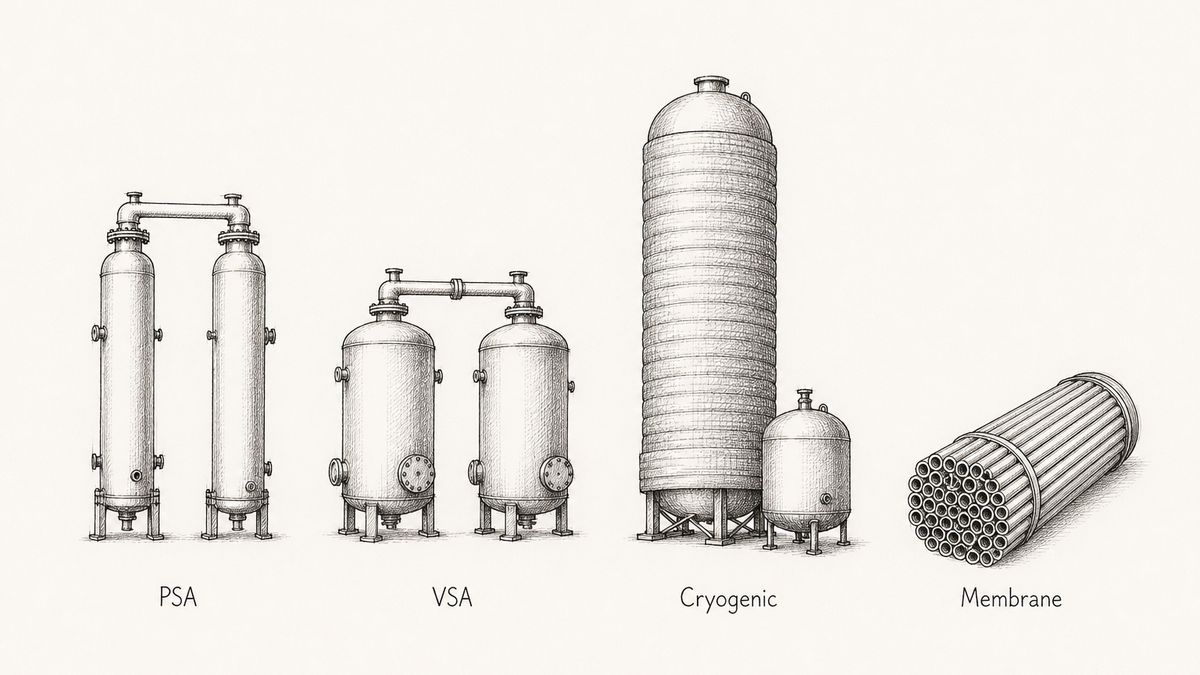
Four processes make almost all on-site oxygen. They do different jobs, so you cannot swap one for another. Three numbers point to the right one. The purity you need. The volume you need. And whether you would rather pay for power or pay for a bigger plant. Learn how each one works before you talk to anyone. A supplier who builds only one type will describe your project as that type.
Pressure swing adsorption (PSA) pushes air through a sealed vessel that holds onto nitrogen and lets oxygen pass. When the material is full, the pressure drops and the nitrogen is released. Two tanks take turns, so one is always working. This process suits small and medium plants. It starts and stops easily. It holds a steady purity that is good enough for most factory work.
Vacuum swing adsorption (VSA) works the same way, but it uses a vacuum to release the nitrogen. It separates the gas better, and the plant is larger. Power costs matter more. It usually appears where the volume is bigger.
Cryogenic separation cools air until it becomes a liquid. The gases then boil off at different temperatures and split apart. This is the only way to reach the highest purity at large volume. It is also the only way to get liquid oxygen as a product. It is a plant in every sense. It costs a lot, it runs cold, and it takes a long time to start.
Membrane separation pushes air through hollow fibres. Oxygen and water vapour pass through faster than nitrogen. The plant is simple and small. It reaches a lower purity than the other three, so it suits low volume work where that is acceptable.
Then ask about the future, not just today. What happens if your demand doubles in three years? A PSA plant usually grows by adding more units side by side. That is easy to do in steps. A cryogenic plant grows by being built larger from the start. Ask what the next step looks like.
Purity, Grades and What the Number Means
Purity means how much of the gas is oxygen. It is the wrong number to focus on. What matters is what is left over.
A plant that makes ninety-three per cent oxygen produces a stream that is mostly oxygen. The rest is mostly argon. That level is fine for most metal work and most burning work. Go up to ninety-nine point five per cent, and you also take out the argon. Go higher still, and you chase the last of the nitrogen and the water. Each step up costs more power and needs a more complex plant.
So the question is not what purity is possible. The question is what purity your process needs. Put that in your specification, and stop guessing.
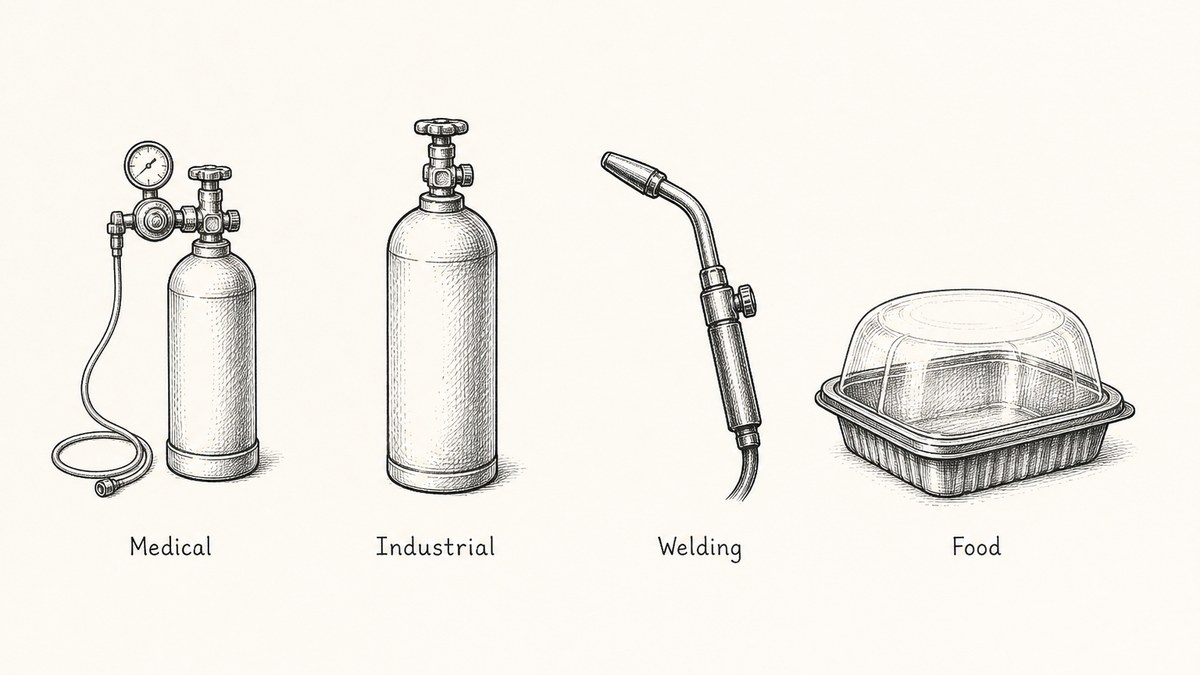
The end use sets the grade. Your supplier does not choose it. Industrial use covers burning, cutting and general workshop use. Welding needs a drier, cleaner gas, because water and oil spoil a weld. Medical is the strictest, because oxygen for patients is a regulated product. Food and beverage is almost as strict, but it follows food rules instead. If your oxygen touches a patient or a food product, agree the grade with your own quality team first. Do that before you size the plant.
Three questions follow. What purity does the plant promise at the flow you need? A figure quoted at a lower flow is a different promise. What happens at the end of the service interval, or on a hot, wet day? A plant that only holds its figure on a good day has a hidden fault. And how do you measure and record purity while the plant runs? You need an analyser, the instrument that reads the gas. An analyser that is not checked and logged is not proof. Ask which analyser is fitted, where it sits in the line, and how the reading is kept.
Where the Plant and the Storage Can Stand
The rules that say where the plant and its storage may stand are about the site, not the plant. They are written as distances. The rule is again 29 CFR 1910.104 on oxygen. This is one of the few rules where you can read a number off the page. You can then check that number against your own drawing, before you buy anything.
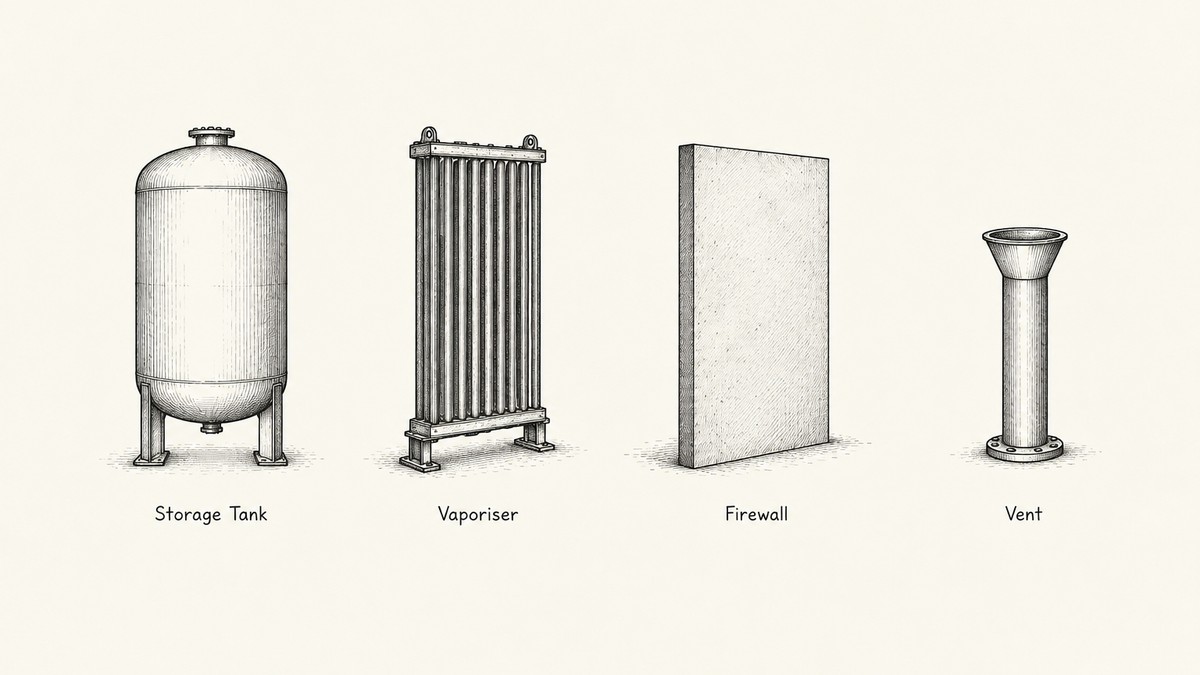
Start with where it may go. There are only two choices. A bulk oxygen system must stand above ground and in the open air. If it cannot, it must go in a building made of noncombustible material. That building must have good vents, and it must be used only for this purpose. There is no third choice.
Two things follow. If you plan an indoor room, that room stops being a general room. It becomes an oxygen room, which changes the cost and sometimes the insurance. And wherever the storage stands, it must be clear of power lines. It must also be clear of pipes that carry flammable or combustible liquids, and of pipes that carry flammable gas. It must also be easy for a supply truck to reach at ground level.
Liquid oxygen adds one more rule, and this one surprises people. Anywhere a leak could fall needs a surface that will not burn. The rule says plainly that asphalt and bitumen count as combustible. A car park surface looks fine, but it is not fine in the one spot where a leak could reach the ground. The rule also prefers ground higher than nearby fuel storage. If that is not possible, it asks for low walls, curbs or a slope. Then liquid cannot collect under the storage.
Then come the distances. Check them on your layout drawing. Do not wait and argue about them later. The rule gives these distances from any bulk oxygen storage container. Fifty feet from a building that can burn, and twenty-five feet from a building with fire-resistive walls. At least ten feet from any opening in a fire-resistive wall next door. Fifty or ninety feet from above-ground flammable liquid storage, depending on how much it holds. Twenty-five or fifty feet from above-ground combustible liquid storage. Fifteen and thirty feet for the underground cases. Fifty or ninety feet from flammable gas storage, again by volume. Fifty feet from solids that burn fast, and twenty-five feet from solids that burn slowly. In a courtyard or a closed area, seventy-five feet one way and thirty-five feet at about a right angle. And twenty-five feet from busy areas such as offices or changing rooms.
Two parts of that list matter more than the numbers. The first is the exception, and a tight site can win back space with it. Those distances do not apply if a protective wall stands between the storage and the thing you are protecting. A fire wall of the right height is enough. The storage container may then sit as close as one foot from the wall. If you know this, you can fix a difficult layout with a wall instead of moving the storage.
The second part is the size limit we met earlier. The whole table only applies above that number. That is why the size decision deserves a careful answer.
| Item on the drawing | What the rule asks for | What to check first |
|---|---|---|
| Where the storage goes | Outdoors above ground, or a noncombustible ventilated room used only for this | Whether the room can be set aside for it |
| Lines above and beside it | Clear of power lines and fuel or gas pipes | The site services drawing, not the plant drawing |
| Ground under a liquid leak | A surface that will not burn, and asphalt does burn | The paving spec where a leak could land |
| Distance to buildings | Set distances to buildings and to wall openings | The measured layout, before ordering |
| Distance to fuel storage | More space for larger liquid and gas stores | Your neighbours' storage sizes, not just your own |
| A tight site | A fire wall exception allows as little as one foot | Whether a wall costs less than moving the site |
What Is Actually Inside a Skid-Mounted Plant
A skid-mounted oxygen plant is easier to install but harder to understand. The working parts sit inside one frame. Four of them do the work.
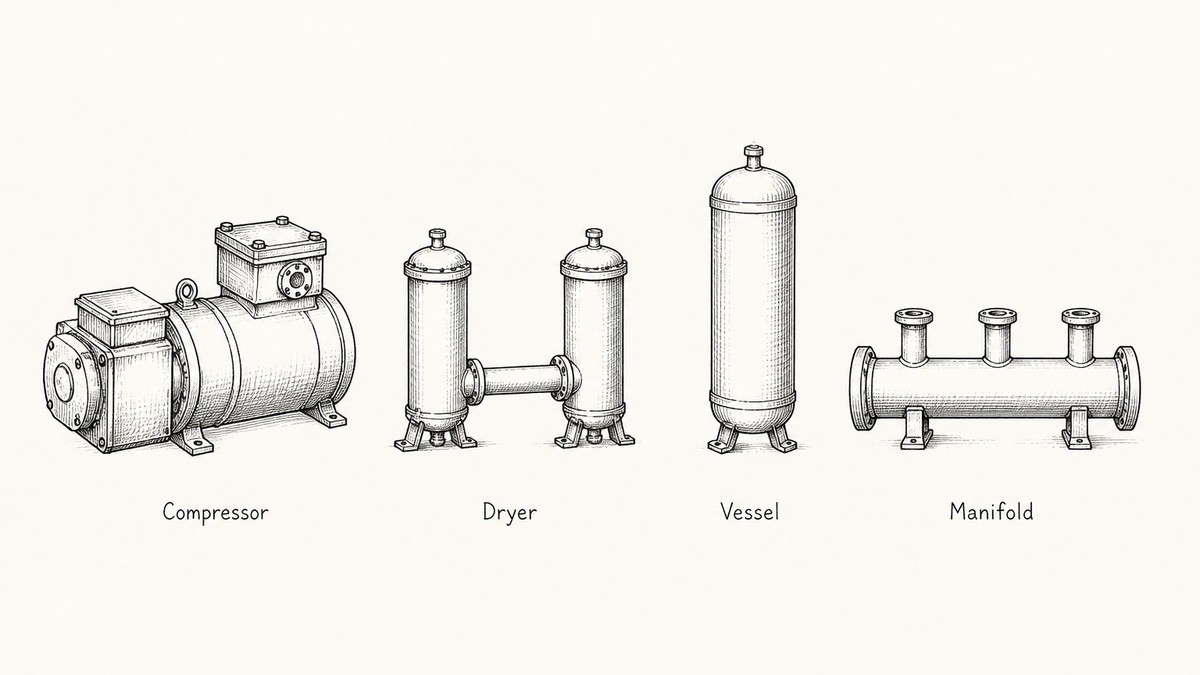
An air compressor and its pre-treatment. Separation only works on clean, cool, dry air, and a wet inlet is the most common reason a plant gives poor results. A dryer or filter set that takes out water and oil. That stage also protects everything after it. The adsorption vessels, in pairs for a PSA or VSA plant. These hold the material that separates the gas, and they take turns on a cycle. And a buffer vessel and manifold that smooth the flow. They pass the gas to your pipework at a steady pressure.
Around those four sit the parts that decide whether the plant is easy to run. A purity analyser and its sample point. A control panel with the cycle logic and the alarms. A drain, because the pre-treatment makes water all the time, and a plant with nowhere to put it will flood. And relief devices on the pressure side. Size them and vent them. Do not just fit them. Ask for the piping and instrument drawing. It is the fastest way to see what you get and what you do not.
What you do not get matters just as much. The foundation and the steel. The power supply and its protection. The air ducting and its filters. The storage, vaporizer and regulator set that goes at the outlet. The vent route. And the ground work for the surface under any possible spill. Those items belong to your project, not to the supplier. The air path into the plant is one of them. That path is a fan and duct problem as much as a compressor problem. Put the air path that feeds the plant on the same drawing as the compressor.
Write that boundary into the enquiry. Do not assume it. The pressure side needs attention at the same time as the plant. That is why a pressure relief device has to be sized for the line it protects, and not chosen by size alone.
Oxygen Service Is About the Metal
Oxygen has no smell, and it looks like air. It acts like a mild gas, until the moment it does not. The problem is simple. Oxygen makes everything else burn more easily. So dirt that is harmless in compressed air can start a fire in oxygen. That is why the rules for oxygen equipment are about the metal and about the surface. They are not only about pressure.
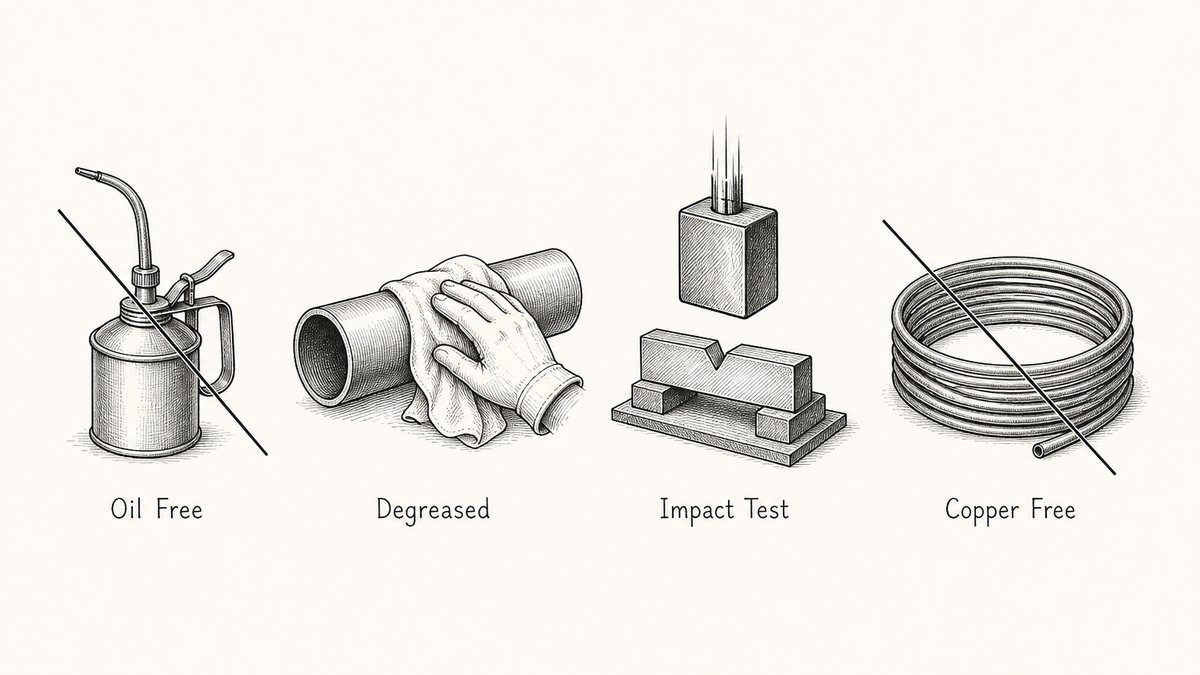
The rule mentions storage containers first. It asks for strong supports made of noncombustible material, on a firm foundation. Then it sets a rule that matters for anything cold. Liquid oxygen containers must be made from materials that pass an impact test. The test is UG-84, in the ASME Boiler and Pressure Vessel Code, Section VIII. ASME is a rulebook for pressure vessels, used around the world. That test checks that the metal does not turn brittle in the cold. It is not a strength test. It exists because a container full of a very cold liquid must take a sudden load without cracking.
The rest of the rule follows the same idea. Containers that run above fifteen pounds per square inch gauge must be designed, built and tested to that code. Psig is a pressure unit. Insulation around a liquid oxygen container must be noncombustible. Containers that hold high-pressure gas take the code route, or the transport rules instead.
Then the rule turns to the pipes. It is short, and it covers a lot. Pipes, tubes and fittings must be suitable for oxygen service and for the pressures and temperatures involved. The pipes and tubes also follow the gas and air piping section of the pressure piping code. Read as a buyer, that sentence asks for a document, not a description. Suitable for oxygen service means somebody chose the materials. You have the right to see that choice as a list of everything that touches the gas, with the cleaning rule next to it.
Three questions turn that into something you can check. Which materials touch the oxygen, listed one by one? Which of them does the supplier treat as restricted in oxygen service? What is the cleaning spec, and does it come with a written step-by-step and a record? A promise that the parts were wiped is neither. And does anything in the line depend on grease or oil that could reach the gas? Lubricants must stay out of the product path.
Now the question of which metals are allowed. A restriction such as copper-free belongs on your drawing. Decide it from the specification you are buying to. Do not let a supplier assume it for you. The same idea applies to the storage containers. Choose the metal by what it must hold. Then check how a pressure vessel is specified and stamped to a code. Do that before you accept a material list.
Who Is Responsible for Which Part
The most useful thing you can do before any quotation arrives is to draw the boundary. Everything on one side belongs to the supplier. Everything on the other side belongs to your project. The arguments that waste weeks are almost always about a part nobody wrote down.
On the supplier's side, expect the skid-mounted plant complete. The compressor, the pre-treatment, the adsorption vessels, the buffer vessel, the manifold, the analyser and the control panel. All of it tested together before it leaves. Expect the material list, the test records and the cleaning records to come with it. On your side, expect the foundation and the steel. The power supply and its protection. The air ducting. The storage, vaporizer and regulator set at the outlet. The vent route. And the ground work under any possible spill. Relief devices may sit on either side, depending on how the scope is written. That is exactly why the scope must be written down.
Then add the two items that are not equipment at all. The first is the siting decision. That belongs to you, and to whoever reviews the layout. It does not belong to the supplier. The second is the record set. That belongs to whoever has to defend the installation later. Ask for five things. The material list. The pressure test records. The impact test evidence for any cold container. The analyser calibration certificate. And the cleaning procedure. A supplier who hands over all five in one folder has done this before. A supplier who answers with a brochure has not. You will only find out when somebody asks you for the file.
One more rule belongs on the same list. How you handle and store the gas around the site is covered by the general requirements for compressed gases. That rule sits in the same part of the code as the oxygen section. Read them together, not one after the other.
What to Put on the Enquiry
An enquiry that describes the gas and stops there produces quotations you cannot compare. Five groups of information fix that. All of them are things you already know, or can find out in an afternoon.
The gas. The purity you need, given as a figure at a stated flow, not as a word. And what the gas will be used for. The numbers. The flow you need now, and the flow you expect in three years. The delivery pressure where you will use the gas, and how often the plant will run. A plant that runs all day and one that starts three times a day are sized differently. The site. The space you have, indoors or outdoors. The temperature and humidity range, and the height above sea level. And where any fuel storage, power line or building sits that the layout must respect. The scope. The plant alone, or a wider scope that includes the storage, the vaporizer, the relief devices and the outlet manifold. And the conditions. The destination, and the power you have with its voltage and frequency. The documents you need, and whether you want a test at the factory before it leaves.
Two of those change the answer more than the plant does. Naming a purity at a flow makes any process comparison mean something. It is also the first thing a serious supplier will ask you for. Stating the site limits up front turns the distances into an input instead of a surprise. That is the difference between buying a plant that fits, and buying a plant and then rebuilding the site around it. Writing it all down also makes the plant easy to check when it arrives. That is why it is worth sending a written brief the factory can price against instead of a sketch.
How to Compare Two Quotations
Two quotations cannot be compared unless they describe the same gas, the same scope and the same site. Ask both for the same lines, and you will find out quickly.
Start with the process and the gas. Which process, what purity at what flow, and at what delivery pressure. Then the plant, with its power demand at that duty, its footprint and its weight. A plant that will not fit your space, or will not run on your supply, is not the cheaper option. Then the scope. Name every item, from the compressor through to the outlet manifold, and state what is left out. Then the site items. Then you can see whether the storage, the vaporizer, the relief devices and the ground work sit inside the price or outside it. Then the materials and the cleaning documents. A material list is a deliverable, not a favour. Then the testing and the records, including whether the plant is tested complete before it leaves. And finally the spares, and the air ducting that is always needed. That is where a low price tends to hide its real cost. And the point where the risk becomes yours.
Every item on that list costs less to settle while the plant is still in the supplier's works. That is the whole case for testing the plant before it leaves the works.
| Line on the quotation | What good looks like | Why it matters |
|---|---|---|
| Process and gas | A named process, purity at a stated flow and pressure | A purity with no flow behind it is not a promise |
| Plant | Power demand at duty, footprint and weight | A plant that will not fit is not a cheaper option |
| Scope | Every item named, and what is left out stated | Storage and vaporizing are often left out |
| Materials | A written material list and cleaning rule | Suitable for oxygen service means a document, not a promise |
| Records | Pressure, impact and calibration records | The file is what an insurer or reviewer will ask for |
| Testing | Tested complete before it leaves | Faults found at the works cost the supplier, not you |
Questions Buyers Ask Before Ordering
What is the difference between an oxygen plant and an oxygen generator?
People use the two words loosely. There is a useful split. A generator usually means a small on-site plant, often a PSA or VSA type. It makes oxygen from air at a purity you set. A plant can mean the same thing. It can also mean a larger plant that makes liquid as well. That is a different size of project, and it follows different site rules. So do not argue about the name. Ask what the plant makes, at what purity and flow, and whether it also makes liquid. Those three answers tell you what you are buying.
Which process suits my site, pressure swing or cryogenic?
Neither one is right for every site. They do different jobs. A PSA plant is the usual answer for small and medium on-site supply. It starts and stops easily, and you can grow it by adding capacity side by side. A cryogenic plant answers a different need. Very high purity at large volume, or liquid oxygen as a product. It comes with the cost, the cold and the slow start of a full plant. Three numbers decide. Your purity. Your volume. And whether you want liquid. Ask each supplier what purity they can promise at your flow. Then compare.
Where is an oxygen plant or its storage allowed to be installed?
For a bulk oxygen system, the rule gives two choices, not a preference. It stands above ground and in the open air. If it cannot, it goes inside a building made of noncombustible material. That building must have good vents, and it must be used only for this purpose. There is no third choice. Wherever it stands, it must be clear of power lines. It must also be clear of pipes carrying fuel or flammable gas, and easy for a supply truck to reach at ground level. Liquid oxygen adds one more rule. Anywhere a leak could fall must have a surface that will not burn. The rule says asphalt and bitumen do burn. So settle the layout before you order.
How pure is the oxygen from a pressure swing plant?
It depends on how the plant is built and what you ask it to do. So the honest answer is a figure at a stated flow, not a general claim. Most PSA plants serve workshop use and burning work well. Higher grades are possible with more pre-treatment and a different cycle. The figure that matters is what the plant holds at the end of its service interval, and on a hot, wet day. What it does when it is new, with cool dry air, matters much less. Ask for the promised figure at your flow. Ask how purity is measured and recorded while the plant runs.
Why does oxygen equipment have to be oil-free and cleaned?
Because oxygen makes everything else burn more easily. Dirt that is harmless in compressed air can start a fire. That is why the rules for oxygen equipment cover the metal and the surface, not only the pressure. Pipes and fittings must be suitable for oxygen service, not merely strong. In practice that means three things. A written cleaning rule with a record. A material list that names everything touching the gas. And no lubricant anywhere it could reach the gas. Ask for the procedure and the record. A statement that the parts were wiped is neither.
What are the main risks when buying an oxygen plant from China?
The risks are the items that are not the plant. A quotation that prices the plant alone will usually leave out the storage. It may also leave out the vaporizer, the relief devices, the air ducting and the ground work. Those are exactly what turn a low price into an expensive project. The second risk is siting. A plant bought before anyone checked the distances can be built correctly and still not fit. Write the scope down. State purity at a flow. Check the layout against the distances first. Then test the plant at the works before it is packed.
Check the site before you buy the plant
Send the purity at a stated flow, the pressure you need and the space you have. We will put the process choice and the site distances on paper before anyone quotes. We will ask for the material list and the cleaning rule. And we will hold the order until the pressure, impact and calibration records match.
Request an Oxygen Plant Quote
Questions & Comments
We read every one and reply within 24 hoursAn oxygen plant is judged on three things a quotation rarely shows. The purity at the flow you need. Whether the site can take the storage. And whether the material and cleaning records exist. Send us the gas, the flow and the space. We will settle all three before anyone quotes.