
Bioreactor Manufacturer: Vessel, Controls and Cleaning From China
 ·
Updated October 14, 2026
·
17 min read
A bioreactor manufacturer builds the vessel your cells or bacteria grow in, and the vessel itself is the easy part. What you are actually buying is a tank that can be cleaned and steamed without being taken apart, a set of instruments that are calibrated and recorded, and a file of documents your own quality team will have to defend to an inspector. Miss any one of those three and the vessel will work perfectly while the batch fails. This guide covers what a bioreactor really includes, the design details that decide whether it can be cleaned, the clean-in-place and steam-in-place cycle, the calibration record behind the sensors, the plumbing that stops dirty water running backwards, the materials and the papers that travel with them, what changes as the vessel grows, and how to compare two quotations line by line.

| Your process | What decides the build | Where the cost sits |
|---|---|---|
| Cells grown in a stirred tank | Impeller shape and the speed it runs at | The agitator and the shaft seal |
| A plastic bag in a rigid holder | The film and how the holder supports it | The bag, on every single batch |
| Pilot runs before production | Vessel size and the number of instruments | The control panel and the sensors |
| A product that must be sterile | Whether the vessel can be steamed where it stands | The jacket, the seals and the steam supply |
| Small volumes, many different products | How fast it can be cleaned between batches | The cleaning design and the records |
What a Bioreactor Is, and What You Are Actually Buying
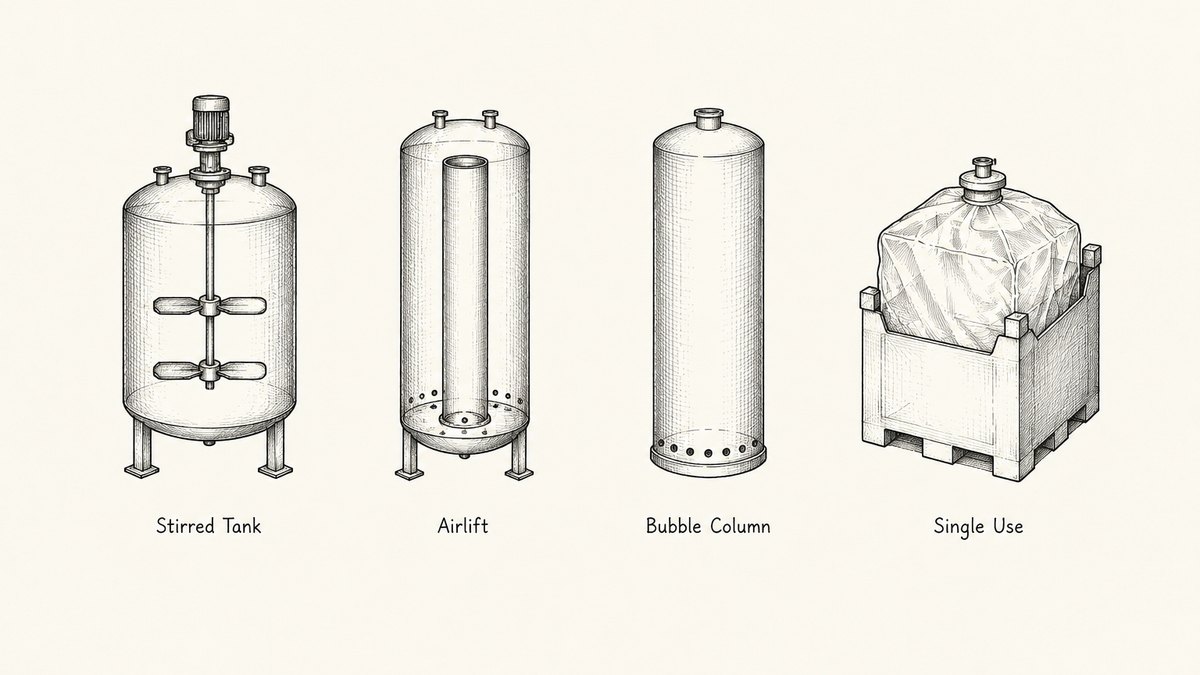
A bioreactor is a vessel that holds a living culture under controlled conditions, and almost all of the cost sits in the parts that make the conditions controllable rather than in the tank itself. Four shapes cover most of the market. The stirred tank has a shaft down the middle with impellers on it, and it is the default for anything that needs good mixing. The airlift moves the liquid with rising gas instead of a shaft. The bubble column does the same thing without the inner tube. The single-use reactor puts a plastic bag inside a rigid holder and throws the bag away after the batch.
What arrives in the crate is more than a tank. You should expect the vessel with its jacket, the headplate with its ports, the agitator and its seal, an air sparger, a set of instrument connections, a control panel, and the valves that let the whole thing be cleaned and steamed in place. What usually does not arrive is everything around it: the clean steam supply, the chilled water, the compressed air, the drain, and the clean room it stands in. Those are yours to arrange, and they are the reason a quoted price and a working installation are two different numbers.
The single most useful question at this stage is not about the vessel at all. Ask what the supplier has already built for a process like yours, and then ask to see the document package that went with it. A supplier who can show you a completed file, with material certificates, weld records and calibration certificates inside it, has done this before. A supplier who answers with a brochure has not. The same test works across the wider industrial machinery category these vessels belong to, because the paperwork is what separates a machine builder from a steel shop.
One more part is worth noticing early because it is easy to leave out of the enquiry. Any gas or liquid entering the vessel has to pass through a filter, and those filters have to be ordered separately. A sparger that looks like a simple pipe with holes in it is often a sintered part with a controlled pore size, and the difference matters to both the gas transfer and the sterility of the batch. If your process depends on either, the filter belongs on the drawing rather than on a later order. That is the same discipline as buying a sintered metal filter to a stated pore size, and it is cheaper to specify once than to retrofit.
The Design Rule That Decides Whether It Can Be Cleaned
If a vessel that holds a drug cannot be cleaned properly, nothing else about it matters. That is not an opinion, it is the shape of the rule: equipment must be of appropriate design, adequate size and suitably located to allow both its intended operation and its cleaning and maintenance. In the United States that sentence sits at 21 CFR 211.63 on equipment design, and it is the single most useful line a buyer can carry into a supplier meeting, because everything a good bioreactor does differently from a plain tank is an answer to it.
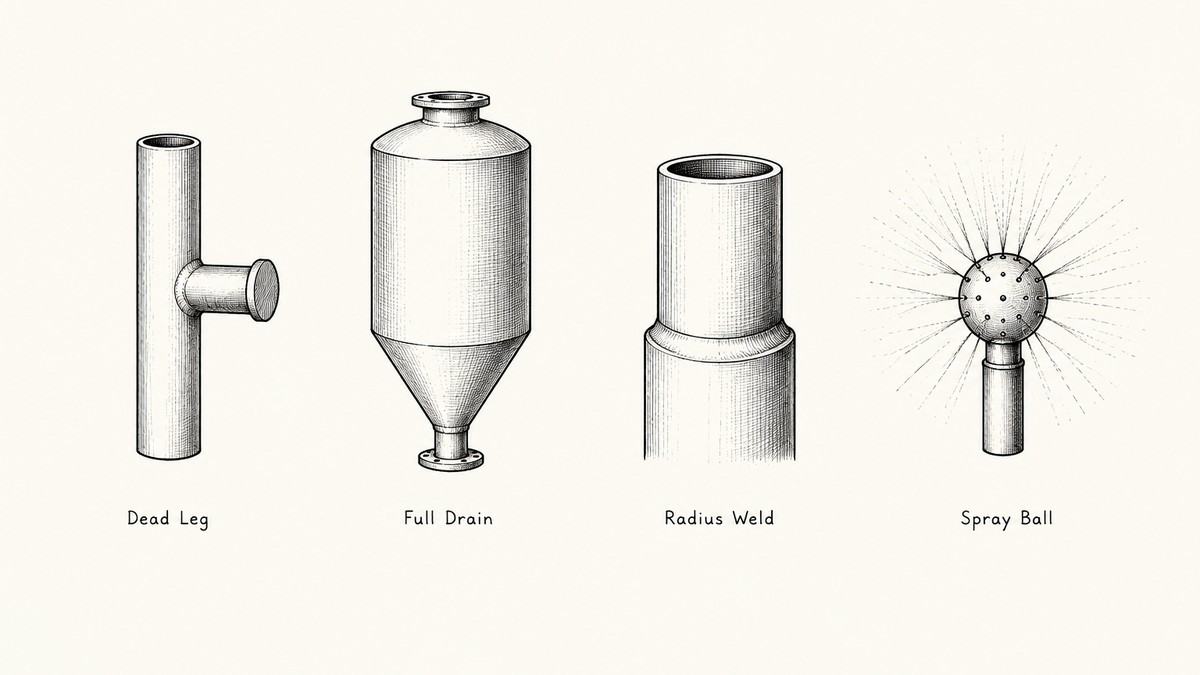
Translated into steel, the rule means four things you can see on a drawing. Every internal surface has to drain to the outlet, so a flat bottom is wrong and a dished or conical bottom is right. Every pocket where liquid could sit has to be short enough that the cleaning flow can flush it, which is why a branch pipe that ends in a closed stub, called a dead leg, is the first thing a reviewer looks for. Every weld that touches the product has to be smooth, with no sharp inner corner to trap residue. And every surface has to be finished to a stated roughness rather than polished until it looks nice.
The second half of the same rule is about what the product touches. Surfaces that contact the culture must not react with it, add anything to it, or soak anything out of it. In plain terms, the steel has to be the right grade, the polish has to be complete rather than local, and anything that must be present for the machine to work, such as lubricant, has to be kept away from the product entirely. A shaft seal that drips oil into a vessel is a design fault, not a maintenance problem.
This is where a cheap quotation hides most often, and it hides in the parts nobody photographs. A dead leg that is slightly too long, a weld that is ground flush on the outside and left rough on the inside, or a surface finish that is stated as a word instead of a number. None of those will be visible when the vessel arrives, and all three will show up in a cleaning check months later. Ask for the drainability of every low point, the maximum length of any branch, and the surface roughness with a number on it. A supplier who can answer those three from the drawings is a supplier who designed the vessel rather than copied one.
| Detail | What it is | What to ask for |
|---|---|---|
| Dead leg | A closed branch where liquid can sit | The maximum branch length on the drawing |
| Full drain | Every internal surface runs to the outlet | A drain test with water, on the real vessel |
| Radius weld | A smooth weld with no sharp inner corner | The weld map and the finish report |
| Spray ball | The device that wets the whole inside | A coverage test report for the vessel |
Clean in Place, Steam in Place and the Written Procedure
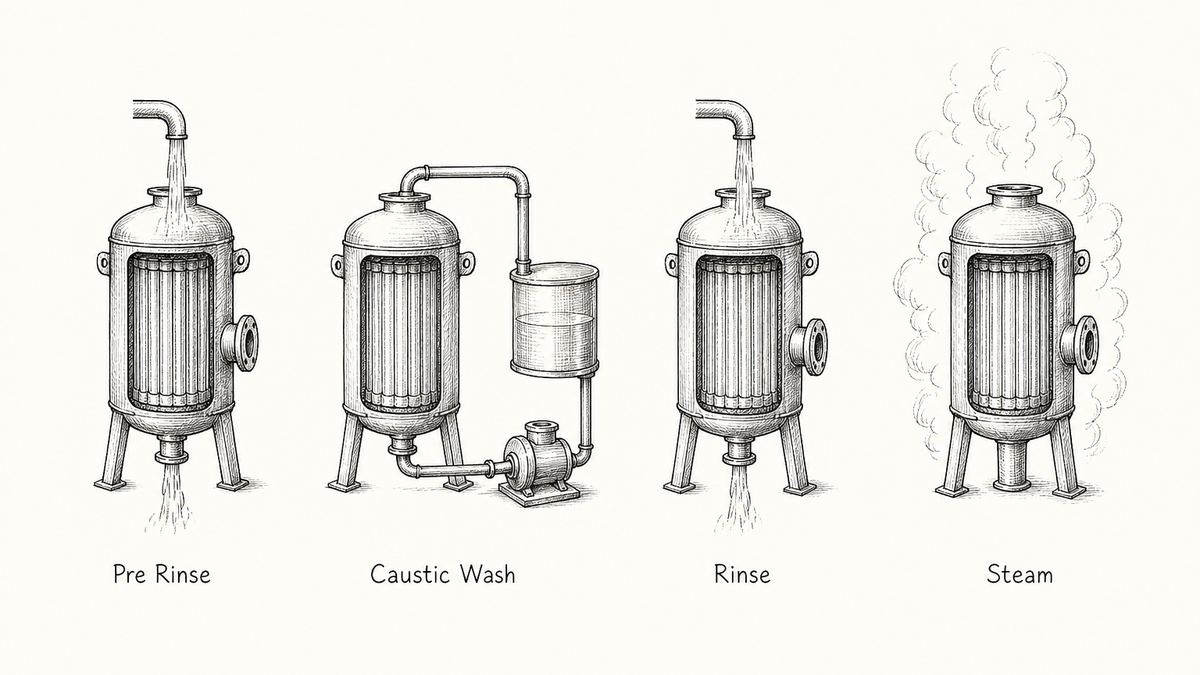
The reason a bioreactor costs more than a tank is that it has to be cleaned without being opened. Cleaning in place means the vessel washes itself with chemicals and water pumped through a spray device; steaming in place means it sterilises itself with clean steam before the next batch. The rule behind both is short and specific, and it is worth reading before you accept any cleaning claim. Equipment has to be cleaned, maintained and, where the product needs it, sanitised or sterilised at suitable intervals, and there has to be a written procedure for all of it. In the United States that is 21 CFR 211.67 on equipment cleaning and maintenance.
The detail of that rule is where a buyer finds the questions worth asking, because it does not stop at the obvious. Yes, responsibility for cleaning has to be assigned, and yes, there have to be schedules. But it also requires a description detailed enough to cover the methods, the equipment and the materials used, and the way the equipment is taken apart and put back together when that is needed. It requires the previous batch marking to be removed or wiped out, clean equipment to be protected from contamination before it is used, and the equipment to be inspected for cleanliness immediately before use. Read as a buyer, that is a list of things your supplier should already have written down for you.
So ask for four documents rather than a promise. The cleaning procedure itself, covering the chemical strength, the temperature, the contact time and the flow. The steaming procedure, with the temperature and the time the vessel is held there. The spray coverage test report, which shows that the cleaning liquid actually reaches the top of the vessel and not just the parts near the spray device. And the record that the vessel was inspected for cleanliness before release. A supplier who can hand over all four is selling a cleaning system. A supplier who says the vessel is cleanable is selling an opinion.
Two practical points save a lot of arguing later. The spray device has to be matched to the vessel, not chosen by size, because a small vessel with a badly placed spray ball can clean worse than a large one with a good layout, and the only honest proof is a coverage test on the real vessel. And the temperature that matters for steam is the temperature of the coldest point, not the temperature on the gauge at the inlet. Ask how the coldest point was identified and how it is measured. The same cleaning discipline is what makes any vessel used for food or medicine workable, which is why the questions carry over to mixing equipment that also has to be washed between products rather than stripped down each time.
Sensors, Control Panel and the Calibration Record
A bioreactor without instruments is a tank with a stirring shaft. What turns it into equipment is a set of measurements kept inside a range, and the rule for those is again written down rather than left to good intentions. Automatic, mechanical and electronic equipment has to be routinely calibrated, inspected or checked under a written programme, and the written records of those checks have to be kept. Where a computer or control system is involved, changes to the master records may only be made by authorised people, the input and the output have to be checked for accuracy to a degree that matches how complex and how reliable the system is, and a backup of the data has to exist. In the United States that is 21 CFR 211.68 on automatic, mechanical and electronic equipment.
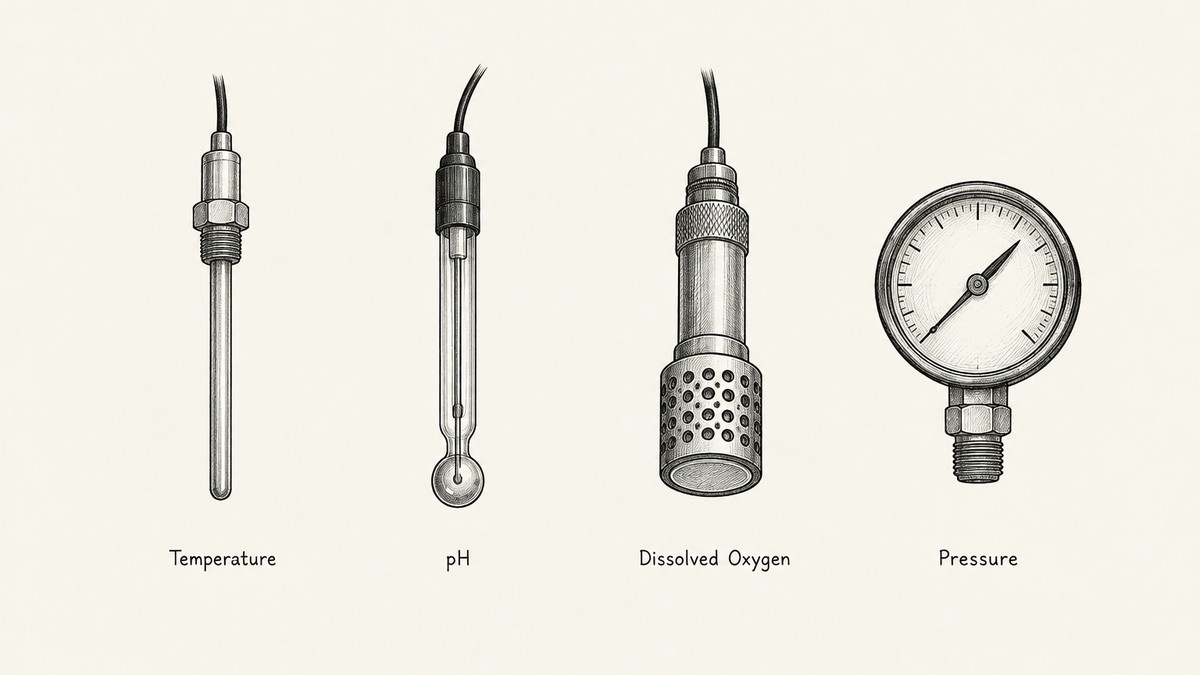
Four measurements do most of the work in a typical culture. Temperature, usually held by water or steam in the jacket around the vessel. pH, which drifts as the culture grows and is the reason the control loop has to add acid or base in small amounts rather than all at once. Dissolved oxygen, which is fed back to the gas flow or the stirrer speed. And pressure, because a vessel that is steamed and then cooled has to be kept under the right pressure throughout. Each one needs a sensor, a loop and a record, and each one is a place where a cheap build saves money you will notice later.
The three questions to ask about every instrument are the same three. What make and model is it, so you can check whether it is a known device or an unbranded one. What is its stated accuracy and range, so you can tell whether it suits your process rather than the supplier's stock. And does it arrive with a calibration certificate traceable to a recognised standard. A sensor without a certificate is a spare part, not an instrument, and once the vessel is in your clean room it is far more expensive to replace than it was to specify.
The control side deserves the same attention as the sensors, because it is where the record lives. Ask how the system stores data, who can change a set point, whether every change is logged with a user and a time, and how the data is backed up and restored. Then ask to see it done rather than described. A supplier who can show the audit trail and the backup on a screen has built a system you can defend. The one thing to avoid is a panel that only displays values, because a display is not a record, and your quality team will be the one explaining the gap.
Plumbing, Drains and Back-Siphonage
The plumbing rule is the shortest one in the set and the one most often broken in real installations, because it is about the building as much as the machine. Water that can reach the product has to be supplied under continuous positive pressure in a system free from defects that could add contamination, and drains have to be big enough, with an air break or another mechanical device where a drain connects straight to a sewer so that dirty water cannot be sucked backwards into the system. In the United States that is 21 CFR 211.48 on plumbing.
That paragraph is worth more to a buyer than it looks, because it names the failure that ruins batches quietly. Back-siphonage happens when pressure in the supply drops while the vessel is still connected, and dirty water on the floor is pulled back up the line into the vessel or into a cleaning skid. The fix is mechanical rather than procedural: an air gap, or a break in the line that no amount of suction can cross. If a supplier's drawing shows a drain piped straight into the machine with no break, the drawing is wrong no matter how good the rest of it is.
Three things belong on your checklist before the vessel ships. Every low point should drain without leaving a pool, which should also be checked with water on site rather than argued about on paper. Every sampling valve and instrument port should be positioned so liquid does not sit behind it. And the water that feeds the machine should be tested and recorded, because it is a raw material for the process even though it arrives through a pipe. Ask who supplies that water, how it is treated, and where the test results are kept.
Materials of Construction and the Papers Behind Them
The grade of steel is one decision and the finish is another, and buyers who get this wrong usually get the finish wrong. A low-carbon stainless grade is the normal choice for anything the culture touches, because the low carbon content makes the welds less likely to corrode. A plainer stainless grade is fine for the parts that never see product, such as the frame or the outer jacket. The contact surface is then treated to a stated roughness. That number matters more than the word used to describe it, because two suppliers can both say polished and mean two different surfaces.
The seals are the part buyers forget. There is no vessel that holds a culture without rubber or plastic seals somewhere, at the headplate, at the shaft, at the ports and at the valves. What you need from the supplier is not a brand name but a statement: which material is used at each point, and what that material is cleared for when it touches product or steam. Ask for that in writing, because a seal is the cheapest part on the machine and the most common cause of a failed cleaning check.
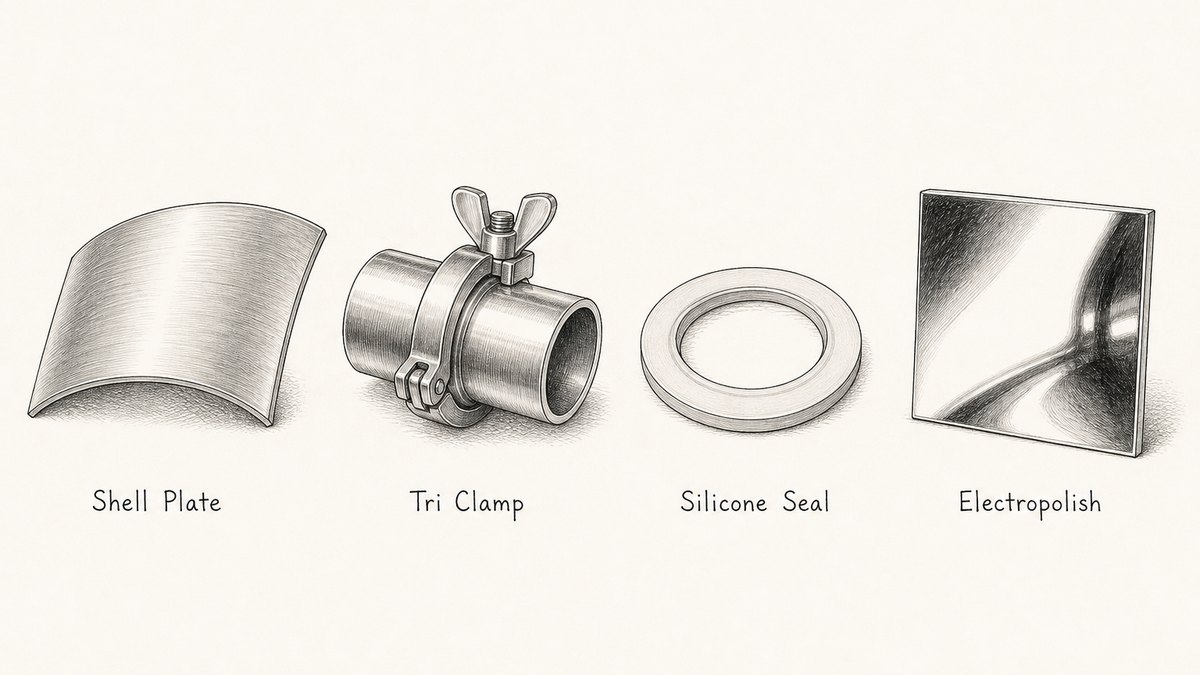
The papers matter as much as the metal. Ask for the material certificate for the contact side with the heat number on it and the same number on the plate, so the two can be tied together. Ask for the weld records: which welds were made, by whom, and how the contact-side welds were finished. Ask for the surface finish report, which should state measured values rather than a description. And ask for the list of every non-metallic part with its material and a written statement of what it is cleared for. A jacketed vessel is also a pressure item with its own testing and documentation, which is the same discipline that applies to a pressure vessel built and stamped to a code, so if the supplier is vague about the jacket, that is a warning about everything else.
One category of certificate needs a plain-words warning. Material certificates come in grades, and the grades describe who is signing. The lower grade is a statement by the maker that the material meets the order. The higher grade is that same statement backed by the results of specific tests on that specific heat, countersigned by an independent party. If your own paperwork, or your customer's, needs the higher grade, say so when you ask for the quotation rather than when the vessel is ready to ship, because it changes the price and it cannot be arranged after the fact.
What Changes Between a Benchtop Unit and a Production Vessel
Scaling up is not enlarging a drawing, and the reason is that three things do not grow at the same rate. Mixing power grows much faster than volume. The area of jacket available to heat or cool the vessel grows more slowly than the volume it has to serve, so a big vessel heats and cools more sluggishly than a small one. And the transfer of oxygen into the liquid depends on the bubbles and the mixing rather than on the size of the tank. A design that works perfectly at bench scale can fail at production scale while every dimension on it is correct.
The practical answer is to scale on the process number rather than on the geometry. Decide which values your culture actually depends on, then ask the supplier to hold those while the vessel grows and to show you the arithmetic. A supplier who can explain how they sized the impeller and the gas flow for your scale has done the work. A supplier who answers that the vessel is simply bigger has not, and you will discover it in the first production run.
Two questions shorten the conversation. Ask for a reference vessel of a similar size running a similar culture, and ask what was changed between it and the design proposed for you. Then ask what the supplier will do if the first run misses the target, and get the answer in the order rather than in a meeting. Scale-up problems are usually solvable, but they are solved much more cheaply by a supplier who has seen them before and has already priced the fix.
Factory Acceptance, Site Acceptance and What to Inspect
A bioreactor should be tested twice, and the two tests are not the same. The factory acceptance test happens at the supplier's works before the vessel is packed, when everything is accessible and the supplier's own tools and people are on hand. The site acceptance test happens after it is installed in your building, and it exists to check what transport and reconnection may have changed. Skipping the first test and relying on the second is the most expensive economy in the whole project, because everything found at your site is found at your cost and your schedule.
The factory test should cover at least six things, and each one should produce a signed record rather than a verbal yes. A pressure test of the vessel and the jacket. A check of the contact-side surface finish against the number on the drawing. A spray coverage test for the cleaning device, run on the real vessel. A calibration check on every instrument against a reference. A loop check, so that each sensor is confirmed to be wired to the right channel and reading where it should. And a functional run of the agitator and the valves through their full range. The paperwork should be reviewed against the agreed list before the crate is closed, not after it arrives.
At your site the priority changes to the things that only exist once the machine is standing. The vessel should be levelled and checked against its drawings. The utilities should be connected and then tested one by one, starting with the drain, because a drain that does not fall to the sewer is a problem no instrument will tell you about. The instruments should be checked again against a reference, since a sensor that travelled is not the same as a sensor that was calibrated. And the first cleaning cycle should be run and recorded before any culture goes in. The same logic as a pre-dispatch check on goods that are about to travel applies here, with one difference: for a vessel, the check before travel is worth more than the check after it.
How to Compare Two Bioreactor Quotations
Two quotations for a bioreactor cannot be compared unless they describe the same machine, and the fastest way to find out is to ask both for the same lines. Everything else on the page is decoration.
Start with the vessel: the grade, the wall thickness, the finish, and the number that goes with the finish. Then the agitator, with its type, its speed range and the arrangement of its seal, because the seal is the part that fails first. Then the instruments, listed by make and model with a calibration certificate for each. Then cleaning, stating plainly whether cleaning and steaming in place are included and whether they are tested at the factory. Then the document package, with every item named rather than described as full documentation. Then the parts you are expected to supply, which is where a low price usually lives: clean steam, chilled water, compressed air and the drain are often excluded. Then the travel and the testing, so you know who pays for the people who come to your site. Then packaging and transport, and the point at which the risk in the machine passes to you. The habit of writing these lines down before you ask is the same one that makes a specification sheet a factory can quote from in the first place.
| Line on the quotation | What good looks like | Why it matters |
|---|---|---|
| Vessel | Grade, thickness and a finish stated as a number | A finish described as polished is not a finish |
| Agitator | Type, speed range and the seal arrangement | The seal is the part that fails first |
| Instruments | Make, model and a calibration certificate each | A sensor without a certificate is a spare part |
| Cleaning | Cleaning and steaming in place included and tested | An untested cleaning claim is a hope |
| Documents | Every item named rather than lumped together | The file is what your auditor will read |
Questions Buyers Ask Before Ordering
What is the difference between a bioreactor and a fermenter?
The vessel is often the same and the difference is what grows inside it. A bioreactor is the general term for a vessel holding a living culture, and it covers cells as well as bacteria. A fermenter usually means a vessel used for microbial fermentation, and it is often built more simply because bacteria are tougher than animal cells and the vessel does not have to be as gentle. In practice the words are used loosely, so the useful question is never the name. Ask what temperature range, what mixing intensity and what cleaning regime the vessel was designed for, and compare those against your own process.
Why does a bioreactor have to be cleaned in place?
Because taking it apart is worse than cleaning it. Every time a vessel is opened, the inside is exposed to the room, the seals are disturbed, and the operator has to be trusted to put everything back correctly. Cleaning in place pumps chemicals and water through a spray device so the interior is washed without being opened, and steaming in place sterilises it the same way. The rule behind this does not simply say clean it. It requires a written procedure covering the methods, the materials, how the equipment is taken apart and reassembled where needed, and an inspection for cleanliness immediately before use.
What documents should come with a bioreactor?
Ask for the list by name rather than accepting the phrase full documentation. You want the material certificate for the contact side with the heat number on it, tied to the same number on the plate. The weld records, covering who welded the contact side and how those welds were finished. A surface finish report stating measured values. A calibration certificate for every instrument. A spray coverage test report for the cleaning device. The piping and instrument drawings. The operating and maintenance manuals. The spare parts list. And the factory test records, signed. If any of those is missing, ask why before you pay, not after the vessel is in your clean room.
Should I buy a stainless vessel or a single-use bag reactor?
It depends on how many products you run and how often you change between them. A stainless vessel costs more up front and then lasts for years, and its cost per batch falls as you use it. A single-use bag reactor costs less up front, arrives sterile, and needs no cleaning between batches, but you buy a new bag every time and the film becomes a cost you repeat forever. The usual dividing line is product changeover: many different products in small volumes favour the bag, while one product at large volume over many years favours stainless. Ask for the bag price per batch before comparing the two, because the comparison is meaningless without it.
What is a dead leg, and why does it matter?
A dead leg is a branch pipe that ends in a closed stub, so liquid can sit in it while the rest of the vessel is being cleaned. Cleaning flow passes the opening and leaves the pocket behind, which makes it the first thing a reviewer looks for on a set of drawings. It matters because a pocket of old liquid can hold organisms that then contaminate the next batch, and because it is invisible on a finished vessel. Ask for the maximum branch length on the drawing and how each branch is arranged. A supplier who can answer from the drawing has designed the vessel. One who answers from memory has not.
What is the biggest risk when buying a bioreactor from China?
The risks are the ones you cannot see after the crate is closed: a surface finish that was described rather than measured, a dead leg that is slightly too long, instruments without calibration certificates, and a document package that arrives incomplete after the vessel is already in your clean room. None of them shows up in a photograph, and all of them are cheap to prevent at the drawing stage. Require the finish as a number, the maximum branch length, a certificate for every sensor, and a named document list. Then test at the supplier's works before the crate is packed, not at your site afterwards.
Check the drain before you check the price
Send the culture, the working volume and the finish you need. We will check the drainability and the dead legs on the drawing, name every instrument and its certificate, ask whether cleaning and steaming in place are tested, and hold the order until the document package matches the agreed list.
Request a Bioreactor Quote
Questions & Comments
We read every one and reply within 24 hoursA bioreactor is judged on the parts you cannot see once it is closed: the drain, the dead legs, the seal, the calibration record and the file. Send us the culture, the working volume and the finish, and we will test those five before anyone quotes a vessel.