
Palletizer Manufacturer: Speed, Patterns and Pallet From China
 ·
Updated October 14, 2026
·
22 min read
A palletizer is bought against four figures, and only one of them is on the quotation. The machine has to reach the rate you need in cases per minute at the worst case size, not the best one. It has to build a stack that still stands after a lorry ride, which is decided by the pattern rather than the machine. It has to fit where you intend to put it, including the clearance a truck needs to take the finished pallet away. And the area it sits in has to be classified before anyone chooses the truck that serves it, because a plain fork truck is not allowed where certain dusts or solvents are present. Get those four wrong and the machine will run perfectly while the line still fails. This guide covers what a palletizer supplier actually builds, the numbers to put in the enquiry, and the checks that catch a machine which does not match its paperwork.
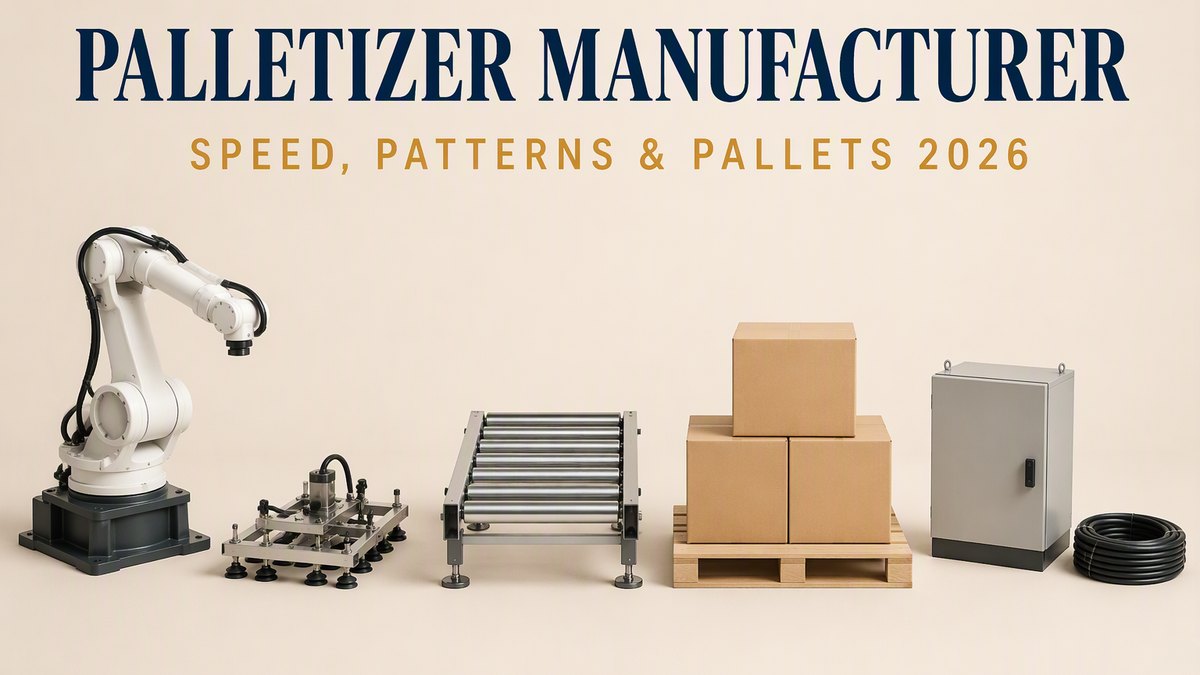
| Your situation | What decides the design | Where the cost sits |
|---|---|---|
| One case size, never changes | The fastest machine you can justify | The tool head and the frame |
| Mixed cases on one line | Pattern changes and a tool that copes with both | The controls and the programming |
| High rate, single product | Cycle time per layer, not per case | The layer forming station |
| Tight floor space | Reach and the pallet exchange method | A robot instead of a gantry |
| Slipsheets or trays | A dispenser and a second tool | The extra magazine and tooling |
What a Palletizer Manufacturer Actually Builds
There are two businesses behind this phrase and they quote very differently. One builds a machine around a standard robot or a standard layer frame and integrates the infeed, the pallet magazine and the controls. The other builds the whole line, including the case conveyor that feeds it and the stretch wrapper that follows it. Both will call themselves palletizer manufacturers.
The way to tell them apart is to ask what the price includes. A machine builder prices the cell: the frame, the tool, the pallet dispenser, the guarding and the panel. A line builder prices the cell plus the conveyor belts and roller sections that carry cases into it and everything downstream. Neither is wrong, but a comparison between the two is meaningless until the scope matches.
What you are really buying is the integration, not the steel. The robot itself is a bought-in item made by one of a handful of suppliers, and so is the vacuum generator and the servo drive. The value the palletizer builder adds is choosing the right arm for the reach and the payload, designing a tool that grips your case without crushing it, writing the pattern so the stack survives transport, and setting the safety circuit so the cell stops when someone opens the gate.
That is why the cheapest offer in a batch is usually the one with the least integration in it. A machine quoted without pattern development, without a documented safety circuit and without a dry cycle test is a frame with a robot bolted to it. It will look identical in a photograph.
The Speed Figure, and Why It Is Not Cases Per Minute
Every quotation carries a speed. Almost none of them mean the same thing, and this is the single most common reason a palletizer underperforms on site without anything being technically broken.
The published figure is normally a peak rate measured under ideal conditions: one case size, a full infeed, no pattern change and no pallet exchange in the middle of the run. Your line does not run under those conditions. It runs at the rate the machine achieves across a shift, which is lower, and the gap is where the disappointment lives.
Four things pull the real rate below the quoted one. Pallet exchange, because the machine stops or slows while a full pallet leaves and an empty one arrives. Pattern changes, which cost time whenever the product changes. Case stability, because a heavy case cannot be accelerated as hard as a light one, so the cycle stretches. And accumulated small stops, which in a real plant add up faster than most buyers expect.
So do not ask for a speed. Ask for the rate at your case size and weight, and ask what the figure assumes. The three sentences worth having in writing are the cycle time at your case, the number of cases per layer and layers per pallet, and the assumed pallet exchange time. Write those down and two quotations become comparable for the first time.
There is a second number that matters more than most buyers realise, and it is the payload at reach. A robot rated at a given payload can only carry it at a short distance from its base. Extend the arm to reach the far corner of a pallet and the safe payload falls. If your case is heavy and the pallet is large, the arm has to be sized for the payload at full extension, not the headline figure.
Patterns, Layers and the Pallet You Actually Use
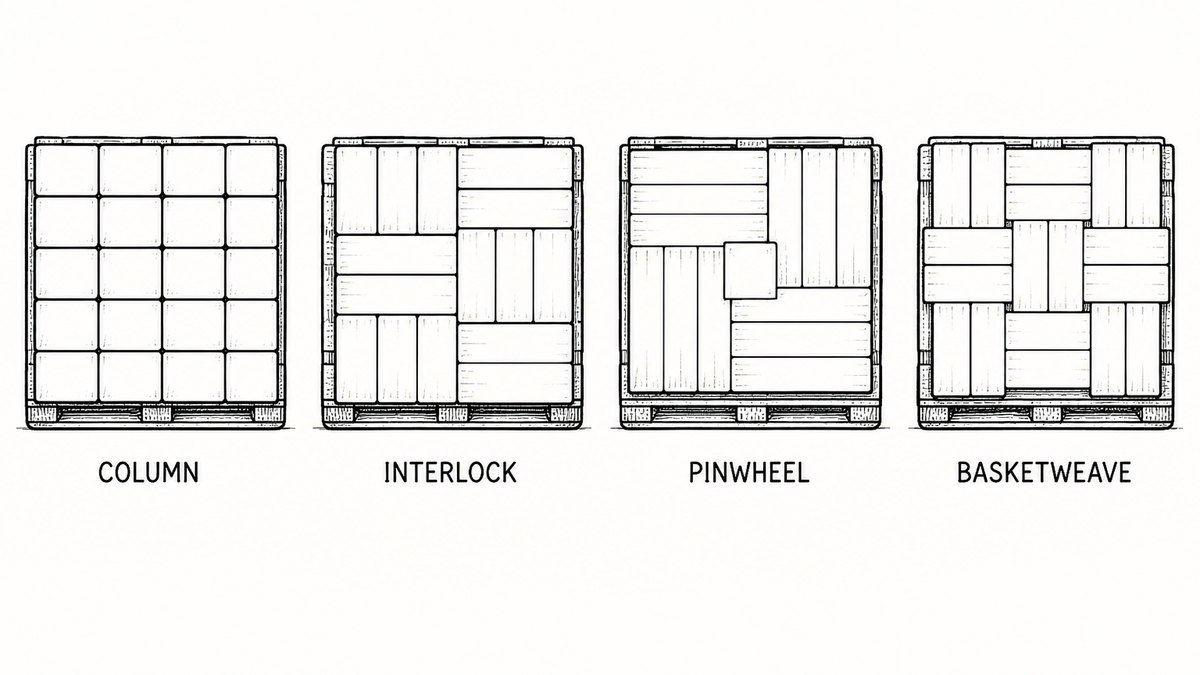
The pattern is the part of a palletizer order that gets the least attention and causes the most damage when it is wrong. A stack that looks fine at the end of the line can lean or collapse after a few hours on a road, and the cause is almost always how the layers were arranged rather than how well the machine placed them.
Column stacking places every case directly on the one below, which is the fastest pattern and the least stable. Interlocking turns each layer at right angles to the one beneath, which ties the stack together and costs cycle time. Pinwheel and basketweave patterns arrange cases around a centre or weave them in pairs, which spreads the load and holds the corners; they are slower again and they need more accurate case handling.
The right choice depends on three things: how far the pallet travels, how heavy the cases are, and whether the load will be stacked in a warehouse. A pallet that goes from the line into a nearby rack in a rigid case can be column stacked. The same case going on a long lorry journey needs interlocking at minimum, and often a slipsheet between layers or a stretch hood rather than plain film.
There is a geometric trap worth knowing about. A pattern is designed for one case footprint, and a small change in that footprint can break it. Cartons are made to a tolerance, and a case that is a few millimetres wider than the drawing can make a pattern that was tight on paper impossible to build. Ask the supplier to state the case footprint they designed the pattern around, with its tolerance, and then measure the cases you will actually run.
The pallet itself is the other half of this, and it is the input buyers most often leave out of the enquiry. A palletizer is set up for one pallet type, one entry height and one board spacing. If you switch supplier and the new pallet has a different top deck or a thicker deck board, the machine has to be adjusted and sometimes re-programmed. Send the supplier the pallet drawing, not just the words Euro pallet or standard pallet, and state whether the pallets are new or repaired, because repaired pallets vary more than new ones and the machine has to cope with the worst of them.
Robot Arm, Layer, Gantry or Hybrid
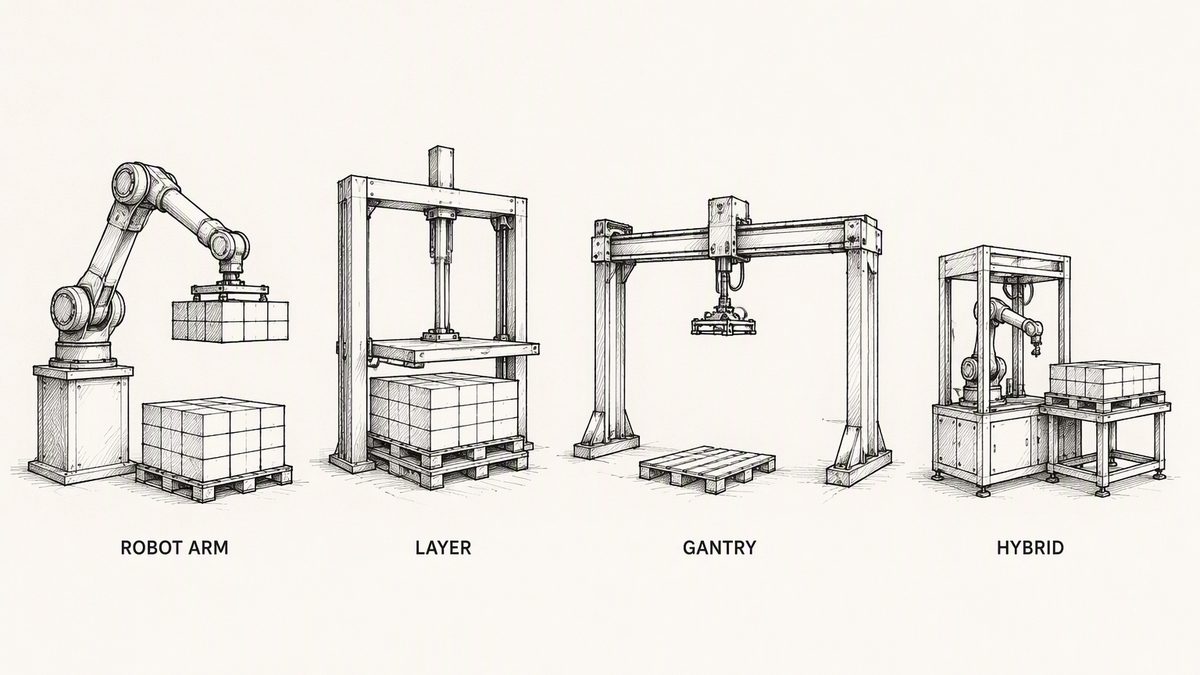
The four architectures in the plate above are not competing for the same work. Each one wins in a different corner of the range, and the quotation should tell you which one it has proposed and why.
| Type | Where it wins | Weakest point | Floor it takes |
|---|---|---|---|
| Robot arm | Mixed cases, multiple lines, frequent changes | Payload falls away at full reach | Small |
| Layer | One product at a high rate | Pattern change is slow and awkward | Large |
| Gantry | Wide pallets and heavy cases | Slow for small cases | Spans the cell |
| Hybrid | High rate with some product variety | Two systems to maintain | Medium |
A robot arm is the flexible answer. It handles one case at a time or a small group, it can serve more than one pallet position, and changing the product is mostly a matter of loading a different program. Its weakness is the reach and payload trade-off described above, which is why heavy cases at the far corner of a large pallet are where robot cells disappoint.
A layer machine builds the whole layer on a plate and lowers it onto the pallet in one movement. At a high rate on a single product nothing beats it, because the machine is not travelling back and forth for each case. The cost is flexibility: changing the pattern on a layer machine is a mechanical job as well as a programming one, so it suits a product that runs for months at a time.
A gantry carries the tool on a bridge that spans the cell, so it can cover a wide pallet or two pallets side by side without the reach penalty a robot has. It is slower than a robot for small cases and it occupies the overhead space, which matters if you have services or a crane in that part of the building.
A hybrid puts a robot inside a frame with a layer plate, which is how builders get high rates while keeping some product variety. It is a genuinely good answer for a line that runs two or three case sizes, and it is also the answer with the most to go wrong, because it has the moving parts of both parents.
None of this needs to be settled by opinion. Give the supplier the rate, the case sizes and weights, the number of pallet positions and the floor you have, and ask which architecture they propose and why. A builder who proposes the same machine for every enquiry is not designing anything.
Where It May Stand: Exits, Aisles and Floors
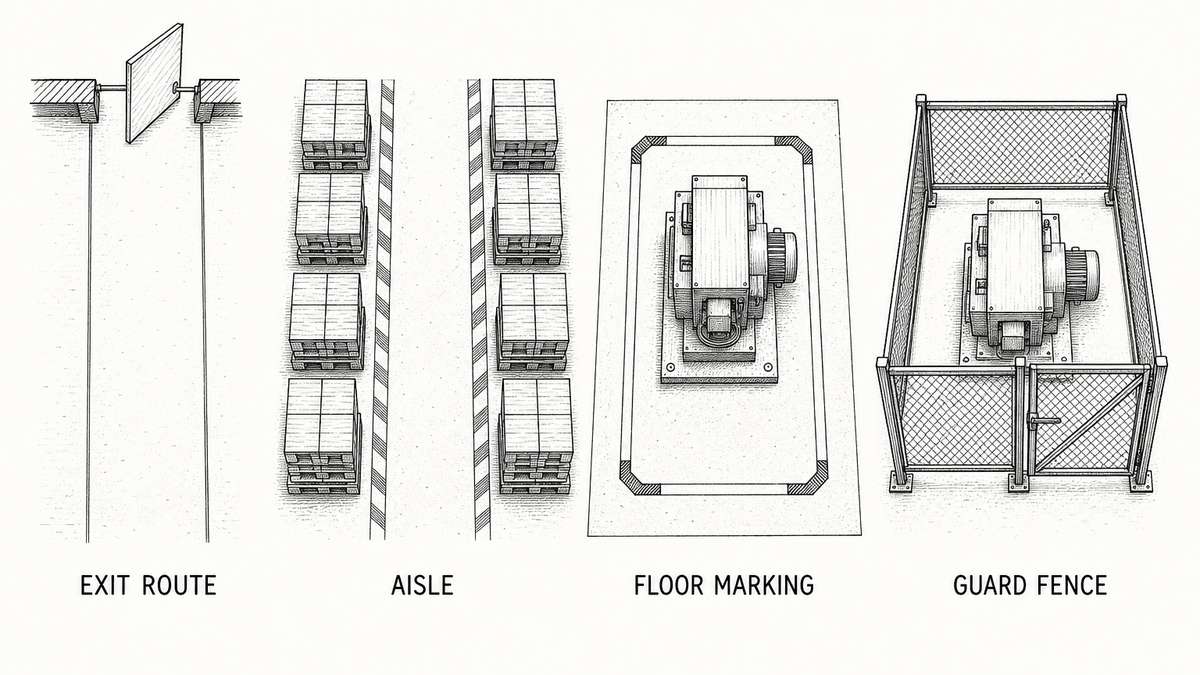
A palletizer is large, it is usually placed at the end of a line wherever there happens to be room, and it arrives with pallet stacks that grow and shrink all day. That combination runs into three rules that have nothing to do with machinery and everything to do with where the machine is allowed to be.
The first is the exit route, and the rule is blunt. Exit routes have to be free and unobstructed, and no materials or equipment may be placed within the exit route either permanently or temporarily. That wording sits in the maintenance rules for exit routes at 29 CFR 1910.37, and the word temporarily is what catches people. A pallet of finished goods waiting to be collected is temporary, and a pallet of finished goods waiting to be collected inside an exit route is a finding. The same section requires that an exit route must not make people travel towards a high hazard area unless the path is shielded by a partition or barrier, which is how a robot cell next to an exit gets resolved: with a fence, not with a sign.
The floor is the second. A walking surface has to be able to carry the maximum intended load for that surface, and it has to be kept free of hazards such as protruding objects and leaks. A palletizer adds two loads most buildings have never been designed for: a stationary point load where the machine is bolted down, and a moving load where the laden pallet leaves. Both are worth raising with whoever owns the building before the machine is ordered, because strengthening a slab afterwards is a far larger job than checking it beforehand. The wording is in the general requirements for walking and working surfaces at 29 CFR 1910.22, which also makes the point that a hazardous floor condition has to be corrected before anyone uses it again, or guarded until it is.
The third is clearance for the truck that takes the pallets away. If the finished pallets are collected by fork truck, the cell needs space the machine itself does not occupy: room to set down, room to turn, and room for the operator to see. Sizing that from the machine drawing alone is how people end up with a palletizer that works and a dispatch area that does not.
All of this belongs in the enquiry rather than in a site visit afterwards. Send the supplier the layout with the exits, the marked aisles and the fence line drawn on it, together with where the full pallets leave and where the empty ones come back. Where the building already has marked storage areas, the racking layout that holds the finished pallets is part of the same drawing, because the racking position decides where the palletizer should stand.
Which Truck May Enter, and Why the Letter Matters
This is the one that surprises people, and it is worth understanding even if you never buy a truck. Powered industrial trucks are classified, and the classification decides whether the truck may lawfully enter the area your palletizer sits in.
The rule lists eleven designations, from the letters D and DS for diesel units through E, ES and EE for electric ones, LP and LPS for liquefied petroleum gas, and G and GS for gasoline. The differences are not about performance, they are about fire and explosion safeguards. An E truck has minimum acceptable safeguards. An ES truck adds safeguards to the electrical system to prevent sparks and to limit surface temperatures. An EE truck encloses the motors and electrical equipment completely. The full list and the meaning of each letter is set out in the designation rules for powered industrial trucks at 29 CFR 1910.178.
Where it becomes a design input rather than a curiosity is the location rules in the same section. In an atmosphere containing hazardous concentrations of metal dust, including aluminium, magnesium and their commercial alloys, only a truck designated EX may be used, and the same is true for dusts such as carbon black, coal or coke. In an atmosphere containing solvents or gases including acetone, alcohol, ammonia, gasoline, hexane, lacquer solvent vapours, naphtha, propane or vinyl chloride in concentrations able to form an explosive mixture, only an EX truck may be used.
Now put that next to a palletizer. If the end of your line sits in a room where aluminium powder, plastic dust or solvent vapour is present, no ordinary truck may drive to the palletizer to collect the finished pallets. You have three ways out: buy an EX truck, which is expensive, keep the truck outside a classified boundary and move pallets by conveyor, or design the cell so the pallet is discharged automatically to a position outside the boundary. The third option is usually the cheapest and it has to be decided at the drawing stage, because it changes the machine.
The section also requires the area to be classified as hazardous or non-hazardous before the truck choice is even considered, and it requires written manufacturer approval before anyone modifies a truck in a way that affects its capacity or safe operation. That last one catches the common habit of welding a custom boom or a special attachment onto a fork truck to suit a new line. The same logic applies to the truck that serves your palletizer, and the forks and attachments that go onto it are a separate item with their own paperwork.
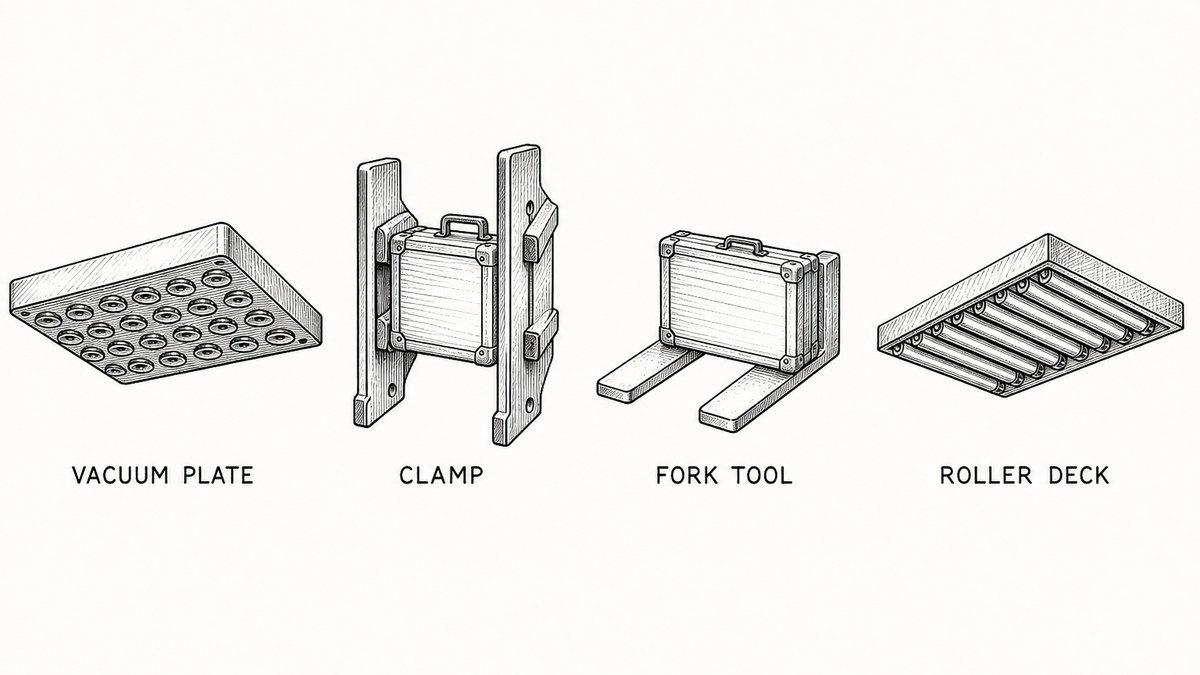
End Effectors: What Actually Holds Your Case
The tool at the end of the arm is where a palletizer makes or loses its reputation. It is a modest line in the quotation and it decides whether cases arrive intact, whether the pattern can be held accurately, and how often the line stops.
A vacuum plate is the usual answer for a regular carton with a sound surface. A grid of suction cups lifts the case and releases it quickly, and the whole tool is simple enough to maintain. It needs a vacuum generator, which is a running cost, and it fails on anything porous, dusty or badly sealed, because air leaks through the surface instead of holding it.
A clamp grips the case between two pads and carries it by friction and compression. It works on cases a vacuum cannot hold and on products that must not be lifted by their top face, and it needs the pads and the force set correctly, because a clamp that is too strong crushes the case and one that is too weak drops it. This is the tool where a supplier's experience shows: the setting is found by trial on your actual product, not calculated from a drawing.
A fork tool slides tines under the case or under a tray, which is the answer for products too heavy or too fragile for the other two, and for trays and slipsheets. It is slower because it has to slide and lift rather than press and lift, and it needs the case base to be flat and rigid enough to be picked from underneath.
A roller deck is a small conveyor on the tool, used where the case has to be supported across a large area or where the transfer has to be gentle. It is the heaviest of the four and the one that most reduces the payload you can lift.
Two questions settle most tool choices. Can the case be lifted by its top face, and does it hold its shape when squeezed? If the answer to the first is yes and the second is no, vacuum is the route. If the answer to the first is no, you are choosing between a clamp and a fork tool, and the deciding factor is whether the base of the case can take a sliding load. Ask the supplier which tool they propose and on what evidence, and ask them to test it on your cases rather than on a sample they keep in the workshop.
What to Test Before It Ships
A palletizer is the rare machine that can be almost completely proven in the builder's workshop, because everything it does is repeatable with empty or dummy cases. That makes the pre-shipment stage unusually valuable, and it makes skipping it unusually expensive.
The dry cycle comes first. Run the machine through the full sequence with your case dimensions and your pallet, at speed, for long enough to build several complete pallets and to see the pallet exchange work more than once. The exchange is where most of the lost rate hides, so watching one exchange is not enough. Ask for the run to continue through at least a full pallet count and to include a deliberate stop and restart, because that is what a real shift looks like.
The pattern test comes second and needs real cases. Cases from a carton supplier are not the same as the cases in a workshop, and a pattern that builds cleanly on perfect samples can fail on cartons that are a few millimetres out. If your cases are not available in time, have the builder run with samples of the same stated size and the same board grade, and record the case dimensions they used so the result means something.
The safety circuit is the third, and it is the one worth witnessing in person. Every gate, every light curtain and every emergency stop has to be tested by actually operating it, and the results recorded. A safety circuit that is described in a manual but never tested is a description, not a demonstration. Ask for the test to be filmed if you cannot attend, and ask for the recording to show the machine stopping each time.
The last item is the documentation set, which should travel with the machine: the electrical drawing as built rather than as quoted, the pneumatic diagram, the program backed up on a removable medium, the safety circuit description, the tool drawings, the spare parts list with prices, and the maintenance schedule. That list is not optional extra paperwork; it is what a maintenance technician needs at two in the morning when the machine has stopped.
All of this is the same discipline that applies to any inspection before the machine is crated, with one addition that is specific to automation: the machine has to be tested with the actual product or a faithful stand-in, because the failure modes in case handling only show up when something real is being moved.
What Actually Moves the Price
Two quotations for the same rate can differ by more than the rate itself, and the differences are traceable to a short list of decisions rather than to the builder's labour rate.
The robot or the frame comes first, and it is sized by the payload at reach rather than by the headline payload. A pallet that is large or a case that is heavy pushes the arm up one or two sizes, and that is a step change in cost. The same is true of the gantry, where the span across the cell decides the beam and the drive.
The tool is next, and it is the cheapest part of the machine and the one with the widest price range relative to its size. A simple vacuum plate and a two-axis tool with a roller deck are not the same line item, and the difference is usually worth paying because it is the part that touches the product.
The pallet handling arrangement comes third. A simple magazine that holds a stack of empty pallets and releases them one at a time is much cheaper than an automatic dispenser with a chain deck and a lift, and the cheaper version needs a person to reload it. How often that person is needed is a decision about the shift, not about the machine.
The controls and the guarding are the fourth and the most commonly under-quoted. A cell with a full perimeter fence, interlocked gates, a light curtain at the infeed, a safety relay and a properly documented circuit costs more than a cell with a fence and a switch, and only one of them will pass a serious review. If the area is classified because of dust or vapour, the electrical equipment inside the cell changes as well.
Then there is the scope outside the cell. The case conveyor that feeds the machine, the stretch wrapper that follows it, the pallet conveyor that takes the finished load away and the installation itself are frequently quoted separately, and comparing a cell price against a line price is how buyers conclude that one builder is twice the price when they are not quoting the same thing.
Freight and installation deserve their own line for the same reason. The machine ships in sections, the tool head usually travels separately, and installation needs a crane and an electrician. A quotation that stops at the port has not finished telling you the price.
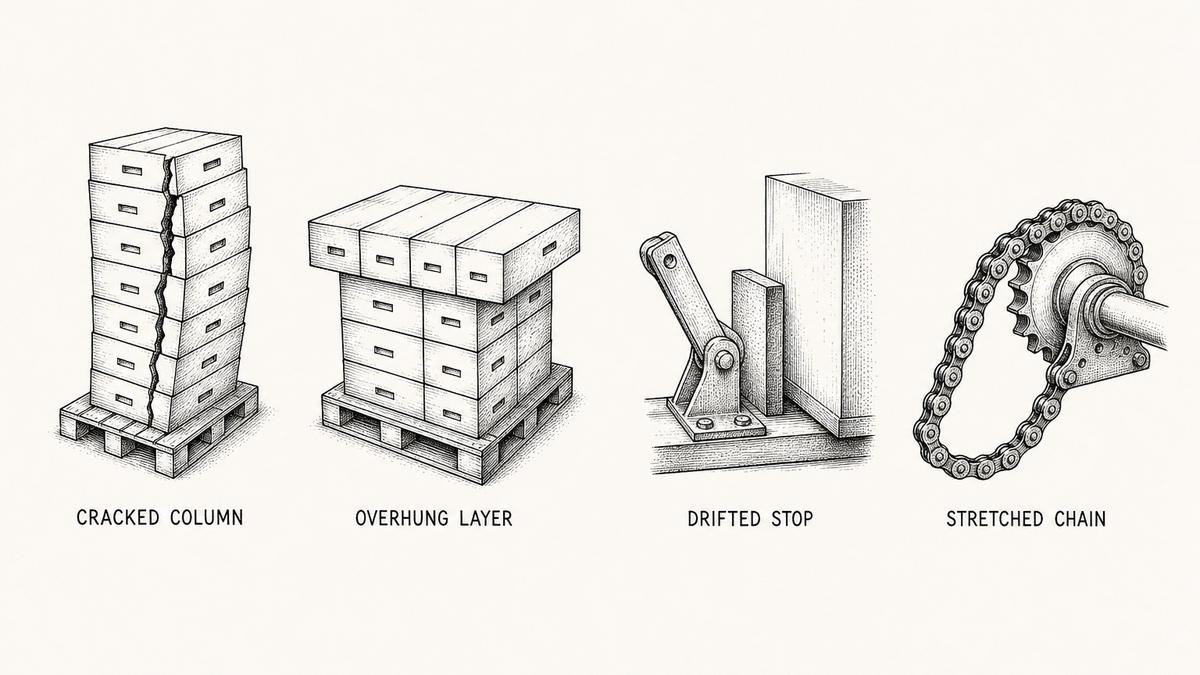
Four Ways a Palletizer Fails to Match Its Paperwork
The failures that cost money are rarely the machine refusing to run. They are the quiet mismatches between what was ordered and what arrived, and they surface weeks after the machine has been signed off.
A cracked column is the first, and it is a load failure rather than a machine failure. Somewhere along the journey the stack leaned, the cases on one side deformed and the pallet arrived with a crack running down one face. The cause is almost always the pattern or the case strength rather than the machine's placement accuracy, which is why the pattern test in the workshop matters so much. If a stack fails in the workshop, it will fail in a lorry.
An overhung layer is the second and it is a programming fault. One layer sits proud of the layer beneath, usually because a pattern was loaded from a slightly different configuration or because a case dimension in the program does not match the case being run. It looks untidy and it makes the load unstable, and it is corrected by a program change rather than a repair.
A drifted stop is the third. Mechanical stops and switches on a palletizer are set at commissioning and they move. A stop that has drifted a few millimetres will still build a pallet, but the cases will not sit square and the pattern will gradually degrade until a stack falls over. This is the failure that a maintenance schedule prevents and that no alarm will warn you about, and it is worth checking on a fixed interval rather than when something goes wrong.
A stretched chain is the fourth, and it is the ordinary wear that every machine has. A chain on the pallet deck or the layer carriage stretches with use, and a slack chain is the early sign of a drive that is about to mistime the sequence. It is cheap to adjust and expensive to ignore, and it belongs on the schedule with the guards and the stops.
Beyond the four, the pattern that repeats is substitution. The robot arrives as a different model to the one quoted, usually one size lower. The vacuum generator is a different make. The guarding is thinner than drawn or the safety relay is a simpler device. None of it is visible in a photograph, and all of it is caught by the same habit: the bought-in items named with make and model in the order, the safe circuit described in writing, and the industrial machinery section that keeps these orders comparable used so that the next enquiry to another builder carries the same figures.
Questions Buyers Ask Before Ordering
How much does a palletizer cost?
There is no useful headline figure, because the price is set by the rate, the case weight and the tool rather than by the machine's size. Two cells that look identical in a photograph can sit far apart if one carries a light carton on a vacuum plate and the other carries a heavy case on a two-axis tool with a roller deck. The productive way to price an order is to fix four things first: the case size and weight, the rate you need across a shift rather than at peak, the pallet drawing, and the scope boundary, meaning whether the infeed conveyor and the stretch wrapper are inside the price. Once those are settled, quotations become comparable and the cheapest one usually stops being the cheapest.
What speed do I need?
Start from the shift, not from the machine. Work out how many cases leave the line in your busiest shift, add the time the machine will lose to pallet exchange and product changes, and you have a working rate to design to. Then ask each supplier for the cycle time at your case, the cases per layer and the layers per pallet, and the pallet exchange time they have assumed. Buying on the published peak rate is how a line ends up short of capacity in its second month, because the peak figure is measured with one product, a full infeed and nothing else happening.
Can one palletizer handle several case sizes?
Yes, within limits, and the limits are set by the tool rather than the machine. A robot cell handles variety much better than a layer machine, because changing product is mostly a matter of loading a different program, while a layer machine often needs a mechanical change as well. The practical constraint is the tool: a vacuum plate that works on one carton may not work on another that is porous or has a smaller flat face. If you run two or three case sizes, say so in the enquiry and ask which tool covers all of them, and expect the answer to involve either a changeable tool or a compromise that costs a little speed on the smallest case.
Do I need a robot or a layer machine?
A layer machine wins when you run one product at a high rate for months at a time, because it places a whole layer in one movement and never travels back and forth for a single case. A robot wins when the product changes, when the floor space is tight, or when the same cell has to serve more than one pallet position. A common mistake is buying a layer machine for flexibility it does not have, and then discovering that a product change costs a day of mechanical work. If you genuinely do not know how much variety you will have in two years, a robot cell is the more forgiving choice.
How much floor space does it need?
More than the machine footprint, and this is where layout goes wrong most often. Add the space for the empty pallet magazine, room for a person to reach the controls, the clearance a fork truck needs to collect a finished pallet, and the guard fence line, which has to stand outside the machine rather than on its edge. Then check that none of it lands in an exit route or the marked aisle you already depend on, because equipment is not allowed to sit in either one. A plan drawing with the machine, the magazine, the fence and the truck path all shown is worth more than a footprint dimension.
What is the biggest risk when buying one from China?
The biggest risk is not the robot, which is a bought-in item from a known maker, but the tool and the pattern. These are the two parts of the machine that are genuinely designed for your product, and they are also the two that are hardest to check at a distance. The remedy is cheap and belongs in the order: make the pattern and the tool subject to a test on your own cases in the builder's workshop before the machine is crated, name the make and model of every bought-in component, and require the electrical drawing and the safety circuit description to be issued as built. A builder who resists a workshop test on your cases is telling you something about how the machine will be commissioned on site.
Size the cell before you price it
Send the case size and weight, the rate you need in cases per minute, and the pallet drawing you actually buy to. We will put those on a datasheet, get quotations you can compare line by line, and hold the order until the dry cycle and the pattern test are witnessed.
Request a Palletizer Quote
Questions & Comments
We read every one and reply within 24 hoursThe argument is almost never about the machine. It is about the rate the cell actually reaches across a shift, the pattern that has to survive the lorry, and the pallet drawing it was set up for. Send us those three and we will settle them before a builder quotes.