
TikTok Dropshipping: What a Viral Spike Does to Supply
 ·
Updated October 13, 2026
·
15 min read
Every guide to selling on TikTok explains the platform and then assumes the supply works. That assumption is the whole risk. A video does not send you steady demand. It sends you a spike, then almost nothing, and the factory, the freight and the delivery window you promised all continue at their own pace regardless. Whether this channel works for you is decided by how those two rhythms meet.

Two Rhythms That Do Not Match
| TikTok demand | Your supply | |
|---|---|---|
| How it moves | All at once, then nothing. | A fixed rhythm you cannot speed up. |
| How fast it changes | Hours. | Weeks, and often more. |
| What it does not care about | Your stock position. | Your best-performing video. |
What this guide covers
1. Why Is a Spike Not Just a Busy Week?
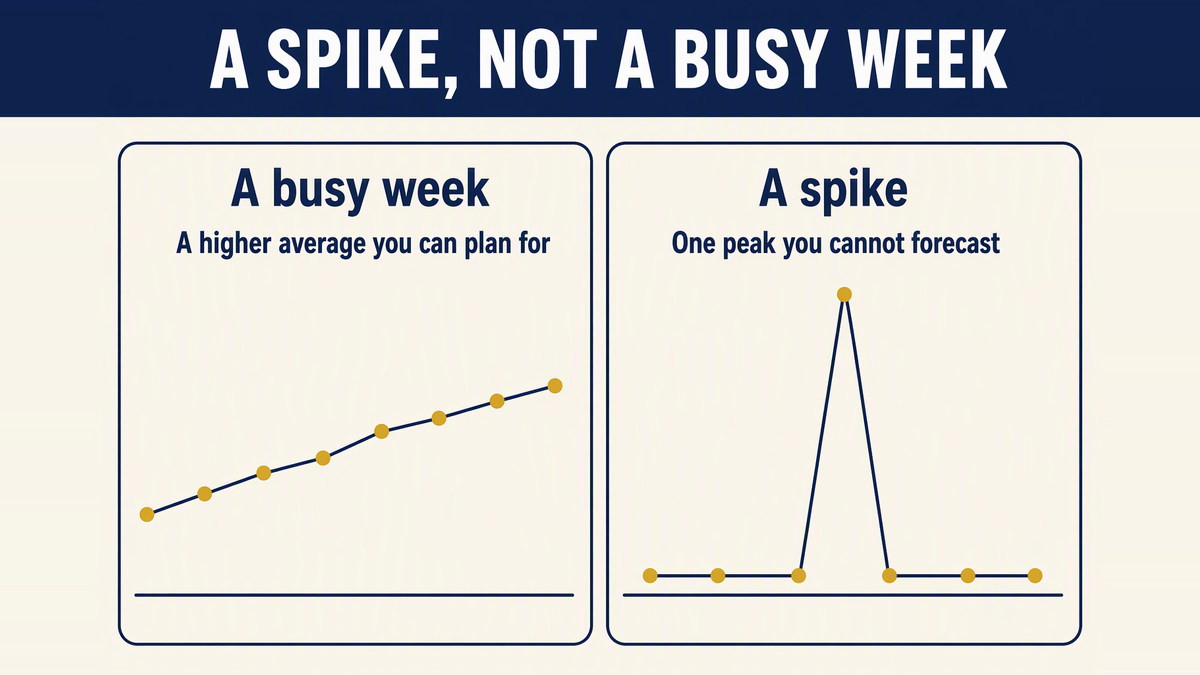
A busy week is a higher average, and you can plan for an average. A spike is a different shape altogether. One video finds an audience, and within a day or two you are taking orders at many times your normal rate. Then the audience moves on to the next thing and the rate collapses, often to below where it started, because the people who wanted the product have already bought it.
Two things follow from that shape, and both are easy to get wrong. The first is that your peak is the number that matters, not your average, so any decision based on an average will be too small exactly when it needs to be large. The second is that the peak is unforecastable. You cannot schedule a spike, and you usually do not know it has happened until the orders are already arriving.
That combination is what makes this channel different from search or email, where demand arrives steadily and roughly in proportion to how much you spend. It is closer to a weather event than to a sales trend, and the sensible response is a plan for the event rather than a forecast of it.
2. Why Can the Supply Side Not Spike?
Because every part of it is a sequence with fixed steps, and a sequence cannot be compressed by wanting it more. There are four stages between a spike and a parcel, and each one has its own minimum.
- The supplier's own stock
- A supplier holding a few hundred units does not have a few thousand, and their answer depends on a production run rather than on your sales. You also cannot see this number, so the shortage is usually discovered from a customer rather than from a report.
- Production, if it has to be made
- A run takes the time it takes. Asking for it faster is possible sometimes and costs more each time, and the same request made repeatedly stops being a favour and becomes a price change.
- Consolidation and freight
- Goods from more than one supplier have to be gathered before they can travel together, which adds days you do not control. Freight then moves on a schedule that is set by capacity rather than by your order volume.
- Your own handling
- Even with stock sitting in a warehouse, a pick-and-pack operation sized for twenty orders a day does not become one sized for four hundred overnight. Everything above the usual rate means extra hands.
Put those together and the honest picture is a system with a floor on its response time measured in weeks. That is not a criticism of Chinese suppliers, who are often faster than suppliers anywhere else at short production runs. It is simply what a physical sequence costs. Our guide to planning around the Chinese New Year shutdown is the clearest example of the same point, because it is the one time each year when the whole sequence stops and no amount of order volume changes that.
This is why the useful question is not "how fast can you ship" but "how much can you ship in the first week without warning". A supplier who ships twenty units a day reliably but cannot reach two hundred for a fortnight is a fine supplier for steady demand and a poor one for this channel. Ask the second question directly, and ask it before a video rather than after one.
3. What Breaks First When a Video Lands?
Three things, in a fairly predictable order. Knowing the order matters, because the first failure hides the second until it is too late to fix.
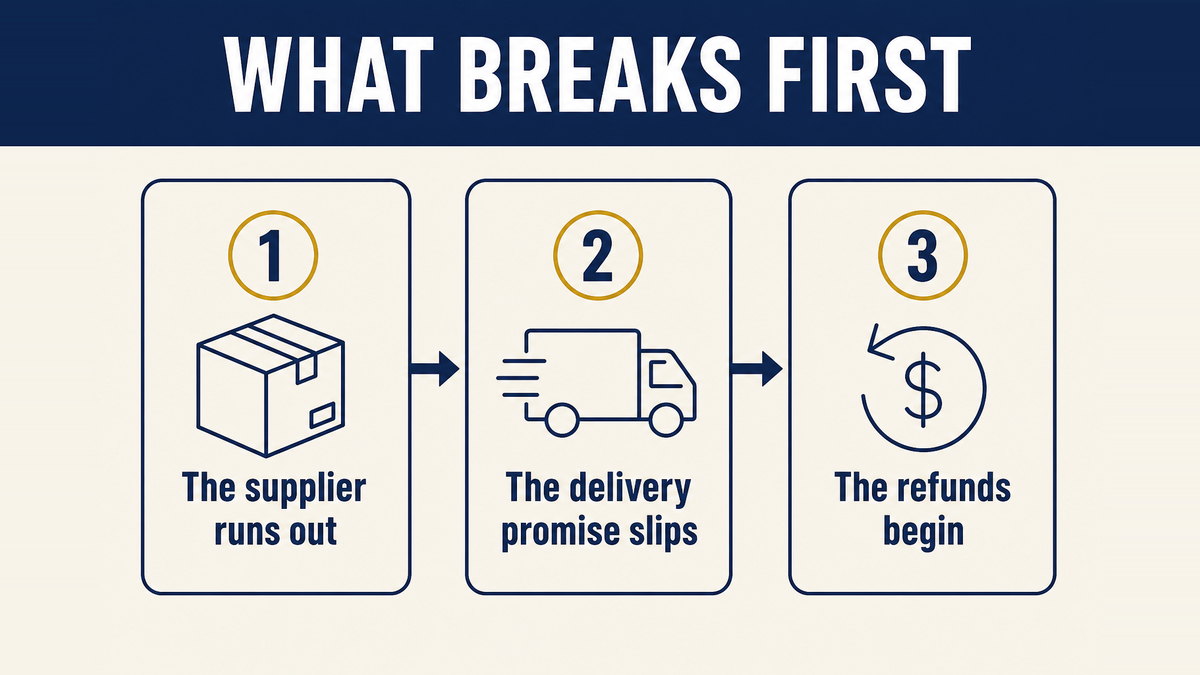
The supplier runs out first, and you find out late because the stock is not yours to count. Orders keep coming in, so from your side everything looks excellent. Then the delivery promise slips. The listing says a window, the parcels are late, and the customers who ordered on the first day and the customers who ordered on the third day are now competing for the same limited stock. Then the refunds begin, which is section four.
The delivery promise is the part worth being careful about, because the number on your listing is not a target. Under the federal rule for orders placed online, whatever time you state clearly at the point of sale is the time you are held to, and the default of thirty days only applies when you state nothing at all. A listing promising seven to fifteen days has chosen seven to fifteen days, and a spike is precisely the situation that makes that promise impossible to keep. Our guide to how long a shipment from China actually takes gives the realistic figures to set that window from. If you cannot hold a short window through a spike, the safer choice is to state a longer one and lose some conversions rather than to miss and collect the complaints.
4. Why Do Refunds Arrive After the Sales Stop?
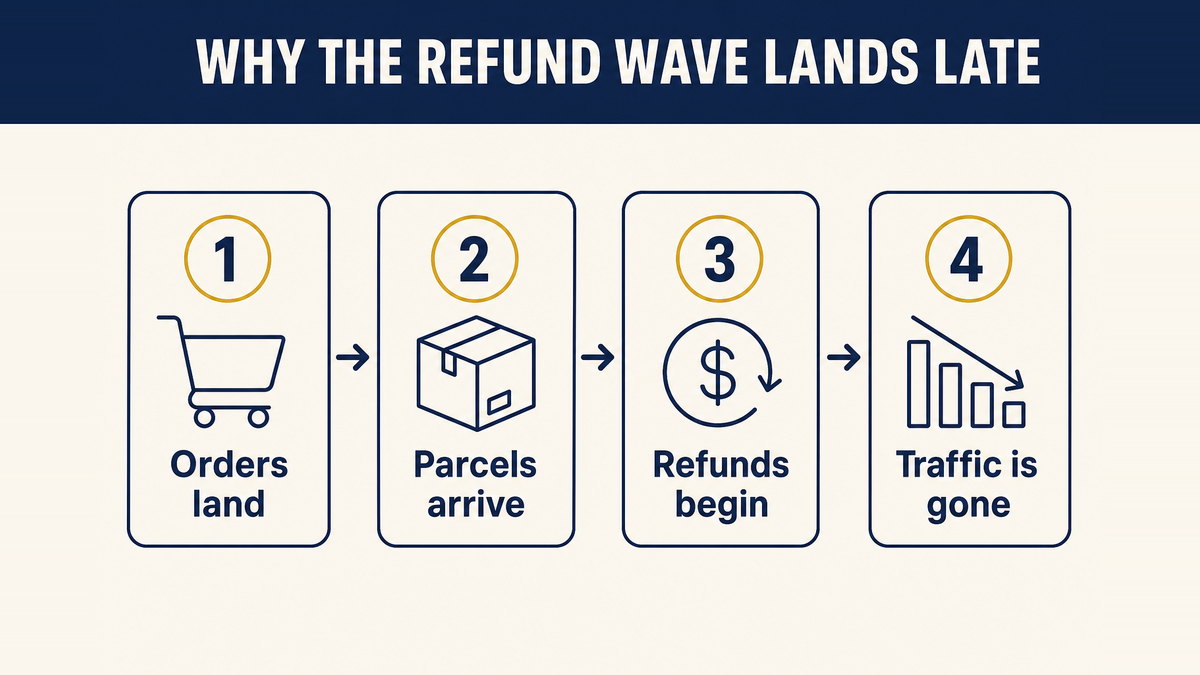
Because returns follow delivery, and delivery follows the spike by weeks. The sequence runs like this: the orders land over a few days, the parcels leave over the following weeks, the customers receive them, and only then does anyone decide they want their money back. By that point the video has long stopped driving traffic and your sales rate is back to normal or below it.
The financial consequence is the part that catches people out. During the spike the money arrives faster than the costs do, because you have been paid and you have not yet paid for all the goods. That gap looks like profit. Weeks later the refunds and the final supplier invoice arrive together, at a moment when no new revenue is coming in to absorb them. A spike can therefore feel like your best month and finish as your worst one.
It is worth naming the other half of this problem, which is that the returned unit has to travel twice and be handled twice. You paid to send it out, you pay again to bring it back or you write it off, and you pay the picking and packing twice over. On a low-value item the cost of the return can exceed the margin the sale produced, which means the orders that come back are worse than orders you never took.
The practical response is arithmetic rather than discipline: work out what proportion of a spike you expect to come back, hold that portion aside as it comes in, and treat the rest as the number you actually earned. Our guide to what a parcel really costs to send is useful here too, because the returned unit has to travel again.
5. Whose Claims Are They Once a Creator Talks About It?
Yours, and this is the part of TikTok selling that almost no guide mentions. The moment you send a product to someone who talks about it, a set of rules about endorsements starts to apply, and those rules are written so that the responsibility does not stop with the person holding the phone.
Start with what counts as a connection. It is broader than most sellers assume, and the rule is explicit that free product is enough.
When there exists a connection between the endorser and the seller of the advertised product that might materially affect the weight or credibility of the endorsement, and that connection is not reasonably expected by the audience, such connection must be disclosed clearly and conspicuously. Material connections can include a business, family, or personal relationship. They can include monetary payment or the provision of free or discounted products (including products unrelated to the endorsed product) to an endorser, regardless of whether the advertiser requires an endorsement in return.
16 CFR 255.5(a), Disclosure of material connections
So a free sample sent to a creator is a material connection, and it does not matter that you asked for nothing in return. If the audience would not reasonably expect that arrangement, it has to be disclosed clearly. That is a conversation to have before the parcel is sent, not after the video is live.
The second rule is the one that surprises sellers more, because it removes the assumption that the creator is the one at risk.
Advertisers are subject to liability for misleading or unsubstantiated statements made through endorsements or for failing to disclose unexpected material connections between themselves and their endorsers. An advertiser may be liable for a deceptive endorsement even when the endorser is not liable.
16 CFR 255.1(d), Endorsements and testimonials
Read plainly, that says a creator who exaggerates what your product does can create a problem for you, and you can hold the problem even when the creator does not. The same section goes on to describe what is expected of an advertiser: give your endorsers guidance about not making misleading statements, monitor what they publish, and act to correct anything that goes wrong. It also notes that this is not a formal safe harbour, so following it reduces the risk without removing it.
The practical version of all of that takes an afternoon. Send the product with a short written note of what it does and, more usefully, what it does not do. Keep a record of what you sent and to whom. Watch the videos that mention you, and if one claims something you cannot support, ask for a correction rather than hoping it goes unnoticed. If the product carries a claim that a regulator has an interest in — a health claim, a safety claim, a performance figure — our guide to picking a product that can be described honestly is the piece to read before you promote it at all.
6. What Should You Settle Before You Post?
Five things, and each is cheaper to arrange in advance than to improvise during a spike. None of them requires you to know whether a video will work, which is the point — they are preparations for an event, not forecasts of one.
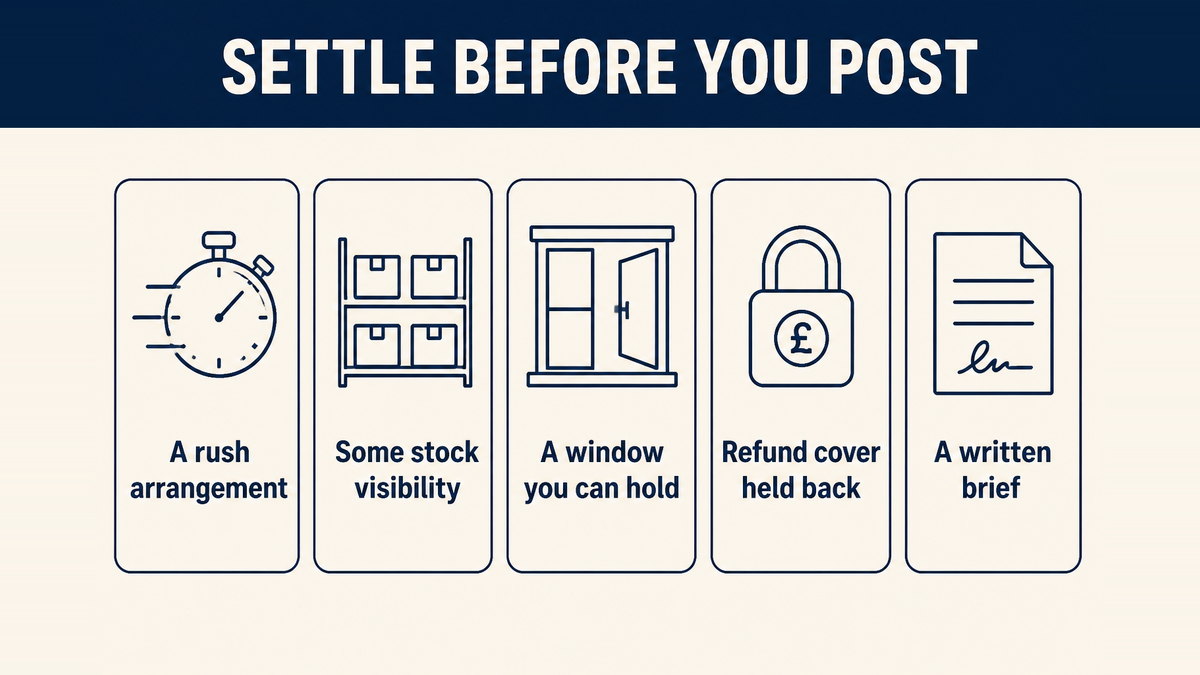
- A rush arrangement, agreed in writing
- Ask your supplier what they can do at short notice and what it costs. A supplier who has already agreed a rush rate answers a message in an hour. One who has never been asked starts a negotiation at the worst possible moment.
- Some visibility of stock
- You do not need a live feed, but you do need to know roughly how many units exist and when the next run is. Our guide to keeping a store and a warehouse in step covers how that count is held and updated.
- A delivery window you can hold in a bad week
- Choose the window for the spike rather than for the calm week. This is a deliberate trade of some conversion for a promise you can keep, and it is the single cheapest protection on this list.
- Refund cover, held back as it arrives
- Decide the proportion before the spike, not after. Our guide to what a warehouse charges to pick and send one order gives the per-order handling figure you will pay twice for a returned unit.
- A one-page brief for anyone you send product to
- What it does, what it does not do, and what has to be disclosed. This is the document that makes section five manageable rather than anxious.
Two pieces to read alongside this one. If you are still choosing what to sell, our notes on reading a trend before it turns cover how to tell a product with a long life from one that has already peaked, which is the difference between a spike you can supply and a spike that arrives after the wave has passed. And if you are weighing this channel against holding stock for it, our guide to moving from per-order buying to bulk covers what changes when you can answer a spike from your own shelf. If the product you are promoting is going into someone else's hands in a plain box, our notes on keeping supplier paperwork out of the parcel apply to this channel exactly as they do to any other.
7. Frequently Asked Questions
Can I dropship on TikTok Shop?
The platform question is the easy one and it changes with the marketplace. The question that decides whether it works for you is whether your supply chain can answer a demand spike that arrives over a weekend, because that is the shape TikTok sends.
How much stock should I hold for a viral video?
Enough to cover the peak rather than the average, and only for a product you can reorder quickly. Holding peak cover for a slow mover is expensive, so the workable answer is usually a modest buffer plus a supplier who has agreed a rush arrangement before you need it.
Why do refunds arrive after the sales stop?
Because returns follow delivery, and delivery follows the spike by weeks. The orders land in one week, the parcels arrive over the following weeks, and the returns then arrive after the traffic has already moved on, which means the money has been spent before the cost appears.
Do I have to disclose that I sent a creator a free product?
Yes. The endorsement rules treat the provision of free or discounted products as a material connection, whether or not you asked for anything in return, and a material connection has to be disclosed when the audience would not reasonably expect it.
Who is responsible if a creator overstates what my product does?
You can be. The rules state that advertisers are liable for misleading or unsubstantiated statements made through endorsements, and that an advertiser may be liable even when the endorser is not. The same section expects advertisers to brief, monitor and correct their endorsers.
What Breaks First, Second and Third
We return the order in which capacity fails, the refund wave that lands after sales stop, and who owns a creator's claim.
Order My Failures
Questions & Comments
We read every one and reply within 24 hoursHad a video take off and the supply not keep up, unsure what your supplier can actually ship in a sudden week, or wondering whether sending free product to creators counts as a disclosure you have to make? Post the product, the supplier and the delivery window on your listing, and our team will help you pressure-test it before the next spike.