
Dropshipping Furniture: The Density Rule, and Why Flat-Pack Wins
 ·
Updated October 13, 2026
·
17 min read
Furniture is the category where the product and the delivery are almost the same size. A chair is not a small thing inside a large box; the box is the chair. That is why furniture does not fail in the way other dropshipping ranges fail. It rarely fails on demand, and it rarely fails on product quality. It fails on the arithmetic that sits between the factory and the customer's door.

Three Ways Furniture Can Travel
| Route | How it is priced | What it suits |
|---|---|---|
| A parcel | Whichever is greater, the weight on the scale or a weight worked out from the box size. | Small, flat and reasonably dense pieces. |
| Less than a truckload | A freight class, and since July 2025 the class follows density. | Flat-pack furniture, usually several units at a time. |
| A full truckload | The whole vehicle, whatever is inside it. | Volume ranges and repeat replenishment, not single orders. |
What this guide covers
1. Why Does Furniture Break the Parcel Model?
Because a parcel network is built to move small, dense things, and furniture is the opposite of that by design. A chair exists to hold a person, so it is mostly air arranged around a frame. A side table stands at the height of a sofa arm, and most of that height is empty space.
Two consequences follow, and they arrive together. The first is that the pieces are light relative to the room they need, which is the exact shape that size-based pricing punishes. The second is that they are awkward, so the carton that protects them is often bigger than the object rather than tighter, and every extra inch is charged for.
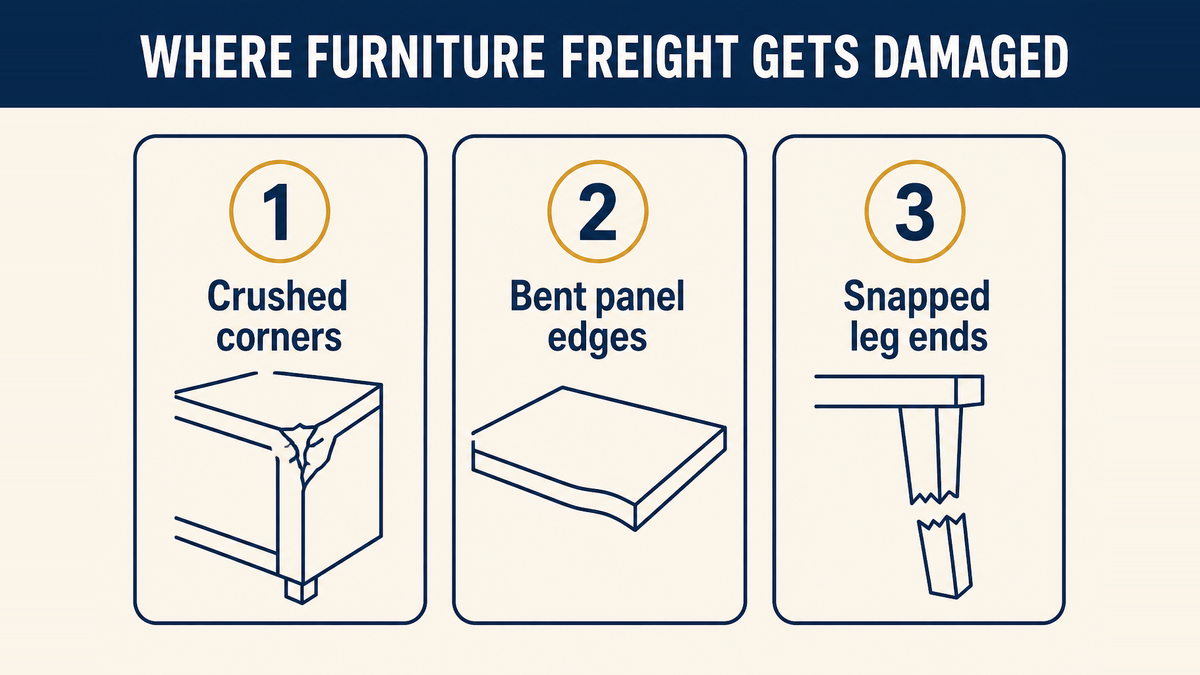
There is a third problem that has nothing to do with size. Furniture arrives damaged more often than most categories, because a large flat panel is easy to bend, a corner is easy to crush, and a long thin part is easy to snap. A damaged dining chair is not a small write-off. It is a refund, a lost product, a lost outbound freight charge and a lost customer, all in one event.
2. What Is Freight Class, and What Changed in 2025?
When a piece is too big for a parcel, it moves as freight, and freight is priced by a rating called the class. The rating comes from the National Motor Freight Classification, which is maintained by the association that has set these standards since the 1950s. The criteria behind it are stated plainly:
The NMFC assigns a freight class based on four criteria: Density, Handling, Stowability, Liability. Based on a combination of these characteristics, a freight shipping class is assigned, ranging from 50 to 500. There are 18 separate classes ranging within these values, with lower numbers indicating cargo that is relatively easier to ship.
NMFTA, Classification FAQ: what factors determine NMFC codes
Read the direction of that scale carefully, because it is the opposite of the way most people assume freight works. A lower class number means freight that is easier to move and costs less per pound. A higher class number means freight that is harder to move and costs more. Class 50 is the cheap end and class 500 is the expensive end.
Then, in 2025, the balance between those four criteria shifted. A substantial update took effect on 19 July 2025, and it moved a large number of commodities onto a standard density scale rather than leaving them on a fixed class.
NMFC Docket 2025-1, effective July 19, 2025, adopted a standard 13-band density scale — from class 400 below 1 lb per cubic foot to class 50 at 50 lb or more — and moved many commodities from fixed classes to density-based classes.
Freight class calculator, the 2025 NMFC density scale
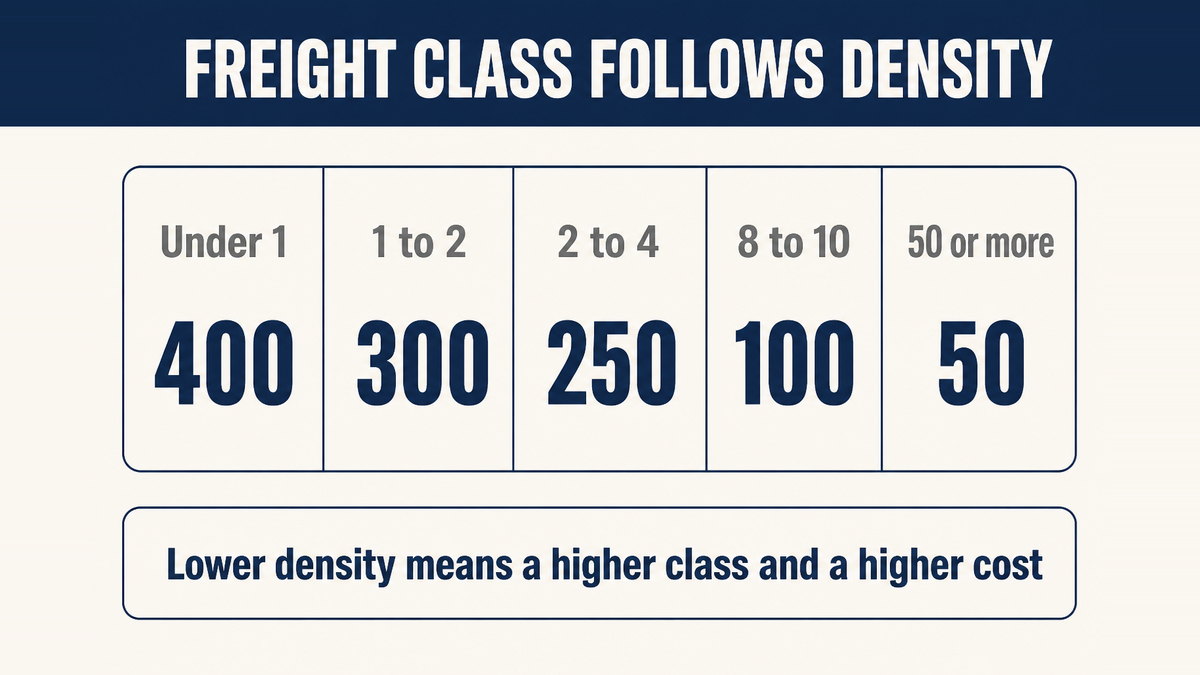
Density is the hinge, and it is easy to work out. Measure each handling unit, pallet included, at its longest, widest and highest points in inches, multiply the three numbers and divide by 1,728 to get cubic feet. Then divide the weight in pounds by that figure. What comes out is pounds per cubic foot, and that lands you in one of the thirteen bands.
| Band | Density (lb per cubic foot) | Class |
|---|---|---|
| 1 | Under 1 | 400 |
| 2 | 1 and under 2 | 300 |
| 3 | 2 and under 4 | 250 |
| 4 | 4 and under 6 | 175 |
| 5 | 6 and under 8 | 125 |
| 6 | 8 and under 10 | 100 |
| 7 | 10 and under 12 | 92.5 |
| 8 | 12 and under 15 | 85 |
| 9 | 15 and under 22.5 | 70 |
| 10 | 22.5 and under 30 | 65 |
| 11 | 30 and under 35 | 60 |
| 12 | 35 and under 50 | 55 |
| 13 | 50 or more | 50 |
The density result is a starting point rather than an answer. The item entry for your particular product decides the class, and some commodities keep a fixed class or carry special handling terms. If the figure on the bill of lading turns out to be wrong, the carrier can weigh and class the shipment again and charge you for the difference, so it is worth measuring properly the first time rather than estimating and hoping. The association's own overview of the classification is at nmfta.org.
3. The Arithmetic on Four Pieces of Furniture
Four examples show how the rule behaves in practice, and the second one is the whole argument in a single line. Each uses the method above: cubic feet from the packed dimensions divided by 1,728, then weight divided by cubic feet.
| Piece | Packed size (inches) | Cubic feet | Weight | Density | Class |
|---|---|---|---|---|---|
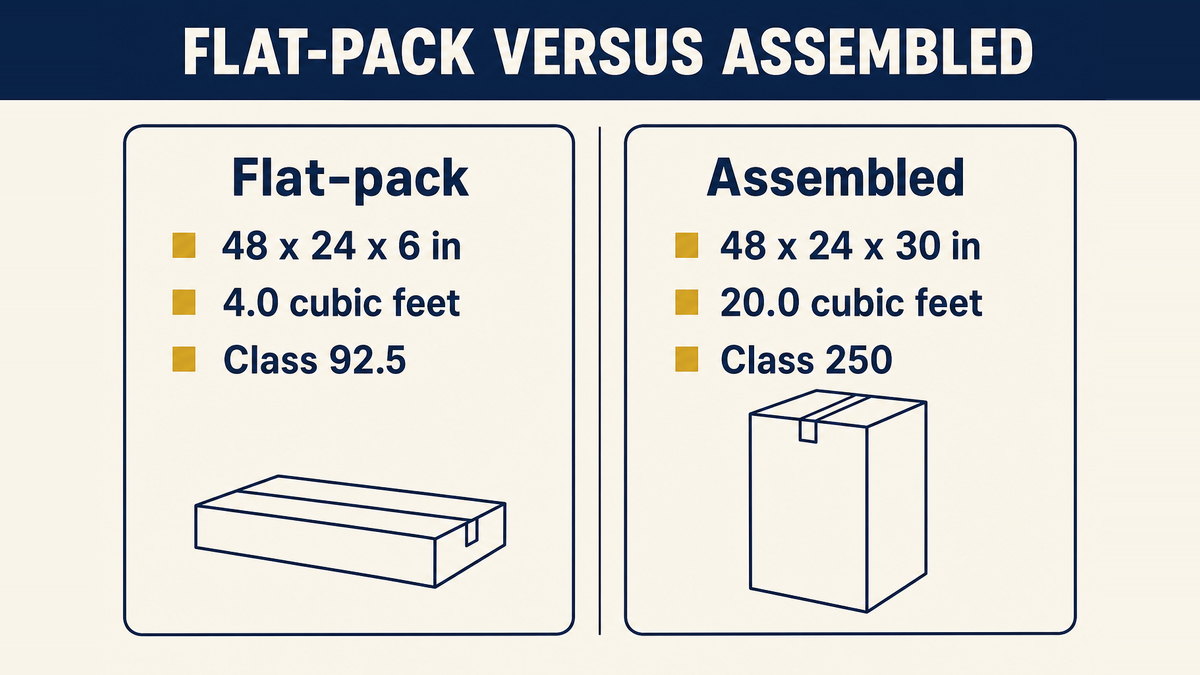
| Side table, flat-pack | 48 x 24 x 6 | 4.0 | 40 lb | 10.0 lb/ft³ | 92.5 |
| The same table, assembled | 48 x 24 x 30 | 20.0 | 42 lb | 2.1 lb/ft³ | 250 |
| Floor lamp, assembled | 12 x 12 x 60 | 5.0 | 8 lb | 1.6 lb/ft³ | 300 |
| Solid wood stool | 20 x 20 x 20 | 4.6 | 60 lb | 13.0 lb/ft³ | 85 |
The first two rows are the same product. Flat, it measures 4 cubic feet and lands in the class 92.5 band. Assembled, with the same table underneath, it measures 20 cubic feet and lands in the class 250 band. Nothing about the product changed; only the height of the parcel did. Class is one of the inputs a carrier uses to set the rate, and the lower-numbered band is the cheaper one.
The lamp shows what happens at the other extreme. It weighs eight pounds and needs five cubic feet to travel, which puts it below two pounds per cubic foot. That is a very expensive shape, and it explains why tall, airy furniture is difficult to sell with delivery included however attractive the product looks.
The stool is the shape you want. It is small and heavy, so it sits high on the density scale and lands in a low class. It is also the least likely of the four to arrive broken, because there is very little empty carton around it to crush.
The table also shows how narrow the gaps between bands can be, which turns a carton height into a pricing decision. Take the flat-pack version at 48 by 24 by 6 inches. If the carton grows by a single inch, to 48 by 24 by 7, the volume rises to 4.67 cubic feet and the density falls to 8.6 pounds per cubic foot, which drops it a whole band into class 100. Shave an inch off instead, to 48 by 24 by 5, and the density rises to 12 and the class falls to 85. One inch of carton is the difference between three different ratings, and it costs nothing to ask a supplier for the tightest carton the protection allows.
4. Why Does Flat-Pack Win Twice?
Flat-pack is usually discussed as a way of saving volume, but the volume is only the first of the two savings. The second one shows up in the damage rate, and it is the one that decides whether a furniture range is profitable.
The density effect is the obvious half. Removing assembled height raises pounds per cubic foot, which moves the shipment into a lower class and a cheaper rate for the same product. A tall assembled piece also occupies more room on the trailer, so you are paying for the space as well as for the rating.
The damage effect is the half that is easier to miss. A tall carton has a high centre of gravity, so it tips and it lands on its corner. A tall piece also puts leverage on its own joints, so a wobble at the top becomes a strain at the base. A flat carton lies low, spreads the load across a wide face and has far less unsupported carton to crush. Two identical pieces, one packed tall and one packed flat, do not have the same chance of arriving intact.
There is a third benefit that only appears once the stock is in a warehouse. Flat cartons stack, so one pallet position holds more units than it would if the same pieces were assembled. That is a smaller storage bill per unit every month, and it is the kind of cost that never appears on a quotation and always appears in the accounts.
5. What Do You Do About Damage?
Damage is not bad luck, it is a specification you either set or leave to chance. A carton is a designed object, and the design is testable before you commit to a thousand units.
- Put the carton through a drop test. A standard drop test drops the packed carton from a set height onto its corners, edges and faces in a fixed order, so a failure is repeatable rather than a matter of opinion. Our guide to carton drop test standards sets out the sequence and the pass marks.
- Protect the three weak points. Corners, panel edges and the ends of long legs are where furniture freight fails. Corner boards, edge protectors and a foam wrap at each end cost very little per unit and remove most of the risk.
- Use the board grade the weight needs. A heavier piece in a thin carton bends the carton, and a bent carton transfers the load straight to the product. Our guide to corrugated flute types and board grades covers how to match the board to the load.
- Check the export packing before it leaves. A pre-shipment check on the carton, the closures and the protection is far cheaper than a claim after the freight has travelled. Our export packaging checklist is built for exactly this pass, and palletizing standards cover what happens when several cartons travel as one unit.
Do not solve a damage problem by making the carton bigger. Extra void around a heavy piece lets it move inside the box, and a piece that shifts gathers speed before it hits the wall. Fill the space, protect the corners and keep the carton as tight as the protection allows. A larger box is a higher class and a worse journey.
6. What Actually Works?
Sort a furniture range by density and by damage risk at the same time and the answer is not the same as sorting it by how good the pieces look.
| Piece | How it travels | Damage risk | Where it sits |
|---|---|---|---|
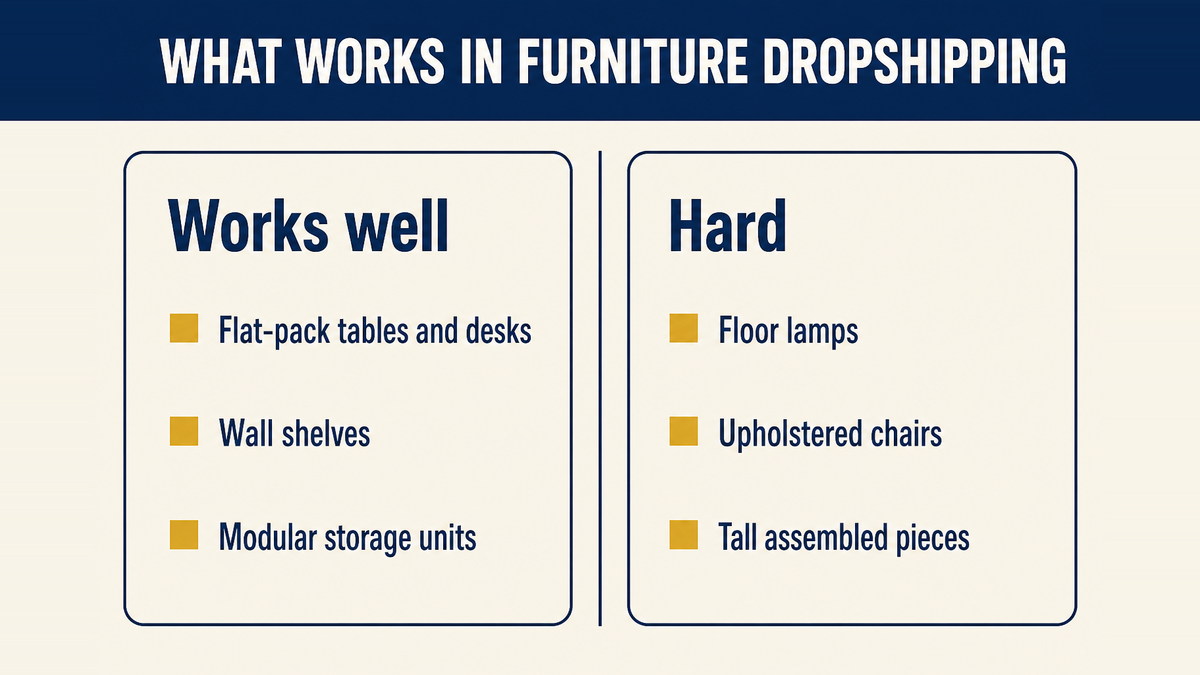
| Flat-pack side table or desk | A dense, low carton, often still a parcel. | Low. | Works well |
| Wall shelf and floating shelf | Very flat and light, so volume is small. | Low. | Works well |
| Modular cube and storage units | Flat panels that stack inside each other. | Moderate. | Works well |
| Dining table, flat-pack | Heavy flat panels, high density. | Moderate, driven by panel edges. | Works with good packing |
| Bookcase, flat-pack | Tall panels, so the carton is long rather than tall. | Moderate. | Works with good packing |
| Folding stool or small chair | Compact and relatively heavy. | Low. | Works with good packing |
| Floor lamp and tall lighting | Long and very light, so a low density class. | High, especially at the joints. | Hard |
| Upholstered armchair or sofa | Bulky, light for its size and awkward to palletize. | High, and hard to repair. | Hardest |
Two things separate the top of that list from the bottom. The pieces that work are dense enough to sit in a low class and flat enough to pack without leaving space for themselves to move. The pieces that fail are the ones that are tall, hollow or soft, because all three of those qualities fight against the way freight is priced and handled.
Where the range really has to include something from the bottom of the list, the answer is usually to stop selling it one at a time. Furniture that travels as freight is cheaper per unit when several cartons move together, which is what pallet and consolidation planning is for. Our guide to consolidating cargo from several suppliers covers how separate orders are combined into one shipment, and our guide to 3PL picking and courier rates covers what a fulfilment partner charges once the stock is on the ground. If you are still choosing what to stock, our notes on picking a product that sells cover the demand side, and the sourcing side of a furniture range is in our guide to buying furniture from China.
7. Frequently Asked Questions
Why is furniture hard to dropship?
Because most pieces are light for the space they take up, and freight is priced partly on density. A lamp or a chair that weighs little but fills a lot of room is charged at a high freight class, so the shipping cost can end up larger than the product cost.
What is freight class?
A rating from the National Motor Freight Classification that carriers use to price less-than-truckload shipments. Classes run from 50 to 500, and a lower number means freight that is easier to ship and cheaper per pound. A higher class means light, bulky freight that costs more.
What changed in the freight rules in 2025?
A large update to the classification took effect on 19 July 2025. It introduced a standard scale of thirteen density bands, running from class 400 below one pound per cubic foot to class 50 at fifty pounds or more, and moved many commodities from fixed classes to classes set by density.
Is flat-pack furniture cheaper to ship?
Yes, and often by more than the saved volume suggests. Removing the assembled height raises the density, which moves the shipment into a lower and cheaper class. A lower, wider carton also survives handling better than a tall thin one.
How do I work out the density of a furniture shipment?
Measure each handling unit including the pallet at its longest, widest and highest points in inches, multiply the three numbers and divide by 1,728 to get cubic feet. Then divide the total weight in pounds by the cubic feet. The result is the density that sets the class.
Four Pieces, Four Classes, Four Costs
We return the class each carton falls into, the cost per unit to a US zip, and the flat-pack option that changes the answer.
Table My Freight Classes
Questions & Comments
We read every one and reply within 24 hoursNot sure what class your furniture sits in, been hit with a reweigh or reclass charge, or losing too many pieces to damage in transit? Post the piece, the packed dimensions and the weight, and our team will work out the density, the class and where the packing needs to change.