
Filter Press Manufacturer: Sourcing Dewatering Presses and Filter Plates From China
 ·
Updated October 13, 2026
·
28 min read
A filter press is a stack of plates clamped shut, with a pump pushing slurry into the gaps between them. The solids stay behind as a cake, the liquid leaves through the cloth, and the plates are opened to let the cake drop out. It is bought on cake dryness, cycle time and plate size, and those are the numbers on every quotation. There is a second set of numbers that almost never appears, though, and on a great many plants it is the one that matters: the machine is the point where a process waste becomes a numbered waste, and the number decides how the cake is packaged, labelled, moved, documented and paid for.
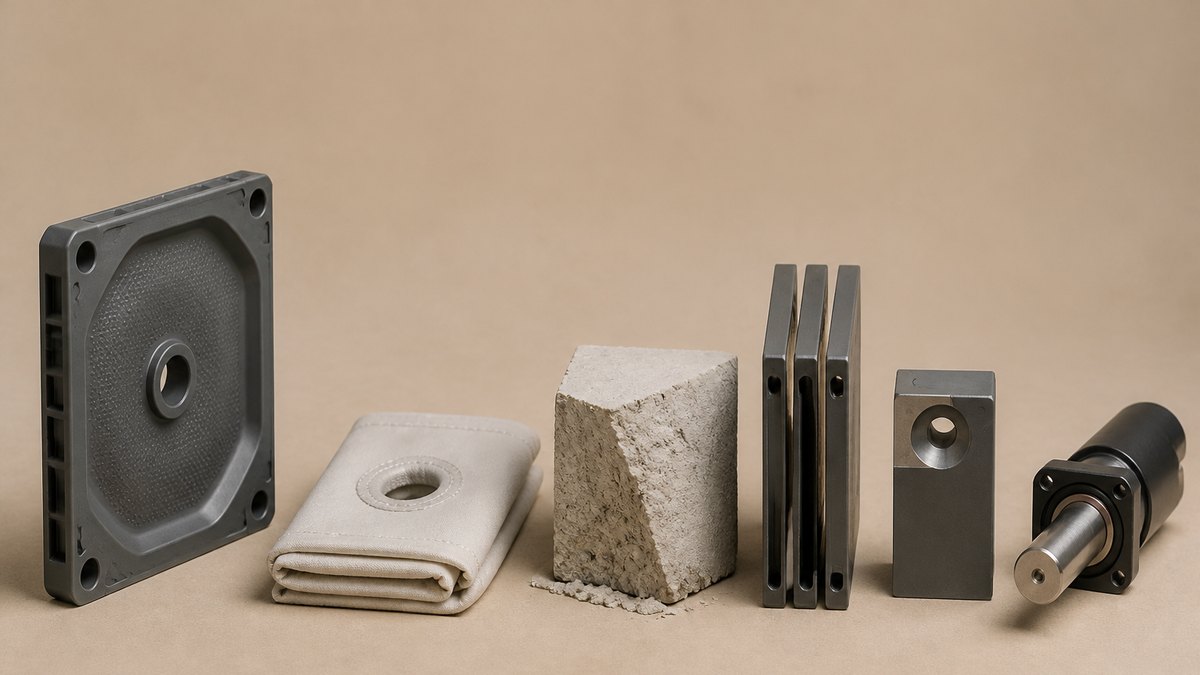
Six Lines That Decide Whether a Filter Press Order Is Complete
| What the buyer has to settle | Why it is not obvious | The line on your order that closes it |
|---|---|---|
| The waste code the cake will carry | Several treatment sludges are named in the hazardous waste list, and the code follows the process upstream | The process the press serves, stated on the enquiry, so the code can be settled before the machine is sized |
| Whether an exclusion applies | Some listings are written with an exception and a condition attached to it | A written statement of which exclusion the plant relies on and why it applies |
| How the cake will be washed | The wash route decides what is left in the cake, and it is a piping choice inside the press | The wash arrangement, the wash ratio and where the wash liquid goes |
| Cake dryness at the design cycle | It is quoted as a percentage of dry solids, and the percentage depends on the cycle the plant will actually run | Cake dry solids at a named cycle time and a named feed solids |
| Plate size, chamber depth and count | Three numbers that together fix the volume, and each is quoted separately by different suppliers | Plate outside size, chamber depth, plate count and the resulting chamber volume |
| Who supplies the cloth | The cloth is the wear part and the one that decides cake release | Cloth weave, weight and material by name, with the replacement interval stated |
What a Filter Press Is, and the Words Around It
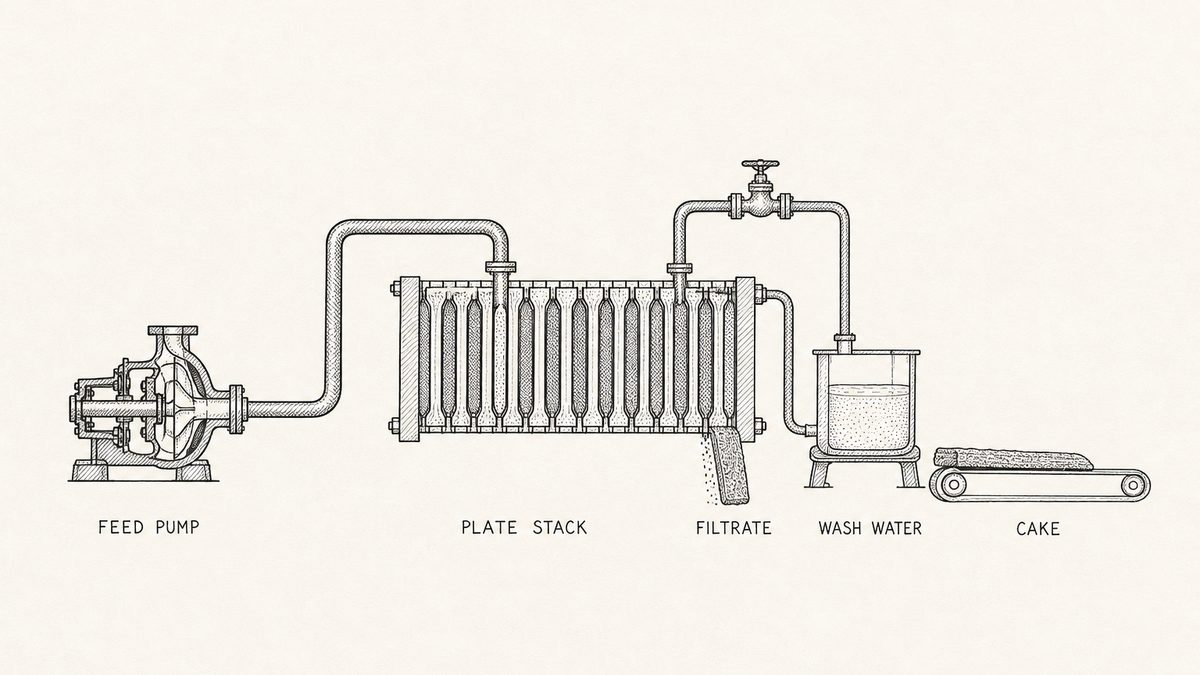
Strip the trade names away and the machine is a stack of flat plates held together by a closing force, with filter cloth stretched over each plate face. Slurry is pumped into the stack at pressure through a hole running down the middle of the whole assembly. The liquid passes through the cloth and out, the solids cannot, and they build up on the cloth as cake. Once the chambers are full, the pump is stopped, the stack is opened, and the cakes fall out.
Everything else in the machine exists to make that happen quickly, or to get the cake drier, or to let the plant wash something out of the cake before it is discharged. The words are worth settling first, because suppliers use several of them loosely.
- Filter press
- The whole machine. A family name covering several plate designs, not one product.
- Plate and frame
- The older arrangement: a flat frame that forms the chamber, alternating with a flat plate that carries the cloth. Simple, forgiving, and poor at getting a dry cake.
- Recessed chamber
- The common modern arrangement: each plate has a dish moulded into its face, and two facing dishes form the chamber. Fewer parts and a deeper chamber than plate and frame.
- Membrane plate
- A recessed plate with a flexible membrane behind the cloth that can be inflated with water or air after the pump stops, squeezing the cake to drive out more liquid.
- Chamber
- The space formed between two facing plate recesses, which fills with cake. Chamber volume, multiplied by the number of chambers, is the batch size.
- Filter cloth
- The woven fabric over each plate face. It is what actually does the filtering, it is a wear part, and its weave decides both the clarity of the filtrate and how easily the cake releases.
- Feed eye
- The hole through the centre of every plate, forming a continuous passage down the middle of the stack through which slurry enters each chamber.
- Corner port
- The holes near the plate corners. They carry filtrate away, and on a wash press they also carry wash liquid in and out.
- Cake
- The solid material left in the chamber after the liquid has gone. Its dryness is quoted as a percentage of dry solids, and its handling depends entirely on what it is.
- Filtrate
- The liquid that comes out through the cloth. Clear filtrate and dirty filtrate are often collected separately, because the first part of a cycle is cloudy until the cloth has built a layer.
- Cycle time
- From closing the plates to opening them again, including filling, filtering, any washing, any squeezing and discharge.
- Cake wash
- Pushing clean liquid through the cake after filtering, to displace the liquid still held in it. This is the step that decides what the cake contains when it leaves.
- Closing force
- The hydraulic force holding the stack shut. It has to beat the feed pressure, and it is what seals the plate faces against each other.
- Blinding
- When solids work into the weave of the cloth and stay there, so the cloth stops passing liquid at the rate it should.
Two of those words do most of the work in a quotation. Cake dryness is what the machine is judged on and it is never a single number, because it depends on the cycle time and the feed solids that produced it. And cake wash is the step that most often gets left out of a quotation entirely, even though it is the step that decides what the plant is allowed to do with the cake afterwards.
The Machine That Produces a Numbered Waste
Here is the part of this subject that the manufacturer pages do not touch, and it is the part that has commercial consequences before anything else does. In several industries, the sludge that comes off a filter press is not simply a waste. It is a listed hazardous waste, carrying a code, and the listing has its own inclusions, exceptions and conditions. The rule that does this opens with a sentence that is worth reading slowly:
“The following solid wastes are listed hazardous wastes from non-specific sources unless they are excluded under §§ 260.20 and 260.22 and listed in appendix IX.”
The rule is 40 CFR 261.31, and the wastes it lists are not exotic: they are the ordinary sludges from plating, heat treating, coating and refining, which is to say the sludges that come out of an ordinary factory's wastewater treatment plant and are dewatered on a filter press. The machine is not incidental to the listing. It is the device that turns the plant's process water into a solid the plant then has to account for.
What that changes about buying one. Three things, and they are all on the enquiry rather than on the drawing.
First, the code has to be settled before the press is sized, because the code decides the container, the label, the storage area, the transport paperwork and the disposal route, and some of those are more expensive than the press. A plant that orders a press on cake dryness alone and discovers the code afterwards may find that the cake has to be handled wetter, or in a closed container, or in a smaller batch, and each of those is a machine decision.
Second, the process upstream is what decides the code, so the enquiry has to state the process rather than the material. Two factories can press visually identical sludge and end up with different answers, because one runs an electroplating line and the other runs a coating line.
Third, the machine's own operating choices feed into the answer. How the cake is washed, whether the wash liquid is returned to the front of the plant or sent away separately, and how dry the cake is pressed all change what leaves the gate. Those are choices a buyer can make deliberately at the specification stage, or can leave to whoever pipes the machine up on site.
F006, F012, F019, F037: Which One You Get
The listing table names its wastes by code, and four of them are wastewater treatment sludges of the kind a filter press produces. The wording matters, because each one is drawn around a particular process.
F006 — “Wastewater treatment sludges from electroplating operations except from the following processes: (1) Sulfuric acid anodizing of aluminum; (2) tin plating on carbon steel; (3) zinc plating (segregated basis) on carbon steel; (4) aluminum or zinc-aluminum plating on carbon steel; (5) cleaning/stripping associated with tin, zinc and aluminum plating on carbon steel; and (6) chemical etching and milling of aluminum”
F012 — “Quenching waste water treatment sludges from metal heat treating operations where cyanides are used in the process”
F019 — “Wastewater treatment sludges from the chemical conversion coating of aluminum except from zirconium phosphating in aluminum can washing when such phosphating is an exclusive conversion coating process.”
F037 — “Petroleum refinery primary oil/water/solids separation sludge — Any sludge generated from the gravitational separation of oil/water/solids during the storage or treatment of process wastewaters and oily cooling wastewaters from petroleum refineries. Such sludges include, but are not limited to, those generated in oil/water/solids separators…”
How to read that as a buyer. F006 is a plating sludge, and the six exceptions are all narrow process routes rather than general relief. F012 turns on whether cyanides are used, which is a fact about the heat treating line rather than about the sludge. F019 covers aluminium conversion coating, and it has the most interesting structure of the four, because its exception is conditional on a plant-level arrangement. F037 is written as a definition with an explicit list of what it includes, which is the form to expect where the industry is large and the process is complicated.
The practical move. Write the process into the enquiry in the words the rule uses, not in the words the factory uses. “Anodising line, sulfuric acid” and “conversion coating, aluminium, chromium based” tell anyone reading it which code is in play, and whether one of the exceptions is worth investigating. “Metal finishing wastewater” tells them nothing, and it is what most enquiries say.
A caution about the code being a plant decision, not a machine decision. The press cannot be bought to produce one code or another. What the press can do is make the plant's position better or worse: a drier cake with less free liquid is easier to handle and to sample, and a wash arrangement that removes a soluble constituent can change whether the waste still shows the property that made it a problem in the first place. Those are engineering choices made when the machine is specified, and they are much cheaper than remaking them later.
The Exceptions Are Written Into the Listing
An exception in a hazardous waste listing is not a general relief. It is a sentence with conditions in it, and every condition is something the plant has to be able to show. The F019 exception is the clearest example, because it is short and it turns on two words that are easy to read past.
“Wastewater treatment sludges from the chemical conversion coating of aluminum except from zirconium phosphating in aluminum can washing when such phosphating is an exclusive conversion coating process.”
“In aluminum can washing”. The exception is drawn around one industry. A plant that runs zirconium phosphating on sheet aluminium for a different product is not inside this exception on the strength of the chemistry alone, because the sentence names the application.
“Exclusive”. This is the word that catches people. The exception applies when the zirconium phosphating is the only conversion coating process at the plant. Add a second coating line, or switch part of the plant to another conversion coating, and the word no longer describes the operation. The listing is then back in play for the whole sludge, not just for the part that changed.
And a second, longer exception sits in the same row. The motor vehicle route is written as a conditional exclusion with its own conditions about where the waste goes and how it is stored before it goes there:
“Wastewater treatment sludges from the manufacturing of motor vehicles using a zinc phosphating process will not be subject to this listing at the point of generation if the wastes are not placed outside on the land prior to shipment to a landfill for disposal and are either: disposed in a Subtitle D municipal or industrial landfill unit that is equipped with a single clay liner and is permitted, licensed or otherwise authorized by the state; or disposed in a landfill unit subject to, or otherwise meeting, the landfill requirements in §258.40, §264.301 or §265.301.”
Read the conditions in that sentence and notice how many of them are about the handling of the material rather than about the process. The waste must not be placed outside on the land before it is shipped. It must go to a landfill of a specified kind. And the rule goes on to attach recordkeeping to the facility, in a paragraph the listing table points to directly.
What this means for the press and the piping around it. If a plant relies on an exclusion, then the way the cake is stored and moved is part of the basis for the exclusion. A press that discharges onto an open pad in the yard, with the cake sitting there until a truck comes, is a different position under the rules from a press that discharges into a covered container under a roof. That is a layout decision, taken when the machine is bought, and it is decided by the sentence above rather than by anybody's housekeeping policy.
The mixing question. Where a plant relies on an exception for one stream and has another stream that is not excepted, the two sludges have to stay apart. That means separate presses, or one press run in campaigns with a documented clean-out between them, and it means the filtrate routing has to keep up. A quotation that assumes one machine serving both lines has quietly assumed away the exception. Ask how the supplier expects the two streams to be kept separate, and if the answer is vague, the exception is probably not safe.
Delisting: Getting Your Own Cake Out of the List
The opening sentence of the listing section said the wastes are listed unless they are excluded under two named sections and entered in an appendix. The second of those sections, 40 CFR 260.22, is the delisting route: a facility can petition to have its own waste at its own site taken out of the listing, on the basis that the waste as it is actually generated does not show the hazardous characteristics that put the category on the list.
Why this belongs in an article about buying a filter press. Because the evidence for a petition is the waste itself, and on these processes the waste is the cake. A petition is built on sampling and analysis, and the sampling is taken from the machine. That makes the press's behaviour part of the application: how consistently it discharges, whether the cake can be sampled chamber by chamber across a batch, whether the press can be run to a documented cycle, and whether the plant can show that what it sampled is what it normally produces.
What a specification can do about it. Four things, all cheap at the order stage and awkward afterwards. First, a cycle that is recorded rather than judged by eye, so a batch has a defined start and end. Second, cake discharge that is accessible and clean enough for a person to take a sample without mixing it with yesterday's pile. Third, chamber-to-chamber consistency, which is a question about feed distribution across the stack and is decided by the feed arrangement. Fourth, a machine that can be held at a fixed cycle while the sampling campaign runs, rather than one that has to be pushed to keep up with production.
What this does not fix. Delisting is a regulatory process with its own cost and its own uncertainty, and nothing about the press makes it succeed. What the press can do is avoid making it harder. If a plant is considering the route, the person writing the petition should be involved before the machine is specified, because the sampling plan and the machine specification have to agree with each other and it is a great deal easier to change a drawing than to change a discharge arrangement that has already been built.
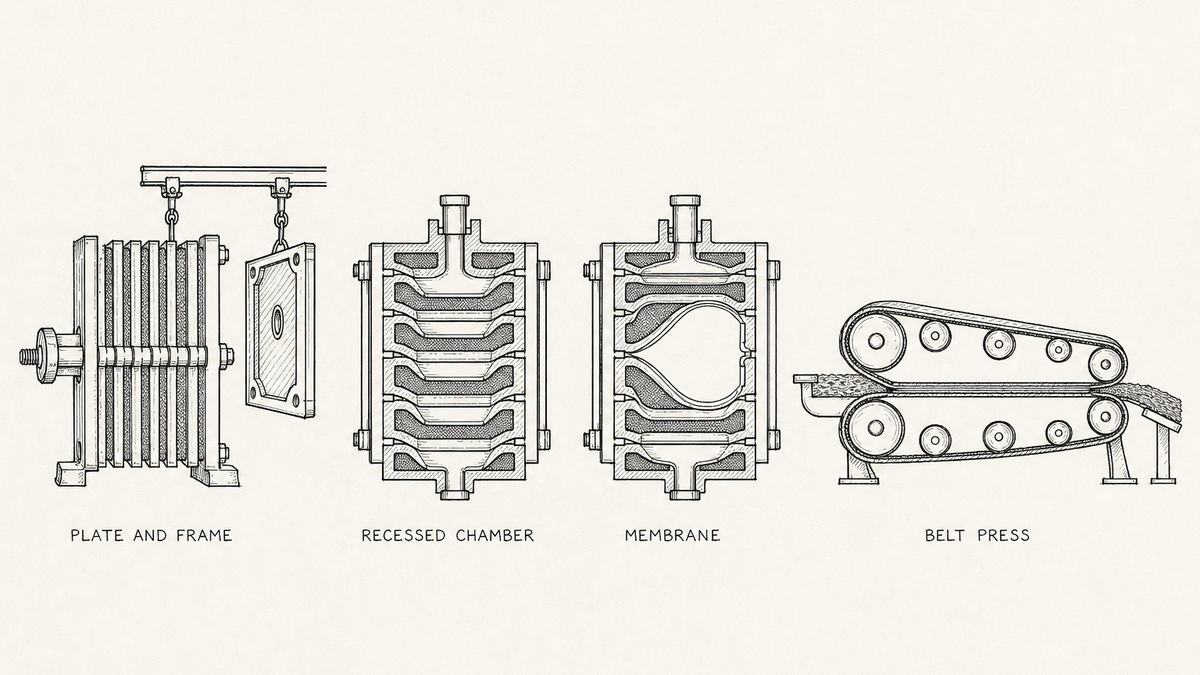
Plate and Frame, Recessed Chamber, Membrane, Belt
The four designs are not alternatives at the same price. Each one buys cake dryness with something else, and the something else is usually labour, floor space or capital.
Which Press Suits Which Duty
| Duty | Best fit | What it costs you |
|---|---|---|
| Ordinary sludge, dryness not critical | Plate and frame | Wetter cake and more manual handling |
| Ordinary sludge, a dryness target to hit | Recessed chamber | Higher closing force, so a heavier frame |
| Dryness is the whole point | Membrane | Membrane plates, a squeeze supply and a longer cycle |
| Very high throughput, modest dryness | Belt press | Poorer cake, more wash water, a different machine to maintain |
| The cake is a listed waste | Enclosed recessed chamber or membrane | Containment, drip trays and discharge designed in |
| Two streams that must not mix | Two presses, or one run in campaigns | A second machine, or a documented clean-out between runs |
Recessed chamber is the default for a reason. It gives more chamber volume per plate than plate and frame, the plates are a single moulding rather than a plate and a separate frame, and the cake forms as a slab that releases in one piece. Where a supplier quotes plate and frame for a duty that a recessed chamber would serve, the usual reason is that plate and frame is what the factory already has patterns for.
A membrane plate is a cycle decision as much as a machine decision. The squeeze adds time to every cycle and it needs a supply of water or compressed air at the right pressure. It is worth it where the dryness target cannot be met by pumping alone, and it is a waste of capital where the cake is going to a dryer anyway. Ask for the dryness both with and without the squeeze, because a supplier who can only quote one figure has not modelled the machine.
The belt press is a different animal and should be judged separately. It runs continuously, which suits a large steady flow, and it produces a wetter cake than a plate press on the same sludge. If the cake is a listed waste, the extra water is extra weight to transport and dispose of, and it is often the reason a plant that started with a belt press moves to a plate press later. Where a plant keeps both, the belt press usually takes the bulk and the plate press takes the stream that needs to be drier.
Where the cake goes next shapes the choice more than buyers expect. A press discharging into a closed container, a skip or onto a screw conveyor under the discharge all need different amounts of headroom and different containment, and those are settled before the plate count is. Decide the discharge first and let the press be sized around it, not the other way round.
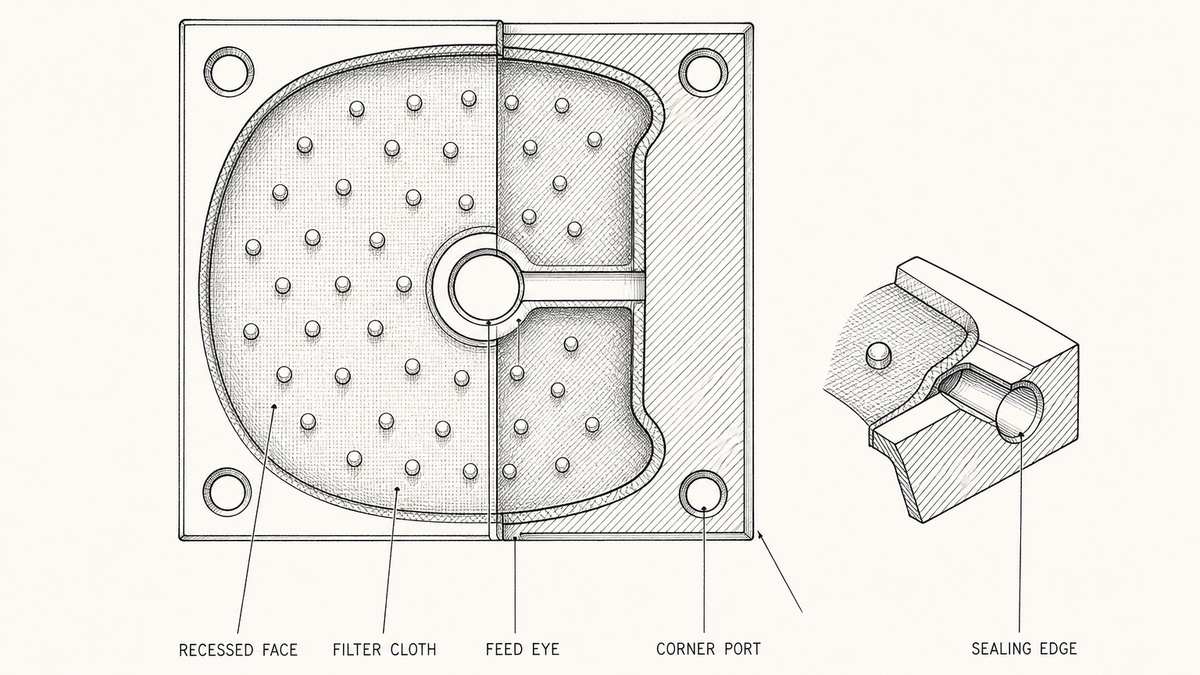
Plates, Cloths and the Chamber
The plate is the part the machine is named after and the part a buyer most often leaves to the supplier. It is worth specifying, because plate size, chamber depth and material together decide the batch size, the cake thickness and how the machine behaves in five years' time.
Plate material follows the duty, not the price list. Polypropylene is the common material and it covers most sludges, with temperature and chemical limits that are usually fine and occasionally not. PVDF appears where the slurry is hotter or more aggressive. Cast iron and aluminium appear where the closing force is high or the cake is abrasive, at the cost of weight and corrosion. Ask what temperature and what pH the plate material was chosen against, in the same way as for any wetted part, because a plate that softens will not hold its sealing edge and a stack that leaks never gets its cycle time back.
Plate size is a handling decision as much as a capacity decision. A larger plate gives more chamber volume for the same number of openings, and it also gives a heavier cake to handle and a heavier plate for whoever changes the cloth. Standard sizes exist for a reason, and one of them is that cloths and spares are cheaper and quicker to obtain. A plate size that is not a standard one is a commitment to a single factory for every cloth and every spare plate for the life of the machine.
Chamber depth is the number that decides your batch size. Chamber volume is roughly plate area multiplied by chamber depth, and the number of chambers is the plate count minus one. Those three figures give the batch in litres, and they should be on the quotation together. A quotation that gives the plate size and the plate count but not the depth has not told you the batch size, and the batch size is what the plant's production rate is matched to.
Cloth is where the machine's performance actually lives. The weave decides how clear the filtrate is and how easily the cake releases; the weight decides how long it lasts; the material decides what it can stand chemically. Air permeability is the measurable number behind the weave, and it is the figure to put on the order along with the material and the weight per unit area. Two cloths of the same material at different permeabilities are two different machines as far as the plant is concerned.
Ask how the cloth is fixed. Cloths that are simply laid over the plate and pressed between the faces are the simplest and the hardest to fit in a hurry. Cloths with eyelets or a caulked edge take longer to make and hold better. What matters commercially is that the fitting method is one the plant's own fitters can repeat, on site, with the plates in the frame, because a cloth change is the most frequent maintenance job on the machine.
Drainage pips and the sealing edge do the quiet work. The small raised bosses on the dished face let filtrate run out from under the cloth rather than being trapped against the plate by the cloth's own pressure. The raised flat rim around the face is what seals against the neighbouring plate. Both wear, both are moulded in, and the pips are worth a look at the factory because a plate moulded with shallow or sparse pips drains badly for its whole life.
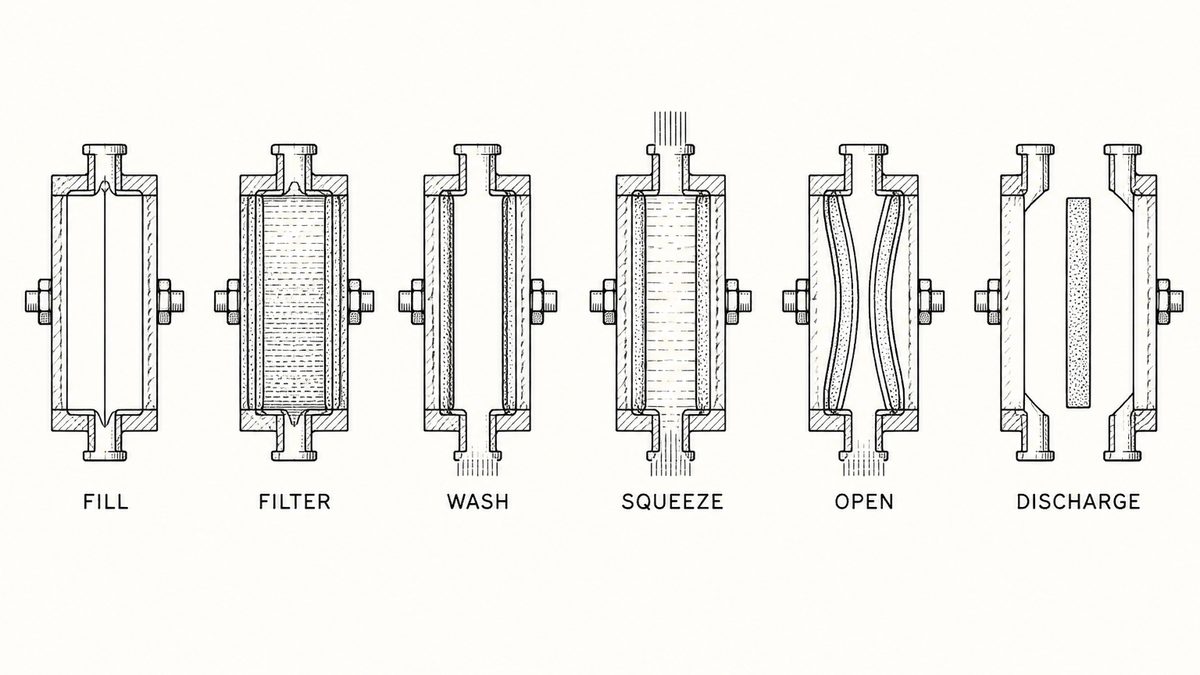
The Cycle: Fill, Filter, Wash, Squeeze, Open, Discharge
A filter press is a batch machine, and almost every argument about its performance is an argument about how long each step takes and which steps the plant actually runs. The six steps are worth taking one at a time, because a quotation that prices four of them is not a cheaper machine, it is a shorter cycle.
Fill. The chambers are empty and the pump runs at whatever pressure the feed can give. Filtration is happening from the first moment, so fill and filter are really one step that gradually changes character: the early part of the cycle is limited by the pump's flow, and the later part by the resistance of the cake. Ask for the pump curve, because the same press with a different pump is a different machine.
Filter. The chambers fill with cake and the flow falls away. The decision here is when to stop. A plant that runs to a fixed time gets a variable cake; a plant that runs to a target pressure gets a fuller chamber but a longer cycle. Ask what the machine is designed to stop on, and whether the control system can do it automatically, because on a machine with several presses one operator cannot watch them all.
Wash. This is the step that decides what the cake contains when it leaves, and it is the step most often left out of scope. Wash liquid is pushed through the cake, displacing the liquid still held in the pores, and the liquid that comes out the far side carries the soluble material away. There are two common arrangements: a simple wash that goes in one corner port and out the opposite one, and a two-sided wash that uses the plate design to spread the liquid more evenly. The second is better on a thick cake and needs plates moulded for it.
Squeeze. On a membrane machine, water or compressed air is pumped behind the membrane after the feed pump stops, pressing the cake from both sides. It is the single most effective way to raise cake dry solids and it adds two things to the plant: a supply of squeeze water or air at the right pressure, and time in every cycle.
Open and discharge. The hydraulic ram releases, the plates run apart, and the cakes fall. On a well designed machine on the right duty, this step takes a couple of minutes and the cakes release whole. On the wrong duty it is the step that eats the day, because a sticky cake has to be scraped off each plate by hand and a blinded cloth holds the cake in place.
The cycle time is the sum, and it is what the plant's throughput depends on. A press that filters beautifully in four hours but takes forty minutes to discharge is a worse machine than one that filters adequately in three and discharges in five. When a supplier quotes a cycle time, ask for it broken down by step and ask which steps the plant is expected to perform. A cycle that assumes automatic discharge, no washing and no squeeze is a real cycle, but it is not the cycle the plant will be running.
Cake Dryness, Filtrate Quality and the Wash Cycle
Cake dryness is the number the whole order turns on, and it is the number most often quoted without the conditions that produced it. The figure is almost meaningless on its own, because it depends on at least four things the buyer controls.
Feed solids. A thicker feed gives a drier cake for the same cycle, because less liquid has to be removed to reach the same point. A dryness figure quoted without the feed solids it was measured at cannot be checked, and two suppliers quoting the same percentage at different feed solids are quoting different machines.
Cycle length. Running the pump longer always drives more liquid out, and it always costs throughput. Every dryness figure is really a pair: this dryness at this cycle time. Ask for the pair, and for the shape of the curve between them if the supplier has it, because the useful engineering question is where more time stops buying more dryness.
Whether a squeeze is used. A membrane machine's advertised dryness is usually measured with the squeeze running. Ask for the figure both ways.
Whether the cake is washed, and with how much liquid. A wash displaces the liquid held in the cake with clean liquid. The measure is the wash ratio, the volume of wash liquid per volume of cake, and it decides how much of the soluble material leaves. A wash at a low ratio removes the free liquid and very little of what is held inside the particles; a wash at a high ratio removes more and produces more liquid to handle. This is a trade the plant has to make deliberately, because the wash liquid has to go somewhere and on a regulated plant it is a stream with its own answers to give.
Filtrate is not one stream. The first liquid through a clean cloth is cloudy, because the cloth has not yet built the layer that does the real filtering. Most installations separate that early cloudy filtrate from the clear filtrate that follows, and send the cloudy part back to the front of the plant. Where the cake is a listed waste, that separation matters more than usual, because returning a stream to the front of the plant is a process decision with its own consequences. Ask how the supplier expects the filtrate to be split and where each part goes.
A mass balance the buyer can check. Feed solids and cake dryness give the split between cake and filtrate, and that arithmetic is worth doing before the order because it tells you how much liquid the plant will be handling. Take the dry solids in the feed, divide by the dry solids fraction of the cake, and the result is the cake mass. The difference between that and the feed is the filtrate. On any real duty the answer is a large multiple of the cake mass, which is the reason filter presses are usually bought together with a tank and a filtrate pump rather than on their own.
The property behind a listing is worth knowing as well. A waste can be hazardous because it shows a property rather than because it appears on a list, and for a sludge the property that usually applies is toxicity, which is decided by leaching a sample and testing the leachate rather than by testing the solid. That is a laboratory exercise performed on the cake, and it is another reason the discharge has to be sampleable. The rule that sets the test is 40 CFR 261.24.
Where the cake goes next is part of the dryness argument. A cake that is going straight to a drier gains little from a long squeeze. A cake that is a listed waste gains a great deal, because a wetter cake is more weight to transport and more liquid to account for. And a cake that is going onto the belt that takes the cake away has to be dry enough to travel without smearing, which is a different requirement from being dry enough to satisfy a disposal route.
What to Put in the Specification Sheet
A filter press enquiry that goes out as a paragraph will come back as quotations that cannot be compared, and the reason is almost always that each supplier assumed a different cycle. The fix is a duty sheet with a revision number, and for this machine it needs five blocks. The general shape is the same as for any fabricated industrial product and is set out in a duty sheet the works can price from; a filter press adds the process and waste blocks.
The process block. What the press serves, in the words the waste rules use rather than the words the factory uses: the coating line, the plating line, the heat treat line, or the water treatment step. This is the block that lets the supplier and the plant agree early on which waste code is in play, and it is the block that decides whether an exception might apply.
The slurry block. Feed solids as a percentage, the particle size distribution if it is known, the temperature, the pH, and the chemical species that matter for the plate and cloth material. Solids settling rate matters too, because a feed that settles in the pipe before it reaches the press needs a different feed arrangement.
The duty block. Batch volume required, the cycle time the plant will actually run, the cake dryness target with the feed solids it applies to, whether a squeeze is expected, and whether the cake is washed.
The machine block. Plate outside size, chamber depth, plate count, the resulting chamber volume, plate material, cloth weave, weight and permeability, the closing pressure, the hydraulic system, and the discharge arrangement including what the cake lands on or in.
The records block. Material certificates for the plates and the frame, a dimensional record taken before assembly, a pressure test of the closing system, a factory run of one complete cycle on water or on the plant's own slurry if that can be arranged, the cloth specification from the cloth maker, and drawings with a revision number where nothing changes without written agreement.
Sourcing From China: Factory, Trader and What to Ask
China makes a great many filter presses, and the range runs from a properly engineered machine with its own plate moulds to an assembly of bought-in parts around a fabricated frame. The enquiry cannot tell them apart, which is why the questions matter more than the paperwork.
Four questions a real works answers from its own floor. Do they mould their own plates, and if so on what machine and from what grade of compound? How is the frame fabricated, and is the closing force the hydraulic system develops checked against a drawing or against a pressure gauge? Who makes the cloth, and can the cloth maker's specification be supplied with the machine? And how is the feed arrangement machined so that all chambers fill evenly, which on a wide stack is a real design question and not a detail?
Plates are the tell. A factory that moulds its own plates has a mould on site, has a compound it buys in quantity, and can change a plate design for a customer who needs a different chamber depth. A trader buys plates from a moulder and assembles a press around them, which is a legitimate business and means the plate design is fixed by somebody else. Neither is automatically better, but they are different risks and the buyer should know which one they are dealing with before the order rather than after.
Ask what is bought in. The cloth, the hydraulic power pack, the pump, the control panel and often the plates are bought from specialists, and that is normal. What matters is that the quotation names the makes for the bought items, because those are the parts that decide reliability and the parts that will need replacing. A quotation that lists a hydraulic power pack with no make has not decided yet, and an undecided part is decided later on price.
Ask for a reference on the same kind of sludge. Not the same press size, the same sludge. A supplier who has built a press for a plating sludge, or for a coating line, has met the cloth and plate material question before and will usually volunteer what went wrong on the first attempt. That story is worth more than a reference list of machine sizes.
Agree the approval point before the plates are made. A plate is a moulded part, so the expensive mistakes are made in the mould and in the first article it produces. A first plate off a new mould, measured against the drawing for face flatness, chamber depth, feed eye diameter and port positions, catches those mistakes while a change is still cheap. On a press with a hundred plates, one wrong plate is a hundred wrong plates.
Inspection Before Shipment, and Start-Up on Site
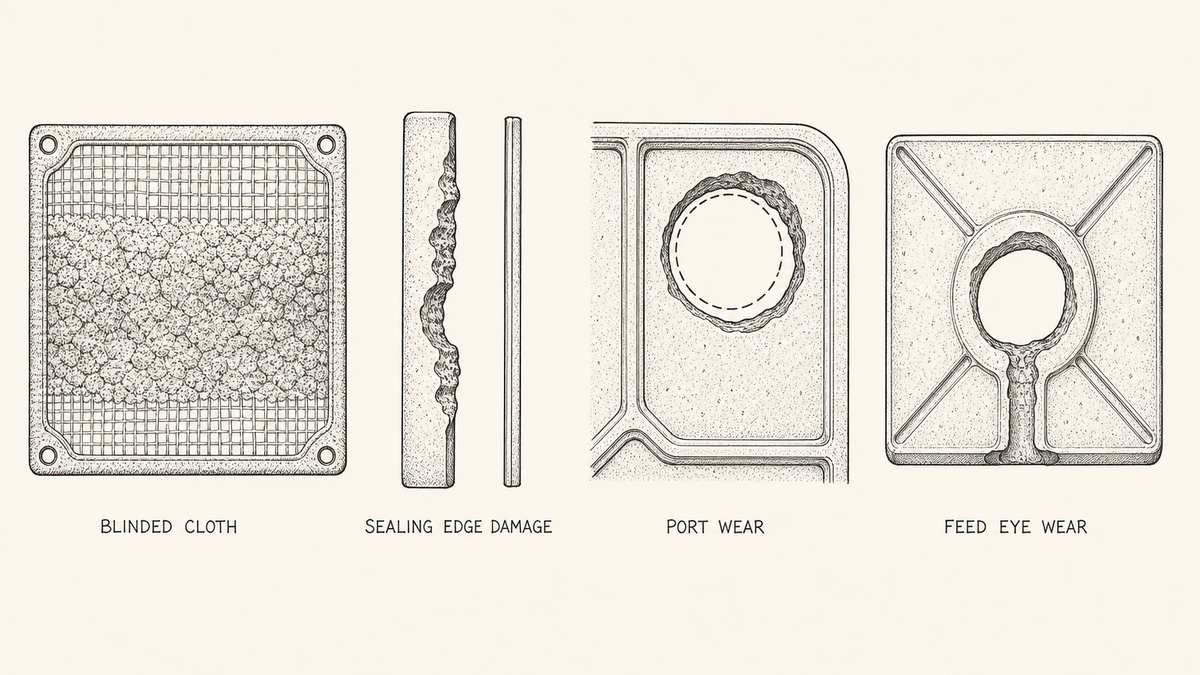
The advantage a filter press has for a buyer is that most of what matters about it can be measured in the works. A plate is flat or it is not, a port is round or it is not, a cloth is the weave that was ordered or it is not. Four failures account for most of the cost of ownership on this machine, and each has a check that belongs at the factory.
Blinded cloth is a duty problem that shows up as a maintenance problem. If the solids work into the weave, the cloth stops passing liquid and the cycle stretches without anyone touching a control. It cannot be inspected away on a new cloth, but the things that decide how soon it happens can be checked: the cloth specification against the cloth maker's own sheet, the weave and weight against the order, and whether the plate's drainage pips are deep enough for the cloth to sit on rather than lie flat against. A cloth pressed flat onto a shallow-pipped plate blinds early and no cloth change will fix it.
Sealing edge damage is the failure that will not stay sealed, and it is usually a closing-force problem. The raised flat rim on each plate seals against its neighbour, and it fails in two ways: it is moulded with a flaw, or the stack is closed harder than the plate can take and the rim is crushed at an edge. At the works, check the rim for moulding defects against a straight edge and check that the frame's closing pressure is set to what the plate material is rated for rather than to what the pump can produce.
Port wear is a slurry problem and it is the one that quietly ruins a clean filtrate. The corner ports erode, and an eroded port lets solids past into the filtrate line, which then gets blamed on the cloth. Measure the port diameters rather than reading them off the drawing, and check the port faces where they mate between plates, because that is where the erosion starts.
Feed eye wear is the one that decides how evenly the machine fills. The central eye is a passage formed by every plate in the stack, and if the eyes are drilled off-centre or worn oval the chambers fill at different rates. Some chambers will then be underfilled while the machine reaches its stop condition, which shows up later as a thin cake in the middle of the stack and no obvious cause. Check the eye diameter and that the eyes line up along the stack with the plates closed.
The rest of the works inspection. Plate face flatness measured against a straight edge on a representative sample rather than on the first plate out of the box. Chamber depth measured, because that figure is your batch size. Plate and frame dimensional check against the general arrangement drawing. Closing system pressure tested and the relief setting recorded. A full cycle run in the works, even on water, to show the plates open, the ram retracts and the control panel sequences correctly. Cloth supplied with the cloth maker's specification sheet, not a generic description. And the discharge arrangement checked for the headroom and containment the plant actually has, because a machine that discharges into a space too small to take a container has been built for the wrong site.
Start-up on site is where the cycle gets fixed, and it is worth treating as a recorded event. The first run should be on the plant's own slurry with the plant's own feed, and it should establish the cycle time, the cake dryness and the wash ratio as they will actually be run. Those three figures then go into the operating instructions with the feed solids beside them, because a cake dryness figure with no feed solids attached cannot be compared to anything later. This is the same discipline as the closing test before the press is crated and the count of what arrived, carried through to the day it runs.
Price, Scope and Lead Time
There is no useful average price for a filter press, because the spread between two machines for the same duty is a multiple rather than a percentage. What a buyer can do is understand which decisions move the number.
What moves it most. Plate count and plate size together are the first driver, because they set the frame size, the closing force and the hydraulic system. Whether the machine is recessed chamber or membrane is the second, since membrane plates and their squeeze supply are a separate system. Plate material is the third, and it is not a smooth scale. Then, in rough order: whether the machine is automated, the cloth, the pump, and how much containment and discharge equipment is inside the scope.
The scope boundary is where cheap quotations are made. Two quotations can differ by a large factor and both be honest if one stops at the press and the other includes the feed pump, the filtrate tank and pump, the wash supply, the discharge containment, the platform and the electrical work. The first question to ask of any quotation is where it stops, and the second is which of the bought-in items are named.
Lead time follows the plates and the hydraulics. A frame is fabrication and moves quickly. Plates are moulded, and on a non-standard plate size the mould is the long item. Hydraulic power packs are bought in and can have their own delivery. Ask for the lead time broken down by item, because the item at the front of that list is the one worth confirming at order.
Buy the wear parts at the same time as the machine. A spare set of cloth, a spare plate or two in the same size and material, the seals in the closing system, and the pump wear parts. Those items cost little at order time and a great deal at breakdown time, and on a press the cloth will certainly be needed.
Questions Buyers Ask
How much does a filter press cost?
There is no meaningful average, because the price follows the plate count, the plate size and the material rather than the cake output. Two machines for the same duty can differ by a multiple if one is a small recessed chamber press with a manual discharge and the other is a membrane machine with automation, containment and a filtrate package. Ask for a priced breakdown: plates, frame and closing system, hydraulic power pack, cloth, feed arrangement, discharge and containment, and instrumentation. That turns a total into something comparable. The most common reason one quotation looks dramatically cheaper is that the pump, the filtrate handling or the containment are not inside it.
What usually goes wrong with a filter press?
Four things cover most of it. The cloth blinds, so the cycle stretches and the cake stops releasing, which is usually a duty or a drainage-pip problem rather than a cloth fault. The sealing edge on the plates is damaged, which leaks slurry from the moment the stack is closed, and it is usually caused by closing harder than the plate is rated for. The corner ports erode, which lets solids into the filtrate and gets misdiagnosed as a failing cloth. And the feed eye wears oval, so the chambers fill unevenly and the middle of the stack produces a thin cake for no visible reason. Of the four, only the cloth is expected wear on a well specified machine.
Will my sludge be a listed hazardous waste?
It may be, and the answer follows the process rather than the sludge. Several wastewater treatment sludges are named in the hazardous waste list, including those from electroplating, from quenching in heat treating where cyanides are used, from the chemical conversion coating of aluminium, and from petroleum refinery oil and water separation. Each listing is written around a particular process and each carries its own exceptions, some of which are conditional on things a plant has to be able to show. The practical move is to describe your process in the words the rule uses when you ask, and to settle the question before the press is specified rather than after it is installed.
How do I get a drier cake?
In order of how much each costs: run the cycle longer, which always works and always costs throughput; raise the feed solids, which is a change to the plant rather than to the press; use a membrane plate and squeeze the cake after the pump stops, which is the single most effective step and needs a squeeze water or air supply; or move to a recessed chamber from a plate and frame design, which gives a better formed cake. Ask any supplier for cake dryness both with and without a squeeze, and always with the feed solids and the cycle time that produced it, because a dryness figure on its own cannot be compared to anything.
Should I use a filter press or a belt press?
It depends on what the cake is going to do next. A belt press runs continuously and suits a large steady flow, and it produces a wetter cake. A plate press runs in batches and produces a drier cake. Where the cake is a listed waste that has to be transported and accounted for, the extra water in a belt press cake is extra weight and extra liquid to answer for, and that is the reason many plants that started with a belt press add a plate press later. Where the cake is going straight to a drier, the belt press's lower capital cost and continuous operation usually win. Plants that run both normally give the belt press the bulk and the plate press the stream that needs to be drier.
What should I check before a filter press ships?
Six things, all measurable in the works. Measure the chamber depth, the port diameters and the feed eye diameter rather than reading them off the drawing, because those three figures are your batch volume and your fill behaviour. Check plate face flatness on a representative sample against a straight edge. Check the sealing edge for moulding defects. Check that the closing pressure is set to the plate rating and record the relief valve setting. Run one full cycle in the works, even on water, to show the ram retracts, the plates run apart and the panel sequences. And check the discharge arrangement against the headroom and containment the plant actually has, because that is the mistake that cannot be corrected on site.
Send the process and the slurry — the cake output alone will not size it
Send us the process and the slurry. The process, in the words the waste rules use, because that settles the code; the feed solids percentage, particle size if you have it, temperature, pH and the species that decide plate and cloth material. Then the duty: batch volume, the cycle time you will actually run, cake dryness with the feed solids behind it, and whether you will wash and squeeze. Then the machine: plate size, chamber depth, plate count, plate and cloth material, closing pressure, and what the cake lands on. Drawings and records on request.
Request a Filter Press Sourcing Quote
Questions & Comments
We read every one and reply within 24 hoursMost filter press arguments are arguments about the cycle: which steps the plant will actually run, and how long each takes. Tell us the process and the slurry and we will pin the cycle down before the plate count is fixed.