
Rotary Dryer Manufacturer: Sourcing Rotary Dryers and Dryer Components From China
 ·
Updated October 13, 2026
·
27 min read
A rotary dryer is a long steel drum, set at a slight slope and turned slowly, with hot gas passed through it so that wet bulk material tumbles from one end to the other and comes out dry. It is the workhorse of mineral processing, fertiliser blending, sand and aggregate plants, and it is bought on three numbers: diameter, length and evaporation rate. Those three numbers are not the ones that decide whether the machine can be accepted, though. On one large class of plants the dryer's maximum inlet temperature is a figure a named person has to sign for, in writing, on the back of thirty days of recorded running. That single sentence turns a process target into a design constraint.
Six Lines That Decide Whether a Rotary Dryer Order Is Complete
| What the buyer has to settle | Why it is not obvious | The line on your order that closes it |
|---|---|---|
| The maximum inlet gas temperature | On some plants it is a figure a named person signs for, not a process target | The certified inlet ceiling, the burner it implies, and the instrument that proves it |
| Which category the dryer falls into | One rule splits these dryers into two types, and the choice changes what the plant owes | The category by name, written on the datasheet |
| Direct or indirect firing | It decides whether the hot gas ever touches the product | The firing arrangement, and a product-contact statement |
| The lifter pattern | The drum size does not decide drying; the way the material falls through the gas does | The lifter form, its count and its height |
| The seal at each end | It is where the air leak, the dust and the argument all start | The seal type, its material and its running clearance |
| What the factory itself must certify | One rule puts an accuracy figure on monitoring devices and asks the supplier to certify it | The certificate, the tolerance, and the operating point it applies to |
What a Rotary Dryer Is, and the Words Around It
The machine has been built the same way for a century, and the vocabulary is small but used loosely on both sides of an enquiry. Ten words carry the subject, and getting them straight in the first email removes most of the arguments that come later.
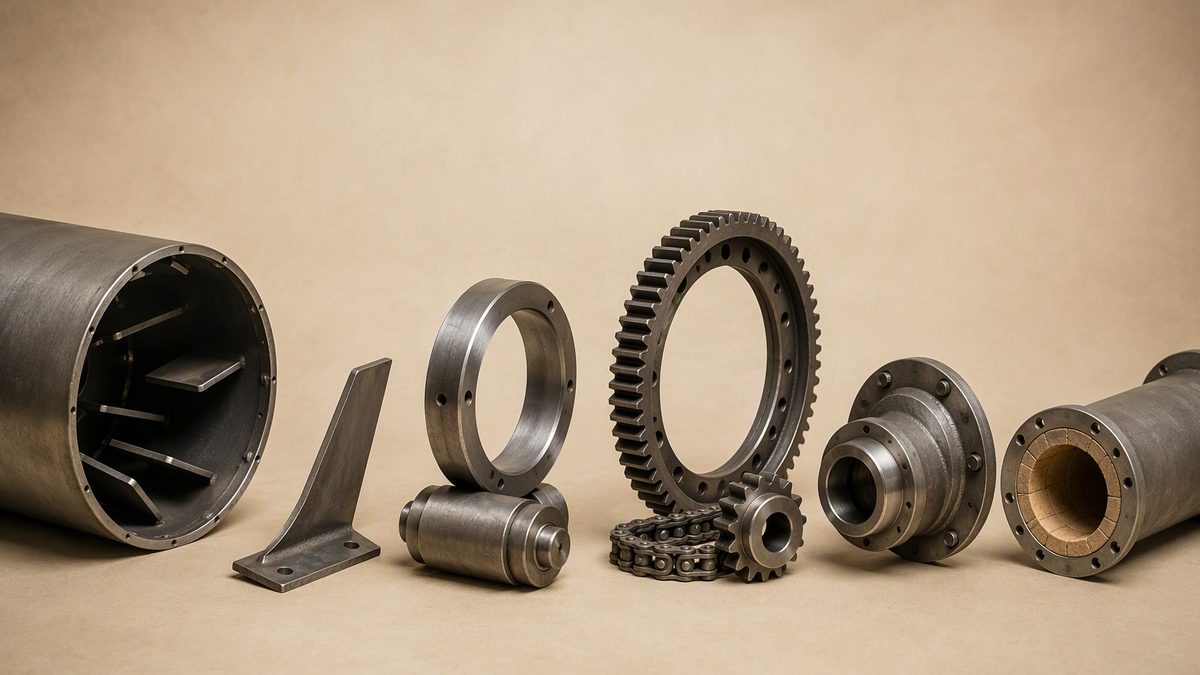
- Rotary dryer, drum dryer, rotary kiln
- Three machines that look alike and do different jobs. A rotary dryer tumbles material through a moving gas stream to take water out of it, and it runs at a few hundred degrees. A rotary kiln is the same steel drum taken to a much higher temperature to change the material by heat, and it is lined with refractory. A drum dryer is a name used for both and also for a small steam-heated cylinder used in food plants. The distance between them matters commercially: a factory that builds dryers may have no business quoting a kiln, and a quotation that mixes the two usually shows that nobody read the enquiry.
- Direct fired and indirect fired
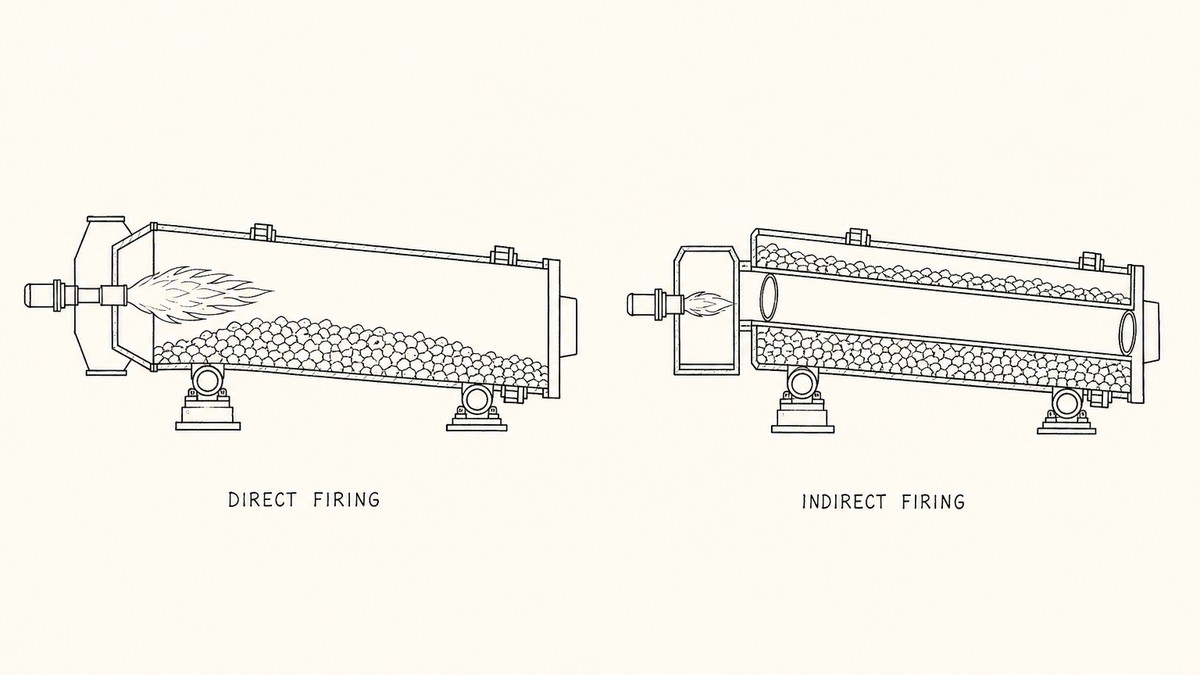
- Where the flame goes. In a direct-fired dryer the burner fires into the drum and the combustion gas itself is the drying gas, so it passes over the product. In an indirect-fired dryer the burner fires into a tube or a furnace box and the product never meets the flame or its gas. Direct firing is cheaper, far more efficient and can reach higher temperatures; indirect firing is used when the product must not contact combustion gas at all, because of what is being dried, because the plant handles solvent, or because the exhaust is regulated. The choice is the first thing to settle, and it changes the burner, the gas path, the seal arrangement and the price.
- Cocurrent and countercurrent
- Which way the gas runs relative to the material. In a cocurrent dryer the hottest gas meets the wettest material at the feed end, and both cool together down the drum. In a countercurrent dryer the gas enters at the discharge end and meets the driest material while it is still hottest. Cocurrent is gentler on a heat-sensitive product because the material is never exposed to the peak temperature at a low moisture content, and it is the usual arrangement. Countercurrent dries further and is chosen where the final moisture has to be very low and the product can take the heat.
- Moisture content, wet basis and dry basis
- The single most common source of a mis-sized dryer. Moisture on a wet basis is the weight of water divided by the weight of the whole wet mass; on a dry basis it is the weight of water divided by the weight of the dry solids alone. A material at 30 percent wet basis is at about 43 percent dry basis, and on a wetter material the gap widens fast. Every heat calculation a factory does is built on one of the two, so the basis belongs in the first line of the enquiry rather than in a later correction.
- Evaporation rate
- The weight of water taken out per hour, which is not the same as the throughput. A dryer moving twenty tonnes an hour from five percent moisture to one percent is taking out under a tonne of water an hour; the same twenty tonnes entering at thirty percent is removing eight. The evaporation rate, not the tonnage, sets the gas volume, the drum diameter and the burner size, and two machines that look identical in tonnage can differ by a factor of eight in the work they have to do.
- Residence time
- How long a particle spends inside the drum. It is set by the length, the slope, the rotational speed and the internal lifters, and it has to be long enough for the heat to reach the middle of a lump and short enough that the surface does not dry past the point of use. It is the number a factory keeps in its head and rarely writes down, which is exactly why it belongs on the datasheet.
- Lifters, or flights
- The angled steel blades fixed inside the drum. They pick material up as the drum turns and drop it back through the gas stream as a curtain, and that curtain is the surface across which drying actually happens. Their form, their height, their number and their spacing decide whether the drum dries efficiently or merely turns. They are also the parts that wear, and they are the first thing to look at when a dryer runs out of capacity.
- Riding ring, support roller and thrust roller
- The drum is not carried on a shaft. It rides on two or more machined rings shrunk or bolted around its outside, each sitting on a pair of steel rollers on a concrete or fabricated base. One station carries the thrust, usually through a pair of rollers set with their axes at an angle or a separate thrust roller bearing on a flange, to stop the drum sliding downhill. The rings and rollers are the parts that establish the drum's alignment, so a worn roller does not simply make noise, it changes the shape of the material curtain inside.
- Girth gear and pinion
- The drive. A large toothed ring is bolted around the drum near one end, and a small pinion on a gearbox turns it. The gear is the most expensive single item on the drive train and the one with the longest lead time, and its tooth form, its material and how it is bolted are all worth asking about. Some smaller dryers are chain driven or friction driven instead, which is cheaper and wears faster.
- Seal, and why it is never a small item
- The joint between the rotating drum and the stationary housings at each end. It is asked to do three things at once: keep the product in, keep the air out and tolerate the drum moving as it heats and expands. Every rotary dryer leaks, and the only question is how much and what it costs. A leak at the discharge end drags cold air into the gas path and quietly reduces the dryer's capacity, which is one of the few faults that shows up as a shortfall rather than as damage.
Two comparisons are worth settling before anything else, because they decide whether a rotary dryer is the right machine at all.
A rotary dryer against a fluid bed dryer. A fluid bed dryer has no large moving drum, it holds far less material at any moment, it responds to a change in feed within seconds, and it is much easier to enclose and to instrument. What it cannot do is swallow a wet, sticky or lumpy feed, which is exactly what a rotary dryer is good at. Where the feed is a slurry, a filter cake or a run-of-mine material with lumps in it, the rotary dryer is the only one of the two that will keep running, and it will do so while being harder to control and slower to react.
A rotary dryer against a belt dryer. A belt or conveyor dryer carries material on a moving mesh so that the bed never turns over and the product is treated gently, which suits a fragile pellet or a food product that must not break. It also needs the material to be pre-formed into a bed, which means it cannot take the same wet lumpy feed. The two machines are chosen by what the material will tolerate rather than by cost. A great deal of the material-handling equipment around a dryer is chosen the same way, on what the material will take rather than on the price, which is true of the belt conveyor beside it just as much as it is of the dryer.
The Number the Buyer Signs For
Here is the part that does not appear on any manufacturer's product page, and it is the reason this article exists. For one large class of plants in the wood products industry, the federal rule does not merely suggest a drying practice. It defines a category of dryer, and then it makes the plant prove that the dryer stays inside two limits, one of which is a temperature.
The rule is 40 CFR 63.2263, and the operative sentence reads:
“If you operate a dry rotary dryer, you must demonstrate that your dryer processes furnish with an inlet moisture content of less than or equal to 30 percent (by weight, dry basis) and operates with a dryer inlet temperature of less than or equal to 600 °F.”
Two limits, and a phrase that reads like paperwork: the plant has to prove the machine stays inside them. The next sentences say what that proof involves, and this is where the commercial weight sits. The plant must designate and clearly identify each dry rotary dryer. It must record the inlet moisture content and the inlet temperature for at least thirty calendar days. It must submit the highest recorded twenty-four-hour average of each with its notification. And then the sentence that changes everything:
“In addition, you must submit with your notification of compliance status a signed statement by a responsible official that certifies with truth, accuracy, and completeness that the dry rotary dryer will dry furnish with a maximum inlet moisture content less than or equal to 30 percent (by weight, dry basis) and will operate with a maximum inlet temperature of less than or equal to 600 °F in the future.”
A named person signs that the machine will operate below 600 °F in the future. Not that it usually does, and not that it was designed to. That is a promise about how the equipment will be run for as long as it exists, and the only honest way to make it is to buy a dryer that cannot easily be pushed past the limit.
Read the sentence again as a buyer rather than as a plant manager, and four consequences fall out of it.
- The ceiling becomes a specification, not a setting
- Somebody has signed for an inlet temperature, so the burner has to be sized and set so that the ceiling is not reachable in normal operation, with margin for a cold start, a wet batch and a fouled gas path. A dryer sold on the basis that it can reach a high temperature is, on this duty, a dryer that makes the promise hard to keep.
- The instrument stops being a display
- A reading that supports a signed statement has to be recorded, and the recording has to survive an inspection. That means a temperature element in the right place, a transmitter with a stated accuracy, a logger that keeps thirty days and cannot be quietly reset, and a calibration record. A dryer quoted with a dial gauge on the burner panel is not the same machine as one quoted with a recorded, calibrated inlet temperature.
- The thirty days start before the promise is made
- The demonstration is thirty days of recorded running at the plant's own feed and conditions, and the highest twenty-four-hour average is what gets submitted. A dryer that has never seen the real feed cannot produce that record. The practical effect is that a plant buys a machine whose behaviour under its own worst material is already known, or it risks a certificate it cannot support.
- The moisture limit is a feed promise, not a dryer promise
- The same sentence caps inlet moisture at 30 percent on a dry basis, so the dryer's drying duty is bounded from above by what the plant feeds it. If the feed runs wetter than that, the plant has broken a promise it signed; accordingly, the dryer has to be able to dry the material at the boundary value, not merely on an average day. That is a question worth asking a factory directly, because a quotation built on average moisture will look cheaper and will not hold.
None of this means every rotary dryer in the world is bound by the rule. 40 CFR 63.2263 sits inside a subpart that governs plywood and composite wood products sources, and a mineral processing plant or a fertiliser plant answers to other parts with their own numbers. What travels is the shape of the thing. Where a regulator has written a temperature into a rule and asked somebody to sign for it, the dryer stops being a drum with a burner on the end and becomes a machine with a certified operating envelope. That is true wherever the plant is and whoever is asking, because the signature is the plant's own, and the question a buyer has to answer is simply whether the machine can hold the envelope it was bought to hold.
Named in the Rule: Dry, Green, and the Mineral List
The same body of rules does something else that is worth knowing before a dryer is ordered, and it is more specific than most buyers expect. Instead of governing dryers as a class, it names individual dryers one at a time, and what it says about a named dryer depends on which name applies to yours.
The first split is between a dry rotary dryer and a green rotary dryer, and the choice belongs to the plant rather than to the factory. Under 40 CFR 63.2241:
“If you have a dry rotary dryer, you may choose to designate your dry rotary dryer as a green rotary dryer and meet the more stringent compliance options and operating requirements in § 63.2240 for green rotary dryers instead of the work practices for dry rotary dryers.”
Two categories, two sets of obligations, and one machine underneath. This matters to a buyer because the category is a decision the plant makes with a signature rather than a property of the steel, and the decision is much easier to make on a dryer that was designed with it in mind. A dryer bought for the less demanding category and later redesignated will be asked to hold limits it was never specified against.
The second thing the rule does is put a clock on maintenance, written in months. Still in 40 CFR 63.2241:
“After the initial tune-up, each annual tune-up is required to be completed no more than 13 months after the previous tune-up.”
An interval written as thirteen months is a maintenance window that closes. A plant that runs an annual shutdown at a fixed date each year can find itself drifting past the limit, and the answer is usually to bring the interval inside the shutdown rather than to argue about it. For the buyer this becomes one more line to settle with the factory: what the tune-up procedure actually is, which parts it covers, and whether the factory supplies a written one with the machine. A dryer delivered without a tune-up procedure is a dryer whose owner has to invent one.
The third thing is the most concrete of all. The mineral industry rules set out a list of named dryers and treat them differently. Under 40 CFR 60.734, a group of named dryers may substitute a visible-emissions reading taken by an observer for a continuous opacity monitor, and the list is written out item by item: a ball clay vibrating grate dryer, a bentonite rotary dryer, a diatomite flash dryer, a diatomite rotary calciner, a feldspar rotary dryer, a fire clay rotary dryer, an industrial sand fluid bed dryer, a kaolin rotary calciner, a perlite rotary dryer, a roofing granules fluid bed dryer, a roofing granules rotary dryer, a talc rotary calciner, a titanium dioxide spray dryer, a titanium dioxide fluid bed dryer, a vermiculite fluid bed dryer and a vermiculite rotary dryer.
A second list, in the same section, names dryers that are exempt from those monitoring requirements altogether, and it is a different set of names: a ball clay rotary dryer, a diatomite rotary dryer, a feldspar fluid bed dryer, a fuller's earth rotary dryer, a gypsum rotary dryer, a gypsum flash calciner, a gypsum kettle calciner, an industrial sand rotary dryer, a kaolin rotary dryer, a kaolin multiple hearth furnace, a perlite expansion furnace, a talc flash dryer, a talc rotary dryer and a titanium dioxide direct or indirect rotary dryer.
Read the two lists side by side and a pattern appears that a buyer can use. A feldspar rotary dryer sits on the first list; a feldspar fluid bed dryer sits on the second. A gypsum rotary dryer is exempt; a bentonite rotary dryer is not. Nothing about the drum changes between those pairs. What changes is what the plant has to install, run and record, and in some cases the difference is a continuous monitoring instrument against a person walking past and writing a number down. When a buyer is told that two quotations are for the same duty, the honest question is which name on that list applies, because the answer can move six figures of plant cost that never appears in the dryer's price.
What to do with this before you order. Ask the plant, or the permitting consultant if there is one, which category and which named type the dryer will be, and get the answer in writing before the enquiry goes out. Then put the category on the datasheet as a requirement rather than a description, and ask the factory to confirm in its quotation that the machine it is offering is suited to that category. That is a two-line change to an enquiry and it removes the whole class of problem where a correctly built dryer turns out to be the wrong named dryer.
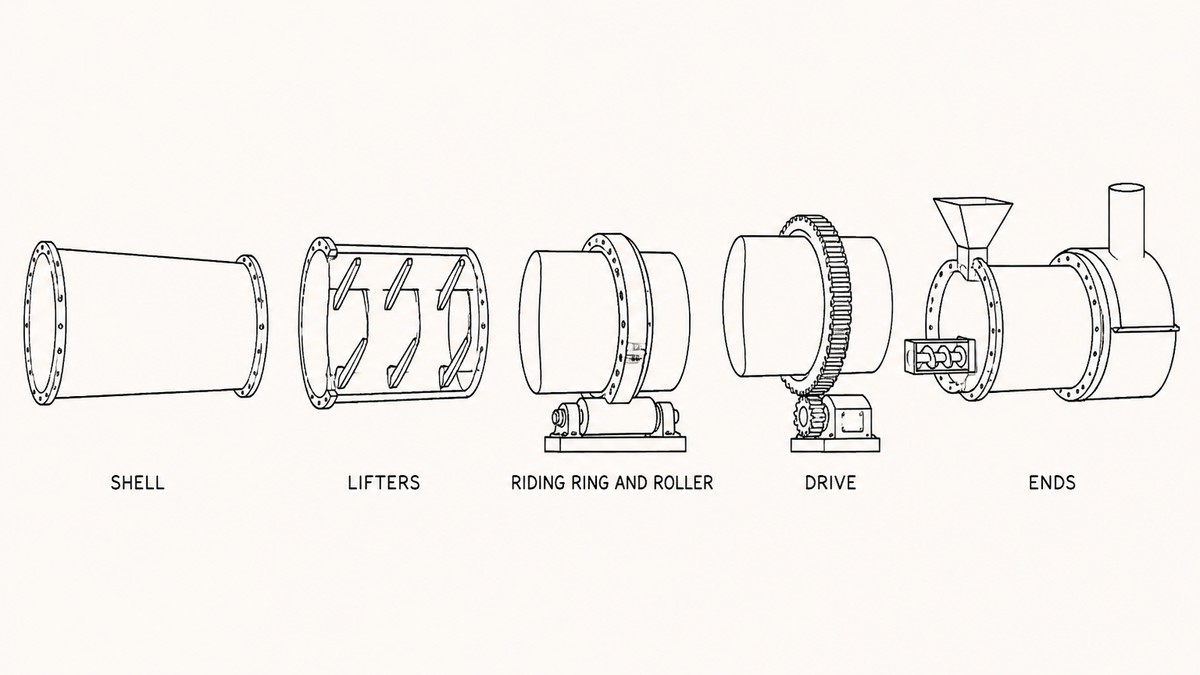
The Five Sections of the Machine
A dryer quotation is long and hard to read because it describes one object in the order the factory happens to think about it. Read against the five sections below and it becomes a checklist, and the empty lines start to show.
- One: the shell
- The drum itself. Plate thickness, diameter, length, material, how the courses are rolled and welded, whether the ends are flanged or dished, and the working slope it is set at. The shell is the largest single piece of steel in the order and the one whose straightness everything else depends on, because a shell that is not round makes every other part fight it.
- Two: the lifters
- The internal blades. Their form, height, count, spacing, thickness and material, and how they are fixed to the shell. They are a small share of the price and the largest share of the performance, and they are the part a factory is most likely to describe in one word.
- Three: the riding rings, rollers and bases
- The rings machined and fitted around the shell, the pairs of support rollers they sit on, the thrust arrangement that stops the drum sliding, and the concrete or fabricated bases under it all. The rings are the reference surfaces for the whole machine, and their face run-out after assembly is the single best measure of whether the shell was built straight.
- Four: the drive
- The girth gear, the pinion, the gearbox, the motor and the coupling between them. It is the section with the longest lead time and the highest chance of being bought in rather than made, so the question of who makes the gear matters commercially as much as technically.
- Five: the two ends
- The feed housing, the discharge housing, the seals between them and the turning shell, the burner and its mount, and the ducts leaving each end. This is the section that is under-specified most often, and it is where most of the arguments at commissioning come from.
Two habits make the quotation easier to read. The first is to ask for a priced breakdown by those five headings rather than one lump sum, because it shows immediately whether the factory makes the shell and the lifters or buys them, and it makes a change order cheap to price. The second is to ask which of the five the factory considers to be its own work and which it subcontracts, and to get the answer before the order rather than at the first problem.
A dryer rarely stands alone. Whatever feeds it and whatever takes the dried product away are chosen against the same kind of specification, and a machine that arrives alone while the screw conveyor that carries the dried product away is still being tendered is a common way to lose a month between arrival and first production.
The Shell, the Lifters and the Material
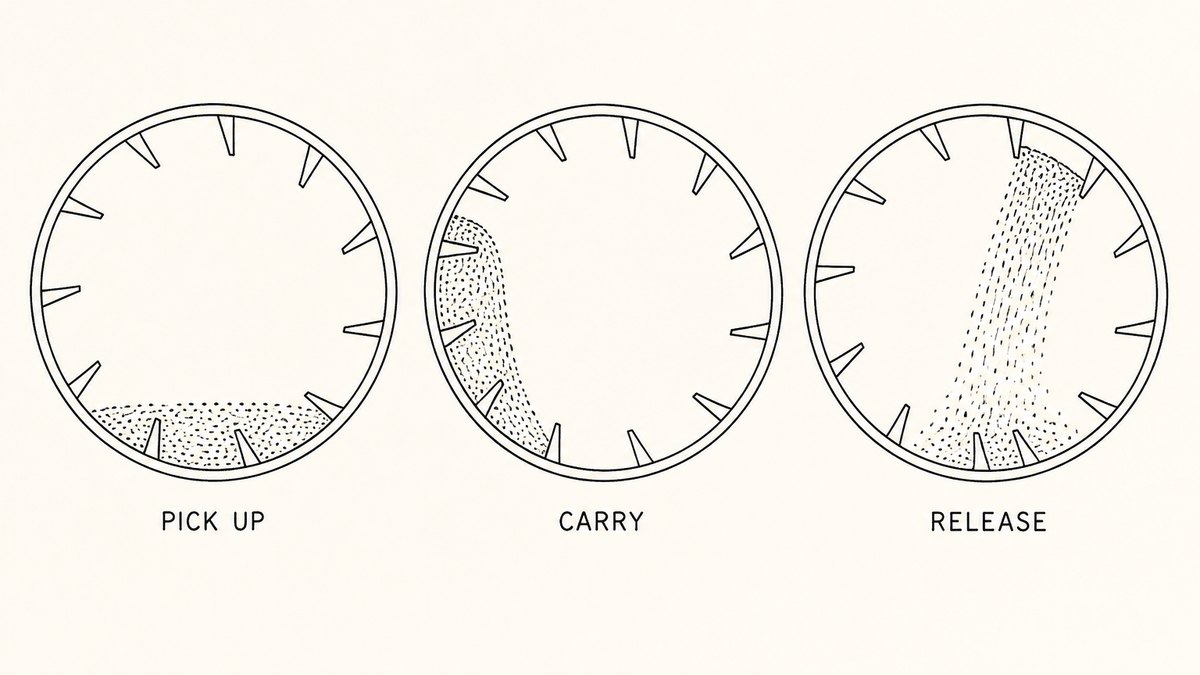
Here is the idea that separates a dryer that works from a dryer that merely turns, and it has almost nothing to do with the diameter. Drying happens on the surface of the material, and the amount of drying a drum gets done in a given length depends on how much surface is exposed to hot gas at any moment. The lifters are what create that surface. Each blade lifts a wedge of material up the rising side of the turning shell and then lets it fall back through the gas stream as a curtain of particles. A drum with the right lifters turns the material over dozens of times along its length. A drum with the wrong ones slides a shallow bed along its bottom, exposes very little surface, and quietly dries at a fraction of the rate it was sold to achieve.
This is why a dryer can pass its no-load test and still fail on the plant. An empty drum turns beautifully whatever is inside it.
The shell. Three questions decide it. What plate thickness, and is it stated as the thickness of the plate as ordered or as the minimum allowed after rolling? What material, and is the grade certified as delivered? And how is the drum straightened after welding, because the welding pulls a long shell out of line and a shell that is not straight will not turn on its rings without being forced. The straightness check is a measurable thing: the finished shell is turned on its supporting rollers or on a temporary set, and the radial run-out of the riding ring faces and the shell ends is read off with a dial indicator and written down. A factory that does this as routine will have a record to show. A factory that does not will describe the drum as true and change the subject.
Slope, length and speed together set the residence time, and the slope is the cheapest of the three to change and the easiest to get wrong on site. A drum set slightly flatter than designed holds material longer, which sounds harmless and is not: it raises the bed depth at the discharge end, raises the torque on the drive, and on a heat-sensitive product it can push the material past the point where it should have left. The slope belongs on the foundation drawing as a dimension with a tolerance, and the installing contractor should be asked to record what it actually achieved.
The lifters. The common forms are worth knowing by name because they behave differently. A straight radial lifter is a flat blade set on the radius, cheap to make and the default choice. A lifter set at an angle to the radius throws material forward along the drum as well as upward, which speeds the material through and is used to stop a wet feed from lying at the feed end. A spiral lifter does the same thing more strongly, and a sawtooth or stepped lifter breaks a bed that tends to slide as one mass. A lifter with a lip or a shelf on its outer edge carries material higher before releasing it, which lengthens the curtain and increases the drying surface per pass.
Three numbers belong on the drawing. The lifter count around the circumference, because it sets how many curtains exist at any moment. The lifter height as a fraction of the drum diameter, because a blade too short cannot lift a deep bed and a blade too tall drops material onto the blade behind it. And the spacing along the length, which in most drums is altered in the first section and the last: a dense pattern near the feed handles the wettest and stickiest material, and a sparser pattern near the discharge stops the dry product from being broken up on the way out. A quotation that gives one lifter description for the whole drum is a quotation written by somebody who has not thought about the moisture profile.
Materials follow the duty. Plain carbon steel is normal for a neutral, non-abrasive material. Abrasive sand or aggregate wears plain steel quickly, and the answer is either a harder plate on the lifter edge, a thicker lifter, or a change of form so the material does not slide along the blade. A corrosive feed needs a stainless grade or a coating, and a food or feed product needs a grade that can be cleaned and that does not leave material trapped in a crevice. The lifters are welded to the shell in most drums and bolted in a few, and bolting is chosen where the lifter must be replaceable without cutting and re-welding inside a drum.
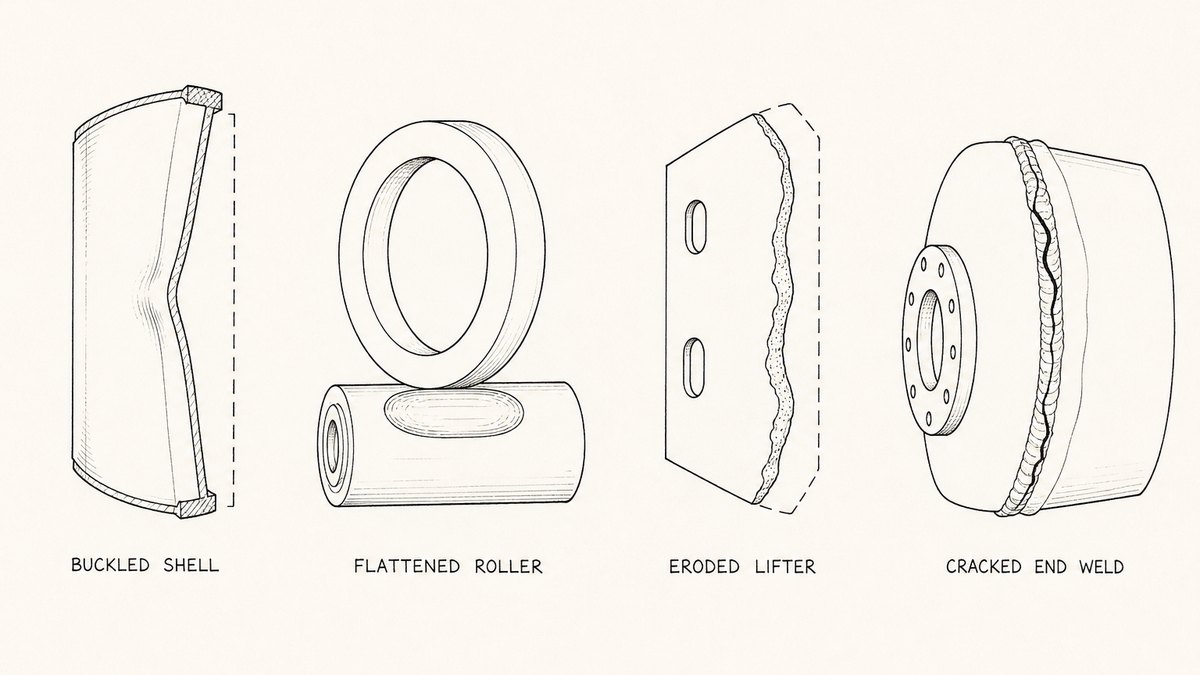
One practical point about wear that buyers discover late: a lifter wears on its leading edge and along its outer corner, so its shape changes rather than its size. After a year of abrasive service the blade is still there and still bolted in, and the curtain it throws is measurably worse. Wear checks on lifters should be a profile measurement at a fixed set of positions, not a visual glance, because the part that has changed is the shape.
The Feed End, the Discharge End and the Seals
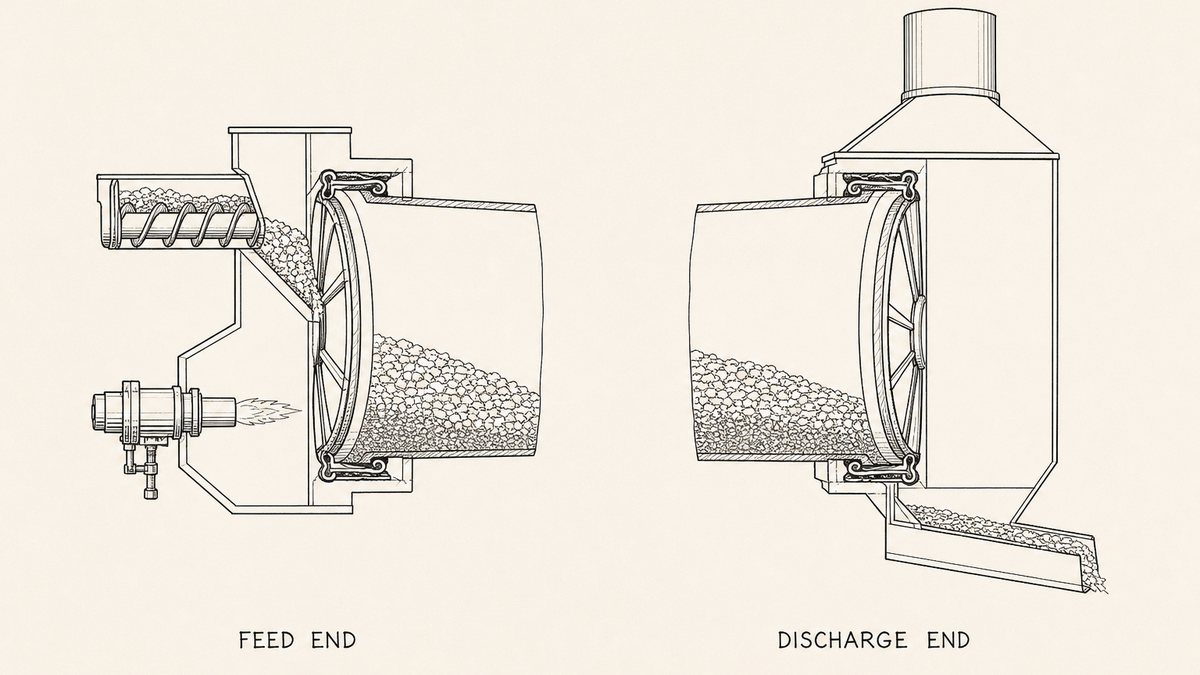
Both ends of a rotary dryer are places where something that turns meets something that does not, carrying a hot gas stream and a dusty product at the same time. Everything difficult about the machine is concentrated in two joints.
The feed end. The material arrives from a hopper, a belt, a screw or a rotary valve, and each choice has a consequence. A screw feeder gives a steady rate and can be sealed against the drum pressure, but it packs and wears on a sticky feed. A chute is cheap and needs the plant layout to deliver the material at the right height and angle, and it is the arrangement most sensitive to a feed that changes. A rotary valve seals the feed line against the drum's pressure and is the usual answer where the dryer runs under a slight negative pressure, because the valve becomes the air seal. Whichever is used, the question to settle at the enquiry stage is what happens when it blocks, because a dryer that keeps turning while the feed has stopped is being run without material to dry and the risk is the drum the plant ends up damaging, not the feeder.
There is a related point which is easy to miss: a screw feeder discharging into a dryer is working against a pressure that a normal conveyor never sees, so the same hardware described for one duty is not automatically right for the other.
The discharge end. The product leaves under the gas hood, and the hood is doing two jobs at once. It has to collect the dry product and guide it into the outlet chute without letting it spill, and it has to gather the exhaust gas and hand it to the duct without starving the drum of its gas flow. The order of those two functions is what usually decides the design, because a hood that favours the product tends to obstruct the gas and a hood that favours the gas tends to let the product catch on ledges and build up.
The seals. Three families cover most dryers, and they are chosen by what the plant can tolerate rather than by what is cheapest.
- Labyrinth seals
- Interlocking rings that do not touch, so there is no rubbing wear and nothing to replace. They leak, deliberately, and the leak is small. They are the usual answer where a little cold air in and a little dust out can be tolerated, and where the plant would rather have a fixed gap than a wearing strip.
- Flexible strip seals
- A strip of spring steel, fabric or rubber bearing lightly against a machined band on the shell, often bolted to the stationary housing as a leaf that can be adjusted or replaced. They leak less than a labyrinth and they need attention, because the strip wears and the load has to be reset. Most dryers use this type at one end and a labyrinth at the other, which is a sensible compromise and worth asking about explicitly rather than accepting whichever type comes out of the factory's standard drawing.
- Packed or purged seals
- A gland with packing rings, or a seal that is fed with compressed air or an inert gas at slightly above the drum pressure so the flow at the gap is always outward. Packed glands suit a plant that already has a maintenance habit around them and are common on older machines. A purged seal is the right answer where the product must not meet air, or where the gas stream must not be diluted, and it is the arrangement that makes an inert-atmosphere dryer possible.
The point to hold on to about all three is that a seal is a controlled leak, not a barrier, and every rotary dryer leaks. A leak at the discharge end is the expensive one even though it is the quieter one, because the drum runs under slight suction and the leak pulls cold air in. That air has to be heated like any other, and it takes capacity away from drying without showing up anywhere as a fault. A dryer that is short on capacity by five percent and has nothing else wrong with it is often a dryer whose discharge seal has opened up.
Two sizes of the same trap deserve their own line. The shell grows in length when it gets hot, by a few millimetres on a short drum and by several on a long one, and something has to give. The seals and the ductwork have to allow for that movement, and a hot gas duct that is rigidly tied to a fixed structure at both ends will find a way to open a joint or crack a flange. This is exactly the problem that the expansion joint in the hot duct exists to solve, and a dryer drawing with no movement allowance in its ducting is a drawing with a commissioning fault built into it.
The Burner and the Air System
The burner is where the dryer's temperature limit is set, which is why it belongs near the end of a sourcing decision rather than at the beginning. Once a ceiling has been agreed, the burner is chosen to sit comfortably under it across the whole range of feed conditions the plant expects, with something in hand for a cold start and a wet batch.
What the burner has to cope with. A gas burner is the simplest to control and the cleanest to operate, and it needs a reliable gas supply at a stable pressure. An oil burner needs a pump set, a heater on heavy grades, atomising air or steam, and a maintenance routine around the nozzle, and it is chosen where gas is not available or where the plant already handles oil. A solid-fuel burner burning pulverised coal or biomass needs a mill, a classifier and a feed system of its own, and it turns the dryer's firing end into a small process plant in its own right. Each of those choices changes the turn-down range, which is the ratio between the highest and lowest firing rate the burner can hold stably, and turn-down is the number that decides whether the dryer can run at half rate on a light day without the flame going out.
The combustion chamber. A direct-fired dryer sometimes fires straight into the drum and sometimes into a separate furnace box or combustion chamber built onto the feed end, and the difference is not decorative. A chamber gives the flame room to finish burning before it reaches the material, which matters because an unburnt flame reaching a wet product leaves soot and a smell that show up in the finished goods. It also gives a place for the ash to settle, which a solid-fuel burner needs. When a chamber is used, it is lined with refractory, and the refractory is a wear part with its own replacement interval, its own cure-out schedule on first firing and its own effect on the dryer's weight and foundation loads. A quotation that includes a combustion chamber should say whether the refractory is included, who installs it, and what the dry-out procedure is.
The air system. Every dryer of this kind is really an air system with a drum in the middle. An induced-draft fan at the far end pulls the gas through, which holds the whole drum under a slight negative pressure and is what keeps dust and flame from escaping at the seals. The gas then passes a cyclone to drop the coarse carry-over, and then whatever final cleaning the plant is required to have: a fabric filter, a wet scrubber, or both. Two details are worth settling because they are easy to leave implicit. The first is who sizes the exhaust train, because a dryer sold without its fan and filter is a dryer that will be matched to whatever the buyer happens to install, and a fan slightly too small quietly caps the dryer's capacity for the rest of its life. The second is where the pressure drop is measured, because the readings across a cyclone and a baghouse are how the plant will know the system is fouling.
The supplier certification that a rule asks for. One detail in this area is written down and worth taking to a factory verbatim. Where a wet scrubber is used on a dryer covered by the mineral industry rules, 40 CFR 60.734 asks for the monitoring devices to be certified, and it says what that means:
“Any monitoring device ... must be certified by the manufacturer to be accurate within 5 percent of water column gauge pressure at the level of operation.”
Read that closely, because it is unusually precise about a commercial duty. It is the equipment supplier who certifies, not the plant. The tolerance is a percentage of the reading at the operating point, not of the instrument's full scale, so an instrument that looks accurate on paper can miss the mark at the pressure the scrubber actually runs at. And the certificate has to be about the level of operation, which means the factory has to know what that level is before it can sign. A buyer asking a dryer and scrubber supplier for a certificate to that wording is asking a fair question that a serious supplier will already know how to answer, and the answer is a useful test of whether the supplier has supplied this class of equipment before.
Behind all of it sits the temperature reading that the whole first half of this article is about. The instrument has to be in the right place, which is where the gas actually mixes and not against the chamber wall; it has to be the right type for the temperature and the atmosphere; it has to be recorded; and it has to be part of a calibration routine. A dryer whose inlet temperature is measured by a dial gauge on the burner panel is a dryer that cannot support a signed statement, and the gap between that and a recorded reading is a few hundred dollars on a very large order and worth far more than that later.
Sizing It: Heat Load, Residence Time and Slope
A buyer does not need to be able to size a dryer to be able to check one. The arithmetic behind a rotary dryer is short, and working through it once turns a quotation from a set of confident numbers into something you can test.
Start with the water and ignore everything else, because evaporation is where nearly all the heat goes.
- Step one: how much water has to leave, per hour
- Take the wet feed rate, work out the moisture on a dry basis, and subtract the moisture the product is allowed to leave with. The difference is the water to be removed. State the basis every time, because this step is where most mis-sized dryers are born. A dryer quoted against a wet-basis figure that the factory treated as dry-basis is working on a different duty from the one you think you bought.
- Step two: the heat that water needs
- Each kilogram of water has to be warmed from its incoming temperature to its boiling point and then turned into vapour, and the second part is much larger than the first. For a rough check, a kilogram of water takes a bit over two thousand kilojoules to evaporate from room temperature, and warm water from a process takes less. The material itself also has to be warmed, along with the air that leaks in, and neither is free. A useful sanity figure is that the heat needed to dry a material is roughly the water load multiplied by that evaporation figure, plus a smaller term for the solids.
- Step three: the fuel that has to be burned
- Divide the heat the process needs by the efficiency of the whole arrangement, which for a direct-fired drum is often around half to two thirds of the heat in the fuel, with the rest going out of the exhaust. That gives the burner output, and the burner output is a number a quotation should state. A dryer quoted for a tonnage without a burner output has left the number out that you can check.
- Step four: the gas volume and the drum
- The burner's heat warms a mass of gas, and the gas volume at the working temperature has to fit through the drum without carrying the product away or lifting the bed. Drum volume then follows from the gas velocity the product will tolerate and the residence time it needs. This is where the lifters come back into the arithmetic: the same drum volume does more drying with more exposed surface.
Three checks are enough to catch most of the trouble, and they take an afternoon.
Check one, the burner against the water. Ask for the burner output in kilowatts or in kilograms of water per hour and compare it with the evaporation the duty needs, allowing for the stated efficiency. If the burner is smaller than the water load can justify, the dryer will be short from the first day and no amount of adjustment will fix it.
Check two, the drum volume against the residence time. A factory's table of standard drum sizes is a real thing, and a dryer is often chosen from that table rather than from the duty. Ask which standard size was used, what residence time it gives at the proposed slope and speed, and whether that is inside the range the factory considers right for this material. If the answer is that the next size up would have been the right one and the price is why it was not chosen, the buyer should know that before placing the order, not after.
Check three, the gas temperature against the ceiling. The dryer's working inlet temperature has to sit under whatever ceiling applies, with margin. A quotation offering an inlet temperature that is comfortably under the ceiling is easier to accept and to certify than one that runs at the edge, and a factory that has understood this will quote it that way without being asked.
Two numbers in a quotation are worth treating as warnings rather than information. The first is an evaporation rate given per square metre or per cubic metre without saying what the drum was filled to, because the same drum has several different capacities depending on the lifters and the filling. The second is a single case temperature with no moisture basis, which tells you the factory is quoting a number it has used before rather than one it has worked out for you.
What to Put in the Specification Sheet
Everything in the previous sections turns into a document, and the document is what the factory quotes against and what the inspection checks. A dryer ordered from a paragraph of email is a dryer that will be argued about. The list below is the shape of a datasheet that a serious factory can quote against and a shipping inspection can be run against.
- Process data
- The material by name and its source; the feed rate; the incoming moisture and the target moisture, both with the basis stated; the temperature of the feed; the bulk density loose and packed; the largest lump size; whether the material is free-flowing, sluggish, sticky, dusty or friable; whether it is abrasive or corrosive; whether it is combustible as a dust; and the plant's ambient conditions for the design day.
- Machine data
- The shell diameter and length; the shell material and the plate thickness stated as a minimum after forming; the slope; the working inlet gas temperature and its ceiling; the evaporation rate the machine is warranted for; the residence time; the total weight wet and dry; and the running speed.
- Lifters and internals
- The lifter form by name; the count around the circumference; the height as a fraction of the diameter; the spacing along the drum and whether it changes between the feed and discharge sections; the thickness and material; and how they are fixed, welded or bolted.
- Drive
- The girth gear size, tooth form and material; the pinion and its material; the gearbox ratio and make; the motor power with the starting condition stated, because starting a loaded dryer takes more than running it; the coupling type; and who makes each of those items and where.
- Ends, seals and burner
- The feed arrangement; the discharge arrangement; the seal type at each end with its material and running clearance; whether either seal is purged and with what; the burner type, fuel and turn-down range; whether there is a separate combustion chamber and whether the refractory is included; and the exhaust train, its fan, cyclone and final cleaning device with the pressure drops.
- Instrumentation and records
- The inlet gas temperature element and its position; how it is recorded and for how long; the calibration interval; the gas outlet temperature; the drum speed; the drive current; and any pressure or flow readings the plant is relying on, each with a stated accuracy.
- Documentation
- A general arrangement drawing and a section drawing with a revision number; a welding procedure and welder qualifications; a material certificate for the shell plate, the rings and the gear; a run-out or straightness record for the finished shell; a bill of materials with makes; an installation and alignment manual; a commissioning sequence including the burner and the refractory cure-out; and a spare parts list with the items the factory considers consumable.
- Inspection and packing
- The inspection that will be carried out before shipment and by whom; the acceptance criteria in numbers rather than adjectives; the surface treatment and painting system with its dry film thickness; how the drum is divided for shipping and where the field joints are; how each section is supported in its transport cradle; and what is protected against sea air.
Two habits make the datasheet do its job. The first is to write the acceptance criteria as measurements: a run-out figure in millimetres, a paint thickness in microns, a clearance as a dimension with a tolerance. An adjective like "true" or "even" is not a criterion and cannot be checked. The second is to get the process data in the same document as the machine data, so that a factory cannot quote a machine against different assumptions from the ones the plant is working to. Writing the order out as a single controlled document rather than as an email thread is the same discipline that putting the process data on a drawing applies to any order from a Chinese factory, and a dryer is a good example of why it matters, because there are so many numbers that a verbal understanding is guaranteed to drift.
What the Rule Asks of a Supplier
Most of what a rule asks of a buyer eventually lands on the supplier, and it is worth collecting those items in one place, because they are the parts of the order that a factory is least likely to offer and most likely to be able to meet if asked.
- A certificate to a stated tolerance
- Where monitoring devices are part of the supply, a certificate of accuracy to the figure the rule names, taken at the operating point rather than at full scale. On a dryer covered by the mineral industry rules that figure is on the scrubber's pressure and flow devices, and the supplier, not the plant, is the one who certifies.
- An instrument that can support a signed statement
- A recorded, calibrated, correctly positioned temperature reading at the point the rule cares about, with a stated accuracy and a log that keeps the period the rule asks for. This is a design item, not an accessory, and it is far cheaper to have designed in than to retrofit.
- A written tune-up procedure
- The interval is written in months in the rule, so the plant has to be able to perform the work on a schedule. What a plant needs from a factory is the procedure: what is checked, what is adjusted, what is measured, what is recorded, and which parts are expected to be replaced. A dryer delivered without that leaves the plant writing its own procedure, which then has to be defensible.
- A statement about which category the machine suits
- Since the rule splits dryers into two types and lets the plant choose, a supplier should be able to say which type the design suits and what it would take to move from one to the other. Two lines in a quotation is enough.
- Drawings under revision control
- Nothing changes without written agreement, including the lifter form, the pitch, and the clearances. A dryer is assembled from a drawing, and a drawing that can be altered quietly during build is how a machine ends up different from the one that was accepted on paper.
- Evidence rather than assurance
- A run-out record, a material certificate, a weld record and a paint thickness reading. Each is a small item of paperwork and the only kind of evidence that survives a dispute, since a supplier's assurance that something was checked cannot be examined.
The shape of this list is worth noting: almost every item is documentation rather than steel. A dryer that meets the rule is not a different machine from a dryer that does not. It is the same machine with a smaller certified envelope and a file of evidence behind it, and the cost difference between the two is mostly in whether those items were designed in at the start.
Sourcing From China: Factory, Trader, and What to Ask
China builds a large share of the world's rotary dryers, and the range of firms offering them runs from a works that rolls its own shells and machines its own rings to a trading company that has one drawing and several suppliers. The difference is not visible in a catalogue and is not always visible in a price. It is visible in the answers to four questions, all of which a real works answers from its own floor.
Question one: how is the shell rolled and how is it straightened? A works that rolls its own shell will describe the plate rolls, the number of courses, the welding sequence, and what it does afterwards to bring the drum back into line, usually rolling the drum on temporary rollers and correcting with local heat. It will also be able to say what run-out it achieves and how it measures it. A trader will describe the finished drum. The follow-up question is the useful one: what is the run-out figure, measured where, and can that record come with the machine?
Question two: how are the riding rings made, and how is the drum turned after they are fitted? Rings are either forged and rolled as one piece, rolled from bar and welded, or machined from plate, and the three are different in price and in how they behave. The important part is not the method but what happens next: the rings are the reference surfaces, so the finished drum is usually turned on them, or on a temporary set, to machine the ends and to check the shell. A works that does this has a procedure and a record. A supplier who has never seen it done will not know what the question means.
Question three: what lifter form is proposed, and is there tooling for it? Ask for the form by name, the height, the count and the spacing, and whether it changes along the drum. Then ask whether the factory rolls and forms its own lifters or buys them in, and whether it holds the forming tooling for the proposed profile. A lifter form that the factory has never formed before is the most common hidden cost in a dryer order, because it is quoted as if it were standard and then produces a first article that does not match the drawing.
Question four: who makes the girth gear, the gearbox and the burner? On most dryers these are the three bought-in items with the longest lead times, and a factory that is honest about this will name its suppliers and give lead times. A factory that claims to make all three should be asked to show where. The answer matters because the lead time of the gear alone can set the delivery date of the whole machine, and because a buyer who knows the gear make and model can check its service record anywhere in the world.
Then the commercial half, which is short. Ask what the factory makes in house and what it buys, because it decides where quality risk sits. Ask for the lead time broken down by item rather than as one figure, so that a slipped gear can be seen coming. Ask whether the factory will turn the finished drum on its rollers for a witnessed check before it is packed, since this is the one test that cannot be done after the machine is in pieces on a ship. Ask how the drum is divided for shipping and what the field joints are, because a twenty-metre drum travels in sections and the joints become the buyer's problem on site. And ask what happens if the shell arrives out of round, which is the question that tells you most about how a supplier behaves after the money has moved.
On a first order from a new factory, the answer to the last question is worth backing with a step rather than a promise. A first article on the shell and the lifters, approving the first shell section off the line before the rest of the drum is built, catches a forming or rolling error while it is still cheap to correct. A works that resists this is a works that has not done it before.
Inspection Before Shipment, and Acceptance on Site
A rotary dryer has one great advantage for a buyer, which is that almost everything about it can be measured while it is still in the works. A shell is round or it is not, a drum turns true or it does not, and a gear either makes contact across the tooth or it does not. None of that needs a running plant. It needs a dial indicator, a feeler gauge, a tape and somebody who will write the numbers down. This is the inspection that pays for itself many times over, and it is worth running against the datasheet rather than against a general idea of quality.
Before shipment. Seven things are worth measuring or witnessing, in roughly the order of the trouble they cause.
- The shell diameter and roundness
- Measured at several stations along the length and at more than one angle at each station, because a shell can be round at the ends and slightly oval in the middle and behave badly. Written down as measured values, not as a pass.
- The run-out of the finished drum
- With the drum turned on its riding rings or on a temporary set, the radial and face run-out of the ring faces and the shell ends is read with a dial indicator. This one measurement is the best single test of the whole drum build, because it catches rolling, welding and machining errors together. Ask for it before and after the rings are fitted if the factory will do both.
- The lifters
- The form against the drawing, the height, the count around the circumference and the spacing along the drum, and the weld quality at the foot of each blade. Lifters are the part most likely to differ quietly from the drawing, and the difference is invisible once the ends are closed.
- The girth gear and the pinion
- The tooth contact pattern after the gear and pinion are set up, the backlash, and the condition of the bolted joint between the gear and the shell. Contact that sits at one end of the tooth rather than across the middle is a gear that will wear fast, and it is set at the works, not on site.
- The riding ring and roller contact
- How the ring face sits on the roller across its width. Contact across the full width is right; a ring riding on one edge of its roller is a machine that will wear its rings and knock its own alignment out.
- The seals, and the clearance they run at
- The seal type against the order, the material, and the running gap measured rather than described. Since a seal is a controlled leak, the gap is the specification, and a seal fitted with no measurable clearance is a seal that will burn or rub.
- The paperwork that supports the machine
- The material certificates, the weld record, the run-out record, the paint thickness readings and the drawing revision actually built to. This is the half of an inspection that a buyer new to the job forgets, and it is the half that matters most two years later. Checking it before it is loaded costs a day of somebody's time; discovering on site that the shell plate was not the grade ordered costs a drum.
Two practical points about how the inspection is run. First, ship in sections and inspect in sections, because a dryer that is inspected assembled and then cut up for transport has not really been inspected. Second, have the numbers written into a report with the instrument identified, since a report of measured values is evidence and a report that says the drum was checked is not. On site, the acceptance checks are different and mostly about alignment: the base levels, the roller positions and skew, the ring contact after the drum has been set down, the seal gaps, and the freedom of the drum to move as it heats. The plant should also record the slope it achieved, because it will never be easier to measure than on the day the foundations are finished.
Failure Modes, and Which Side Each One Is on
When a rotary dryer disappoints, the argument that follows is usually about whose fault it is rather than what happened, and the argument is much easier to settle on evidence than on memory. Most of the common failures leave a signature, and the signature usually points at one side or the other without needing an opinion.
It is worth being clear about what the two sides mean. Supplier-side failures are things that were wrong when the machine left the works: a shell that was not round, a lifter form that differed from the drawing, a gear set up on one edge of the tooth. Plant-side failures are things the machine was asked to do something it was not bought to do: a feed wetter than the agreed limit, a burner pushed past the temperature it was certified under, a drum started full of material that had set solid over a weekend. Between them sits a third group, where the machine was right and the duty was different from the one described, and that group is the one worth spending time on at the enquiry stage because it is the only one that a good datasheet can prevent.
Six Symptoms and Which Side Each One Is on
| The symptom | What the evidence looks like | Whose side it is on |
|---|---|---|
| Capacity short from the first week | A recorded run-out and lifter dimensions that match the drawing, with the feed moisture above the agreed figure | Plant side if the feed is wetter than agreed; supplier side if it is not, and the burner or drum volume is below the duty |
| Product leaving too wet at the discharge | Drum turning true, gas temperature at or under the ceiling, residence time shorter than the datasheet | Supplier side if the slope or the length was changed without agreement; plant side if the feed rate was raised |
| A bright rubbed band inside the shell on one side | A band that runs along one generator of the drum rather than all the way round | Supplier side: the drum is not straight or the rings are not concentric, and it has been running forced |
| The drive tripping on start-up | Trips when starting a drum left full, no trip once running | Plant side if the drum is routinely left full; supplier side if the drum binds when empty |
| A riding ring or roller worn into a flat | A flat spot on the roller with a matching scar on the ring, and contact only on one edge | Supplier side: the roller was set up out of line at the works or the base was not aligned to the drawing |
| The inlet temperature drifting above the ceiling | A log showing excursions above the certified figure, usually on a wet feed or a cold start | Plant side if the burner was pushed; supplier side if the burner has no stable low-fire and cannot be held under the limit |
Two of these deserve a longer look because they are the expensive ones. The rubbed band inside a shell is the classic result of a drum that has been running out of line, and it is the fault that starts as a noise and ends with a shell that has to be re-rolled or replaced. It is also the fault that is easiest to prove, because the band is on one generator and the run-out record is in the file.
The temperature excursions are the other one, and they are the reason a recorded instrument matters more than a good burner. An excursion does not usually break anything on the day. What it does is put the plant's own signed statement in question, and that is a problem the plant cannot pass to anybody else, because the signature is its own. The remedy is a burner that can be held at a low fire without going out, an interlock that cuts the firing when the feed stops, and a log that shows the limit was respected. All three are cheap at the ordering stage and awkward afterwards.
Price, MOQ and Lead Time: What Actually Moves the Number
A rotary dryer is priced largely by weight and by the handful of items inside it that carry a brand. Everything a buyer can do to control cost sits in those few places, and most of the rest of the price is arithmetic that no negotiation will move.
What moves the price up or down.
- The steel in the shell
- Diameter, length and plate thickness together decide the largest single cost item. Plate thickness is the one that gets quietly reduced to win an order, and it is the one to specify as a minimum after forming rather than as the thickness of the plate as ordered, because a negative rolling tolerance can take a millimetre off every plate on a large drum.
- The shell and lifter material
- Carbon steel is the baseline. Stainless for a corrosive or food-grade duty can multiply the shell cost several times over, and hardfacing the lifter edges is a smaller and more targeted spend. Where the duty is abrasive, hardfacing the lifters usually buys more life per pound spent than upgrading the whole shell.
- The riding rings
- A ring rolled from a single billet and a ring welded up from bar both work and are priced differently. The forged and rolled ring is stronger and dearer, and on a large drum the difference is a real part of the quotation.
- The girth gear and the gearbox
- The two bought-in items with the longest lead times and the widest range of price. A named European or Japanese gearbox and a domestic one differ in cost, in delivery and in what the plant can get serviced locally. This is the place where a buyer can choose a cheaper option and understand exactly what they are trading.
- The burner and the combustion chamber
- Fuel type, turn-down range, whether a chamber is included, and whether the refractory is in the scope. A solid-fuel burner has a feed system and a mill attached to it and is a different order of cost and complexity from a gas train.
- The exhaust train
- The fan, the cyclone and the final cleaning device. A dryer quoted with no exhaust train is not cheaper, it is incomplete, and the buyer pays for it later with less choice.
- The seals and the instrumentation
- A labyrinth versus a purged seal is a small line in the quotation and a large line in the running cost. The recorded, calibrated temperature instrument is a few hundred dollars on a large order. Both are the cheapest quality in the whole machine.
- The paint system and the documentation
- A two-pack epoxy system to a stated dry film thickness, and a file of certificates and records. Both look like overhead and both are what keeps the machine alive on a coastal site and defensible in a dispute.
Minimum order and lead time. The minimum order for a rotary dryer is normally one machine, so there is no quantity minimum to clear. What quantity changes is the sections: a plant ordering two drums of the same size gets its forming tooling, its drawings and its transport cradles amortised, which is a real saving on the second unit. Lead time is where the money actually gets made or lost, and it is worth asking for it broken down rather than as one number. The steel and the fabrication usually run a few weeks to a couple of months, the girth gear and the gearbox are often the longest single items, and the burner can be close behind. Painting, packing and the transport of a drum that has to be divided into sections add time at the end, and sea freight from China to a distant port is measured in weeks rather than days. A quotation that gives one delivery figure is hiding where the risk is; a quotation that says the gear is the constraint is telling the buyer something useful.
Questions Buyers Ask
How much does a rotary dryer cost?
There is no useful average, because the price follows the shell weight and the drying duty rather than the size written on the drawing. Two drums of the same diameter and length can differ by a large multiple if one is carbon steel with plain lifters and the other is stainless with a solid-fuel combustion chamber and a named gearbox. What a buyer can do is ask for a priced breakdown by the five sections, which turns the total into something comparable between quotations. The items that move the number most are the shell plate weight and thickness, the shell material, the riding rings, the girth gear and gearbox make, and whether the burner and the exhaust train are inside the scope at all. A quotation that is much cheaper than the others is nearly always cheaper because one of those items has been reduced or left out, and finding out which is the whole job.
What usually goes wrong with a rotary dryer?
Four things cover most of it. The drum runs out of line, which shows as a bright rubbed band inside the shell along one side and comes from a shell that is not straight or rings that are not concentric. The capacity is short, which is usually a drum selected from a standard table against a duty that needed the next size, or a feed wetter than the moisture the dryer was quoted against. The lifters wear out of shape, which does not stop the machine but quietly reduces the drying surface it can create. And the temperature limit is exceeded, which breaks nothing on the day and puts the plant's own signed statement in question. Of the four, the first two are worth inspecting for before the machine is shipped, because both are measurable in the works and expensive to correct afterwards.
Is there a legal limit on the inlet temperature?
For one large class of plants, yes, and it is a rule rather than a recommendation. Where a wood products source runs a dry rotary dryer, the federal rule sets the inlet moisture at no more than 30 percent on a dry basis and the dryer inlet temperature at no more than 600 degrees Fahrenheit, and it asks for thirty days of recorded running and a signed statement by a responsible official that the dryer will stay inside both limits in future. Other industries answer to other rules with their own figures, and many dryers are under no such limit at all. What matters for a buyer is not which rule applies but whether the plant has signed anything, because a signed limit turns the temperature into a design constraint on the burner, the air system and the instrument.
How do I choose between direct and indirect firing?
By asking whether the product may meet combustion gas. If it may, direct firing is cheaper, more efficient and can reach higher temperatures, and it is the normal choice. If it may not, because of what the product is for, because the plant handles a solvent, or because the exhaust is regulated, the burner has to be confined to a tube or a furnace box and the product kept in the annular space around it. Indirect firing costs more to run because less of the heat reaches the material. The choice should be settled before the enquiry goes out, because it changes the burner, the gas path, the seal arrangement at both ends and the price, and a factory that is asked to quote both will usually quote the one it prefers to build.
How long should the material stay inside the drum?
Long enough for the heat to reach the middle of a lump and short enough that the surface is not dried past the point the product needs. The figure is set by the drum length, the slope, the running speed and the lifters, and it should appear on the datasheet because the plant cannot measure it and the supplier can. What makes it worth pinning down is that it is not fixed once the drum is ordered: raising the feed rate shortens it, changing the slope changes it, and a wetter feed means the same residence time does less drying. A supplier who gives a residence time and says what it was calculated for has done the work. One who gives a drum size and no residence time has left the buyer to find out in production.
How do I check a dryer quotation before I place the order?
Four checks, all short. Ask for the moisture figures with the basis stated, and check that the factory used the same basis you did. Ask for the burner output, and see whether it is consistent with the water that has to be evaporated at the stated efficiency. Ask which standard drum size was used, what residence time it gives and whether the next size was considered. And ask which of the five sections the factory makes and which it buys, with lead times for the bought items. If those four answers are consistent and written down, the quotation is worth working with. If any of them cannot be answered, that is the finding, and it is far cheaper to find it before the order than after the drum has been built.
Send the moisture basis and the ceiling — the diameter and length are not enough
Tell us what has to be dried, then the numbers that decide whether the machine can be accepted: the material and its source; the feed rate; the moisture in and the moisture out, each with the basis stated as wet or dry; the feed temperature; the loose and packed bulk density; the largest lump; whether the material is free-flowing, sticky, dusty, abrasive or corrosive; and whether it is combustible as a dust. Then the process limits: the inlet gas temperature you can run at, the ceiling you have to stay under and who signs for it, whether the plant has agreed a category for the dryer, and whether the burner must be direct or indirect. Then the machine: drum diameter, length, shell material and minimum plate thickness after forming, the working slope, the lifter form by name with its height, count and spacing, the riding ring construction, the girth gear and gearbox make, the motor power with the starting condition, the seal type at each end with its running clearance, and whether the exhaust fan, cyclone and final cleaning device are inside the scope. Add the records you will need: a run-out or straightness record for the finished shell, material certificates, a weld record, a paint thickness reading, a datasheet with a revision number and no changes without written agreement, a first article on the shell and the lifters before the rest of the drum is built, and packing that supports every section in its own cradle for a sea crossing.
Request a Rotary Dryer Sourcing Quote
Questions & Comments
We read every one and reply within 24 hoursMost rotary dryer arguments come down to two numbers that were never written down: the moisture basis the dryer was sized on, and the inlet temperature the plant has signed for. Tell us both, and we will pin them down before the order.