
Forklift Fork Manufacturer: Sourcing Forks and Attachments From China
 ·
Updated October 12, 2026
·
25 min read
A forklift fork is bought on length and capacity, and it is condemned on neither. What condemns it is the heel — the thick corner where the blade turns up into the shank — which wears thinner every day the truck works, is where every crack starts, and is the only part of the fork the people who inspect these things for a living actually look at. Two other things decide whether the fork is even allowed on the truck: the hook profile, which has to match the carriage or the fork will not go on at all, and the load centre, which is the distance forward from the carriage to the middle of the load and which reduces the fork's real capacity the moment it grows. There is also a federal rule that most buyers have never read, and it says something blunt about attachments: a fork or an attachment that changes capacity must not be modified or fitted without the truck manufacturer's written approval.
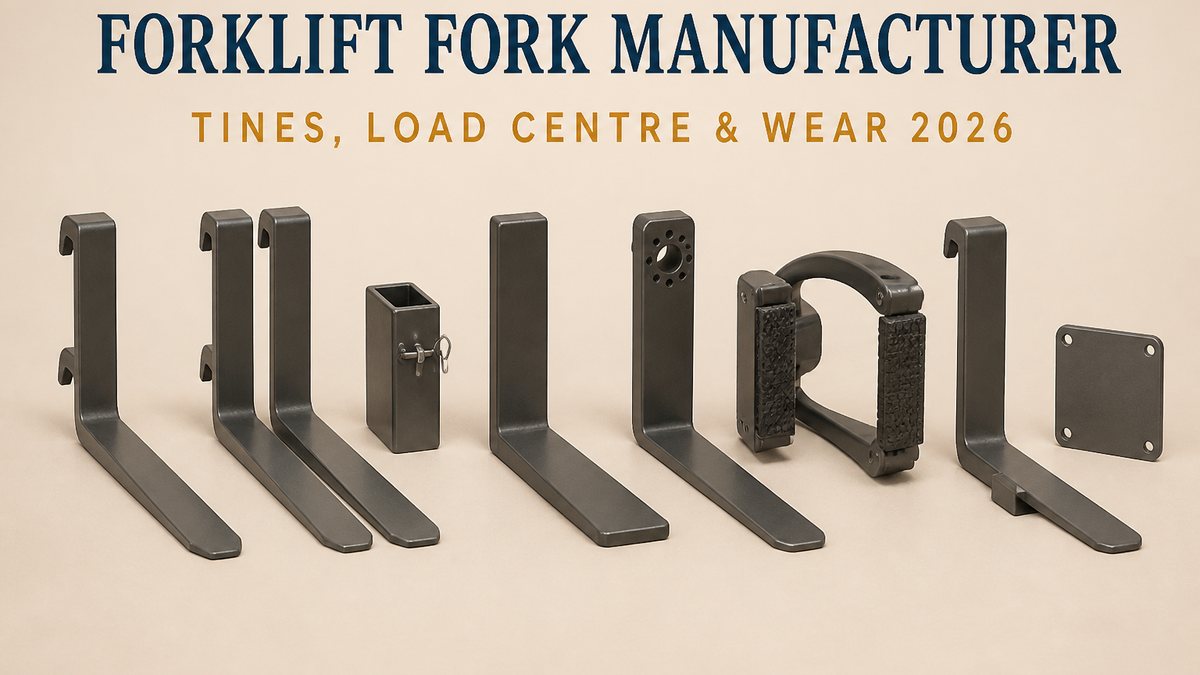
Six Lines That Decide Whether a Fork Order Is Complete
| What the buyer has to settle | Why it is not obvious | The line on your order that closes it |
|---|---|---|
| The hook profile, or class | A fork of the wrong class will not go onto the carriage at all, and nothing else about it matters | The class, or the hook dimensions measured off the truck |
| Length and rated capacity | Capacity is quoted at a stated load centre, and a longer fork moves the load centre forward | Length, capacity and the load centre both figures apply to |
| Whether the pair is matched | One new fork beside one worn fork loads the new one harder and lifts the load crooked | Forks supplied as a matched pair, marked with a pair number |
| What the truck will actually lift | The fork capacity and the truck capacity are two different numbers, and the smaller one wins | The truck's own data plate, checked against the load centre in use |
| Whether an attachment is involved | An attachment adds its own weight forward of the carriage and changes the rating of the truck | The attachment weight and its load centre, in writing |
| What the rules require you to do next | A fork is examined before every shift, and a modification needs written approval from the truck maker | An inspection routine and a documented approval before any alteration |
What a Forklift Fork Is, and the Words Around It
A forklift fork is a steel cantilever. It is fixed at one end, to the carriage at the front of the truck, and it carries the whole load at the other end, in mid air, with nothing underneath it. Everything about the part follows from that one fact: it has to be thick where it is fixed, it can be thin where the load is, and the place where it changes from one to the other is where it eventually fails.
Six words describe the part, and getting them right matters because they are the words on the drawing, on the data plate and in the conversation with the factory.
- Fork, tine and blade
- The whole part is a fork or a tine, and the two words mean the same thing. The blade is the horizontal part that the load sits on, and the tip is the far end of it, which is tapered thin so that a pallet can be slid on without being lifted. Where somebody says tines, they are usually talking about a pair, and it is worth knowing that a pallet truck has forks of a different and much lighter kind.
- The heel
- The thick corner where the blade meets the shank, and the most important piece of metal on the whole part. Every load the truck carries puts its bending force into that corner, and every drain on the truck's life shows up there. It is the part that wears, the part that cracks, and the part an inspector measures. A fork is not condemned for being old; it is condemned for having a thin heel or a crack in one.
- The shank and the hooks
- The shank is the upright part at the back that sits against the carriage. It carries two hooks on a hook-type fork: a top hook that takes the load and a bottom hook that stops the fork swinging out when the load is picked up. The hooks are what make a fork removable, and their profile is what makes one fork fit one truck and not another.
- The carriage
- The frame on the front of the truck that the forks hang on, which runs up and down the mast. It is part of the truck, not part of the fork, but its hook spacing is what decides which forks you can buy. This is why a buyer who orders forks without knowing the carriage will usually end up with a pair that does not fit.
- Class
- The size band a fork's hooks belong to. Two trucks of very different size can take forks of the same class, and two trucks of similar size can take different ones, so class is the number to quote and never the truck's make or capacity. The dimensional detail sits in an industry standard that is sold rather than published free, so the practical way to establish a class is to measure the hooks on the fork you are replacing.
- Load centre
- The distance from the front face of the fork blade to the middle of the load, measured horizontally. It is the figure that decides how much the fork can actually carry, because the further out the load sits, the more leverage it has. A fork rated on a short load centre loses capacity as soon as the load centre grows, and this is the single most misunderstood number in the whole subject.
One boundary is worth drawing at the start, because it changes who you buy from. A fork is a simple forged or rolled steel part with no mechanism in it, and it is made by a forge or a specialist steel mill. An attachment is a machine — a clamp, a spreader, a rotator, a push-pull — with hydraulics, bearings and its own data plate, and it is made by an attachment manufacturer. They are sold together constantly and they are not the same order. A factory that forges forks almost never builds clamps, and the price a fork factory gives you for a clamp is a price for something it will buy in.
Hook Profiles and Classes: the Line That Decides Whether It Fits
Before length, before capacity and before price, a fork has to physically hang on the carriage. That is decided by the hooks, and the hooks are described by a class.
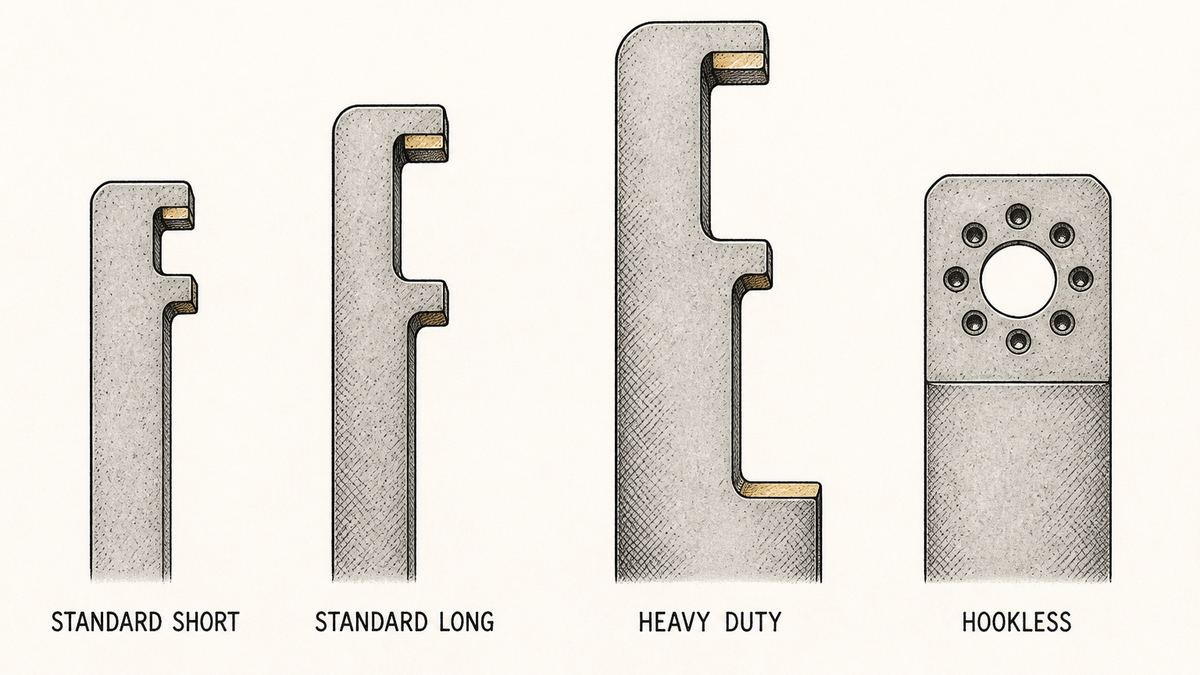
The classes run in bands from the small trucks up to the very large ones, and each band has its own hook shape and its own spacing between the top and bottom hook. The numbers themselves come from an industry standard that is sold rather than published, so this article does not reproduce the dimensions. What a buyer needs is the practical rule: the class is written on the fork, and if it is not, it is measured off the fork you are replacing. Measuring is done with a rule across the hook, and it takes less time than reading this paragraph.
Three things follow from that, and each one has cost somebody a shipment.
Two forks can be the same length and the same capacity and still not be interchangeable. Length and capacity are the numbers buyers compare, and they are the numbers that have nothing to do with whether the fork fits. A pair of perfectly good forks of the right length and rating will sit on the floor next to the truck if the class is wrong, and the only way to know is to have the class right on the order.
A fork from a heavier class will not fit a lighter carriage. The instinct is that a bigger, stronger fork is a safer fork, and on a truck whose carriage takes a smaller class it simply does not go on. Going the other way — a lighter-class fork on a heavier carriage — is worse, because it can be made to sit there while being loaded beyond what its hooks were built for.
Shaft-mounted forks are a different family and are not a class question at all. On some trucks, particularly reach trucks and a good many electric models, the forks are not hung on hooks. They slide onto a shaft that passes through a bore in the shank, and they are retained by a pin or a bolt. Those forks have no hooks and no class in the hook sense; they have a bore size, a shank width and a bolt pattern. If your truck is one of those and you order a hook-type fork, you will get a fork with two hooks on the back of it that has nothing to hang on.
One more identification point saves a lot of arguing. A fork is normally marked with its capacity, its length, its class and its manufacturer, either stamped into the shank or on a tag, and a pair is normally marked so that the two halves can be identified as belonging together. Look for those marks first whenever you are asked to match a fork. A fork with no marking at all is a fork nobody can rate, and no honest factory will quote you a replacement for it without the class being established another way.
The Parts of a Fork, and Where It Wears
A fork has fewer features than almost any other thing on a truck, and every one of them has a job. Knowing the names is what lets you read a quotation critically, because a fork drawing is mostly a set of dimensions and the dimensions are named after these features.
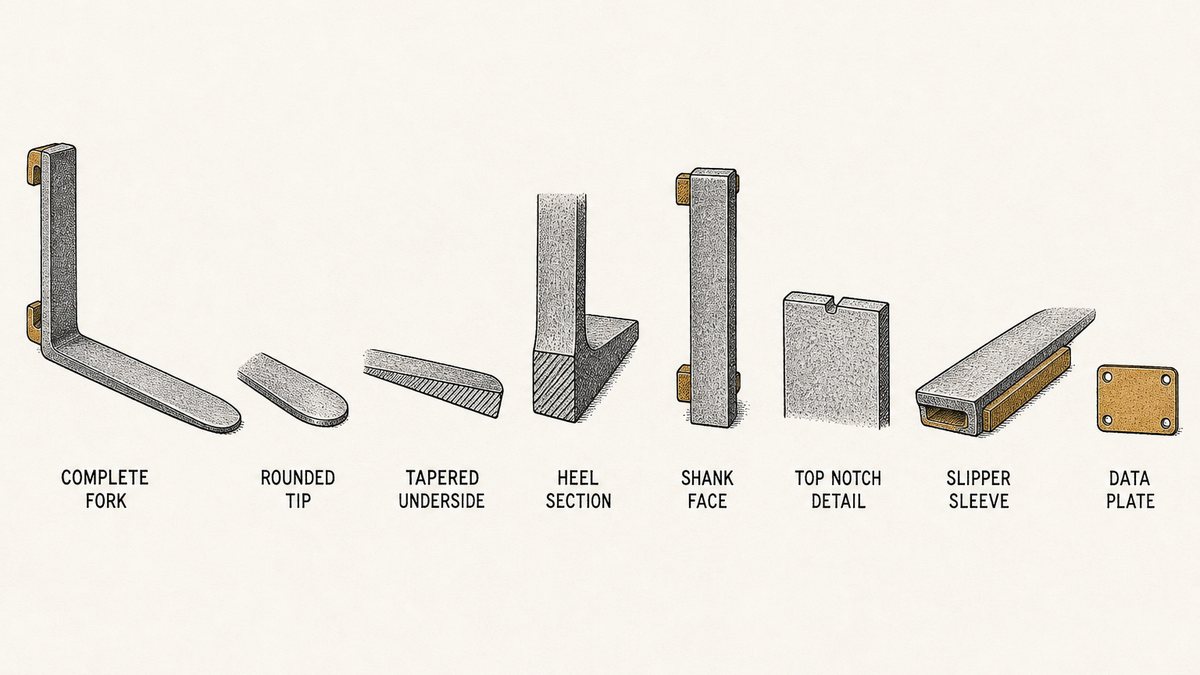
The blade is the part that carries the load, and it is thick at the heel and thin at the tip. The taper is not decoration: a pallet with a closed bottom has to be entered by a blade that is thin enough to slide into the gap, and the load only sits on the blade once it is most of the way on. That is why the taper runs along the underside and why the top face of a good fork is flat along its whole length.
The tip is the first part to be damaged and the last part to matter. A tip worn blunt makes a pallet harder to enter and is a sign of a hard life, but it does not affect what the fork can carry. Tips get worn off on concrete, on rough yard surfaces and by drivers using the fork as a scraper.
The heel is the thick corner and the part that decides the fork's fate. Bending force from every load is concentrated there, and it is where the metal is both thickest and most worked. A heel wears from the underside as the blade scrubs on the ground and on pallet edges, and it wears from the top as loads are dragged across it. Both types of wear reduce the thickness of the section that is resisting the bending, so a heel that has quietly lost a tenth of its thickness has lost more than a tenth of its strength. This is why the rule an inspector follows is about the heel section and not about the fork's age.
The shank is the upright part that sits against the carriage, and its whole job is to transfer the load's bending force into the carriage. It is usually the thickest part of the fork, and it is also where a fork gets bent, because a shank that is pushed sideways or dragged through a racking leg takes a permanent set.
The top hook and the bottom hook are the two lugs that hold the fork onto the carriage. The top hook is the load-bearing one and sits in the carriage's upper recess. The bottom hook is the anti-swing one: without it, picking up a load at speed would let the fork tip forward out of the carriage. Hook wear is the quiet fault of the whole part, because the hooks are hidden behind the carriage, nobody looks at them, and a worn top hook lets the fork sit at a slightly wrong angle forever, which tilts every load the truck carries. If you want to understand how a fork is meant to be held, the same principle of a lug seated fully home in a shaped recess applies to almost any loaded bracket, and the castors that carry carts around a warehouse are a good comparison, which is what this guide to the casters that carry it covers.
The fork marks are the shallow notches or stamped characters on the shank and sometimes on the blade. They are the fork's identity: capacity, length, class and maker. A fork whose marks have been ground off or welded over cannot be rated, and in a serious inspection that alone is enough to take it out of service.
The slipper or extension sleeve is not part of the fork. It is a hollow steel sleeve that slides over the blade to make it longer, and it is the cheapest way to reach further with a truck you already own. It is also the most misused accessory in material handling, because it puts the load further out without changing anything else, and the section below on load centre explains what that does. One detail about it belongs here, in the components section: a slipper has to be retained, usually with a pin through a hole near the inner end, or it will slide off the blade at the worst possible moment.
Load Centre and Rated Capacity: Why a Longer Fork Carries Less
This section is the one that decides whether a fork is safe on your truck, and it is the section most often skipped, because the arithmetic is invisible until the truck is already tipping.
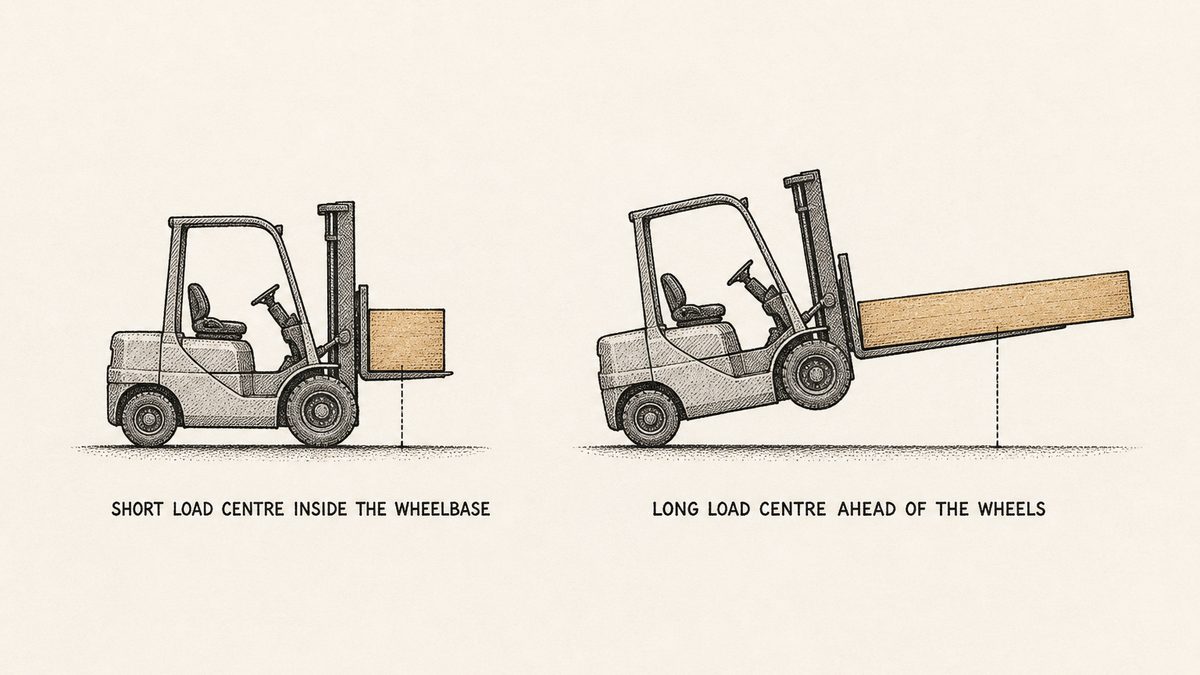
The rule that governs forklifts in the United States defines load centre in one sentence: it is the horizontal distance from the load's edge — or from the fork's or attachment's vertical face — to the line of action through the load's centre of gravity. In plain words, it is how far out from the front of the blade the middle of the load sits.
That distance is a lever. A load 600 mm out from the carriage pulls the truck forward twice as hard as the same weight sitting 300 mm out, and the fork bends twice as much, and the front wheels carry twice as much. Everything about a forklift's stability comes down to where that line of action falls relative to the wheels.
Capacity figures are therefore quoted at a stated load centre, and the stated load centre is a short one, because that is what a standard pallet gives you. Three consequences follow that a buyer has to hold on to.
Putting the same load on a longer fork reduces the capacity. If a pallet is 800 mm deep and sits on a 1,200 mm fork, the load will normally be pushed back against the carriage, and the load centre stays short. But if the load cannot be pushed back — because the pallet is deep, because it is a long crate, because there is a wall in the way — the load centre grows, and a fork that was comfortably inside its rating now is not. Buying a longer fork to reach further is exactly the decision that moves the load centre forward.
A fork extension slipper makes the problem worse in two ways at once. It adds its own weight out on the blade, and it moves the load further out, so it eats into capacity from both directions. A slipper is a legitimate tool and it is used every day, but it must come with a reduced capacity figure, calculated for the extended load centre, and that figure should be marked or documented. Treating a slipper as free extra length is how trucks tip.
The truck's rating and the fork's rating are two different numbers, and the smaller one governs. A fork may be rated for more than the truck can lift, in which case the truck is the limit. A fork may be rated for less, which is more dangerous because it is the fork that bends rather than the truck that refuses. The truck's own data plate states the load it can carry at a stated load centre and with stated attachments, and that plate is the authority for the whole assembly. If the load centre in real use is longer than the one on the plate, the safe load is less than the plate says, and that has to be worked out rather than hoped about. Storage layout has a lot to do with this, since a deep pallet position that forces the load further out is a racking decision as much as a fork one, and the rack beam depths and clearances that create those situations are covered in this guide to pallet racking.
There is one more number worth putting in the specification, and almost nobody does: the load centre the fork is to be rated at. A fork manufacturer can rate the same forging at more than one load centre, and the number that ends up on the fork depends on what the buyer asked for. If you are replacing a fork on a truck that lifts a specific product with a specific load centre, say so, and ask for the rating at that distance rather than at the standard one.
The Types You Will Be Quoted, and What Each One Is For
Forks come in a handful of forms, and the differences are about the material being handled rather than about the truck. A quotation that offers one form for all five of the jobs below has not read the enquiry.
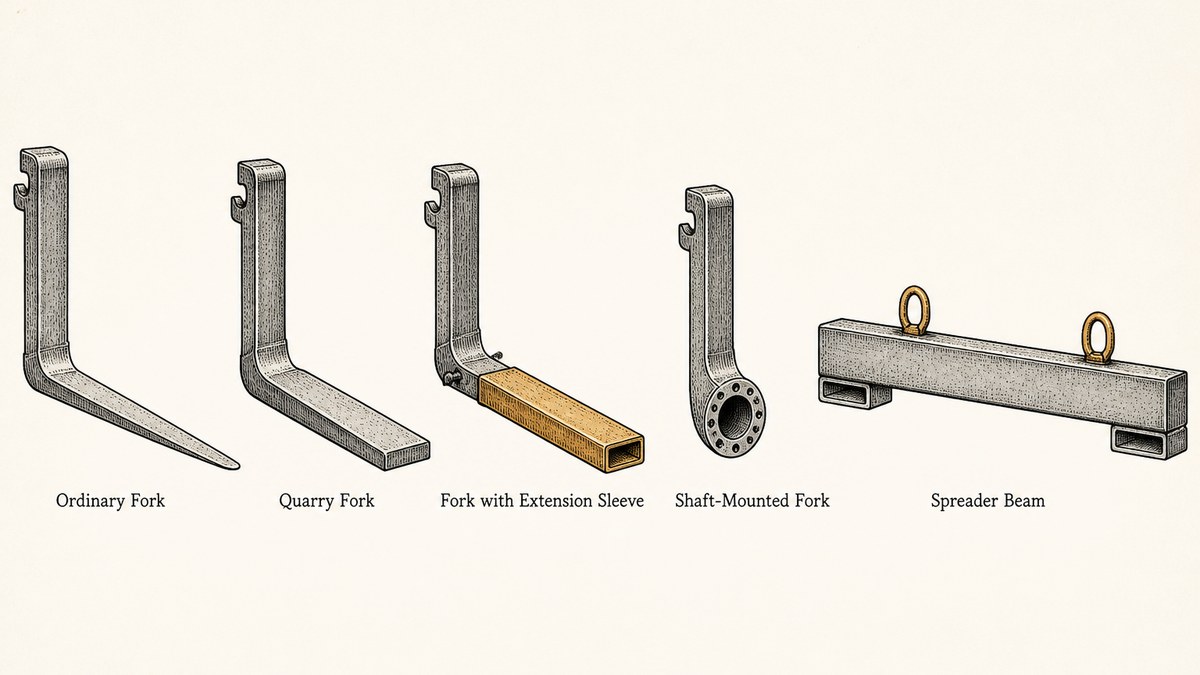
An ordinary tapered fork is the default. It is designed for pallets, and its thin tapered tip is the whole point of the design. Against anything else it is the wrong tool.
A quarry or whole-tine fork is a heavy blade with a blunt tip that does not thin out along its length. It exists for lifting blocks, kerbs, stone and rough material where the load is picked up from the side or underneath and never has to be slid into a pallet. If you buy these for a warehouse they will be hard to get under a pallet, and if you buy ordinary forks for a quarry the tips will be destroyed in a month.
A fork with an extension slipper is a standard fork with a sleeve fitted, and it is the answer when the reach needed is occasional. It is not the answer when the reach needed is permanent, because a purpose-made longer fork is stronger and lighter than a standard fork with a sleeve on it. The temporary one is the one that gets treated as permanent, which is why the capacity reduction matters.
A shaft-mounted fork is the pin-type fork already described, and it is a different order in every respect: no hooks, a bore, a shank width and a bolt pattern instead of a class.
A spreader beam or a fork-mounted lifting device is the fifth item in the picture and it is not a fork at all. It is a beam that goes on the forks and picks up a load, often one that must not be squeezed, such as a coil, a long pipe, a bundle or a boat. These devices are where the rule described later in this article bites hardest, because a device that hangs on the forks changes the geometry of the lift and the rating of the truck, and it has to be designed and approved as such rather than improvised by a welder.
Two further variants appear often enough to name. A full-taper fork is made so that the blade thins gradually from the heel to the tip over its whole length rather than only at the end, which makes it easier to enter tight pallets and slightly reduces what it can carry. And a notched or cut-out fork has a shaped cut in the blade to clear a specific product or a specific attachment, and it is always a special order, because the cut takes metal out of the section that resists bending.
Attachments: What They Do to the Rating of the Truck
An attachment is a device that goes on the carriage in place of the forks or on the forks, and it makes the truck do a job the forks cannot. It also changes two things that matter: the weight hanging out in front of the wheels, and the distance from the wheels to the load.
The attachment's own weight has to be carried before any load is picked up. A clamp or a rotator can weigh as much as a small load, and it weighs it in the worst place — forward of the carriage, on the lever arm. A truck that lifts a certain figure on forks lifts less with a clamp fitted, and the difference is not small. That reduced figure is what has to be established, written down and given to the operators, because a driver who learned the truck on forks will assume the same capacity with the attachment on.
The attachment moves the load centre further out. A clamp grips a roll or a box at a distance from the carriage, and a spreader beam hangs the load below and forward. Both push the centre of gravity of the whole combination further out, which is the same lever effect described above. This is why attachments are almost always supplied with their own capacity plate stating the load they can handle on a stated truck, and why fitting one without the plate is the same as taking the truck's rating away and writing a new one by guesswork.
Most attachments are hydraulic, and that makes the truck's hydraulic circuit part of the order. A clamp, a rotator or a side-shifter needs a valve section, a flow rate and a pressure that the truck has to provide, and it needs the right number of hydraulic functions. A mismatch shows up as an attachment that moves too fast, too slow, or not at all, and the fix is in the truck's hydraulics rather than in the attachment. If your project involves building or modifying a hydraulic circuit, the pump and valve side of it is its own subject, and the displacement, pressure and control questions are covered in this guide to a the pump that drives a forklift fork.
An attachment changes the shape of the truck, and the truck has to work in the space it now occupies. A clamp holds a round load that rolls; a push-pull handles a slip sheet that has no pallet to keep the load tidy; a rotator lets a bin be tipped. Each of those makes the truck longer or wider at the front, which changes what it can do in an aisle, at a doorway and at a loading dock. The general materials handling rule requires that safe clearances be kept for aisles and passages and that dockboards and bridgeplates be secured before being driven over, and an attachment that adds half a metre to the front of a truck is exactly the change that turns an aisle that meets the rules into a tight one. That is the moment to re-check the route and the racking clearances, not after the first collision.
Attachment selection is therefore a specification exercise, not a shopping one. Before quoting, a supplier should know the load's weight, shape, size and centre of gravity; how it is presented; whether it must not be squeezed or scratched; the truck's model, capacity and hydraulic functions; and the load centre the whole combination will work at. A supplier who quotes an attachment without asking for the load centre has quoted a device, not a solution, and the missing figure is the one that decides whether the truck can lift it.
Steel, Heat Treatment and the Marks That Matter
A fork is a piece of heat-treated steel with nothing clever about it, and that is precisely why the invisible details matter so much. Two forks of the same size and the same claimed capacity can differ in how they were made, and the difference shows up years later at the heel.
Steel grade. Forks are made from a medium-carbon or low-alloy steel rather than from ordinary structural steel, and the grade is chosen so that the part can be hardened and tempered to a controlled toughness. The grade should be named on the quotation. A fork quoted simply as “steel” is a fork with no stated starting point, and there is no way to check the heat treatment of a metal whose grade is unknown.
How the shape was formed. A rated fork is either forged or rolled and formed. Forging is used because the bending at the heel is severe and a forged part has a continuous grain flow that follows the bend, instead of being cut across it. Rolled and formed forks are entirely legitimate for standard sizes and are cheaper, and the forming leaves a smooth radius at the heel rather than a sharp corner. What is not legitimate is a fabricated fork with a welded heel. A weld at the heel puts a heat-affected zone and a stress raiser exactly where the bending force is highest, and it destroys the heat treatment of the surrounding metal. A welded fork is not a rated fork, whatever it says on it.
Heat treatment. The whole fork is hardened and then tempered back to a controlled hardness, which is what gives it the combination of strength and toughness a fork needs. This produces a part that is hard enough to resist wear at the heel and the hooks and tough enough not to shatter. Two things follow for a buyer. First, ask for the hardness range in writing, because it is the one measurable proof that the heat treatment was done. Second, understand that any later welding, heating or grinding on the fork undoes it locally, which is why the industry treats a heated or welded fork as scrap.
Proof testing. A rated fork is proof loaded at the factory to a multiple of its rated capacity before it is released, and that test is what turns a piece of steel into a rated product. Ask whether the forks are proof tested and ask for the test record, because a factory that proof tests has a rig, and a rig is expensive. A fork that has been proof tested and marked is a fork somebody is prepared to put their name behind.
Marking. The rule described below requires nameplates and markings to be in place and legible, and a fork is no different. A fork should arrive marked with its capacity, its length and its class or its mounting detail, plus the maker, and a matched pair should be marked so the two halves can be identified together. Check that the marking is stamped or rolled into the metal rather than painted on, because a painted mark is gone at the first scrape.
Finish. Most forks are supplied unpainted or with the shank painted and the blade bare. That is not a cost saving; it is deliberate. Paint on the blade covers cracks, and the blade is the part that has to be inspected. A fork delivered with its blade fully painted should have that paint removed and the metal examined before it goes into service.
The Rules a Fork and an Attachment Have to Meet
Forks are governed in the United States by the rule on powered industrial trucks, and the parts of it that matter to a buyer are not about how a fork is made. They are about what you are allowed to do with one, what you have to check every day, and what has to be written down when anything changes. Read as a purchasing document, this is the most useful page in the article, because it turns several vague worries into specific duties.
The rule is 29 CFR 1910.178, Powered industrial trucks. Five of its provisions bear directly on forks and attachments.
You may not modify a fork or fit an attachment that changes what the truck can do without the manufacturer's written approval. Paragraph (a)(4) says that modifications and additions which affect capacity and safe operation shall not be performed by the customer or user without the manufacturer's prior written approval, and that the capacity, operation and maintenance instruction plates, tags or decals shall be changed accordingly. In plain words: cutting a notch in a blade, welding a hook onto a fork, extending a fork by welding, or hanging a fabricated device on the carriage is not a workshop decision. It needs the truck maker's written approval, and when it is approved the truck's own plate has to be updated to say so. This is the single most important line in the article for anybody who has ever solved a handling problem with a welder, and it is also the line that makes a properly designed attachment worth its price.
An attachment that did not come from the truck factory has to change the truck's marking. Paragraph (a)(5) requires that where a truck carries front-end attachments other than factory-fitted ones, the user shall ask for the truck to be marked to identify the attachments and to show the approximate weight of the truck and attachment combination at maximum elevation with the load laterally centred. That is a second capacity figure, for the truck as it is actually configured. It exists because an attachment moves the load centre and adds its own weight, and the original plate is no longer the truth about that machine.
The plates and markings have to be there and legible. Paragraph (a)(6) puts the duty on the user to see that all nameplates and markings are in place and maintained in a legible condition. If you have ever bought a used truck with the data plate missing, or a fork with its stamping ground off, this is the paragraph that matters. It is also the reason to refuse a fork with no marking, because a fork nobody can rate is a fork nobody can use.
There is a daily duty, and it is written as a duty rather than a recommendation. Paragraph (q)(7) requires that industrial trucks be examined before being placed in service, and that a truck shall not be placed in service if the examination shows any condition adversely affecting safety. The examination is to be made at least daily, and where trucks are used around the clock it is to be made after each shift. Defects found must be immediately reported and corrected. The practical meaning for a fork buyer is that a cracked or bent fork is not something to notice at the next service; it is something the daily check is supposed to catch before the truck moves, and it is why the fork inspection habit described in the next section is not a nice-to-have.
Replacement parts have to be equivalent in safety to the originals, and a truck out of condition comes out of service. Two further provisions in the maintenance part of the rule tighten the same idea. Paragraph (q)(1) requires that any truck not in safe operating condition shall be removed from service, and that all repairs be made by authorised personnel. Paragraph (q)(5) requires that all parts needing replacement be replaced only by parts equivalent as to safety with those used in the original design. Together those two lines are the answer to the cheapest question in this whole subject, which is whether a no-name fork is acceptable. It is acceptable if it is equivalent in safety to the fork it replaces, and the way to establish that is the capacity, the class, the steel and the proof test record, not the price.
Two more paragraphs are worth knowing because they close the loop. Paragraph (q)(6) forbids altering a truck so that the relative positions of its parts differ from the manufacturer's original arrangement, or altering it by adding or removing parts, and adds the specific sentence that additional counterweighting of fork trucks shall not be done unless approved by the truck manufacturer — which is the rule that stops somebody solving a capacity problem by hanging weight on the back. And paragraph (l)(3)(i)(G) puts fork and attachment adaptation, operation and use limitations into the list of subjects operators must be trained on, which is why the reduced capacity figure for a fitted attachment is a written instruction rather than a verbal one.
One honest limitation belongs at the end of this section. The dimensional detail of fork classes, hook profiles and the inspection limits that decide when a fork is worn out all sit in an industry standard rather than in the rule, and that standard is sold rather than published free. The rule incorporates it by reference — paragraph (a)(2) requires new trucks to meet the ANSI standard for powered industrial trucks — so the rule tells you the standard applies without reproducing it. This article does not quote figures from that standard. What the rule gives you for free is the framework: written approval before modification, correct marking after modification, a daily examination, and equivalent parts.
Daily Checks and the Periodic Inspection That Finds Cracks
Fork inspection divides into two jobs that are completely different. The daily check is a look and a comparison, done by an operator before the truck moves. The periodic inspection is a test, done by somebody with the right materials, that finds what the eye cannot.
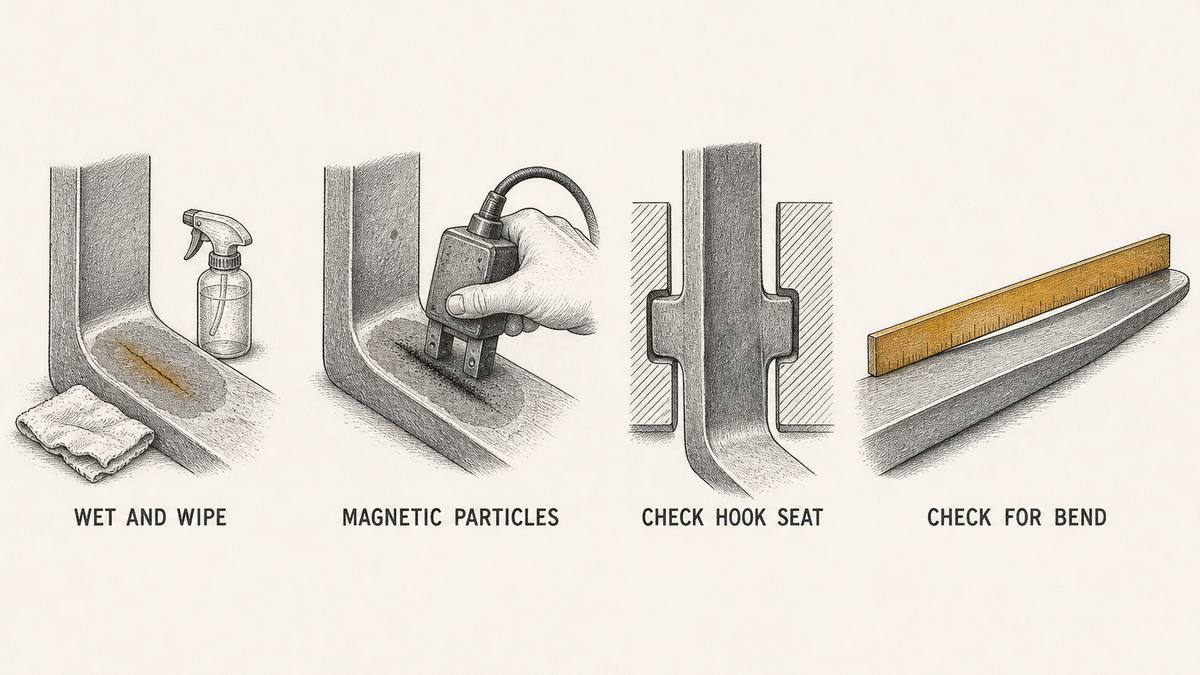
The daily check looks for five things. A crack, usually at the heel, where a fine dark line runs across the top of the blade or around the corner into the shank. A bend, checked by sighting along the top face of the blade, which should be flat. Excessive wear at the heel, which shows as a step or a hollow under the corner. Worn or flattened hooks, which show as bright polished patches on the bearing faces of the top hook. And the fork marks, which should still be legible. Anything found means the fork comes off the truck, because the truck must not go into service with a condition that affects its safety.
The periodic inspection is where cracks are actually found. A fine crack at a heel is invisible against grey steel, and the two standard ways to find it are dye penetrant and magnetic particle testing. Dye penetrant is the simpler of the two: the area is cleaned, a coloured liquid is sprayed on and left to soak into any opening, the surface is wiped, and a developer is applied that draws the liquid back out so a crack shows as a coloured line. Magnetic particle testing uses a magnetic field and iron particles, and it is better at finding cracks that have not reached the surface. Both are done at the heel, because that is where cracks start. A workshop can be asked for either on a sample basis, and a supplier who has the equipment and can show you a report is a supplier who understands what these parts do in service.
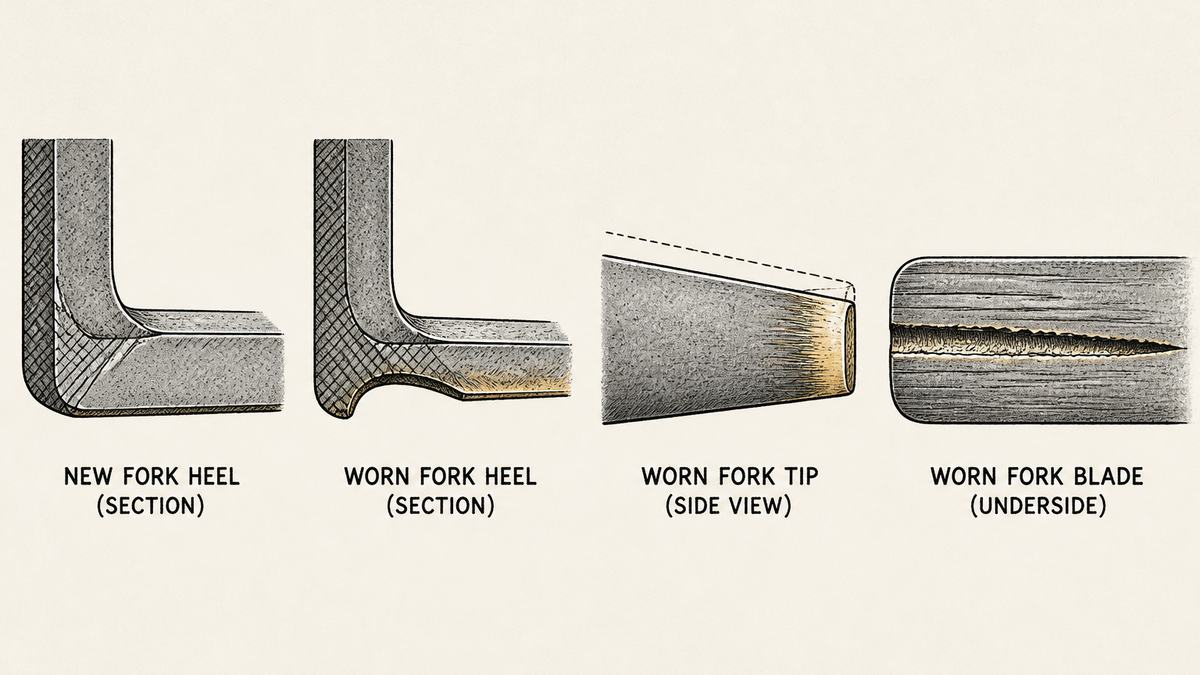
Wear is measured, not judged. The limit that decides when a fork heel is worn out is a figure in the industry standard rather than in the rule, so the honest instruction is to ask the fork supplier or the truck manufacturer for the limit that applies to the specific fork, and to measure the heel section against it with a rule or a caliper. What a buyer can do without any standard is to measure the heel of one of a new pair and record the figure, which gives a plant its own reference for comparing a fork later. That single recorded dimension turns “that heel looks worn” into a decision.
The hooks deserve their own line on the checklist, because nobody looks at them. They are behind the carriage, in shadow, and covered in grease. What shows a worn hook is a flattened, narrowed or brightly polished bearing face, and what it causes is a fork that sits slightly out of square, which tilts every load the truck lifts and is often blamed on the driver. Put the hooks on the inspection sheet by name, and check both forks, because a pair wears together and one worn hook on one side is a fork sitting crooked.
Never weld, heat or grind a fork to repair it. This is the point where a workshop that is good at steel gets it wrong, because welding a worn heel is a perfectly reasonable repair on almost any other steel part and a completely unacceptable one on a rated fork. The heat destroys the treatment that gives the part its strength and toughness, and it creates a hard, brittle zone exactly where the bending is highest. A damaged fork is replaced or scrapped. The rule's own logic supports that: a replacement part has to be equivalent in safety to the original, and a repaired heel is not.
What to Put in the Specification Sheet
A fork is ordered well or badly in a single page. What follows is the list worth sending, and it is worth more attention than usual because so much of a fork is decided by numbers that a factory has to be told, not by a shape it can copy. The structure of the document is the same as for any part out of a Chinese workshop, and it is set out in this guide to a the one-page enquiry format.
The class or the mounting detail. The class if it is a hook-type fork, or the bore size, shank width and bolt pattern if it is shaft mounted. If the class is not known, send the hook dimensions measured off the fork being replaced, with a photograph of the shank. This is the first line on the sheet because it is the one that decides whether the fork can be fitted at all.
Length. The blade length, stated as the horizontal dimension from the shank to the tip, and stated in the unit the supplier works in as well as yours. A fork quoted at the wrong length by a unit conversion is a fork that reaches too far or not far enough, and both are expensive.
Rated capacity and the load centre it applies to. Both figures. A capacity with no load centre attached is not a rating, and a fork rated at one load centre can be rated differently at another.
Steel grade and hardness range. The grade in writing, and the hardness range the fork is to be heat treated to. These two lines are what make the fork a rated product rather than a shape.
The forming method. Forged, or rolled and formed. And an explicit line that the fork is to be a single piece with no welded joint anywhere in the blade, shank or heel.
Proof test. Whether the forks are proof tested, at what multiple of the rated capacity, and a record supplied with the shipment. Ask for the test figure to be stated rather than described.
Marking. What is to be stamped into the shank: capacity, length, class, the maker, and a pair number so that a matched pair can be identified. Say whether the marks are to be stamped or rolled, and say they are to remain legible after painting.
Finish. Which parts are painted and which are to be left bare. Write down that the blade is to be supplied unpainted, so that there is no argument about paint covering the surface that has to be inspected later.
Matched pairs, and the tolerance within a pair. A truck lifts with two forks and the load has to sit level, so the two forks in a pair have to be matched in length and in heel section. Ask for the pair to be matched and for the permitted difference between them to be stated.
The attachment, if there is one. Its weight, its own rated capacity, the load centre it is rated at, the truck it is intended for, its hydraulic requirement, and its fixing to the carriage. An attachment without its own weight and rating written down cannot be assessed against the truck at all.
Packing and documents. How the forks are to be packed so that the heel is not damaged in transit, and what travels with them: the proof test record, the material certificate, and any drawing that carries the class or mounting dimensions.
The last line is the same one as on any specification, and on this part it is worth more than usual: what you will reject. Write down that forks with a welded joint, with illegible or missing marks, with a bend, or with a heel section outside the stated tolerance will be rejected. On a part whose whole safety case rests on a few invisible properties, one line about rejection does more work than a page of description.
Inspecting and Testing Forks Before They Ship
Forks are heavy, simple and easy to check, and almost everything that matters can be verified on the factory floor with a rule, a square and the paperwork. The wider sequence, and how much of a shipment to inspect, is set out in this guide to inspection before shipment.
Measure the mounting first, and measure it off the sample you sent. The hook profile, the hook spacing and the shank thickness are the dimensions that decide whether the fork goes on the truck, and they are the ones a factory is most likely to have interpreted from a photograph rather than from a measurement. Lay the new fork beside the old one, shank to shank, and compare hook to hook. If the new fork will not hang on the same carriage, nothing else about it is worth checking.
Check the length and the pair match. Measure the blade length on both forks in a pair, and measure the heel section on both. Two forks of a pair that differ in length lift a load crooked; two that differ in heel thickness load the thinner one harder. Both are easy to check with a rule and both are difficult to argue about later.
Look for a welded joint anywhere in the blade, shank or heel. A ground-down weld at the heel can be hard to see under paint, which is one reason to ask for the blade unpainted. Look at the junction between the blade and the shank on both the top and the underside, and at any place where a hook has been attached. A rated fork is one piece.
Look at the heel section and the radius. The transition from blade to shank should be a smooth generous radius with no sharp corner and no tool marks. A sharp corner there is a stress raiser, and a stress raiser is where the crack will start.
Confirm the steel and the heat treatment from the paperwork, not from the surface. Ask for the material certificate naming the grade, and for the hardness range the forks were treated to, with the test record. These are the two invisible properties that decide whether the part is a rated fork, and neither can be seen. A factory that can produce the documents quickly has a heat treatment line and a testing habit; a factory that answers with a verbal assurance is asking you to take the same risk as the cheapest supplier.
Ask for the proof test record. A rated fork is proof loaded before release. The record should name the test load and the capacity it corresponds to. If the forks were not tested, say so and price the order accordingly, and understand what you are buying.
Check the marking while the forks are still in the crate. Capacity, length, class or mounting detail, the maker, and a pair number. Confirm that the marks are stamped or rolled into the metal and not painted on, and confirm they can still be read after the finish has been applied.
Look for anything that should not be there. A bend seen by sighting along the top face of the blade, a dent or a gouge in the blade, a crack — and cracks are worth looking for with more than the eye. If the order is large or the duty is severe, ask for dye penetrant or magnetic particle testing at the heel on a sample, and ask for the report. It is the one check that finds what the eye cannot, and it is the check that separates a supplier who understands forklift forks from one who forges steel shapes.
Two habits make the rest of the list work.Keep one fork from the first delivery, in writing, as the reference the rest of the order is compared against — a first article on a part where a substitution would be invisible. And record the heel dimension of that reference fork in your own maintenance system, because that single number is what will let you decide in five years whether a fork has worn past use.
The Defects: Wear, Bends, Cracks and Worn Hooks
Four faults cover almost everything that takes a forklift fork out of service, and they split cleanly into two groups. Two of them are wear, which is a slow process to be managed with a routine. Two of them are damage, which is a decision to be made today.
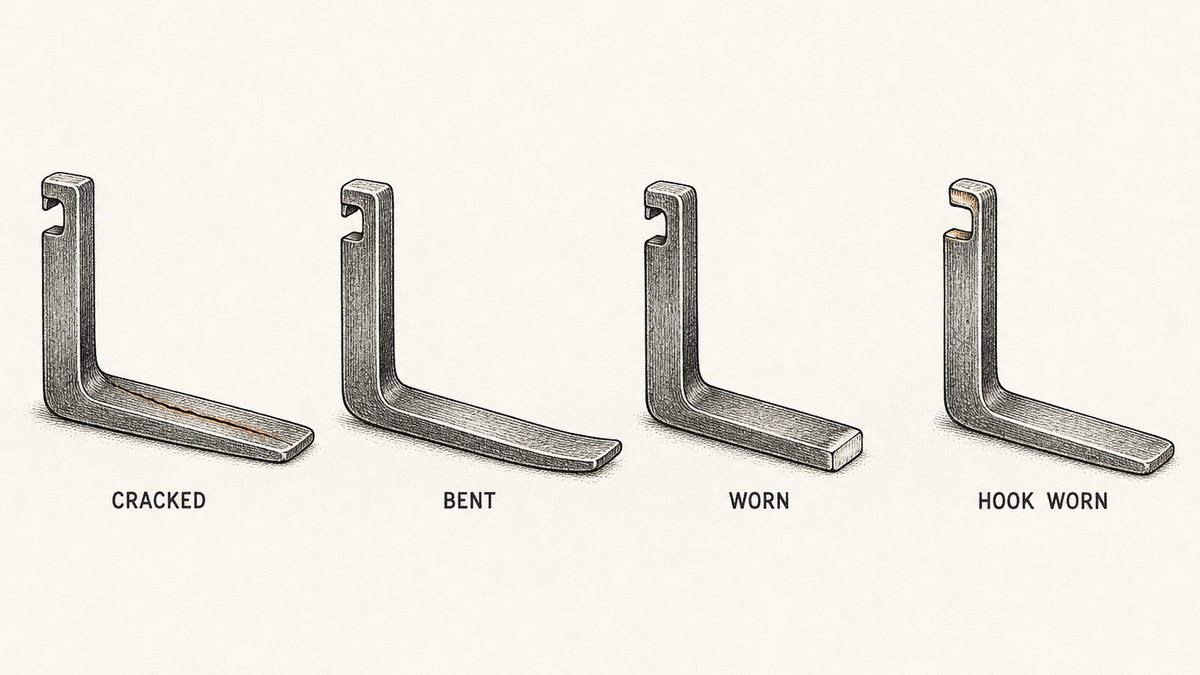
A crack at the heel is the fault that kills people, and it is the hardest to see. It starts as a hairline in the top surface of the blade where it curves up into the shank, or on the underside at the same corner, and it grows across the section a fraction at a time with every load. A fork does not normally bend when it fails; it drops the load. The cause is usually a combination of a heel that has worn thin and a load that has been carried further out than the fork was rated for, and the two together explain most of the cases. This fault is not wear to be monitored; a fork with a crack is out of service and stays out.
A bent blade is damage, and it is almost always an accident. The blade takes a permanent set downward, or the shank twists, and the fork no longer lies flat. The causes are a load picked up at speed with the tip, a fork driven into a racking leg or a wall, a load dropped onto the blade from height, or a fork used as a lever or as a scraper. A bent fork cannot be straightened, because straightening means heating and bending steel that has been heat treated, which is the same mistake as welding it. A bent fork is replaced. The practical check is to sight along the top of the blade: it should be flat, and a blade with a curve in it is visible immediately against a straight edge.
A worn tip is the harmless one, and it is worth separating from the others. The taper wears off, the tip squares up and the metal goes bright and shiny. It makes a pallet harder to enter and it is a sign of hard use, and it does not reduce what the fork can carry. Many plants replace forks for worn tips while keeping heels that are worn far past their limit, which is a good illustration of how inspection goes wrong when it is based on what is easy to see.
Worn hooks are the fault nobody looks for. The bearing faces of the top hooks flatten, narrow and polish bright, and the fork then sits slightly out of square in the carriage. The load tilts, the driver compensates, and the real fault is found months later during a check of something else. Hooks wear faster on trucks that do a lot of picking up and putting down, and on trucks where the forks are changed often. They deserve their own line on the inspection sheet, and a hook that has worn past its limit is a reason to replace the fork, because a hook cannot be built up by welding.
Six Faults and Which Side Each One Is On
| The fault | What gives it away | Whose side it is on |
|---|---|---|
| New fork will not hang on the carriage | Hook profile or hook spacing differing from the fork it replaces | The supplier's if the class or the measured hook dimensions were on the order; yours if only the length was |
| Welded joint found in a blade or heel | A ground-down seam under the paint, or a hard zone beside it | The supplier's, and the fork is not a rated fork |
| No material certificate or proof test record | Grade and hardness range not available in writing | The supplier's if the paperwork was ordered; otherwise a decision you made |
| Crack at the heel after a period in service | A hairline across the top of the blade at the heel, or a dye penetrant indication | The plant's, unless the certificate shows the wrong grade or hardness |
| Blade bent downward | A curve visible when a straight edge is laid along the top face | The plant's, and the cause is nearly always an impact |
| One fork of a pair wearing faster | A difference in heel section between the two forks of the pair | The supplier's if the pair was not matched as ordered; otherwise a mixed pair in service |
The way to use that table is to photograph and measure before raising anything. Two of the six rows are settled by a pair of calipers and the order paperwork, and one of them — the welded joint — is settled by a single question asked at the right time. The row worth the most money is the first one, because a fork that will not hang on the carriage is a total loss that a tape measure would have prevented.
Price, MOQ and Lead Time: What Actually Moves the Number
This article does not quote prices, because a fork price without a class, a length and a rating attached to it is not information. What it can do is name the things that move the number, so that when two quotations differ you know which question to ask.
The steel and the heat treatment. These are the two biggest drivers and the two least visible. A fork made from a proper hardenable grade, forged and then hardened and tempered to a controlled range, costs materially more than a fork cut and formed from ordinary plate and left as it is. On the outside the two look almost identical, which is why the grade and the hardness range belong on the order in writing rather than in a conversation.
Whether the fork is proof tested. Proof testing needs a rig and it takes time per pair, and a factory that has the rig has paid for it. A quotation that includes a test record is not more expensive for no reason; it is the difference between a rated product and a steel shape.
The forming method and the shape. A standard-size fork that can be rolled and formed from a section is the cheapest legitimate option. A forged fork, a full-taper fork, a fork with a notch cut for a specific product, or a quarry fork with a heavy blunt blade each adds cost, and each is a genuine difference in the part rather than a markup.
Length and capacity, together. A longer or higher-rated fork is a bigger piece of steel, and it is priced as one. The trap is comparing a short fork of a given capacity against a long fork of the same capacity and assuming the difference is margin, when it is metal.
Whether the order is a pair or a batch. Forks are normally sold in pairs and made in batches, so the price per pair falls sharply with quantity and a single matched pair of an unusual size carries most of the setup. This is the same pattern as any forged or rolled part, and it is why a small order of an odd size looks expensive and a repeat order of the same size looks cheap.
Marking, packing and documents. Stamping the marks, packing so that the heel is not damaged in transit, and supplying the material certificate and the proof test record are each small lines on a good quotation. On a part whose safety case rests on properties you cannot see, those lines are the product, and a quotation that omits them is a quotation for a different thing.
Attachments are a separate order with a separate price structure. A clamp, a rotator or a spreader beam has its own design cost, its own hydraulics and its own rating, and it should be priced by an attachment manufacturer with the load, the truck and the load centre on the table. A fork factory quoting a clamp is quoting a bought-in item with a markup on it, which may be fine and is worth knowing.
Two commercial habits are worth more than any price list. Ask for the price at three quantities, which shows the setup content immediately and gives you a reference for the second pair a plant always ends up needing. And buy the spare pair before you need it, because a cracked fork takes a truck out of service the moment it is found, and the daily inspection duty means it will be found on a working day rather than at a convenient one. Two forks on a shelf cost less than one truck standing still.
Questions Buyers Ask
How do I find out which class of fork my truck takes?
Measure the fork you are replacing rather than reading a number off the truck. The class is defined by the shape and spacing of the mounting hooks, and the practical way to establish it is to measure across the hook and the distance between the top hook and the bottom hook, then send those figures with a photograph of the shank. If you have no fork to measure, the truck's make, model and carriage can usually be traced back to a class, and the manufacturer or a fork supplier can confirm it. On a shaft-mounted truck there is no class at all: you need the bore size, the shank width and the bolt pattern instead. Getting this wrong is the only fork error that results in a pair of forks that cannot be used at all.
Should I buy a longer fork, or use an extension slipper?
They are both legitimate and they fail differently. A purpose-made longer fork is stronger and lighter than a short fork with a sleeve over it, but its rating is based on the load centre in use, and a longer fork moves the load further out before anything is even loaded. An extension slipper is the right answer for occasional reach, and it is the wrong answer when it becomes permanent, because it adds its own weight on the lever arm as well as extending the load centre. Either way, the figure that has to change is the capacity. Ask for a reduced capacity rating calculated for the extended load centre, and put it where the operator can see it, because the rating on the fork no longer describes the arrangement.
Why can my truck lift less than the figure on the fork?
Because the fork and the truck are rated separately and the smaller figure governs. The fork has a capacity at a stated load centre. The truck has a capacity at a stated load centre, on its own data plate, with any attachments it was configured with. In real use the load centre you actually have may be longer than the one either was rated at, because the load cannot be pushed back against the carriage, because a slipper is fitted, or because an attachment holds it further out. When the load centre grows, both capacities fall. The number that matters is the truck's, recalculated for the load centre in use and for any attachment fitted, and the rule on powered industrial trucks requires that an attachment that did not come from the factory results in the truck being re-marked with the weight of the truck and attachment combination.
Can a cracked or worn fork be repaired by welding?
No. Welding a fork destroys the heat treatment in the area around the weld and leaves a hard, brittle zone exactly where the bending force is highest, and the repair is more likely to fail than the original fault. The same applies to straightening a bent fork by heating it. A rated fork is a one-piece heat-treated part, and the rule underscores the principle by requiring replacement parts to be equivalent in safety to the parts used in the original design — a repaired heel is not equivalent. A damaged fork is replaced. Any welding done to a fork, by anyone, turns that fork into scrap.
Do I have to change the truck's data plate when I fit an attachment?
Yes, and the rule is expressed in two places. It requires that modifications and additions affecting capacity and safe operation are not made without the truck manufacturer's prior written approval, and that the capacity, operation and maintenance instruction plates, tags or decals be changed accordingly. It also requires that where a truck carries front-end attachments other than factory-fitted ones, the user asks for the truck to be marked to identify the attachments and to show the approximate weight of the truck and attachment combination at maximum elevation with the load laterally centred. In practice that means: written approval from the truck maker, a new or amended plate, and the operator trained on the reduced figure, which the training requirements in the same rule make explicit.
How do I check a fork supplier who says they are a manufacturer?
Ask four things and read the answers. What grade of steel, and what hardness range are the forks heat treated to, in writing, with a certificate. Are the forks proof tested, at what multiple of rated capacity, and will the test record travel with the shipment. Are the forks forged or rolled, and can they confirm the blade, shank and heel are one piece with no welded joint anywhere. And can they state the permitted difference between the two forks of a matched pair. A forge answers all four from its own records and does not need to ask anyone. A trader answers the length, the price and the delivery date and refers the rest upstream, which is a perfectly good answer when it is given openly and a warning when it is not.
Send the hook dimensions and the load centre — not just the length
Tell us what the fork has to do, then the lines that decide whether it is safe: the class, or the hook profile and hook spacing measured off the fork being replaced, with a photograph of the shank; whether the truck is hook type or shaft mounted, and if shaft mounted the bore size, shank width and bolt pattern; the blade length, the rated capacity and the load centre that capacity applies to; whether the forks are to be supplied as a matched pair and what difference between the two is acceptable; the steel grade and the hardness range, and whether the fork is forged or rolled and formed; an explicit confirmation that the blade, shank and heel are one piece with no welded joint; whether the forks are proof tested and whether the test record and material certificate travel with the shipment; the marking to be stamped into the shank, including a pair number, and which parts are to be left unpainted so the blade can be inspected later; how the order is to be packed so the heels arrive undamaged; and if an attachment is involved, its own weight, its rated capacity, the load centre it is rated at, the truck it is for, its hydraulic requirement and how it fixes to the carriage. If a truck is already in service and something has gone wrong, describe what you see: whether a crack has appeared at the heel and on which face, whether a blade has taken a permanent bend, whether the tips are worn or the hooks are flattened and bright, whether one fork of a pair is wearing faster than the other, and what the truck has been lifting and how far out. The pattern usually says whether the fault is in the fork, in the load centre, or in the way the truck has been used.
Request a Forklift Fork Sourcing Quote
Questions & Comments
We read every one and reply within 24 hoursA fork is decided by numbers the factory has to be told rather than by a shape it can copy: capacity, load centre, section and attachment. Send those and we will check the fork against the truck it is going on.