
Pulley Manufacturer: Sourcing V-Belt Pulleys From China
 ·
Updated October 12, 2026
·
26 min read
A pulley is quoted as a diameter and a groove, and that is exactly how a buyer ends up with a wheel that shakes the bearing out of the motor, sits so deep in a worn groove that the belt never grips, or cannot be got off the shaft without a gas torch. The diameter is the figure everybody exchanges. The groove form, the bore, the balance and the belt tension around it are the four that decide whether the drive lasts. There is also one more thing, and it is not about the pulley at all: it is the American rule that says how high a pulley and its belt may sit above the floor before somebody has to cover them.

Six Lines That Decide Whether a Pulley Quote Is Complete
| What the buyer has to settle | Why it is not obvious | The line on your order that closes it |
|---|---|---|
| Which belt the pulley is made for | The belt section sets the groove shape, and a wheel cut for one section will not hold another | The belt section, written as it appears on the belt itself |
| Where the belt actually rides | A V-belt grips by wedging into the flanks, so the working diameter is inside the rim, not at it | Pitch diameter, not just outside diameter |
| How the pulley holds the shaft | Straight bore, taper-lock bush and clamp hub look identical on a quote and come apart very differently | The bush system and its size, named on the drawing |
| Whether it will shake at running speed | Balance is a separate operation and is often left out to keep the quoted price down | A balance requirement stated at a named speed |
| How the drive is set up | A drive with no way to tension the belt cannot be kept tight, whatever the pulley is like | Slotted base or jockey pulley, and the alignment method |
| What covers the belt and the pulley | The rule is written around how high the drive sits above the floor, not around the pulley | Guard drawings with the guard height above floor level |
What a Pulley Is, and the Four Words Buyers Mix Up
A pulley is a wheel with a groove around the outside that carries a belt, turning on a shaft. That is the whole of it. Everything else about the part is a choice made inside that sentence, and most of the ways a pulley order goes wrong start with a buyer and a supplier using different words for the same wheel, or the same word for different wheels.
Four words get mixed up constantly, and they are not interchangeable.
- Pulley
- The general word, and the safest one to use. A pulley can be flat faced, grooved for a V-belt, toothed for a timing belt, or shaped to carry a rope. If you are not sure what you are holding, call it a pulley and describe the belt that goes round it.
- Sheave
- The same part under its American name, and the word that appears on most drawings and in most crane and hoist catalogues. A sheave is a wheel with a groove. Because your supplier's drawing may say sheave while your order says pulley, the two documents should both carry the same diameter and the same groove description, or somebody in the workshop will guess.
- Sprocket
- A toothed wheel that drives a roller chain, not a belt. It looks similar from across a workshop and it is a completely different part with a different groove shape, a different material and a different hardening. Pulleys and sprockets are usually made by different factories, and a sprocket manufacturer will quote a chain wheel while a pulley factory will not.
- Gear
- A toothed wheel that meshes directly with another wheel. Nothing wraps it, so it has no groove and it is a different trade again. Plastic gears in particular come from a separate supply chain with its own mould and material questions.
The mix-up matters commercially rather than technically. A factory that makes belt pulleys usually has the casting patterns, the lathes and the groove tools for round grooved wheels. The moment the part needs teeth or a chain profile, the answer changes, the tooling changes and the price changes. So the first job is not to find a manufacturer. It is to be certain which of the four words describes the part you want, and to say it the same way twice.
Once the word is settled, one more split matters, because it decides who can make the part. Belt pulleys come in two families. A friction pulley carries a plain V-belt or a flat belt and grips by wedging into the groove, and it is the everyday industrial pulley. A toothed or timing pulley carries a belt with teeth on the inside, and it drives by those teeth meshing with matching teeth cut into the wheel. Both are made on the same kind of lathe and both are round with a bore, but the tooling is not the same, and a factory set up for V-grooves may be quoting you a timing pulley they cannot cut.
The Parts of a Pulley, and Which One Your Price Hides In
A pulley is a small number of features, and each one carries part of the price. Knowing the names is what turns a one-line quotation into a specification you can argue about.
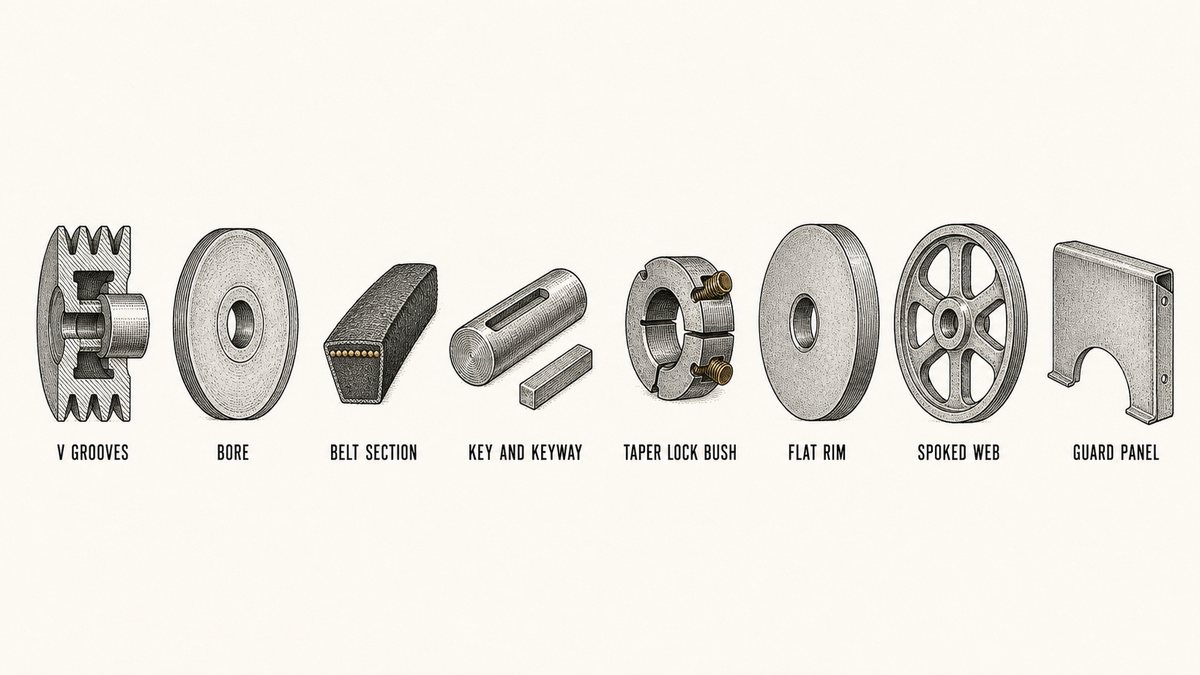
Working from the outside in, the features are these.
The rim is the outer ring, and the grooves are cut into it. Two measurements describe the rim and they are not the same number. The outside diameter is the measurement you get with a ruler across the whole wheel. The pitch diameter is the diameter at the point where the belt actually rides, which is inside the rim by roughly the thickness of the belt. The ratio between two pulleys, and therefore the speed of whatever is being driven, is set by the pitch diameters. Buy a pulley on outside diameter alone and you have left the ratio to chance.
The web is the disc between the rim and the centre. It can be a solid disc, a disc with drilled lightening holes, or a spoked wheel with arms. A solid web is the cheapest and the heaviest. A spoked wheel is lighter and lets air through, which matters on a fast drive because it helps the belt and the groove stay cooler. A drilled web sits between the two and is the usual answer for a cast pulley of moderate size, because the pattern is cheap and the weight comes down.
The hub is the boss in the middle that gives the wheel enough length along the shaft to sit straight. Hub length is one of the quiet cost lines on a quotation. A short hub is less metal and less machining, and it is also the reason a pulley rocks on its shaft under load. If nothing else on the drawing is negotiable, the hub length should not be the place a supplier saves money without telling you.
The bore is the hole the shaft goes through. The keyway is the slot cut along the bore, and the key is the small bar of steel that sits in it to stop the pulley turning on the shaft. On a small hub a keyway takes out a real share of the wall, so the hub has to be thick enough around it. A hub that is too thin at the keyway is the reason a small pulley cracks at the bore rather than wearing out in the groove.
The bushing is a separate split sleeve that goes between the shaft and the pulley, and it is the single feature that changes most about how the part behaves in service. The setscrews, usually called grub screws in a Chinese factory, are the small screws that lock a plain bore onto the shaft. They are also the feature that most often decides whether the pulley can be removed in five minutes or has welded itself on.
Then there is the feature nobody puts on a quotation and every factory makes a decision about: whether the grooves and the bore are machined in the same setting. A groove cut on one machine and a bore bored on another are two operations, and their positions depend on how the part was clamped each time. Machining the groove, the rim face and the bore without unclamping the part is what keeps the groove centred on the bore, and a pulley whose groove is not centred on its bore will pull the belt sideways on every turn no matter how well it is balanced. It is worth asking as a question, because the answer tells you what kind of workshop you are dealing with.
Three of those features are where a quoted price is really decided. The first is whether the grooves are cast to shape or machined after casting. A cast groove is cheaper and less accurate, and it is what a very low quotation usually contains. The second is whether balancing is included, because balancing is a separate operation on a separate machine and dropping it costs the factory nothing while costing you a bearing. The third is whether a bushing is included or the pulley comes with a plain bore, because a bush is a bought-in part with its own cost and its own brand, and the difference between the two is invisible on a one-line quotation.
The Drive Types You Will Be Quoted
Almost every quotation you receive will be for one of four wheels, and the difference between them is the belt, not the pulley. Ask which belt the wheel is cut for before you compare prices, because the same diameter and the same number of grooves can describe two wheels that will not accept the same belt.
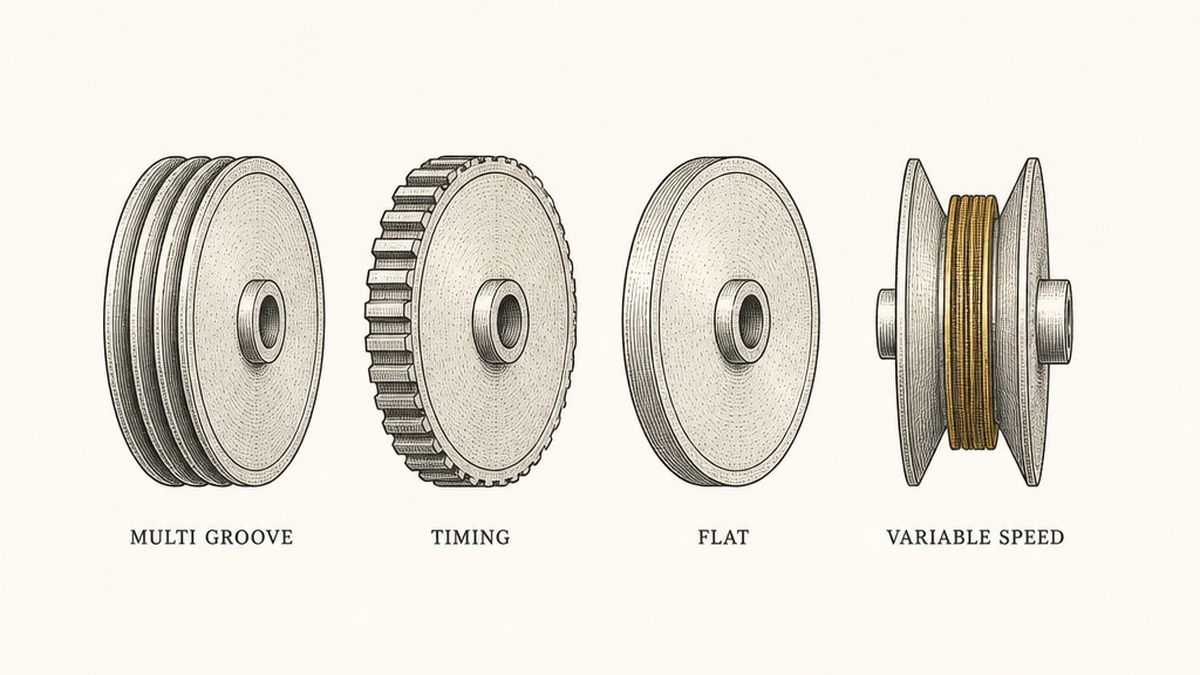
A multi-groove V-belt pulley is the workhorse. It carries two, three, four or more V-belts side by side in parallel grooves, and the number of grooves is chosen so that a single belt failing does not stop the machine. It is the usual choice for pumps, fans, compressors, crushers and any driven machine on a factory floor. The grooves are V-shaped in section, so the belt wedges in and grips the flanks.
A timing or synchronous pulley carries a belt with teeth on the inside and drives by those teeth meshing with matching teeth cut into the wheel. Nothing depends on friction, so the two shafts stay locked together in step and the drive can be much more compact. Timing drives are chosen when the driven shaft has to be in step with the driving shaft rather than merely turned by it. It is a different wheel from a V-groove pulley and it is cut with a different tool.
A flat pulley has a smooth face with no groove at all, usually with a slight crown in the middle so the belt centres itself. Flat belts carry high speed and low load well, and they are common on older and heavier machinery. A crowned face is not a decoration; the crown is what keeps a flat belt from walking off the edge.
A variable speed pulley is a pair of flanged halves that can be moved closer together or further apart while the machine runs, so the belt rides higher or lower in the gap and the effective diameter changes. It is the way a belt drive gives a continuously adjustable speed without any electronics. Variable speed pulleys are the ones where the moving parts wear, because the flanges slide on the hub as well as carrying the belt load.
Two more types turn up often enough to be worth naming. A poly-V or micro-V pulley carries a wide flat belt with several small V-ribs moulded along its inside face, and it is the belt you will find driving an alternator or a water pump on a vehicle. It looks like a flat pulley with a faint pattern on it, and it is a separate specification from a classic V-groove wheel. A rope sheave has a groove shaped to a round rope rather than a wedge belt, and it is a different trade again, because the groove has to match the rope construction.
Groove Profile: Why “A Section” Is Not Enough
Here is the sentence worth taking from this section: a V-belt does not grip by friction against the bottom of the groove. It grips because the belt is pushed down into a wedge, and the two flanks of the groove squeeze its sides. Take the wedge away and the belt slips, however tight you pull it.
That single fact explains almost every groove problem a buyer meets, and it leads to three rules worth putting on the drawing.
The belt must not bottom out. If a belt settles all the way down and touches the bottom of the groove, the flanks are no longer squeezing it and the drive stops transmitting properly. The belt then slips, heats up and polishes the groove, and the operator reacts by tensioning it further, which makes it sit even deeper. A correctly made pulley leaves the belt standing proud of the rim, and that is checked by dropping a new belt into the groove and looking at it, not by reading a number.
The groove angle is a stated dimension, not a habit. The angle of the wedge is not identical on every pulley. It is set by the belt section and by how small the pulley is, because a belt has to bend around a small pulley and the flanks have to open slightly to let it. This is the reason a small pulley and a large pulley from the same drive are not the same casting with a different diameter. Ask for the groove angle and the groove depth as dimensions on the drawing. If the reply is a description rather than a number, the workshop is cutting to a habit rather than to your belt.
Grooves wear, and wear changes the ratio. Every hour of running polishes the flanks, and material trapped between belt and groove grinds them slowly sideways. As the flanks wear the belt sits deeper, the working diameter gets smaller and the driven shaft speeds up or slows down a little without anybody touching a control. On most drives that drift is harmless. On a drive where the speed matters, it is the reason a machine that used to run to specification slowly stops doing so, and it is found by dropping a new belt in and seeing how far it now sits above the rim.
One buying point follows from all of this. Grooves can be cast to shape or cut after casting, and the two are not equally accurate. A cast groove is cheaper, and on a light drive with a slack tolerance it works perfectly well. A machined groove is what you want on anything with real load, on anything where the speed has to hold, and on anything with more than one groove, because with several belts running side by side the grooves have to match each other. If a quotation is markedly lower than the others for the same stated pulley, the groove is the first place to ask about.
The Bore and the Bushing Decision
The bore is the hole through the hub, and it is where most of the practical pain on a pulley lives. The groove decides whether the drive grips. The bore decides whether the pulley stays on the shaft and whether you can get it off again.
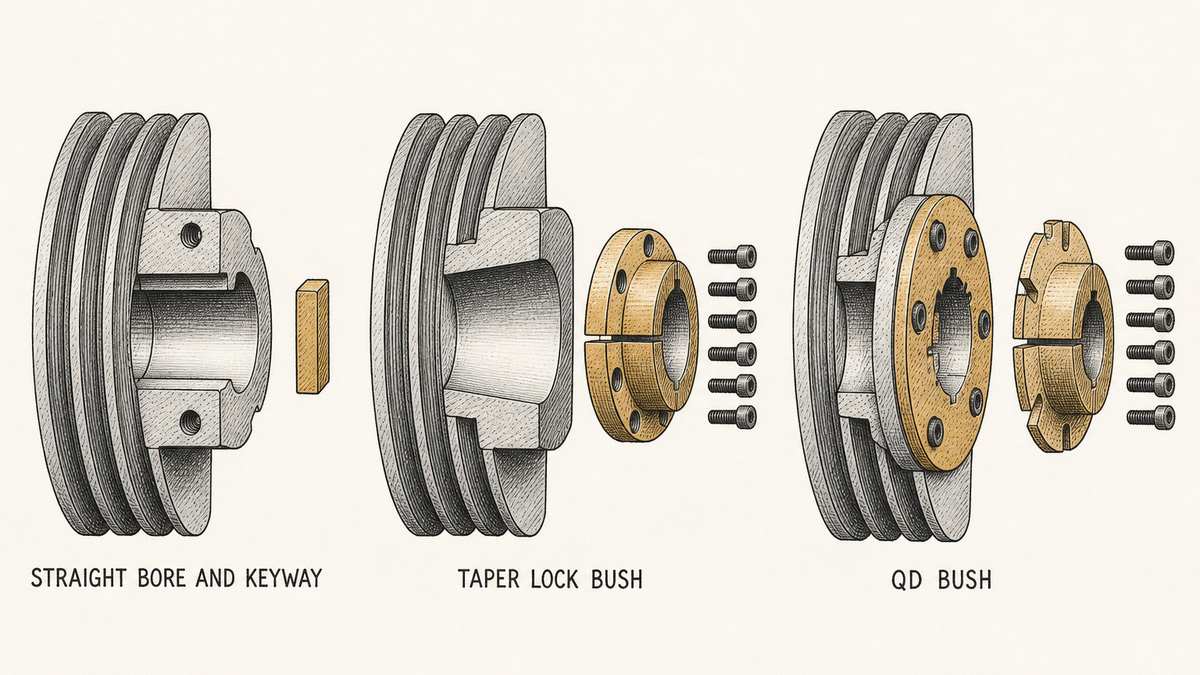
There are three ways a pulley is normally held, and they are worth understanding before you order rather than after the pulley arrives.
A straight bore with a keyway and setscrews is the oldest and the cheapest. The bore is finished to the shaft size, a keyway is cut along it, a key is fitted into the keyway, and one or two setscrews are tightened down onto the key or onto the shaft to stop the pulley sliding along. It works, and on a light drive with a well-fitting shaft it works for years. Its weakness is not the drive, it is the removal. A setscrew bites into the shaft, the bite becomes a raised burr, and the burr has to be filed away before the pulley will come off. On a shaft that has run hot or rusted, a straight-bore pulley can be genuinely difficult to remove, and this is where a gas torch gets used on a part that should have been designed to come apart.
A taper-lock bush is a split sleeve with a flange. The bush sits between the shaft and the pulley, the three or so screws draw the flange up against the pulley hub, and the taper squeezes the split sleeve onto the shaft. The advantage is that the same mechanism runs in reverse: take the screws out, put them into the threaded jacking holes and turn them, and the bush pushes the pulley free. The bush comes off the shaft afterwards by hand. The pulley is released without a puller and without heat. A taper-lock bush is made in standard sizes, and it is the arrangement most buyers should be asking for unless there is a reason not to.
A quick-detachable, or clamp hub, does the same job with a wide slotted flange and a different screw pattern. It is common in American practice, it releases the same way, and it holds a very high load. The practical difference is which bush your plant already keeps on the shelf, because a bush is a consumable and mixing systems across a plant means stocking two sets of spares.
Three questions close this section and each one has caught a buyer I have worked with.
Is the bush included, and which bush size? A quotation that says a 300 mm pulley with a 35 mm bore has told you almost nothing, because it has not said whether that bore is a plain hole or the inside of a taper-lock bush. The bush size is a separate standard, it is fitted to the shaft, and the pulley is bored to the bush rather than to the shaft. Ask for the bush size, not just the bore. If you are replacing a pulley on an existing line, measure the bush you already have.
Is the hub thick enough around the keyway? A keyway removes a slot of material from the wall of the bore. On a small pulley with a large shaft, the remaining wall can be thin enough that the hub cracks at the keyway under load. Ask for the hub diameter as well as the bore, and be suspicious of a very small difference between the two on a loaded drive.
Can the pulley be taken off without heat? Ask it plainly. The answer tells you which of the three arrangements is really being offered, and it tells you whether the design has been thought about as something that will need maintenance rather than as something that will be fitted once and forgotten.
How the Pulley Is Made, and What It Means for Your Order
A pulley arrives at the price it does because of how it was made, and there are three ways, each with its own cost structure.
The first is casting. A pattern is made in the shape of the pulley, moulds are formed in sand from the pattern, molten metal is poured in, and the cooled casting is then machined on the rim face, the grooves and the bore. This is how most industrial pulleys are made, because casting is the cheapest way to get a shape with a rim, a web and a hub in one piece with no joints. Grey iron is the usual metal, because it is cheap, it machines well, it absorbs vibration, and it wears reasonably in a groove.
The second is fabrication, where the rim, web and hub are cut from plate and tube and welded together. It is used for very large sizes, for one-off shapes, and where steel rather than iron is wanted because the part has to survive shock or a very high speed without cracking. A fabricated pulley is heavier for the same strength, and it needs the weld to be sound, because a weld near the rim is where a crack will start.
The third is machining from solid, where a pulley is turned out of a billet or a piece of bar. It is expensive in material and in machine time, and it is used for small quantities, for prototypes, and for sizes where a casting pattern would cost more than the parts. If you need three pulleys, a machined part can be cheaper in total than a casting. If you need three hundred, the casting wins by a wide margin.
The consequence for your order is the pattern cost. A standard size that the factory casts every week has its pattern already, and you pay only for the metal and the machining. A size they have never made needs a new pattern, and the cost of that pattern sits on the first order whether the supplier itemises it or hides it in the unit price. This is why a small order of an unusual size can look shockingly expensive per piece while the same size becomes cheap once the quantity is large. If you are being quoted an unusual size, ask directly whether a new pattern is needed and, if it is, how many pieces it takes to absorb it.
One more manufacturing point is worth more than it looks. Ask whether the groove, the rim face and the bore are machined without unclamping the part. Machining three features in one setting keeps them in a fixed relationship to each other; machining them in three settings leaves their positions dependent on how the part was clamped each time. A pulley whose groove is not square to its bore and not centred on it will pull the belt sideways on every turn, and no amount of balancing will hide it. A workshop that understands the question will answer it immediately. A workshop that does not will answer with the price.
Material choice deserves one line here as well, because grey iron is a foundry's everyday metal and the same grade turns up in much other heavy industrial hardware. If you are also buying the casters under the unit on the same project, the same questions about grade, wall thickness and porosity apply, and the same failure modes follow from getting them wrong.
Balance: Static, Dynamic, and What Grade You Actually Need
Balance is the part of a pulley specification that is most often dropped to reach a price, and it is the part most often blamed later for a bearing that failed early.
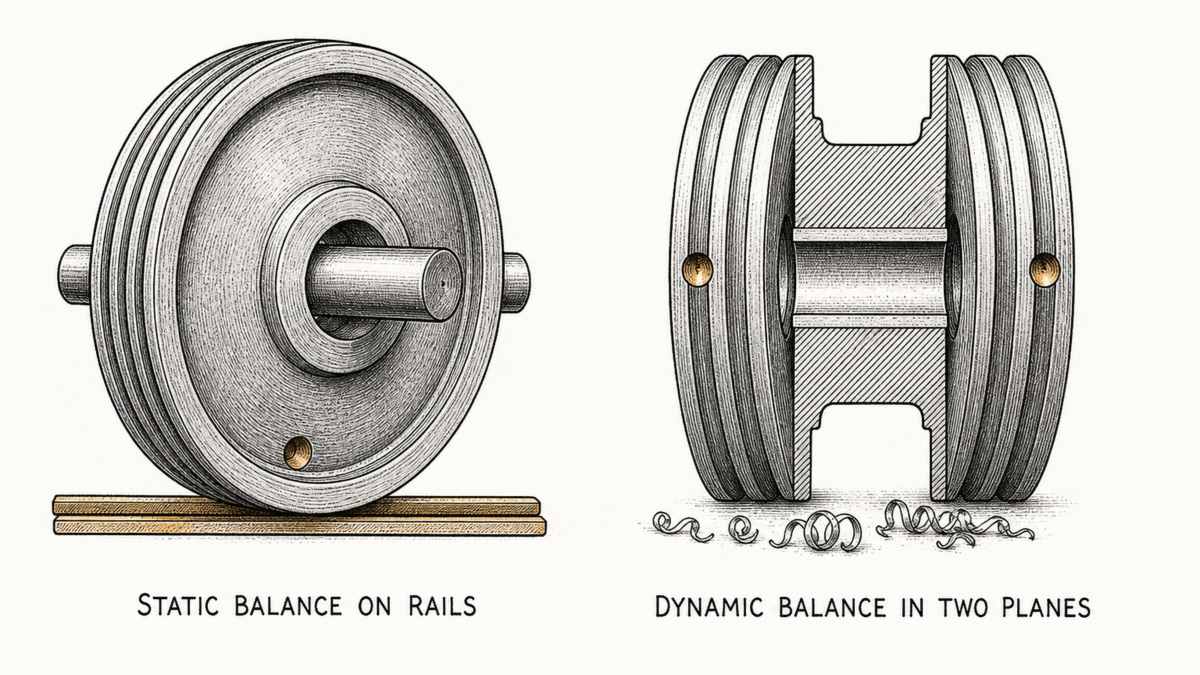
An out-of-balance pulley creates a force that pushes the shaft sideways once per turn. The force grows with the square of the speed, so a wheel that feels perfectly smooth at a slow speed can shake a machine hard at a fast one. That sideways force goes into the shaft, into the bearings and into whatever the pulley is bolted to.
There are two ways to correct it and they are not the same job.
Static balance deals with one plane. The pulley is put on a mandrel, the mandrel is laid across two level knife edges or narrow horizontal rails, and the wheel is allowed to settle. It rotates until the heavy side is at the bottom. The correction is made by removing a little metal from the heavy side, and the test is repeated until the pulley stops in a different position each time. Static balance corrects the weight difference between one side of the wheel and the other, and for a narrow pulley running at a modest speed it is often all that is needed.
Dynamic balance deals with two planes. The pulley is spun in a balancing machine, the machine measures the movement in two separate planes, one on each side of the wheel, and it tells the operator where to remove metal on each face. This catches a fault static balance cannot see: a pulley that is correct on each side on its own but whose two sides are out of step with each other, so that the wheel is trying to rock the shaft as well as push it. On a wide multi-groove pulley, a spoked wheel, or any drive running fast, that rocking is the fault that damages bearings.
Correction is made by drilling. The shallow dimples you see in the web and near the rim edge of a machined pulley are not decoration and they are not manufacturing marks; they are the places metal was removed to bring the wheel into balance. That is also useful in reverse: a pulley with dimples has been through a balancing operation, and a pulley with none has either not needed it or never had it.
Two practical points follow, and both are things to put on the order rather than to discuss afterwards.
A balance grade means nothing without the speed it is stated at. Balance is written as a grade from an international standard, and the grade is tied to the running speed of the wheel. A grade quoted on its own can describe a wheel that is perfectly acceptable at one speed and unacceptable at another. So the line on your order should name both: the balance requirement and the speed at which it applies. That way the requirement is testable, and the factory knows what it is being asked to achieve.
Balance and running true are different things. A pulley that has been balanced can still shake a machine if its bore and its groove are not centred on each other, because then the whole wheel orbits as it turns even though its weight is perfectly distributed. This is the reason the machining sequence in the previous section matters as much as the balancing machine does, and why a supplier who balances a badly machined pulley has solved half a problem.
Material and the Cheap Substitutions
The metal a pulley is made from decides how it fails. There are five materials you will be offered, and the choice is not usually about strength in the ordinary sense. It is about what happens when the part is overloaded, shocked or run hot.
Grey cast iron is the default and the right answer for most industrial drives. It is cheap, it casts into a complex shape in one piece, it machines easily, and it has one property the other materials do not: it damps vibration. A grey iron pulley rings less and shakes less than a steel one of the same shape, because the graphite flakes inside the iron turn movement into heat instead of passing it on. Its weakness is that it is brittle. It does not bend when it is overloaded or dropped; it cracks, and it cracks without warning.
Ductile iron is the same foundry process with the graphite in a different form, and the result is a metal that yields before it breaks. It is used where the rim has to be thin, where the part takes shock, and where a cracked pulley would be a real hazard rather than an inconvenience. It costs more than grey iron and behaves much more like steel.
Steel, either welded up from plate and tube or machined from solid, is chosen for large sizes, for very high rim speeds and for drives that take real shock. Steel bends rather than shattering, which matters on a fast wheel, and it survives being hit. It is heavier for the same strength, it damps far less than iron, and it costs more to make, so it is normally chosen for a reason rather than as an upgrade.
Aluminium is chosen for weight. A lighter pulley spins up faster, takes less power to accelerate, and puts less load on the shaft and bearings. The trade is in the groove. Aluminium is softer than iron or steel, so the flanks wear faster, and a bare aluminium groove on an abrasive duty is a short life. It is usually paired with a hard coating or with a steel insert at the groove. If an aluminium pulley is quoted for a hard-working drive, ask how the groove is protected.
Engineering plastics and nylon are used for light drives, for quiet running and where corrosion matters. They are light, they do not rust, and they absorb noise. Their limits are real: the material softens as it warms, so a plastic groove loses its shape under a load it would carry cold, and the same wheel will behave differently in a hot plant than in a cold one. Plastic is a good answer for a light duty and a poor one for a heavy drive. It is worth knowing that this is a separate supply chain with its own tooling questions, much as it is for the gears inside a pulley.
Two substitutions are worth watching, because both look like nothing on a quotation and both show up later.
The first is wall thickness. A pulley carries its load through the rim and the hub, and the cheapest way to save metal is to make both thinner than they need to be. Ask for the rim thickness at the base of the groove and the hub diameter, and compare them with the shaft size. A rim that is thin where the belt pulls will flex, and a flexing rim loosens the groove and eventually cracks at the web.
The second is paint in the wrong place. Painting is cosmetic on the outside and a problem on the inside. Paint in the groove changes the surface the belt grips, and paint in the bore changes the fit on the shaft. A workshop that masks the machined surfaces before painting is a workshop that understands its own part. A pulley that arrives with a fully painted bore and a coated groove tells you the machining and the finishing were done by people who never thought about how the pulley works, and it is a fair predictor of the rest of the order.
Belt Tension, Alignment and Drive Layout
Most of what gets blamed on a bad pulley is really a drive that was never lined up or never tensioned, so this section is worth as much attention as the pulley itself.
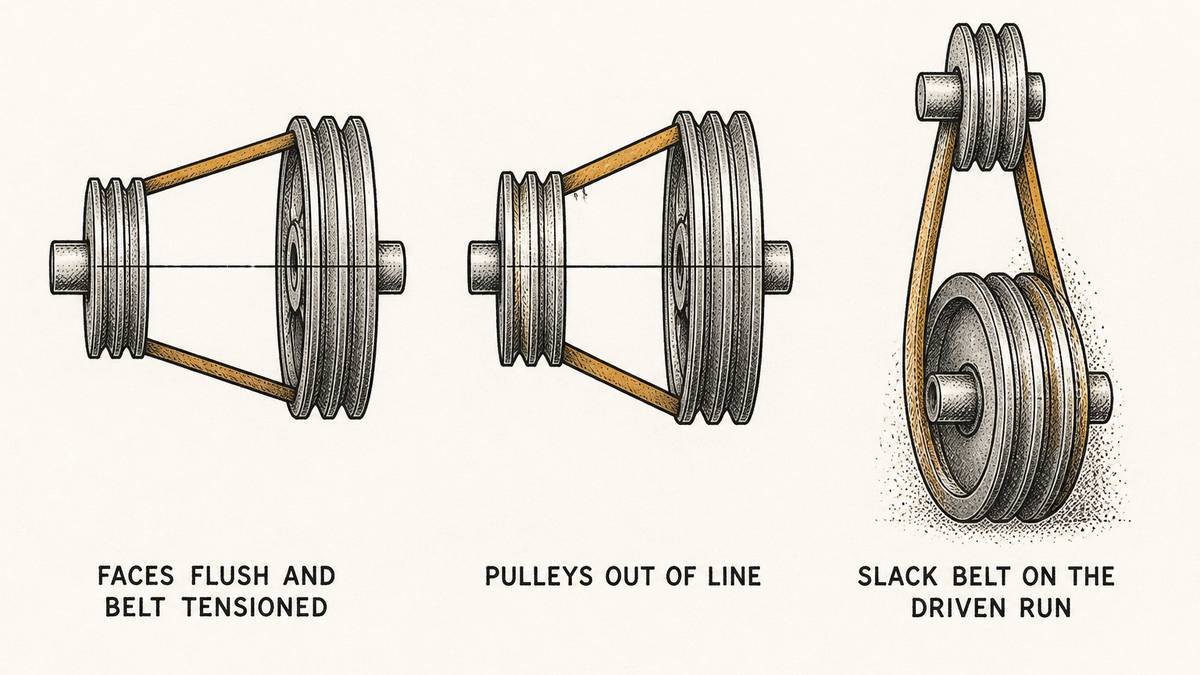
Alignment comes first, before tension. Two pulleys on a belt drive have to sit in the same plane, so that the belt leaves one groove and enters the other without changing direction. The check is simple: lay a straight edge across the face of one pulley and see whether it lies flat against the face of the other. If it does not, one pulley is standing proud of the other. A misaligned drive wears one flank of the groove, frays one edge of the belt and pulls the belt sideways, and it does all three at once. It is also the fault most often fitted by the customer rather than the factory, because the pulley is correct and the machine it was bolted to is not.
Tension is a band, not a setting. A belt that is too loose slips. Slipping generates heat and polishes the groove, and because a polished groove grips less, a slipping belt slowly destroys the thing it runs in. A belt that is too tight overloads the bearings at both ends of both shafts and shortens their life for no benefit, because grip comes from the wedge rather than from tension. The practical check is deflection: press the belt at the middle of the longest unsupported run and look at how far it moves for a firm push. What counts as right depends on the belt section and the centre distance, so it should come from the belt supplier rather than from habit.
The small pulley is the one to watch. A small pulley has less of its circumference in contact with the belt, so the belt has less area to grip, and a small pulley on a big ratio can have so little contact that it slips however tight it is. The two answers are to move the shafts further apart so more of the small pulley is wrapped, or to add a tensioner. The second answer has a cost people forget: an idler that presses on the outside of a belt bends it backwards, and a belt that bends backwards both ways in one circuit does not last as long as one that only ever bends one way. If a drive needs two idlers to work, the layout is probably wrong. If you do need a tensioner, note that the rule has something to say about suspended counterweighted tighteners: they have to be firmly fastened, their bearings capped, and something has to be provided so that the tightener cannot fall if the belt breaks.
The drive needs a way to be adjusted. A belt stretches, a groove wears and a machine settles. A drive with no means of taking up that slack has to be rebuilt or replaced to be re-tensioned, which nobody does, so the belt runs slack for the rest of its life. The usual answers are a slotted or pivoting motor base, a screw take-up, or a jockey pulley on an adjustable arm. Ask for one of them by name. Machines arriving without any adjustment on the drive is one of the most common surprises on an imported unit.
Layout decides how much grip you get. A drive with the belt running horizontally between two pulleys on the same level is the easy case. A vertical drive, where one pulley is directly above the other, relies on the weight of the belt itself to stay in the groove, so it needs more tension for the same grip. Long centre distances need support or they whip. A drive that carries more than one belt needs the belts matched to each other, because a new belt running beside a stretched one carries more than its share of the load and fails first. Buy belts in matched sets and replace them as a set.
One last point on the layout, and it is a safety point rather than a performance one. Every one of those choices produces a belt running over a pulley somewhere at a height a person can reach. The general machine guarding rule requires guarding that protects people from hazards including ingoing nip points, rotating parts and flying chips and sparks, and it requires a guard to be fixed to the machine where it can be, or secured elsewhere if it cannot. It also requires the guard itself not to be a hazard, which is why the edge finish of a guard matters as much as its position. That is the general rule; the specific rules for belts and pulleys are in the next section.
The Guarding Rule Your Machine Has to Meet Before It Ships
This is the part of a pulley order that most buyers never see, because it is not a property of the pulley. It is the rule that decides where the pulley may sit and what has to be built around it, and if you are exporting a machine into the United States it is a rule your supplier has to design to, not a job for whoever installs it.
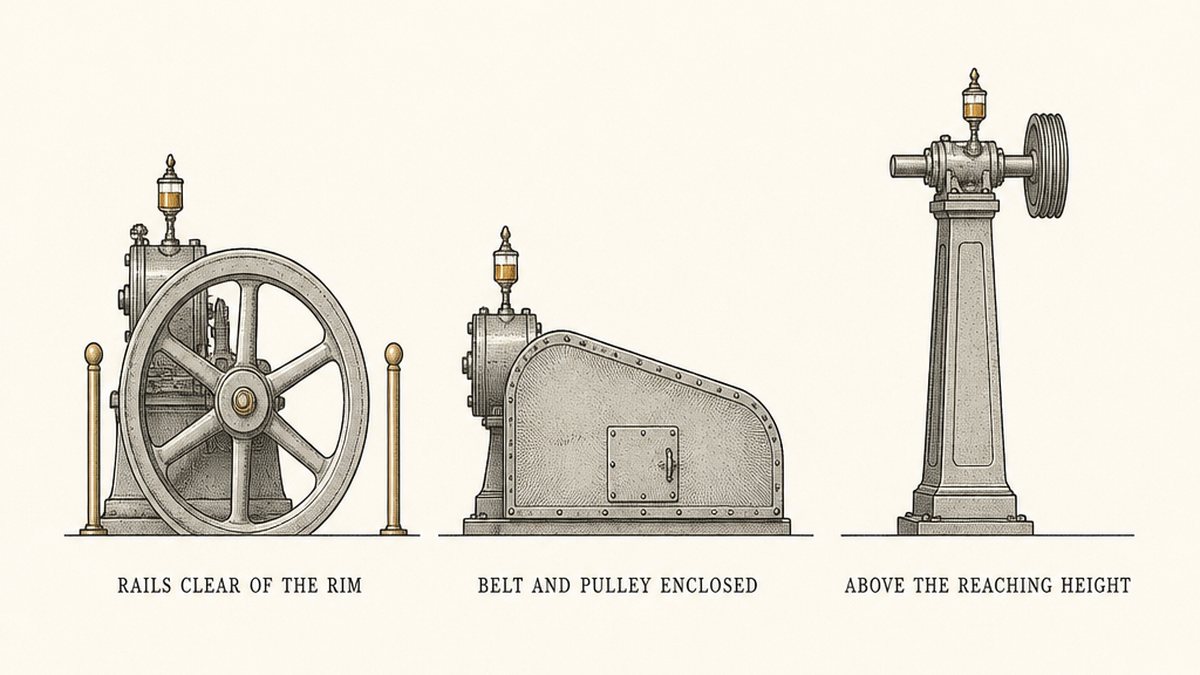
The rule is 29 CFR 1910.219, Mechanical power-transmission apparatus. It covers belts, pulleys, shafting, gears, sprockets and chains, and its whole logic runs on one number: seven feet. Anything below that height above the floor or working platform is treated as reachable and has to be guarded. Anything above it is treated as out of reach and mostly is not.
Here is what the rule actually asks for, in the order a designer meets it.
Pulleys. A pulley with any part at seven feet or less above the floor or working platform has to be guarded. There is one stated exception and it is a useful one: a pulley that also acts as a balance wheel, such as the wheel on a punch press, where the contact point between the belt and the pulley is more than six feet six inches above the floor, may be guarded with a disk covering the spokes rather than a full enclosure. That exception exists because the wheel has to turn freely for the machine to work, and covering it completely would stop it.
Flywheels. A flywheel with any part at seven feet or less above the floor or platform has to be guarded by an enclosure of sheet, perforated or expanded metal or woven wire, or by guard rails placed not less than fifteen inches and not more than twenty inches from the rim. If the flywheel sits in a pit or within twelve inches of the floor, a toeboard is required as well.
Belts. Where both runs of a horizontal belt are seven feet or less from the floor, the guard has to extend at least fifteen inches above the belt. Where both runs are forty-two inches or less from the floor, an ordinary guard is not enough and the belt has to be fully enclosed. A guard for an inclined belt also has to leave a clear seven feet between the belt and the floor at any point outside the guard, so that nobody walks into it.
Sprockets and chains. All sprocket wheels and chains have to be enclosed unless they are more than seven feet above the floor or platform. Where a chain drive passes over another machine or a working area, protection against falling has to be provided as well. Sprockets worked by hand are treated separately.
Keys, setscrews and anything that sticks out. All projecting keys, setscrews and other projections in revolving parts have to be removed, made flush or covered with a metal guard. The rule then carves out one exception and immediately advises against relying on it: the requirement does not apply to keys, setscrews or oil cups in the hubs of pulleys less than twenty inches in diameter where they sit inside the plane of the rim. The very next line of the rule recommends that no projecting setscrews or oil cups be used in any revolving pulley at all. As a buyer, the useful reading is that a pulley hub with a screw sticking out of it is a defect to correct rather than an argument worth having. The same section requires unused keyways to be filled or covered, and projecting shaft ends to be smooth and not to stick out more than half the shaft diameter unless they are capped or sleeved.
Couplings. A shaft coupling has to be built so that it presents no hazard from bolts, nuts, setscrews or turning surfaces. Bolts and setscrews are allowed where they are covered with safety sleeves, or where they run parallel to the shaft and are countersunk or do not reach beyond the flange of the coupling.
Oiling points. Where frequent oiling has to be done, the rule requires openings with hinged or sliding covers that close themselves. Any point that cannot easily be reached has to have an oil feed tube if oil is to be added while the machine is running. There is a reason the rule is specific here. Oiling a moving drive is one of the classic ways people are caught by a belt, and a self-closing cover on an oiling opening is what makes that job safe.
Vertical and inclined belts up to two and one-half inches wide. If the belt runs at less than a thousand feet per minute and has no metal lacing or fastenings, it may be guarded with a nip-point belt and pulley guard instead of a full enclosure. It is the narrow, slow, lightly built drives that get this lighter treatment, and it is worth knowing the limit exists, because a supplier may offer a nip-point guard on a drive that is above the width or the speed and expect you not to notice.
Rooms used only for power transmission. Belts, pulleys and shafting in a basement, tower or room used only for transmission equipment do not need the guarding, but only if four conditions are met together: the room is locked against entry by anyone not authorised, the vertical clearance in passageways is not less than five feet six inches, the lighting meets a named standard, and the oiler's route is protected. It is not a blanket exemption for a locked room, and a supplier who describes it as one has not read it.
Two further provisions matter to a buyer more than they look. The first is that the rule does not allow a broken pulley to stay in service. A pulley with cracks, or with pieces broken out of its rim, shall not be used. That is a rule about something you may be shipped, and it is a reason to look at rims on arrival rather than at commissioning. The second is that the rule sets a care routine: all power transmission equipment has to be inspected at intervals not exceeding sixty days and kept in good working condition, pulleys have to be kept in proper alignment so that belts do not run off, belts, lacings and fasteners have to be inspected and kept in repair, and machinery has to be oiled when it is not in motion wherever that is possible. A supplier who can hand you a maintenance sheet built around those points is a supplier who has read the rule rather than heard about it.
The installation rule sits alongside all of this. 29 CFR 1910.147 is the rule on locking out machinery, and it applies exactly where this one pushes people to: it covers the moment an employee has to remove or bypass a guard or put a hand into a machine. It requires a program built from procedures, training and regular inspection. In plain terms, every time somebody takes a guard off to oil a bearing, clear a blockage or check a belt, the drive has to be isolated and locked first. A machine designed with a lockable isolator and a guard that comes off with a key rather than a spanner is a machine that makes that routine possible. A machine with a bolted-down guard and no isolator makes it impossible, and the guard quietly stops being refitted.
There is a limit to what an article like this can hand you. Beyond the rule, most of the detail in this field sits in industry standards that are sold rather than published free, and this article does not quote figures from those. What the rule gives you is enough to write a specification and to ask a supplier the right questions. If you are also buying the machine the pulley drives, the same logic runs through the drive end of a the screw conveyor feeding a pulley, where the guarding rule for the conveyor itself sits next to the guarding rule for its drive.
Six Things to Ask For by Name on a Machine With a Belt Drive
| Ask for | Why it decides something |
|---|---|
| The guard drawing, with the guard height above floor level stated | The whole rule turns on the seven foot line, so the height has to be a stated figure rather than a matter of where the drive ends up sitting |
| Guard material and edge finish named | The rule names suitable materials and requires them to be free of burrs and sharp edges, because a guard that cuts people is its own hazard |
| Hinged or sliding self-closing covers at every oiling point | Oiling a running drive is the classic belt injury, and a cover that closes itself is what makes the job safe |
| Guard fixings that need a key or a tool, not a spanner on six bolts | A guard that is slow to refit is a guard that stays off, and an off guard is worse than no guard because everybody assumes it is on |
| A lockable isolator on the drive, with a hasp that takes a padlock | Every guard removal becomes a lockout job, so the machine has to make lockout possible |
| A maintenance sheet listing the sixty day inspection and the alignment check | The rule sets a care routine as well as a guarding requirement, and the sheet is what turns that into work somebody actually does |
What to Put in the Specification Sheet
A pulley is a small part and it is easy to order badly, because the useful description is longer than the obvious one. What follows is the list worth putting on one page and sending, rather than exchanging in messages. If the format is new to you, the same structure works for any machined part out of a Chinese workshop and the general shape of it is set out in this guide to a a worked specification sheet.
The drive it belongs to. What the pulley drives, how fast the driving shaft turns, and the speed the driven shaft has to run at. That last figure is what fixes the ratio and therefore the two pitch diameters, and it is the figure most often left out, which is how two pulleys arrive that do not produce the speed the machine needs.
The belt. The section, written as it appears on the belt itself, plus the belt make if your plant has standardised on one. If you are copying an existing drive, measure the belt you are running rather than reading it off a drawing that may be older than the machine.
Grooves. How many, the section they are cut for, the groove angle, and whether the grooves are machined or cast to shape. If there is more than one groove, say so plainly, because the grooves have to match each other.
Diameters. The pitch diameter, which is the one that sets the ratio, and the outside diameter, which is the one you can measure with a rule. Give both, because a supplier who is given only one will assume it is the other.
The bore and the mounting. The shaft size, the bush system and the bush size, the keyway size, and whether a key is supplied. If the pulley replaces an existing one, give the bore and the bush of the part it replaces rather than working from the shaft measurement, because shaft sizes are not always what they were drawn at.
Material and web. The grade of iron or the steel specification, and whether the web is solid, drilled or spoked. Add the rim thickness at the base of the groove and the hub diameter, because those two are where a cheap quotation is hiding.
Balance. The balance requirement and the running speed it applies at, plus whether the correction is made in one plane or two. A balance requirement with no speed attached is not a specification.
Rim height and hub length. The width of the rim face and the length of the hub along the shaft. Hub length is the cheapest thing to shorten and the first thing to cause a pulley to rock.
Finish. Which surfaces are painted, and an explicit line that the groove and the bore are to be left unpainted and free of paint. Write it down, because it is easier to state than to argue about after the fact.
Marking and packing. What is to be marked on the pulley, how the parts are to be packed, and whether each pulley is to travel with its own bush and key. A pulley arriving without its bush is a pulley that cannot be fitted.
The last line of the sheet is not a specification at all and it is worth having anyway: what you will reject. Write down that pulleys with cracks, with broken rims, with porosity visible on a machined surface, or with a groove that bottoms a new belt, will be returned. It takes one line and it changes how the order is read at the other end.
Inspecting and Testing a Pulley Before Shipment
A pulley is a part where almost everything that matters can be checked with a rule, a new belt and half an hour. That is worth knowing, because it means you do not have to take the factory's word for the two things that are hardest to see afterwards: whether the groove is cut to your belt, and whether the groove is centred on the bore.
Drop a new belt into the groove. This is the single most useful check and it needs no instrument. A correctly cut groove leaves the belt standing proud of the rim. If the belt settles down until it touches the bottom of the groove, the groove is too deep or too worn for that belt and the drive will slip no matter how it is tensioned. Do it on every groove, not just the first one, because a multi-groove pulley can be cut correctly in one groove and wrong in the next.
Measure the pitch diameter and the outside diameter, and the bore. Both diameters, because a factory that has delivered the outside diameter you asked for may have delivered the wrong pitch diameter, and the pitch diameter is the one that sets the speed. Take the bore at both ends, because a bore that is tapered will rock on the shaft and a rocking pulley is a loose pulley.
Spin it on a mandrel and watch the rim. Put the pulley on a true shaft or a mandrel, support the ends, and turn it slowly against a fixed pointer held near the rim. If the gap between the pointer and the rim changes as the pulley turns, the bore and the groove are not centred on each other, and no amount of balancing will fix it. This is the check that catches the machining fault described earlier, and it is the one a factory with three separate machining settings will fail.
Check the keyway and the key. The keyway should be the width you asked for along its whole length, with square corners rather than rounded ones, and the key should fit it without hammering and without rattling. A key that has to be driven in distorts the hub; a key that is loose will work its way out sideways under load. Both are cheap to fix at the factory and expensive to fix on site.
Fit the bush, if there is one. A taper-lock or clamp bush should slide onto a clean shaft by hand, and the screws should draw the pulley up without the bush going in crooked. Check that the screws are the right length and that the jacking holes are threaded, because those are the holes that will be used to take the pulley off. If the bush is missing from the shipment, the pulley cannot be fitted at all, so count the bushes and the keys against the packing list.
Look for the balance correction, if you ordered it. A pulley that has been dynamically balanced carries drilled dimples, usually on the web or near the rim edge, on both faces. A pulley that was specified as balanced and arrives with no dimples on either face has either been balanced to a very fine standard by another method or has not been balanced at all, and that is a question worth asking before the container closes.
Look at the rim and the cast surfaces. The rule does not permit a pulley with cracks or with pieces broken out of its rim to be used, so a cracked rim is not a quality argument, it is a rejection. Set the pulley down and look at the web and the inside of the rim as well, where a rough surface full of small holes shows a casting that was poured badly. Small holes in a machined surface are the mark of a casting that will be weak where it is loaded, and they are visible without any equipment at all.
Check the paint. The groove and the bore should be bare metal. Paint in either place is a sign of a workshop that painted the whole part without masking the surfaces that matter.
Two things make this list work rather than just exist. The first is a retained sample: keep one pulley from the first delivery, in writing, as the reference the rest of the order is compared against, and the same discipline applies to any part where the customer will notice a change, which is the whole point of a signing off a first article. The second is doing the checks before the goods are packed rather than on arrival, because the difference between a correction and a claim is whether the container has already left. The general sequence for arranging that, and for deciding how much of an order to inspect, is set out in this guide to a pre-shipment check in China.
The Defects That Show Up in the First Month
Pulley problems divide cleanly into two groups, and knowing which group a fault belongs to tells you who pays for it.
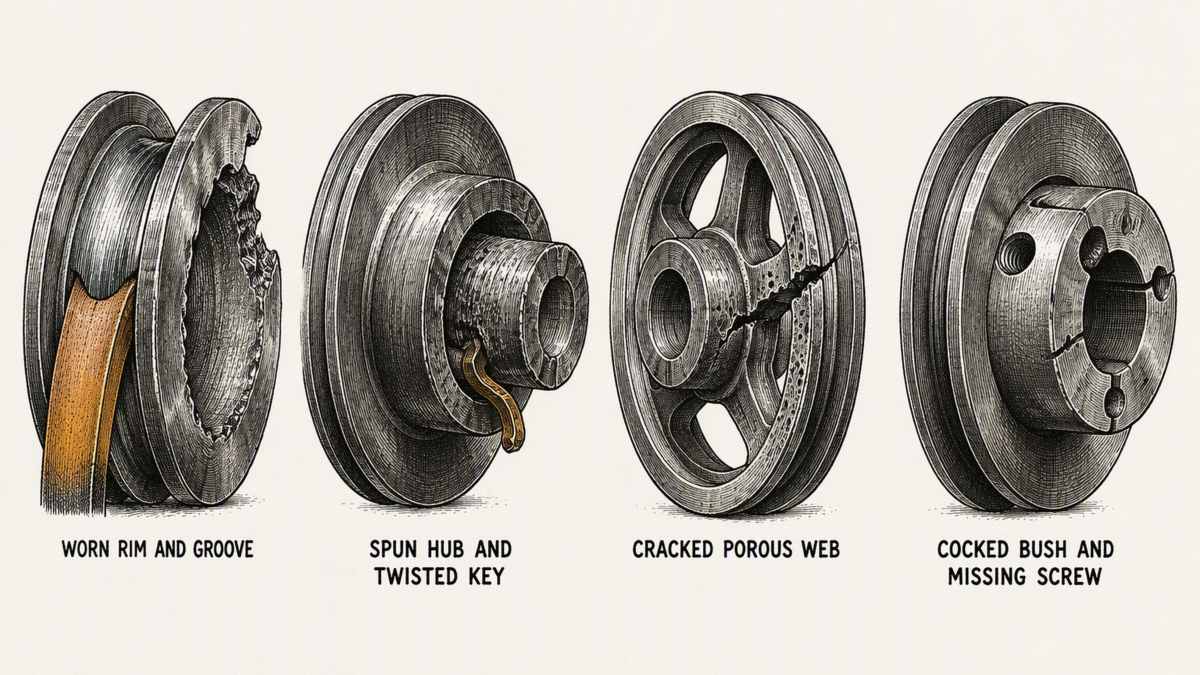
A cracked or broken web arrives with the machine. A crack running out from the hub towards the rim, or a piece broken out of a rim, is either a casting fault or transit damage. A casting with small holes in it can carry a load perfectly well for a while and then crack at the web, because the web is where the load from the rim is carried into the hub. Transit damage looks the same afterwards, which is why the packing matters and why a photograph of the pallet before it is opened is worth more than an argument later. This is the defect the rule names outright: a pulley with cracks or with pieces broken out of its rim is not to be used.
A cocked bush arrives with the machine too. A taper-lock bush fitted with the wrong screws, or with one screw missing, or pulled up unevenly, goes in crooked. The split line then opens, the bush burrs against the hub, and the pulley runs out of true from the first turn. It is a fitting fault rather than a manufacturing fault, and it is the reason to insist on a fitting instruction with the shipment rather than to assume the fitter has done thousands of them.
A worn rim and a widened groove are built in service. Both come from the same cause: a belt that is running out of line, or too loose, or both. One edge of the belt rubs one flank of the groove, the flank polishes, the belt sits deeper, the belt slips, and the operator tightens it, which makes it sit deeper still. By the time the rim wall has worn thin enough to break away, the pulley has been telling you about the misalignment for months. This is the failure that the alignment check in the drive section exists to prevent, and it is worth connecting the two in your own mind: a worn groove is not a pulley fault, it is a drive fault that has been charged to the pulley.
A spun hub and a twisted key are built in service as well. When the pulley comes loose on the shaft, the key takes the whole load instead of sharing it with the grip of the fit, and it fails in a way that is easy to read afterwards: the key is twisted, the keyway corners are rounded over, and the bore and the shaft are both scored and galled. There are three usual causes. A bush that was not tightened to its own figure. A setscrew that worked loose on a plain bore, letting the pulley creep along the shaft. Or an oversized bore on an undersized shaft, which is a machining fault that only reveals itself once the drive is loaded. All three are preventable, and the second is the reason a bush is worth having instead of a plain bore with a grub screw.
The reading for a buyer is straightforward. Keep the two groups apart when you raise a problem. A cracked casting and a cocked bush are the supplier's, and the answer is a replacement plus a written note on what will change in production. A worn groove and a spun hub are usually the plant's, and the answer is an alignment and tension routine rather than a claim. A supplier who can tell the difference without being prompted is worth keeping, and the way to test that is to send a photograph and ask what they think happened rather than to send a claim and see whether they accept it.
Price, MOQ and Lead Time: What Actually Moves the Number
This article does not quote prices, because a pulley price with no size, no quantity and no material attached to it is not information. What it can do is name the things that move the number, so that when two quotations differ you know which question to ask.
Size and volume. Price per piece falls with size up to the point where the part outgrows the standard pattern, and it falls steeply with quantity because the pattern and the setup are spread over more pieces. This is why the same pulley can cost several times as much per piece at ten off as at two hundred.
Whether the grooves are machined or cast. A cast groove skips a machining operation and a cutting tool, and it is the first thing to disappear from a keen quotation. On a light drive it is fine. On anything loaded, or anything where the speed has to hold, it is the difference you are paying for.
Whether balancing is included. Balancing is a separate operation on a separate machine with an operator's time attached. It is easy to leave out and impossible to see until the machine runs.
Whether a bush is included, and which one. A taper-lock or clamp bush is a bought-in part with its own cost and its own brand, and a quotation that says a bore and no bush may be quoting the cheapest version of the part. When you compare two prices, compare them with the bush included and named.
Material. Grey iron is the baseline. Ductile iron, steel and aluminium each move the price for their own reasons, and a quotation that does not name the material has not told you which one you are being offered.
Painting, marking and packing. Small individually, and bigger than people expect on a heavy part, because packing is charged by weight and volume. If the pulleys are going to be shipped with other machinery, say so before the price is set rather than after, because how a part is packed changes once the factory knows it is going inside something else.
Two commercial points are worth more than a price list. The first is to buy the bush as a separate line even when it comes fitted, and to take one spare bush and one spare belt for every drive you cannot afford to stop. A bush is the cheapest insurance on the whole assembly, and it is the part that decides whether the pulley can be taken off in ten minutes on a Sunday. The second is to ask who makes the bush. Standard bushes are made to a shared size by several makers and the same size from two makers is close to interchangeable, but the pulley hub has to be bored to suit, so mixing systems across a plant is the thing to avoid rather than mixing makers.
On lead time, the shape of the answer is simple. A standard size the factory casts and machines every week is quick. A size that needs a new pattern is slower by the time it takes to make the pattern and prove the first casting, and that is the point at which an order placed late stops being a delivery problem and becomes a design problem. If a drive has to be modified, ask how long a new pattern takes before the machine is stripped, not after.
One last point, and it is the one that decides most of these orders. The three features that a hidden price cut lands on are the groove, the balance and the bush. A quotation that names all three, and states the balance speed and the bush system, is comparable with another quotation. A quotation that names none of them is not cheaper, it is just less specific, and the difference will appear on the machine rather than on the invoice.
Questions Buyers Ask
How do I work out what pulley size I need?
Start with the speed, not the size. You need the speed of the driving shaft, the speed the driven shaft has to run at, and the belt you intend to use. The ratio of the two speeds is the ratio of the two pitch diameters, so once one pulley is fixed the other follows from it. Then check that the small pulley is not so small that the belt has too little of its circumference in contact to grip, and that the centre distance leaves room for the drive to be adjusted. A supplier who asks for the two speeds and the belt before quoting is working the problem properly; a supplier who asks only for a diameter is selling you a wheel rather than a drive.
Is a pulley and a sheave the same thing?
Yes. A sheave is the American name for the same part, a wheel with a groove that carries a belt, a rope or a cable, and it is the word that appears on most drawings and in most crane and hoist catalogues. The trap is next to it: a sprocket looks similar from across a workshop but carries a chain and is a different part with a different material and hardening, and a gear has no groove at all because it meshes directly with another wheel. Use the word pulley and describe the belt, and there is nothing to misread.
What does it mean if the belt bottoms out in the groove?
It means the belt has settled far enough into the groove to touch the bottom, and when it does that the two flanks are no longer squeezing its sides. A V-belt grips by wedging, not by sitting on the bottom, so once the belt bottoms out the drive stops transmitting properly however tight it is. In practice the belt slips, heats, polishes the groove and sits even deeper. The check takes seconds: drop a new belt into the groove and see whether it stands proud of the rim. If it sits flush, the groove is wrong for that belt or has worn past use.
Do I need dynamic balancing, or is static balance enough?
It depends on how wide the pulley is and how fast it turns. Static balance corrects the weight difference between one side of the wheel and the other, and it is usually enough for a narrow pulley at a modest speed. Dynamic balancing corrects two planes separately and it catches a pulley whose two faces are out of step with each other, which is what makes a wide multi-groove pulley or a spoked wheel try to rock the shaft as well as push it. If the drive runs fast, if the pulley is wide, or if a bearing failure would stop production, ask for two-plane balancing at the running speed. Always state the speed, because a balance requirement without one cannot be tested.
Why did my pulley come loose on the shaft?
There are three usual reasons and they look different afterwards. A bush that was not pulled up to its own tightening figure lets the pulley creep. A setscrew on a plain bore works loose, and the pulley then slides along the shaft until the key takes the whole load and twists. Or the bore was machined oversize against an undersized shaft, so the fit was never tight and the pulley was held only by the key from the start. The first two are fitting faults and the third is a manufacturing fault. A twist in the key with rounded keyway corners points at the first two; a bore that is loose when the pulley is first offered up to the shaft points at the third.
How do I check a pulley supplier who says they are a manufacturer?
Ask four concrete questions. Will they machine the groove, the rim face and the bore without unclamping the part, so that the groove is centred on the bore? Do they balance in one plane or two, and at what speed do they state the result? Will they send a general arrangement drawing with the pitch diameter, the groove angle, the hub length and the bush size on it before you order? And will they name the grade of iron or the steel specification, plus the rim thickness at the base of the groove? A factory making pulleys answers all four from its own records and can send the drawing. Somebody selling them answers the diameter and the price and refers the rest upstream, which is a perfectly good answer when it is given openly and a warning when it is not.
Send the belt and the two speeds — not just a diameter
Tell us what the drive has to do, then the lines that decide whether the wheel will do it: the belt section as it appears on the belt, and how many grooves; the speed of the driving shaft and the speed the driven shaft has to run at; the pitch diameter and the outside diameter, or the pulley you are replacing with its bore and its bush; whether the mounting is a plain bore with a keyway, a taper-lock bush or a clamp hub, and which bush size; the material and grade, the web type, the rim thickness at the base of the groove and the hub length; whether the grooves are to be machined or cast; the balance requirement with the speed it applies at, and whether it is one plane or two; and the finish, marking and packing, with a bush and a key travelling with every pulley. If you are building a machine rather than replacing a part, tell us the height the drive will sit above the floor, because that is the figure that decides what has to be guarded and whether the guard is part of your order or somebody else's problem. If a drive is already running and giving trouble, describe what happens and roughly when: which side of the belt is fraying, whether the belt sits deep in the groove, whether the rim is bright and polished on one flank, whether the pulley has moved along the shaft, or whether a bearing on one end keeps failing. The symptom usually says which line of the specification was decided badly.
Request a Pulley Sourcing Quote
Questions & Comments
We read every one and reply within 24 hoursA pulley looks simple and is easy to order badly, because the useful description is a good deal longer than the obvious one. Send the duty, the belt and the shaft, and we will turn it into a one-page enquiry.