
Abrasive Wheel Manufacturer: Sourcing Grinding and Cutting Wheels From China
 ·
Updated October 12, 2026
·
17 min read
An abrasive wheel is the one product in a workshop where the instruction is a sound. 29 CFR 1910.215 tells the user to inspect and sound the wheel just before mounting it, tapping it gently, and to leave it out if it sounds cracked. In the same sentence they say something a buyer should notice more: the running speed of the machine has to be checked against the maximum operating speed marked on the wheel. The limit travels with the wheel. The machine does not carry it. That inverts the usual order of buying, because a wheel cannot be chosen and then matched to a machine — and it is why so much of what makes this product good or bad is decided before anything spins.
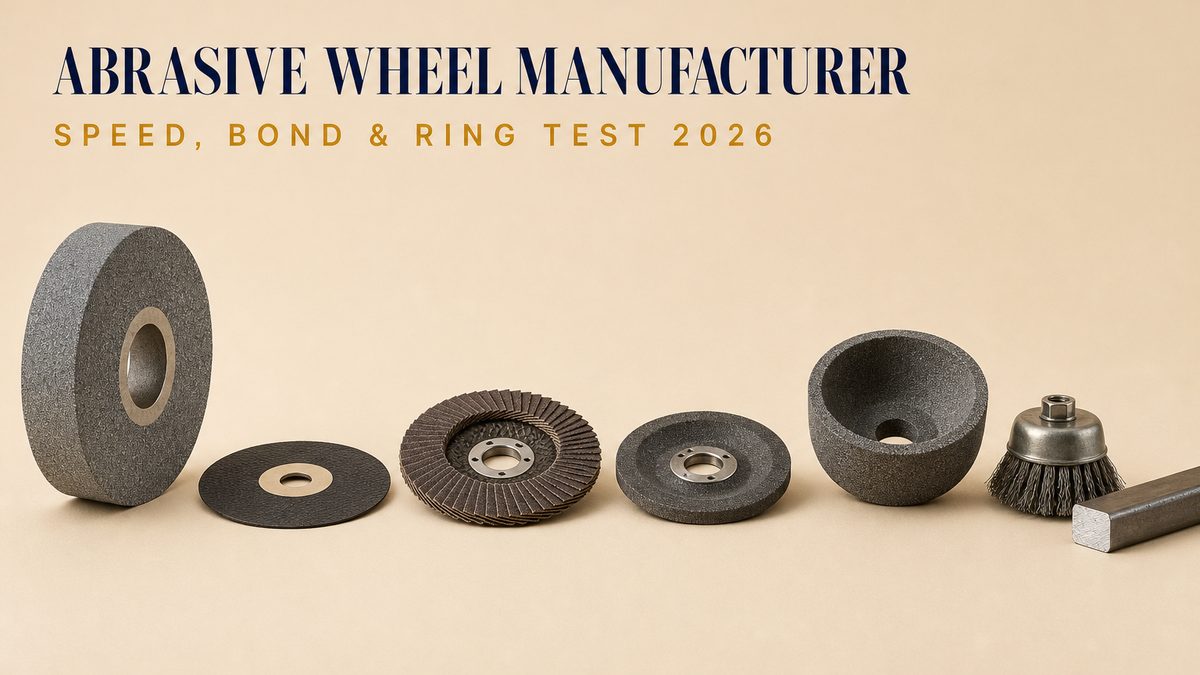
The Four Things That Decide Whether a Wheel Can Be Used at All
| What the buyer has to settle | Why it is not obvious | The line on your order that closes it |
|---|---|---|
| The speed the wheel is made for | The limit is marked on the wheel, so the wheel has to suit the machine rather than the other way round | The maximum operating speed, stated on the wheel and on the paperwork |
| Whether the sound test can be trusted on your product | Organic bonded wheels do not give the clear ring that vitrified and silicate wheels give, so a dull note does not always mean damage | The bond type, named on the order rather than assumed from the picture |
| Whether the wheel rules apply to what you are buying | Metal, wooden, cloth and paper discs with a layer of abrasive on the surface are left out of the wheel rules | A clear split between wheels and coated discs on the same quotation |
| The parts between the wheel and the operator | Blotters, recessed flanges and a work rest set to a stated gap are all required, and all of them are easy to leave off | Whether the goods are wheels only, or a mounted assembly |
| How the wheel was fired and trued | Firing time and truing are the two cost lines that can vanish without changing how the wheel looks | The recorded process, and a true running check on the first order |
| Whether the price is a price or a warning | A cheap wheel is usually a cheaper grain, a shorter kiln run or thinner packing, and only one of those shows up on arrival | The cost lines shown separately, with the grain and the bond named |
What an Abrasive Wheel Actually Is: Grain, Bond and Three Numbers
An abrasive wheel is not a solid disc with a rough surface. It is a controlled mixture of hard grit held together by a weaker material, and the whole design depends on the bond giving way before the grit does. That is the point of the product: a dull grain has to be released so a fresh sharp one takes its place. A wheel that holds its grain too tightly stops cutting and starts rubbing, which is what a loaded or glazed face is.
So there are two materials doing opposite jobs. The grain is the hard part that cuts. The bond is the softer part that holds the grain but is meant to wear away at the right rate. Between them sits a third factor, the spacing, which is how much room is left between grains and decides whether the wheel can clear the material it removes.
Grain materials come in a rough order of how hard they are and how much they cost. Aluminium oxide is the everyday choice for steel. Silicon carbide is harder and more brittle, and gets used on cast iron, stone and materials that are not steel. Zirconia and ceramic grains are the tough ones, used where a lot of metal has to come off quickly, and they cost several times more. The bond families are covered further down, and they change what the wheel does far more than most buyers expect.
Then the three numbers on a wheel that a buyer has to recognise, because they have to be specified and they have to match what is being mounted:
- Diameter
- Set by the machine's guard, not by preference. A wheel larger than the guard was designed for either will not fit or will not be covered, and a wheel worn down to a fraction of its original size no longer has the surface speed it was built for.
- Thickness
- Decides how much side load the wheel will take. A thin cut-off wheel is meant to make one straight plunge cut and will fail quickly if it is leaned on sideways; a thick wheel takes side pressure better but cuts more slowly and heats the work more.
- Arbor hole
- The bore through the middle, and the most common source of a wheel that will not mount properly. A bore that is oversized, or a reducing bushing that does not fit closely, lets the wheel sit off centre so it runs out of true from the first turn.
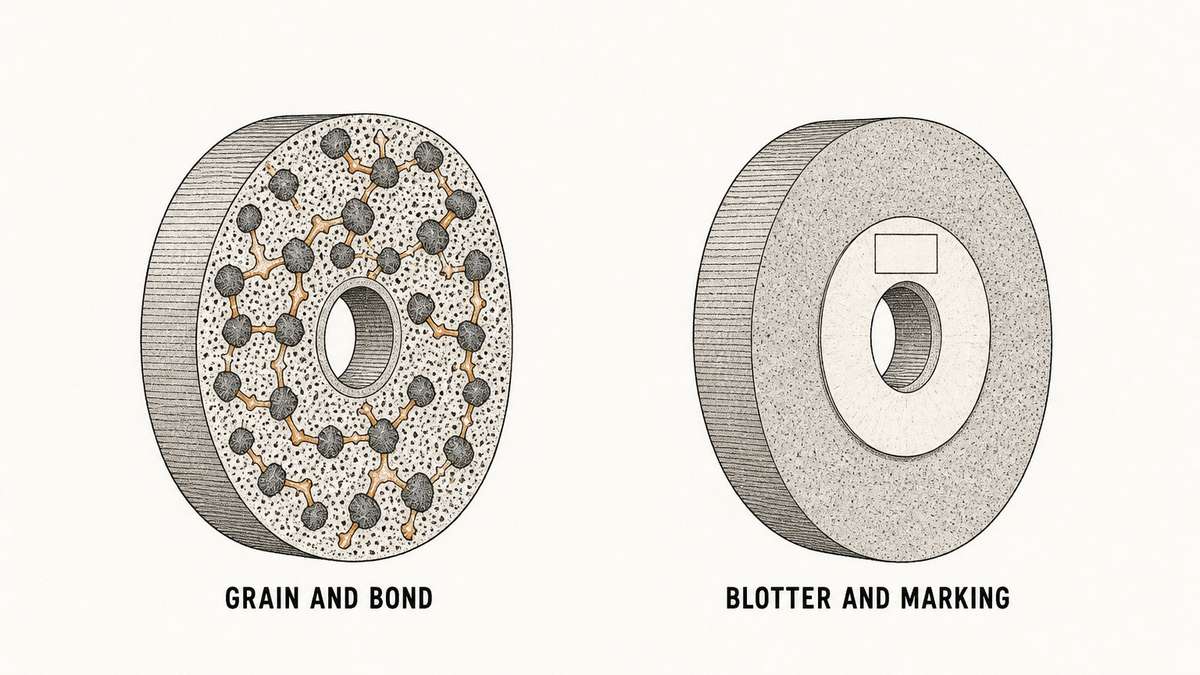
The reason this matters before a single price is compared is that the variables are set at different stages and only one of them can be corrected later. The grain and the bond are fixed when the mixture is made. The truing happens at the end and is the last chance to make the wheel round and flat. A factory that wants to save money on the first two can do so without the wheel looking any different in a photograph, which is why written specifications matter more on this product than on almost anything else in the toolbox.
The Speed Limit Is on the Wheel, Not on the Machine
Here is the single most useful fact about buying this product, and it comes straight out of the rules. The maximum operating speed is marked on the wheel. The running speed belongs to the machine. The two have to be compared before the wheel goes on. The regulation asks the user to check the spindle speed of the machine before mounting, to be certain that it does not go above the figure marked on the wheel.
Look at what that sentence does to the buying decision. A bench grinder and an angle grinder are not the same animal, and a wheel made for one is not a wheel for the other, even if the two happen to share a diameter. The buyer cannot start from the wheel and then go looking for a machine to drive it, because the machine is already on the shop floor. The buying question is therefore backwards from the usual one: not “what wheel do I like”, but “what is the machine's spindle speed, and which wheels are built to run at it”.
Two practical consequences follow, and both of them belong on the order rather than in a conversation.
The first is that the marking is a specification, not a decoration. If the figure is printed badly, or printed on a label that comes off, or buried under a coat of varnish, then the wheel has lost the one piece of information it is required to carry. It would be the same as shipping a rated lifting part with the marking missing, and the parallel is exact: the same pattern of rules that puts a safe working load on a lifting eye bolt puts a speed limit on an abrasive wheel, and in both cases the number is the maker's and the user is forbidden to go past it. Specify that the marking is permanent, legible, and applied as the last step before packing.
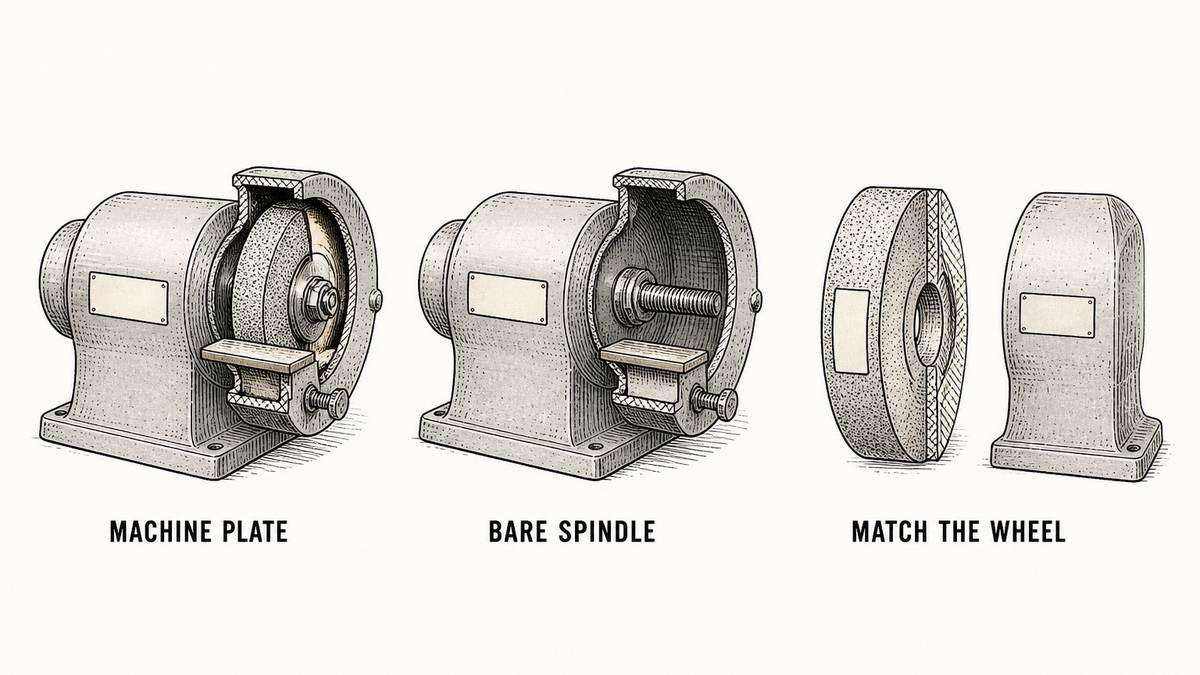
The second consequence is about responsibility when the two figures do not match. The maker is responsible for stating the limit honestly; the buyer is responsible for having bought a wheel whose limit covers the machine. Nobody at the machine side is required to know what was ordered. So the safe order is the one where the speed is settled in writing and the figure the factory marks is the figure the factory quoted. Ask for both in the same document.
One more thing is worth saying, because it is where buyers get quietly caught. An over-speed failure of a bonded wheel is not a gradual event; the wheel is in pieces. Everything else in this article is about the smaller risks. This one is the reason the rest of it exists.
The Ring Test, and Why a Wheel That Does Not Ring Is Not Always a Bad Wheel
The check the rules ask for before mounting is not a measurement. It is a sound. The wheel is tapped gently with something light and non-metal — the handle of a screwdriver on a small wheel, a wooden mallet on a heavier one — and if it sounds cracked or dead it is not to be used. The rule gives the practice its own name: the ring test.
The rule then immediately adds two conditions that most people who have heard of the ring test have never read.
The first condition is about the wheel's condition at the moment of the test. The wheel has to be dry and free from sawdust, because a damp or dirty surface deadens the sound. A wheel that has sat in an unheated store, or been wiped down with an oily rag, will sound dull for reasons that have nothing to do with its structure. Tapping it while wet is worse than not testing it, because a dull note invites you to condemn a sound wheel.
The second condition changes how a buyer should read a supplier's own test procedure, and it is easy to miss. Organic bonded wheels do not give the same clear metallic ring as vitrified and silicate wheels. The bond family changes the note. So the same tap that gives a bright ring on a vitrified bench wheel gives something much duller on a resin-bonded cut-off wheel, and that dull note is not evidence of damage. It is evidence that the wheel is resin bonded.
For a buyer this reads as a question for the factory and a line for the order. The question is which bond the product uses, because that decides whether the ring test can be used as a receiving check at all. The line is the bond family itself, named rather than assumed. A quotation reading “grinding wheel, 180 mm” has told you the diameter and nothing about whether the wheel is a hard-cutting bench wheel or a fast-wearing cut-off disc, and those are different products with different failure modes.
There is a related trap on the receiving side. The test looks for damage from transport and storage, so the thing it catches most often is a cracked bore — damage at the hole, usually from being dropped or pressed onto a spindle that did not fit. That is a defect created after the wheel left the kiln, which makes it a packing and handling question rather than a manufacturing one. It also means a sound ring on arrival says nothing about how the wheel was made. Two separate checks, neither replacing the other: the sound check catches handling damage, and the process record catches a wheel that was made badly in the first place.
What the Wheel Rules Cover, and What They Leave Out
This is the part of the rules that most often gets misapplied by buyers, and it is worth reading carefully because it is a scope paragraph rather than a requirement. Section 1910.215 states that natural sandstone wheels, and metal, wooden, cloth or paper discs having a layer of abrasive on the surface, are not covered by it. The construction-industry version of the same rule covers portable grinding in the same way, and leaves out the same products.
Read that as a list of what is left out. A bonded wheel — a disc made by mixing grain with a bond, pressing it and firing or curing it — is inside the rules. A coated product — a backing disc of metal, wood, cloth or paper with abrasive stuck to the surface — is outside them. That single sentence splits a supplier's catalogue in two, and the two halves do not share a rulebook.
It matters because catalogues do not split them. A page of grinding products from one factory will list vitrified bench wheels, resin-bonded cut-off wheels, depressed-centre grinding discs, flap discs and fibre discs next to each other, all described as wheels, all photographed the same way. They are not one product family and the rules treat them differently. Quoted as one line item, you have bought a mixed lot with a mixed set of obligations, and no factory will volunteer the difference.
So split the quotation, and name the split on the order: bonded wheels as one group with grain, bond and speed stated; coated discs as a separate group with backing material, abrasive type, grit and the disc's own speed rating stated. A flap disc still carries a speed limit and still has to suit the machine. Leaving the wheel rules out of scope does not leave the speed question out of scope; it only means a different set of requirements applies, and the person checking the goods needs to be told which set.
One further boundary is worth knowing for the same reason. The wheel rules say that on machines designed as portable saws, the spindle end, the nut and the outer flange may be exposed, and that side covers of a guard may be left off where the work itself covers the side of the wheel. Those are not permissions to ship a machine with no guard. They are recognitions that some machines are built differently. If you are buying a mounted assembly rather than a bare wheel, this is the paragraph that decides how the guard is made, and it is why a drawing is needed rather than a photograph.
Guards, Blotters and Flanges: The Parts Between the Wheel and the Operator
A wheel on its own does nothing dangerous. The energy comes from the machine, and the parts that turn a wheel into a usable tool are also the parts that stand between it and the person using it. Three of them have rules that are specific enough to be written into an order.
- Blotters
- A blotter is a compressible ring of paper fitted between the flange and the face of the wheel. The rules say blotters shall always be used between flanges and wheel surfaces, because they spread the clamping force evenly around the hole instead of concentrating it at a few points. There are listed exceptions, including mounted wheels, some plate-mounted wheels, abrasive discs of the inserted-nut or projecting-stud type, and cups or cylinders held in chucks. So the question to ask is not whether blotters are nice to have. It is whether your product type is on the exception list, and if it is not, whether the blotters are in the box.
- Flanges
- The rules give flange shapes their own requirements. Straight relieved flanges have to be recessed on the side facing the wheel, and flanges of the sleeve or adaptor type have to be undercut so that there is no bearing on the sides of the wheel close in to the arbor hole. The point is stated plainly in the text: getting this wrong causes excessive flange pressure around the hole of the wheel, and the text adds that this is especially true of sleeve and adaptor flanges. A wheel cracked at the bore is very often a flange problem, not a wheel problem.
- The guard
- The guard is the only part that does anything useful when a wheel fails. A bonded wheel that lets go does so in fragments, and a properly fitted guard is what turns a burst into an incident rather than an injury. If you are supplying a machine as well as a wheel, the guard diameter has to suit the wheel diameter, and the mounting has to be rigid enough that the guard does not move under load.
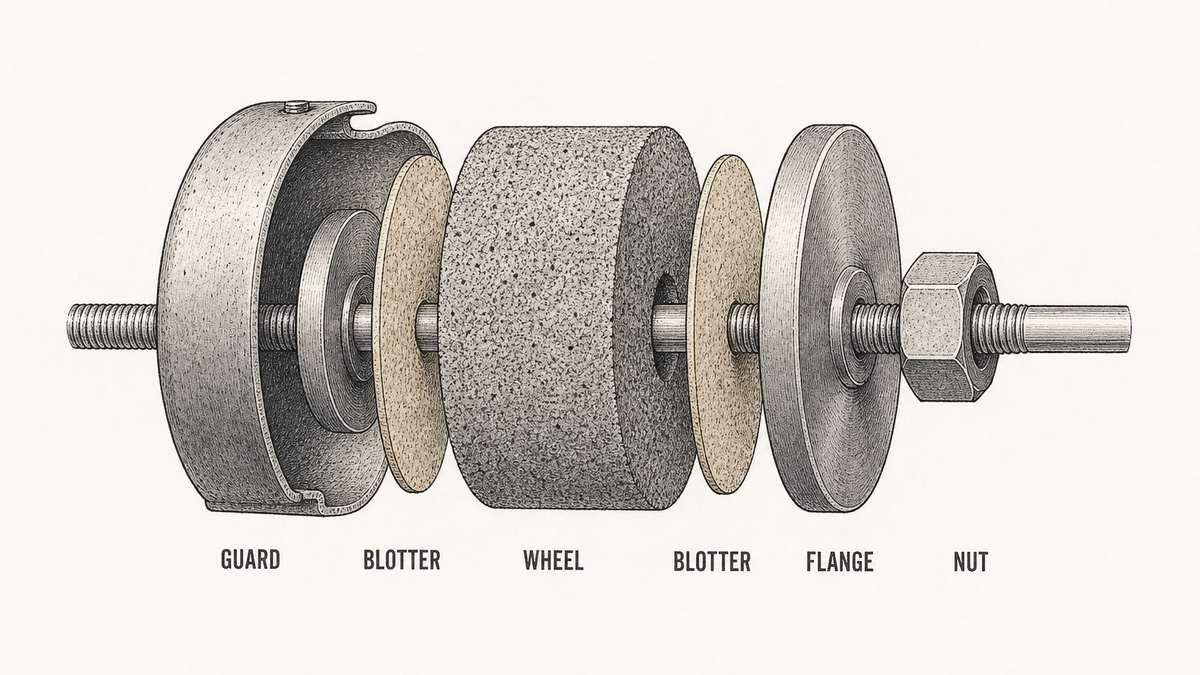
If you sell bare wheels rather than assemblies, this section is still yours, because it decides what goes in the carton. Blotters are cheap, they weigh almost nothing, and they are exactly the part a cost-cutting supplier leaves out when nobody asked. Put them on the order as a line item with a quantity per wheel, and put the flange drawing in the same document if you are buying the flanges too.
Work Rests and the Eighth of an Inch That Breaks Wheels
One rule in this section is more precise than the rest, and it is the one that reads least like a rule and most like a workshop tip. On offhand grinding machines — the bench machines where the operator holds the work by hand — work rests must be used to support the work. They have to be rigid, and they have to be adjustable so they can be moved in as the wheel wears. And then the number: the gap between the rest and the wheel must be kept to a maximum opening of one-eighth of an inch.
The reason is given in the same sentence, and it is worth quoting because it explains the failure rather than just forbidding it: a wider gap lets the work be jammed between the wheel and the rest, and that is what causes wheel breakage. A thin workpiece that slips into a wide gap is pulled down between two hard surfaces with nowhere to go. Nothing about that event involves an overloaded wheel. The wheel simply loses.
Two more requirements sit alongside it. The rest has to be securely clamped after each adjustment, so that grinding pressure cannot move it. And the adjustment must not be made while the wheel is running. Both of those are about the same thing: a rest that moves is a rest that opens a gap, and an open gap is the condition that breaks wheels.
For a buyer the consequence is that a work rest is a product in its own right, and a poor one cannot be compensated for by care at the machine. Ask for the adjustment range, the clamping method and the plate thickness. A rest made from thin sheet with a single screw clamp will move under a heavy pass; one made from thick plate with a lever clamp will not. If you are sourcing machines and wheels together, this is a detail cheap machines get wrong, and one of the few places where the cheapness is visible before the goods arrive. The same question comes up on any load-bearing accessory: are the checks that make a caster's load figure worth trusting testing the part that will actually be loaded.
Reading an Abrasive Wheel Supplier's Data Sheet
Most abrasive wheel listings give a shape, a diameter and a price. That is enough to order a commodity and not enough to buy on, because the three variables that decide what the wheel does to the work are all missing. Seven lines turn the listing into something you can order against.
- The dimensions, all three
- Diameter, thickness and arbor hole. Diameter alone leaves the other two to the factory's judgement, and the bore is where an ill-fitting wheel shows up first.
- The grain and the grit size
- What the abrasive is and how coarse it is. These two decide whether the wheel cuts freely or rubs, and they are the first things a cheaper quotation changes.
- The bond family
- Vitrified, resinoid, rubber, shellac or metal, and for coated products the backing material instead. This line also tells you whether the ring test is a useful check on your product or a misleading one.
- The maximum operating speed
- The number that has to be marked on the wheel and has to cover the machine it will be mounted on. Give the factory the machine's spindle speed and ask them to confirm the wheel suits it, so the comparison is on paper before it is on a spindle.
- How the wheel was formed and cured
- Pressed in a die and then fired or cured, with the process named and the kiln or oven time described. On a vitrified wheel this is the longest single step and the easiest one to shorten.
- The true running figure
- How far the finished wheel is allowed to run out of true, and how it was measured. A wheel that is round is a wheel that does not shake the machine apart.
- The marking and the packing
- What is printed on the wheel, where, and by what method, plus how many wheels go in a carton and what separates them. Packing is part of the specification on this product, because the failure it prevents is a cracked bore, which is the exact defect the user is instructed to look for before mounting.
Send those seven lines to two or three factories as a written request rather than asking for a price on a description, and the answers will sort the suppliers for you. A factory that presses and fires its own wheels will answer the forming and curing lines without hesitating. A trader will answer the dimensions and the price and go quiet on the rest. The check is the same one that separates a maker from a reseller on any industrial consumable, and it is worth doing properly rather than by impression, which is what the method in our guide to telling a factory from a trading company is for.
Bond Types and What Each One Rules Out
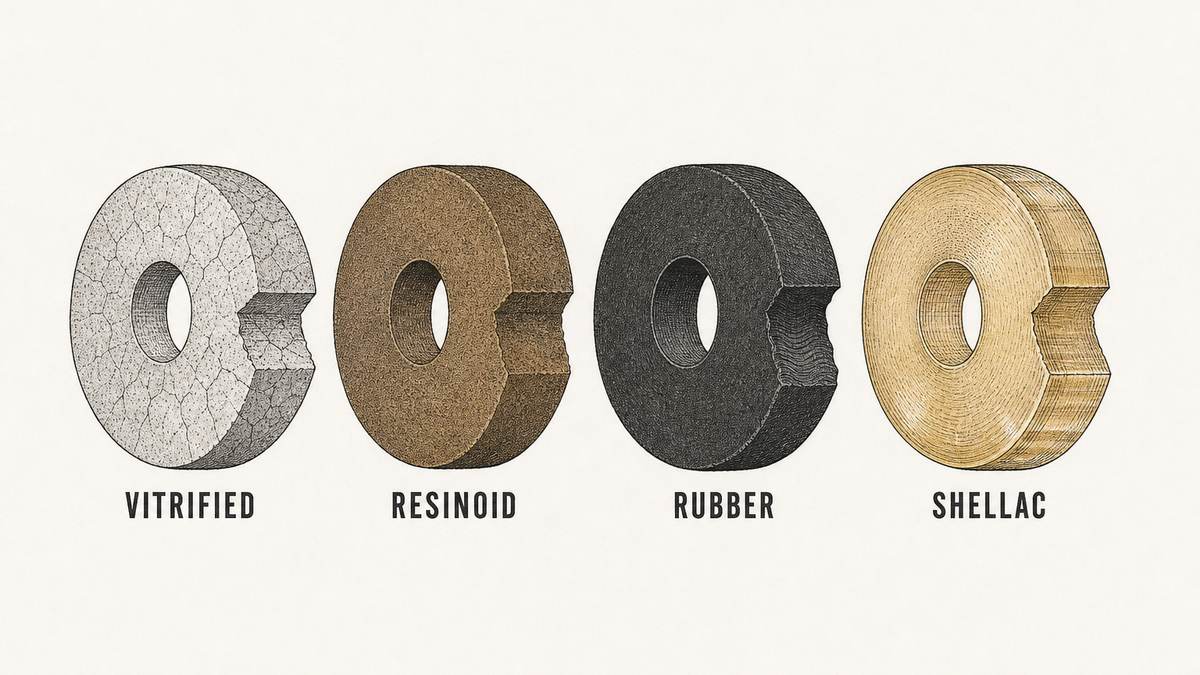
The bond is the material holding the grain, and it decides more about how a wheel behaves than the grain does. Four families cover almost everything a buyer will be quoted.
Vitrified. A glass-like bond, set by firing the wheel in a kiln. This is the classic bench wheel: rigid, porous and resistant to water, oil and heat. It gives the clear metallic ring the sound test is looking for, so a dead note here is a genuine warning. Firing is slow and energy-hungry, which is why this family is where a shortened kiln run shows up.
Resinoid. A synthetic resin, cured in an oven rather than fired. Tougher than vitrified and better at taking shock and side load, which is why cut-off wheels and portable grinding discs are almost always resinoid. They give a much duller note when tapped, and the rules say outright that organic bonds do not sound like vitrified ones. So a dull ring on a resin cut-off wheel on receipt is expected, and a receiver who condemns the batch on the sound test has misread the product.
Rubber. A softer, springier bond used where a fine finish matters and heat has to be kept down. Rubber-bonded wheels are sensitive to storage, because the bond ages.
Shellac. A bond giving a high finish at low heat, used where a vitrified wheel would burn the surface. It is a small part of most catalogues and a common quiet substitute when a buyer asks for a finish quality without naming the bond.
Metal-bonded wheels, where the bond is a metal matrix, are the diamond products used on very hard materials. That is a different price category and a different supply chain, and generally not what a general-purpose wheel factory is set up to press.
What the buyer has to do with all of this is small and specific. Name the bond on the order. Then use the bond to decide which receiving checks make sense, because the ring test is a strong signal on one family and a weak one on another, and the rules say so in as many words. And when a supplier offers to substitute “the same wheel” at a lower price, the bond is the first thing to ask about, because a swap from vitrified to resinoid can leave the diameter, the thickness and the picture unchanged while making it a different product for a different job.
What to Test, and What the Record Should Show
Testing on this product splits into two kinds, and confusing them is how buyers end up with paperwork that proves nothing.
The first kind is a process and strength check at the factory: that the mixture was made to the stated recipe, that the pressing gave even density, that the cure or firing ran for the stated time and temperature, and that the finished wheel runs true. These are the checks that prove how the wheel was made. They cannot be done by looking at the wheel, and on a bonded product they are the only way to catch a shortened kiln run.
The second kind is a check on the wheel as it stands, and the rules are direct about who does it and when: the user inspects and sounds the wheel immediately before mounting. That check belongs to the person who mounts it, not to the factory, and no supplier document replaces it. What the supplier can do is make it possible — by packing the wheels so they arrive undamaged, and by marking them so the user knows what they are handling.
- The process record
- One document per batch naming the grain type and grit, the bond, the pressing pressure, the cure or firing time and temperature, the true running figure, and the batch number that is also marked on the goods. A general product sheet with no batch number cannot be tied to anything in your warehouse.
- Hardness or grade checking
- Hardness on a bonded wheel is a grade, and it is what decides whether the wheel releases its grain at the right time. Ask how the factory checks the grade, because a wheel that is harder than specified rubs instead of cutting, and nothing about it looks wrong.
- A true running check on the first order
- Measured run-out, on a sample, recorded as a figure rather than a word. This is the cheapest single check on the list and the one that catches a worn pressing die.
- A spin or burst check, if the factory does one
- Ask what the factory tests and at what speed, and ask for it in writing. If they do not do it, you have learned something about the factory. Do not assume it happened because the words appear on a certificate.
Then there is the paperwork habit that makes all of it usable. On a first order, have the goods checked before they ship, with the inspection tied to the same document set you wrote on the request, and keep the batch number visible in the record. The workflow for that is the one in our guide to pre-shipment inspection, and the arithmetic for how many pieces to look at is in our note on the AQL sampling table. A first order is also the moment to run a proper drawing-based check rather than a visual one, because dimensional and process faults on this product are invisible to the eye — the method for that is set out in our guide to approving the first article from a new tool, and it applies here even though nothing is being machined.
Defects That Pass a Visual Check, and the One That Does Not Wait
Four failures account for most of the wheels that come back, and three of them are slow.
A loaded or glazed face. The cutting face has filled with metal and no longer presents sharp grain, so the wheel rubs, heats the work and stops removing material. It is a condition rather than a break, and the cause is usually a wheel that is too hard for the material or a feed rate that is too light.
Out of round. The wheel no longer runs true, so it hammers the work and shakes the machine. Usually a wheel that was not trued, or a bore and flange that did not seat properly, or a die that was worn during pressing.
A cracked bore. A crack radiating from the hole, often with bruising around it. This is the failure that handling and packing cause and that the sound test is designed to catch, and it is the one that most often turns into a burst once the wheel spins.
A burst. The wheel comes apart. This is not a wear condition and it is not a slow failure; it is the event that guards, blotters and correct flanges exist to prevent, and it happens when a wheel is run above its marked speed, or mounted with unequal flange pressure, or started after it had already been cracked.
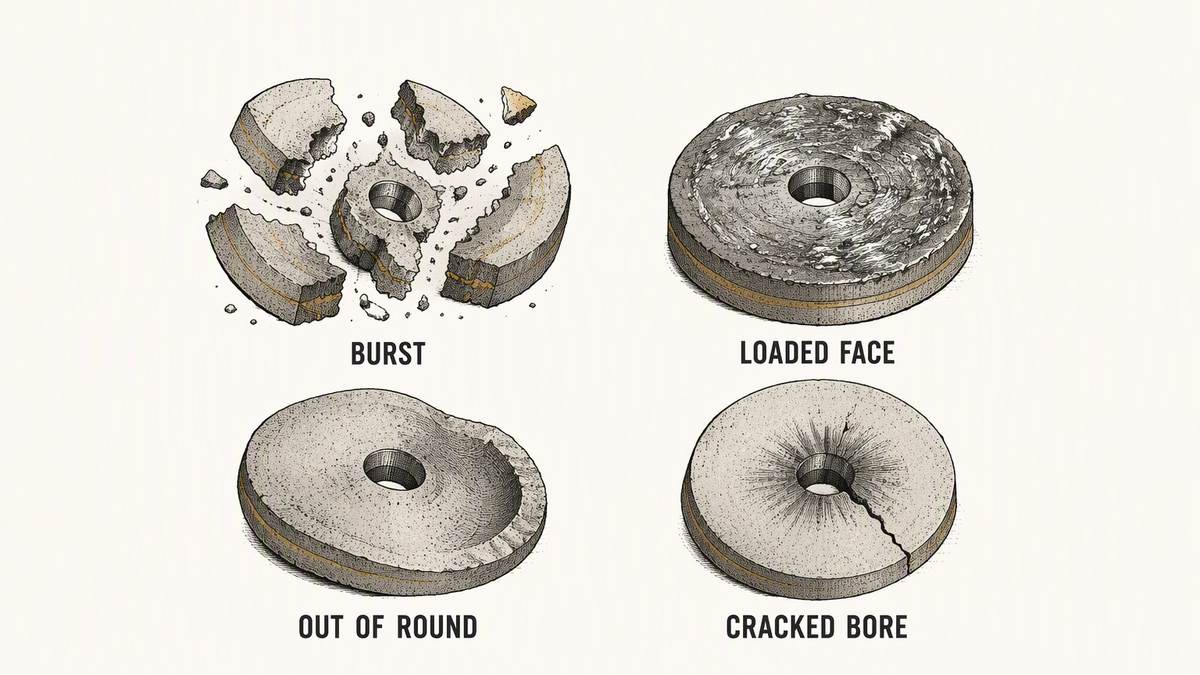
What separates the fourth from the other three is that it is a shipping and receiving question rather than a use question. A burst that is not caused by over-speed is usually caused by damage that arrived with the goods, which is why packing belongs in the specification and why the user is told to sound the wheel before mounting rather than to trust the carton. If you are buying wheels for a workplace, the useful thing you can do as a supplier is ship them so that they arrive as they left, and say so in the packing instructions.
What a visual check cannot catch is the other half of the problem: a wheel made from a cheaper grain, or fired for less time than specified, or pressed in a worn die, looks exactly like a good one. Those are caught by the process record and by a true running measurement, not by looking. That is why a written specification sheet is worth more on this product than on most, and why a certificate number is worth checking with whoever issued it — the same exercise as checking a factory certificate in the issuer's own database.
How the Price Is Built, and How to Check the Supplier Behind It
An abrasive wheel has eight cost lines and only one of them is visible on a quotation. Knowing which eight they are is what makes two prices comparable, because the gap between them is almost never in the line you are looking at.
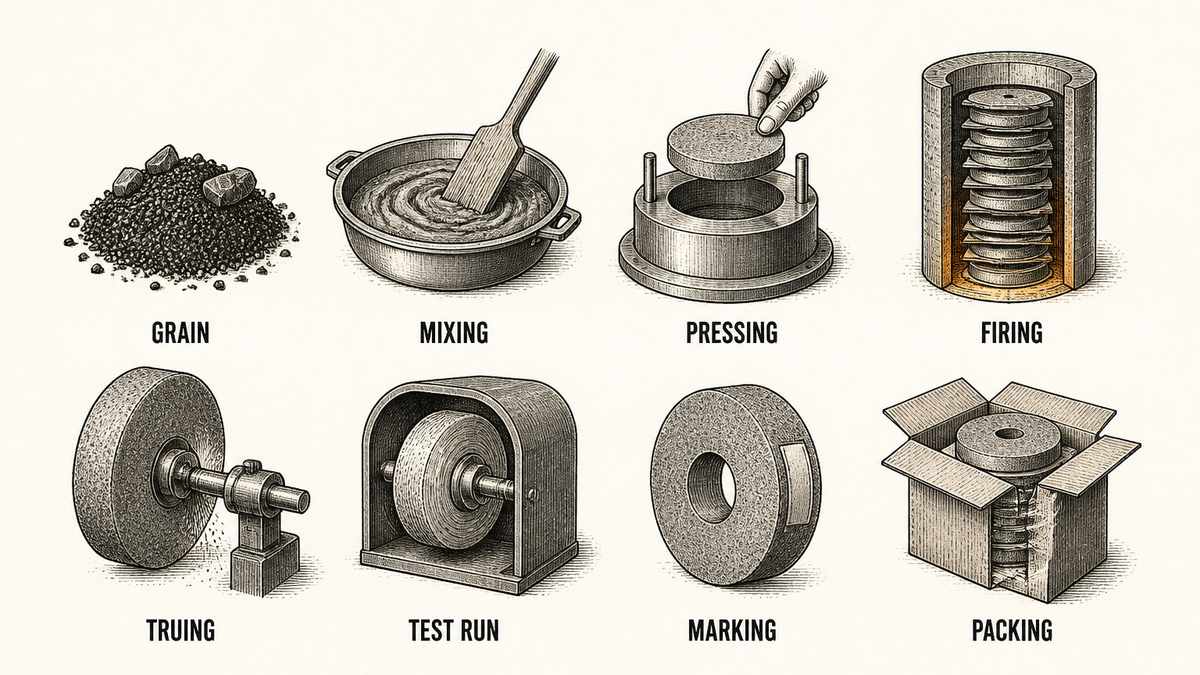
The grain line is the abrasive itself and the largest material cost, so it is also the easiest to change without changing the appearance of the wheel. Mixing is grain, bond and a temporary binder worked together with the right amount of moisture. Pressing is the die and the press; a worn die gives uneven density, which shows up later as a wheel that runs out of true. Firing is the kiln run, the longest and most energy-hungry step, and the line that gets shortened. Truing machines the wheel to size and makes the face true. The test run is the line that vanishes most often. Marking gives the wheel its speed figure, and packing is what stops the bores arriving cracked.
So two of the eight lines are invisible in the finished product, and one of them — the marking — cannot be omitted at all, because a wheel without its speed figure has lost the information the user is required to check. A quotation that states the grain, the grit size, the bond, the curing process and the speed figure is one you can compare; a diameter and a price is not. The same discipline works on any consumable you buy repeatedly, and the checks that make two conveyor belts comparable are the checks that make two wheels comparable.
Minimum order quantity on this product is set by the die, in the same way that it is set by the tool on any pressed or moulded part. A standard diameter, thickness and bore in a standard bond is an off-the-shelf item and can often be bought in small numbers. A non-standard diameter, a different bore, or a different bond means a new die or a new mix, so the first order carries the setup and the quantity follows from it. If you are quote-shopping a small order, quote the standard size first and then ask what changes when you move away from it.
Then check the party you are talking to, which on this product is unusually easy to test. Ask who fires or cures the wheels. A real maker has a kiln or a curing oven and can describe the cycle; a trader buys finished wheels and cannot change the grain or the firing time at all, which matters the moment you want a different bond or a different grit. Ask to see the pressing die and the marking station. Ask for samples from two different production runs rather than five from one afternoon, because two batches made months apart tell you far more about consistency than five made side by side. And on the first order, get the goods checked against the seven lines you wrote on the request before they ship.
Frequently Asked Questions
Do abrasive wheels have an expiry date?
The rules quoted here do not set one, so treat any date a supplier gives you as maker's advice rather than a legal limit. What the rules do say is that the wheel must be inspected and sounded immediately before mounting, because that check is about condition now, not age. Ask how your supplier stores stock, and treat a long-stored carton as a reason to test carefully.
Why do the rules say the maximum speed is marked on the wheel?
Because the limit belongs to the wheel and the running speed belongs to the machine, and the rules tell the user to compare the two before mounting. Spindle speed comes from the motor and pulley; the limit comes from how the wheel was made. So a wheel has to suit a machine that already exists, and the figure has to be legible on the product.
My cut-off wheels do not ring when I tap them. Are they defective?
Not necessarily, and the rules say so directly. Organic bonded wheels do not give the same clear metallic ring as vitrified and silicate wheels, and cut-off wheels are almost always resin bonded. The test also has to be done on a dry wheel free from sawdust, at several points around the rim. Settle the bond type first, then use the test only where it can tell you something.
Are flap discs and fibre discs covered by the same rules as wheels?
No. The rules on abrasive wheel machinery leave out natural sandstone wheels and metal, wooden, cloth or paper discs with a layer of abrasive on the surface, which is the family a flap disc or fibre disc belongs to. Those are coated products on a backing, and different requirements apply. A coated disc still carries its own speed limit and must still suit the machine.
What is a blotter, and do I need to buy them?
A compressible ring of paper fitted between the flange and the wheel face to spread the clamping force evenly around the hole. The rules say blotters shall always be used between flanges and wheel surfaces, then list exceptions: mounted wheels, some plate-mounted wheels, abrasive discs of the inserted-nut type, and cups or cylinders held in chucks. Specify a quantity per wheel and check the carton.
How do I check a supplier who says they are a manufacturer?
Ask about the two steps a reseller cannot fake: who mixes the grain with the bond, and who fires or cures the finished wheel? A maker can describe the cycle and the kiln. A reseller can only pass the question back up the chain. Then ask to see the pressing die and the marking station.
Send the machine's speed and the material — not just “a 180 mm wheel”
Tell us what the wheel has to cut and what will drive it, then the lines that decide whether it can be used at all: diameter, thickness and bore, the grain and grit size, the bond family, the maximum operating speed, the forming and curing process, the marking method, and whether blotters are in the box. If wheels have already arrived out of round, running hot, shedding their face, or with a cracked bore after shipping, or if a mixed quotation has left you unsure which items are bonded wheels and which are coated discs, send a photograph and a short description — the symptom usually says whether it was the grain, the bond, the firing, the flange or the packing.
Request an Abrasive Wheel Sourcing Quote
Questions & Comments
We read every one and reply within 24 hoursSourcing abrasive wheels and getting quotations that all say “180 mm grinding wheel”? Send the machine's speed and what the wheel has to cut, then the lines that decide whether it can be used at all: diameter, thickness and bore, the grain and grit size, the bond family, the maximum operating speed, the forming and curing process, the marking method, and whether blotters are in the box. If wheels have already arrived out of round, running hot, shedding their face, or with a cracked bore after shipping, or if a mixed quotation has left you unsure which items are bonded wheels and which are coated discs, describe what you saw and roughly when it appeared, because the symptom usually says whether it was the grain, the bond, the firing, the flange or the packing.