
Eye Bolt Manufacturer: Sourcing Lifting Eye Bolts From China
 ·
Updated October 12, 2026
·
18 min read
An eye bolt is the cheapest part in a lift and the one that sets its rating. The maker decides that rating, and the rules want it written on the part rather than left in a catalogue: the rule that governs overhead cranes defines a crane's rated load as the load its maker designed it for, shown on the equipment plate, and the same idea runs through every piece of lifting gear. So the question for a buyer is not what an eye bolt can hold. It is how the number gets lost. It is lost when the eye is not forged. It is lost when the load does not come straight out of the eye. It is lost when a lighter eye bolt is used with a heavier chain, because an assembly only runs at the figure of its weakest part. And it is lost the moment nobody stamped the number on the part, because gear without a legible marking is gear nobody may use.
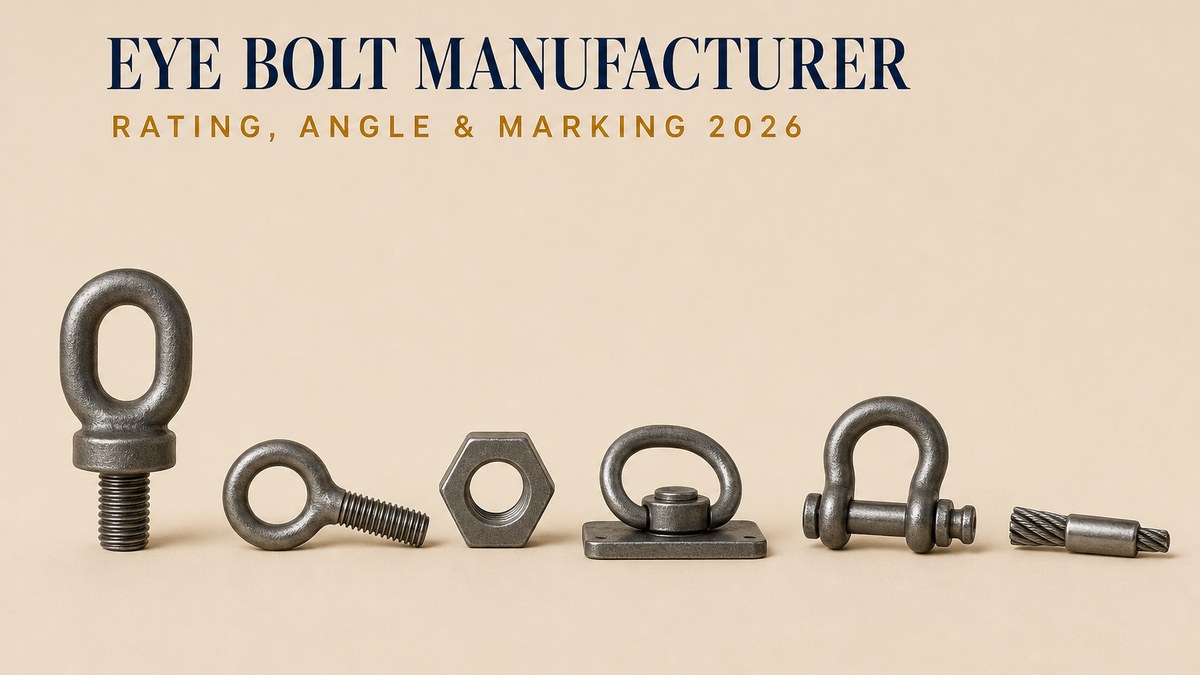
The Four Ways the Number Goes Wrong Before the Load Moves
| What you are trying to avoid | Why it happens anyway | The line on your order that closes it |
|---|---|---|
| A part that cannot lawfully be put into service at all | Rigging gear must carry a permanently fixed, legible marking that states its safe working load, and gear without that marking must not be used | The marking content, the method, and who decides the figure |
| A rating that lapses because the part was not forged | The rules name makeshift fasteners made from bent bolts or rods and refuse them outright | How the eye is formed: one forging, or rod bent over and joined |
| A rating that is real on the bench and wrong in the lift | An attachment must be rated at least as high as the chain it works with, or the assembly is limited by its weakest part | The rating of every component in the assembly, not just the eye bolt |
| A rating that assumes a direction the load does not come from | Loading at an angle stops being edge-of-square almost immediately, and an angled pull bends the eye and shank | The direction the load will pull, and the shoulder that suits it |
| A rating with nothing behind it | A proof test is a pull, not a promise, and the paperwork names who did it | The test, the acceptance figure, and the record per batch |
| A price that fell for a reason you cannot see | On this product the money is bar stock, hammer time, thread and finishing, and only one of those is easy to check | The cost lines shown separately, with the shank diameter and the thread |
What Are You Buying? Four Bodies, and Only One Is Forged in a Single Piece
Start with the shape, because the shape decides which part of the bolt carries the load.
The plain eye bolt. The loop is made by bending round bar or rod stock over into an eye and closing it back against the shank. When the join is a weld, the eye is only as strong as that weld, and a weld is the part of the product with the least metal around it. When the join is a forge weld formed while the metal is hot, the join is better than a cold weld but it is still a join. The whole family is cheap to make, which is why it is everywhere, and it is the family the rules are talking about when they ban makeshift fasteners formed from rods.
The forged eye bolt. A cut length of bar is heated and pressed in a die so the eye, the collar and the shank are one continuous piece with no join anywhere, and the grain of the steel runs around the curve of the eye instead of across it. That is why a forging survives a pull that would open a bent eye. This is the body to specify when the load matters, and the body a supplier will quietly substitute if you write “eye bolt” and nothing else. Ask for a section drawing, because the two look similar in a small catalogue image and completely different at the join.
The machinery or shoulder eye bolt. The same forged body with a wide flat collar machined under the eye. The collar is not decoration: it seats flat against the surface the bolt is screwed into, so the pull runs down the shank instead of bending it over the edge of the hole. A plain eye bolt in the same hole behaves like a lever on its own thread.
The eye nut and the swivel hoist ring. An eye nut is a loop with an internal thread, used where a stud is easier to provide than a tapped hole. A swivel hoist ring is a loop that turns on a bushing set into a base plate, so the eye follows the load and the pull stays in the plane the ring was designed for. It answers a lift that changes direction and costs several times an eye bolt, which is why it is the part most often faked with a welded ring on a plate.
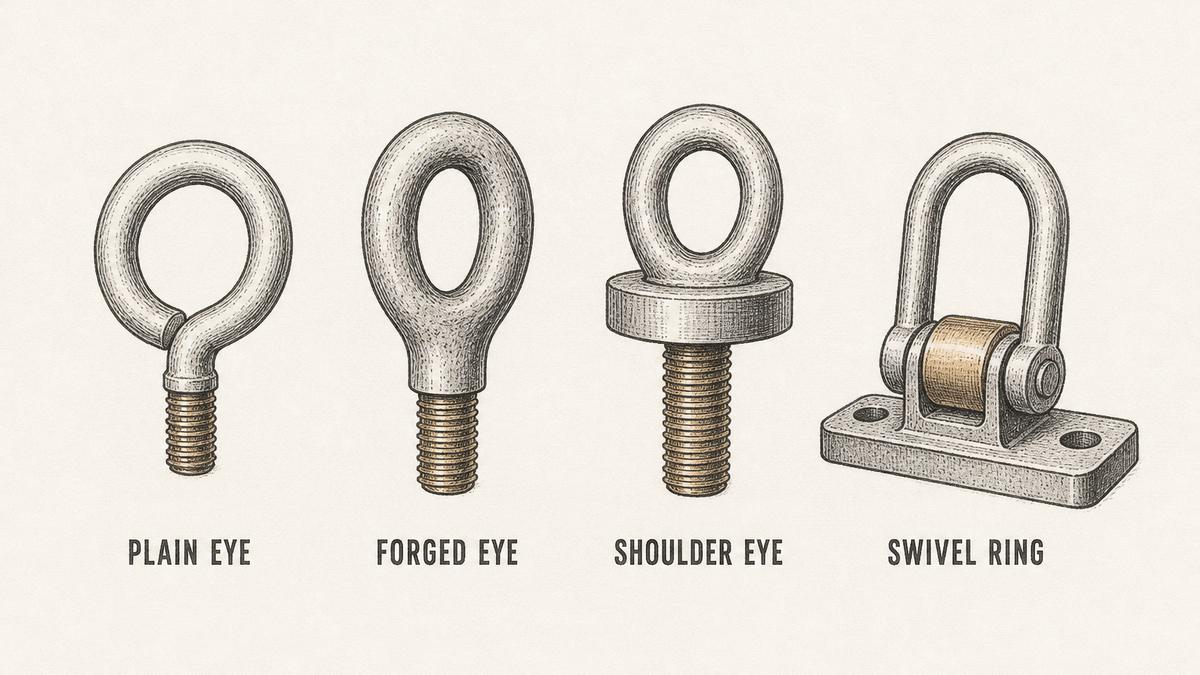
These four are not interchangeable versions of one product. They are four answers to the question “where will the load enter, and what will it do when it gets there”. An order reading “eye bolt, 1/2 inch, galvanised” has specified the thread and the finish and left out the two lines that decide whether the part holds a lift.
Forged or Bent From Rod — Why the Rules Treat These Two Differently
This is the single most useful thing to understand about the product, because it is the one difference a factory can hide in a photograph and the one difference the rules address by name.
29 CFR 1910.184, the section that covers slings, says it twice. A hook, ring or other attachment used with alloy steel chain must have a rated capacity at least equal to the chain it works with. And then, separately: “Makeshift links or fasteners formed from bolts or rods, or other such attachments, shall not be used.” The construction-industry rigging rule carries the same sentence: job or shop hooks and links, or makeshift fasteners formed from bolts, rods, or similar, must not be used.
Read that as a description of a product and it is very specific. Take a length of rod. Bend one end over into a loop. Weld or forge the end back to the shank. Thread the shank. That is a bent eye bolt, and the rule calls the result a makeshift fastener formed from a rod. It is not a rule about quality. It is a rule about what the thing is: a piece of rod with a bend in it, which the person who wrote the rule did not accept as lifting gear.
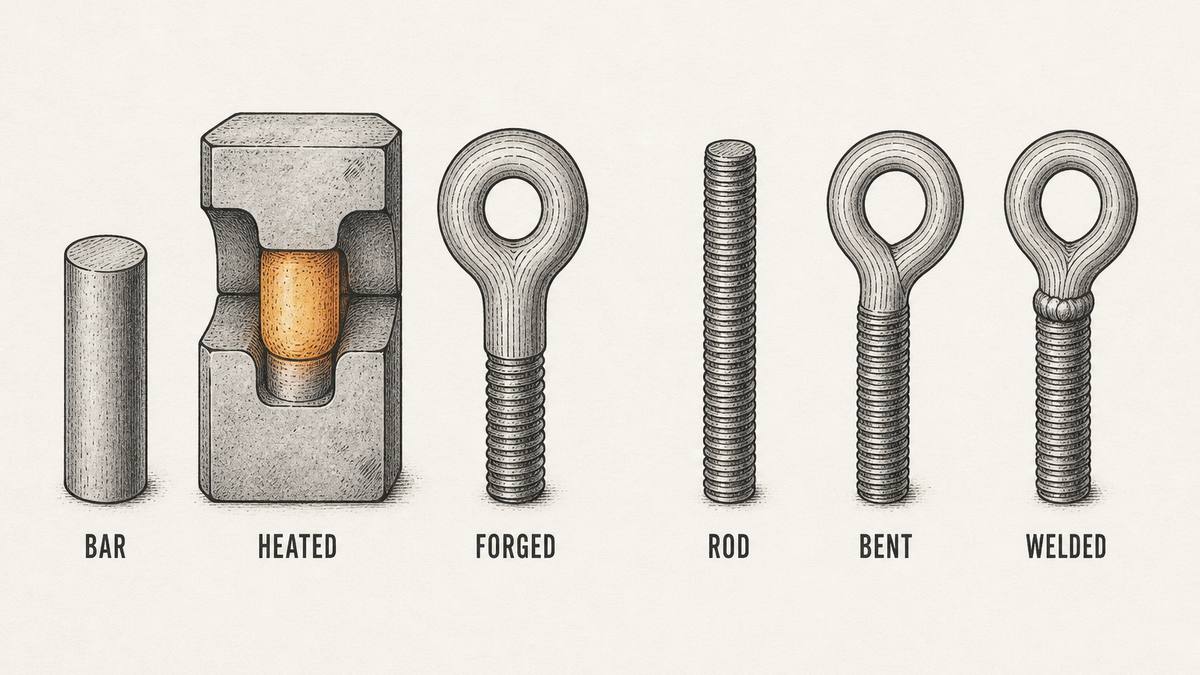
What follows for a buyer is a specification line, not an inspection problem. You cannot check a forging by looking at a finished, painted part in a warehouse. You can check it by requiring the process and by making the supplier show it. Ask for the forming method in writing — drop forged in a closed die, one piece, no welded or forge-welded joint in the eye — and ask for a section drawing or a cut sample with the first order. A supplier who makes both will tell you which one you are being quoted once the question is on the table, and the price difference between the two is one of the few differences on this product that is genuinely visible in a quotation.
There is a quieter version of the same problem. A forged eye bolt can still be wrong if the forging was not hit hard enough or the die was worn, because a forging that does not fill the die leaves the eye thin on one side. That is a supplier-control question, and the way to reach it is through the sample and the test record rather than the drawing.Having the first order checked against a drawing is the cheapest version of that check.
Why the Rating Stamped on the Part Is Not the Rating of Your Lift
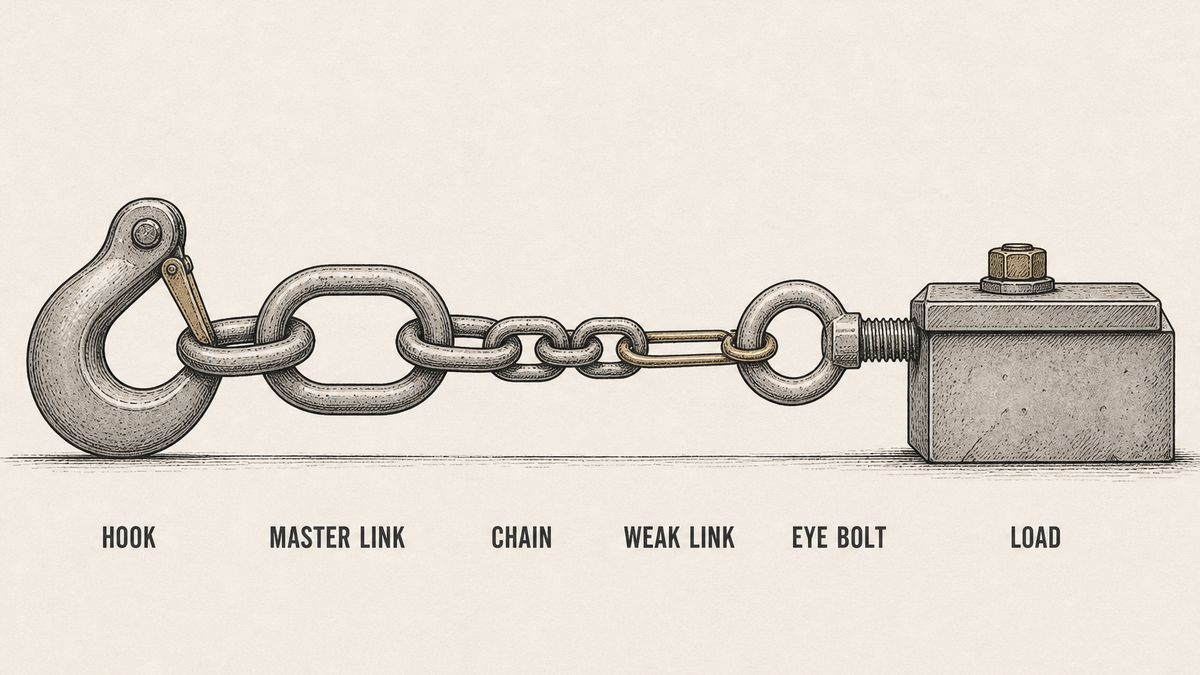
An eye bolt is almost never used on its own. It is the end of an assembly that also contains a hook, a master link, a chain or a rope, and often a second fitting at the load. The rules do not rate the parts. They rate the assembly, and they do it by pointing at the weakest part.
The wording is worth reading slowly. Attachments used with alloy steel chain — and the list of what counts as an attachment is deliberately open, covering hooks, rings, oblong links, pear-shaped links and welded or mechanical coupling links — “shall have a rated capacity at least equal to that of the alloy steel chain with which they are used or the sling shall not be used in excess of the rated capacity of the weakest component”. Both halves of that sentence have to be read together, because the second half is what actually governs a real lift. You may use a small eye bolt with a big chain. You simply may not use the assembly above the smaller figure.
So when a supplier quotes you a chain sling and an eye bolt together, the number on the quotation is not automatically the number you can lift. Buyers get caught here in a very ordinary way: they buy a chain rated well above the load, because the chain is the visible part and the price difference is small, and then choose the eye bolt on price because it looks like a minor item. The assembly comes back rated at the eye bolt. Nothing on the paperwork is wrong. The lift is simply half what the chain could do.
There is a second duty in the same sentence, and it is one a buyer usually has to pass on to whoever will use the goods. The crane rules define the rated load as the load the maker designed the equipment for, shown on the equipment plate, and the rigging rules require each piece of gear to carry a permanently fixed and legible marking stating the safe working load the maker recommends. Employers must not load gear above that figure or use gear without a legible marking. No supplier certificate in your email folder meets that duty. A number on the part does.
So the marking is a purchasing decision, not a warehouse detail. If you are supplying a workplace, an unmarked eye bolt is not a cheap eye bolt; it is one with no lawful use, and the person who has to explain it is your customer. Our note on how load ratings are stated on casters makes the same point on a different product.
The Angle Rule: Why the Same Eye Bolt Holds Less When the Pull Comes Sideways
An eye bolt is rated for a pull along the axis of its shank. Twist the load off that line and you have changed the product into a different one, because the shank now acts as a short lever and the thread takes a bending load it was never sized for. The eye distorts at the same time: it goes out of round and stretches towards the pull.
The rules do not leave the buyer guessing about what counts as straight. The sling section defines the angle of loading and then adds a working tolerance: an angle of loading of five degrees or less from the vertical may be treated as a vertical angle of loading. Five degrees is roughly a finger's width of drift over the length of a hand. It is a small allowance, and it tells you how the rule-writer thought about direction: either the pull is along the line, or it is an angled lift and the numbers change.
That is why the shoulder exists. A shoulder eye bolt has a wide flat collar machined under the eye, and when the bolt is tightened down the collar seats on the surface around the hole, so the pull passes into the plate through the collar face instead of through the threads alone and the shank is held square. A plain eye bolt in the same hole has nothing bearing on that surface, so the whole load arrives at the first engaged thread as a lever — and the thread is the smallest section in the product.
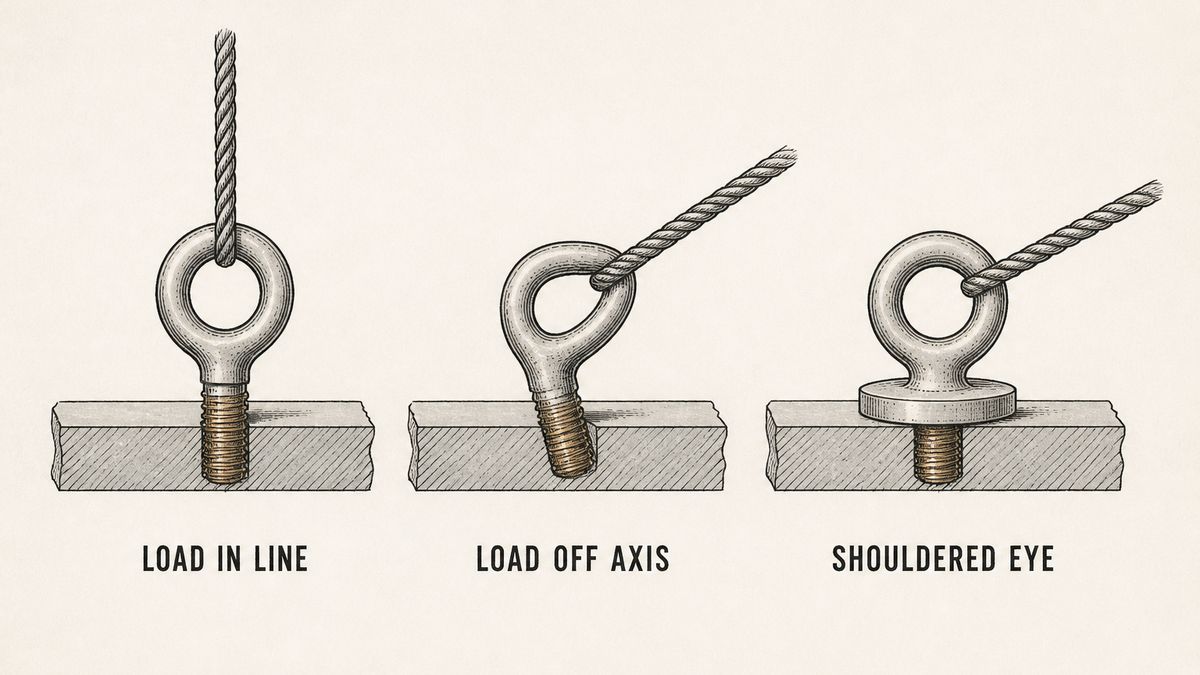
Two cheap questions follow. In which direction will the load pull — straight along the bolt, or off to one side and roughly how far off? And will that direction stay the same for the life of the fitting? If it will not, the honest answer is a swivel hoist ring, which turns to follow the load and keeps the pull in the plane it was designed for. Buying a heavier eye bolt to cover an angled pull is the most common wrong answer here, and it fails for a simple reason: the failure is a bend, not a break.
What Has to Be Marked on the Part, and Who Decides the Number
Rigging equipment must carry permanently fixed and legible identification that states the safe working load the maker recommends, and it must not be used without that marking. The same rule sets the duty on the user: do not load the gear above the figure the maker put on it. The chain-sling section of the sling rules is even more specific about content, requiring durable identification that states size, grade, rated capacity and reach.
Pulled apart, that gives a buyer four decisions that all belong on the order rather than in a warehouse discussion.
- What the marking says
- At a minimum the safe working load, plus the size and the body form so the part can be matched to a drawing later. If the figure depends on how the bolt is loaded, the marking is half true without that condition, so either the rating assumes a straight pull and the order says so, or the part is marked for the direction it was made for.
- How it is put on
- Permanently and legibly. A stamped or laser-marked shank end survives handling; a printed label does not, and a mark buried under two coats of paint or filled solid by galvanising is not legible. This is the one marking requirement a factory can quietly fail while the part itself is perfect.
- Who the maker is
- The figure is the maker's figure, so the part has to be traceable back to the party who set it. A part number or a maker's mark on the same surface does that, and it is what makes a test record useful three years later when a customer asks about a batch.
- Who is the maker, in your chain
- This is the part buyers miss. If you buy to your own brand and your name goes on the box, then from your customer's side you are the one who recommends the figure. The record you need in order to stand behind it is a batch test record from the factory under your own part number, not a general product certificate.
So decide the marking content before you ask for quotations: a factory that has to add a marking step will price it, and one that is never asked ships the part plain. If the goods go into a workplace, an unmarked part is not a saving, and that is a conversation you want with the factory rather than your customer.
How to Read an Eye Bolt Supplier's Data Sheet
Most eye bolt data sheets on supplier pages are one line long: a size, a safe working load, and a picture. That is not enough to buy on, and the missing lines are always the same ones. Seven lines turn a page like that into something you can order against.
- The thread, exactly
- Diameter, pitch and thread form — an M12 by 1.75 is a different part from an M12 by 1.25, and a half-inch UNC is a different part from a half-inch UNF. A supplier who writes only the diameter has left half the interface undefined, and the mating hole or nut is the other half of the joint.
- The body and how it was formed
- Forged in one piece, shoulder type, or swivel ring; and whether there is any joint anywhere in the eye. This is the line that decides whether the part is the product the rules accept or the one they name and refuse.
- The material and the heat treatment
- Grade of steel and what was done to it after forming. Two eye bolts in the same size and finish can come from the same bar stock and behave completely differently after one has been hardened and tempered and the other has not.
- The rating, and the condition it assumes
- Safe working load, plus the loading direction the figure belongs to and whether it is the part's figure or the assembly's. A number with no condition attached is a number you cannot use.
- The finish, and the thickness
- Self-colour, plated, or hot-dip galvanised, and the coating thickness where it matters. On a galvanised part, the coating thickness on the thread decides whether your nut will go on at all.
- The proof test
- The load applied, how it was applied, what was accepted, and how many pieces. A pull either has a figure and a record or it did not happen.
- The marking
- What is written on the part, by what method, and where. If it is not on the sheet, it will not be on the goods.
Send those seven lines to two or three factories as a written request rather than asking for a price on a description, and the replies will sort the suppliers for you. A factory that makes forged eye bolts answers all seven; a trader answers the size, the price and the finish and goes quiet.The same tests that expose a trading company behind a factory front apply here too.
Threads, Shoulders and the Hole the Bolt Screws Into
Here is the awkward part of buying this product: the weakest point in the finished lift is often not on the supplier's data sheet, because it is the hole you tapped yourself.
Under a straight pull, the load travels down the shank and out through the engaged threads. The section that carries it is the core of the shank and the full depth of engaged thread, which is why the depth of thread matters as much as the diameter. A tapped hole that is too shallow puts the load on a few threads, and the first thread to be stripped is followed instantly by the next one, so a short engagement does not fail gently. The common shop guide is an engagement at least as deep as the bolt's own diameter in steel and deeper in softer material, but the figure that actually counts is the one your supplier's rating assumes. Ask for it. An eye bolt supplier who has tested their product knows the engagement their number was measured at, and one who has not will give you a blank look.
Second, how the thread was made. A cut thread is machined out of the shank, so the grain is sliced across at every thread root. A rolled thread is formed by squeezing the shank between dies, so the grain flows around the roots instead of being cut across them. For the same size and steel, a rolled thread is stronger where it matters, and it is a line to put on the order rather than hope for.
Third, the seating face. A shoulder eye bolt only works if the collar lands flat on a machined, square face around the hole. A heavy chamfer, a weld bead or a radius at the hole edge holds the collar off the surface, so the bolt rocks and the pull goes back into the threads — the exact failure the shoulder was bought to prevent. If the surface will not be square, the answer is a swivel ring or a welded pad eye, not a bigger shoulder bolt.
Fourth, the length. A partly threaded shank is normal on this product, and the plain portion between the thread and the eye is the part that is meant to sit inside the hole. Specify the thread length and the total length, not just one of them, and check the drawing rather than the photograph. Getting a shank that is too short means the collar cannot seat; getting one that is too long means the plain shank stands proud of the hole and the load is carried by fewer threads. Both mistakes are invisible in a catalogue image. They are exactly the sort of thing a written specification sheet prevents, because a drawing forces the supplier to answer both numbers.
Materials and Finishes, and What Each One Rules Out
The material and the finish are usually the last two lines a buyer thinks about and the first two lines a factory adjusts to hit a price.
Low carbon steel. Cheap, soft and easy to forge, and the right answer for light duties where the load is trivial and the eye bolt is really just a tie-down point. It cannot be hardened to any useful degree, which is the point to remember: the same shape in this steel will not give you the same number.
Medium carbon or alloy steel. The normal choice for a rated lifting eye bolt. Forged, then hardened and tempered so the part is tough rather than merely hard, because a part that is too hard cracks instead of bending. If the heat treatment is skipped to save a step, the part looks identical and the rating is not there.
Stainless steel. Chosen for corrosion resistance, and the trap is that stainless is not automatically a lifting grade. The common austenitic grades cannot be hardened by heat treatment, so a stainless eye bolt of a given size normally carries less than the same size in alloy steel. Two further properties matter in service: stainless threads tend to seize or gall when tightened dry, and some grades crack in chloride-rich places. If a customer asks for stainless because the site is wet or coastal, stainless is the right instinct and the wrong automatic substitution.
Finishes deserve their own line because two of them can cause a defect rather than prevent one.
Electroplating on a hardened, high-strength part carries a known risk: the plating process can drive hydrogen into the steel, and a part that absorbs it can crack under load without any warning. Look for the order to state that the parts are treated after plating to drive the hydrogen out, and treat silence on that line as a reason to ask again.
Hot-dip galvanising adds a thick coating on every surface, including the thread. A galvanised thread that was cut to its standard size will not accept a standard nut, which is why galvanised fasteners are normally made with a thread allowance and sold with a matched nut. If you are buying a galvanised eye bolt and a nut separately from two suppliers, that is the line where the two will not meet.
And a small one that catches people every year: paint, powder coating and heavy galvanising can cover the marking. Specify the marking as the last operation before packing, or specify that it must remain legible after finishing, and put it in the order rather than in a conversation.
What to Test, and What the Test Record Should Say
A proof test is a pull, not a promise. The sling rules define it as a tension test that does not damage the part, carried out by the maker or an equivalent party, to check how the piece was made. Note what it leaves out: a proof test says nothing about the metal inside the part, so it never replaces a material record.
One figure turns up twice and is worth remembering as a benchmark. The rigging rules require custom lifting accessories to be proof-tested before use to 125 percent of their rated load, and the crane rules cap a crane's test load at the same 125 percent, with the reports kept on file. Two sections, one number, and the same habit of keeping the paper. Compare any offered proof test against 125 percent of the marked figure.
What to ask for on the first order, in the order you will need it:
- The proof load and what was accepted
- The figure applied, the hold time, whether the part is checked for deformation afterwards, and how many pieces were pulled. A pull on one piece out of five hundred is a process check rather than a batch guarantee — fine to accept, as long as you know which one you bought.
- The hardness
- A cheap way to catch skipped heat treatment, because the part that went into the furnace and the part that did not have the same shape and different hardness. It is also the only practical way to catch it without cutting a part open.
- The thread
- Gauging on the pitch and the diameter, and a statement of whether the thread was cut or rolled. A cut thread is not a defect on its own; an unstated one is a line you cannot compare between two quotations.
- The surface of the eye
- On anything going into regular lifting duty, a check for surface cracks inside the eye by a magnetic or dye method. The inside of the eye is the hardest part to make and the hardest to look at, and a crack there starts the whole failure.
- The coating
- Thickness on a plated or galvanised part, measured rather than described, and on electroplated high-strength parts the statement that the parts were treated after plating to drive out hydrogen.
- The record itself
- One document per batch, naming the maker and address, the part number, the batch, the steel grade, the heat treatment, the test figures with their acceptance, the date and a signature, and carrying the same batch number that is marked on the goods.A certificate number is worth checking with whoever issued it — look it up in the issuer's own database rather than on the supplier's own scan.
That last line is what makes a test usable. Only the batch number on the part lets you find the batch again two years later.On a first order, have the goods checked before they ship and tie the inspection to the same document set.
Defects That Pass a Visual Check, and the Four That Cannot
Four failures account for most of the eye bolts that come back, and all four are recognisable without instruments.
An eye that has been opened or stretched. The loop is no longer round and the metal is thinner at the widest point. This is an angled pull or an overload, and the part cannot be straightened and reused, because the metal has already been taken past the point where it will go back.
A thread that has been pulled. The shank has come out of the hole with the thread flattened or smeared. Almost always a tapped hole that was too shallow, or a load above the figure that the engaged depth was measured at. The eye bolt is usually the innocent party and the hole is the problem, which is why the hole belongs in the same drawing as the bolt.
A cracked joint on a formed eye. On a bent eye bolt, the weld or forge weld where the bent end meets the shank is the place to look first, and a crack there is the reason the rules name the product. On a forged eye bolt there is no joint, so there is nothing to find.
Corrosion that has eaten under the finish. Rust bleeding out from a plating break, or a white crust on galvanised parts where the coating has broken down. The part may still look broadly sound while the section has been reduced, and the marking is often the first thing to disappear.
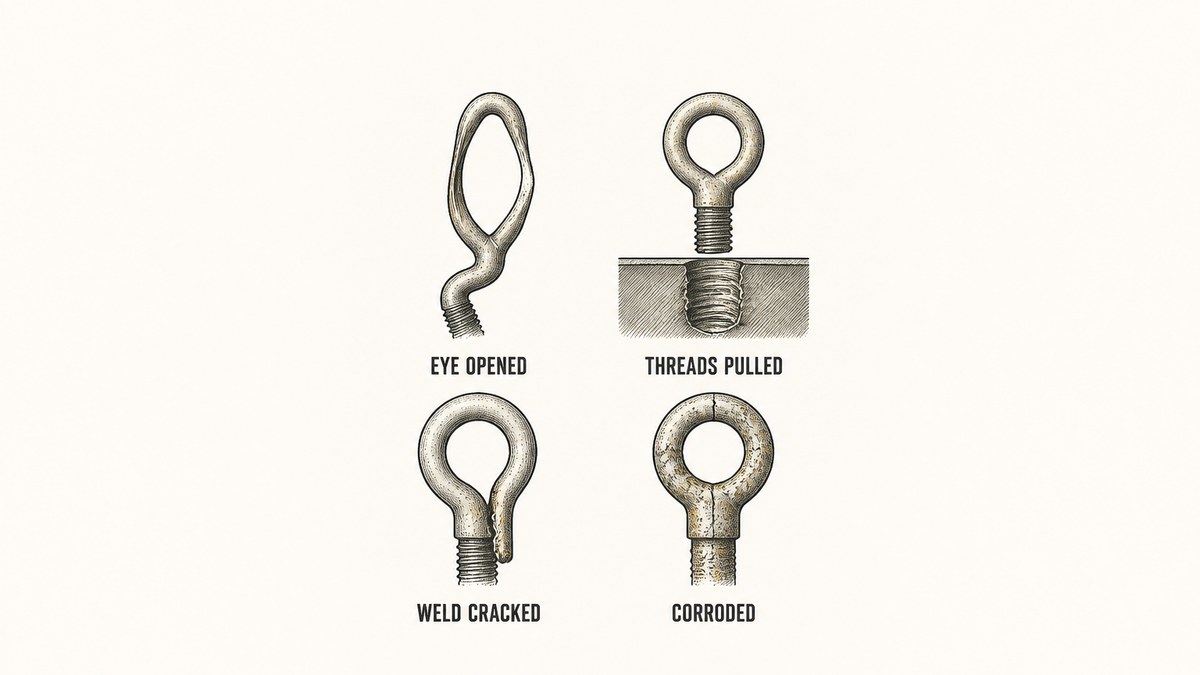
What a visual check cannot catch is where buyers lose money. Looking at a painted part will not find a skipped heat treatment, a shank one size down, a thread cut to the wrong pitch, or a fully threaded shank where a plain length was specified. Those are caught by hardness, by gauge, by measurement against a drawing, and by the material record — not by eyes.That is the case for a sampling plan rather than an informal look at the top of a carton, and the arithmetic for one is settled before the shipment lands, not after.
Finally, pass the daily check on. The rules put a duty on the user to inspect rigging gear and its attachments before each use and to remove anything damaged from service immediately. A one-page note listing the four failures above, and saying that a bent or opened eye bolt is scrap, is a cheap thing to put in the carton and a good reason for a customer to come back.
How the Price Is Built, and How to Check the Supplier Behind It
An eye bolt has eight cost lines and only two of them are visible on a quotation. Knowing which eight they are is what makes two prices comparable, because the gap between them is almost never in the line you are looking at.
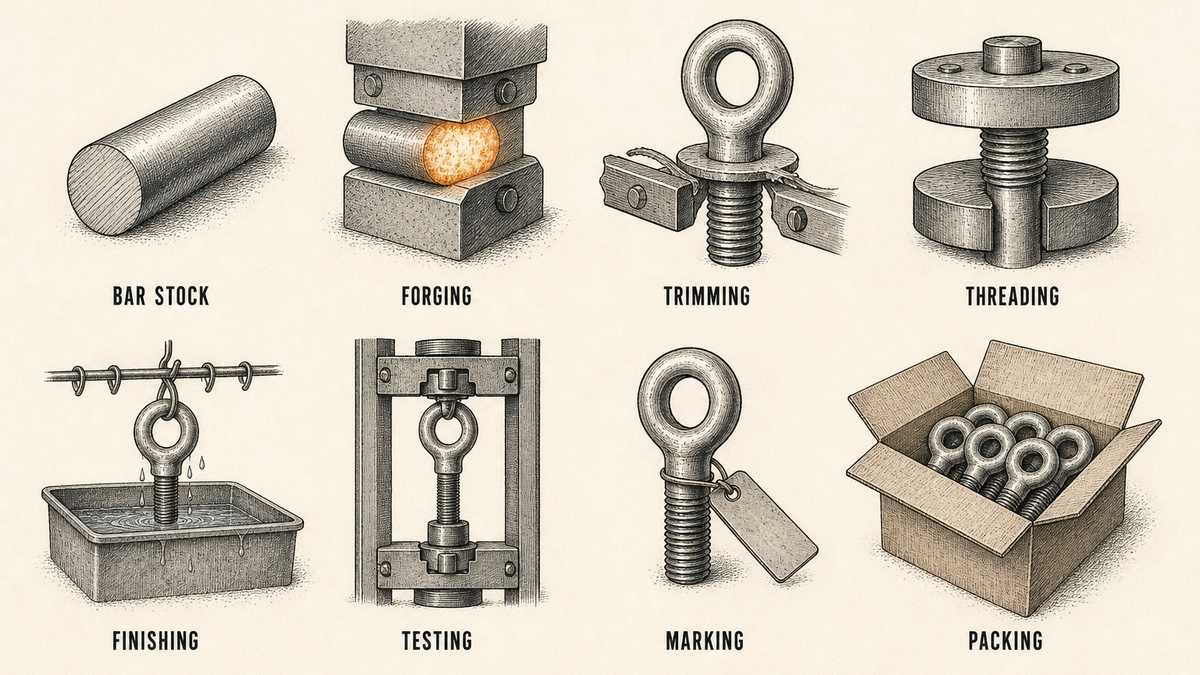
The material line is the weight of bar stock in the grade you asked for, so a shank one size down is a real saving that nobody can see once the part is finished. Forging is the die plus the hammer time plus trimming the flash. Threading differs depending on whether the thread was rolled or cut. Heat treatment is a furnace run that can be skipped entirely, after which the part looks the same. Finishing is coating thickness. Testing is often one pull out of a batch. Marking is a stamping or laser step a factory will leave out if nobody asked, and packing is where the threads and the coating get damaged on the way.
So four of the eight lines are the same bar stock put under a hammer for different lengths of time, and the two that disappear without trace are the heat treatment and the test. A quotation that states the shank diameter, the forming method, the thread type, the heat treatment and the proof test is one you can compare; a size and a price is not. The same discipline works on any machined part — the checks that make a sprocket from two factories comparable are the checks that make two eye bolts comparable.
Minimum order quantity is set by the forge rather than by the factory's goodwill. A standard size and thread is an off-the-shelf forging and can often be bought in small numbers. A special shank length, a non-standard eye or a different material means a die, so the first order carries the tooling and the quantity follows. On a small order, quote the standard size first, then ask what changes when you move away from it.
Then check the party you are talking to, which on this product is unusually easy. Ask who does the forging. A real maker either forges in house or buys from a forge they can name; a trader buys finished eye bolts and cannot change the forging at all, which matters the moment you want a different eye or length. Ask to see the die and the cut section drawing, and ask for two samples from different runs rather than five from one afternoon. On the first order, get the goods checked against the seven lines you wrote.
Frequently Asked Questions
What is the difference between a forged eye bolt and a bent eye bolt?
A forged eye bolt is made from a cut bar heated and pressed in a die, so the eye, the collar and the shank are one continuous piece with no join, and the grain of the steel runs around the curve of the eye. A bent eye bolt has its loop formed by bending rod stock over and joining the end back to the shank, usually by welding. The rigging rules refuse makeshift links and fasteners formed from bolts or rods, so the bent version is the one to avoid for lifting duty. A cut section tells them apart in seconds.
Is the safe working load on my eye bolt the figure I can lift?
Only if the load comes straight out of the eye and the eye bolt is the weakest part of the assembly. The rules require an attachment to be rated at least as high as the chain it works with, or the assembly is limited by its weakest component, so a heavy chain on a small eye bolt gives you the small figure. The figure also belongs to a direction: the bolt is rated for a pull along the axis of its shank.
Can I allow for an angled pull by using a bigger eye bolt?
No. A bigger bolt raises the axial figure, while an angled pull fails by bending the shank and opening the eye, so extra size does not address the failure. The rules treat an angle of loading of five degrees or less from the vertical as a vertical pull, which shows how tightly the straight direction is defined. Where the pull is genuinely off axis, use a shoulder eye bolt seated on a square machined face, or a swivel hoist ring that turns to follow the load.
What has to be marked on an eye bolt?
Rigging equipment must carry a permanently fixed and legible marking stating the safe working load the maker recommends, and must not be used without it. The chain-sling rules go further and require size, grade, rated capacity and reach. Put the safe working load, the size or thread and a part number on the order, name the method, and require the mark to stay legible after finishing — galvanising and paint are what bury it.
What should a proof test record actually say?
The maker and address, the part number, the batch, the steel grade, the heat treatment, the proof load applied with the hold time and the acceptance, how many pieces were pulled, the date and a signature, carrying the same batch number that is marked on the goods. A general certificate with no batch number cannot be tied to the parts in your warehouse. The rules put custom lifting accessories at 125 percent of rated load for a proof test, and cap a crane's test load at the same figure.
Is a stainless steel eye bolt a lifting grade?
Not automatically. Stainless is chosen for corrosion resistance, and the common grades cannot be hardened by heat treatment, so a stainless eye bolt of a given size normally carries less than the same size in hardened alloy steel. Stainless threads also seize when tightened dry, and some grades crack in chloride-rich places. If the site is wet or coastal the instinct is right, but treat stainless as its own product with its own rating.
Send the pull direction and the forming method — not just “a half-inch eye bolt”
Tell us what the fitting has to hold and which way the load arrives, then the lines that decide whether the rating is real: the thread, the body and how the eye is formed, the steel grade and heat treatment, the finish and its thickness, the proof test, and the marking you need on the part. If eye bolts or slings have already arrived with no marking on them, an opened eye, a pulled thread, a cracked joint where the eye was bent from rod, or a certificate that names a different batch, send a photograph and a short description — the symptom usually says whether it was the forging, the thread, the finishing or the paperwork.
Request an Eye Bolt Sourcing Quote
Questions & Comments
We read every one and reply within 24 hoursSourcing eye bolts and getting quotations that all say “half inch, galvanised”? Send the thread and the length, the body form and how the eye is formed, the steel grade and heat treatment, the safe working load and the loading direction it assumes, the finish and its thickness, the proof test, and the marking you need on the part, and we can usually say which lines are missing. If eye bolts or slings have already arrived with no marking on them, an eye pulled open, a thread that stripped out of the hole, or a joint where the eye was bent from rod, describe what you saw and roughly when it appeared, because the symptom usually says whether it was the forging, the thread, the finishing or the paperwork.