
Dog Clothes Wholesale: Sourcing Pet Apparel From China
 ·
Updated October 11, 2026
·
17 min read
Dog clothes wholesale is priced by the fabric and the size run, not by the stitching. Two quotations for the same puffer jacket can sit 40 percent apart and both be honest, because one of them is cut for three sizes and the other for six, or one uses a knit that survives a hot wash and the other does not. That is why a pet apparel order goes wrong in a quieter way than most categories: nothing breaks, nothing leaks, and no rule is broken — the garments simply come back because the chest girth is off by two centimetres, or the red from the first batch is not the red in the second. This guide covers what wholesale actually buys you in this category, why sizing is the hard part, what a pet apparel specification has to state, how the price is really built, what goes wrong, and where a cheap quotation gets its money back.
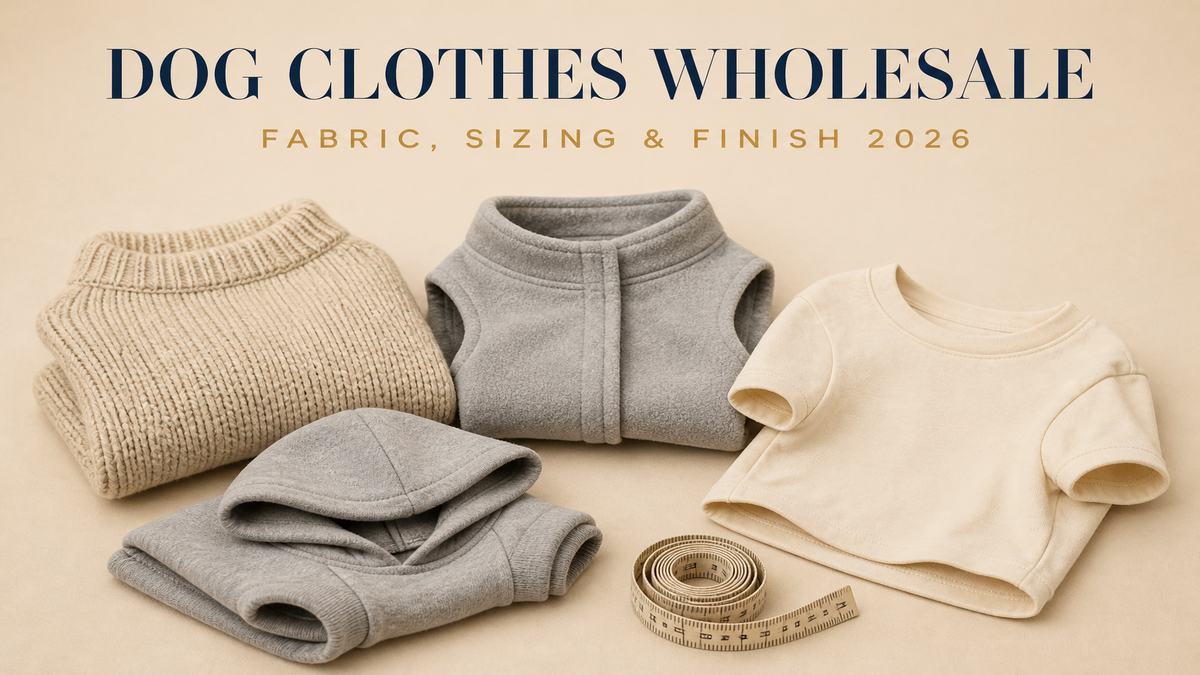
What You Are Buying, and the Line That Decides It
| If you want | What it means in practice | The line on your order that decides whether it works |
|---|---|---|
| Blank stock garments to print or embroider | The factory already runs the style; you add your logo later | The fabric and the size run. A blank garment you cannot decorate consistently is not blank stock |
| Your own design made to order | You supply the pattern and they cut it | The pattern grade — how the design changes between sizes |
| A size range that fits real dogs | There is no standard, so your chart is the standard | Chest girth first, back length second, and the tolerance you allow on each |
| Colours that match across batches | Dyed fabric varies by lot, and the variation is real | The dye lot rule and what you accept when the second batch lands |
| A garment that still fits after a wash | Knit fabric moves when it is washed and dried | The shrinkage limit, the wash method you are testing, and who pays if it fails |
What Does “Dog Clothes Wholesale” Actually Buy You?
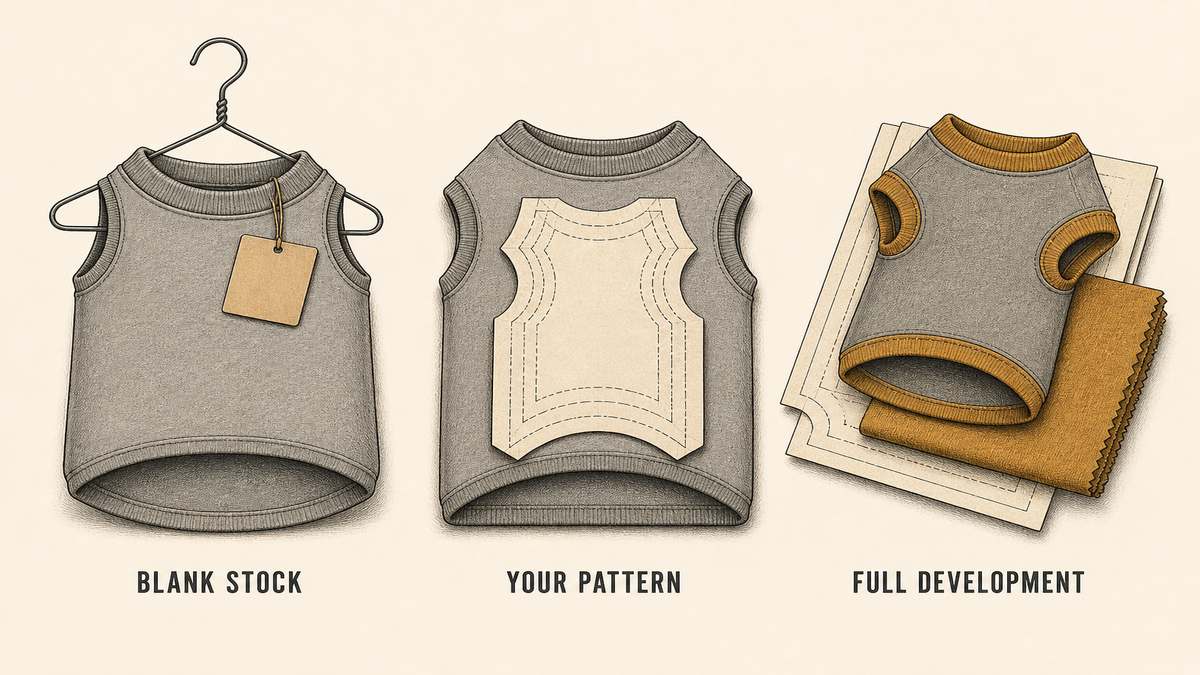
Wholesale in this category covers three different arrangements, and the words a supplier uses will not tell you which one you are in. The question that separates them is what you own when the order is finished.
Blank stock. The factory runs a style it already sells, and prints or embroiders your logo onto it. This is the cheapest and fastest route, and it is the right one when the garment is a vehicle for your artwork rather than a product you designed. What you do not own is the fit. If the supplier's medium runs small against your market, your customers experience that as your mistake, and you cannot fix it without re-cutting the style.
Your pattern on their production line. You bring a pattern, and they grade it, cut it and sew it. You own the fit and the look. What you have to settle in writing is the pattern grade, because a pattern is only correct at one size; the other four or five sizes are a decision about how the garment grows. Get that decision wrong and the small sells and the large sits.
Full development. You arrive with a concept and they help you build the pattern, source the fabric and make a sample. This is the route a brand takes, it costs the most and takes the longest, and it is the only route where the garment is genuinely yours.
One more distinction matters commercially. Some suppliers in this category are garment factories that happen to make pet sizes, and some are pet-accessory traders who place the order at a garment factory. The two answer a question about fabric shrinkage very differently. The method for telling them apart is the same as in any category, and it is set out in whether a dog clothes plant is a plant or a reseller.
Why Is Sizing the Hardest Part of Pet Apparel?
Because nobody has defined the sizes. Apparel for people has a recognised size system, and a supplier can be asked whether it runs true to it. Pet apparel has no such system, so every brand invents its own chart, and two suppliers can both be describing a “medium” that differs by several centimetres of chest girth.
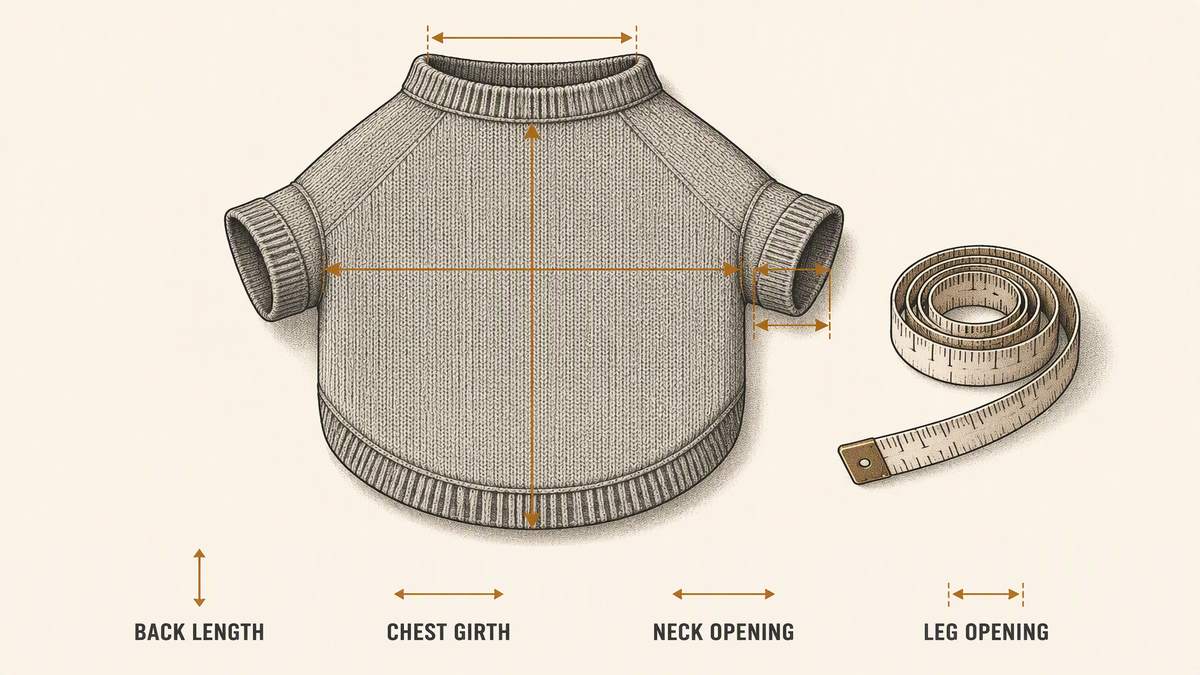
That makes your size chart the single most valuable document in the order. Four measurements do the work:
- Chest girth
- The circumference behind the front legs, at the deepest point of the ribcage. This is the measurement a garment fails on, because it is the one that decides whether the dog can move. Weight is a poor substitute — two dogs of the same weight can differ widely here.
- Back length
- From the base of the neck to the base of the tail. This is what makes a garment look right, and it varies with breed far more than it varies with weight.
- Neck opening
- The collar circumference where the garment closes. Too tight is a comfort problem and a complaint; too loose and the garment rotates on the dog.
- Leg opening
- For sleeved styles, the opening the front leg passes through. This is where a garment that fits standing up becomes unwearable when the dog walks.
Then there is the second half of the problem, which is grading. If your medium has a 46 cm chest and your large has a 56 cm chest, you have decided something about your market — whether you are building for small breeds or aiming at the middle — and the pattern has to follow that decision rather than a round number. This is the same trap that catches sellers in other apparel categories, and the arithmetic of how Asian charts differ from what a Western buyer expects is worked through in the size chart for a dog clothes in us sizes.
The practical consequence is that you should not accept a supplier's size chart as a starting point. Write your own four-point chart, state the tolerance you will accept on each measurement, and make the sample prove it on a dog or a measuring tape rather than on a photograph.
What Has to Go Into the Specification?
If you have sourced apparel for people, this will look familiar, with one important difference: in pet apparel the label and the fibre rules that protect human clothing do not apply, so what is optional for a jacket for a person becomes something you have to decide for yourself. Six lines carry the risk.
- Fabric and knit, named precisely. “Soft fleece” is not a specification and two suppliers will read it differently. Name the fibre blend, whether it is knitted or woven, and the weight per square metre. Then name the test that matters for that fabric, because a knit and a woven fail differently.
- Shrinkage after washing, with the method. This is the line that decides whether a garment still fits in a month. Give a maximum percentage, and name how it is washed and dried, because a garment washed cold and hung to dry is a different test from one washed warm and tumbled. If you do not state the method, you have not stated a limit.
- Colour, and the dye lot rule. Dyed fabric varies between lots, and it varies more in saturated colours. Say what happens the second time: whether the whole order must be cut from one lot, whether you accept a stated tolerance against an approved standard, and what you do with a batch that is outside it.
- Closures, with the force that holds them. Snaps, hook-and-loop, zips and buckles each fail in their own way. Hook-and-loop loses grip after repeated opening; a snap can pull through a thin knit; a zip on a small garment is a stress point. State the type, and for anything that grips or fastens, state what happens when it is pulled.
- Trims and decorations, with how they are attached. Buttons, bows, patches and printed or embroidered graphics all have to stay on. State the attachment method and the pull-off force you will accept, because a decoration that comes away is the most common complaint in this category after fit.
- Labels, and what they claim. This is where pet apparel is genuinely different. The fibre labelling rules that govern clothing for people — the textile fibre rules in 16 CFR Part 303 and the wool rules in 16 CFR Part 300, along with the clothing flammability standard in 16 CFR Part 1610 — are written for garments worn by people. They are not a to-do list for a dog coat. What they are is a useful template: if you label your pet apparel to the same standard you would label human apparel to, you will never be the brand that got caught out by a buyer who assumed you had.
Two of those deserve one more line each. If the garment carries any printed or embroidered decoration, the way it is applied decides how long it lasts, and the trade-offs between the three common methods are compared in embroidering a logo onto a dog clothes. And if the fabric is going to sit against an animal's skin for hours, harmful-substance testing stops being a marketing extra and becomes a question your more careful customers will ask; the OEKO-TEX system at oeko-tex.com is the reference most garment suppliers already understand, which makes it a practical shortcut when you are asking for evidence rather than a claim.
Finally, imported garments have to be marked with their country of origin. That requirement is not about apparel at all — it sits in the customs marking rules in 19 CFR Part 134 — and it applies to a dog coat exactly as it applies to anything else you import. It is a cheap line to forget and an expensive one to fix after the container has landed, because fixing it means marking the goods.
How Is the Wholesale Price Actually Built?
In most manufactured products, the unit price is mostly materials plus labour. In apparel, materials are billed by the metre or the kilogram, and how much fabric a garment uses depends on how efficiently the pattern nests on the fabric — a number that changes with the size run and the fabric width. That is why two suppliers quote different prices for an identical-looking garment without either of them lying.
Four things move the price, and only one of them is labour:
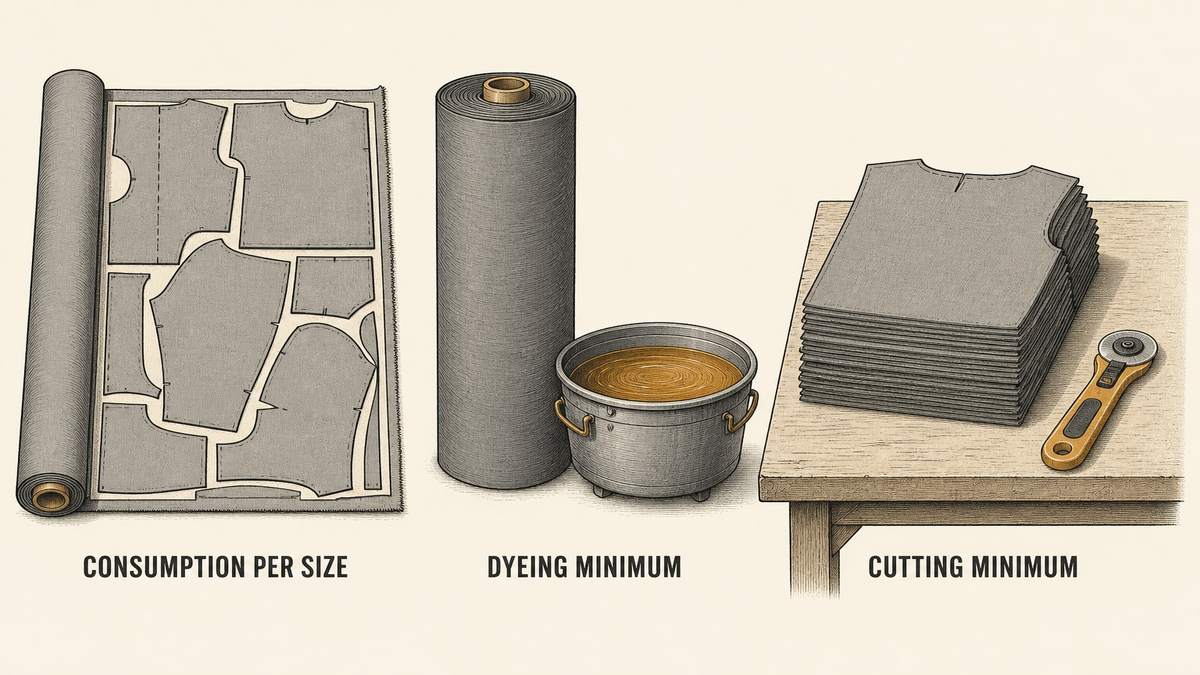
- Fabric consumption per size. Cutting a large and a small from one lay wastes different amounts of cloth, so the fabric cost per garment is not the same across the size run. Ask for consumption per size, not one average figure, and ask what fabric width the cutting plan assumes.
- The size run you order. Six sizes sell better than three but cost more per piece, because the small sizes carry the same fixed work as the large ones. This is also the second most common reason a buyer ends up with dead stock, after fit.
- Minimums by colour, not by style. A dyeing minimum and a cutting minimum are different minimums, and the colour minimum is usually the larger of the two. Five colours of a simple style can mean five minimums, which is why a broad colour range on a first order is expensive out of proportion to the work involved.
- Decoration and finishing. Printing and embroidery carry their own setup, and the setup amortises over the order. This is where a small first order gets painful, and it is worth reading the trade-offs before you commit to a method, since the same artwork can be applied in ways with very different minimums and very different durability.
One structural point about this category that is easy to miss: because pet apparel is small and light relative to its value, it is one of the few product types where shipping is genuinely not the dominant cost. A pallet of dog coats pays for volume rather than for mass, so a landed-cost calculation here behaves more like general merchandise than like the pet food next door, where the same pallet would pay for weight. The general method for working through that arithmetic is set out in what a dog clothes order costs once it has landed.
What Goes Wrong?
Pet apparel fails in four ways, and none of them can be seen in a sample that has never been worn or washed.
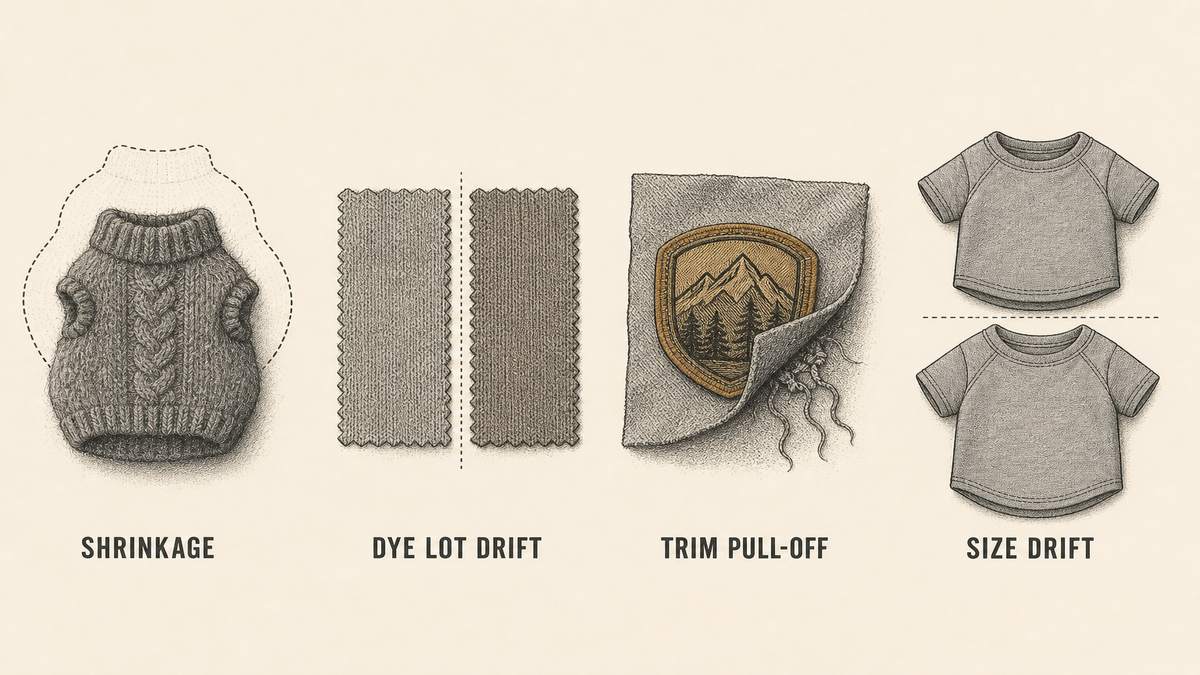
- The garment shrank
- The knit moved in the wash, and the chest girth that fitted on arrival no longer does. This is the failure that generates returns rather than complaints, because the customer does not report it, they simply stop buying.
- The second batch is a different shade
- Dyed fabric varies between lots, and the difference is invisible until the two batches sit on the same shelf. A single-lot rule on a first order is not perfectionism, it is the only way to avoid this one entirely.
- The decoration came away
- A printed patch lifted, an embroidered edge frayed, a button pulled through the knit it was sewn to. It is the most common complaint after fit, and it is settled by the attachment method rather than by the base fabric.
- The same labelled size is not the same garment
- Grading was never agreed, so the medium from one production run and the medium from the next are different garments. This one is worse than a bad fit, because it destroys the size chart your customers relied on.
All four are settled by a number on the order rather than by luck, which is the practical reason the specification and the size chart have to exist before the sample is discussed. A supplier can only meet a limit you stated.
How Do You Check a Supplier Before You Commit?
Four checks, in this order, because each one makes the next cheaper. None of them is expensive, and together they remove most of the risk in this category.
Ask for the pattern grade, not for photographs. Any supplier can photograph a garment. Ask how the chest girth and back length change between sizes, in numbers. A supplier who can answer that from memory is a supplier who has graded before; a supplier who needs to ask the factory is telling you they are placing your order somewhere else.
Buy one sample and wash it. Not to look at — to measure. Take the four measurements, wash and dry the sample by the method you wrote into the order, measure again, and compare against your tolerance. This is the only test that answers the shrinkage question, and it costs one garment.
Make the maker prove the maker. Ask which factory sews it, and check the certificate they offer against the issuer's own record rather than trusting the scan — the general approach is described in the dog clothes certificate, checked in the certifier's own register. In this category that check also tells you whether you are dealing with a garment plant or with a pet-accessory trader, which is the difference that decides how your grey areas get resolved.
Inspect before it ships. On apparel the inspection is mostly measurement, decoration and labelling rather than fabric quality: that the garments measure inside your tolerance, that the decoration is attached, that the labels match the approved wording, and that the cartons are marked. The method is the same as for any order, set out in how a dog clothes shipment is inspected before it leaves, and how many pieces to pull is decided by the the table the sample size for a dog clothes order comes from. Measuring ten garments across the size run is worth more than looking at a hundred.
If the garments are going onto a shelf under your own brand rather than into your own store, the packing and the branding are part of the check too. What goes into that side of an order is covered in custom apparel packaging, and the same logic applies to a dog coat.
Where Does a Cheap Quotation Get Its Money Back?
A low price for pet apparel is rarely a lie. It is a price for less than you assumed, and the same five lines go missing each time. Read any quotation against this list and the gap between two prices stops being a mystery.
- Fabric weight. A lighter knit of the same description uses less material and feels thinner. Nothing about the invoice tells you, and nothing about a photograph tells you either.
- The size run. A quotation that quietly covers three sizes and one that covers six are not the same offer, especially when the missing sizes are the ones that cost the most fabric per garment.
- Wash testing. A supplier who has not tested for the wash method you will use has not checked the shrinkage line, and you will find out from your customers rather than from them.
- Decoration durability. A decorated garment quoted without stating the attachment method is a garment whose decoration may lift. It is the cheapest line to leave vague and the most expensive one to discover.
- The grade. A quotation that assumes the pattern already exists is cheaper than one that includes grading it, and the missing work is the part that decides whether your large actually fits a large dog.
The way to make those five lines non-negotiable is to put them on the enquiry itself rather than in a conversation afterwards, and to ask for the size chart, the wash method and the attachment method as part of the quotation. A supplier who answers all three is quoting on your product. A supplier who answers none of them is quoting on an idea of your product, and the difference shows up in the first production run.
Pet apparel is a good category to be in for one reason worth stating plainly: the product is small, light, durable and easy to sample, so a buyer who settles the fit and the fabric early is competing on design and brand rather than on luck. That is a much better place to be than the category next door, where the same order would have to clear a set of import rules before anyone could sell it. For contrast, the rule chain that governs private label pet food, explained is far heavier, and the construction trade-offs that decide whether a toy survives its first week are covered in the guide to the steps in making a pet toy.
Frequently Asked Questions
What is the minimum order for dog clothes wholesale?
It is set by two separate minimums and the larger one wins. The cutting minimum is the smallest number of pieces worth putting through the line, and the dyeing minimum is the smallest amount of fabric worth dyeing in one colour. Because colour minimums are usually larger than cutting minimums, the real answer is that a first order in one or two colours can be much smaller than the same order spread across five colours. Ask for both numbers separately.
Can I put my own brand on dog clothes made in China?
Yes, and it is done in three different ways. You can buy blank stock garments and add your logo, you can supply your own pattern and have it graded and cut, or you can develop the pattern and the sample with the factory. What separates them is ownership: only the second and third give you the fit. The general framework for putting your brand on a product from China is the same one described in how private label works on a dog clothes order.
How do I choose dog clothing sizes without a standard?
You write your own chart and treat it as the standard. Measure chest girth at the deepest point behind the front legs, back length from the base of the neck to the base of the tail, neck opening and leg opening, then state the tolerance you will accept on each. Weight should not appear in the chart at all, because two dogs of the same weight can differ widely in chest girth. Grading between sizes is then a deliberate decision about which part of the market you are building for, not a round number.
Do pet clothes have to meet clothing labelling or flammability rules?
Not those rules. The textile fibre labelling rules, the wool labelling rules and the clothing flammability standard are written for garments worn by people, so they are not a legal checklist for a dog coat. What does still apply to your shipment is customs country-of-origin marking, which is a separate set of regulation entirely. The practical approach most careful brands take is to label pet apparel to a human-apparel standard anyway, because it costs little and it removes an objection before a buyer raises it.
How much will the fabric shrink, and how do I control it?
The amount depends on the knit and on how it is washed and dried, so there is no single number to quote. What you control is the limit and the method: state a maximum percentage on the order and state exactly how the garment is washed and dried for that test, then prove it by washing one sample yourself before the bulk order. A cold wash and a line dry is a much gentler test than a warm wash and a tumble dry, and a supplier who is not told which one you mean is not answering your question.
Should I buy blank garments and decorate them, or have them made to my design?
Buy blanks when the garment is a carrier for your artwork and the fit is not part of what you are selling. Have them made when you want a fit, a fabric or a construction that nobody is already selling, because blank stock means accepting the supplier's grade. The middle route is usually the practical one for a first apparel order: choose a stock construction you like, then pay for the grading you need rather than for a whole new pattern.
Send the size chart and the wash method, not just the photos
Tell us which market you are selling into, whether you want blank stock, your pattern on their line or full development, the four measurements and the tolerance you will accept on each, the fabric blend and weight, the colours and whether they must come from a single dye lot, the wash method you will test against, the decoration method, and your target volume. Those answers settle the fabric and the grade before a price means anything. We will come back with the size chart written as numbers rather than labels, the specification with a method attached to every limit, which minimums actually apply to your colour range, a sampling and inspection plan that measures garments instead of photographing them, and the fabric, grading and decoration costs shown as separate lines rather than folded into one unit price.
Request a Pet Apparel Sourcing Quote
Questions & Comments
We read every one and reply within 24 hoursTrying to compare dog clothing quotations? Post the sizing basis, the fabric, and whether the pattern is yours or theirs, and we can usually say where that price is coming from. If a size run has already come back fitting badly across breeds, tell us which sizes missed and we will help you work out whether it is the grading or the measurement chart.