
Export Packaging Quality Control Checklist: Tape H-Taping, Desiccants & Polybags (2026 Guide)
 ·
Updated October 1, 2026
·
20 min read
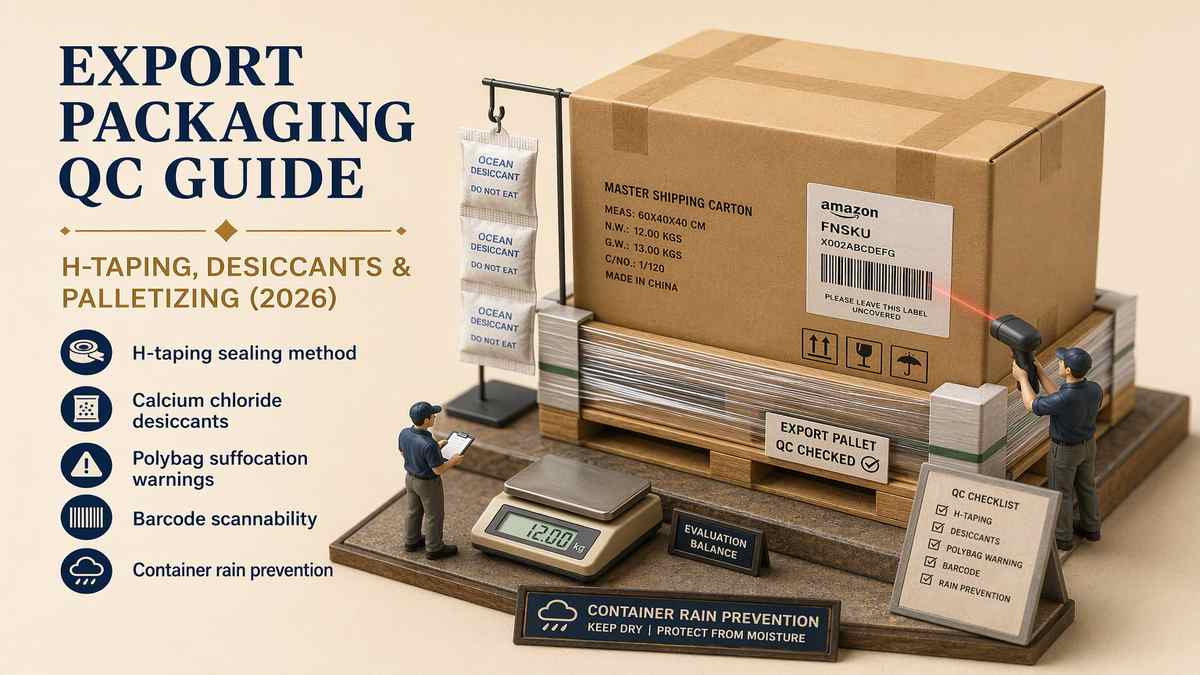
Direct Answer: In 2026, an exhaustive Export Packaging Quality Control (QC) Checklist is your final defense against maritime moisture damage, crushed cartons, barcode rejection, and costly warehouse delays. When manufacturing in China, enforcing five non-negotiable packaging engineering protocols guarantees that 100% of your cargo arrives in mint retail condition: (1) Full H-Taping Seam Sealing (50–75 mm heavy-duty tape sealing all 6 top and bottom flap seams with 75 mm end overlaps); (2) High-Capacity Calcium Chloride Desiccants (250%–300% absorption gel capacity, dosing 8 to 12 hanging poles per 40HQ container to eliminate Container Rain); (3) Corrugated Board Moisture Testing (<10.0% moisture content limit); (4) Polybags with Air Vent Holes & 10pt Legal Suffocation Warnings; and (5) Palletizing Standards (5 layers of stretch film, rigid corner edge protectors, and zero pallet overhang). Enforcing packaging QC during pre-shipment inspections costs pennies per box—remedying waterlogged, moldy inventory after ocean transit costs tens of thousands of dollars.
Even the highest-quality product manufactured with zero factory defects becomes unsellable scrap if poor export packaging allows sea air to corrode electrical components or carton crushing to crack retail display boxes.
To ensure your baseline master cartons possess enough structural compression resistance before packing, review our technical guide on custom shipping boxes and corrugated flute types for 44 ECT double-wall options.
Many overseas buyers mistakenly assume that factory packing lines automatically know how to seal export cartons for international ocean transit. In reality, Chinese packing workers frequently use weak single-strip taping, omit silica desiccants, and over-tighten plastic strapping bands that cut into carton corners.
In this comprehensive 2026 packaging quality inspection guide, we break down the 7 pillars of export packaging QC, provide step-by-step blueprints for H-taping and container desiccant dosing, decode container rain physics, expose 3 common factory shortcuts, and share a 5-step SOP to execute packaging inspections in China with zero defects.
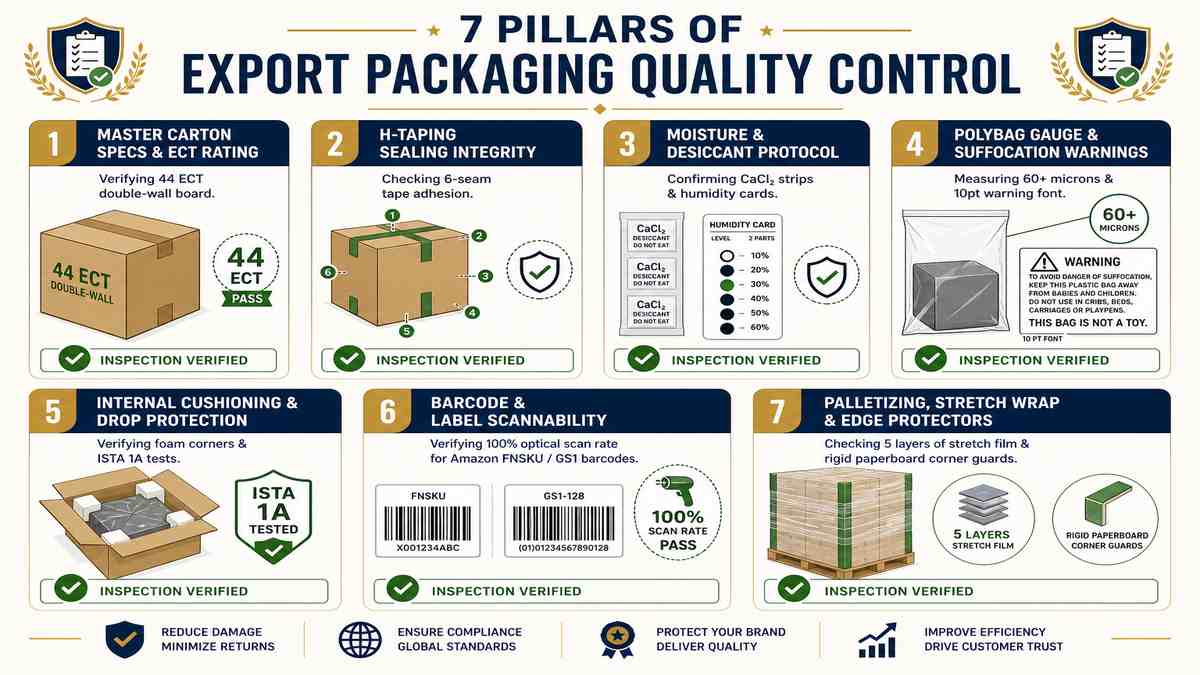
7 Pillars of Export Packaging Quality Control Architecture
To inspect your export shipments comprehensively before container loading, evaluate your packaging against this 7-pillar quality checklist:
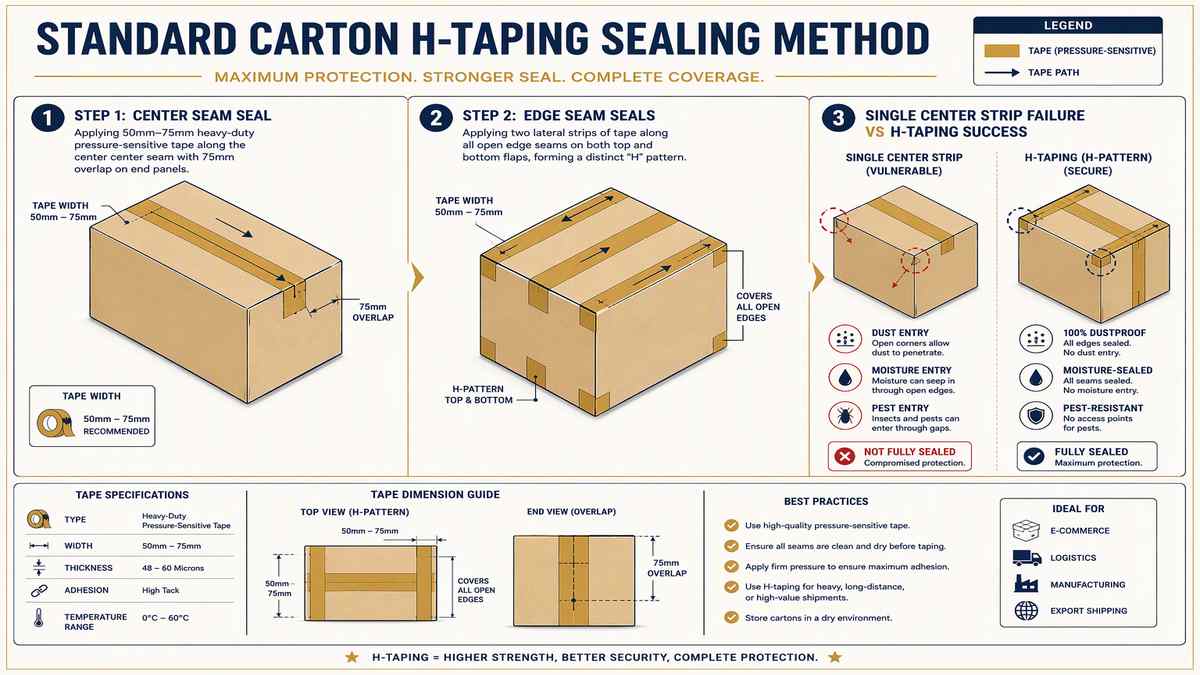
The Standard Carton H-Taping Sealing Method Blueprint
Single-strip taping leaves four corner seams exposed to moisture and tampering. The standardized H-Taping method is the global shipping benchmark:
To calculate the required stacking load for your sealed cartons under pallet pressure, review our engineering guide on the Box Compression Test (BCT) and Edge Crush Test (ECT) for McKee stacking formulas.
Container Rain Physics & Calcium Chloride vs. Silica Gel Desiccants
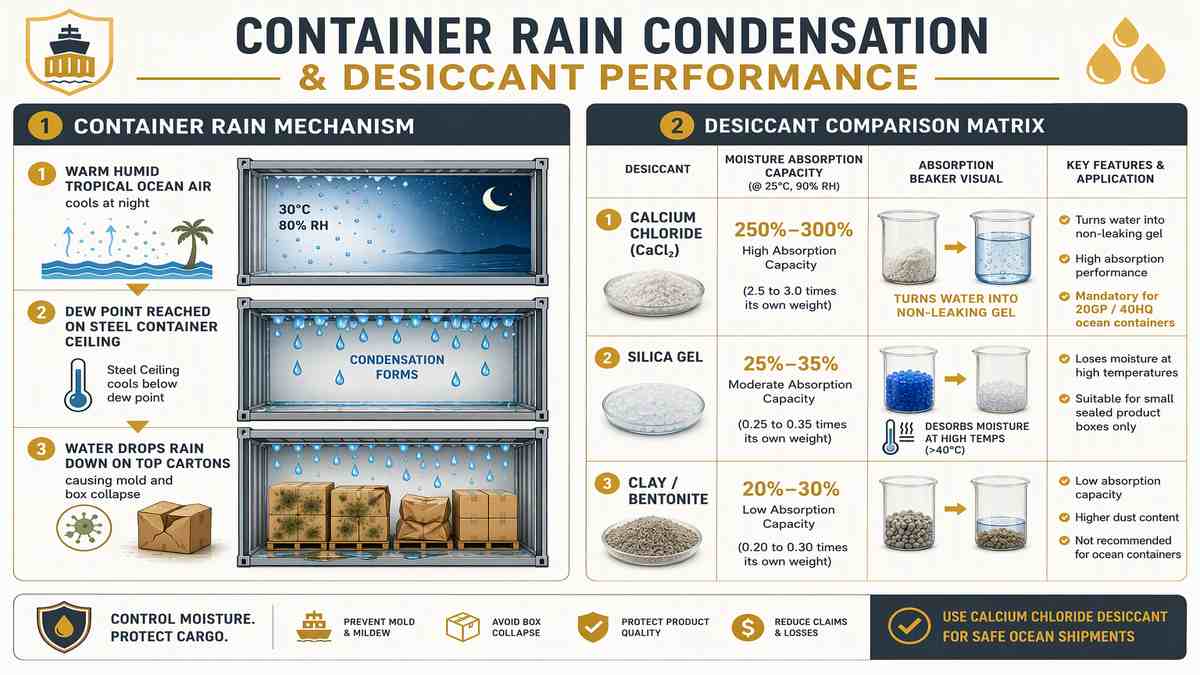
During ocean transit through equatorial waters, shipping containers undergo severe diurnal temperature swings that trigger “Container Rain”:
To align your shipping documentation with the exact gross weights recorded during packaging inspections, review our guide on commercial packing lists and CBM calculations to prevent customs holds.
- Calcium Chloride (CaCl2 Dry Poles): Chemical absorption capacity of 250% to 300% of its dry weight. When moisture is absorbed, it chemically reacts to form a solid gel that permanently locks water inside without leaking, remaining stable up to 80°C.
- Silica Gel Packs: Physical adsorption capacity of only 25% to 35%. Crucially, silica gel is reversible—when container temperatures exceed 40°C during daytime sun exposure, silica gel desorbs and releases its trapped water back into the container atmosphere.
- 20GP Standard Container: 4 to 6 hanging desiccant poles (1.0 kg CaCl2 each).
- 40GP / 40HQ High Cube Container: 8 to 12 hanging desiccant poles (1.0 kg CaCl2 each) suspended from internal ceiling lashing rings.
3 Dirty Tricks in Export Packaging & How to Prevent Them
Low-cost factories cut corners on packing labor and materials to save money on export orders. Guard your brand against these three common practices:
When applying brand markings and handling icons to outer shipping cartons, establishing clear graphic dielines prevents smudging, as explained in our guide on how to put your logo on products from China for private label goods.
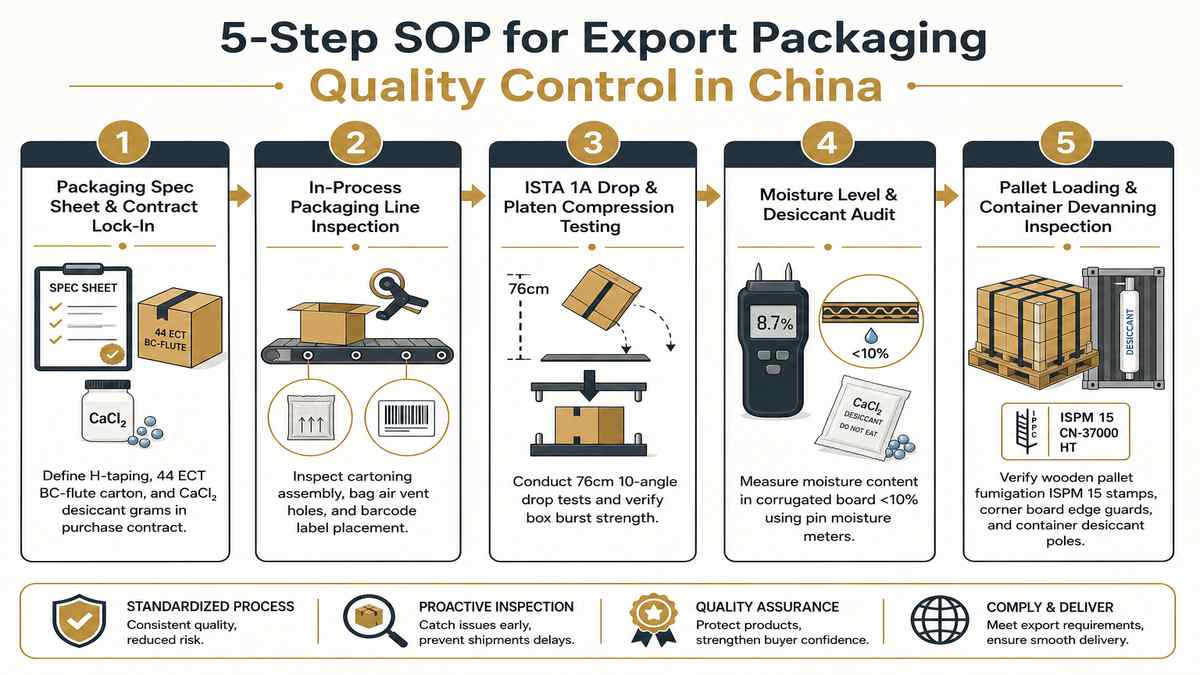
5-Step SOP for Export Packaging Quality Control in China
Follow this standard operating procedure to inspect your export packaging before container loading:
To confirm that packaging converters operate calibrated test machinery, audit suppliers under ISO 9001 Quality Management Standards.
Physical drop endurance testing must follow international transit procedures published by the International Safe Transit Association (ISTA) Standards.
- Lock Packaging Specifications into Bilingual Contract: Define master carton ECT ratings (44 ECT), H-taping rules, CaCl2 desiccant grams, and palletizing rules in your bilingual manufacturing sales contract under PRC law.
- Audit In-Process Packaging Assembly Lines: Audit bidding packaging lines in Ningbo, Shenzhen, or Yiwu using our China factory audit checklist review to check carton folding, polybag vent holes, and barcode label placement.
- Inspect Pre-Production Packaging Samples with FAI Sign-off: Order production sample boxes and execute a formal first article inspection (FAI) sample review, conducting 76 cm drop tests on physical samples.
- Check Moisture Levels & Desiccant Placement on Finished Cartons: Measure corrugated board moisture content (<10.0%) using digital pin moisture meters and confirm desiccant placement in every carton.
- Perform Pre-Shipment Inspection (PSI) & Container Loading Check (CLC): Execute an on-site pre-shipment inspection (PSI) in China under AQL 2.5 standards to check pallet stretch wrapping, corner guards, and container desiccant poles before sealing container doors.
To ensure plastic bags meet consumer safety laws, audit warning text against U.S. Consumer Product Safety Commission (CPSC) Rules.
Illustrative Scenario: How a Camera Brand Eliminated \$65,000 in Water Damage
To see how professional packaging quality control prevents catastrophic supply chain losses, review this smart electronics case study:
A smart home security brand in San Jose, California imported two 40HQ containers of outdoor wireless security cameras with solar panels (\$350,000 total shipment value).
- The Container Rain Mold Disaster: The factory shipped the cameras during the humid summer monsoon season from Shenzhen. The supplier used cheap silica gel packs, single-strip tape on master cartons, and untreated wooden pallets with 18% moisture content. During the 32-day ocean crossing, severe container rain condensation soaked the top two tiers of cartons, causing mold growth on retail gift boxes and internal lens fogging on over 1,200 cameras (\$65,000 in unsellable stock).
- The Sourcing Pioneer Packaging QC Overhaul: Sourcing Pioneer instituted a strict packaging engineering protocol for all later shipments: (1) Mandated full 6-seam H-Taping using 65 mm water-resistant acrylic tape, (2) Replaced silica gel with 10 hanging 1.0kg calcium chloride (CaCl2) desiccant poles per 40HQ container, (3) Mandated kiln-dried ISPM 15 wooden pallets with moisture content <12%, and (4) Added heavy-duty 0.08 mm plastic container ceiling liner sheets to shield top cartons.
- Flawless Maritime Arrival: The following 5 container shipments arrived in Los Angeles with 100% bone-dry packaging, zero mold, zero lens condensation, and a 100% barcode scanning pass rate at Amazon FBA intake.
- The Commercial Outcome: The comprehensive packaging QC protocol permanently eliminated the \$65,000 water damage loss, reduced customer returns to 0.1%, and protected brand reputation across 50,000 annual camera shipments.
Frequently Asked Questions (FAQ)
What is the H-Taping method for corrugated export shipping cartons?
The H-Taping method seals all six potential openings on a corrugated box: one long strip of 50mm to 75mm heavy-duty tape along the center seam with 75mm end overlaps, plus two lateral tape strips sealing the open side edges on both top and bottom flaps, creating a visible ‘H’ pattern that makes the box 100% dust-proof, moisture-resistant, and tamper-evident.
Why is calcium chloride desiccant better than silica gel for ocean shipping containers?
Calcium chloride (CaCl2) absorbs 250% to 300% of its own weight in moisture and locks it into a non-reversible gel that will not leak even at high tropical temperatures. Silica gel absorbs only 25% to 35% and desorbs moisture back into the container atmosphere when daytime temperatures exceed 40C.
How many container desiccant dry poles are needed for a 40HQ ocean shipping container?
For a standard 40HQ container carrying general consumer goods or paperboard packaging, hanging 8 to 12 calcium chloride desiccant poles (1.0 kg each) from the container interior top lashings is the industry benchmark to prevent ‘container rain’ condensation.
What is the acceptable moisture content limit in corrugated export shipping boxes?
Corrugated cardboard moisture content must test strictly below 10.0% (measured using calibrated digital pin moisture meters). Any reading above 12.0% indicates excessive dampness that will cause the box fluting to soften and collapse under pallet stacking weight during maritime transit.
What are the rules for wooden shipping pallets in export ocean freight?
All solid wood export pallets must comply with international ISPM 15 phytosanitary regulations, featuring heat-treated (HT) debarked timber and an official IPPC wheat-stamp logo on two opposite sides. Cartons must be wrapped with at least 5 layers of stretch film with rigid paperboard corner edge protectors and zero box overhang.
Audit Your Export Packaging in China to Eliminate Transit Damage & Customs Holds
Our China quality engineering team inspects carton H-taping adhesion, audits calcium chloride desiccants, tests barcode scannability, and verifies container loading.
Get Free Export Packaging QC Checklist & Audit
Questions & Comments
We read every one and reply within 24 hoursAuditing export packaging quality control in China, implementing H-taping protocols, dosing container desiccants to prevent container rain, or preparing for Amazon FBA warehouse intake? Post your packaging inspection questions below — our on-the-ground quality engineering specialists will guide your logistics defense.