
Custom Blister Packaging & Clamshell Sourcing: PVC vs. PET Thermoforming Costs (2026 Guide)
 ·
Updated October 1, 2026
·
20 min read
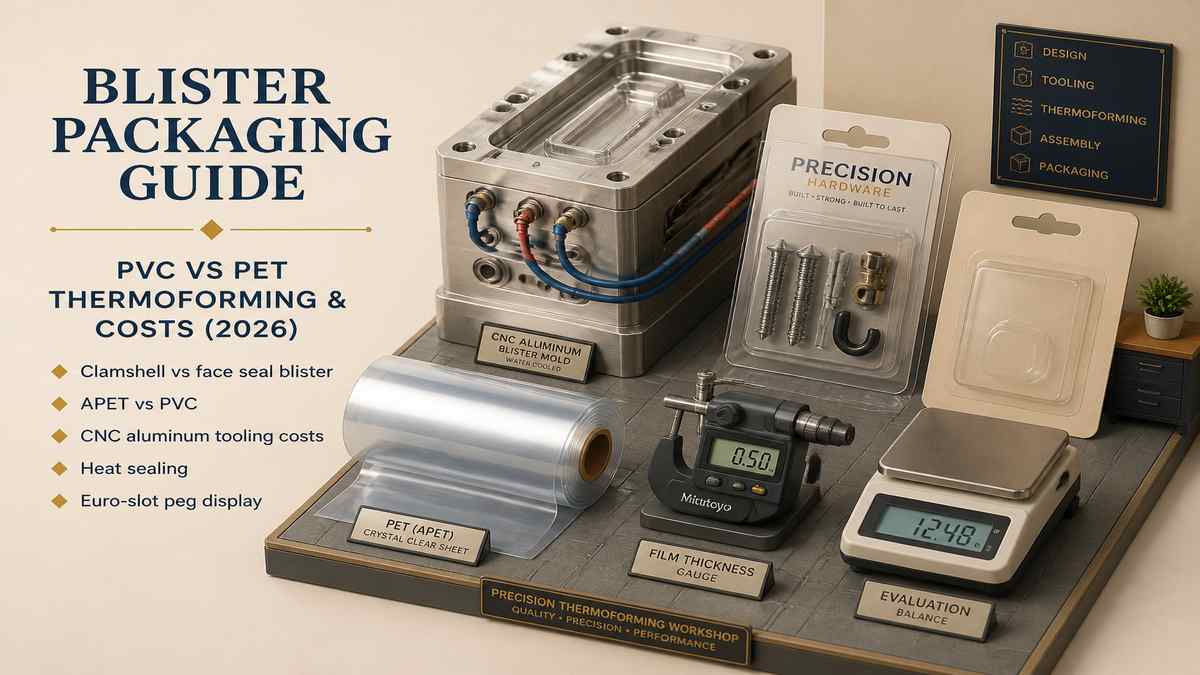
Direct Answer: In 2026, sourcing Custom Blister Packaging and Plastic Clamshells in China is the most cost-effective method for delivering high-visibility retail shelf presence, tamper-evident theft protection, and automated peg-hook display for hardware tools, electronics, cosmetics, and toys. The 10-second rule for global importers is clear: (1) APET & RPET (0.4–0.8 mm thickness) (\$0.05–\$0.12/pc) is the mandatory gold standard for North American and European export, offering 100% recyclability, crystal-clear transparency, and food/medical safety rules; (2) GAG / PETG (3-layer co-extrusion) (\$0.08–\$0.18/pc) is required for heavy-duty hinged clamshells that demand high-frequency radio welding (HF Sealing) without cracking; (3) PVC should be avoided for Western exports due to toxic chlorine restrictions and cold-weather brittleness; and (4) Tooling costs in China are exceptionally low: \$80 to \$150 for rapid gypsum sample molds, and \$800 to \$2,500 for multi-cavity CNC water-cooled aluminum production tooling capable of 500,000+ molding cycles.
For retail products competing on store shelves at Walmart, Target, or Home Depot, clear thermoformed blister packaging allows consumers to inspect the physical product, color, and texture directly while preventing retail theft and in-store tampering.
To understand how rigid clear blisters compare with folding cartons and poly packaging, review our comprehensive breakdown of the types of packaging materials for wholesale products across paperboard and polymer options.
However, overseas buyers frequently encounter painful thermoforming pitfalls: selecting cheap PVC that cracks during winter transit, discovering blisters that peel off printed backing cards due to poor blister varnish oil, or encountering paper-thin corners on deep-draw cavities.
In this technical 2026 packaging sourcing guide, we compare PVC vs. APET vs. RPET vs. GAG plastic resins, break down the 4 main blister packaging formats, examine thermoforming tooling costs and draw ratio physics, expose 3 common factory shortcuts, and share a 5-step SOP to source custom blister packaging in China with zero defects.
PVC vs. APET vs. RPET vs. GAG/PETG: Head-to-Head Comparison
To choose the right thermoformed polymer sheet for your target export market, review this comparative engineering matrix:
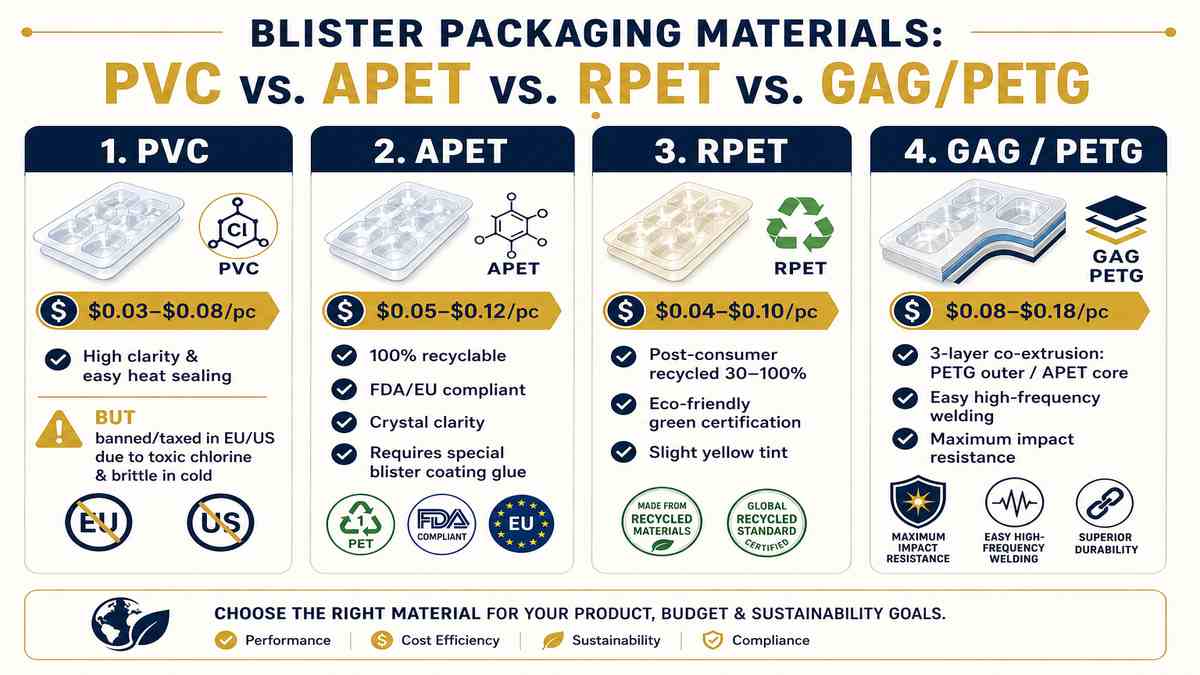
| Evaluation Dimension | 1. PVC (Polyvinyl Chloride) | 2. APET (Amorphous PET) | 3. RPET (Recycled Post-Consumer) | 4. GAG / PETG (Co-Extruded) |
|---|---|---|---|---|
| Unit Cost (USD / pc) | $0.03 – $0.08 (Lowest cost). | $0.05 – $0.12 (Standard). | $0.04 – $0.10 (Eco-tier). | $0.08 – $0.18 (Premium HF). |
| Optical Clarity & Shine | High (Slight blue/yellow tint). | Maximum (Diamond clarity). | Good (Subtle recycled tint). | Maximum (Glass-like shine). |
| Heat Sealing to Cardboard | Very Easy (Wide heat window). | Requires special APET glue oil. | Requires special APET glue oil. | Excellent (PETG heat layer). |
| High-Frequency (HF) Welding | Excellent (Standard). | Difficult (Can cause arcing). | Difficult. | Outstanding (Engineered for HF). |
| Western Regulatory Status | Restricted / Taxed in EU & US. | 100% Safe & Recyclable. | Meets EU Recycled Content laws. | 100% Safe. |
| Cold-Crack Impact Resistance | Poor (Brittle below 0°C). | High (-20°C resistance). | High. | Maximum (Tough, shatterproof). |
| Best Packaging Use Case | Domestic Asian retail (avoid export). | Face seal blister cards, food trays. | Sustainable retail, consumer goods. | Heavy hardware, high-end clamshells. |
4 Major Blister Packaging Formats & Sealing Mechanisms
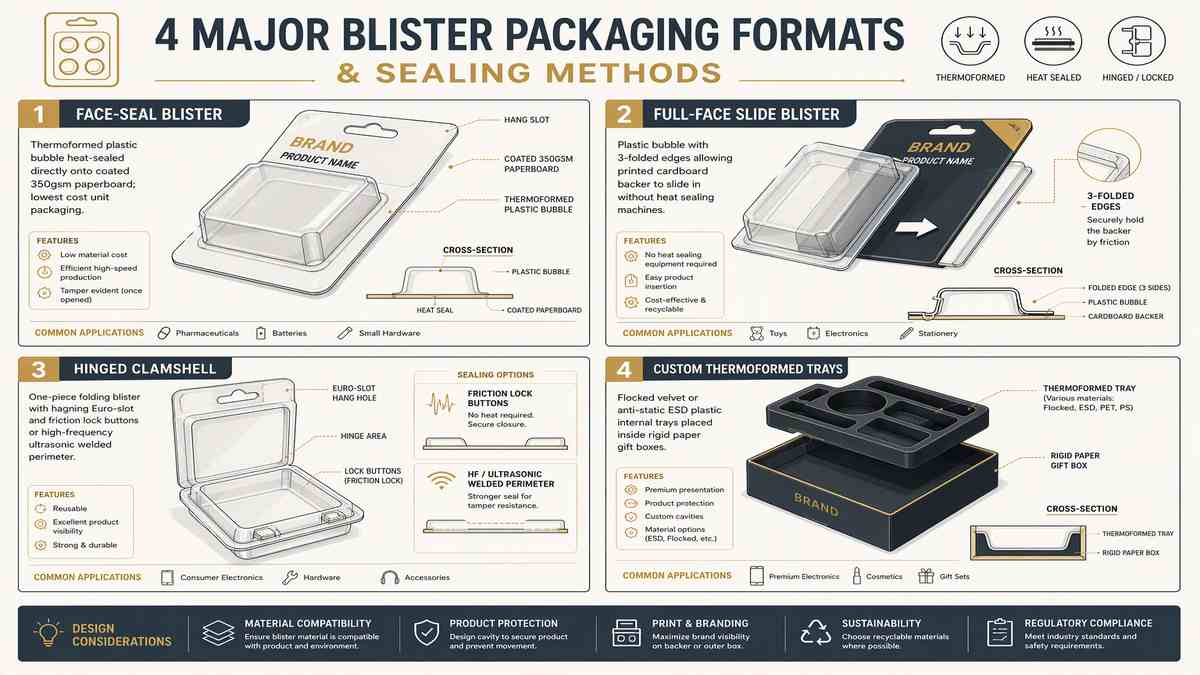
Custom thermoformed packaging is engineered into four standardized retail configurations:
To protect delicate blister packs from crushing during international transit, select appropriate outer packaging as detailed in our guide on custom shipping boxes and corrugated flute types for export master cartons.
Thermoforming Tooling Classes & Cavity Draw Ratio Control
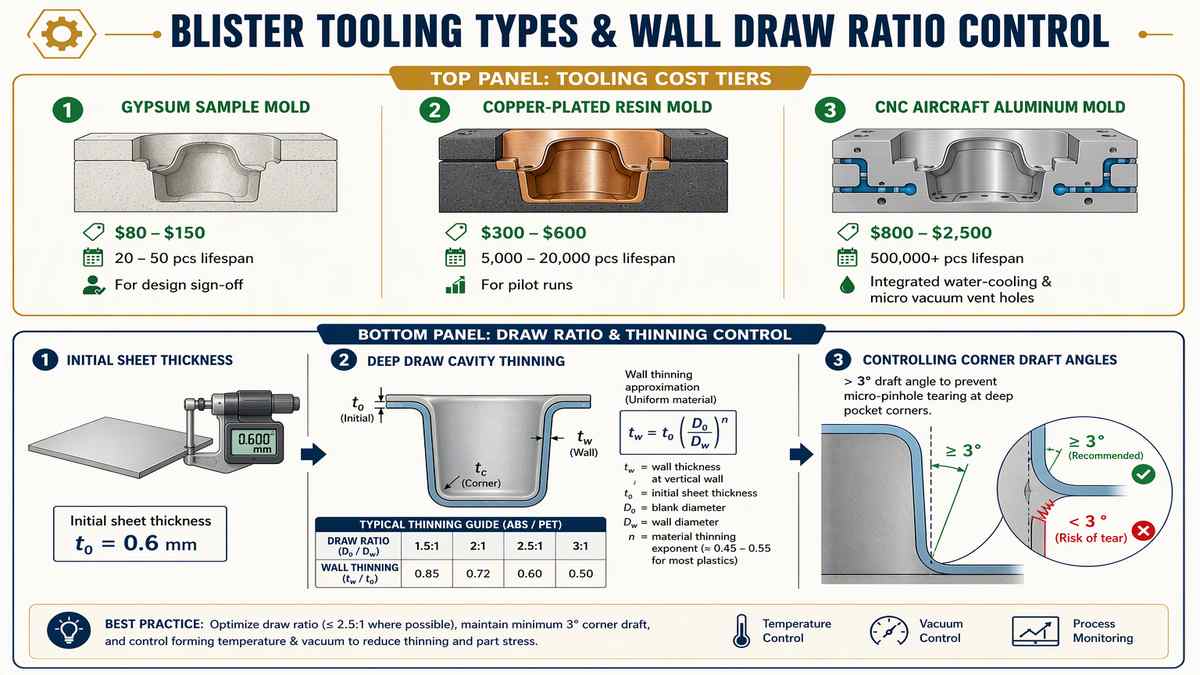
Unlike high-pressure plastic injection molds that cost \$10,000+, vacuum thermoforming molds are fast and economical to produce in China:
To ensure chemical purity and impact resistance during low-temperature shipping, packaging converters must comply with test methods established under ASTM International Plastic Sheet Impact Standards ASTM D1790.
3 Dirty Tricks in Blister Sourcing & How to Prevent Them
Low-cost thermoforming workshops cut corners on plastic sheet quality and adhesive formulas. Guard your brand against these three common practices:
When creating custom printed cardboard backing cards, establishing strict color fidelity standards is vital, as outlined in our guide on how to put your logo on products from China for private label packaging.
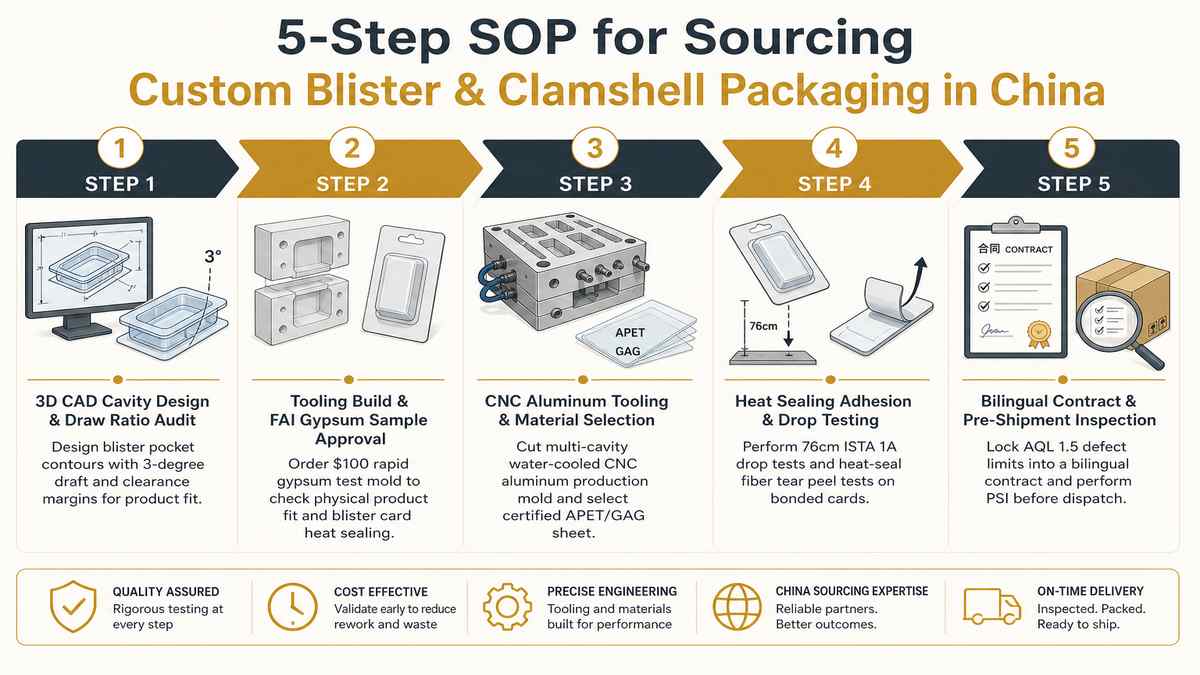
5-Step SOP for Sourcing Custom Blister Packaging in China
Follow this standard operating procedure to source custom blister packaging and clamshells with zero quality defects:
To check that packaging materials meet strict European environmental recycling rules, audit suppliers against European Commission Packaging and Packaging Waste Directives (PPWD).
To confirm that thermoforming factory quality systems operate under calibrated standards, audit facilities certified under ISO 9001 Quality Management Standards.
- Design 3D CAD Cavity Dielines & Draw Ratio Audit: Model 3D blister contours around your physical product, adding 1.5 mm clearance margins, 3-degree draft angles, and standard Euro-slot hanging hole dimensions.
- Order Rapid Gypsum Sample Mold for FAI Fit Approval: Pay \$100 for a rapid plaster sample mold to produce 10 unsealed test blisters, conducting a formal first article inspection (FAI) sample review to check product fit and heat-seal alignment.
- Audit Packaging Converter & High-Speed Thermoforming Lines: Audit bidding thermoforming factories in Dongguan, Ningbo, or Shenzhen using our China factory audit checklist review to check multi-station automated roll-fed thermoformers.
- Sign Enforceable Bilingual Packaging Contract: Lock certified APET/GAG resin grades, sheet thickness tolerances (±0.02 mm), and 100% paper tear adhesion requirements into an enforceable bilingual manufacturing sales contract under PRC law.
- Execute Heat-Seal Adhesion Testing & Pre-Shipment Inspection (PSI): Perform 180-degree manual peel tests and conduct an on-site pre-shipment inspection (PSI) in China under AQL 1.5 standards to check clarity, flange flatness, and barcode scannability before container release.
Illustrative Scenario: How a Gaming Brand Eliminated In-Store Theft
To see how high-security clamshell packaging protects product margins and retail rules, review this consumer electronics case study:
A gaming peripherals brand in Irvine, California developed a custom RGB wireless gaming mouse and magnetic charging dock (\$89 retail value, 8,000-unit initial production run, \$220,000 order value).
- The Retail In-Store Theft Disaster: The brand initially packed the mouse in a standard folding paperboard box with clear PET display windows. When placed on retail shelves at Best Buy, shoplifters easily pushed open the box end-flaps to steal the optical mouse, leaving empty boxes behind and triggering a 6.8% store shrinkage loss and retailer warning notices.
- The High-Frequency Welded Clamshell Overhaul: Sourcing Pioneer redesigned the packaging into a high-security thermoformed clamshell: (1) Sourced a multi-cavity CNC water-cooled aluminum mold (\$1,600 tooling fee) with precision-molded contours for both mouse and dock, (2) Specified 0.60 mm high-impact GAG/PETG co-extruded plastic sheet with diamond optical clarity, (3) Embedded a full-bleed printed double-sided 350gsm graphic insert card, and (4) Sealed the entire perimeter using high-frequency ultrasonic radio welding with a top Euro-slot hanging hole.
- Tamper-Proof & Drop-Tested A Check: The welded clamshell required scissors to open, completely preventing in-store theft, and passed certified ISTA 1A drop tests from 76 cm with zero plastic cracking.
- The Commercial Outcome: Across 8,000 units distributed across 250 retail stores, the brand achieved 100% zero in-store shrinkage theft and a 0.0% shipping transit damage rate, securing expanded endcap retail placement.
Frequently Asked Questions (FAQ)
What is the difference between PVC, APET, and GAG plastic in custom blister packaging?
PVC is the cheapest plastic ($0.03 to $0.08/pc) with easy heat sealing, but it is heavily taxed in the EU due to toxic chlorine content and turns brittle in cold temperatures. APET ($0.05 to $0.12/pc) is 100% recyclable, crystal-clear, and food-safe, requiring specialized blister varnish glue to seal to paperboard. GAG/PETG ($0.08 to $0.18/pc) is a 3-layer co-extruded sheet (PETG outer layers with an APET core) designed specifically for high-frequency radio welding and high-impact clamshells.
How much do custom thermoforming blister molds cost in China?
Thermoforming mold costs in China depend on the tooling material: (1) Rapid Gypsum Sample Molds cost $80 to $150 (lifespan: 20 to 50 pcs for design sign-off); (2) Copper-Plated Resin Molds cost $300 to $600 (lifespan: 5,000 to 20,000 pcs for pilot production); and (3) CNC Aircraft Aluminum Production Molds cost $800 to $2,500 (lifespan: 500,000+ pcs with internal water cooling and micro vacuum holes).
What is the difference between Face Seal Blisters, Slide Blisters, and Clamshells?
Face Seal Blisters heat-weld a thermoformed plastic bubble directly to coated paperboard backing. Slide Blisters feature three folded flange edges that allow a printed cardboard backer to slide in manually without heat-sealing machines. Clamshells are one-piece hinged plastic enclosures with friction-lock buttons or perimeter ultrasonic welds that provide 360-degree product visibility and tamper-evident theft protection.
Why do thermoformed blisters crack at the corners during deep-draw molding?
When hot plastic sheet is pulled deep into a cavity with a high draw ratio (depth-to-width ratio > 1:1), sheet thinning causes the bottom corners to drop below 0.15 mm thickness. Adding a 3-degree to 5-degree draft angle, generous corner radius fillets (R3.0 mm+), and selecting high-impact GAG sheet prevents corner stress tearing.
How do you test if a heat-sealed blister card is properly bonded?
Perform a manual 180-degree peel test on a finished production sample. A properly heat-sealed bond will result in 100% ‘paper tear’ (where the paperboard fibers rip apart across the entire sealing flange) rather than clean plastic peeling, confirming the thermal adhesive penetrated the cardboard.
Engineer High-Visibility Custom Blister Packs & Clamshells with Zero Defects
Our China packaging engineering team audits 3D thermoforming cavity dielines, inspects CNC aluminum tooling molds, tests card heat-seal adhesion, and supervises production.
Get Free Blister & Clamshell Sourcing Review
Questions & Comments
We read every one and reply within 24 hoursComparing APET vs GAG clamshells for retail peg hooks, reviewing thermoforming CNC aluminum tooling quotes, or need on-site heat-seal adhesion testing in Dongguan, Ningbo, or Yiwu? Post your blister packaging questions below — our on-the-ground manufacturing specialists will guide your packaging engineering decisions.