
What is a Commercial Packing List? Essential Fields, Gross Weight & CBM Details (2026 Guide)
 ·
Updated October 1, 2026
·
20 min read
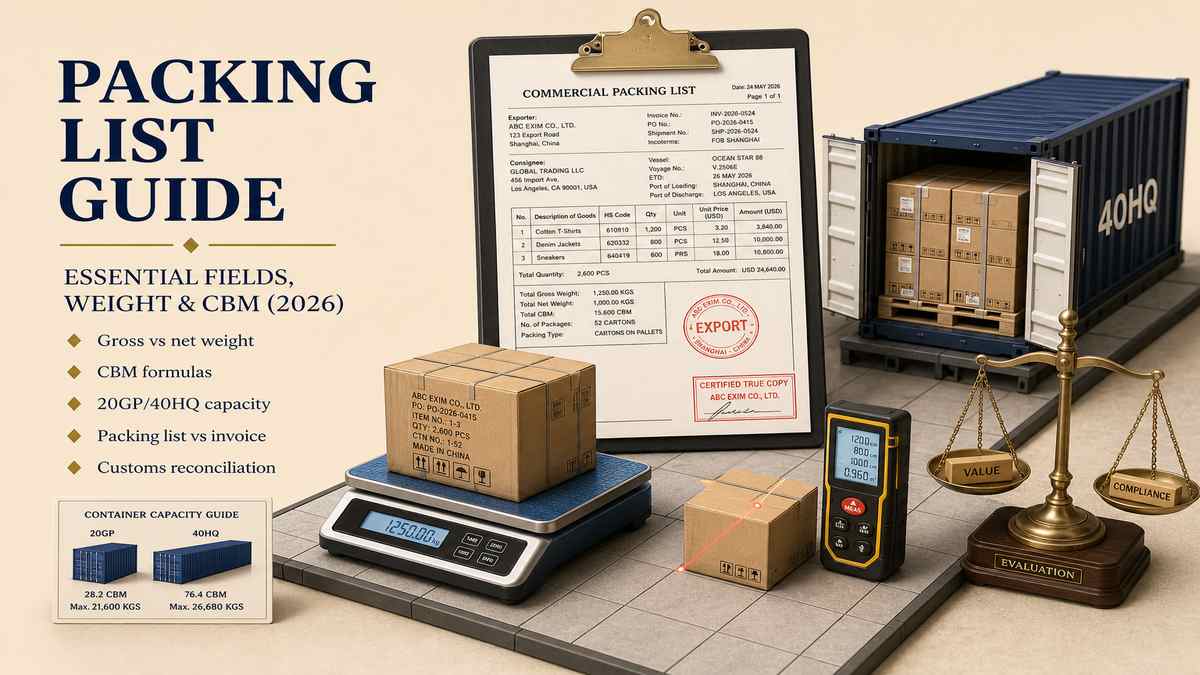
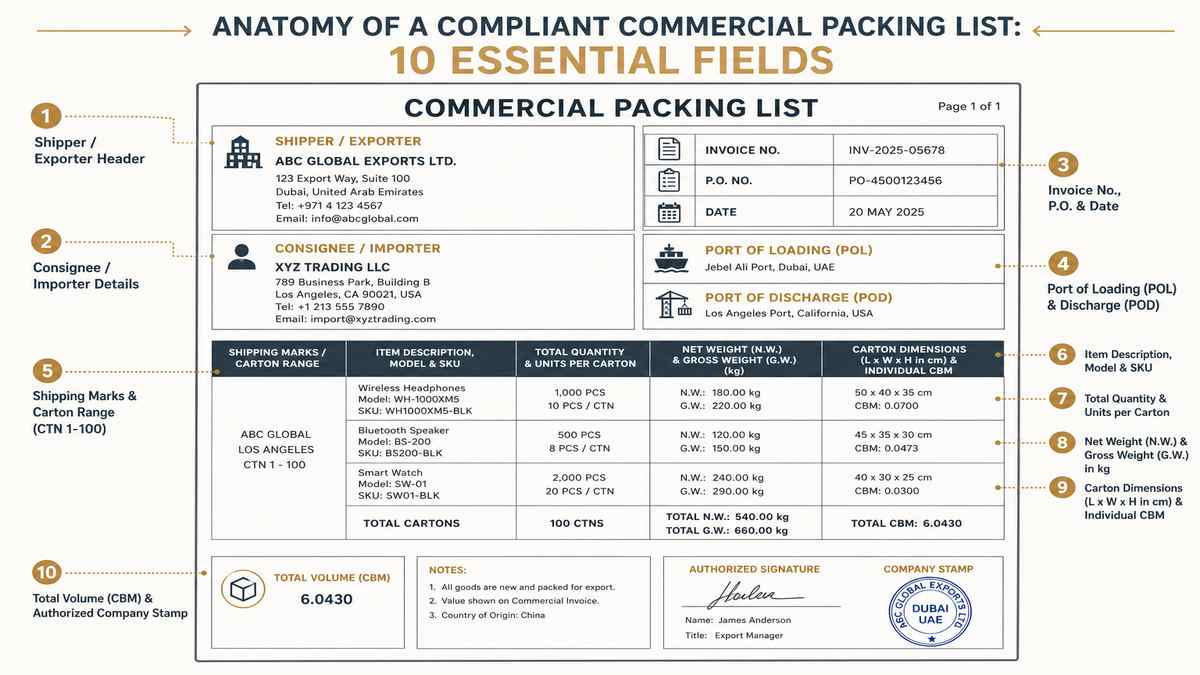
Direct Answer: A Commercial Packing List (CPL) is the indispensable physical passport of your cargo in international trade and ocean logistics. In 2026, a fully accurate packing list must document 10 essential fields with 100% mathematical precision: (1) Shipper & Consignee Details; (2) Invoice & Production Order Numbers; (3) Ports of Loading (POL) & Discharge (POD); (4) Vessel/Voyage & Bill of Lading (B/L) Numbers; (5) Carton Numbering Sequences (e.g., CTN 1–100) & Shipping Marks; (6) Detailed SKU & Item Descriptions; (7) Quantities & Units per Carton; (8) Net Weight (N.W.) & Gross Weight (G.W.) in Kilograms; (9) Outer Dimensions in Centimeters (L x W x H) & Cubic Meters (CBM); and (10) Total Volume & Authorized Company Chop. The golden rule of customs clearance is Three-Way Document Reconciliation (单单一致): the piece count, gross weight, and CBM on your Packing List must match your Commercial Invoice and Bill of Lading with zero differences. A mere 5% weight error can trigger mandatory customs holds, demurrage fines, and weeks of delivery delays.
While product design and manufacturing get all the attention, logistics paperwork is what actually determines whether your cargo clears international ports smoothly or gets impounded in customs warehouses.
To ensure your physical cartons withstand the rigors of ocean shipping before drafting your packing documents, review our guide on custom shipping boxes and corrugated flute types to select 44 ECT double-wall master packaging.
Many first-time importers assume the packing list is just a casual duplicate of the invoice. However, customs officers, freight forwarders, terminal stevedores, and warehouse managers rely exclusively on the packing list to conduct physical tally checks, calculate container payload distribution, and check safety rules.
In this comprehensive 2026 supply chain guide, we compare the Packing List vs. Commercial Invoice vs. Bill of Lading, break down the 10 essential fields, provide exact mathematical formulas for Net Weight, Gross Weight, and CBM, provide container capacity benchmarks (20GP, 40GP, 40HQ), expose 3 common documentation traps, and outline a 5-step SOP to audit export packing lists with zero defects.
Packing List vs. Commercial Invoice vs. Bill of Lading (B/L)
To understand how the packing list integrates into international trade documentation, examine this 3-document comparison matrix:
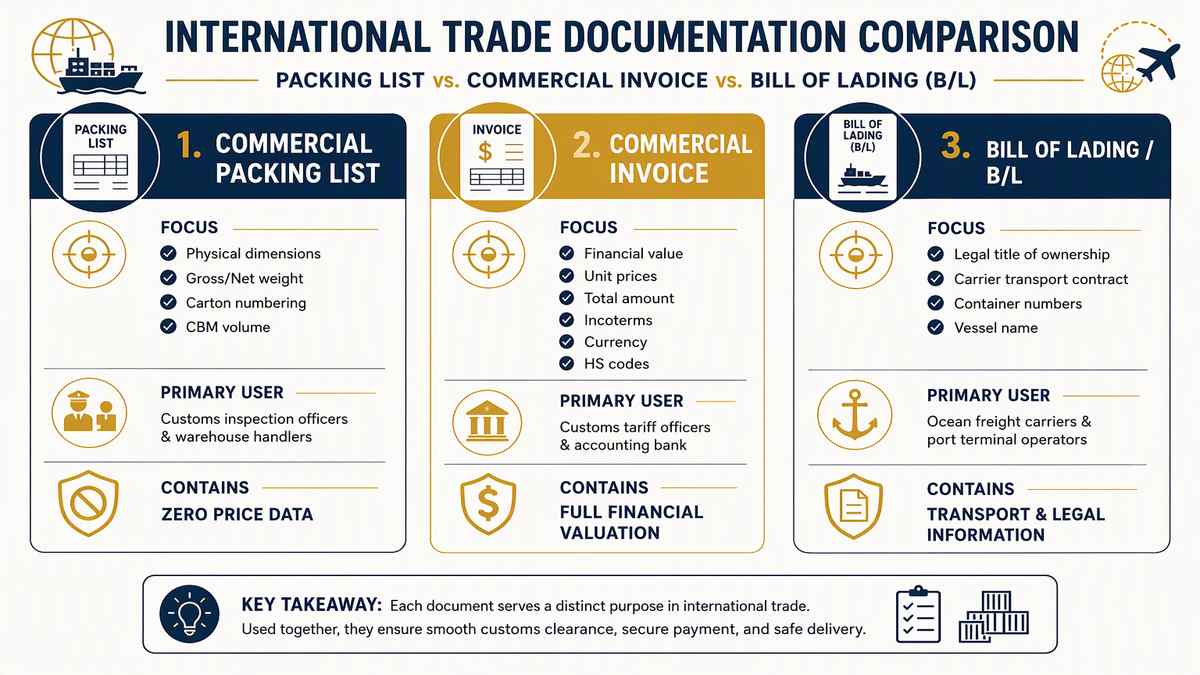
| Evaluation Dimension | 1. Commercial Packing List (装箱单) | 2. Commercial Invoice (商业发票) | 3. Bill of Lading (海运提单 – B/L) |
|---|---|---|---|
| Core Objective | Itemized physical cargo breakdown. | Financial accounting & legal sales bill. | Carrier transport contract & title document. |
| Operational Focus | Weights, dimensions, CBM, carton IDs. | Unit prices, total value, Incoterms, HS codes. | Vessel name, container numbers, seal numbers. |
| Primary User | Warehouse handlers & customs inspectors. | Customs tariff officers, bank, accountants. | Ocean carrier lines, port terminals, freight forwarders. |
| Pricing Disclosure | None (Zero price information). | Full (Itemized line-item values). | Freight prepaid / Freight collect only. |
| Customs Role | Physical tallying & weight a check. | Import duty, GST, and tariff assessment. | Proof of legal cargo possession & release. |
Anatomy of a Accurate Commercial Packing List: 10 Essential Fields
A legally accurate export packing list must contain ten standardized data modules:
To align your outer carton labeling with your packing documentation, explore our detailed guide on the types of packaging materials for wholesale products across retail mailers and master export boxes.
Gross Weight, Net Weight & CBM Formulas and Container Capacity
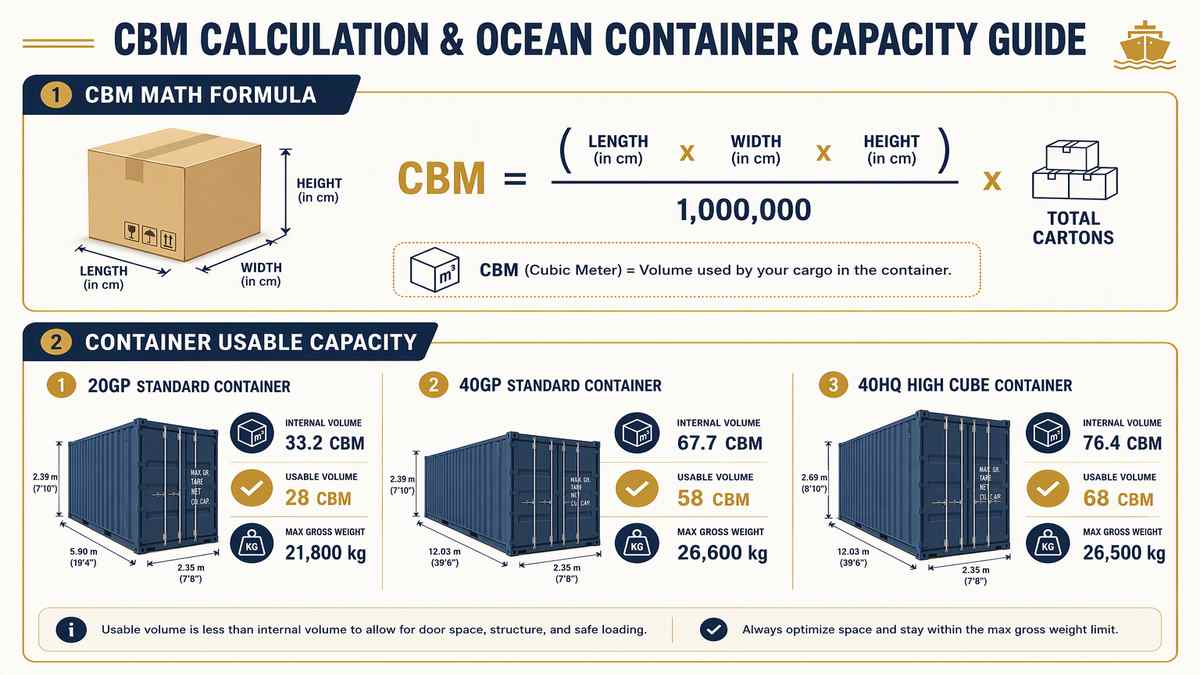
To avoid customs weight penalties, calculate weights and volumes using standardized mathematical formulas:
Regulatory authorities enforce strict cargo weight reporting under U.S. Customs and Border Protection (CBP) Import Documentation Rules to prevent overloaded container transport hazards.
- Net Weight (N.W.): The pure weight of the commercial product alone without any packaging materials. Formula: NW = Single Item Weight x Total Units.
- Tare Weight (T.W.): The weight of the empty packaging materials (master corrugated carton, polybags, protective foam, bubble wrap, and strapping tape).
- Gross Weight (G.W.): The total combined weight of the product plus all packaging materials. Formula: GW = Net Weight + Tare Weight.
Single Carton CBM = [ Length (cm) x Width (cm) x Height (cm) ] / 1,000,000
Total Shipment CBM = Single Carton CBM x Total Number of Cartons
- 20GP Standard Container: Theoretical volume 33.2 CBM → Practical Usable: ~28 CBM (Max payload: 21,800 kg).
- 40GP Standard Container: Theoretical volume 67.7 CBM → Practical Usable: ~58 CBM (Max payload: 26,600 kg).
- 40HQ High Cube Container: Theoretical volume 76.4 CBM → Practical Usable: ~68 CBM (Max payload: 26,500 kg).
3 Dangerous Differences in Packing Lists & How to Prevent Them
Careless documentation creates severe customs roadblocks. Watch out for these three common traps:
When structuring international sales contracts, establish clear delivery milestones using established trade terms defined by the International Chamber of Commerce (ICC) Incoterms Rules to assign documentation responsibilities.
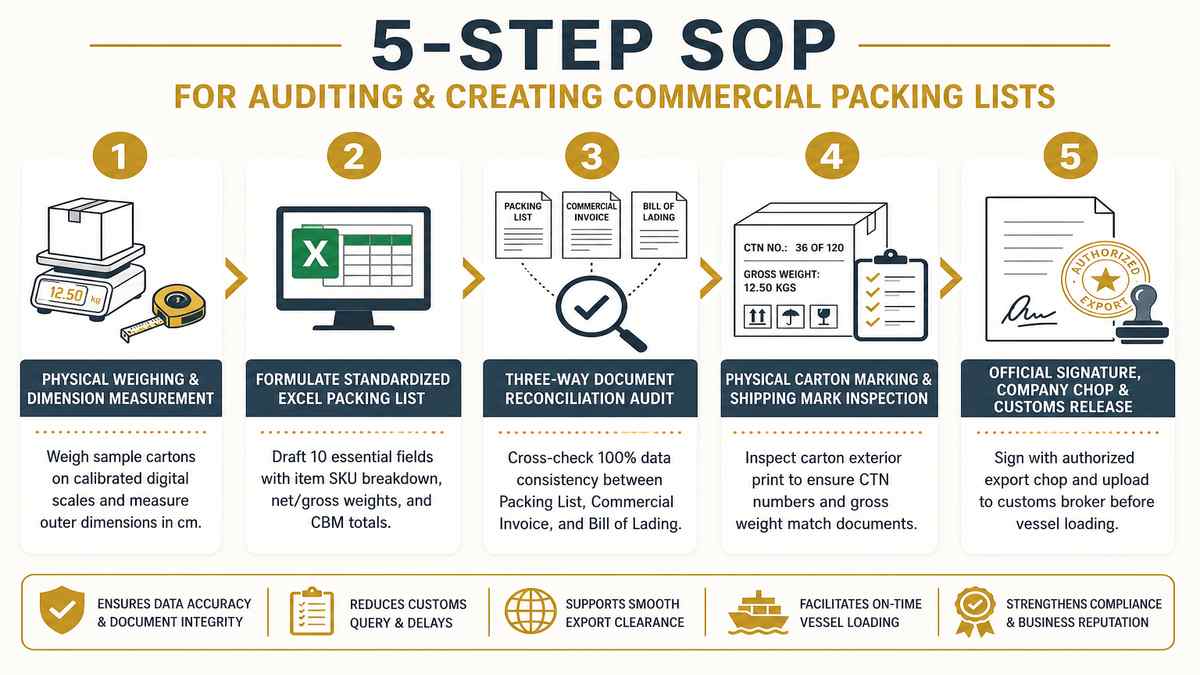
5-Step SOP for Auditing & Creating Commercial Packing Lists
Follow this standard operating procedure to check your export packing lists with zero rules errors:
To check that all custom brand logos and carton markings match your master artwork before packing list generation, follow our guide on how to put your logo on products from China for private label branding.
- Perform Physical Weighing & Dimension A Check: Weigh 10 randomly selected packed master cartons on calibrated electronic platform scales and measure external carton length, width, and height with steel tape measures under ISO 9001 Quality Management Standards.
- Formulate Standardized Packing List Template: Input exact verified carton dimensions, net weights, gross weights, and SKU breakdowns into a structured Excel packing list template, cross-referenced with your bilingual manufacturing sales contract under PRC law.
- Execute Three-Way Document Reconciliation (单单一致): Cross-check that total unit quantities, total carton counts, total gross weight, and total CBM match 100% across the Packing List, Commercial Invoice, and draft Bill of Lading.
- Inspect Physical Shipping Marks with FAI Sign-off: Check that physical exterior carton markings (Main Mark, Side Mark, Gross Weight, Net Weight, Country of Origin) match the packing list during a formal first article inspection (FAI) sample review.
- Execute Pre-Shipment Inspection (PSI) & Authorized Chop Sign-Off: Perform a comprehensive pre-shipment inspection (PSI) in China under AQL 2.5 standards to confirm carton integrity before stamping the document with the official red corporate chop for customs submission.
Illustrative Scenario: How a Chicago Importer Avoided \$5,000 in Demurrage
To see how strict packing list a check prevents catastrophic customs delays, review this hardware import case study:
A building supplies importer in Chicago, Illinois imported two 40HQ containers of commercial stainless steel bathroom hardware (1,800 master cartons, \$160,000 total order value).
- The Estimated Weight Disaster: The Chinese factory clerk created the packing list in the office without weighing the packed cartons, estimating the gross weight at exactly 14.0 kg per carton (declared total gross weight: 25,200 kg). When the first container arrived at Los Angeles Port and passed over the CBP weighbridge, the actual weight was 27,650 kg—a 9.7% weight difference. Customs immediately placed the shipment on an Intensive Inspection Hold.
- The Sourcing Pioneer Intervention: Sourcing Pioneer intervened immediately: dispatching on-the-ground inspectors to the factory’s second production batch in Ningbo, performing digital platform scale weigh-ins across all SKUs, recalculating exact net and tare weights (actual: 15.36 kg/ctn), and issuing a revised, certified Commercial Packing List with matching updated electronic export declarations.
- Flawless Customs Release: The revised documentation satisfied CBP import specialists, clearing the held container and allowing the second container to clear without inspection holds.
- The Commercial Outcome: Catching the error early on the second shipment saved the importer over \$5,000 in port demurrage and exam fees, prevented a 3-week supply chain stockout, and established a permanent electronic weighing a check protocol for all future factory shipments.
Frequently Asked Questions (FAQ)
What is a Commercial Packing List (CPL) in international trade?
A Commercial Packing List (CPL) is a legally binding export shipping document issued by the seller that details the exact physical cargo breakdown: carton numbers, item SKU quantities, net weight, gross weight, package dimensions, total volume in cubic meters (CBM), and shipping marks without disclosing financial pricing.
What is the difference between a Commercial Packing List and a Commercial Invoice?
A Commercial Invoice is a financial accounting document used by customs officers to assess import tariffs and taxes, containing unit prices, total value, Incoterms, and payment terms. A Commercial Packing List is an operational logistics document detailing physical dimensions, weights, and carton ranges used by warehouse handlers and physical customs inspection officers, containing zero pricing data.
How do you calculate total CBM (Cubic Meters) for an export shipment?
To calculate CBM for rectangular shipping cartons, multiply Length (cm) x Width (cm) x Height (cm), divide by 1,000,000 to get the volume per carton in cubic meters, then multiply by the total number of cartons in the shipment.
What are the usable CBM capacities for 20GP, 40GP, and 40HQ ocean containers?
In practical ocean freight operations, actual usable container volume accounts for carton packing clearances: a 20GP standard container holds 28 CBM (max 21,800 kg), a 40GP standard container holds 58 CBM (max 26,600 kg), and a 40HQ high cube container holds 68 CBM (max 26,500 kg).
What happens if the gross weight on the packing list does not match the customs weighbridge?
If the physical gross weight at the port weighbridge differs by more than 3% from the declared packing list weight, customs authorities issue an automatic physical inspection hold (Intensive Exam), resulting in port demurrage charges ($150 to $300/day) and shipment delays of 10 to 20 days.
Audit Your Commercial Packing Lists to Guarantee 100% Customs Clearance
Our China supply chain team conducts on-site pallet weighing, audits carton CBM dimensions, and reconciles Packing Lists with Invoices and Bills of Lading before export.
Get Free Packing List & Customs Audit
Questions & Comments
We read every one and reply within 24 hoursDrafting a commercial packing list for ocean freight, calculating 40HQ container CBM capacity, or facing customs weight inspection holds in Ningbo, Shanghai, or Shenzhen? Post your packing list and customs clearance questions below — our on-the-ground supply chain specialists will guide your logistics documentation.