
Amazon Patent Infringement: How to Solve It and Cut Your Losses
 ·
Updated August 24, 2026
·
Updated August 24, 2026
A patent complaint on Amazon is not a legal battle you need to win. It is a stock problem with a deadline attached. The sellers who come out of this with most of their money still work that out early; the ones who lose everything spend the first two weeks arguing about whether the patent is valid.
This page is about getting your money out. Not about whether the claim is fair.
The patent holder almost never wants your money. They want your listing gone, because in most cases they are selling the same product on Amazon themselves. Once you accept that, the negotiation gets much simpler — you are not asking for permission to keep selling, you are asking for time to clear stock.
We are a sourcing company, not a law firm, and nothing here is legal advice. What follows is what has actually worked for buyers we have helped, in the order we would do it.
What actually happens, and how long you have
Understanding the sequence stops you wasting the days that matter most.
The practical consequence: your first move is not writing an appeal to Amazon. It is finding the person who filed the complaint.
Step one: find who actually filed it
The complaint email names the patent holder, but the detail is often thin — a company name with no contact, or a name that returns nothing useful in a search.
Getting usable contact details
Start with the patent number itself. Public patent databases will give you the registered holder, the filing date and the assignee, and that is usually a more complete record than the email gives you.
If the name leads nowhere, a freelancer who does patent lookups can usually turn a patent number into a full report within a day, for a small fee. Give them the patent ID and a product photo. What you want back is the holder’s name, the company behind it, and any registered address.
Then search that name directly. A holder who sells on Amazon almost always has a website, a company listing, or a storefront somewhere. That is your route in.
Why most of these are Chinese companies
This surprises sellers, and it is the single most useful thing to know about this situation.
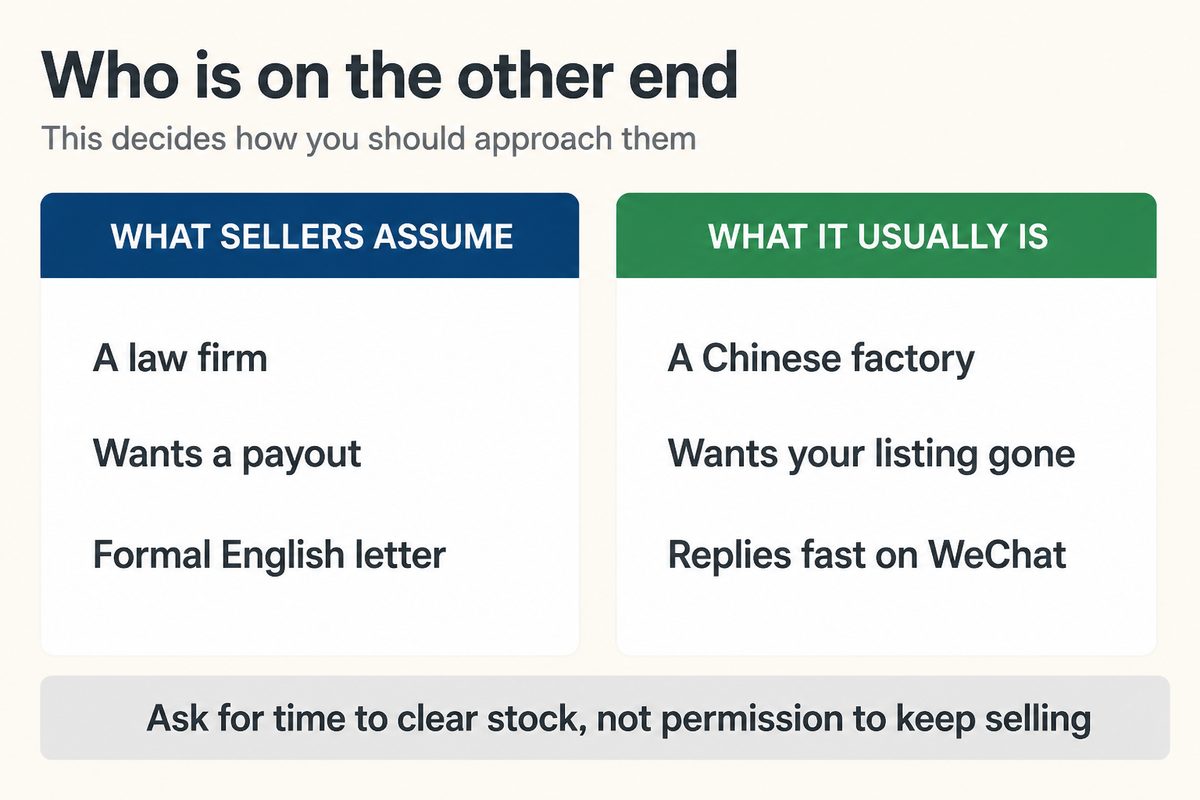
A large share of patent complaints on Amazon come from Chinese manufacturers who have registered a design or utility patent and are selling the product themselves. They are not law firms and they are not looking for a court case. They are a factory protecting a product line.
That changes how you should approach them. A formal legal-sounding letter in English often gets ignored. A direct, polite message — ideally in Chinese, ideally on WeChat rather than email — usually gets a reply within a day. If you cannot do that yourself, this is worth handing to someone who can.
Step two: the conversation that decides everything
Most sellers get this wrong by treating it as a dispute. It is a commercial conversation, and the tone sets the outcome.
Be straight about what happened
You listed a product without knowing it was protected. Say that. Sellers who open by questioning the patent’s validity get nowhere, because the holder has no reason to help someone who is arguing with them.
Give real numbers
How many you have sold, and how many you are still holding. Do not shade these. A holder selling the same product on Amazon can see roughly what your listing was doing, and being caught understating it ends the conversation.
Ask what they want, do not open with an offer
Naming a figure first almost always costs you money. Ask what would settle it. Their number is frequently lower than the one you were about to say.
Ask for time, not for a licence
A permanent licence is the thing they will not give, because it means competing with you forever. A short window to clear existing stock costs them almost nothing and is usually available.
The two documents you want, once you agree terms: a written settlement confirming the matter is closed, and confirmation that they have withdrawn the complaint with Amazon. The withdrawal is the one that matters — a settlement letter alone does not reinstate anything.
What a good outcome looks like
Not “I get to keep selling”. A good outcome is: a payment you can live with, the complaint withdrawn, and a few weeks to move the stock you already own. Sellers who hold out for permanent rights usually end up with nothing and a dead listing.
Step three: get the stock out
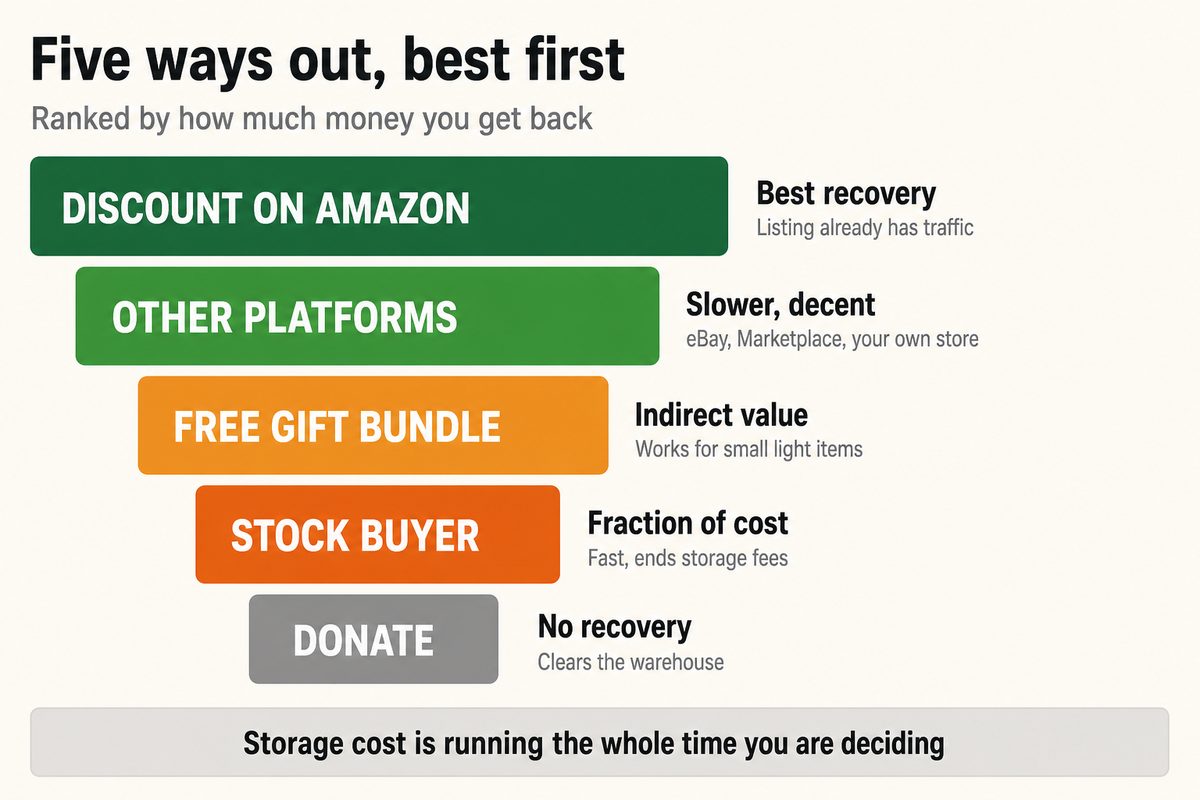
Once you have a window, it is a clearance problem. Ranked by how much money you get back.
One number worth doing before you choose: what your storage is costing per week. Sellers routinely hold stock for months hoping for a better exit, and pay more in storage than the difference between options two and four.
When the supplier told you it was fine
A good share of these complaints trace back to a supplier who said the product was clear. Sometimes that is a lie. Sometimes it is not, and knowing the difference decides whether pushing back is worth your time.
If it is the first case, the recovery route depends on where you bought:
Ordered on a platform: open a dispute and attach everything — the chat where they made the claim, your payment record, and the complaint email from Amazon. Platform disputes turn on documentation, and a screenshot of a supplier saying “we own this patent” is strong.
Ordered directly: you have less leverage, but not none. Suppliers care about repeat business and reputation. A calm message setting out what you lost and what you want, with the evidence attached, resolves more of these than people expect.
What to claim for: the goods, the freight, and the settlement you paid. Not lost profit — that is where these conversations stall.
Checking a supplier properly before you order is the cheapest version of this whole problem. Our guide to running a background check on a supplier covers what to look at.
Not every complaint is the same thing
Amazon groups several different problems under intellectual property, and sellers often respond to the wrong one. What you are holding changes what you should do.
Read the complaint carefully before you act. A trademark complaint that you treat as a patent problem sends you into a settlement negotiation you never needed — sometimes the answer is just editing the listing.
Not having this happen again
You cannot make this risk zero. You can make it much smaller, and most of it costs nothing.
1. Search the patent databases yourself
Free, public, and takes ten minutes. Search the product type and its distinctive features. You are looking for anything close, not an exact match — design patents cover appearance, and “close” is often enough to trigger a complaint.
2. Ask the supplier a specific question
Not “is this safe to sell”. Ask: do you hold a patent on this, and are you aware of anyone who does? Get it in writing. A vague answer to a specific question is information, and it is also the evidence you would need later.
3. Be careful with anything distinctive-looking
Plain commodity goods rarely attract complaints. Products with an unusual shape, mechanism or visual feature are exactly what design patents protect, and those are the ones that get filed against.
4. Watch who else is selling it
If one seller dominates a product that looks patentable and everyone else’s listing is thin or new, that is a signal. The dominant seller may well be the holder, and they are actively defending it.
We can talk to them for you
Most patent holders behind Amazon complaints are Chinese manufacturers, and that conversation goes better in Chinese, on WeChat, from someone local. Send us the complaint email and the patent number and we will tell you honestly what we think it will take to settle.
Get help with thisCommon questions
Can I just ignore an Amazon patent complaint?
No. An open complaint does not expire quietly — the listing stays down, funds can stay held, and repeated unresolved complaints affect the account rather than just the product. Even if you plan to abandon the product entirely, closing the complaint is worth doing.
Should I hire a lawyer?
Depends on the size. For most sellers the amounts involved are smaller than the legal fees, and a direct settlement with the holder resolves it faster. If the claim is large, or the holder is a company pursuing it aggressively, take proper legal advice — this page is not that.
Will paying a settlement let me keep selling?
Usually not permanently. Most holders sell the same product themselves, so a long-term licence means creating a competitor. What is normally achievable is a window to clear the stock you already hold, which is what you should be asking for.
My supplier said they owned the patent. What now?
If you have that claim in writing, you have grounds to seek compensation for the goods, the freight and any settlement you paid. Open a dispute if you ordered through a platform. If you ordered directly, a documented claim still works more often than sellers expect.
How do I find the patent owner if the email is vague?
Start with the patent number in a public database, which gives the registered holder. If that name leads nowhere, a freelancer doing patent lookups can produce a full report inside a day for a small fee. Then search the name for a website, storefront or company record.
Is it worth checking patents before every order?
For plain commodity products, a quick search is enough. For anything with a distinctive shape, mechanism or look, spend longer — those are what design patents cover, and they are where complaints come from.
Where to go from here
If you have a complaint open right now, the order is: find the holder, talk to them directly and honestly, agree a payment and a window, get the withdrawal in writing, then clear the stock as fast as the window allows.
If you are reading this before it happens to you, the useful work is upstream — checking the product before you commit, and checking who you are buying from. Our step-by-step guide to buying from China covers where these checks fit in the wider process, and what suppliers say and what they actually mean covers the specific claims worth pushing back on.
Questions & Comments
We read every one and reply within 24 hoursDealing with a patent complaint right now, or not sure whether the one you got is really a patent issue at all? Post the details below — what the email says and what you are holding — and I will tell you what I would do.