
Tire Factory: Two Numbers Moulded Into the Rubber
 ·
Updated October 22, 2026
·
12 min read
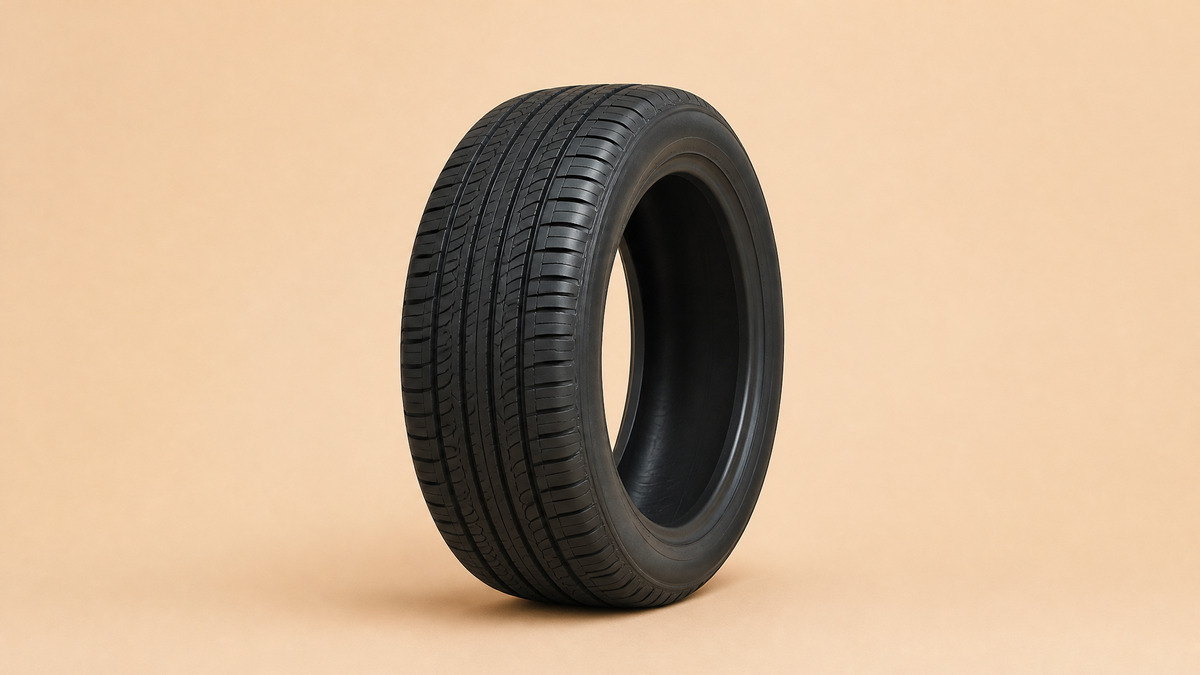
Fifty articles in this series kept finding the same thing: the number that decides whether a product may be sold sits on a document somewhere else. A listing, a fitment, a stamp, a laboratory scope, a fire test, a formula, a sentence. A tyre is the exception, and it is the reason this article closes the gap the series kept pointing at. Everything that matters about a tyre is moulded into the tyre itself: seven items of size and construction on both sidewalls, a certification symbol, and a thirteen-symbol identification number whose last four digits say which week of which year it was made. No visit to a database is required. The wall of rubber is the specification, and a buyer who cannot read it is buying a shape.
1. Two Standards, One Wall
There are two marking rules for a passenger tyre, and which one applies depends on when the vehicle was built and how the cords run. For new pneumatic radial tyres on light vehicles rated at 10,000 pounds gross vehicle weight or less, built after 1975, the rule is 571.139. It asks for four items on each sidewall and five more on one:
“(a) The symbol DOT, which constitutes a certification that the tire conforms to applicable Federal motor vehicle safety standards; (b) the tire size designation; (c) the maximum permissible inflation pressure; (d) the maximum load rating … (e) the generic name of each cord material; (f) the actual number of plies in the sidewall, and in the tread area if different; (g) the term “tubeless” or “tube type”; (h) the word “radial” …” — 49 CFR § 571.139, S5.5
The older family — bias ply tyres, radial tyres for cars built from 1949 to 1975, and T-type spares — sits under 571.109, which asks for seven items on both sidewalls: the size designation, the maximum permissible inflation pressure, the maximum load rating, the cord material, the ply count in the sidewall and in the tread, the words tubeless or tube type, and the word radial on a radial tyre. The letters are the same height in both standards, not less than 0.078 inches.
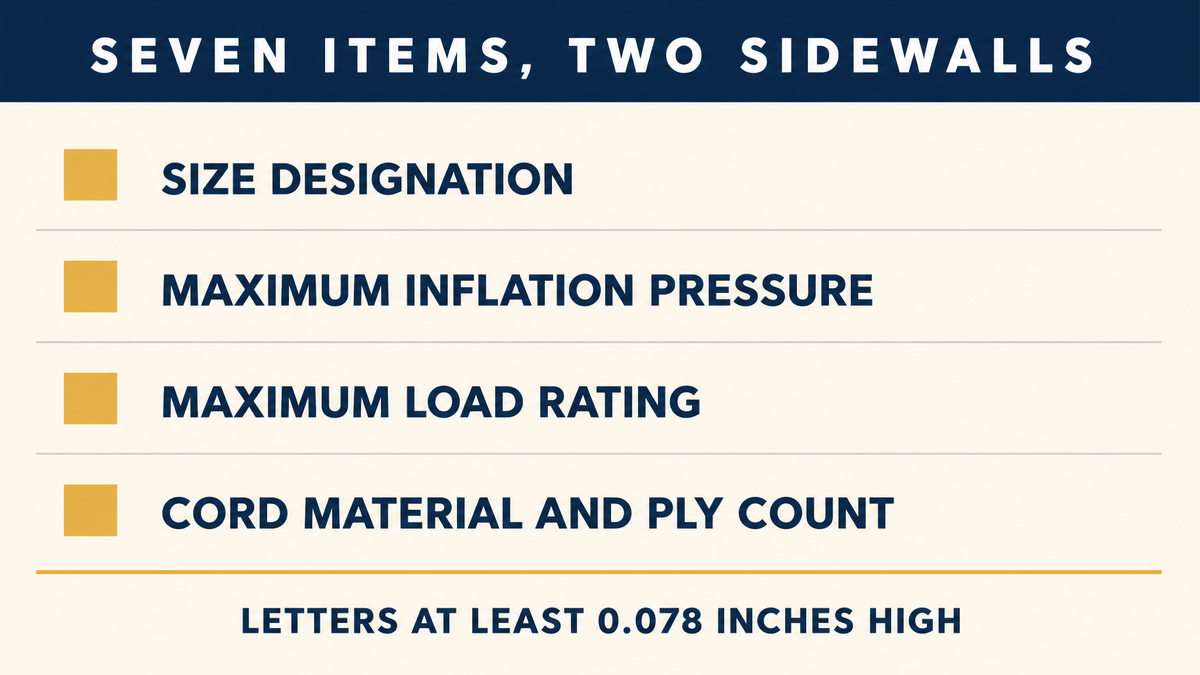
Both paragraphs also fix where the writing goes. The markings must sit between the maximum section width and the bead, and if the widest point of the tyre falls close to the bead the zone shifts to the region between the bead and a point halfway to the shoulder. In no case may they sit where the flange of any rim approved for the tyre would obstruct them. A marking a few millimetres low is legal on a shelf and invisible on a wheel.
139 adds one requirement that 109 does not, and it is the one a mould maker feels. The characters must be raised above or sunk below the tyre surface by not less than 0.015 inches. A marking that is merely printed, or moulded so shallow that it polishes away in the first thousand miles, is not a marking under this standard.
Two smaller items complete the wall. On a radial, the identification number goes on the intended outboard sidewall for tyres made on or after 1 September 2009, with a partial number — every character except the date code — on the other side. And a tyre rated at 420 kPa (60 psi) must carry the words Inflate to 60 psi in letters at least half an inch high on both sidewalls, between the shoulder and the bead.
2. Thirteen Symbols, and the Last Four Are the Date
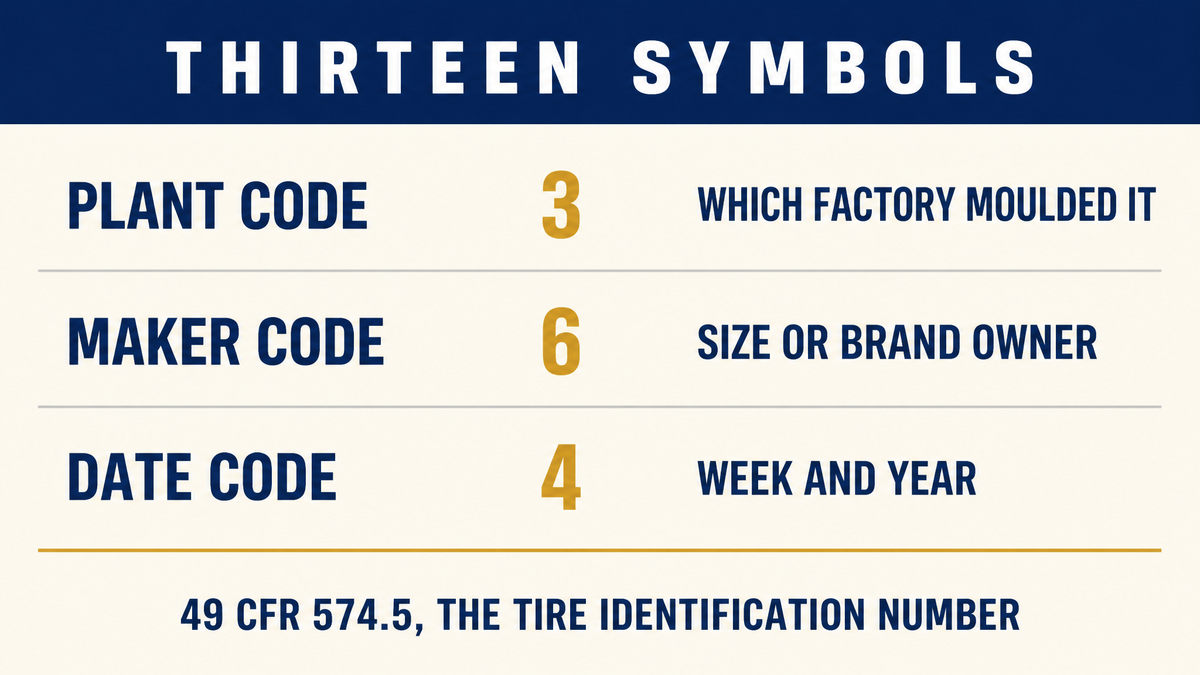
The certification and the identification number come from a different part of the code, and between them they turn a tyre from a product into a record. The number comes from the identification section of part 574, and it is thirteen symbols long, moulded into one sidewall, and it is built in three groups:
The thirteen symbols, group by group
| Group | Symbols | What it tells you |
|---|---|---|
| Plant code | Three | Which factory moulded it |
| Maker code | Six | Size and characteristics, or the brand owner |
| Date code | Four | The week and the year of manufacture |
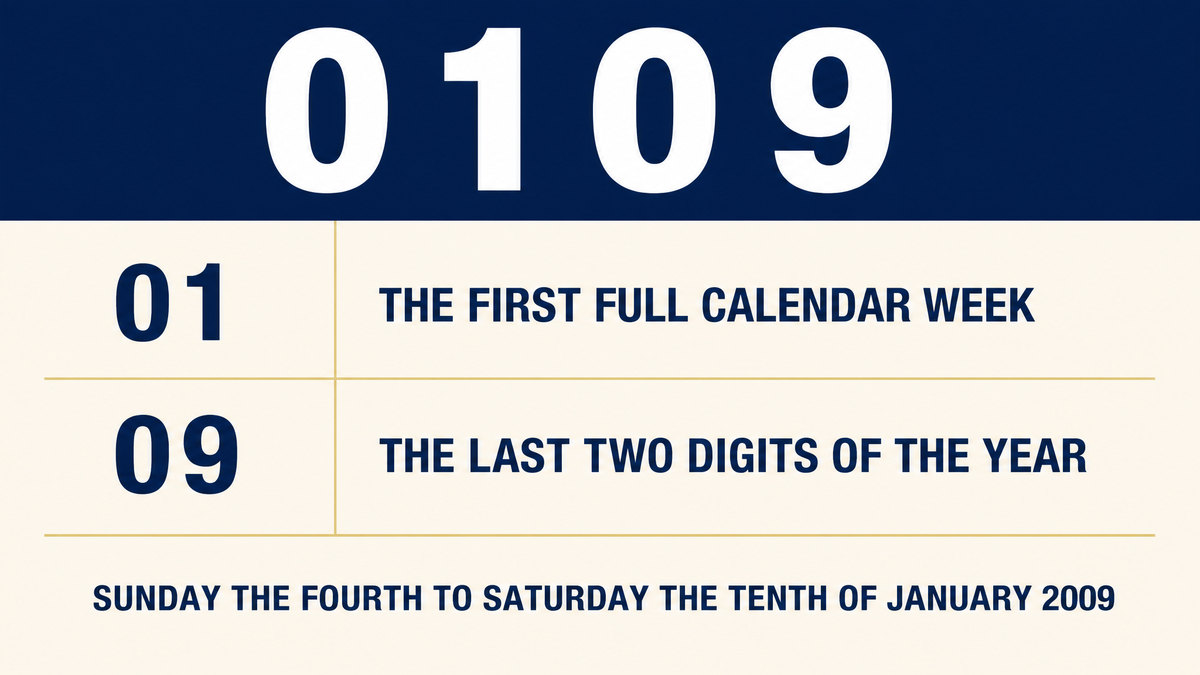
The date code is the part to memorise. Its first two symbols are the week, counting 01 for the first full calendar week of the year, with the week running from Sunday to Saturday. Its last two symbols are the final two digits of the year. The regulation's own example is 0109, which it reads as the first full calendar week of 2009 — the week beginning Sunday, 4 January and ending Saturday, 10 January 2009.
The middle group is where the trade gets separated. Six symbols are the manufacturer's code, and the rule says they may be used either to identify significant characteristics of the tyre or to identify the brand name owner. So the same six symbols can describe a factory's own size coding or somebody's brand — and the manufacturer has to keep a record of what each code means, with the corresponding size and brand, and hand it over on request.
Two smaller rules in the same section are worth carrying into a supplier conversation. The alphabet is restricted: the only symbols allowed in the number are A, B, C, D, E, F, H, J, K, L, M, N, P, R, T, U, V, W, X, Y and the ten digits — no G, I, O, Q, S or Z, which are the letters most easily misread on a curved black surface. And retreads carry a shorter number, seven symbols, with a separate “R” mark that is not part of the number.
3. What the Rule Does Not Say About Age
Here is the place to be precise, because the trade is full of confident statements that the code does not make. The four digits identify a week and a year. The sections read for this article set no shelf life, no expiry date and no maximum age at which a tyre may be sold. What they set is identification, and through the record-keeping part of the code, a chain that runs back from a tyre to the person who bought it.
That combination is worth understanding on its own terms. The identification number exists so that a batch can be found again — if a mould, a compound or a plant turns out to be wrong, the number is how a recall reaches the right tyres and the right owners. The manufacturer carries the responsibility for keeping those records, and may designate another party to hold them, but the duty stays with the manufacturer.
For a buyer, that leaves age as a judgement rather than a rule — and the code is the only fact available to make it with. Tread tells you how far a tyre has travelled. The date code tells you how long it has existed, which is a different question and often the more useful one for a warehouse. So the specification belongs in the order as a shipping condition rather than a legal one: no tyre in the container older than a stated number of weeks at the date of shipment, checked against the four digits on a sample from each pallet, before the carton is opened.
There is one more thing the code settles, and it is easy to miss. The week runs Sunday to Saturday, and 01 is the first full calendar week of the year, which means the first days of January can belong to the last week of the previous year. A tyre marked 5208 is not a 2008 tyre built in December by accident; it is a tyre built in the final week of 2008. Anyone reading the code as a simple year stamp will mis-date the first and last weeks of every year.
4. The Load and the Pressure Lines
The pressure figure is not a free choice in either standard, and the two lists differ in a way that matters on a specification sheet. Under 571.109 the maximum permissible inflation pressure must be 32, 36, 40 or 60 psi, or 240, 280, 300, 340 or 350 kPa. Under 571.139 the list is the kPa set only, and on a passenger tyre each kPa marking must be followed in brackets by the equivalent figure in psi, and each load rating in kilograms by the equivalent in pounds.
The load rating has the same structure in both. It must be the figure in the individual manufacturer's own submission, or the figure published for that size, type and pressure in the references the standard names. Where a size appears in more than one publication with different figures, the tyre must carry at least the lowest published maximum — a rule that quietly protects the buyer from a factory shopping for the most generous table.
Two tolerances complete the picture, and both are checkable with simple tools. The measured section width may not exceed the declared width by more than 7 per cent, or by 7 per cent or 10 millimetres for the higher-pressure tyres, whichever is larger. And the treadwear indicators are more specific than buyers expect: under 109 a tyre has to carry an indicator that shows when the tread has worn to 1.6 millimetres (1/16 inch), and under 139 it needs not less than six of them spaced around the circumference — or three on a rim of 12 inches and below — at the same depth.
Read as an order, the four figures become one line each: the pressure from the allowed list for that standard, the load from a named table, the width within 7 per cent, and indicators at 1.6 millimetres. None of them is negotiable, and all of them are moulded on the sidewall where the customer can check them.
5. The Plant Code, and the Factory Claim
The first three symbols are the part of a tyre that a trading company cannot invent. The plant code is assigned by NHTSA on request, and it represents the identity of the manufacturer or retreader — which makes it a registered fact about where the tyre was moulded, not a marketing string.
That has a direct consequence for the phrase every supplier uses. “We have our own factory” is not a claim about enthusiasm; it is a claim about three symbols. Either the plant code on the sample belongs to the plant the seller names, or the tyre came from somewhere else. Asking for a photograph of the sidewall and the plant code on it is a thirty-second check that settles the question the audit would otherwise spend a day on.
The six-symbol maker code adds a second layer that buyers rarely think about. It may identify the brand owner rather than the factory, which is how a tyre can legally carry one company's name and come out of another company's mould — provided the maker keeps a record of what the code means. So a brand is not a place, and the two groups on the sidewall are separate facts: three symbols for where, six for whose.
One more line belongs here, and it is the strictest sentence in the section. The DOT symbol is a certification that the tyre conforms to the applicable federal standards, and it must not appear on tyres to which no such standard applies. That is a useful test when a sample arrives with a symbol on it and a specification sheet that describes something else.
6. What the Record Says
Method first. The federal recall file holds 245,845 records, has no header row, and every field is scanned. Controls: brake 28,639, air bag 16,162. Twenty-five terms were counted, and not one came back empty.
| Term | Records | Campaigns |
|---|---|---|
tire | 29,586 | 1,048 |
tires | 24,210 | 722 |
tyre | 32 | 12 |
tread | 1,267 | 151 |
sidewall | 835 | 130 |
bead | 139 | 19 |
ply | 96 | 15 |
cord | 703 | 47 |
innerliner | 18 | 8 |
retread | 1 | 1 |
load | 3,092 | 369 |
inflation | 744 | 91 |
pressure | 15,665 | 979 |
blowout | 119 | 23 |
separation | 4,746 | 578 |
chunking | 14 | 13 |
cracking | 1,394 | 119 |
dot | 1,159 | 220 |
date | 884 | 123 |
age | 12 | 4 |
balance | 106 | 13 |
alignment | 623 | 57 |
valve | 8,247 | 527 |
rim | 1,712 | 115 |
wheel | 12,289 | 1,273 |
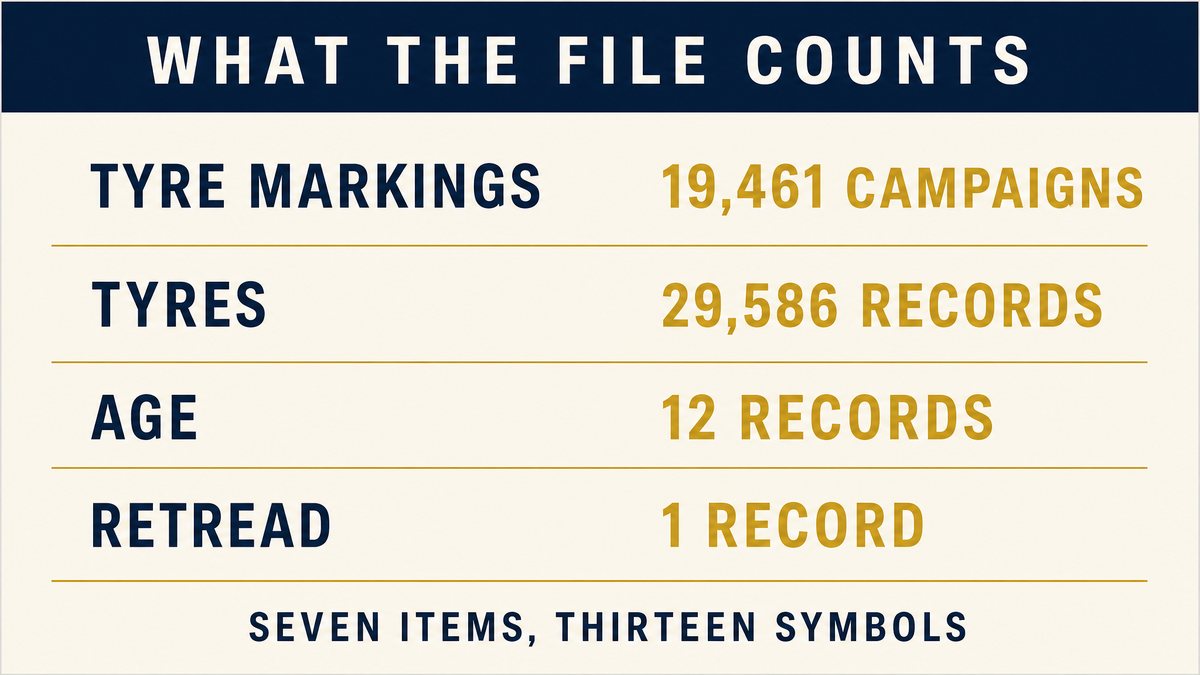
The biggest heading in the whole file is the marking. Campaigns filed under TIRES:MARKINGS number 19,461 — more than any other component heading this series has counted, including brakes. The plain tyre heading carries 1,368, the valve heading 653, tread and belt 458, sidewall 316, the pressure monitoring heading 271, the temporary spare heading 187, bead 86, and the tube heading exactly 1. So the record's largest category is not the tyre as a shape. It is the writing on the tyre.
The failure words are thin, and one industry is missing entirely. blowout reaches 119 records in 23 campaigns, chunking 14 records in 13, innerliner 18 records in 8, and retread reaches a single record in a single campaign. A process that renews a large share of the world's truck tyres appears once in a quarter of a million rows. Meanwhile the biggest technical rows are the familiar ones: a Michelin LTX M/S campaign at 1,200,000 units under tread and belt, a Uniroyal Laredo at 799,900, a Cooper Discoverer sidewall campaign at 430,298 and a Primewell Valera at 394,378.
The word the buyer needs is almost absent. age reaches 12 records across 4 campaigns. In a file that counts 19,461 marking campaigns, the word for the thing a marking exists to establish appears twelve times. dot reaches 1,159 records and date 884, so the vocabulary is present at the level of the symbol and the field — but not at the level of the question a fleet actually asks, which is how old the casing is.
The finding. This is the mirror image of the last fifty articles. In every other row the product's specification lived outside the record and the record held only what broke. Here the record is dominated by the specification itself — by markings — and the words for age, for retreading and for the specific failures a marking is meant to prevent are the thinnest in the table. So the sidewall is not a formality that the file happens to count. It is the one thing the file counts most, and reading it is the whole job.
7. Five Questions a Tyre Quote Should Answer
A tyre quotation in this trade usually arrives as a size, a pattern name, a quantity and a price per unit. Three of those four are about the shape, and the shape is the part the customer can already see. Five questions get at the part that is moulded in and cannot be changed after the fact.
- What are the four digits, and what is the oldest batch in the container? Tread says how far a tyre has been; the code says how long it has existed. Ask for the date code on a sample from each pallet, and set the maximum age as a shipping condition.
- Whose plant code is on the sidewall? Three symbols, assigned by the agency, identifying the plant that moulded the tyre. It is the cheapest test of a factory claim that exists.
- What load rating, at what pressure, and from which table? The pair travels together, and the pressure has to be one of the permitted figures. A load quoted at an invented pressure is a number without a basis.
- Where does the marking sit, and will the rim flange hide it? The rule requires a zone beside the bead, and forbids a position the rim obstructs. On a mould that is a millimetre decision, and in a complaint it is the first thing a customer photographs.
- Does the six-symbol maker code name the plant or a brand? It may legally identify the brand owner, so a brand on the sidewall is not evidence of a factory. Ask what the code means, and expect a written answer.
8. Six Lines to Put in the Order
Everything above reduces to six lines, and every one of them is already printed on the product. That is the difference between this category and the fifty before it: nothing has to be obtained from a third party.
| Line | What to write | Why it is on the list |
|---|---|---|
| 1 | The size designation in both inch and metric form | Both are permitted and both are read by different buyers |
| 2 | The load rating, and the pressure it is rated at | A load figure is meaningless without its pressure |
| 3 | The date code, and the maximum age at shipment | Four digits, checked on a sample per pallet |
| 4 | The plant code, and whose plant it belongs to | Three symbols assigned by the agency |
| 5 | The maker code, and what it identifies | Six symbols may name a brand, not a factory |
| 6 | The marking position on the drawing, clear of the rim flange | A legal mark can be invisible once mounted |
Six lines, all of them visible on a photograph of one sidewall, and none of them requiring a certificate from anybody.com/factory-audit-checklist-guide/" target="_blank" rel="noopener">what an audit reads off a sidewall is where a mould meets a specification, and the carton checks before a container is sealed are where a date code becomes a shipment condition — with how a tyre's volume decides the freight worth settling at the same time, because a tyre is the clearest case of a cargo that bills on space.
Frequently Asked Questions
How do I read the date code on a tyre?
The last four symbols of the thirteen-symbol identification number. The first two are the week, with 01 being the first full calendar week of the year and the week running Sunday to Saturday. The last two are the final digits of the year. So 0109 means the first full week of 2009, which ran from Sunday 4 January to Saturday 10 January.
Is there a legal age limit for a new tyre?
The sections read for this article set identification and recordkeeping, not a shelf life. Nothing in them states an expiry date or a maximum age at sale. That leaves age as a buyer's judgement, and the four digits are the only fact available to make it with — which is why a maximum age at shipment belongs in the order.
What has to be moulded into the sidewall?
Seven items, on both sidewalls, in letters at least 0.078 inches high: the size designation, the maximum permissible inflation pressure, the maximum load rating, the cord material, the ply count in the sidewall and tread, whether the tyre is tubeless or tube type, and the word radial on a radial tyre.
What does the DOT symbol on a tyre mean?
It is a certification that the tyre conforms to the applicable federal safety standards, and the rule says it must not appear on tyres to which no such standard applies. It is a statement of conformity rather than a quality grade, and it sits alongside the identification number rather than replacing it.
Can a tyre carry a brand that is not the factory?
Yes. The six-symbol maker code may be used to identify the brand name owner rather than the plant, and the manufacturer has to keep a record of what each code means. The three-symbol plant code is the part that identifies where the tyre was actually moulded.
Which inflation pressures are allowed?
The maximum permissible inflation pressure must be 32, 36, 40 or 60 psi, or 240, 280, 300, 340 or 350 kPa. A specification that quotes any other figure is describing something the standard does not recognise, and the load rating has to be the one published for that size and pressure.
A tire is the only part in this series whose regulation is moulded into the product, in symbols, for a reader who will never open the standard. FMVSS 139 asks for four items on one sidewall and a fifth when the tire is radial; FMVSS 109 asks a different set of a tire built for a different duty.
So a factory does not have one label. It has one label per standard it builds to, and the two do not map onto each other. Deciding which standard a SKU belongs to is therefore a step that happens before the engraving is cut, not after the first container arrives.
A Plant-to-Mould Cross-Reference
The plant code list set against the mould each one uses, so a claim about origin traces back to a specific line.
Trace My Plant Code
Questions & Comments
We read every one and reply within 24 hoursWhich marks a tire carries depends on the standard it was built to, and the two sets do not overlap. Send the SKU and the market, and we will name the marks and the sidewall.