
Alloy Wheels Supplier: The Rim That Carries No Stamp
 ·
Updated October 22, 2026
·
12 min read
A wheel quotation is written in millimetres and kilograms: diameter, width, offset, bolt pattern, centre bore, load rating, weight. Two of those numbers decide whether the wheel has to be stamped into the metal, and neither of them is on the drawing. What decides it is the vehicle the rim is made for, and the answer is not the one most suppliers expect: the marking rule narrows as the vehicle gets smaller. A rim for a passenger car can leave the factory with no federal marking at all, while the same factory's rim for a light truck or a motorcycle has to carry five items, cut into the alloy to a stated depth. This article reads the two standards that split the duty — FMVSS 110 for vehicles up to 10,000 pounds and FMVSS 120 above it — and the finding is a gap in the middle of the most popular product in the category.
1. Two Standards, and a Duty That Stops Short
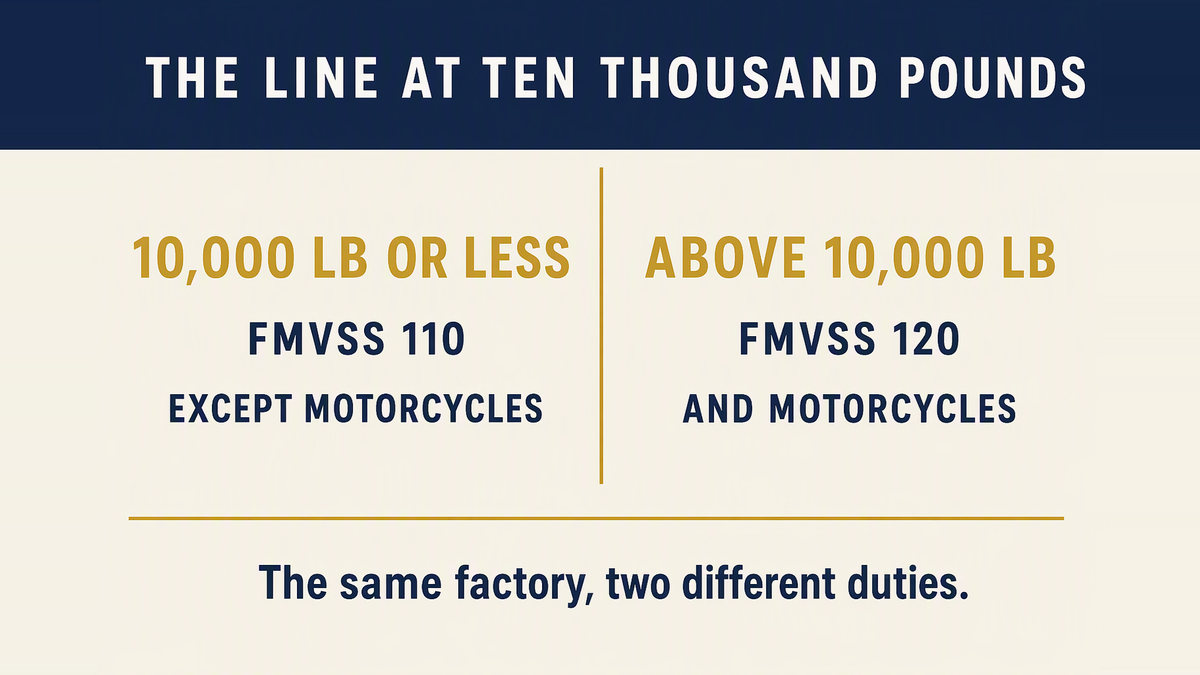
The federal rules for rims are not in one place. They sit in two vehicle safety standards that divide the market by weight, and the weight line is the same in both. FMVSS 110 covers motor vehicles with a gross vehicle weight rating of 4,536 kilograms (10,000 pounds) or less, except for motorcycles. FMVSS 120 covers vehicles above that figure, and motorcycles. Each of the two standards deals with tyre selection and with rims, and each one contains a rim-marking paragraph.
Here is the part that surprises people. The rim-marking paragraph in FMVSS 110 is not written for every vehicle that standard covers. It carries a heading of its own, and the heading is the qualification:
“S4.4.2. Rim markings for vehicles other than passenger cars. Each rim or, at the option of the manufacturer in the case of a single-piece wheel, each wheel disc shall be marked with the information listed in S4.4.2 (a) through (e), in lettering not less than 3 millimeters in height, impressed to a depth or, at the option of the manufacturer, embossed to a height of not less than 0.125 millimeters.” — 49 CFR § 571.110
Read the heading again. For vehicles other than passenger cars. So under FMVSS 110 the marking duty reaches a rim for a multipurpose passenger vehicle, a truck, a bus or a trailer, and it does not reach a rim for a passenger car. And FMVSS 120's marking paragraph sits in a standard that, by its own application clause, covers only rims for vehicles over 10,000 pounds and for motorcycles.
Put the two together and the position of a 17-inch passenger car alloy wheel is unusual. Under these two sections, no marking requirement attaches to it. That is not a statement that no rule anywhere touches it — a rim is still covered by the performance duty in the next section, and a wheel that goes onto a finished vehicle meets the rules for the vehicle. It is a statement about the metal in your hand: the most popular product in this category is the one that the federal marking rule does not reach, and the letters and numbers that customers ask you to stamp on the back of the spokes are, for that wheel, a commercial decision rather than a federal one.
Two consequences follow immediately, and both are worth having in mind before a supplier briefs you on certification.
A blanket certification claim is the wrong shape. A factory that produces passenger car wheels, light truck wheels and motorcycle wheels is producing three products whose marking duties differ. “Our rims are DOT marked” tells you nothing about which of the three you are buying, and the honest version of the sentence names the vehicle class.
The stamp is not the test. Marking a rim is a duty that is discharged by a die or a CNC tool, and it is not evidence that anything was measured. The item stamped onto the rim under FMVSS 110 is the manufacturer's own certification — section 5 below reads that clause in full, because it is the sentence that tells you who is actually on the hook when a wheel cracks.
What this guide covers
- Two standards, and a duty that stops short
- What a passenger car rim has to do instead
- Five items, two dimensions, one side of the wheel
- The letter list is not the same list
- Who is doing the certifying
- What the record says
- Five questions a wheel quote should answer
- Six lines to put in the order
- Frequently asked questions
2. What a Passenger Car Rim Has to Do Instead
A wheel with no marking duty is not a wheel with no duty. The same section that stops short of marking a passenger car rim opens with the requirements that do apply to it, and they are written as behaviour rather than as paperwork:
“S4.4.1 Requirements. Each rim shall: (a) Be constructed to the dimensions of a rim that is listed by the manufacturer of the tires as suitable for use with those tires … (b) Except for trailers, in the event of rapid loss of inflation pressure with the vehicle traveling in a straight line at a speed of 97 km/h (60 mph), retain the deflated tire until the vehicle can be stopped with a controlled braking application.” — 49 CFR § 571.110
Two duties, and both are worth pulling apart before an order document is written.
The first is a dimensional duty that belongs to somebody else's listing. The rim has to be built to the dimensions of a rim that the tyre manufacturer lists as suitable for those tyres. The wheel maker does not decide what is suitable; the tyre maker's listing does, and the listing is a published document. So when a supplier offers a 17 × 7.5 with a set of offsets, the useful question is not whether the factory thinks the fitment is right. It is which published listing the dimension comes from, and that is a document you can open.
The second is a behaviour at a stated speed. With the tyre deflating fast and the car travelling straight at 97 km/h, the rim has to hold the tyre on the wheel well enough for the driver to stop under controlled braking. Read the exception in front of it as well: trailers are left out of this duty. So the retention requirement attaches to the rims on the towing vehicle and not to the rims on the trailer, which is the opposite of the intuition that the heavier, more heavily loaded axle needs more.
Notice what is absent from both clauses. There is no load rating stamped on the rim, no test report number, no file that travels with the wheel. FMVSS 110's rim requirements are dimensional and behavioural, and they are established on the vehicle. That is why the marking paragraph could be narrowed to “vehicles other than passenger cars” without leaving a hole in the safety of a passenger car: the wheel is covered by what it has to do, and the stamp was never the safety requirement.
The commercial reading is straightforward, and it changes what a buyer should be asking for. On a passenger car wheel the deliverable is a dimension and a behaviour, so the paperwork worth collecting is the tyre maker's listing reference, the drawing tolerance on the bead seat, and the test that shows the wheel keeps the bead seated. On the wheels covered by the marking paragraph, the deliverable includes a stamp, and a stamp is a separate item of work: a die or a program, a position, a depth, and a factory that can repeat it on the ten-thousandth wheel as well as the first.
3. Five Items, Two Dimensions, One Side of the Wheel
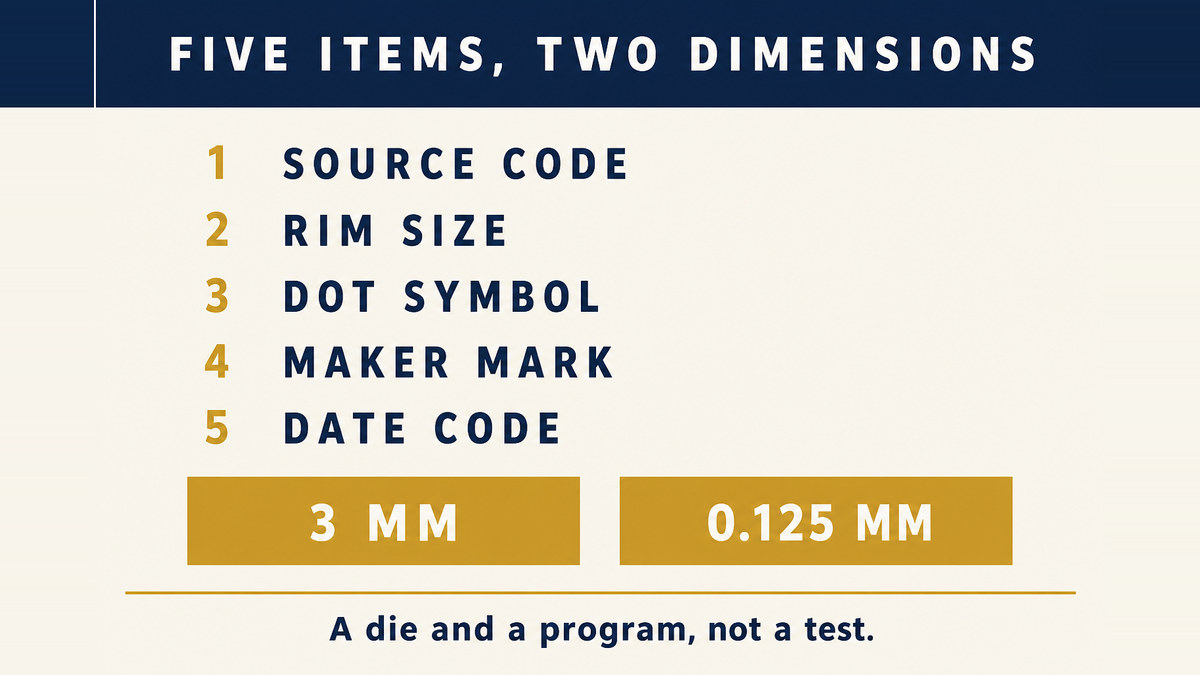
Where the marking duty does reach a rim, the clause is unusually specific, and the specificity is the useful part. It names five items, two dimensions, and the side of the wheel the first three items must appear on.
| Item | What it has to say | The worked example in the rule |
|---|---|---|
| (a) | A letter indicating the source of the rim's published dimensions | One of the codes listed in the paragraph — see section 4 |
| (b) | The rim size designation, and for a multi-piece rim the rim type designation | 20 × 5.50, or 20 × 5.5 |
| (c) | The symbol DOT | The maker's own certification — section 5 |
| (d) | A designation identifying the rim's manufacturer by name, trademark or symbol | Name, mark, or a symbol |
| (e) | The date of manufacture, numerically or as a symbol | September 4, 2001 → 90401, 904, 01 or 01, 904 |
The two dimensions are stated in the opening sentence and they apply to the whole set: lettering not less than 3 millimetres in height, impressed to a depth or embossed to a height of not less than 0.125 millimetres. The rule also gives the manufacturer a choice of mark position — the rim, or in the case of a single-piece wheel, the wheel disc.
Placement then follows. Items (a) to (c) have to appear on the outward side in the FMVSS 110 wording, and on the weather side in the FMVSS 120 wording, which that standard defines precisely as the surface area of the rim not covered by the inflated tyre. For multi-piece rims the rule goes further: items (a) to (e) appear on the rim base, and items (b) and (d) also appear on every other part of the rim. A multi-piece wheel therefore carries the size and the maker's mark more than once, on the parts that can be separated and mixed up in a workshop.
Now the practical point that costs money, and it follows from the depth figure rather than from anything the rule says about refinishing. The requirement is a minimum: the mark must be at least 0.125 millimetres deep where it is pressed in. Any process that takes metal off the face of the wheel — a machine-cut refinish, a re-polish of the spokes, a re-machining of the lip — removes depth from the marking along with everything else. A wheel that leaves the factory with a mark slightly deeper than the minimum can come back from a refurbisher with a mark that is no longer legible, and a stamp you cannot read is not a stamp. So the depth is not a detail for the factory's own quality sheet: it belongs in the order, with a tolerance, and it is one of the few wheel specifications a buyer can check with a straight edge and a magnifier before the wheels leave the warehouse.
There is a second, softer point about the date. Item (e) allows the month and year without the day, expressed either in figures or in a symbol the maker has registered with the agency. That single item is the only one that ties a wheel to a production run, and it is the item a buyer leans on when a batch has to be traced. If the date is carried as a symbol, the next section explains who has to be able to read it back.
4. The Letter List Is Not the Same List
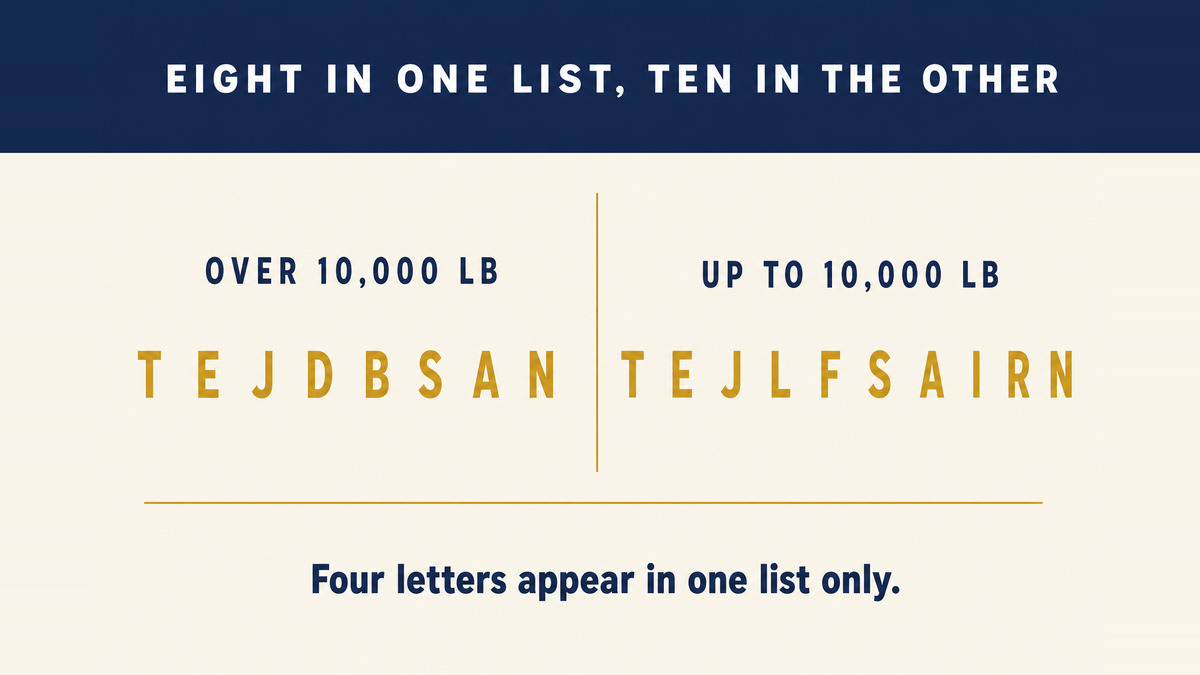
Item (a) does not name a letter. It names a list, and the two standards carry two different lists. Reading them side by side is the fastest way to see why a stamp has to be checked against the vehicle it is going on rather than against a photograph of a similar wheel.
| Code | Body it points to | FMVSS 120 (over 10,000 lb) | FMVSS 110 (up to 10,000 lb) |
|---|---|---|---|
| T | Tire and Rim Association | yes | yes |
| E | European Tyre and Rim Technical Organization | yes | yes |
| J | Japan Automobile Tire Manufacturers' Association | yes | yes |
| S | Scandinavian Tire and Rim Organization | yes | yes |
| A | Tyre and Rim Association of Australia | yes | yes |
| N | Independent listing, tyre standards | yes | yes |
| D | Deutsche Industrie Norm | yes | not in the list |
| B | British Standards Institution | yes | not in the list |
| L | ABPA, Brazil | not in the list | yes |
| F | Tire and Rim Engineering Data Committee, South Africa | not in the list | yes |
| I | Indian Tyre Technical Advisory Committee | not in the list | yes |
| R | Argentine Institute of Rationalization of Materials | not in the list | yes |
The counts are the first thing to notice: eight codes in one list, ten in the other. Six letters are common to both. Two letters, D and B, appear only in the list for the heavier vehicles and motorcycles. Four letters, L, F, I and R, appear only in the list for vehicles up to 10,000 pounds. So the same character can be a valid source code on one wheel and a code that is not in the list on the next one, and a buyer comparing two wheels by photograph will not see the difference.
There is a second reading that matters more often in this trade, and it concerns a letter that appears in both lists. In the marking required by either standard, J indicates the Japan Automobile Tire Manufacturers' Association as the source of the rim's published dimensions. It is one of a set of source codes, and the set exists so that a reader can go to the right published table and know what the published numbers mean. On the marketing side of this business the letter J is often presented as if it were a quality mark, or run together with the initials of an industry standard into a single claim. In the two clauses that create the marking, the letter does one job: it names the body that published the dimensions. That is worth knowing before a supplier's certification summary is accepted as a description of the federal duty.
Two administrative duties attach to the marking as well, and both are useful to a buyer. First, a maker that chooses to express the date of manufacture as a symbol rather than in figures must notify the agency in writing, naming every manufacturer and brand-name owner that uses the symbol, with a narrative description and an actual-size drawing of it, at least 60 calendar days before the symbol is first used, and the material is placed in a public docket. Second, and this is the one to use: each manufacturer of wheels shall provide an explanation of its date of manufacture symbol to any person upon request. That sentence is a lever. A date code that nobody can read is a code the maker is required to explain, and asking for that explanation in writing is a reasonable step before accepting a delivery.
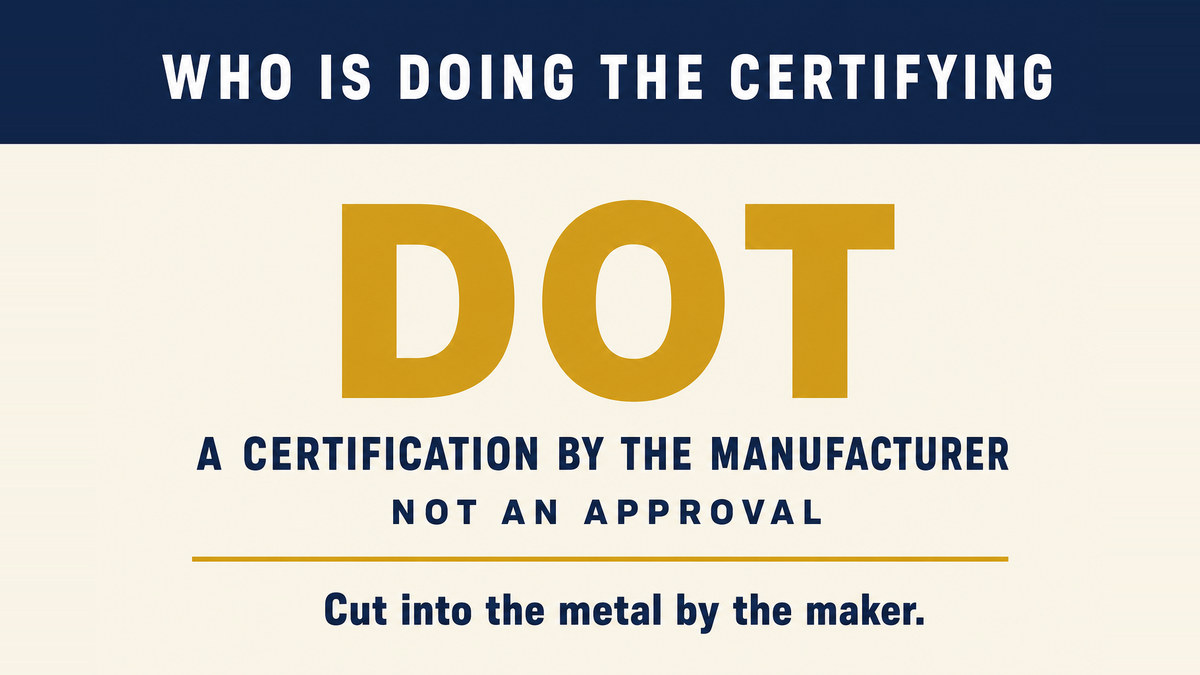
5. Who Is Doing the Certifying
The third item on the list is the one most often misread in a brochure, and the clause states its meaning in the same sentence that requires it:
“(c) The symbol DOT, constituting a certification by the manufacturer of the rim that the rim complies with all applicable Federal motor vehicle safety standards.” — 49 CFR § 571.110 and § 571.120
So the stamp does not record that an agency tested the wheel. It records that the wheel's manufacturer certified it, and the two standards are self-certification standards: the maker builds to the requirement and puts its own mark on the metal. That is not a loophole; it is the structure, and it puts the whole weight of the statement on the party named in item (d) of the same list. The four items around the DOT symbol are there to make that party findable: the source code points to the published dimensions, the size points to the fitment, the maker's mark points to the maker, and the date code points to the run.
This is the mirror image of a finding from the previous article in this series. There, a number printed on a carton turned out to mean less than a buyer assumed, because it identified a producing facility and the agency said in its own words that it was not an endorsement. Here a symbol cut into the wheel means exactly what the clause says it means: somebody has certified something. The distinction is worth carrying when a supplier's summary of certification is read, because one phrase describes a fact about a factory and the other describes a legal statement by a company about its own product.
Three checks follow directly from the clause, and none of them needs a lab.
Ask which vehicle class the marking is for. The duty is worded for vehicles other than passenger cars in one standard and for the heavier vehicles and motorcycles in the other, so “DOT marked” is incomplete. A supplier that sells into all three classes should be able to say which class each part number belongs to.
Ask who the maker's mark belongs to. Item (d) identifies the manufacturer by name, trademark or symbol. A wheel carrying a distributor's brand carries the distributor's mark as the manufacturer's designation, and that is a decision with consequences rather than a piece of artwork.
Write down the date code and ask for the explanation. Item (e)(2) requires the wheel manufacturer to explain its date symbol to any person on request. A supplier that cannot explain its own stamp in writing has a gap that is visible in the clause, not in an inspection report.
6. What the Record Says
Method first. The federal recall file holds 245,845 records and has no header row, so every field is scanned rather than trusting a column map. Controls: brake appears in 28,639 records and air bag in 16,162. Every term is counted with its own pattern.
| Term | Records | Campaigns |
|---|---|---|
wheel | 12,289 | 1,273 |
wheels | 3,857 | 496 |
rim | 1,712 | 115 |
rims | 2,426 | 349 |
alloy | 93 | 17 |
tire | 29,586 | 1,048 |
tyre | 32 | 12 |
spoke | 61 | 17 |
spokes | 111 | 10 |
lug | 917 | 117 |
hub | 1,624 | 204 |
bolt | 4,385 | 577 |
hubcap | 55 | 7 |
chrome | 105 | 18 |
forged | 23 | 5 |
casting | 229 | 47 |
machining | 146 | 26 |
balance | 106 | 13 |
vibration | 1,454 | 225 |
shimmy | 0 | 0 |
crack | 6,093 | 519 |
fracture | 2,868 | 399 |
weld | 2,498 | 286 |
corrosion | 3,294 | 342 |
offset | 50 | 7 |
This is the first article in the segment where the product's own word is in the file. alloy appears 93 times across 17 campaigns, and the largest of them is the product itself at scale: a Honda campaign for an 18-inch alloy wheel, 406,290 units, filed under the component heading WHEELS. No other campaign in the set comes near it — the next largest is a TRD brake kit campaign at 200,000 units, then a Subaru Forester wheel campaign at 20,366, a Toyota Tundra campaign at 16,249 under WHEELS: LUGS/NUTS/BOLTS/STUDS, a Mitsubishi Outlander campaign at 14,791 under labels, and a Toyota Highlander tyre campaign at 4,869. Compare that with the two articles before this one, where the product's own word came back at zero, and the difference is worth stating plainly: an alloy wheel is a part that gets recalled, and a coating and an ozone generator are parts that do not appear on this kind of list at all.
Then comes the complication, and it is the same mechanism this series keeps meeting. The word the category is named after is shared with another object. wheel is the second-largest term in the table at 12,289 records across 1,273 campaigns, but look at what the biggest campaigns are about: a Toyota Tacoma campaign at 1,486,413 units under a frontal air bag inflator heading, a Ford Fusion campaign at 1,301,986 units filed under steering wheel and handle bar, a Ford Explorer campaign at 1,194,173 under rear suspension, a Toyota Matrix campaign at 1,128,659 under engine and cooling, a Dodge Ram 5500 campaign at 1,059,444 and a Chrysler Town & Country campaign at 925,239, both under frontal air bags. In this file, wheel most often means the thing the driver holds.
The word rim behaves the same way in a more useful direction. It reaches 1,712 records across 115 campaigns, and its four largest campaigns are a Peterbilt 387 campaign at 213,230 units, a Toyo Extensa A/S campaign at 68,763 units filed under tires: bead, an Alcoa aluminum wheel campaign at 45,794 units filed under WHEELS, and a Vail Sport tyre campaign at 39,569. Three of those four sit under a heading for labels, and the one that names a wheel maker by name is an aluminium wheel. That is the shape of this product in the record: the rim problems that get filed are overwhelmingly problems with the information attached to the rim rather than with the metal, which is exactly the half of the job that section 1 to section 5 of this article has been about.
The parts vocabulary agrees. lug reaches 917 records across 117 campaigns and almost all of the biggest are filed under the same component heading for wheel fasteners: a Ram 5500 campaign at 447,985 units, a Mercury Milan campaign at 128,616, a Mazda3 campaign at 25,003 and a Cadillac SRX campaign at 18,871. hub reaches 1,624 records and its two named wheel campaigns are an Audi Q5 campaign at 126,161 units and a Carquest part campaign at 34,604, both filed under WHEELS: HUB, alongside a long run of axle hub campaigns. And the making vocabulary is present but thin: casting at 229 records and 47 campaigns, machining at 146 and 26, forged at just 23 records across 5 campaigns. The last figure is worth pausing on, because forged wheels occupy most of the premium end of this category and the record carries almost no trace of the word.
Two smaller results finish the picture. There is exactly one zero in the twenty-five terms: shimmy, the trade's own name for the vibration a wheel develops when it is out of true, does not appear once, while the general word vibration appears 1,454 times across 225 campaigns. And the spelling split is the widest yet recorded in this series: tire at 29,586 records against tyre at 32, a ratio of roughly nine hundred to one, which is the same American-English behaviour seen at rows 41, 42 and 43 and at a much larger multiple here.
7. Five Questions a Wheel Quote Should Answer
A wheel quotation usually carries a diameter, a width, an offset, a bolt pattern, a centre bore, a weight, a finish, a load rating and a price. Two of those lines decide whether the wheel carries a stamp, and neither of them is on the drawing.
- Which vehicle class is this part number made for? The marking duty is worded for vehicles other than passenger cars in one standard and for vehicles over 10,000 pounds and motorcycles in the other. A factory selling into all three classes should be able to say which class each part number belongs to, and a supplier that answers “DOT marked” without naming the class has not answered the question.
- If the wheel must be marked, which of the five items are on it, and where? Ask for a photograph of the actual marking on a production wheel, not a rendering, and check that the source letter, the size designation and the DOT symbol are on the outward or weather side. Then ask for the letter height and the impression depth in millimetres, against the 3 millimetre and 0.125 millimetre figures in the clause.
- Which published listing does the dimension come from? The requirement is that the rim be built to the dimensions of a rim that the tyre maker lists as suitable for those tyres. So the reference is a document, and the useful question is which one. An answer that names a body — one of the organisations behind the source codes — can be checked; an answer that names the factory's own drawing cannot.
- Whose mark is in the manufacturer's position, and can they explain the date code? One item on the list identifies the manufacturer by name, trademark or symbol, and the clause requires each wheel manufacturer to explain its date symbol to any person on request. Ask for that explanation in writing before the first delivery, not after a batch has to be traced.
- How deep will the marking be after finishing? The depth figure is a minimum, so every process that takes metal off the face reduces the margin above it — a machine-cut refinish, a re-polish of the spokes, a re-cut lip. If the wheel is finished or refurbished after marking, ask what depth remains and how it is checked, because a mark that has become illegible is a mark that no longer does the one job it had.
8. Six Lines to Put in the Order
Everything above collapses into six lines that belong in the order document rather than in a conversation, because each one is a fact that can be checked when the wheels arrive.
| Line | What to write | Why it is on the list |
|---|---|---|
| 1 | The vehicle class the part number is made for | It decides whether a marking duty attaches at all |
| 2 | The published listing the dimension comes from, by name | The dimension duty is set by the tyre maker's listing |
| 3 | The five marked items, the side of the wheel, and a photo of a production sample | Part of the set has to sit on the outward side |
| 4 | The letter height and the impression depth, in millimetres, after finishing | A minimum depth can be lost to a refinishing pass |
| 5 | The name behind the manufacturer's mark | That party is the one certifying the wheel |
| 6 | A written explanation of the date code | The clause requires the maker to give one on request |
Two of the six lines are measurements and four are decisions, which is the split this series has found in the last three articles. What is different here is that the decisions are not about the product at all. They are about which rulebook the wheel is in, which document its dimensions come from, and who accepts the certification — and all four can be settled in an email before a tool is cut. If you want the marking and the drawing read against each other before the die is made, a factory audit checklist arrives too late for it and a pre-shipment inspection can only measure what has already been cut into the metal. It belongs where the drawing and the stamp are approved together, and it is closer to the arithmetic of the volumetric basis than to an inspection: a short list of items, each of which either agrees with the others or does not.
Frequently Asked Questions
Do alloy wheels need DOT approval?
There is no approval step. The standards are self-certification standards, and the DOT symbol on a marked rim is, in the words of the clause that requires it, a certification by the manufacturer of the rim that the rim complies with all applicable Federal motor vehicle safety standards. The maker certifies; no agency approves a wheel before it is sold.
Why does my wheel have no marking?
Because the rim-marking paragraph in the standard for vehicles up to 10,000 pounds is written for “vehicles other than passenger cars”, and the marking paragraph in the standard for heavier vehicles sits in a standard whose application clause covers only vehicles over 10,000 pounds and motorcycles. A rim for a passenger car therefore carries no marking duty from either section. It still has the dimensional duty and the retention duty described in section 2.
What has to be stamped on a rim that is covered?
Five items: a letter naming the source of the rim's published dimensions; the rim size designation, plus the rim type designation for a multi-piece rim; the symbol DOT; a designation identifying the manufacturer by name, trademark or symbol; and the date of manufacture. The first three must appear on the outward side, and the lettering must be at least 3 millimetres high and pressed or raised at least 0.125 millimetres.
What does the letter J mean on a wheel?
It names the Japan Automobile Tire Manufacturers' Association as the source of the rim's published dimensions. It is one of a set of source codes, and its purpose is to tell a reader which table the published numbers come from. It is not a quality mark, and in that marking it does not stand for any certification.
Does a TÜV or JWL mark satisfy the US rules?
Those marks are not named in either of the two rim-marking clauses, so neither one discharges the marking duty created by them. What the clauses name is a set of source codes and the DOT symbol, and the duty is worded around the vehicle the rim is made for. A mark from a private body can still be useful to a buyer as evidence of testing, but it is a separate thing from the federal marking.
How do I read the date code?
Item (e) allows the date as the month, day and year, or as the month and year, expressed either in figures or as a symbol the maker has registered with the agency. The rule's own example is that September 4, 2001 may be written as 90401, as 904, 01 or as 01, 904. If a symbol is used, the clause requires the wheel manufacturer to explain it to any person on request, so the fastest route is to ask the supplier for the written explanation.
A wheel is the rare part whose rule is about a document rather than a component. FMVSS 110 and 120 place the load rating, the rim size and the inflation pressure on the vehicle placard and in the owner's book, and leave the casting to carry nothing but its own dimensions.
Buyers who ask for a stamp on the rim are asking for something the standard never required, and a factory that offers one is selling reassurance rather than conformity. What the order needs is the load figure the wheel was designed to, written where the fitter can read it.
Both Faces Photographed, Measured, Dated
We send a labelled photo of each face, the two dimensions the standard names, and a note on whether machining removed any marking.
Order the Photo Set
Questions & Comments
We read every one and reply within 24 hoursAlloy wheels rarely arrive with a load figure attached, and that is normal rather than a fault. Send the vehicle list and the sizes, and we will show where the number is published.