
Wheel Bearing Manufacturers: The Number Is 1/8 Inch, Measured Somewhere Else
 ·
Updated October 15, 2026
·
12 min read
Every part in this cluster is measured somewhere, and the wheel bearing is the one whose measurement is taken on a different component. There is no gauge that reads a bearing in place and no dial indicator that touches it. The inspection rules work around that: you lift the vehicle correctly, rock the tyre, and read the looseness as relative movement between the brake drum and the backing plate, measured out at the edge of the tyre. The limit in the regulation that spells this out is one-eighth of an inch. And the British rule adds a failure that no movement test can find, because it points the other way.
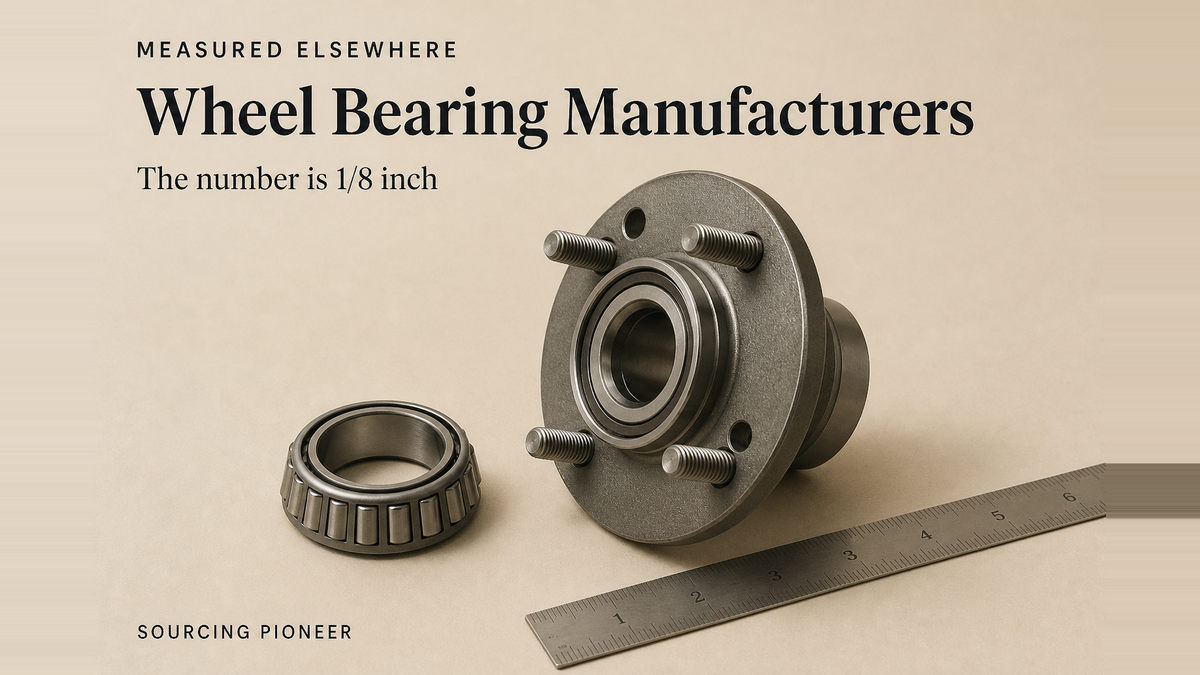
1. What a Wheel Bearing Is, and the Two Ways It Is Built
A wheel bearing carries the vehicle's weight on the rotating axle and lets the wheel turn with as little drag as possible. There are two ways to do that, and the difference decides who sets the specification.
The first is the serviceable arrangement: a pair of tapered roller bearings running in races in the hub, greased on assembly, with a nut that sets the end float. This type must be adjusted, and its clearance is a setting rather than a property of the part. The second is the sealed hub unit: a bearing assembly built into the hub flange, greased for life, with no adjustment at all and often with a wheel-speed encoder ring built into the seal.
That distinction is the first thing a quotation has to settle, because the rules use two different phrases for the two types. One rule rejects a bearing that is "excessively worn or not properly adjusted" — and the word adjusted only means something for the serviceable arrangement. For a sealed unit there is nothing to adjust, so a quotation that offers an "adjustable" bearing for a vehicle that left the factory with a sealed hub is offering the wrong architecture, however good the bearing is.
| The element | What it decides | What a vague quote hides |
|---|---|---|
| The build type | Whether there is anything to adjust | Serviceable or sealed for life |
| The bearing setting | Drag, heat and end float | The preload or end float figure |
| The seal | Whether grease stays in and water stays out | Seal type and how it is retained |
| The retaining device | Whether the assembly stays together | The nut, cotter key or staking |
| The encoder ring | Whether the ABS and stability systems read the wheel | Whether one is fitted, and its type |
What this guide covers
- What a wheel bearing is, and the two ways it is built
- The federal rule never mentions the bearing
- So the measurement is taken somewhere else
- Two failures in opposite directions
- The retaining device is a rejection item
- Where a bearing problem shows up instead
- What a cheap hub quote leaves out
- What to check on a sample
- Where the unit price comes from
- Frequently asked questions
2. The Federal Rule Never Mentions the Bearing
The federal inspection rules have a section called wheel assemblies, and it is worth reading in full, because it covers the rim and the fasteners and says nothing whatever about the bearing inside them:
Wheel integrity. A tire rim, wheel disc, or spider shall have no visible cracks, elongated bolt holes, or indication of repair by welding. Deformation. The lateral and radial runout of each rim bead area shall not exceed one-eighth of an inch of total indicated runout. Mounting. All wheel nuts and bolts shall be in place and tight.
National Highway Traffic Safety Administration, 49 CFR 570.10, Wheel assemblies (read 15 October 2026)
Three criteria, all about the rim: no cracks, no elongated bolt holes, no weld repair, runout within an eighth of an inch, and every wheel nut and bolt present and tight. The bearing is not named.
That is not an oversight so much as a division of labour. The federal rule governs what can be seen and measured on a wheel that is bolted on. The bearing's condition is a state inspection question, and the states answer it with a method rather than a specification.
One number is worth keeping from that section, because it comes back later: one-eighth of an inch is the federal limit for rim runout. It is also the number the same class of regulation uses for bearing looseness — measured somewhere else entirely.
3. So the Measurement Is Taken Somewhere Else
Virginia's inspection regulation contains the most useful page written about wheel bearings, because it explains not just the limit but where to take the reading and what to do first. It begins with the rejection ground, and it names two things — the bearing and its adjustment:
Wheel bearing/steering linkage. Reject vehicle if any wheel bearing is excessively worn or not properly adjusted; any cotter key or other locking device is missing or inoperative.
Commonwealth of Virginia, 19VAC30-70-110(C), Steering and suspension (read 15 October 2026)
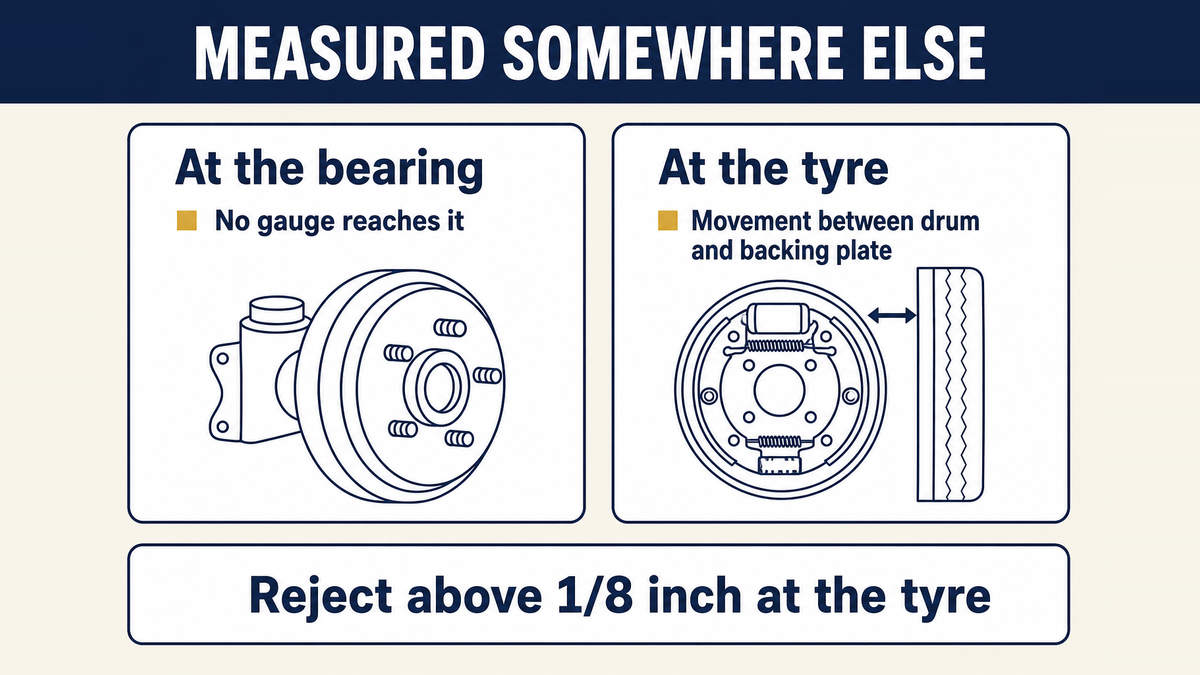
Then it tells the inspector where to look, and the answer is not the bearing. Wheel bearing looseness, the regulation says, "is detected by the relative movement between the brake drum or disc and the braking plate or splash shield" — and the figure is measured out at the rim of the tyre rather than at the joint:
Reject vehicle if relative movement between drum and backing plate (disc and splash shield) is more than 1/8 inch measured at the outer circumference of the tire.
Commonwealth of Virginia, 19VAC30-70-110(C), Steering and suspension (read 15 October 2026)
Read the geometry and it makes sense. A bearing has a small clearance, and the tyre sits at the end of a lever roughly a foot long. Measuring at the tyre multiplies the bearing's float into something an inspector can see, and the eighth of an inch at the tyre corresponds to a few thousandths at the bearing itself.
There is a second condition that has to be met before any of this works, and it is a trap for anyone who tests a bearing off the vehicle. The regulation states that lifting techniques differ, and sets them out by suspension layout: on vehicles with the spring or torsion bar on the lower arm, hoist at the frame; where the spring is on the upper arm, hoist at the lower arm; and on front-wheel-drive vehicles, the inspector has to consult the maker's lifting information. Get the lift wrong and the joint you are measuring is the suspension rather than the bearing.
The same document shows why isolating the two matters. Its procedure for king pin play instructs the inspector to "first eliminate all wheel bearing movement by applying service brake" — because the same rocking motion reveals both, and the check is only meaningful once one of them has been taken out of the picture.
4. Two Failures in Opposite Directions
Everything so far measures looseness. The British inspection document lists a defect that would pass that test, because it is the opposite condition, and it appears in the same list as excessive play:
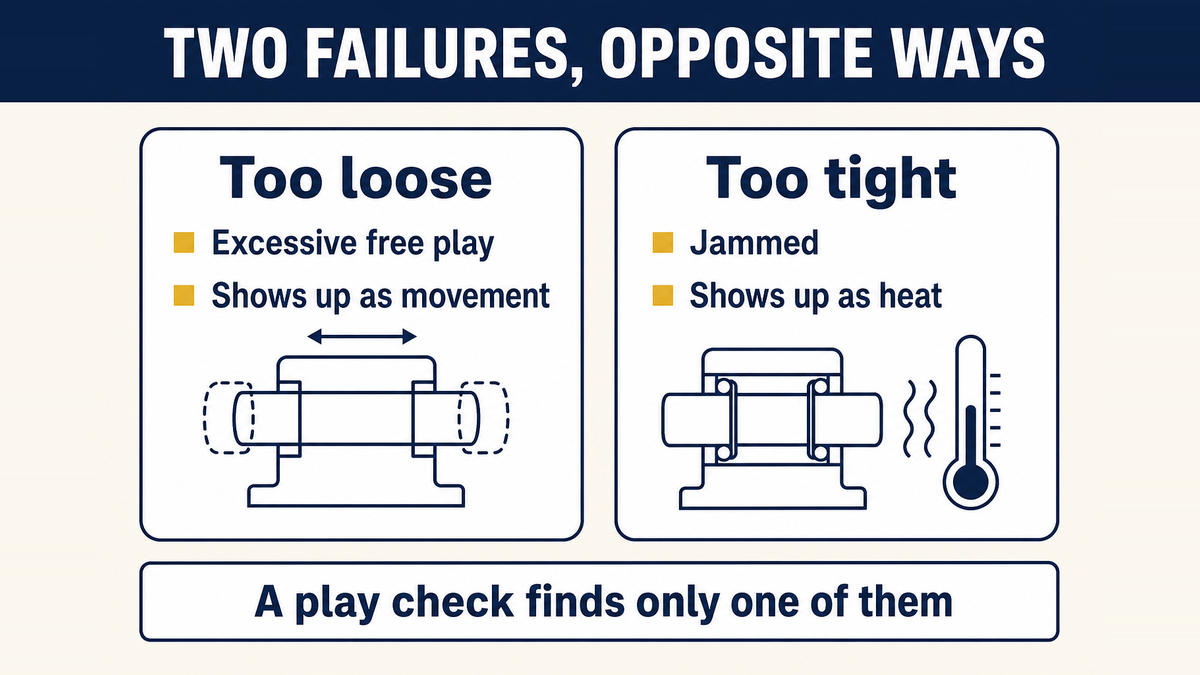
Stub Axles and Wheel Bearings. Excessive wear of king pins and/or bushes or swivel joints. Excessive free play in wheel bearings. Wheel bearing too tight, jammed. Excessive lift in stub axle or at swivel joint. King pin loose in axle beam or swivel joint excessively worn or insecure.
Driver and Vehicle Standards Agency, Categorisation of vehicle defects, part 1, IM 53 Axles, stub axles and wheel bearings (read 15 October 2026)
Excessive free play, and too tight or jammed, listed as separate defects of the same component. A bearing can be over-set on installation, or worn into a state where it runs hot, and the result is drag, heat and eventual failure — not movement. An inspector rocking a tyre looking for play will not find it, and the rule knows that, which is why the two conditions sit next to each other in the same table.
For a buyer, this is the point at which the bearing setting becomes a specification rather than a workshop preference. A serviceable bearing has a target — an end float or a preload, depending on the design — and the two failure modes are on either side of it. A factory that states a setting is quoting a part; one that states nothing is asking the fitter to guess, and both guesses are defects.
5. The Retaining Device Is a Rejection Item
Go back to the first sentence of the Virginia rule and read the part after the semicolon, because it is easy to skip and it decides a small line in a quotation:
Reject vehicle if any wheel bearing is excessively worn or not properly adjusted; any cotter key or other locking device is missing or inoperative.
Commonwealth of Virginia, 19VAC30-70-110(C), Steering and suspension (read 15 October 2026)
A missing or ineffective cotter key is a rejection ground on the same footing as a worn bearing. That single clause has a direct commercial consequence: on a serviceable hub, the nut's retention is part of the product. A hub supplied without its retaining device, or with a nut that cannot be locked, has shipped an incomplete assembly — and the customer finds out at inspection, not at fitting.
The same logic explains why sealed hub units are increasingly specified on new vehicles. A unit that cannot be adjusted also cannot be over-adjusted or left unlocked, and the retaining device becomes part of the assembly rather than a step a fitter can get wrong. If you sell both types, the two should never share a line in a quotation, because the second one removes a failure mode the first one has by design.
6. Where a Bearing Problem Shows Up Instead
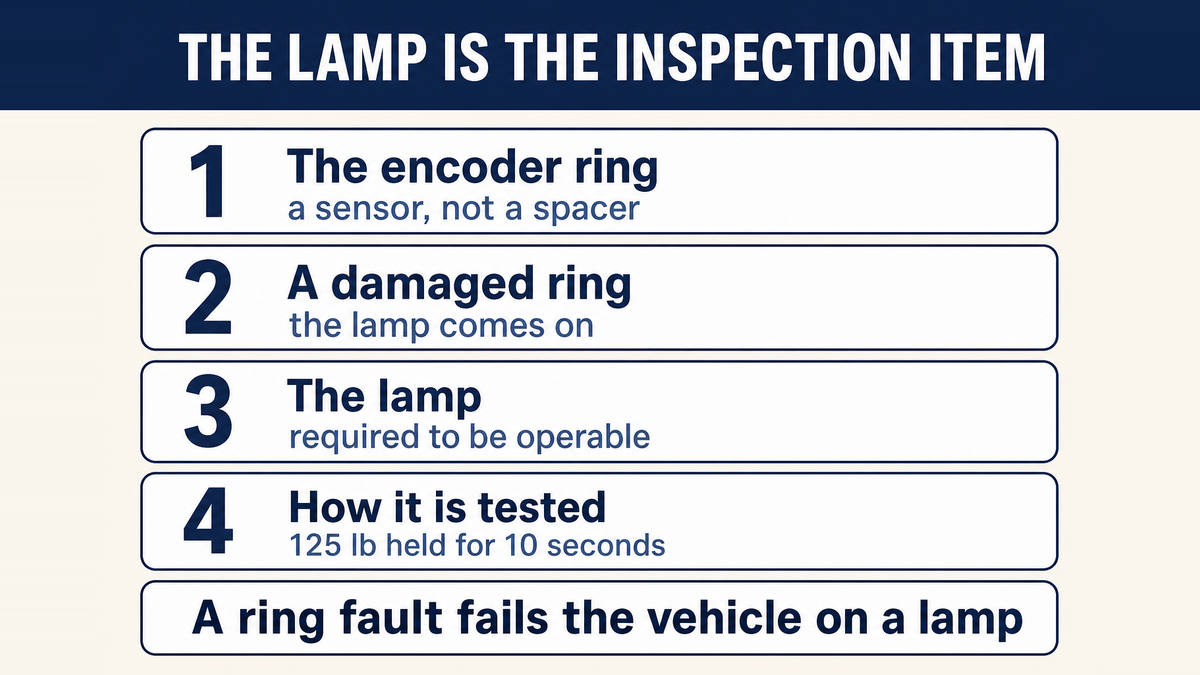
Modern hub units carry a wheel-speed encoder ring, and that ring turns the hub into a sensor as well as a bearing. The consequence is that a damaged ring does not present as a bearing fault at all — it presents as a warning lamp, and a warning lamp is itself an inspection item. The federal rule requires the brake system failure indicator lamp to work, and cites the standard that put it there:
Failure indicator. The brake system failure indicator lamp, if part of a vehicle's original equipment, shall be operable. (This lamp is required by Federal Motor Vehicle Safety Standard No. 105, 49 CFR 571.105, on every new passenger car manufactured on or after January 1, 1968, and on other types of motor vehicles manufactured on or after September 1, 1975.)
National Highway Traffic Safety Administration, 49 CFR 570.5(a), Service brake system (read 15 October 2026)
The same section requires the brake system to show integrity, tested by "applying a force of 125 pounds to the brake pedal and hold for 10 seconds" and noting whether the lamp lights. So a lamp that comes on is not a cosmetic problem in this regime. It is the visible evidence the rule is designed to look for.
Two sourcing consequences follow. First, the encoder ring is a functional component: its type, its position and the integrity of its magnetic track belong in the specification, not in a footnote, because a ring that reads incorrectly puts a lamp on and the vehicle fails on something other than the bearing. Second, the lamp gives a buyer a cheap early warning. A hub that generates complaints about warning lamps before it generates complaints about noise is a hub with a ring problem, and that is a process question at the factory rather than a warranty argument with the customer.
7. What a Cheap Hub Quote Leaves Out
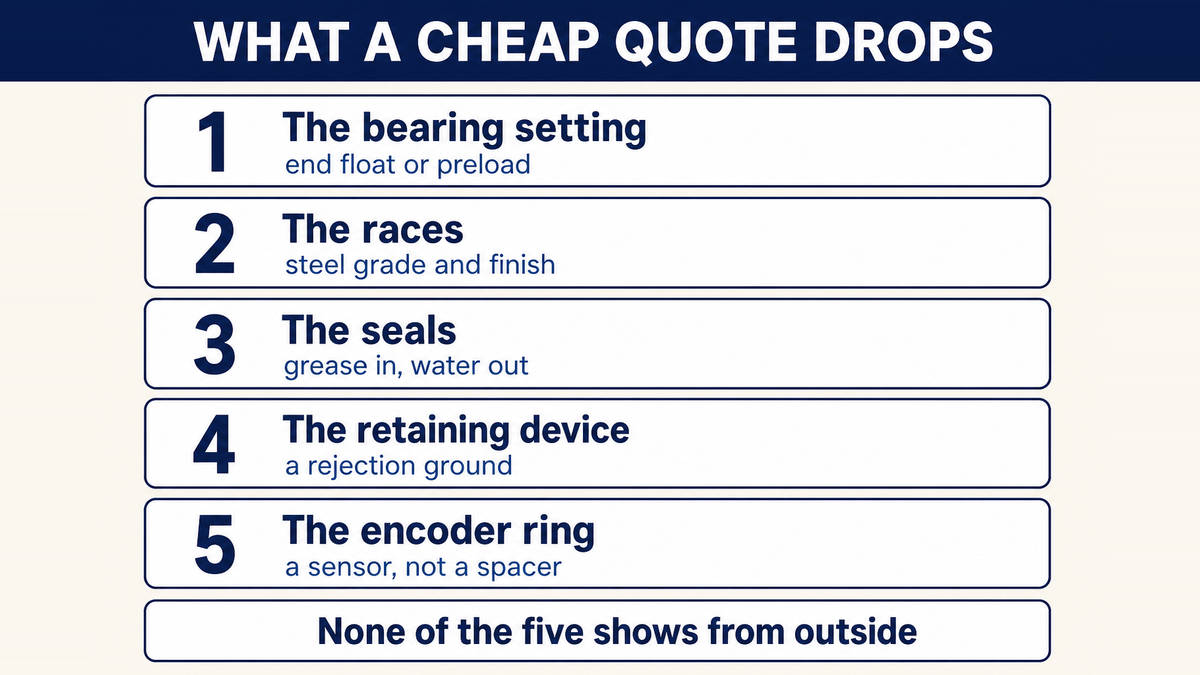
A hub assembly is a compact part with a lot inside it, and a quotation that names a part number has said nothing about five decisions:
The bearing setting. For a serviceable hub, the end float or preload figure, and for a sealed unit the fact that it is sealed and cannot be adjusted. This is the line that decides whether the part can be fitted wrongly, and it is the one most often left out.
The races and the rolling elements. Bearing steel grade, heat treatment and surface finish set the life of the part. These are the smallest features on the assembly and the most expensive to get right, which makes them the natural place to save.
The seals. A hub lives behind a wheel, in water and grit. Seal type and how it is retained decide whether the grease stays where it was put, and a failed seal takes the bearing with it.
The retaining device. The nut, cotter key or staking that keeps the assembly together — a rejection ground in its own right in at least one state, and an easy omission from a kit that ships as "the hub".
The encoder ring, where one is needed. Its presence, its type and its position relative to the sensor. A hub without the ring cannot serve an application that needs one, and a hub with the wrong ring creates a fault the customer will see on the dashboard.
8. What to Check on a Sample
A hub is a sealed assembly, so a sample check is part measurement and part record. Six checks cover the ground.
- The setting. For a serviceable hub, measure the end float or turning effort and compare it with the stated figure; for a sealed hub, confirm that there is no adjustment and no play.
- Rotation quality. Turn the assembly by hand and listen. Roughness or a tight spot in a new unit is a defect the rules would call jammed, and the customer will call it heat.
- Runout of the hub flange against the drawing, because the flange carries the disc and the wheel, and runout there becomes a brake complaint.
- Seal type and retention, and whether the seal survives being pressed into position without distortion.
- The retaining device: present, correct and capable of being locked.
- The encoder ring, where the application needs one: fitted, correct type, and undamaged after assembly.
On the factory side the usual visit checks apply, and our sequence is in the factory audit checklist. Where a supplier also holds a social or ethical audit, the scheme behind the certificate is worth reading — see social audit schemes compared.
9. Where the Unit Price Comes From
A hub assembly's price is built from the bearing steel and its heat treatment, the races and rolling elements, the hub forging or casting and its machining, the seals, the encoder ring, and the assembly and setting. The bearing internals set the material and process cost and are invisible in a photograph. The hub's machining sets the runout, which is where a brake complaint or a wheel vibration will come from. The ring is a small line that decides whether a modern vehicle's systems read the wheel at all.
Weight then decides how the goods move, because a hub is a dense steel assembly charged on what it weighs — the reverse of the calculation in how volume decides what a shipment is charged.
A quotation worth comparing therefore names the build type, the setting, the bearing steel, the seal type, the retaining device and the encoder ring where required. How the goods are described for entry is the subject of how an HTS code is assigned, and the origin paperwork behind it is set out in the certificate of origin guide. Because the bearing sits inside the hub, the appearance of the package is the only thing a customer can judge before fitting, which is why the checks in our pre-shipment packaging guide matter more here than for a bare part.
10. Frequently Asked Questions
How is wheel bearing wear measured?
Indirectly. The inspection regulation describes looseness as the relative movement between the brake drum or disc and the backing plate or splash shield, and the figure is read at the outer circumference of the tyre. The limit in that regulation is one-eighth of an inch. The tyre sits at the end of a lever, so a small bearing clearance becomes a visible movement at the rim.
Why does the lifting method matter?
Because the same rocking motion reveals both bearing movement and suspension movement, and the regulation varies the lift by suspension layout to isolate the bearing. Where the spring or torsion bar is on the lower arm the vehicle is hoisted at the frame; where the spring is on the upper arm it is hoisted at the lower arm; and on front-wheel-drive vehicles the inspector has to consult the maker's lifting information.
Can a wheel bearing be too tight?
Yes, and it is a listed defect in its own right. The British inspection document lists excessive free play in wheel bearings and a wheel bearing that is too tight or jammed as separate defects of the same component. An over-set bearing runs hot and drags rather than moving, so a test that looks for play will not find it.
Do the retaining parts matter?
They are a rejection ground. The same regulation that sets the one-eighth of an inch limit also provides that a vehicle is rejected if any cotter key or other locking device is missing or inoperative. On a serviceable hub the nut's retention is therefore part of the product rather than a fitting detail, and a hub that ships without a lockable retaining device has shipped an incomplete assembly.
What happens to a hub with a damaged encoder ring?
It stops being a bearing fault and becomes a warning lamp. A ring that reads incorrectly puts a lamp on the dashboard, and the brake system failure indicator lamp is itself required to be operable under the federal inspection rules, which also check for illumination while a 125 pound force is held on the pedal for 10 seconds. The ring's type and position belong in the specification for that reason.
End Float and the Retaining Device
We return the end float figure, the method used to take it, and the retaining device that appears as a rejection item.
Check My Hub
Questions & Comments
We read every one and reply within 24 hoursA wheel bearing is sold by dimension and judged by preload and sealing. Send the hub drawing and the vehicle, and we will set preload, seal type and the ABS ring.