
Temu Competitors: The Competitive Landscape, Mapped by Tier
 ·
Updated October 15, 2026
·
17 min read
Temu does not have one rival. It has four groups of them, and they compete on other things. Two are Chinese platforms that look almost the same to a shopper. One is a fast-fashion retailer that taught the model Temu copied. One is Amazon's own answer, launched in late 2024 under a price cap. And under all of them sits a rule change on small parcels. It is moving the ground under every one at once. This guide maps the landscape by tier. It then says what each tier means if you buy goods and not just order them.
| Tier | Who is in it | What they compete on |
|---|---|---|
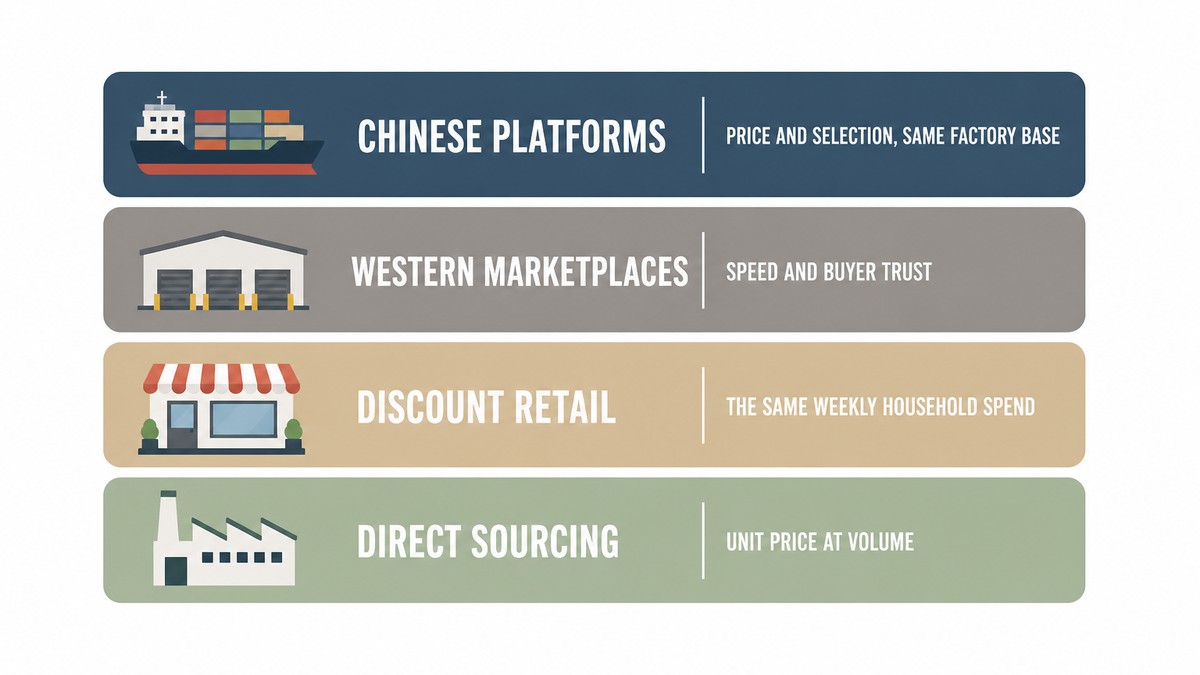
| Chinese platforms | AliExpress, Shein, TikTok Shop, DHgate | Price, selection and speed out of the same factory base |
| Western marketplaces | Amazon Haul, Walmart, eBay | Delivery speed and buyer trust |
| Discount retail | Dollar stores and off-price chains | The same household budget, offline |
| Direct sourcing | Wholesale platforms and suppliers | Unit price at volume, not per parcel |
The Short Answer: Four Tiers, Not One Rival
Most pages on this question list eight apps and stop. That list is not wrong, but it hides the useful part. The rivals are not competing for the same thing, so a single ranking tells you very little.
Tier one is other Chinese platforms. AliExpress, Shein, TikTok Shop and DHgate all draw on the same factory base in the same provinces. They compete with Temu on price and selection. They lose or win on small gaps in shipping and returns.
Tier two is the Western marketplaces. Amazon, Walmart and eBay have the warehouses, the delivery speed and the buyer trust. What they did not have was a price point below ten dollars at scale. Amazon changed that in November 2024.
Tier three is discount retail. A dollar store or an off-price chain competes for the same weekly household spend. It is easy to forget, because it happens offline. It is the tier Temu is stealing from in its biggest market.
Tier four is direct sourcing. This is not really a competitor at all. It is the tier most readers of this site belong in. A buyer who orders a few hundred units is not shopping. They are buying, and the maths of a retail app stops working for them above a certain volume.
So the honest answer to "who competes with Temu" depends on which question you are asking. A shopper wants the cheapest small item. A reseller wants a supply route. Those are two contests, with two sets of winners.
Why Temu's Own Model Defines the Competition
Temu is owned by PDD Holdings. That company also runs Pinduoduo inside China and files an annual report in the United States. That filing is the clearest window on how the contest is going.
For the year ending 31 December 2025, PDD reported total revenue of RMB 431.8 billion. That is about 61.8 billion US dollars, up 10 per cent on the year before. Growth, in other words, is still real.
Profit moved the other way. Operating profit fell 13 per cent and net income fell 12 per cent over the same year. Sales and marketing spending rose 13 per cent, to about 17.9 billion dollars. The company made more money and kept less of it.
Management said so plainly. On the same release, the vice president of finance was blunt. "The external environment and competitive landscape are undergoing rapid changes," she wrote. The full results release is published by the company. So the numbers can be checked, not simply believed.
There is a real reason for the squeeze, and it explains the whole landscape. Temu runs what its owner calls a fully-managed model. Temu decides what is listed, what it costs, and how it ships. Sellers supply into a system that Temu controls. That model is what makes the prices possible.
It is also expensive. A fully-managed model means Temu carries the cost of shipping, returns and price support itself. Every rival that forces prices down hits Temu's own margin, not a seller's. That is why a price war hurts this company more visibly. In an open marketplace, the seller absorbs the gap.
Two consequences follow, and both are visible in public reporting. Temu has been pushing goods already held in warehouses inside the buyer's own country, to cut delivery time. And the company has been pivoting further into that fully-managed model as tariff costs rose. Reuters reported in August 2025 that PDD beat revenue estimates while net profit fell. Its headline named the cause: competition squeezing margins. The same report noted that Amazon has used its scale to negotiate pricing with suppliers.
| What the numbers show | Figure | What it means for the contest |
|---|---|---|
| Revenue, year ending 31 Dec 2025 | RMB 431.8bn (US$61.8bn), up 10% | Demand is still growing |
| Operating profit | Down 13% | The growth is being bought |
| Sales and marketing spend | US$17.9bn, up 13% | Customer acquisition is the battleground |
| Cash and short-term investments | RMB 422.3bn at 31 Dec 2025 | The price war can be funded for a long time |
Tier One: The Chinese Platforms
These four are the rivals that look most alike, and the ones a comparison page usually lists. They draw on the same factories in the same provinces. What separates them is not the goods.
AliExpress. Part of Alibaba Group, and it has been running since 2010. It is an open marketplace. Millions of independent sellers set their own prices and ship their own parcels. That makes its catalogue far wider than Temu's, and its delivery far less even. The two are compared directly in the full Temu and AliExpress comparison. This page will not repeat that ground.
Shein. A fast-fashion retailer, not a general marketplace, and the more dangerous rival of the two. It built the buying habit Temu later copied: a small first batch, then reorder whatever sells. Where Temu is a platform that lets other sellers supply, Shein designs and commissions its own ranges. On clothing the two overlap almost completely.
TikTok Shop. This one competes on another mechanism, and it is easy to underestimate for that reason. Temu and AliExpress wait for a shopper to search. TikTok Shop puts a product in front of someone who was not looking for it. That turns advertising spend into a sales channel, and it reaches buyers a search bar never would.
DHgate. The smallest of the four and the oldest. It sits closer to small wholesale than to retail. It wins orders in the low hundreds, not single units. For a buyer testing a product it is a workable starting point. The guide to what DHgate is and is not safe for covers that route in detail.
Two names are often added to this list and should not be. Taobao and 1688 are domestic Chinese platforms. They sell to buyers inside China in Chinese. They are the upstream source that many of the sellers above buy from. A foreign buyer can reach them, but not as a competitor to Temu.
Tier Two: The Western Response
The Western marketplaces had the warehouses, the delivery speed and the buyer trust. What they did not have was a price point below ten dollars at any scale. That gap closed in November 2024.
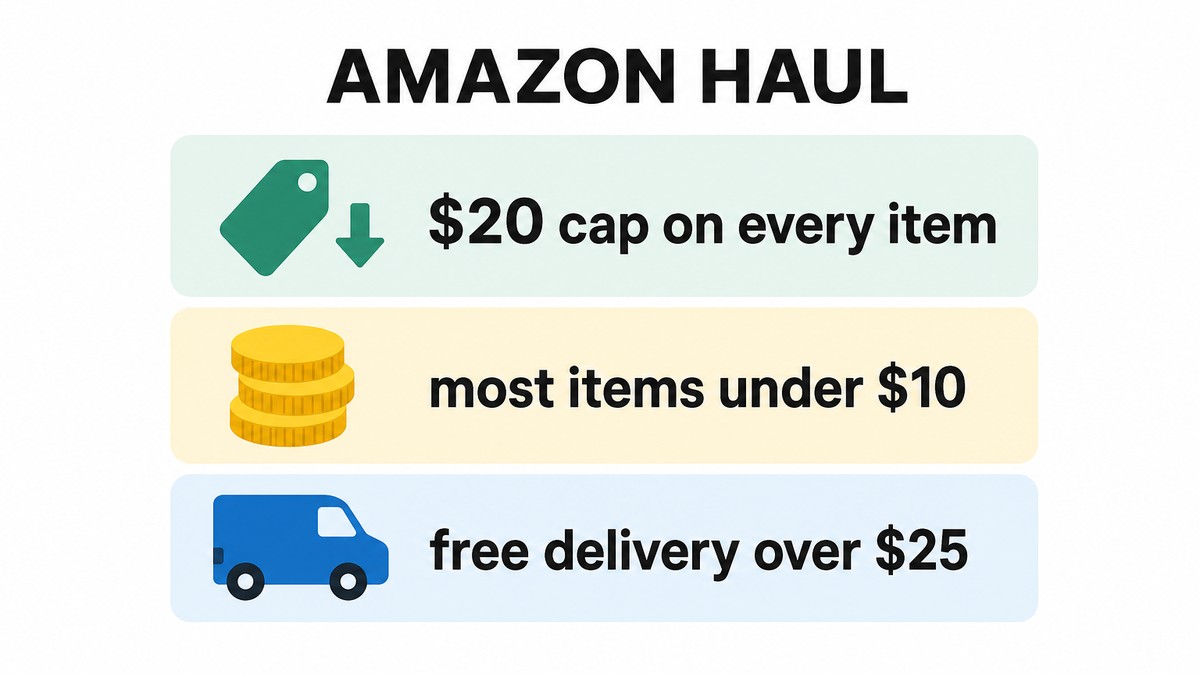
Amazon Haul. Amazon launched it as a mobile-only storefront inside its shopping app, aimed at United States customers first. Every item is capped at 20 dollars. Most sit under 10 dollars, and delivery takes one to two weeks. Orders over 25 dollars ship free. The launch was reported by the BBC. It quoted Amazon's own description of "crazy low prices" on goods "worth the wait".
Read that cap carefully, because it is the most revealing number in this whole landscape. Amazon did not try to beat Temu on speed. It accepted the slow lane that it had spent twenty years avoiding, and asked customers to wait. The company judged that a low price matters more than fast delivery. It had previously refused to sell that category at all.
Walmart. It competes from both directions at once, with stores on the ground and a marketplace online. Its edge is the same as Amazon's and cheaper to run. Goods are already inside the country before anyone orders them.
eBay. The model stands apart, so it barely competes head-on. Much of its volume is used goods, where price is set by condition, not by a factory. It still matters for the buyer who wants one specific item, not a cheap one.
One caution about this tier comes from the launch coverage itself. A Forrester analyst told the BBC that shoppers were tiring of poor quality and slow shipping. She added that if the goods disappointed shoppers and lost Amazon money, the experiment might not last. That is the honest risk in the Western response. Matching a price is easy. Matching it without losing the customer is not.
The Rule Change That Moves Everyone At Once
There is a fifth force in this landscape and it is not a company. It is a customs rule, and it affects every platform in tier one at the same moment.
For years, a six-dollar item genuinely cost six dollars. Part of the reason had nothing to do with the platform selling it. Many countries allowed low-value parcels to enter without duty. The allowance was not designed for online retail. Online retail simply used it.
That is changing, and it is changing in one direction. The United States tightened its treatment of small parcels. The change was widely reported as aimed at China-based retailers. The European Commission also opened action against Temu in October 2024. It was concerned that Temu was failing to stop the sale of illegal products.
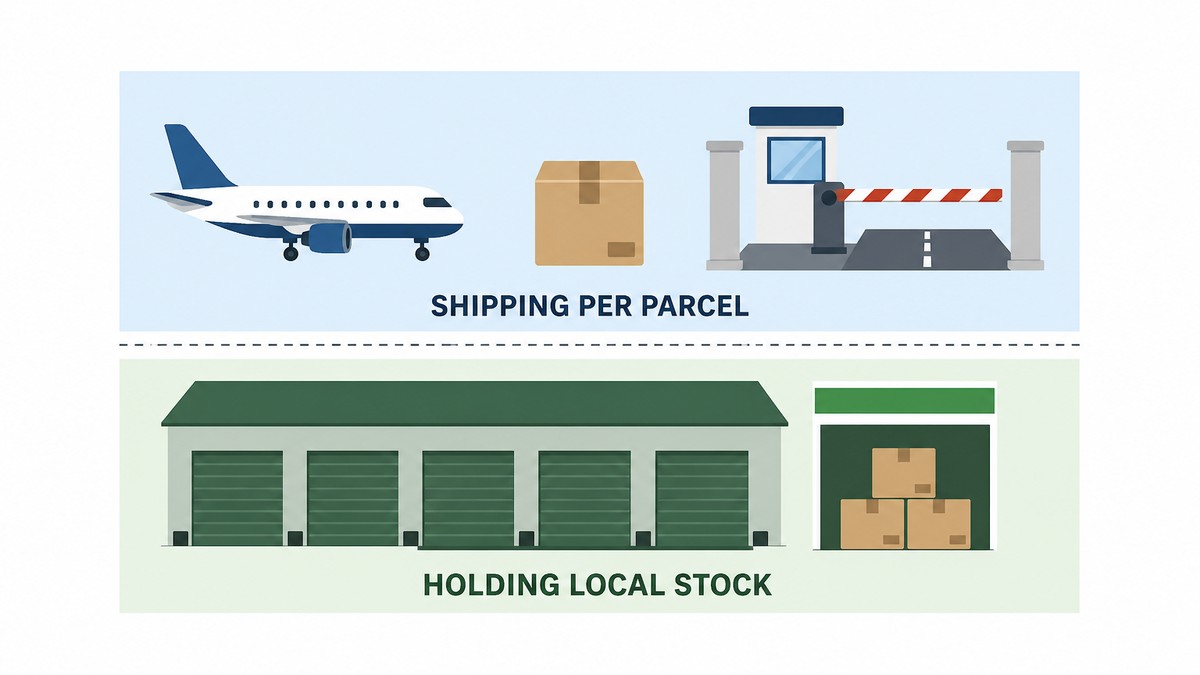
Here is why this matters more than any price gap between the platforms. A rule on small parcels hits every tier one platform at once. They all depend on the same shipping maths. It does not touch tier two. Amazon Haul and Walmart already hold their stock inside the buyer's country. A policy change therefore hands the advantage to the incumbents, without either side doing anything.
Temu's response fits that reading exactly. Reuters reported that the company has been pushing goods already sitting in United States warehouses. It has also recruited more local sellers, to cushion the effect of tariffs. That is the same move as building local stock, and it costs money.
The real point is the one a buyer should carry away. The cheapness of a single parcel was partly a policy accident, and policy is moving. Anyone whose margin depends on that rule being unchanged is not really exposed to competition. They are exposed to a customs notice.
What the Landscape Means If You Buy
Three things follow from the landscape, and each changes a decision.
The tier decides your cost structure, not your supplier. A retail app charges you per parcel. Direct sourcing charges you per unit. The goods may come from the same town. Above a few hundred units, that gap becomes the largest avoidable number in a small business.
Do not wait for the price war to end. PDD reported cash and short-term investments of RMB 422.3 billion at the end of 2025. It also spent about 17.9 billion dollars on sales and marketing that year. This contest is funded. A plan that assumes Temu's prices must rise soon is a plan resting on somebody else's balance sheet.
Treat the parcel rule as a business risk, not a footnote. A change in duty treatment can move your landed cost by a fifth. If that is true, you do not have a pricing strategy. You have a bet on a policy staying still.
The practical pattern that survives all of this is unglamorous. Use a retail platform to find out whether a product sells, because it costs almost nothing to try. Then move to a supplier once you reorder the same item. Which platform suits which job, and where those suppliers list, has its own guide. Start with the guide to the main B2B platforms. The wider set of routes is covered in how to find China wholesale suppliers. The step most buyers skip is how quality inspection actually works before a shipment leaves.
Questions Buyers Ask About Temu's Competition
Who are Temu's main competitors?
They fall into four groups, not one. Other Chinese platforms, which are AliExpress, Shein, TikTok Shop and DHgate. Western marketplaces, chiefly Amazon Haul, Walmart and eBay. Discount retail chains, which compete for the same household spend offline. And direct sourcing routes, which are not really competitors because they serve buyers buying at volume, not shoppers buying single items. Each group competes on something else.
Is Shein a Temu competitor?
Yes, and on clothing it is the closest one. Shein is a fast-fashion retailer, not a general marketplace: it designs and commissions its own ranges, where Temu runs a platform that other sellers supply into. Shein also built the buying habit Temu later copied. It produces a small first batch and then reorders whatever sells. On apparel the two overlap almost entirely.
Is Amazon Haul a direct competitor to Temu?
Yes, and it was built to be. It launched in November 2024 as a mobile-only storefront inside Amazon's shopping app for United States customers. Every item is capped at 20 dollars, most sit under 10 dollars, and delivery takes one to two weeks with free shipping over 25 dollars. Notably, Amazon accepted slow delivery to reach the price, which it had avoided doing for two decades.
Why is Temu so cheap?
Three reasons. It runs a fully-managed model, so it controls listing, pricing and shipping, and buys at scale. It spends heavily to win customers: about 17.9 billion dollars on sales and marketing in 2025. And until recently, many countries allowed low-value parcels in without duty, which cut the landed cost of a single item. The third reason is a policy, not an achievement, and it is changing.
Is Temu actually making money?
Its owner grew and earned less at the same time. For the year ending 31 December 2025, PDD Holdings reported revenue of RMB 431.8 billion, up 10 per cent, while operating profit fell 13 per cent and net income fell 12 per cent. Sales and marketing spending rose 13 per cent. Management stated that the competitive landscape is changing quickly and that these investments will affect financial performance.
Can a small seller compete with Temu on price?
Almost never, and the arithmetic explains why. A platform buying at scale, funded by a company holding hundreds of billions in RMB, is not a price you can undercut by working harder. The routes that do work are these: a narrower range, faster delivery than one to two weeks, service a platform cannot give, or your own design. Competing on price against this tier is the one strategy with no margin left in it.
Stop paying per parcel for goods you reorder
Send us the product you keep reordering and roughly how many units a month you get through. We will price it bought direct, tell you the realistic minimum order, and say honestly whether your volume is worth the switch yet.
Price it direct
Questions & Comments
We read every one and reply within 24 hoursTell us the product you keep reordering and roughly how many units a month you use. We will compare a retail app price against a direct price and say honestly whether your volume is worth switching yet. Questions about duty or inspection are welcome.