
The Shopify System: What It Includes, What It Costs, and Where It Stops
 ·
Updated October 15, 2026
·
16 min read
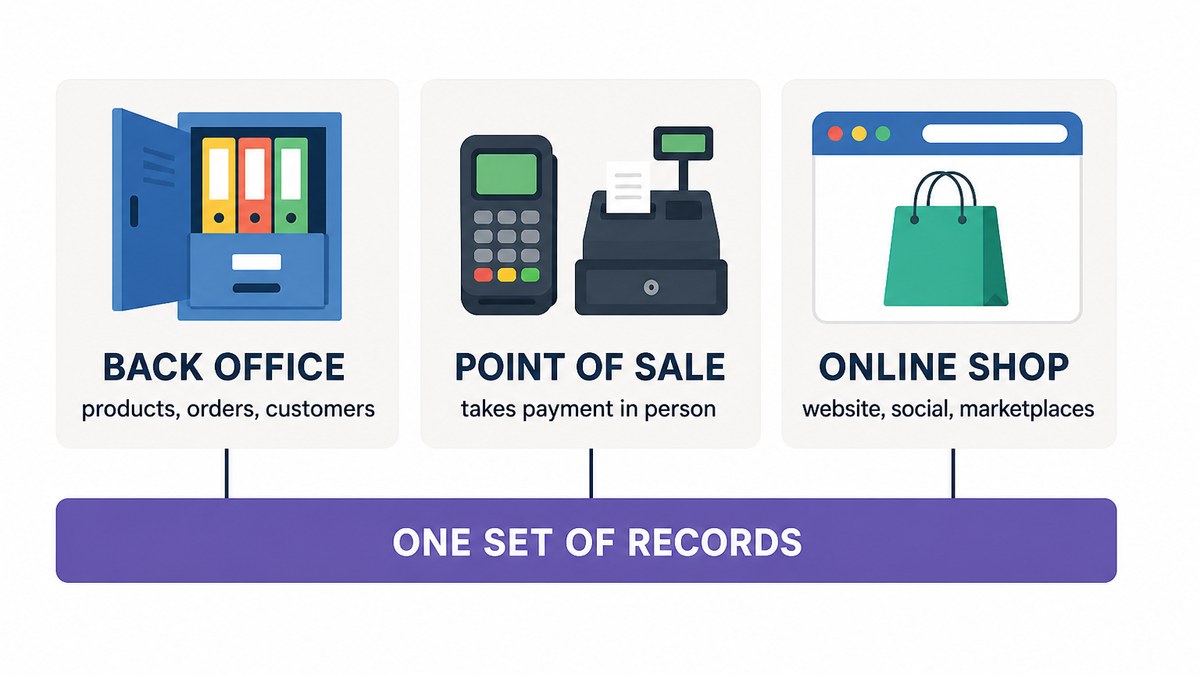
The Shopify system is not one thing. Shopify describes it as three parts that share one set of records: a back office, a point of sale, and an online shop. Two of those three get most of the attention, and the third is the one that decides whether a China-based seller makes money. This guide sets out what each part does, what each part costs, and the boundary most guides skip. The system will track your stock to the unit. It will not move a single box.
| Part | What it does | What it does not do |
|---|---|---|
| Back office | Holds products, orders, customers and stock levels | Source, buy or store anything |
| POS | Takes payment in person and writes the sale back to stock | Work without the back office behind it |
| Online shop | Sells on a website, social channels and marketplaces | Ship the parcel |
| Apps and Markets | Add duties, currencies, languages and third-party tools | Replace your own supply chain |
The Short Answer: Three Parts Sharing One Set of Records
Shopify answers this itself. Its own description of the system's three parts splits it into a back office, a POS system and online sales. The company then draws the line plainly. Shopify is the platform that runs the business. POS is the part that connects it to selling in person.
That wording matters more than it looks. The three parts are not three products bolted together. They write to the same records. A sale at a counter and a sale on a website reduce the same stock number. That is the main reason to use one system instead of buying a shop, a till and a spreadsheet separately.
The unified record is also why the parts cannot be judged alone. A POS that does not share stock with the website creates overselling. A website that does not share customer records with the counter cannot recognise a returning buyer. You are not buying software. You are buying one set of books.
Everything else Shopify sells builds on those three parts. Markets localises the shop by country. Apps add the tools Shopify does not build. Payments take the money. None of it is a fourth part, and none of it changes the boundary described later in this guide.
The Part Most Searchers Actually Mean
Search this term and the results are dominated by point of sale material, which tells you what the phrase usually means in practice. So it is worth being precise about what POS adds, and when a seller who never opens a shop still needs it.
Shopify's own description of POS is a hardware and software pair. The software comes as an app. The hardware is a card reader and whatever else the counter needs. Shopify states 99.9 per cent uptime across the platform. The POS app works in nearly every country, it says, though the integrated card reader does not.
The pricing page carries the numbers a seller needs. In-person card rates are 2.6 per cent plus 10 cents. That is lower than the online rate. Both come from Shopify's own published pricing page. The advanced retail tier is POS Pro at 89 dollars a month per location, and it is a per-location charge, not a per-account one.
Three situations justify it, and one does not. Bring POS when you sell at a market, a fair or a pop-up. Bring it when a buyer wants to collect an online order in person. Bring it when you run a real shop alongside the website. A channel comparison between the big marketplaces is the wrong tool for deciding this, because POS is not a sales channel. It is a second till for a channel you already have.
Inventory: The Number Every Part Agrees On
Inventory is the reason the three parts are worth joining. It is the one figure every part reads and every part writes. A sale at a counter and a sale on a website reduce the same count, so you cannot sell the same unit twice.
The entry plan includes inventory management and 10 inventory locations. Ten is more than most small sellers need. It matters for one reason. A China-based seller usually holds stock in two places at once. Goods sit in a warehouse in China and in a warehouse in the destination country. Those are two locations against one count.
The useful part is what the count does for you. It blocks an oversell before it happens. It shows a true position across channels. And it tells you when to reorder, which is the number a growing seller actually needs.
What the count cannot do is see your supplier. The system knows what you told it. If a factory runs three weeks late, your stock number stays correct and your delivery promise becomes wrong. That is the gap the next section is about.
Fulfilment: The Boundary Most Guides Skip
Here is the part that costs people money. Shopify splits its product into a back office, a point of sale and online sales. Read those three again. Not one of them moves a parcel.
Shopify's own Markets page describes "optimized fulfillment" as automatically shipping from the closest fulfillment centre. That sentence is easy to misread. The system routes the order to the nearest centre. It does not create the centre, staff it, or put stock in it. The routing is real and it is useful. The building is yours to find.
There is a second clue in Shopify's own definition of gross merchandise volume. It counts the value of orders facilitated through the platform, including shipping and handling, duty and value-added taxes. So the platform counts freight in the number it reports to investors, while never touching the freight itself. That is not a criticism. It is the clearest statement of where the boundary sits.
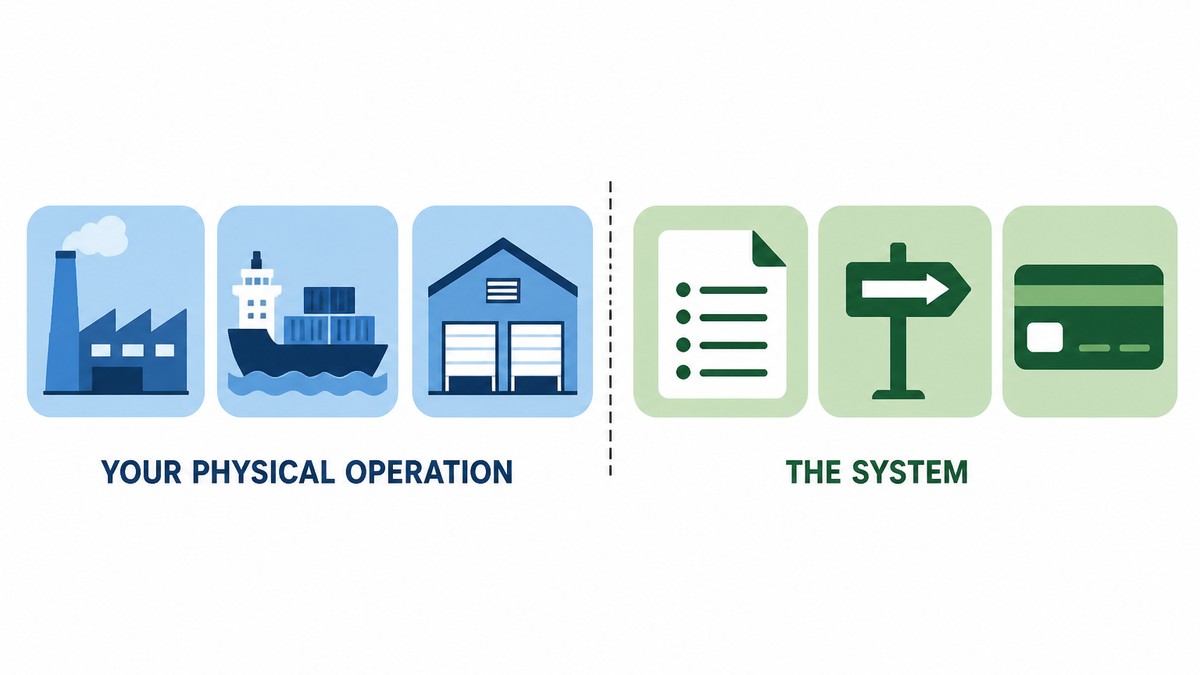
Put plainly: the system records, routes and charges. It does not store, pick, pack or ship. Everything on the left of that line is software. Everything on the right is a physical operation you have to buy, build or delegate.
Sooner or later a seller has to choose one of three physical answers, and each has a different cost shape. Hold your own stock and pay for space. Hand it to a third-party warehouse and pay per pick, per pack and per parcel. Or have the supplier ship each order direct, which is cheapest per order and worst per problem. What a third-party warehouse charges for picking, packing and courier rates sets out the middle option in detail. The other link, connecting a China warehouse to this system through an integration, covers how the order data gets there.
What a China-Sourced Seller Has to Wire In
If your goods come from China, five settings decide whether the system helps you or quietly costs you money. None of them is a feature you switch on and forget.
Duties and taxes. The system estimates and collects them at checkout. You supply the rules behind that estimate. A wrong rule means you either absorb a cost you did not price. Or you lose a sale to a checkout total the buyer did not expect.
Local currency, language and domain. Markets lets you set these per country, and gives each market its own URL or subfolder. That is the difference between a foreign buyer trusting the page and leaving it.
B2B as a market of its own. Wholesale buyers can be given a different catalogue, different prices and a different page layout. If you sell both to consumers and to shops, this is the setting that stops one audience seeing the other's prices.
A second inventory location. Stock in China and stock abroad are two locations against one count, which is how you avoid promising goods that are still on a ship.
The app layer. Third-party apps are how the system reaches a Chinese warehouse or an accounting tool. An integration is only as good as the data the other side sends, so a connection that fails silently is worse than no connection.
One thing on this list is not software at all, and it is where most new sellers lose money. The system will not agree your specification, approve a sample or check a shipment. Those stay with you, and they are the reason a wrong size run costs more than a wrong setting. Writing the specification sheet a Chinese factory actually quotes from is the document that feeds everything downstream. And the size conversion work that cuts return rates is the cheapest fix available to a clothing seller. If you are still choosing suppliers, the routes that actually reach a factory cover that step before any of this matters.
| Setting | What the system does | What you still have to supply |
|---|---|---|
| Duties and taxes | Estimates and collects at checkout | The rules behind the estimate |
| Currency, language, domain | Sells locally in each market | The translation and the local prices |
| B2B catalogue | Shows wholesale buyers a separate catalogue | The price list and the minimum order |
| Second stock location | Tracks two locations against one count | Telling it where the stock actually is |
| App integrations | Connects to a Chinese warehouse or an ERP | Clean data from the other side |
The Cost Stack, Line by Line
The subscription is the line everyone quotes and the smallest line on the bill. The published numbers below all come from Shopify's own pricing page, and the arithmetic that follows is mine.
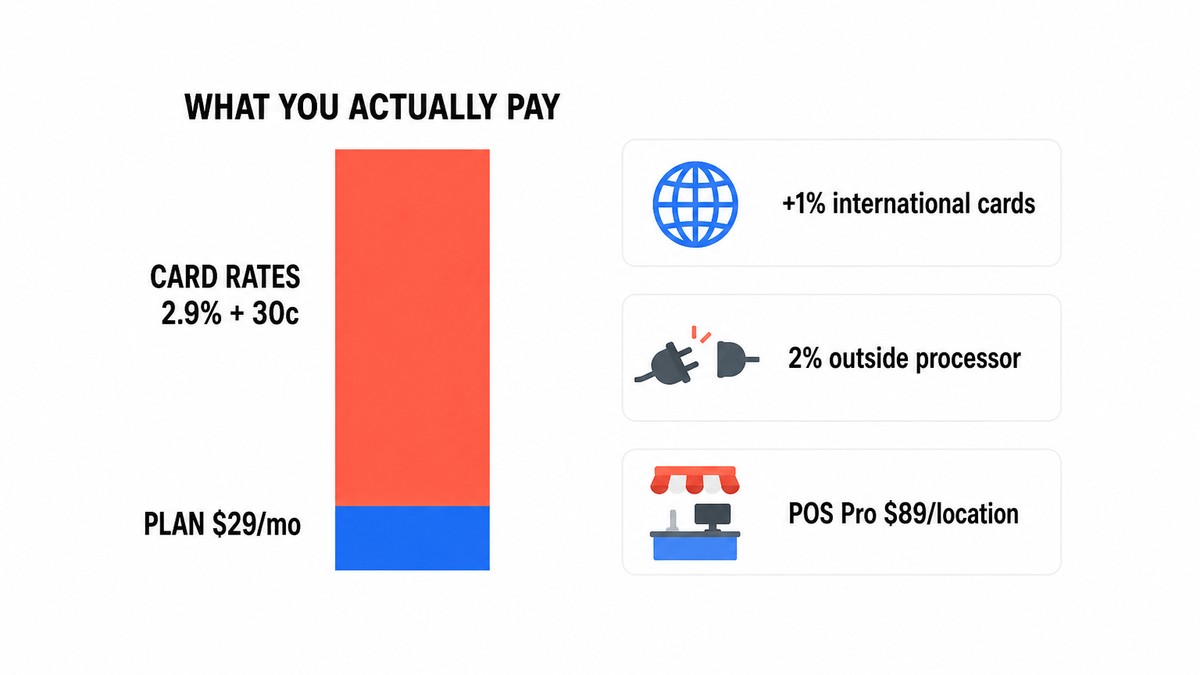
The plan. Basic costs 39 dollars a month, or 29 dollars a month if you pay for a year up front. That difference is worth knowing before you choose a billing cycle.
Card rates online. The standard rate is 2.9 per cent plus 30 cents per transaction. The premium card rate is 3.5 per cent plus 30 cents. And then the line that matters most to a seller outside the United States: international rates add 1 per cent.
Card rates in person. In-person card payments are 2.6 per cent plus 10 cents, which is cheaper than taking the same payment online.
The third-party fee. If you use a payment provider other than Shopify Payments, a 2 per cent transaction fee applies. On low margins that fee alone can decide the question.
POS Pro. 89 dollars a month for each location. Per location, not per account. Two shops means twice that line.
Apps and shipping. Apps carry their own subscriptions and they are where a modest bill becomes a large one. Shipping runs the other way: Shopify advertises carrier discounts of up to 87 per cent off.
Here is the arithmetic that makes the shape clear, using published rates and my own example. A seller turns over 20,000 dollars a month on a card, in 400 orders. Every one is cross-border, so the standard rate plus the international surcharge applies. That is 3.9 per cent of 20,000 dollars, or 780 dollars, plus 30 cents on each of 400 orders, or 120 dollars. The plan adds 29. So roughly 929 dollars a month before apps, before any third-party fee and before freight. The plan is 3 per cent of that total. The card rates are the bill.
What the System Will Not Fix
A short list, because most of it is uncomfortable and it is better read before you pay for anything.
It will not find your supplier. It will not agree a specification. It will not approve a sample, check a shipment or renegotiate a price. It will not make a product people want. And it will not hold a single box.
It will not lower your duty bill either. It estimates and collects the charge, which moves the cost earlier instead of making it smaller. That is still worth having, but it is a cash-flow tool, not a saving.
What it does do is narrow. It makes one stock number true at the same time across every channel you sell on. It puts transaction costs, tax and freight rules in front of you at the point of sale instead of at the end of the month. And it turns a selling decision into a number you can read before you commit.
That is a smaller promise than the marketing suggests, and a more useful one. The system does not run the business. It reports on it fast enough for you to run it better.
Questions Buyers Ask About the Shopify System
What is included in the Shopify system?
Shopify describes three parts that share one set of records. A back office holds products, orders, customers and stock. A point of sale takes payments in person and writes those sales back to the same stock. An online shop sells on a website, on social channels and on marketplaces. Markets, payments and apps build on those three and are not separate parts.
How much does the Shopify system cost?
The entry plan is 39 dollars a month, or 29 dollars a month if you pay yearly. Online card rates are 2.9 per cent plus 30 cents, or 3.5 per cent plus 30 cents on premium cards, with 1 per cent added for international cards. In-person payments are 2.6 per cent plus 10 cents. Using an outside payment provider adds a 2 per cent fee, and POS Pro is 89 dollars a month for each location.
Is Shopify POS the same thing as Shopify?
No, and the difference matters when you are budgeting. Shopify is the platform that runs the business: products, orders, customers and stock. POS is the part that connects that platform to selling in person, using an app plus a card reader. It is an add-on to a plan you are already paying for, and it is charged per location on the advanced tier.
Does Shopify store and ship my products?
No. The system records stock, routes an order to the closest fulfilment centre you have registered, and charges the customer. It does not own a building, hold your goods, pick an item, pack a box or hand a parcel to a carrier. You need your own space, a third-party warehouse, or a supplier who ships each order direct.
Can the Shopify system handle products made in China?
For the software side, yes. It estimates and collects duties and taxes, sells in local currencies and languages, gives each market its own domain, and can hold stock across up to ten locations on the entry plan. What it will not do is anything physical, and it will not manage your supplier. Specification, sampling and inspection stay entirely with you.
Do I need POS if I only sell online?
Usually not. POS earns its fee in three situations: selling at markets, fairs and pop-ups; letting a customer collect an online order in person; and running a real shop alongside the website. If none of those applies, the advanced POS tier is a monthly cost for a counter you do not have. The standard plan already includes casual in-person selling.
The system stops at the warehouse door
Send us the product you sell and how you hold your stock today. We will tell you which of the three physical answers fits your volume, and what the sourcing side has to put in place so the system has something true to record.
Get a Stock Plan
Questions & Comments
We read every one and reply within 24 hoursTell us the product you sell and how you hold stock today. We will say which of the three physical answers fits your volume, and what the sourcing side has to put in place so the system has something true to record.