
Robotic Palletizer Manufacturer: Reach, Cycle and Safety From China
 ·
Updated October 14, 2026
·
21 min read
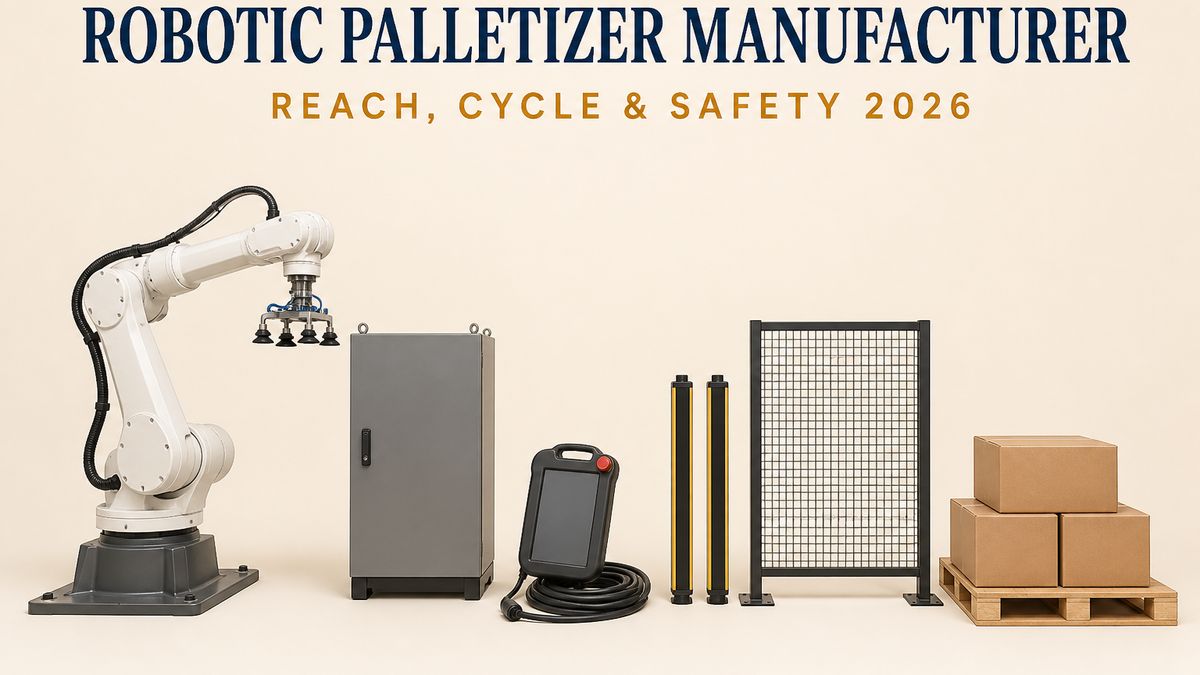
A robotic palletizer is the only part of a palletizing cell that is bought rather than built, and it is the part most often sized wrongly. The arm is rated for a payload at a reach, and the load it can safely carry falls as the arm extends, so the case that lifts easily near the base is the case that decides the size of the machine when the pallet corner is the target. Two other figures decide whether the cell works: the cycle time at your case, which is arithmetic rather than a brochure number, and the working space in front of the control cabinet, which is fixed by rule and cannot be used for storage. This guide covers the four figures a robot datasheet has to state, the cycle time sum, the mountings, and the safety and signage the cell is checked against.
| Your situation | What decides the choice | Where the cost sits |
|---|---|---|
| Heavy cases, large pallet | Payload at full extension, not headline payload | One or two robot sizes up |
| Light cartons, high rate | Cycle time and the tool, not the arm | The tool and the controls |
| Two case sizes on one line | Tool changes and stored programs | The tool and the programming |
| Low ceiling or a tight corner | Mounting and the swept envelope | Brackets, beam and re-work |
| Operators working alongside | Whether a rated collaborative arm is needed | The arm itself |
Which Arm, and How the Datasheet Is Written
The arm is made by one of a handful of suppliers and bought in by every cell builder, so the brand name is the least interesting part of the datasheet. What matters is whether the four figures on it were measured the way your duty needs them measured, because the same physical arm can be quoted as capable or incapable of your job depending on how the numbers were read. That is also why a specification sheet the builder can actually quote from is worth more than a brand name on the cover.
The first figure is payload, and it is the one most often quoted wrongly. A payload rating belongs to a reach, not to the arm on its own. An arm sold as a twenty kilogram machine carries its twenty kilograms close in and noticeably less at the far end of its stroke. When the working target is the far corner of a pallet, that corner is the only place the figure needs to be true. Ask for the payload at your working reach, not the headline number.
The second is the number of axes, which is a question about the motion you need rather than about quality. A four-axis arm handles cases at a high rate on a single pallet position and cannot reorient a case in three dimensions, so it struggles the moment a pattern needs a case turned. A six-axis arm can place a case in any orientation, which is what makes it the usual choice for mixed products and for pallets built in more than one pattern. The cost difference is real and it is usually worth paying once variety is in the plan.
The third is whether the arm is a standard industrial machine or a rated collaborative one. A collaborative arm is designed and rated so that it can share a workspace with a person under defined conditions, and it costs more for the same reach and payload. It earns its price where an operator has to load or clear the cell by hand all day. Where the cell is fenced and the operator never enters during a cycle, a standard arm behind proper guarding does the same work for less.
The fourth is the environment the arm is rated for, which is rarely asked and occasionally decisive. Washdown, cold store, and dust-laden areas each have their own protection class, and an arm specified for a clean dry room will not last in a freezer. State the environment in the enquiry rather than assuming the standard machine covers it.
Reach, Payload and the Corner of the Pallet
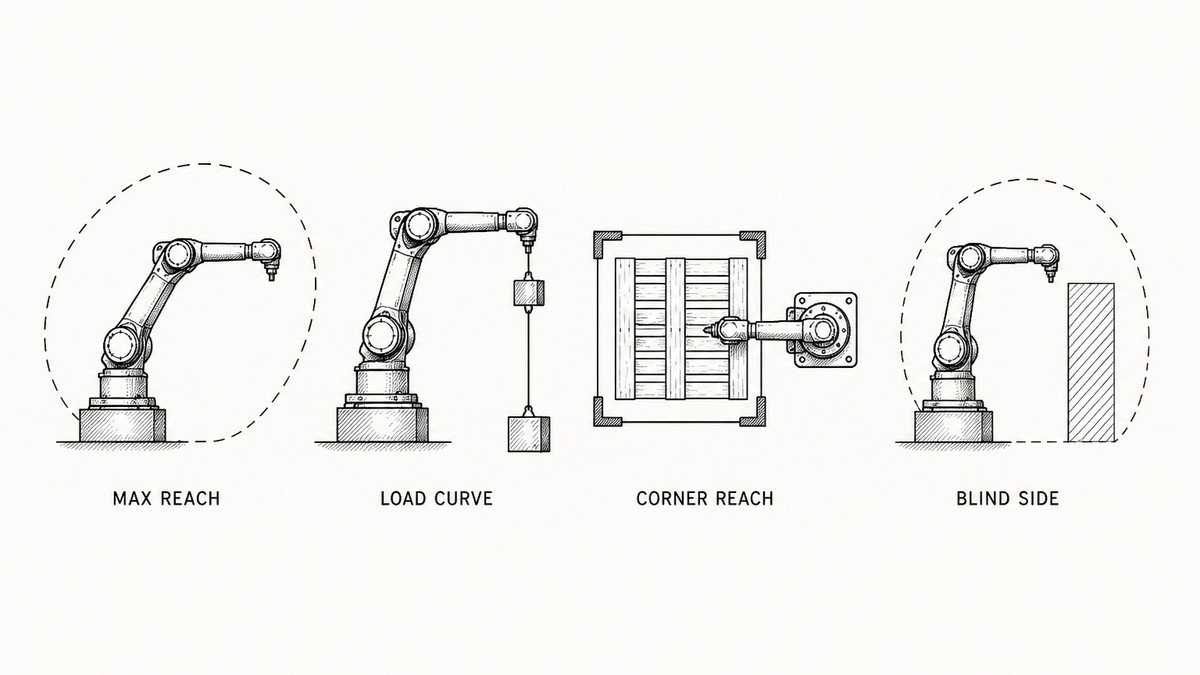
Reach is drawn as a circle and behaves like a curve, and the difference between the two is where machine sizing goes wrong. The published reach figure is the distance to the furthest point the tool can touch in the best case. The payload at that distance is lower than the payload at the base, and the shape the arm sweeps is not a tidy circle but a region with a hollow centre where the wrist cannot reach and a blind side where an obstruction sits.
Two distances have to be measured before an arm is chosen. The first is the distance from the base centre to the corner of the finished pallet, which is the furthest point any case will ever be placed at. The second is the height difference between the pallet deck and the highest layer, because an arm placing a heavy case at the top of a stack is lifting as well as reaching, and the two demands add together.
The practical consequence is that a cell expected to build a full pallet must be sized on its worst case, which is a heavy case at the far corner of the top layer. A supplier who sizes on the average case at the near edge will quote a smaller arm and win the order, and the cell will then be reprogrammed to place the top corners more slowly, which shows up as a rate that cannot be reached rather than as a fault.
The obstruction is the other half of reach and it is usually the machine's own frame. The layer plate, the pallet magazine and the fence all sit somewhere inside the swept region of an arm mounted beside them, and each one removes a slice of the region the arm was going to use. This is why a reach figure on its own says almost nothing: the cell has to be drawn before the arm can be confirmed, and the drawing has to show the obstructions as clearly as it shows the pallet.
Cycle Time Arithmetic
Cycle time is arithmetic, and doing it in public is the fastest way to find out whether a quoted rate is achievable. A palletizer cycle is a pick, a travel and a place, repeated for every case, plus the interruptions that are not part of the cycle at all but are part of the shift.
| Element of the cycle | What sets it | How it is shortened |
|---|---|---|
| Pick | Tool approach and the case surface | A tool that needs less travel to grip |
| Travel | Distance and the acceleration the case survives | Shorter paths, mounted closer to the pallet |
| Place | Pattern accuracy and settling time | A pattern that needs less fine positioning |
| Interruptions | Pallet exchange, tool change, small stops | An automatic pallet magazine, stored programs |
The pick and place halves of the cycle are hardware, and the travel is where the interesting compromise sits. An arm moves a load as fast as the load tolerates, and the limit is often the case rather than the machine: a light carton of loose contents will shift or deform under hard acceleration, so the arm is slowed to protect the product. That is why two cells with the same arm can quote different rates, and why the case always has to travel to the builder for a test.
Interruptions are the part a quotation usually omits and the part that decides the shift figure. Pallet exchange is the largest of them, because a full pallet has to leave and an empty one arrive while the line keeps producing. An automatic magazine with a chain deck removes most of that downtime and costs more than a simple stack that a person reloads. Tool changes matter when more than one case size is run, and stored programs make them minutes rather than hours. Small stops are the accumulation of everything that halts the cell for a few seconds, and a well-integrated cell simply has fewer of them. The cell is also only as good as the infeed conveyor that delivers cases to it, because a starved cell idles as surely as a stopped one.
So the number to ask for is not a rate. It is the cycle time at your case, the cases per layer and the layers per pallet, the pallet exchange time, and the assumed availability across a shift. Given those four, anyone can work out the rate, and two quotations become comparable for the first time.
Floor, Wall, Ceiling or Angled
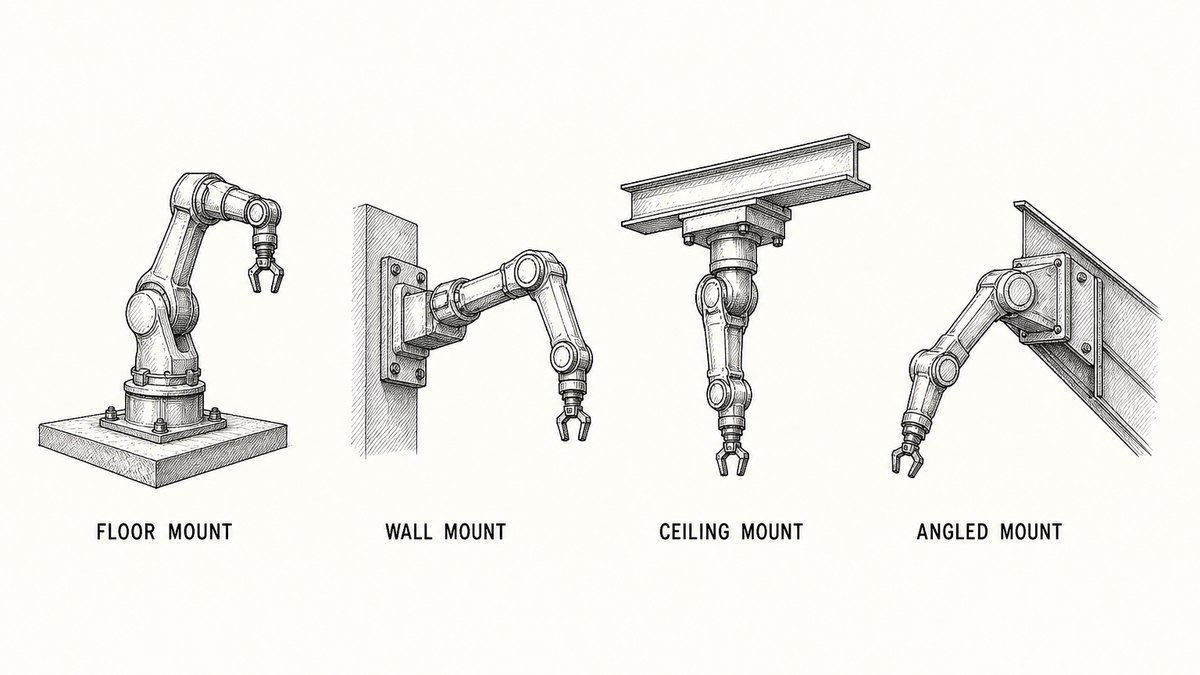
How the arm is held up is chosen after the reach is understood, and it changes both the price and the building. A floor mount on a plinth is the default, the cheapest to build and the easiest to maintain, because everything is reachable from standing height. It also consumes the most floor, since the base sits inside the working area rather than above it.
A wall mount moves the base out of the way and lets a modest arm cover a pallet it could not otherwise reach. What it adds is a structural question, because the wall now carries the arm's overturning load rather than the floor. Not every wall in a factory is built to take that, and the bracket is often the more expensive half of the arrangement.
A ceiling mount is how a low-ceiling area gets a palletizer at all, and it frees the floor completely. It brings its own problems: an overhead beam has to be designed for the dynamic load, the arm has to be specified for an inverted mounting with its own load behaviour, and maintenance now happens at height. Greasing a ceiling-mounted arm is a job that gets postponed, which is a running cost rather than a capital one and worth weighing before the saving looks attractive.
An angled mount is the compromise used where the pallet position is low and the reach is short, and it is the one most likely to be drawn on site rather than by the builder. If the quotation includes a sloped bracket, ask who designed it and who is responsible for its strength, because brackets invented at installation are a common source of vibration and premature wear.
The Plinth and the Load Path
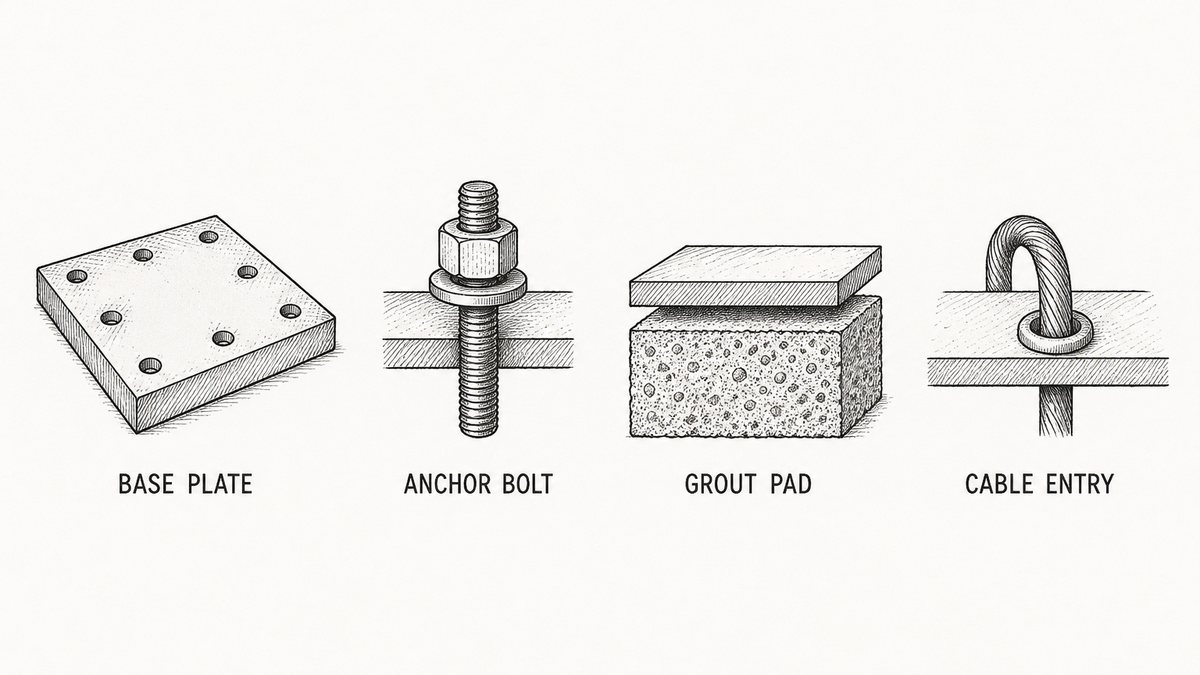
A robot is a machine that throws its own weight around, so the base has to be tied to something that will not move. The plinth and the anchors are a small line on the quotation and the most common cause of a cell that runs, drifts and then alarms.
The base plate is drilled to the arm's footprint and the holes are usually larger than the bolts, so there is room to adjust the position during installation. The anchors are the load path: they carry the overturning moment from a heavy case at full extension, and a bolt that is adequate for the static weight can still be inadequate once the arm is moving. Ask for the anchor specification to come from the arm manufacturer rather than from the installer's habit.
Grout is what actually spreads the load from the plate into the slab, and a plate sitting on shims with a gap under it is held by the bolts alone. That arrangement works until the first hard cycle shakes it loose. A grouted pad under the plate turns the plinth into a single stiff body, which is why the grout is specified rather than optional on any arm big enough to matter.
The cable entry deserves the same thought as the bolts. Cables are the part of a robot cell that fails first, and they fail at the point where they bend. A cable tied into a sharp hole will chafe through a conductor in months, and the fault will appear as an intermittent alarm that nobody can reproduce. A soft collar, a generous bend radius and a service loop are all cheap at installation and expensive afterwards.
The Safety Circuit and the Rated Robot
A robot cell has two safety obligations that get confused with each other. The first is that the machine must stop when a person approaches or enters in a way that the design did not allow. The second is that the stopping function must be reliable, meaning it fails in the safe direction rather than the convenient one. Both are engineering decisions with documented answers, and neither is satisfied by a fence and a switch.
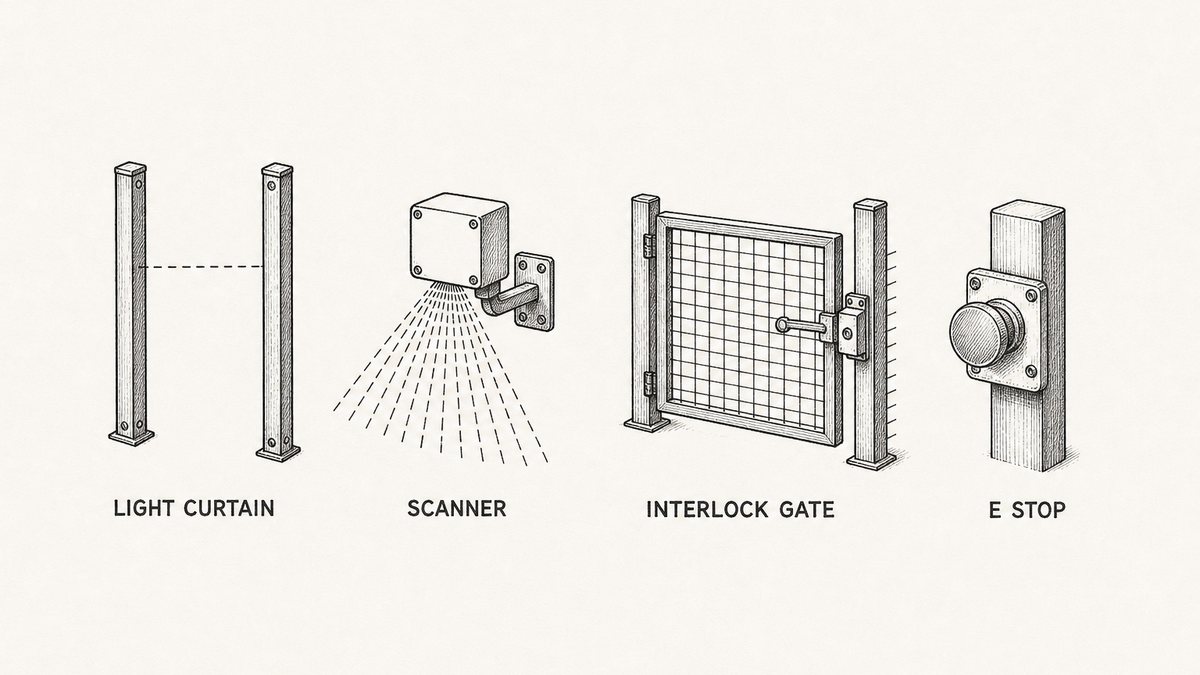
There are three ways a cell is normally arranged, and they cost differently. A physical barrier with an interlocked gate is the simplest and most common: the person cannot reach the arm, and the gate stops the cycle. A light curtain or a scanner replaces part of the barrier with an invisible boundary, which is what allows a pallet or a person to pass through without a gate, and it needs the detection zone set so that a person cannot walk past it before the machine has stopped. A rated collaborative arm with a monitored stop allows the person and the arm to share space under defined conditions, and it removes some of the fencing at the cost of a more expensive arm.
The devices are the visible half and the circuit behind them is the half that matters. A cell should arrive with a documented safety circuit that says which conditions stop the machine, how each stop is triggered, and how the circuit has been arranged so a single fault does not remove the protection. That document is what a competent reviewer will ask for, and a cell that cannot produce it has a fence rather than a safety system.
Two practical points are worth putting in the order. Every device has to be tested by operating it, with the result recorded, rather than described in a manual. And the emergency stops have to be reachable from where a person would actually stand, which on a palletizing cell means both the infeed side and the pallet exchange side, not just the control cabinet.
Signs, Tags and the Working Space
Two obligations around a robot cell have nothing to do with robots, and both are checked at a glance by anyone who inspects the plant. The first is the space in front of the control cabinet. The second is the signage on the cell. Neither is expensive to satisfy at the design stage and both are awkward to fix afterwards.
The working space rule at 29 CFR 1910.303 is the more useful of the two because it comes with a number. Working space in front of electrical equipment has to be at least the width of the equipment or 762 millimetres, whichever is greater, and it has to be enough to let the doors or hinged panels open through at least ninety degrees. That space may not be used for storage. On a palletizing cell the cabinet is usually the last item located and the first one to be squeezed, and it is exactly the cabinet whose door has to swing while an engineer is holding a meter. The same rule requires lighting at the working space and, for large boards, an entrance at each end. It also settles an argument that comes up on every installation, which is whether a pallet can be parked in front of the panel. It cannot.
The signage is the second, and the wording matters as much as the position. Under the sign and tag specifications at 29 CFR 1910.145, signs are classified by what they mean: a danger sign means an immediate danger and calls for special precautions, while a caution sign is for a potential hazard or an unsafe practice, and the two are not interchangeable. Caution signs have a yellow background with a black panel and yellow letters, safety instruction signs have a white background with a green panel, and every sign has to be made with rounded or blunt corners and be free of sharp edges and projections. The wording itself is expected to be concise, easily read, to give enough information to be understood, and to make a positive rather than a negative suggestion.
Tags are the third item and they are what a maintenance technician meets in practice. A tag carries a signal word and a specific message, and the signal word is limited to a small set. It has to be readable from at least five feet. Tags are for conditions that are out of the ordinary or not readily apparent, and they are not required where guarding or a sign already protects the hazard, which is worth knowing because it stops a cell being covered in labels that all say roughly the same thing.
One more rule catches the layout rather than the machine. An exit route has to be free and unobstructed, and no materials or equipment may be placed within it either permanently or temporarily, which is set out in the exit route requirements at 29 CFR 1910.37. The word temporarily is the one that bites on a palletizing line, because a stack of finished pallets waiting for collection counts. Put the cell, the cabinet and the pallet buffer on a plan with the exit routes drawn on it before anything is ordered, and none of this becomes a surprise at handover.
Commissioning, Simulation and What to Keep
A robot cell is the rare machine that can be proven twice: once in software, before any steel is cut, and once in the builder's workshop on the actual cases. Both are worth insisting on, and they catch different things.
Simulation answers the questions that are expensive to answer later. Whether the arm reaches the far corner with the case it will actually carry. Whether the swept region collides with the magazine, the fence or the wrapper. Whether the cycle time adds up with realistic accelerations. A builder who simulates can show you a film of a plausible cell before the frame is welded, and disagreement about the layout is much cheaper to settle on screen than on the floor.
Workshop testing answers the questions simulation cannot. Whether the tool actually grips the case without marking it. Whether the pattern builds cleanly when cartons are a few millimetres off the stated size. Whether the pallet exchange works with the pallets you really buy, including the repaired ones. None of that can be modelled because it depends on the physical product, and it is the reason a builder should ask to have your cases rather than use their own samples. It is the same discipline as a pre-dispatch check on the assembled cell, with the addition that the product being handled has to be the real one.
What to keep afterwards is the last decision and the one most often forgotten. The program should arrive backed up on a removable medium, not only inside the controller. The electrical drawing should be issued as built rather than as quoted. The safety circuit should be documented. The tool drawings and the spare parts list should be handed over with prices. And the robot's own manual should be supplied in a language somebody on site reads. A cell handed over without those five items runs until the first problem and then waits for a visit.
Four Things That Drift on a Robot Cell
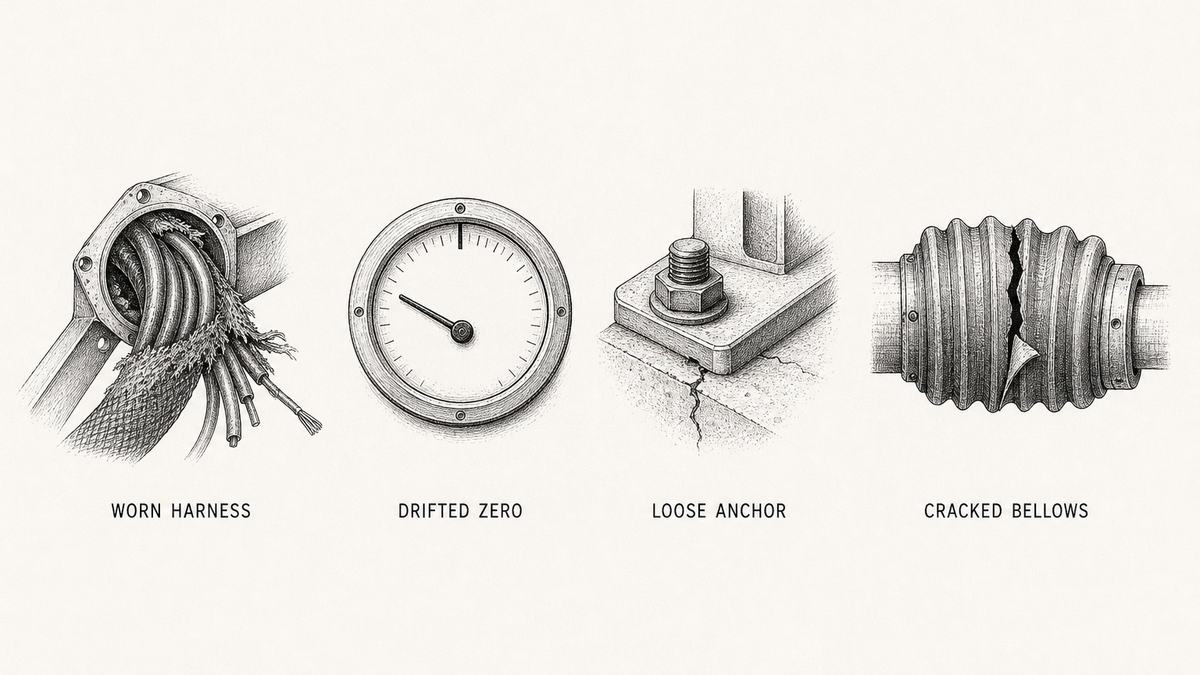
A robot cell rarely fails suddenly. It drifts, and the four things that drift most are all cheap to check and expensive to discover.
The harness is the first. Cables running through a joint that moves a thousand times a shift will eventually break a conductor, and the break starts as an intermittent fault that clears itself and stops the line for ten minutes a day. A visual check of the cable bundle at each joint, looking for a flattened or chafed section, finds it before it becomes a fault. This is the single most common wear item on a palletizing cell.
The zero position is the second. An arm's idea of where it is comes from encoders, and a mechanical knock, a hard emergency stop or a low battery can move that reference. The symptom is not an alarm but a pattern that slowly stops lining up, until a stack leans or a case catches the fence. Checking the reference against a fixed mark on a schedule costs a few minutes and prevents the slow drift that takes weeks to notice.
The anchors are the third, and they are the most serious because they are structural. A bolt that has lost its preload lets the plinth move a fraction under load, which shows up as vibration and inaccurate placement and eventually as a crack in the grout. A torque check on the anchors belongs on the annual list, not on the list of things to do when it feels wrong.
The bellows and seals at the joints are the fourth. The ribbed sleeves that keep dust and water out of a joint perish, split and tear, and once one is open the joint is running on contaminated grease. Replacing a sleeve is inexpensive. Replacing the joint is not, and the pair of operations is separated only by whether anybody looked.
All four belong on a written maintenance schedule handed over with the machine, and the schedule should say what to check rather than only when to grease. For the wider picture of where a robotic cell sits in a machine order and what the surrounding families are, the industrial machinery section that lists these families is the place to start, and the broader cell it belongs to is covered in the palletizer sourcing guide that covers the whole cell.
Questions Buyers Ask Before Ordering
How much does a robotic palletizer cost?
The honest answer is that the arm is not the variable. A robotic cell is priced by the reach and payload it has to achieve, the tool that touches the product, the pallet handling arrangement and the safety circuit behind it. A cell for light cartons at a modest rate and a cell for heavy cases at the far corner of a large pallet sit in different bands even when the pictures look similar, because the second one needs a bigger arm, a stronger plinth and anchors rated for the overturning load. Fix the worst-case case and pallet position first, then ask for quotations, and insist that each one states the arm model and the payload at your working reach.
Do I need a collaborative robot?
Only if a person genuinely has to share the workspace during the cycle. A collaborative arm is rated so that it can work alongside somebody under defined conditions, and it costs more for the same reach and payload. Where the cell is fenced, interlocked and the operator never enters while it runs, a standard industrial arm behind proper guarding does the same job for less. The exception worth considering is a cell that has to be loaded or cleared by hand many times a shift, because there the fencing becomes a production problem rather than a safety one.
What is the difference between payload and payload at reach?
A payload rating belongs to a distance. An arm quoted at a given payload carries that much close to its base and less as it extends, and the reduction is not small. Because a palletizer always places cases at the outer part of its working area, the number that matters is the payload at the furthest corner of your pallet, at the top of the stack, with your heaviest case. Ask for that figure in writing. A supplier who answers with the headline payload has not understood the question.
How accurate does the pattern have to be?
More accurate than the case tolerance, which is why the case has to be measured rather than assumed. A pattern is designed around a footprint, and cartons arrive a few millimetres off it. If the arm places perfectly and the cartons vary, the stack still leans. The practical approach is to state the footprint and its tolerance in the enquiry, run the pattern in the workshop with the real cartons, and accept that part of the machine's accuracy budget is being spent absorbing variability in the product rather than in the placement.
Can the cell be extended later?
Sometimes, and it depends on two decisions made at the start. If the arm was sized on the worst case rather than the average, there is usually capacity in it for a second pallet position or a modest rate increase. If it was sized tightly, there is not, and the honest options become a second cell or a bigger arm. The other decision is the controls: a controller with spare inputs and a program written in a readable structure can be extended, while a minimised program with everything hard-wired cannot. Ask what spare capacity the proposed arm and controller have before you need it.
What is the biggest risk when buying a cell from China?
The tool and the pattern, for the same reason they are the risk on any palletizer: they are the two parts genuinely designed for your product and the two hardest to check at a distance. The remedy belongs in the order rather than in a later argument. Require a workshop test on your own cases, name the make and model of the arm and every bought-in component, require the safety circuit to be documented and each device to be tested with the result recorded, and require the plinth and anchor loads to be issued by the arm manufacturer rather than chosen by whoever installs it. Those four requirements cost nothing to write and they are what separates a cell from a frame with an arm on it.
Size the arm on the worst case
Send the heaviest case, the far corner of your pallet, and the rate you need across a shift. We will put those on a datasheet, ask for the payload at your working reach rather than the headline figure, and hold the order until the tool and the pattern are tested on your own cartons.
Request a Robot Cell Quote
Questions & Comments
We read every one and reply within 24 hoursThe argument is almost never about the arm. It is about the payload it still has at the far corner of the pallet, the cycle time that comes out of the elements, and the working space in front of the cabinet that cannot be used for storage. Send us those and we settle the cell before a builder quotes.