
Oil Filter Manufacturer: The Ratio Nobody Asks For
 ·
Updated October 22, 2026
·
12 min read
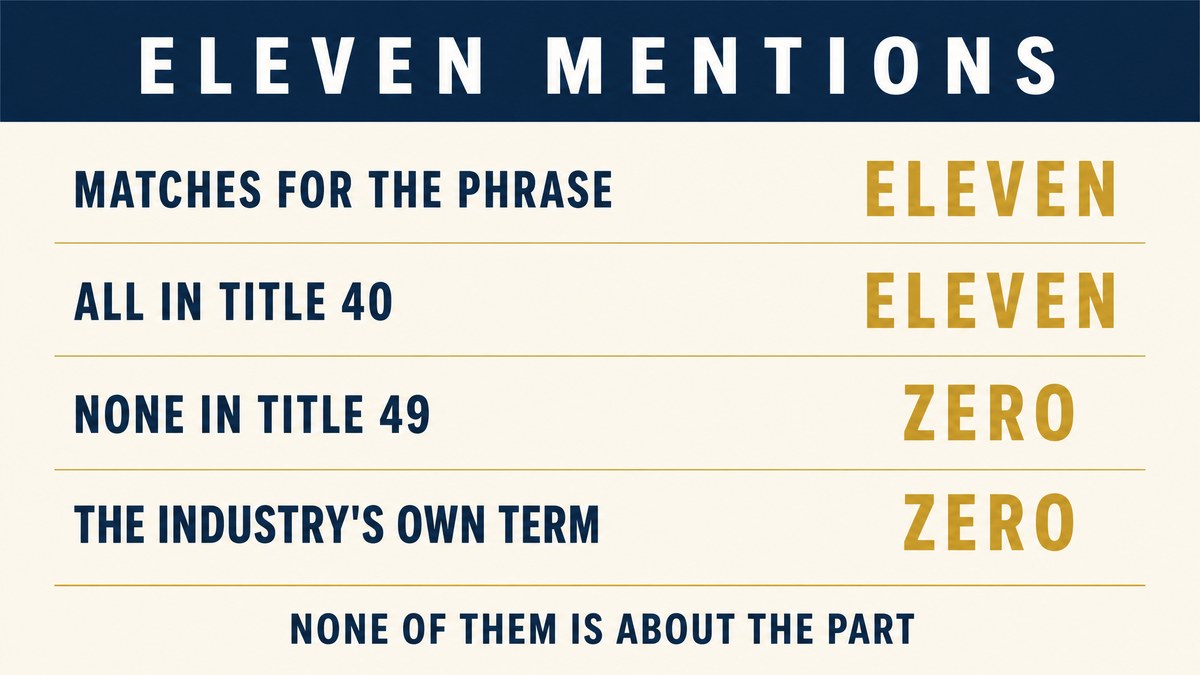
Seventeen articles in this series have opened with a federal document. This one opens with a search that returns nothing useful. The phrase oil filter appears eleven times in the entire Code of Federal Regulations, and every one of those mentions sits in Title 40 — emissions testing, fuel economy, industrial processes. None of them is in the vehicle safety standards. The phrase the industry actually uses for the part, lubricating oil filter, appears zero times.
So the oil filter has no law, and that is not the interesting part. The interesting part is what a buyer asks for instead: an efficiency number, usually a percentage, usually without a micron or a method attached to it. A filter that is “99 per cent efficient” is not a product description. It is half of a sentence, and the missing half is the only thing that decides whether the filter protects an engine.
1. Eleven Mentions, All in the Wrong Title
The search is worth doing once, because it settles the question. Searching the Code of Federal Regulations for the exact phrase oil filter returns 11 results, and they fall in Title 40 at Parts 86, 89, 94, 80, 437 and 610. Those parts govern emissions testing, fuel economy labelling and industrial process rules. The vehicle safety standards live in Title 49, and there is not one hit there.
That result is not a technicality. In this series, a tyre, a rim, a wiper, a jack, a tire changer, an extinguisher, a cargo net, an exhaust, a headlamp and a seat belt all had a sentence somewhere addressed to the maker of the part. A water pump and a timing belt had none, and the articles about them were built on that absence. An oil filter is the first part where the absence is complete: no marking duty, no performance floor, no category in the aftermarket parts subpart, and not even a passing mention in the safety title.
What exists instead is a test. And a test is a weaker document than a law in one respect and a stronger one in another: it does not oblige anybody, but when two parties name the same test, it decides the argument.
2. The Only Document Is a Test
The test the industry names is ISO 4548-12, and its scope sentence is short enough to quote in full: it specifies a multi-pass filtration test with continuous contaminant injection and using the online particle counting method for evaluating the performance of full-flow lubricating oil filters for internal combustion engines. The current edition is 2017, reviewed and confirmed in 2022.
Three words in that sentence do all the work, and each one rules out a cheaper claim.
Multi-pass. The filter is not asked to catch a single dose of dirt. Contaminant is injected continuously while clean oil circulates, so the filter is measured while it is filling up — which is the condition it spends its life in. A single-pass efficiency number describes a different test, and a better-looking one.
Continuous injection. The dirt rate is fixed and declared. Without it, a filter can look efficient simply because it was fed less dirt per hour than the filter it is being compared to.
Online particle counting. Particles are counted upstream and downstream while the test runs, by size band. That is what produces a curve rather than a number, and the curve is the answer.
None of this is a legal requirement. It is a method, and the reason to insist on it is that the alternative — a supplier's own bench, their own dust, their own arithmetic — is not comparable to anything.
One more word in that scope is worth a paragraph: full-flow. A full-flow filter sits in the main gallery and passes everything the pump delivers, which is why its restriction matters as much as its efficiency. A filter fine enough to catch ten-micrometre particles and thick enough to be efficient when cold will push the system into bypass during a winter start, and a bypassed filter catches nothing at all. That trade — efficiency against pressure drop, at the coldest temperature the vehicle will see — is the real engineering in the product, and it is invisible in a percentage.
3. The Answer Is a Ratio, Not a Percentage
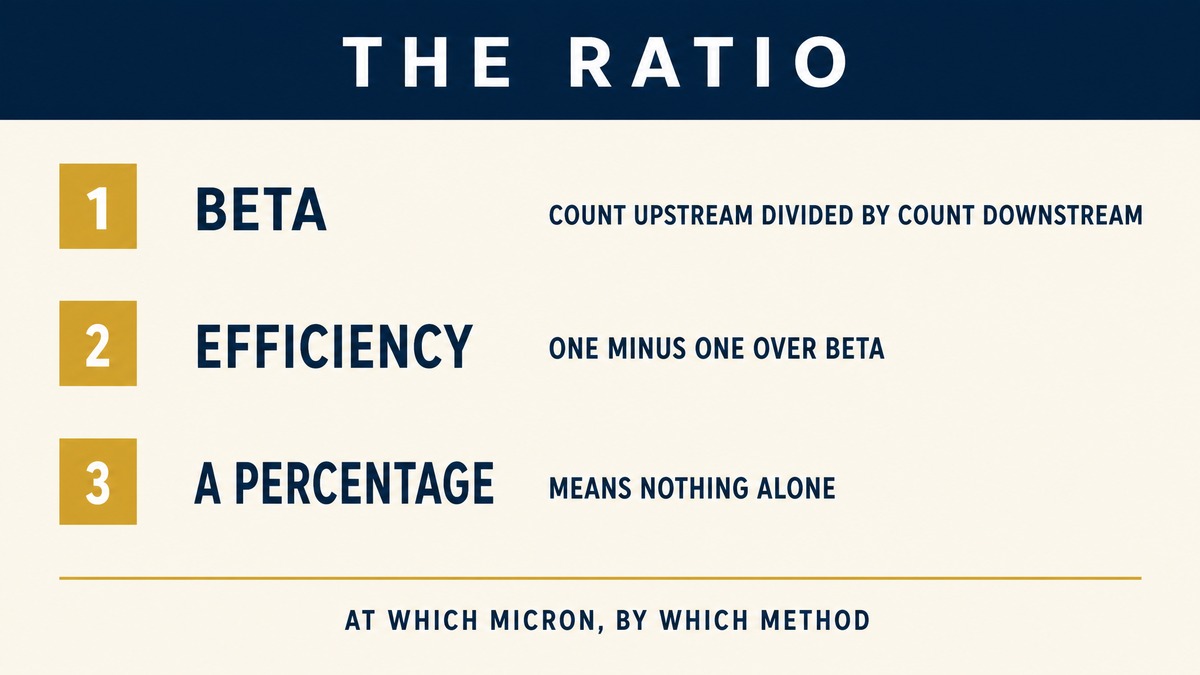
The number the multi-pass test produces is called beta, and it is a ratio: at a stated particle size, the count upstream divided by the count downstream. If 10,000 particles of 10 micrometres enter and 100 leave, beta at 10 micrometres is 100.
Efficiency is that ratio rewritten: 1 − 1/beta. So beta 2 is 50 per cent, beta 20 is 95 per cent, beta 75 is 98.7 per cent, and beta 200 is 99.5 per cent. The arithmetic is trivial; the consequence is not. A single percentage can be produced by an infinite number of beta values at different micron sizes, and those filters are not interchangeable.
Two suppliers can both truthfully say “99 per cent”. One means beta 100 at 30 micrometres, which is a coarse filter that protects the bearings and nothing finer. The other means beta 100 at 12 micrometres, which is a different product with a different pressure drop and a different life. The sentence is identical and the parts are not.
There is a second reason to ask for the curve rather than the peak. A filter's capture efficiency is not constant through its life: as the media loads, the passages narrow and efficiency rises, while the pressure difference across the filter also rises until the bypass valve opens. The multi-pass method exists to describe that whole behaviour, which is why a figure quoted from a single-pass bench — usually the best-looking point of a fresh element — tells a buyer almost nothing about the fourth month.
4. What You Can Specify Without a Laboratory
The useful consequence of having no law is that the order has to carry the specification, and most of it can be written by a buyer who owns a caliper and a thread gauge. The table below is the minimum. None of it is federal; all of it is checkable, which is also the argument for a factory audit that opens a sample filter rather than a brochure.
| Property | What goes in the order | How it is checked |
|---|---|---|
| Thread | the exact thread, for example 3/4-16 UNF, and the direction | thread gauge on a sample |
| Gasket | material, inside and outside diameter, thickness | caliper, plus a fitted leak check |
| Bypass valve | opening pressure in kPa, and whether it is in the base or the element | bench with regulated air or oil |
| Burst pressure | the pressure the can must hold without rupture or permanent distortion | pressure ramp to failure on a sample |
| Media | type (cellulose, synthetic blend, full synthetic) and area in square centimetres | drawing plus a cut-open sample |
| Anti-drainback | fitted or not, and the material — silicone or nitrile | visual on a cut-open sample |
| Filtration claim | beta value and micron and the test named as ISO 4548-12 | the supplier's report, read for all three |
Thread and gasket are also the only two properties that can fail before the engine turns over. A gasket of the wrong thickness seats on the boss instead of the can, and a thread that is close but not identical cross-threads once and then leaks for the life of the vehicle. Both are cheap to check on a sample and impossible to check in a photograph, which is why they sit at the top of the table rather than in a footnote.
Two rows deserve emphasis. Media area is the property that most directly sets life, and it is the one quotation sheets leave out, because a photograph cannot show it. A filter with the same external dimensions can carry a third less media if the pleats are shallower or fewer, and it will look identical in the box.
And the filtration claim: three things or nothing. A beta value without a micron has no meaning, a micron without a test method has no comparability, and a percentage is not a specification at all. If the report names a different standard, that is not a defect — it is a different product, and the two reports cannot be placed side by side.
5. Where the Price Difference Comes From
Two filters at half the price and the same thread differ in five places, and four of them are invisible after the can is crimped.
The media area. More pleats, deeper pleats, or a larger can all buy area. Area buys life, because the filter has more places to hold contaminant before the bypass opens. It is the first thing to shrink when a quotation is cut. Filters are light for their volume, so the freight also moves on cube: a CBM calculation belongs next to the unit price.
The media itself. Cellulose, a synthetic blend and full synthetic media hold different amounts of the same dirt and behave differently in the presence of water. A blend is not a cheaper version of the same thing; it is a different curve.
The bypass valve. A valve that opens early dumps unfiltered oil to the bearings during every cold start. The opening pressure is a number, and the difference between a well-made and a cheap valve is usually that the number is not the one on the drawing.
The can and the seam. Steel gauge and the crimp decide burst behaviour. A can that bulges under pressure has already changed the bypass geometry inside it.
The anti-drainback valve. Silicone and nitrile age differently at sump temperature. A hardened valve lets the oil gallery drain back overnight, which is the dry start a buyer never sees in a specification.
6. What the Record Can Say, and What It Cannot
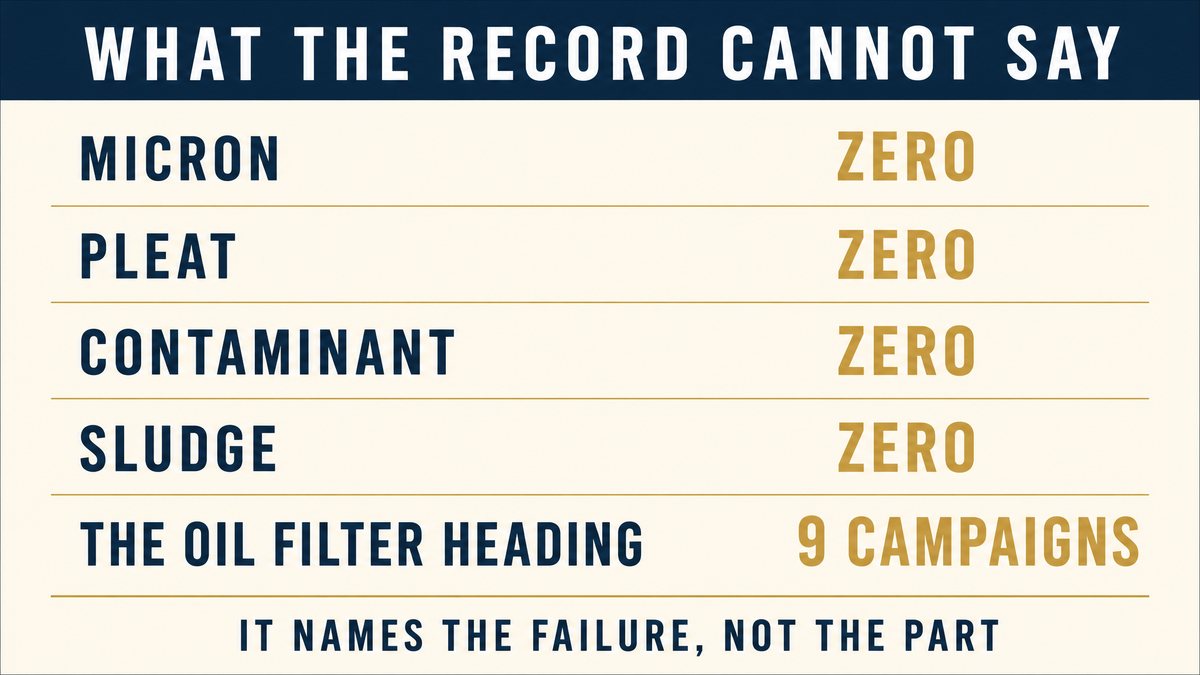
Method unchanged. The federal recall file holds 245,845 records across 15,305 campaigns, no header row, every field scanned, twenty-five terms each with its own pattern. Controls: brake 28,639, air bag 16,162.
Four terms returned nothing at all, and they are the four that describe the product:
| Term | Records | What it would have described |
|---|---|---|
micron | 0 | the size at which efficiency is claimed |
pleat | 0 | the geometry that creates surface area |
contaminant | 0 | what the part exists to remove |
sludge | 0 | the condition it is meant to prevent |
What the record does contain is consequence. clogged appears in 3,741 records, collapse in 275, burst in 122, debris in 1,049. Those are the words of a warranty claim, not of a specification. The field can tell you that a filter collapsed; it has no vocabulary for the media that would have prevented it.
The headings make the same point from the other side. Under the whole file there are two headings that name an oil filter, and they carry 9 and 67 campaigns. Meanwhile the word filter itself appears in 1,748 records across 209 campaigns — but look at what those campaigns are: the three largest are an airbag control module, a fuel pump and another fuel pump. The word is borrowed from the prose describing other systems.
So the oil filter is the mirror image of the seat belt. There, the record used the standard's nouns because the standard had defined them first. Here there is no standard to borrow from, and the record fills the gap with the only vocabulary it has: the complaint.
7. Seven Questions an Oil Filter Quote Should Answer
A quotation in this category is usually a photograph, a list of cross-reference numbers and a price. The seven questions below are the ones that turn it into a product, and six of them can be answered from a drawing and a test report.
- Which test, and which edition? ISO 4548-12 is the name to expect; the edition matters because the method has been revised. A report that does not name the standard is a bench result, not a comparison.
- Beta at which micron? One number with the other. Beta 75 at 20 micrometres and beta 75 at 10 micrometres are different filters with different lives.
- What media, and how many square centimetres? Type and area. The area is the property that sets life and the one a photograph cannot show.
- Where is the bypass valve, and at what pressure does it open? In the base or in the element, and the opening pressure in kPa. An early-opening valve sends unfiltered oil to the bearings.
- What burst pressure, and what anti-drainback material? The can's limit, and silicone or nitrile for the valve that keeps the gallery primed.
- Thread and gasket, dimensioned? The thread by designation, the gasket by inside diameter, outside diameter and thickness.
- Two prices. One as quoted, one with the six items below named.
8. Six Lines to Put in the Order
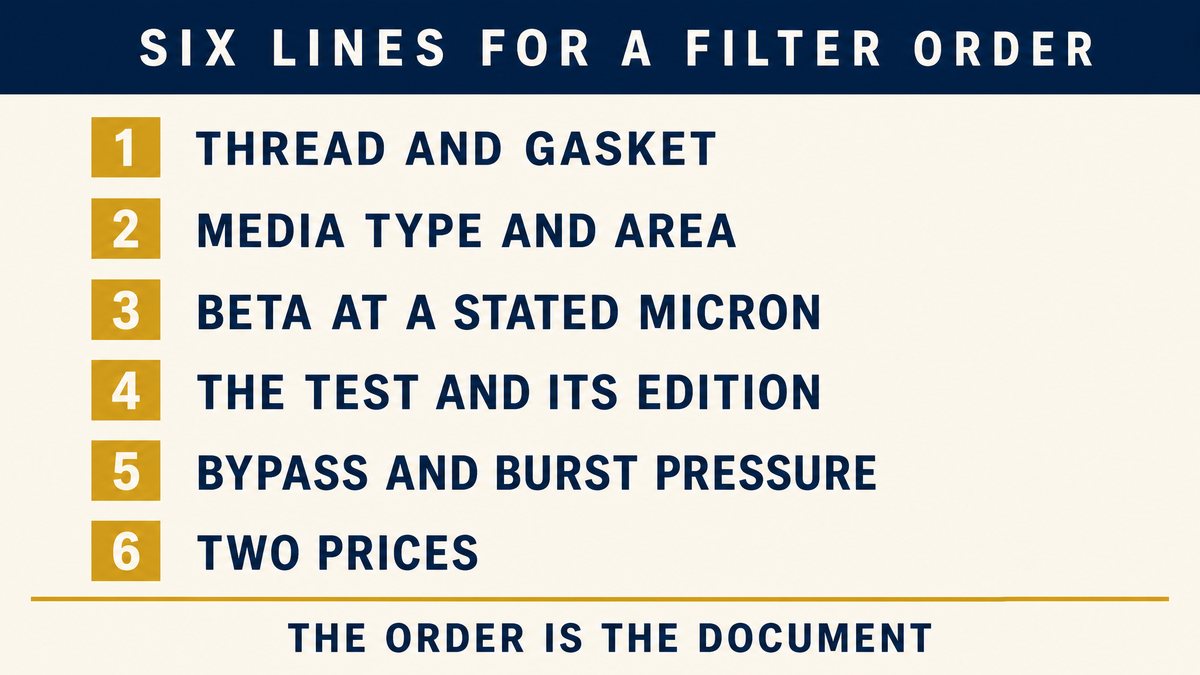
There is no clause to cite, so the order is the document. Six lines, and the sixth is the one that turns a percentage into a claim.
- Thread and gasket, by designation and by dimension.
- Media type and area, in square centimetres.
- Beta at a stated micron.
- The test named — ISO 4548-12, with the edition.
- Bypass opening pressure and burst pressure.
- Two prices: as quoted, and with the five items above written into it.
An oil filter is sold with a micron number that means little on its own. The figure that describes performance is a ratio: how many particles of a stated size enter, and how many leave.
A ratio converts into an efficiency, and the conversion is where quotations drift. Two suppliers quoting ninety-nine per cent can be describing different particle sizes, and neither sheet has to say which one it used.
A Bench Sheet With the Micron Stated
Three columns, micron, ratio and test dust, filled from the supplier's own run rather than a catalogue headline.
Fill My Bench SheetFrequently Asked Questions
Is there a federal standard for oil filters?
No. The phrase oil filter appears eleven times in the Code of Federal Regulations and every mention is in Title 40, in emissions, fuel economy or industrial process rules. Nothing in the vehicle safety standards names the part, and the industry's own term, lubricating oil filter, returns nothing at all.
What does “99 per cent efficient” actually claim?
On its own, nothing. It needs three companions: the particle size at which the figure was measured, the beta value behind it, and the test method used. The same sentence can describe a coarse filter at 30 micrometres and a fine one at 12.
What is beta, in one line?
The number of particles of a stated size upstream divided by the number downstream. Efficiency is 1 − 1/beta, so beta 100 is 99 per cent, beta 20 is 95 per cent and beta 2 is 50 per cent.
Is ISO 4548-12 a regulation?
No. It is a test method, and it obliges nobody. Its value is that two parties who name it are measuring the same thing, which is exactly what a percentage quoted without a method cannot do.
Why does the test have to be multi-pass?
Because a filter spends its life loading. A single-pass test measures a clean element catching one dose of dirt, usually the best-looking moment of its life. The multi-pass method injects contaminant continuously and counts particles online, so the result describes behaviour rather than a peak.
Does a more expensive filter always filter better?
No. Price tends to follow media area and construction, and area buys life more than it buys efficiency. A cheap filter with a fine but small medium can beat an expensive one on the first kilometre and lose on the tenth thousand.
Questions & Comments
We read every one and reply within 24 hoursAn oil filter's micron number says little without the ratio behind it. Send the data sheets, and we will put the beta values on one basis so that they can be compared.