
Cabin Filter Manufacturers: A Fire Rule, and a Standard That Cannot Compare
 ·
Updated October 15, 2026
·
10 min read
The two filters before this one in the series were governed by their consequences: the oil filter by how it is disposed of, the engine air filter by what changing it does to emissions. The cabin filter is governed by something blunter. It sits inside the passenger compartment, so the federal rule that reaches it is a fire rule — and the test of whether that rule applies is not a component list but a distance: thirteen millimetres from the air the occupants breathe. Its filtration performance, meanwhile, is covered by a standard that says in its own abstract that two differently shaped filters cannot properly be compared. Both facts change how this part should be bought.
1. What a Cabin Filter Is, and What It Is Not
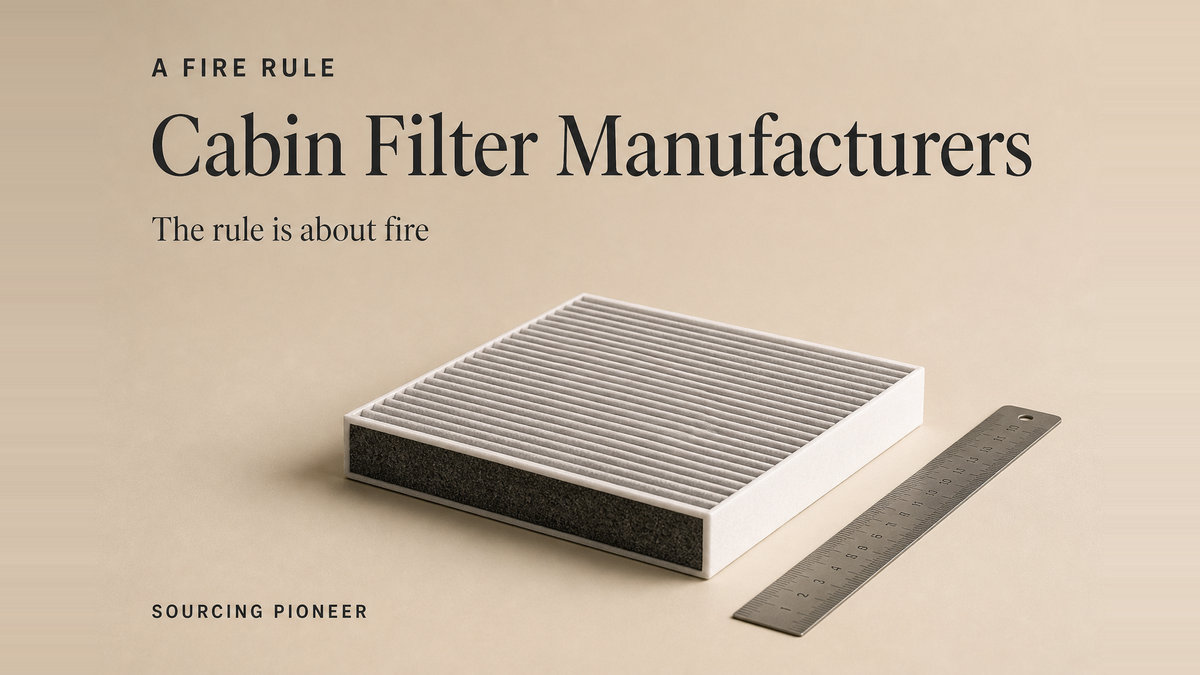
A cabin filter sits in the heating, ventilation and air-conditioning case, cleaning the air drawn from outside or recirculated inside the car. It is usually a pleated panel or a folded element, often with a layer of activated carbon for odour, held in a frame that has to seal against the case so that air goes through the medium rather than around it.
The first thing to settle is what it is not. A cabin filter is not in the engine's intake path, so the tampering regime that reaches an engine air filter does not apply to it. It is not in the engine's oil circuit, so the disposal rule that reaches an oil filter does not apply either. It is a filter whose only contact with regulation is that it is an object inside the vehicle where people sit.
That produces an unusual position for a buyer. The part carries no federal performance figure, no approval number and no disposal obligation — and it is still covered by a federal safety rule, because of where it is rather than what it does.
| The element | What it decides | What a vague quote hides |
|---|---|---|
| The medium | What is removed, and at what pressure loss | The test basis for any efficiency figure |
| The frame and seal | Whether air bypasses the element | Seal material and compression |
| The carbon layer | Odour and gas handling | Whether it is carbon or a grey coating |
| The materials themselves | How they behave if they burn | Burn behaviour, unasked and untested |
What this guide covers
- What a cabin filter is, and what it is not
- The federal rule that reaches it is about fire
- Thirteen millimetres is the test
- The standard says you cannot compare two filters
- What to put in the contract instead
- What a cheap cabin filter quote leaves out
- What to check on a sample
- Where the unit price comes from
- Frequently asked questions
2. The Federal Rule That Reaches It Is About Fire
The standard is the one on flammability of interior materials, and its scope is written as a list followed by a catch-all. Read the catch-all carefully, because it is what brings an unlisted part inside the rule:
The portions described in S4.2 of the following components of vehicle occupant compartments shall meet the requirements of S4.3: Seat cushions, seat backs, seat belts, headlining, convertible tops, arm rests, all trim panels including door, front, rear, and side panels, compartment shelves, head restraints, floor coverings, sun visors, curtains, shades, wheel housing covers, engine compartment covers, mattress covers, and any other interior materials, including padding and crash-deployed elements, that are designed to absorb energy on contact by occupants in the event of a crash.
National Highway Traffic Safety Administration, 49 CFR 571.302, S4.1, Standard No. 302; Flammability of interior materials (read 15 October 2026)
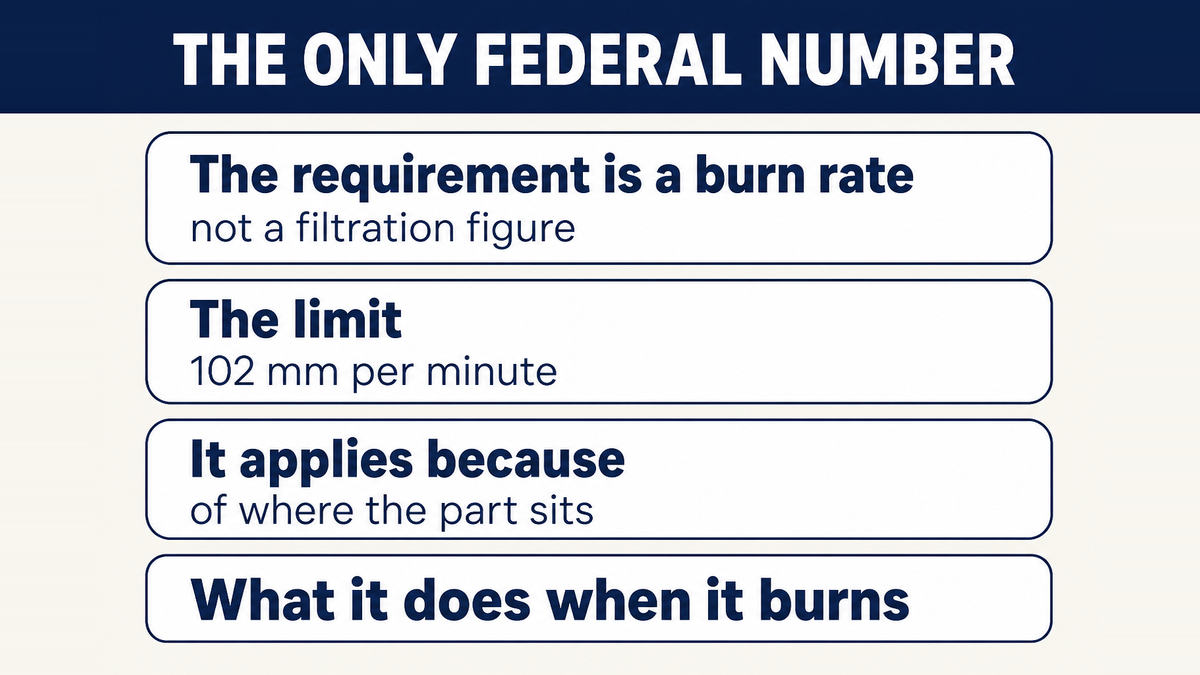
The requirement itself is a burn rate, and it is stated as a limit rather than a test:
When tested in accordance with S5, material described in S4.1 and S4.2 shall not burn, nor transmit a flame front across its surface, at a rate of more than 102 mm per minute.
National Highway Traffic Safety Administration, 49 CFR 571.302, S4.3(a), Standard No. 302; Flammability of interior materials (read 15 October 2026)
102 mm per minute. That is the only federal number that applies to a cabin filter, and it describes what the part does when it catches fire rather than how well it filters. For a buyer the practical reading is straightforward: the materials in the part are a safety-relevant specification, and the medium, the frame and any carbon layer all contribute to how the assembly behaves.
3. Thirteen Millimetres Is the Test
The question a supplier will eventually ask is whether the standard applies to their filter, since a cabin filter is not named in the list. The answer is in the same standard, and it is expressed as a proximity rather than a part number:
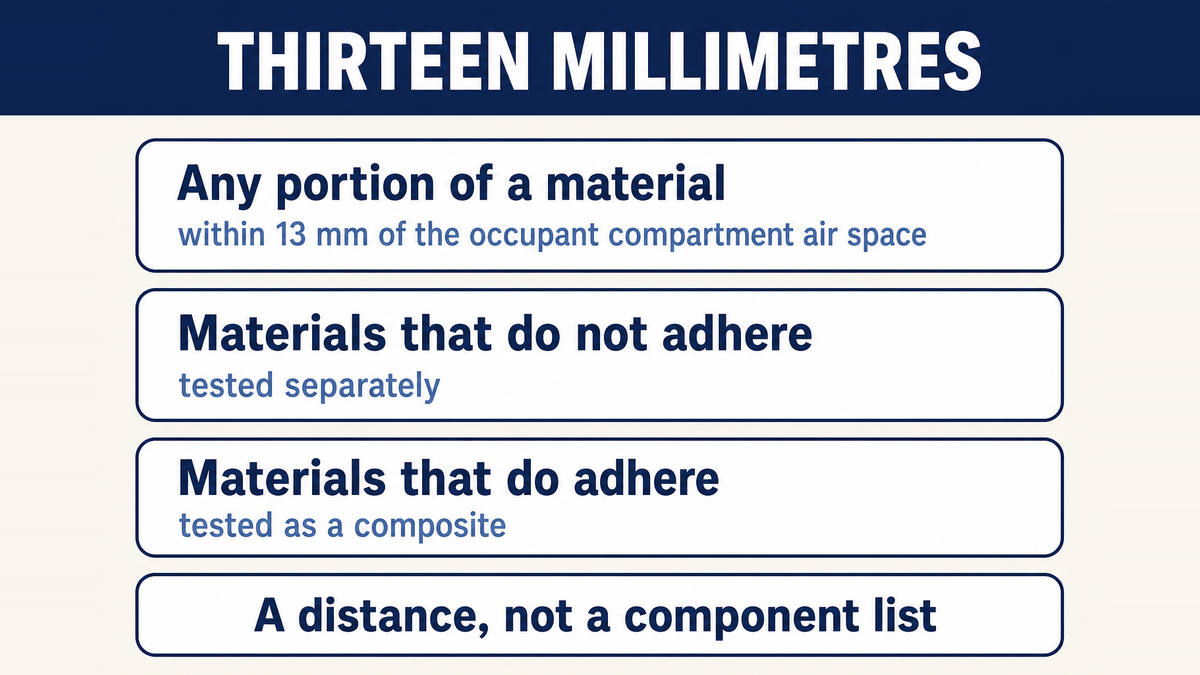
Any portion of a single or composite material which is within 13 mm of the occupant compartment air space shall meet the requirements of S4.3.
National Highway Traffic Safety Administration, 49 CFR 571.302, S4.2, Standard No. 302; Flammability of interior materials (read 15 October 2026)
Thirteen millimetres from the air space the occupants breathe. The rule is not asking what the part is called or what it does; it is asking where the material sits. And the standard goes on to remove the escape route of assembling your way out of it, by requiring materials that do not adhere to each other to be tested separately, and materials that do adhere to be tested as a composite.
Three consequences follow for anyone quoting into this market.
The material specification is a safety document. Because the test turns on where the material is, a filter element and its frame are in scope on proximity, and a supplier who cannot state what the medium and frame are made of cannot say anything about burn behaviour.
Substitution is not neutral. A cheaper medium or a different frame plastic is a change to the materials being judged. If the buyer has never asked the question, they will not notice the change — which is precisely why the question belongs in the buying specification rather than in a later conversation.
The obligation is the vehicle maker's, and the evidence is the supplier's. The standard binds whoever builds the vehicle. The factory that moulds the frame and pleats the medium is the only party that can supply the material record. A quotation that states the materials and their burn performance is doing what a quotation for this part ought to do.
4. The Standard Says You Cannot Compare Two Filters
Filter performance is covered by a test specification for passenger compartment filters, and its scope states plainly what it covers and what it measures:
This part of ISO/TS 11155 specifies a particulate filtration test, including the critical characteristics of equipment, test procedure and report format, for the consistent assessment of filter elements in a laboratory test rig with particle sizes larger than 0,3 μm. It is applicable to filters for removing particulate matter from external or recirculated air used for ventilating motor vehicle passenger compartments or cabins.
International Organization for Standardization, ISO/TS 11155-1:2001, Road vehicles — Air filters for passenger compartments — Part 1: Test for particulate filtration (read 15 October 2026)
Then comes the sentence that should be read before any two suppliers are put side by side, because it is the standard disclaiming the comparison:
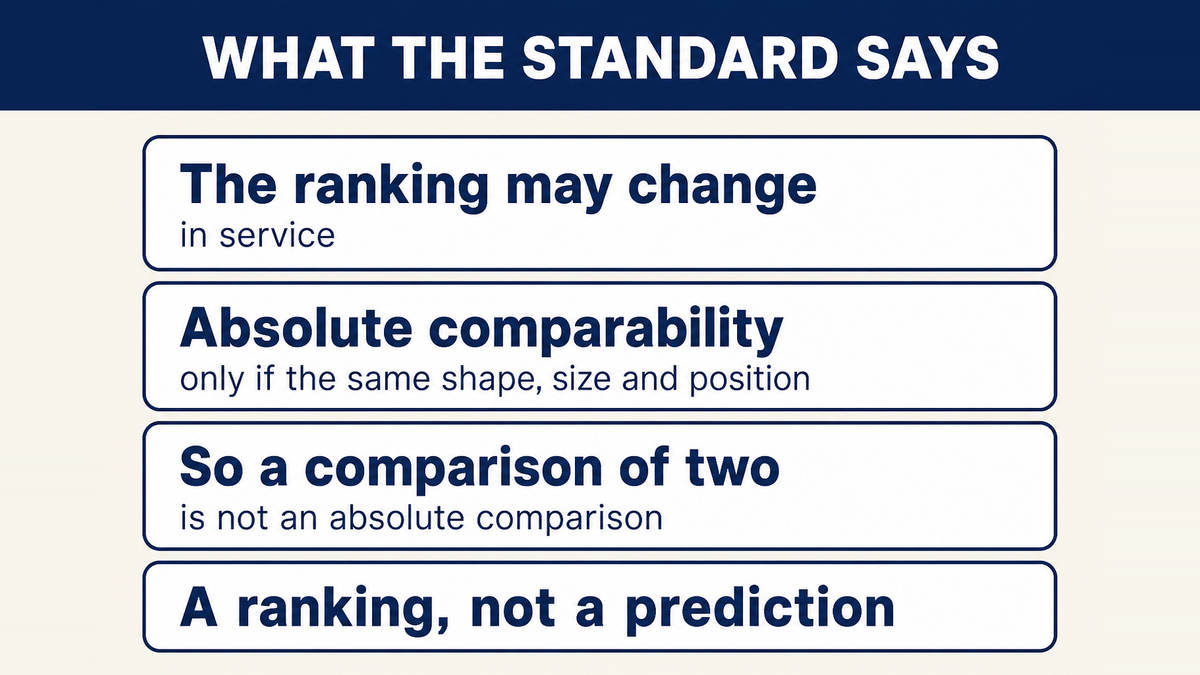
The test specified in this part of ISO/TS 11155 enables an assessment of filter elements for pressure loss, fractional filtration efficiency and accelerated particulate holding capability against standardized laboratory particulate challenges. Because the test methods exclude the full range of possible particulate challenges and environmental effects, the relative ranking of filters may change in service. NOTE 1 Absolute comparability is only possible with filter elements of the same shape and size as well as the same position in the test duct.
International Organization for Standardization, ISO/TS 11155-1:2001, abstract (read 15 October 2026)
Two admissions sit in that paragraph, and both are commercially useful.
The ranking may change in service. A laboratory result is a ranking against a standard challenge, not a prediction of how the filter behaves in traffic, in pollen season, or in a wet climate. Two filters ordered by laboratory efficiency are not ordered the same way in the field.
Absolute comparability requires the same shape, the same size and the same position in the test duct. That is a very narrow condition. Two suppliers' elements for the same vehicle are not the same shape and size in the sense the standard means unless they are effectively the same part, tested in the same rig, in the same place. A comparison of two differently built filters is therefore not an absolute comparison, whatever the numbers say.
The document also carries its status honestly: it is a technical specification rather than a full international standard, published in 2001 and still under review. None of this makes it useless. It makes it a laboratory method with stated limits, which is exactly what a buyer needs to know before treating an efficiency claim as a purchasing criterion.
5. What to Put in the Contract Instead
The same standard offers a way out of the comparison problem, and it is buried in a note that most buyers never read. It is a suggestion for exactly the situation a purchasing department is in:
NOTE 2 Subject to agreement between supplier and the customer, the test procedure allows for the calculation of gravimetric efficiency as a single parameter for quality control purposes. For gravimetric efficiency tests refer to ISO 5011.
International Organization for Standardization, ISO/TS 11155-1:2001, abstract, Note 2 (read 15 October 2026)
Agree one number, and use it to hold the supplier to a part. That is the whole idea: rather than comparing two factories' efficiency curves, agree a single gravimetric figure as a quality control parameter, test it, and treat movement in that figure as evidence that something in the part changed.
It works because it is comparative rather than absolute. The buyer is not claiming a filter is better than a rival's; they are saying that the filters they were promised behave the way the sample behaved, and that a batch which does not is a batch to query. On a spec where the test standard itself disclaims inter-product comparison, a within-part consistency check is the only measurement that carries its own weight.
Two practical points follow. First, the parameter has to be written into the order, because the note makes it conditional on agreement between supplier and customer — it is not automatic. Second, it has to be tested the same way each time, because the value is only meaningful as a trend against the same method.
6. What a Cheap Cabin Filter Quote Leaves Out
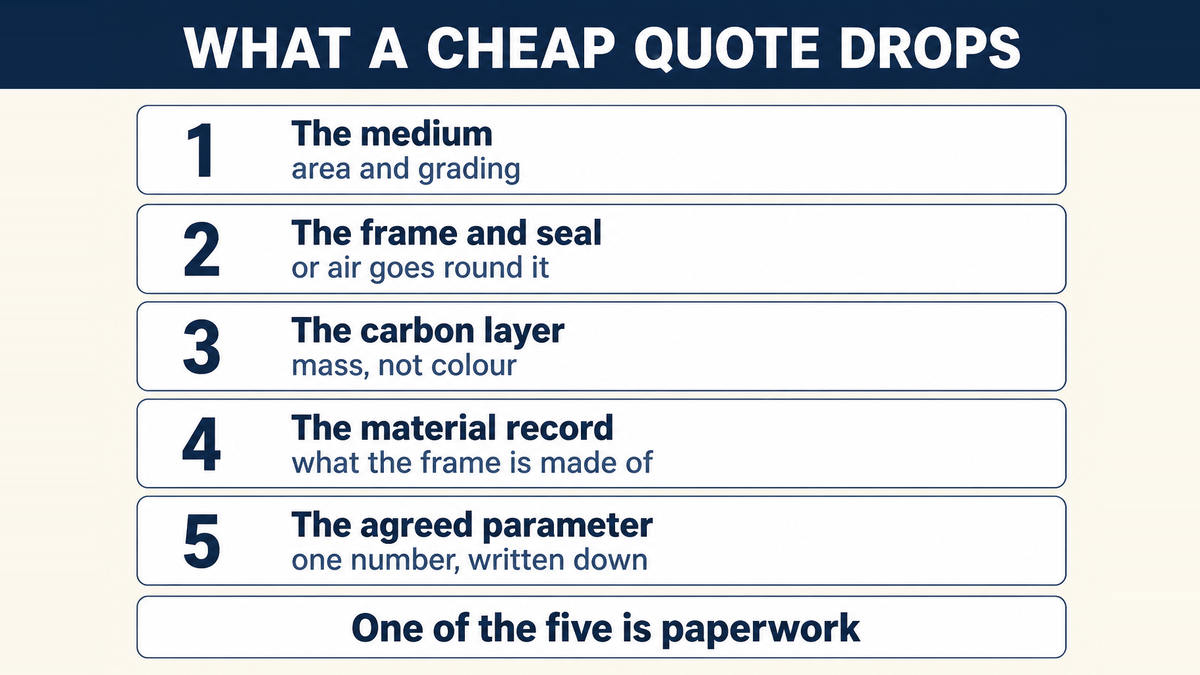
A cabin filter is a folded sheet of paper in a plastic frame, which is exactly why the differences are easy to hide. Five places a low quote tends to come from:
The medium. Area, grading and pore structure decide what is captured and how quickly the element loads. A thinner or shorter pleat pack is the simplest saving, and it is invisible unless the element is measured.
The frame and its seal. The seal is what makes air go through the filter rather than round it. A frame that does not compress evenly, or a sealing foam that hardens, leaves a filter that looks correct and cleans almost nothing.
The carbon layer. Activated carbon is a cost, and a grey coating that looks like carbon is not carbon. If odour handling is being sold, the layer needs a specification and a mass, not a colour.
The material record. Because flammability is judged on the materials and their position, a supplier who cannot state what the frame and medium are made of has nothing to say about the standard that applies. This is the line a cheap quote omits entirely.
The agreed quality parameter. A gravimetric efficiency figure agreed with the customer, and the test that produces it. It costs a laboratory day and it turns a promise into something a batch can be measured against.
7. What to Check on a Sample
The part is fully visible and cheap to test, which makes sampling unusually productive. Six checks cover the ground.
- Pleat count and medium area, measured on more than one piece, because a short pleat pack is the commonest saving and the easiest to see.
- The frame seal. Compression and evenness all round, checked against the case it is meant to seal rather than against a drawing alone.
- The carbon layer, where odour handling is claimed: its mass and its construction, not its appearance.
- The material list for the medium, frame and any carbon layer, with whatever burn behaviour information the factory holds.
- The gravimetric efficiency figure, agreed in writing and tested to the same method each time.
- Fitment dimensions against the application, including the thickness of the sealing frame, since a filter that is dimensionally close but seals poorly behaves like a filter that was never fitted.
On the factory side the usual visit checks apply — where the medium comes from, who pleats and frames it, and who signs off the first article. Our sequence is in the factory audit checklist. Where a supplier also holds a social or ethical audit, the scheme behind the certificate is worth reading — see social audit schemes compared.
8. Where the Unit Price Comes From
A cabin filter's price is built from the medium, the carbon layer where there is one, the frame and seal, the pleating and assembly, and the packaging. The medium and the carbon set the material cost and are the lines with the widest spread between grades. The frame is where fitment lives, and fitment is the only property a customer can judge before the part is in the car. The material record and the agreed test are small costs that decide whether the part can be defended at all.
Weight is very low for the volume, so this is the most volumetric part in the series so far — cartons fill long before they approach a weight limit, which makes packing density the number that decides freight, as set out in how volume decides what a shipment is charged.
A quotation worth comparing therefore names the medium and its basis, the carbon layer's mass where one is used, the frame and seal specification, the fitment dimensions, the materials list, and the agreed gravimetric parameter. The sheet metal and plastic side of a frame or housing is covered in metal stamping and machined parts. How the goods are described for entry is the subject of how an HTS code is assigned, and the origin paperwork behind it is set out in the certificate of origin guide.
9. Frequently Asked Questions
Is there a federal standard for cabin filter performance?
Not for filtration. The only federal figure that reaches a cabin filter is a burn rate: material within thirteen millimetres of the occupant compartment air space must not burn or transmit a flame front across its surface at more than 102 millimetres per minute. The rule is about fire, and it applies because of where the part sits rather than what it does.
How do I know whether the flammability rule applies to my filter?
By distance, not by name. The standard requires any portion of a material within thirteen millimetres of the occupant compartment air space to meet the burn requirement, and it requires materials that do not adhere to each other to be tested separately while adhering materials are tested as a composite. A cabin filter sits inside that air space, so its materials are in scope by proximity.
Can two cabin filters be compared on efficiency?
Not absolutely. The test specification used for passenger compartment filters states in its abstract that absolute comparability is only possible with filter elements of the same shape and size as well as the same position in the test duct, and that the relative ranking of filters may change in service because the test methods exclude the full range of particulate challenges and environmental effects.
What should be measured instead?
The same standard offers an answer in a note: subject to agreement between supplier and customer, the test procedure allows gravimetric efficiency to be calculated as a single parameter for quality control purposes. Agreeing one such figure makes the measurement a consistency check on the part a buyer was promised, rather than a contest between two products that the standard will not rank.
What should a cabin filter quotation contain?
The medium and the basis for any efficiency figure, the carbon layer's mass where odour handling is sold, the frame and seal specification, the fitment dimensions, a materials list covering the medium and frame, and the agreed gravimetric efficiency parameter with the test method it is measured by.
A Clause That Compares What the Standard Refuses To
We write the efficiency claim as a tested condition with its airflow, because the standard forbids the plain comparison a listing wants.
Write My Filter Clause
Questions & Comments
We read every one and reply within 24 hoursA cabin filter carries a fire rating before it carries a filtration claim. Send the part number and the vehicle, and we will confirm the rating, the frame material and the fitment rows.