
Wholesale Air Filters: No Federal List, and a State One That Names Vehicles
 ·
Updated October 15, 2026
·
11 min read
Every part in this cluster so far has been judged on whether it still does its job. The air filter is judged on something else: whether changing it changes the vehicle. A filter element that simply replaces a dirty one is an ordinary replacement part. A filter element sold as part of an intake kit is a modification to an emission control system, and in the United States that puts it inside a tampering regime with two very different personalities. Federally there is no list of approved parts and no certificate to hold. In California there is a list, and getting onto it means an order that names the vehicles and the part numbers — and that the fitting instructions can void.
1. What an Air Filter Is, and the Two Numbers It Lives By
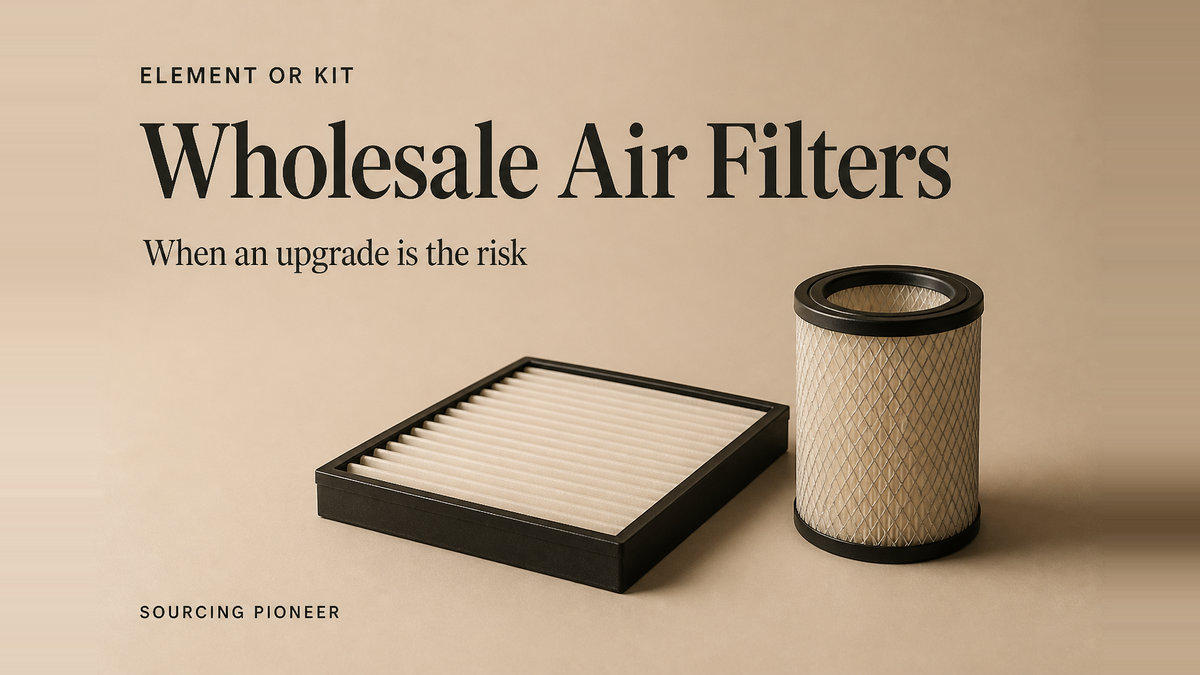
An engine air filter is a pleated medium held in a frame, sitting in the intake path. Its job is to stop abrasive dust before it reaches the cylinder walls, and its problem is that everything it does to trap dust costs airflow.
Two numbers describe it, and they pull against each other. Efficiency is the share of particles of a given size the medium removes. Restriction is the pressure drop the medium adds to the intake. A medium that removes more is usually a medium that restricts more, and the design of a filter is a settled trade between the two rather than a problem with one right answer.
A third number matters commercially and is rarely quoted: dust-holding capacity — how much dust the filter can hold before its restriction rises to the point where it must be changed. A filter with a small medium area can be efficient on day one and loaded within a season, which is why an element that looks identical from outside can behave quite differently over an interval.
Then there is the axis the whole article turns on. A replacement element restores the intake to what the vehicle was built with. A filter sold with a housing, tubing and brackets — the pieces that together make up a kit — is a change to the intake system, and the pieces are the product.
| The element | What it decides | What a vague quote hides |
|---|---|---|
| The medium | Efficiency against restriction | The test basis for any figure |
| The frame and seal | Whether unfiltered air bypasses the element | Seal material and compression |
| The pleat pack | Dust-holding capacity | Media area and pleat count |
| What ships with it | Whether it is a part or a modification | Housing, tubing, hoses, brackets |
What this guide covers
- What an air filter is, and the two numbers it lives by
- Federal: no list, no certificate
- California: an actual list, and it names vehicles
- The instruction sheet is part of the exemption
- The kit is enumerated, down to a hose standard
- What a cheap air filter quote leaves out
- What to check on a sample
- Where the unit price comes from
- Frequently asked questions
2. Federal: No List, No Certificate
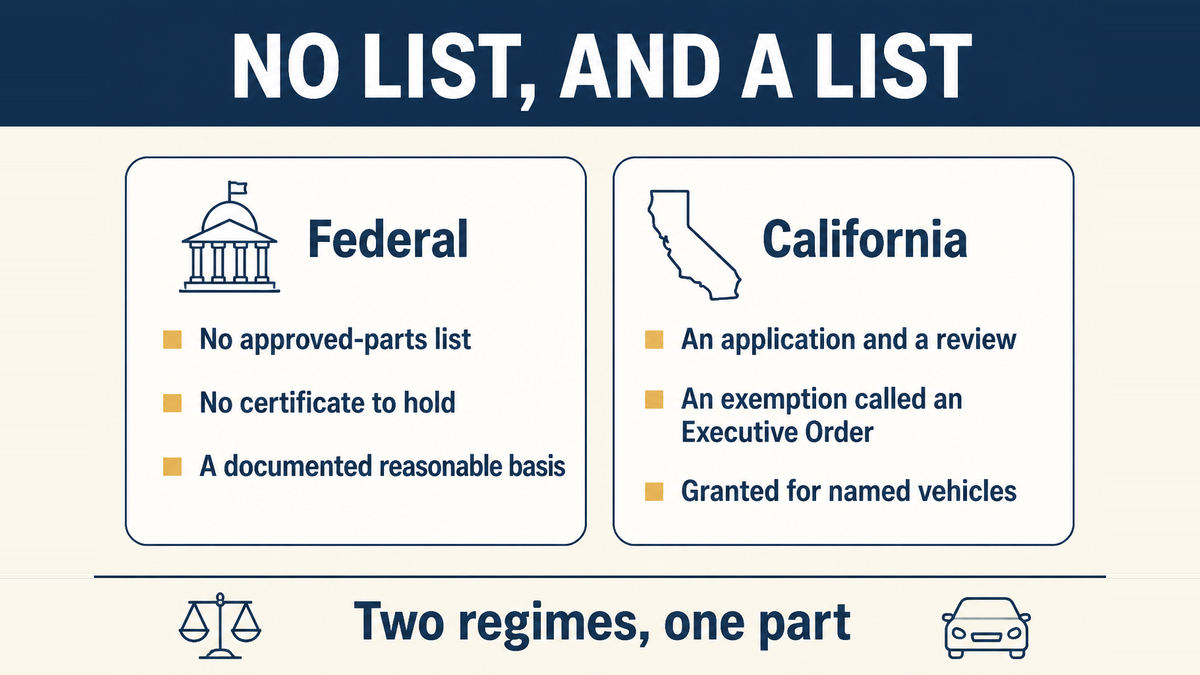
The federal rule that reaches an air filter is not a product standard. It is the prohibition on tampering with emission controls, and the agency's own policy describes how it is enforced. The starting point is that there is nothing to look up:
EPA does not verify or certify any aftermarket devices, so does not list them. Note: EPA's Mobile Source Enforcement Memorandum No. 1A: Interim Tampering Enforcement Policy (June 25, 1974) states that the EPA typically does not take enforcement action for certain conduct that may appear to be a violation of the CAA if the person performing the conduct has a documented "reasonable basis" demonstrating that the conduct does not adversely affect emissions.
United States Environmental Protection Agency, Tampering and Aftermarket Defeat Devices (read 15 October 2026)
The policy has since been replaced. The agency issued an enforcement policy on vehicle and engine tampering and aftermarket defeat devices dated 23 November 2020, which supersedes the 1974 memorandum, and it keeps the same shape: the defence is not a certificate but a documented reasonable basis to conclude that the part does not adversely affect emissions.
That has three consequences a supplier needs to absorb before quoting into this market.
There is no approval number to print on a box. A buyer cannot ask a factory for its federal approval, because the federal agency does not issue one. A quotation that claims federal approval for an air filter is describing something that does not exist.
The evidence sits with whoever made the claim. A reasonable basis is a file, not a badge: test data, engineering reasoning, and a record of the basis on which the conclusion was reached. If a factory has no such file, it has no defence, and neither does the buyer who repeats the claim.
The safe description is the unexciting one. A filter presented as a replacement element for a stated application is an ordinary service part. The same filter presented as improving airflow, adding power or replacing the factory intake is making a claim about the vehicle's behaviour — which is what draws the rule in the first place.
3. California: An Actual List, and It Names Vehicles
California takes the other approach. Instead of a general enforcement discretion, it runs an exemption programme with an application, a technical review and a published outcome. The state agency states the requirement directly:
Manufacturers of add-on and modified parts planning to sell, offer for sale, or advertise their product for use in California vehicles should apply for an exemption from Vehicle Code Section (VC) 27156. A VC 27156 exemption is granted if the product has been determined not to cause any increase in vehicular emissions. The first step to obtain an exemption is to submit an application to the California Air Resources Board (CARB).
California Air Resources Board, Manufacturers of Aftermarket Parts (read 15 October 2026)
The agency describes what the exemption is, and the description contains the detail that decides whether a supplier can actually sell there:
Exempted parts are add-on or modified parts that have undergone an CARB engineering evaluation. If the part or modification is shown to not increase vehicle emissions, it is granted an exemption to emission control system anti-tampering laws. This exemption is called an Executive Order (EO) and allows the modification to be installed on specific emission controlled vehicles.
California Air Resources Board, Aftermarket, Performance, and Add-on Parts (read 15 October 2026)
"Specific emission controlled vehicles." The exemption is not for a part; it is for a part on a list of vehicles. The application forms confirm where an air filter sits in that system, because they are divided by product type and one of the categories is Air Intake Kits or Modifications.
That last word is the one to notice. An air filter element on its own is a service part. An air filter with the housing, tubing and brackets that turn it into an intake kit is a modification, and a modification needs the order. Whether a supplier is in this regime is decided by what is in the carton, not by what the filter is made of.
4. The Instruction Sheet Is Part of the Exemption
A published order shows how narrow the permission is, and it is worth reading one because the terms repeat across the programme. This order covers a cold air intake kit, and it lists what the kit contains:
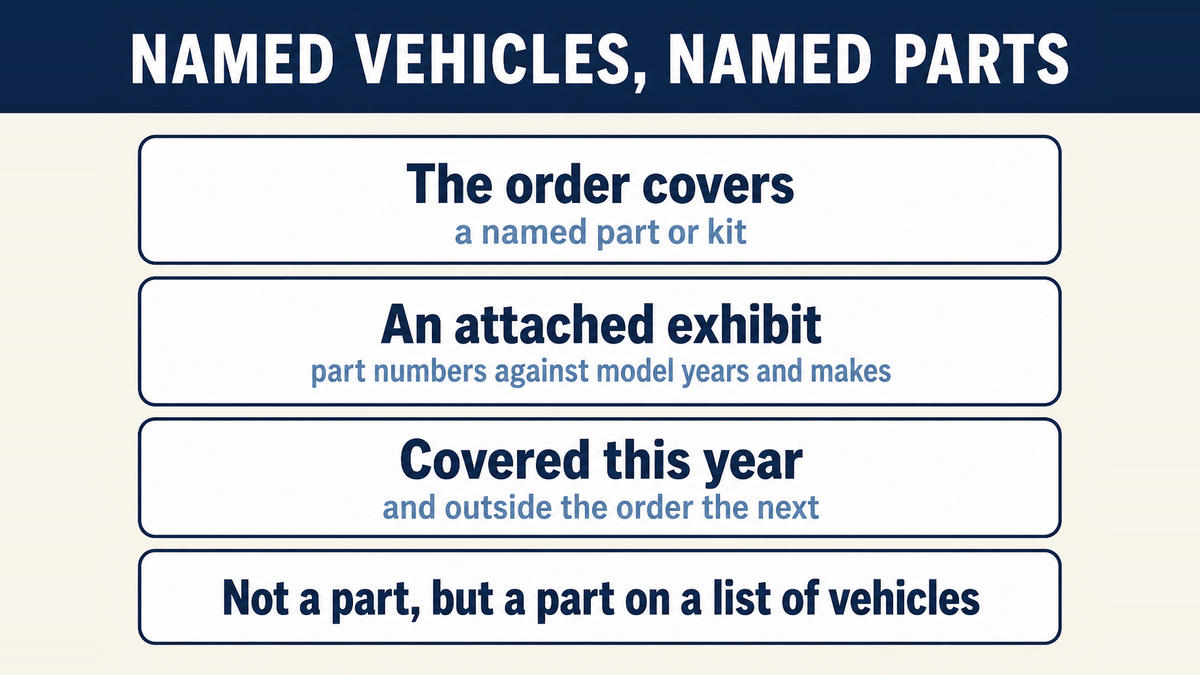
…has been found not to reduce the effectiveness of the applicable vehicle pollution control systems and, therefore, is exempt from the prohibitions of Section 27156 of the Vehicle Code for the vehicles listed in the attached Exhibit A. The Cold Air Intake Kit includes the following main components: open-element air filter (either oiled reusable or dry disposable), air filter box/housing, intake system tubing, crankcase ventilation hose (as applicable; must be SAE J30R7 or factory equivalent), assorted brackets, and hardware.
California Air Resources Board, Executive Order D-590-14 (read 15 October 2026)
Two things stand out for a buyer. The first is the phrase "for the vehicles listed in the attached Exhibit A": the permission attaches to an exhibit that lists part numbers against model years and makes, so the same kit is exempt for one model year and not for the next. The second is in the condition that follows, which makes the paperwork part of the product:
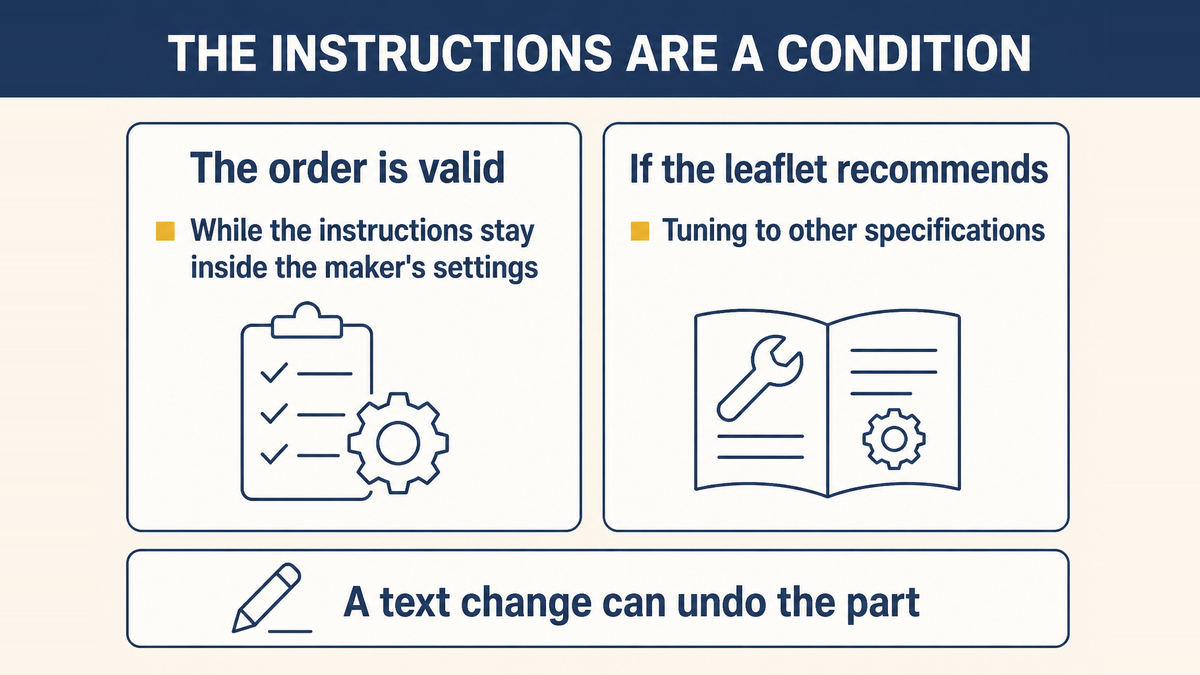
This Executive Order is valid provided that installation instructions for the Cold Air Intake Kit will not recommend tuning the vehicle to specifications different from those o[f the manufacturer]…
California Air Resources Board, Executive Order D-590-14 (read 15 October 2026)
The exemption is conditional on the instructions. A kit sold with a leaflet that recommends altering the vehicle's settings puts the exemption at risk, however well the hardware was made. That makes the printed instruction sheet a controlled document rather than a courtesy — it has to be written, reviewed and held under the same change control as the part, because a text change can undo the permission the part was granted.
This is a pattern already familiar from elsewhere in this cluster, where a fitting instruction turned out to be an expected deliverable rather than an extra. Here it carries more weight, because the instruction is a condition of the exemption itself.
5. The Kit Is Enumerated, Down to a Hose Standard
The same order shows how specific a permission can be, because it does not approve a concept; it lists components. Among them is a crankcase ventilation hose with a stated requirement: it "must be SAE J30R7 or factory equivalent".
Two lessons follow, and both are about quotation practice.
A kit is quoted as a bill of materials, not as a filter. If the exemption names the housing, the tubing, the hose, the brackets and the hardware, then every one of those lines is inside the scope of the permission. A supplier who substitutes a cheaper hose has changed a component that the order names, and with it the basis on which the kit was allowed.
A named standard in an order becomes a purchasing requirement. A hose standard is not a preference when it appears in the document that makes the sale lawful. Asking a factory to state the hose specification is therefore a reasonable first question, and a factory that cannot answer it is a factory that has not looked at what it is selling into this market.
For a buyer assembling a range, the practical form is a component schedule held with the order: each part, its specification, and the order or approval it relies on. That document is what makes a substitution visible before it happens rather than after a customer in a regulated state notices.
6. What a Cheap Air Filter Quote Leaves Out
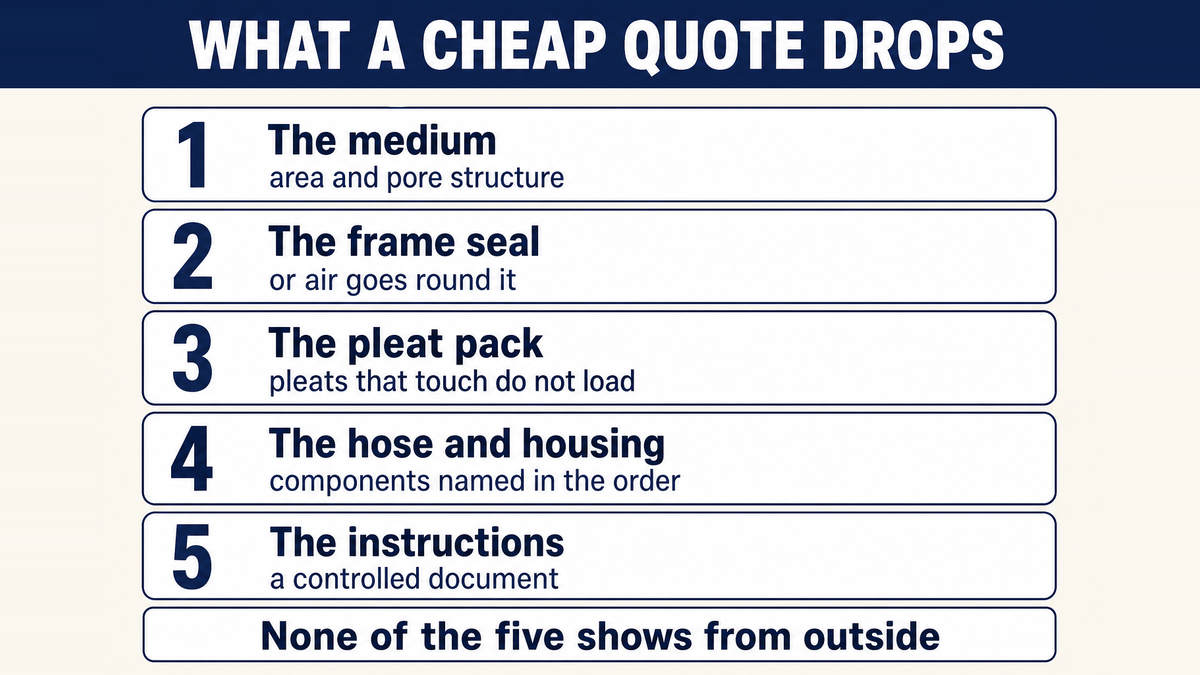
An air filter is one of the cheapest parts on any vehicle, which is why the differences hide easily. Five places a low quote tends to come from:
The medium. Pleat count, media area and the pore structure of the paper or synthetic decide both what is trapped and how long the filter lasts. Efficiency figures without a stated test basis are the least checkable line in the quotation, and the medium is where a cheap filter saves first.
The frame seal. The edge seal is what stops air going round the element rather than through it. A seal that is thin, hard, or uneven lets dust past a filter that is otherwise perfectly good — and the failure is invisible, because nothing looks broken.
The pleat pack. How the pleats are spaced and held. Pleats that touch each other cannot be loaded between them, so the effective area is smaller than the count suggests.
The hose and housing, where a kit is involved. Because a kit's components are named in the permission that allows it to be sold, a substitution there is not a saving; it is a change to a document the seller relies on.
The instructions and the evidence file. An instruction sheet that stays inside the vehicle maker's recommendations, and a record behind any performance claim. Neither costs much to produce and both are the difference between a replacement part and a modification with no basis.
7. What to Check on a Sample
An air filter is fully visible, which makes sampling unusually productive. Six checks cover the ground.
- Pleat count and media area, measured rather than quoted, on more than one piece from the same batch.
- The edge seal. Thickness, material and whether it compresses evenly all the way round when the element is seated. Check it against the housing it is meant to seal.
- The frame. Rigidity and dimensional match to the airbox, because a frame that twists will not seal at the corners.
- The medium's identity, with the test basis for any efficiency or restriction figure the supplier is repeating.
- What is in the carton, if the product is a kit: the component schedule against the permission it relies on, including hose standards and hardware.
- The instruction sheet, read for any recommendation that goes beyond the vehicle maker's settings.
On the factory side the usual visit checks apply — where the medium comes from, who pleats and seals it, and who signs off the first article. Our sequence is in the factory audit checklist. Where a supplier also holds a social or ethical audit, the scheme behind the certificate is worth reading — see social audit schemes compared.
8. Where the Unit Price Comes From
A filter's price is built from the medium, the frame and the seal, the pleating and assembly, and the packaging. The medium is the largest material line and the one with the widest spread between grades. The frame and seal are small lines that decide whether the filter works at all. Where the product is a kit, the housing and the hoses are added and become the lines most affected by the permissions the product relies on.
Weight is low for the volume, so a filter moves closer to the volumetric calculation than a cast part does — the opposite of the hubs and arms in the suspension articles, and the method is set out in how volume decides what a shipment is charged. Filters are also light and bulky, so cartons fill before they weigh anything, which makes packing density the number that decides freight.
A quotation worth comparing therefore names the medium and the basis for any figure, the frame and seal specification, the pleat count and media area, and — for a kit — the full component schedule with the hose standard and the permission the kit relies on. The sheet metal and joining side of a housing is covered in metal stamping and machined parts. How the goods are described for entry is the subject of how an HTS code is assigned, and the origin paperwork behind it is set out in the certificate of origin guide.
9. Frequently Asked Questions
Does an air filter need federal approval?
There is no federal approval to obtain. The agency states that it does not check or certify any aftermarket devices and therefore does not list them. What exists instead is an enforcement policy on tampering, under which the protection is a documented reasonable basis to conclude that the part does not adversely affect emissions — a file held by the party making the claim, not a certificate on a box.
When does an air filter become a modification?
When it stops being an element and becomes a kit. California divides its exemption application forms by product type, and one of the categories is air intake kits or modifications. An air filter element on its own is a service part; the same element sold with a housing, tubing and brackets is a modification that needs an exemption to be sold or offered for use in that state.
What does a CARB Executive Order cover?
A named part or kit, on named vehicles. The orders state that the part is exempt from the prohibitions of the vehicle code for the vehicles listed in an attached exhibit, so the permission attaches to a list of part numbers against model years and makes. It is not a general approval of the design, and the same kit can be covered for one model year and outside the order for the next.
Can the fitting instructions affect the exemption?
Yes. A published order is valid provided that the installation instructions will not recommend tuning the vehicle to specifications different from the manufacturer's. That makes the instruction sheet a controlled document rather than an extra: a leaflet recommending altered settings can put the permission behind the part at risk.
What should an air filter quotation contain?
The medium and the basis for any efficiency figure, the frame and edge seal specification, the pleat count and media area, and for a kit the full component schedule including hose standards and the approval it relies on. Where the supplier is making a performance claim rather than offering a replacement element, the documented basis for that claim should be part of the package.
The Paper Trail an Inspector Would Follow
A folder in reading order: exemption reference, instruction leaflet, then the anti-tampering wording, each dated to a batch.
Order My Paper Trail
Questions & Comments
We read every one and reply within 24 hoursTrying to work out whether a filter element or a full intake kit is what you are actually selling, getting a hose specification stated rather than assumed, or holding an evidence file behind a performance claim? Send us the vehicle, the airbox and the market, and our team will put the specification in writing.