
Is Dropshipping Still Profitable? The Three Fixed Costs
 ·
Updated October 13, 2026
·
17 min read
This question is normally answered with a mood rather than a calculation. Search it and you will find a wall of videos with the word "dead" in the title, a set of forum threads where people report their own results, and a handful of software vendors explaining why the answer depends on which tool you buy. None of that is usable, because none of it tells you whether your cost structure works. The honest answer is that profitability was never a property of the model. It is a property of the arithmetic, and the arithmetic is decided by three costs that refuse to shrink when the order gets smaller. Get those three wrong and the business loses money at any level of demand. Get them right and the model is unremarkable but workable, which is all it ever was.
The Three Costs That Do Not Scale Down With the Order
| Cost | Why it does not shrink |
|---|---|
| The fixed part of the payment fee | Charged per transaction, so it is the same on a 15 order as on a 60 one |
| The parcel | Costs roughly the same to move whether the contents are cheap or expensive |
| The minutes | Handling, answering and resolving take about the same time per order regardless of value |
What this guide covers
- Why the usual answers cannot help you
- The first fixed cost: the per-transaction fee
- The second fixed cost: the parcel itself
- The third fixed cost: the minutes
- What the arithmetic says about which stores lose money
- Where the numbers people quote come from, and why they mislead
- Frequently asked questions
1. Why Can the Usual Answers Not Help You?
Because both camps are describing their own cost structure and presenting it as a fact about the model. The people saying it is dead are usually reporting a specific failure, and the people saying it works are usually reporting a specific success, and neither of them has told you the one thing that decides which case you are in.
Notice what the pessimistic version actually argues. The claim is not usually that customers stopped buying. It is that acquisition costs rose, that the cheap products no longer support the advertising needed to sell them, and that returns and disputes eat what is left. Every one of those is a statement about cost per order. The optimistic version argues that the tools got better, that fulfilment got faster, and that you can now sell at higher prices. That is also a statement about cost per order. The two sides disagree about the numbers and agree about the subject.
So the useful move is to stop treating profitability as a yes or no and treat it as a function of order size. A store is not profitable or unprofitable in the abstract; it is profitable on baskets above some size and unprofitable below it. The size of that crossover is set by costs that behave in two different ways, which is where almost all of the confusion lives.
Costs that scale are the easy half. Product cost scales with the order, because a bigger order contains more product. A percentage payment fee scales with the order, because it is a percentage. Those two behave politely: they take a roughly constant share of revenue, so a percentage margin stays roughly constant as the basket grows or shrinks. The other half does not. Three costs sit on the order rather than in it, and their share of revenue rises as the order falls. They are the reason a store can report a healthy average margin and still be losing money on a large fraction of its orders.
2. What Is the First Fixed Cost?
The fixed part of the payment fee, and it is the one most often left out because it looks too small to matter. Payment pricing is published, so there is no excuse for guessing at it. Two of the major processors quote it as a percentage plus a flat amount per transaction.
Fees Processing fees. Online — Applies to card payments made online or through an invoice. 3.3% + 30¢ · 2.9% + 30¢ · 2.9% + 30¢
Square, published processing fees (read 13 October 2026)
PayPal Checkout 3.49% + fixed fee. Standard Credit and Debit Card Payments 2.99% + fixed fee. … Fixed fee — US dollar 0.49 USD
PayPal, business fee table (read 13 October 2026)
Two observations follow from reading those tables rather than skimming them. The first is that the flat component is on every transaction, so its share of revenue depends entirely on the size of the transaction. On a sixty dollar order, a fixed fee of forty-nine cents is under one per cent. On a twenty dollar order it is two and a half per cent, and on a twelve dollar order it is over four per cent. The percentage rate did not change; the basket did.
The second is that the rate itself moves with your plan rather than with your volume. Square's published online rate is 3.3% plus 30 cents on the entry tier and 2.9% plus 30 cents on the paid tiers, which means the same transaction costs forty basis points more if you are on the free plan. That is the whole reason a free plan can be more expensive than a paid one, and it is worth costing out rather than assuming the plan without a subscription is the cheap option.
There is also a comparison worth making against the offline world, because it explains why this cost feels unfamiliar. Square's published in-person rate is 2.6% plus 15 cents. The gap between that and the online rate is not a markup for greed; it reflects card-not-present risk, and it is the price of not having the customer in front of you. For a dropshipping store, every order is card-not-present, so the higher rate is your baseline rather than an exception you can negotiate away.
One structural detail that gets overlooked. Some platforms charge their own fee on top when you use a payment provider other than their own, so the payment cost can be the processor's rate plus a platform percentage. Shopify's pricing page states that third-party transaction fees may apply when you use a third-party payment provider instead of its own, and that the rate depends on your plan. That is a second fixed-ish charge on the same order, so if you are comparing processors, compare the total rather than the processor's own rate.
3. Why Is the Parcel the Second Fixed Cost?
Because the price of moving a parcel is set mostly by its size, weight and destination rather than by what it is worth. A parcel containing a fifteen dollar item and a parcel containing a sixty dollar item of similar size cost about the same to send, and both are billed at the same rate. The cost sits on the order, so its share of revenue falls as the order value rises and climbs as it falls.
The mechanism behind that is worth understanding, because it is the part sellers most often misjudge. Carriers price on whichever is greater, the actual weight or a volumetric figure derived from the dimensions, which is why a large light parcel can be billed as though it were heavy. The practical consequence for a store is that a product's shipping cost is a property of its packaging as much as of its contents, and a redesign that reduces the box can reduce the cost per order for every order that follows. Our guide to how volumetric weight and CBM are calculated works through the arithmetic, and our notes on what a China warehouse charges to store, pick and send an order show how that cost is actually billed to you.
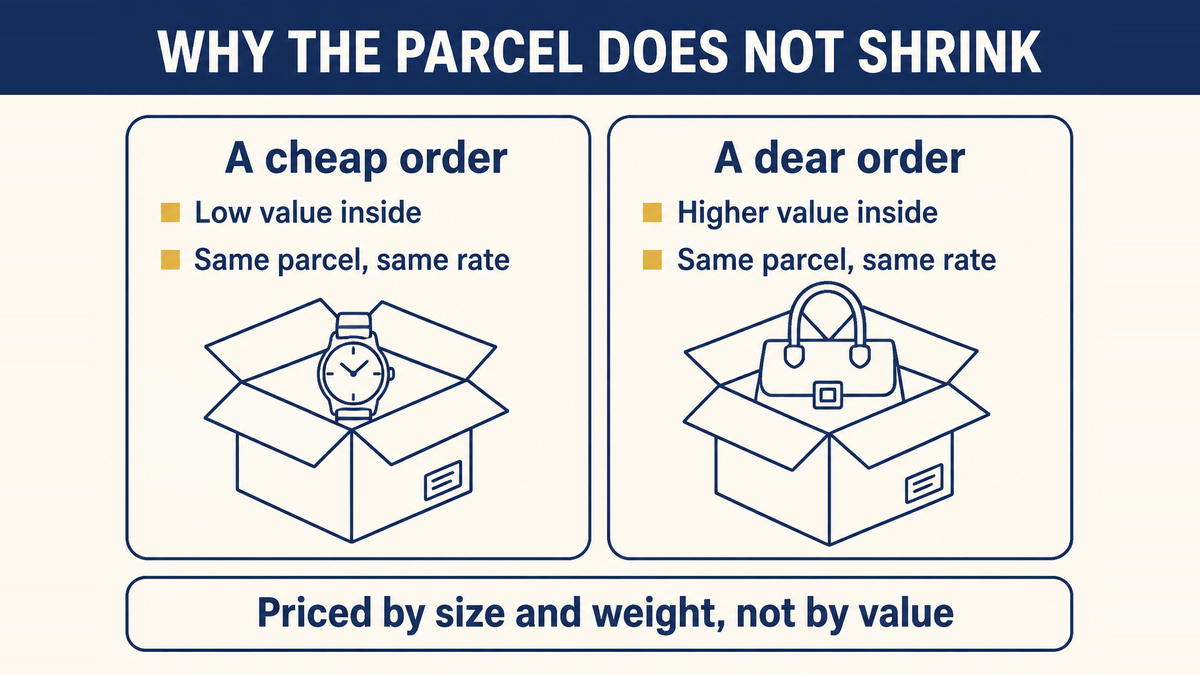
There is a second-order effect that matters more than the base rate, and it concerns the delivery promise rather than the price. A cheap order still has to arrive within the window you advertised, and if it does not, the cost of fixing it is not proportional to what the customer paid. A replacement parcel costs a whole parcel, whatever it contains, and if a parcel travels twice the shipping line bills you twice. That is why the low-value order carries more risk per dollar than the high-value one, and why a catalogue built entirely from cheap items is a structurally thinner business than it looks on a margin spreadsheet.
The same asymmetry applies to the return leg. Our guide to realistic transit times from China covers the forward journey, and the return journey is the one most sellers never price at all. A customer who returns a fifteen dollar item can consume more than the order ever earned, which means the cheapest way to protect the margin on small baskets is usually to reduce how often they go wrong rather than to negotiate a better rate.
4. Why Are the Minutes the Third Fixed Cost?
Because handling an order takes about the same time whether it is worth fifteen dollars or sixty, and time is the least visible cost in the whole calculation. This is the cost that decides whether the previous two are survivable, because it is the one that grows when you cut corners rather than when you try harder.
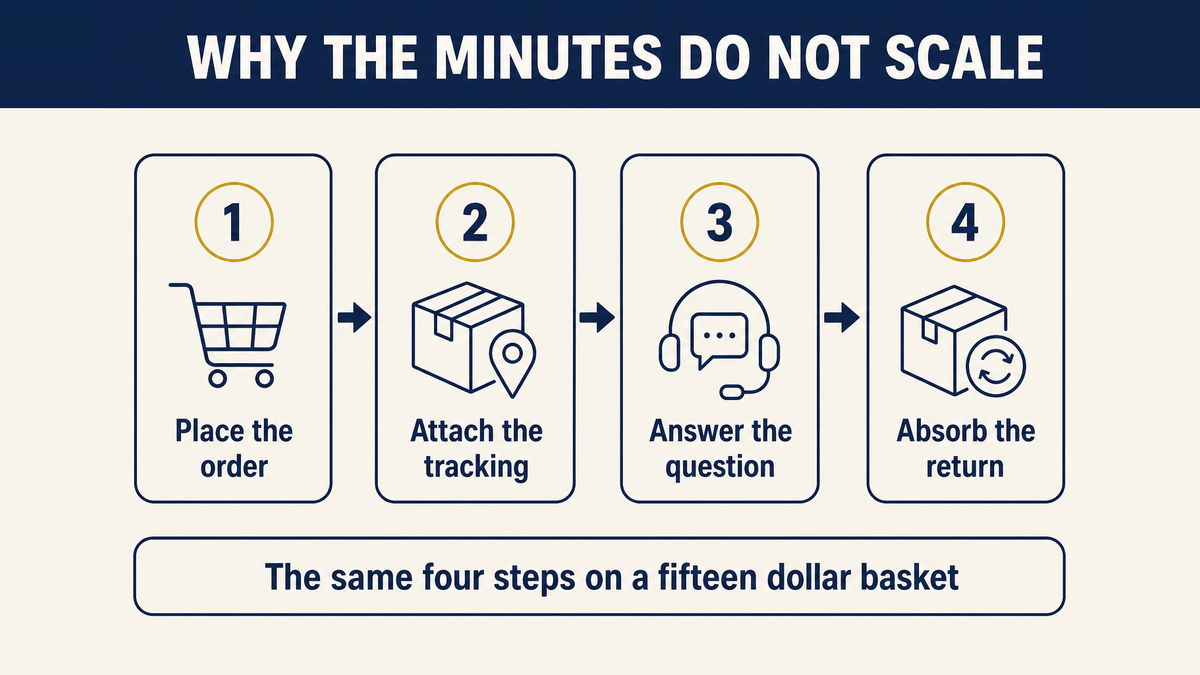
The work per order is more or less constant: the order has to be placed with a supplier, the tracking has to come back and be attached to the order, and a share of orders will generate a question, a delay or a dispute that requires a person. None of those steps get faster because the item was cheap. A store selling a twelve dollar product and a store selling a sixty dollar product face the same queue of messages; one of them is being paid five times as much to work through it.
What makes this the decisive cost is the way it interacts with the other two. When a small order is losing money, the tempting remedy is to handle it more carelessly: skip the tracking update, answer the message with a template, let the return through without checking. Each of those saves minutes in the short term and converts a small loss into a larger one later, because the unpriced minutes were the thing keeping the parcel out of trouble. A cheap basket does not become workable by being handled badly; it becomes a basket that also produces a dispute.
The practical reading is that the third cost is best reduced before the order exists rather than after it arrives. Fewer listings, each of them well documented, produces fewer questions than a wide catalogue with ambiguous descriptions, and a handling time you can genuinely hold produces fewer delays than one you cannot. Both are supply decisions, and both show up here as minutes saved.
One warning about the arithmetic itself, because it is easy to run in a way that flatters the result. The three fixed costs should be measured on your smallest typical basket, not your average one. An average conceals the distribution, and the distribution is the entire subject: if the smallest realistic order is unprofitable, then every marketing pound that brings in a small order is buying a loss, even while the average looks healthy. Our guide to what separates a product that sells from one that does not is the counterpart to this section, because a large part of product selection is really basket-size selection.
5. What Does the Arithmetic Say About Which Stores Lose Money?
That the deciding factor is usually basket size rather than demand, which is why the debate about whether the model is dead keeps missing the point. Work it through with the published numbers rather than with opinions, and take a deliberately small order as the test case, because that is the order that decides whether the model works for you.
The Same Store at Two Basket Sizes
| Line | Small basket | Larger basket |
|---|---|---|
| Price the customer pays | $19.00 | $59.00 |
| Product cost | −$4.50 | −$13.50 |
| Payment fee (2.99% + fixed) | −$1.06 | −$2.25 |
| Parcel, billed on size not value | −$6.80 | −$6.80 |
| Handling, messaging and returns provision | −$2.90 | −$3.40 |
| Left over | $3.74 | $33.05 |
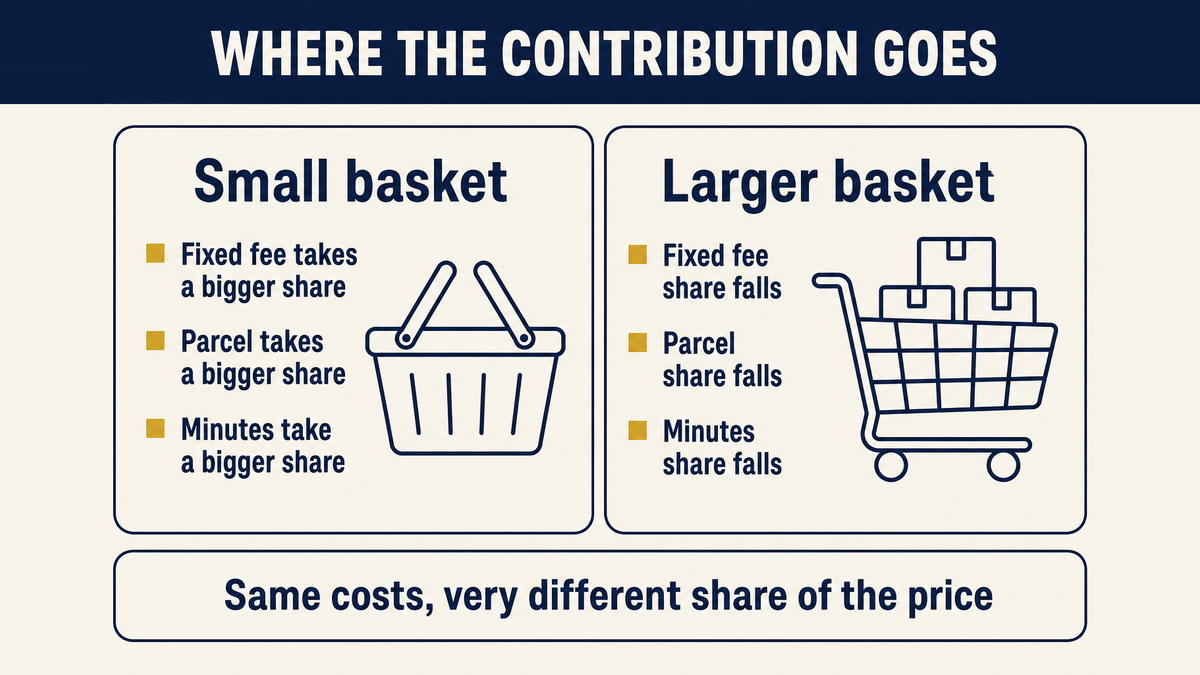
Read the fixed rows rather than the total. The product line grew 200 per cent between the two baskets and the fixed fee grew 45 per cent, because most of it is a percentage. The parcel did not grow at all. The minute line grew 17 per cent, which is the closest thing to a genuine constant in the table. So the small basket carries fifteen per cent of the price in fixed-ish costs while the larger one carries eleven per cent, and the difference compounds with volume rather than being a one-off.
Now apply an advertising cost to each. A seventeen per cent acquisition cost on the small basket is about three dollars and twenty, which leaves roughly fifty cents of contribution per order. The same seventeen per cent on the larger basket leaves about twenty-three dollars. The two orders are processed by the same person, in the same number of minutes, with the same parcel. That is the whole finding: a store is not made unprofitable by the model, it is made unprofitable by selling the wrong basket size at the wrong acquisition cost.
Two conclusions follow, and they are uncomfortable in opposite directions. The first is that raising prices is often the most effective single change, because it improves every scaling line at once, and it is usually possible precisely because the products are undifferentiated rather than because they are premium. The second is that a store with a genuinely tiny order value may have no workable configuration at all, and the honest response is to change the product rather than to optimise the operations.
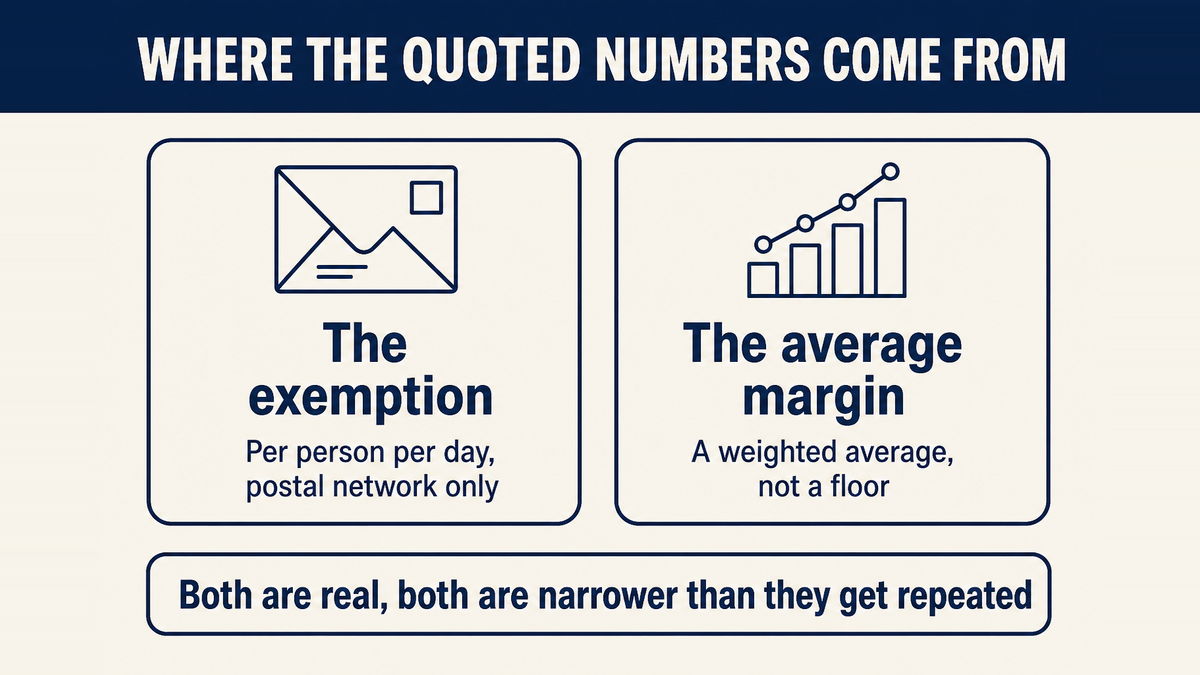
6. Where Do the Numbers People Quote Come From?
Mostly from rules that are real but narrower than the way they get repeated. Two of them come up constantly in this discussion, and both are cases where the underlying fact is true and the conclusion drawn from it is not.
The customs exemption
The first is the exemption for small shipments, which is regularly described as though it made per-order shipping from overseas free of duty as a general rule. The provision is narrower than that, and the same section currently limits it further.
(a) … any shipment of merchandise imported by one person on one day having a fair retail value … not exceeding $800 … (b) The exemption provided in paragraph (a) of this section is suspended for merchandise arriving via all modes other than through the international postal network …
19 CFR 10.151, Importations not over $800 (read 13 October 2026)
Three details in that text change how it should be used. The limit is per person per day rather than per order, so it is a daily allowance and not a per-parcel one. The same section excludes a shipment that is one of several lots sent separately for the express purpose of securing free entry, so splitting a larger order into smaller parcels to stay under the limit is not a route it allows. And the suspension in the second paragraph means the exemption is currently available on the postal network rather than on every commercial line, which makes the choice of shipping lane a customs decision as well as a speed decision. Treating the exemption as a general discount overstates the saving on a lane where it does not apply.
The average-margin figure
The second is the reported profit margin, which is usually presented as a single number for a whole store. That number is a weighted average, and a weighted average tells you which basket sizes you sell rather than whether any of them work. A store at twelve per cent net on an average order of forty dollars can be losing money on every twenty dollar order it takes, and the single figure will not show it. The number worth knowing is contribution on the smallest basket you realistically accept, because that is the order you can choose to stop accepting.
This is also where the sourcing side turns out to be a profit decision rather than a cost decision. The product cost is the line that scales with the basket, and it is the line a sourcing relationship actually moves, whereas the fixed fee and the parcel are broadly the same whoever you buy from. Our breakdown of what a bulk order really costs to land is the piece that turns a supplier quote into the number this calculation needs, and our guide to moving from per-order buying to holding stock covers the point at which the parcel line can be attacked directly instead of absorbed.
7. Frequently Asked Questions
Is dropshipping still profitable in 2026?
For some cost structures, yes, and for others no, and the deciding factor is rarely demand. Three costs do not shrink when the order gets smaller: the fixed part of the payment fee, the parcel itself, and the minutes needed to handle the order. A store whose prices cover those three on its smallest typical basket can be profitable. A store that covers them only on its average basket is losing money on a large share of its orders.
What is the biggest hidden cost in dropshipping?
The fixed portion of the payment fee, because it is small in absolute terms and therefore ignored. PayPal publishes a US-dollar fixed fee of 49 cents per transaction and a checkout rate of 3.49 per cent, and Square publishes a 30 cent fixed component on its online rate. On a 20 dollar order that fixed part is already more than one and a half per cent of revenue before any variable cost is counted.
Does the 800 dollar de minimis exemption make dropshipping cheaper?
Not automatically, and not on every lane. The exemption in 19 CFR 10.151 covers shipments not exceeding 800 dollars in fair retail value imported by one person on one day, but the same section states that the exemption is currently suspended for merchandise arriving by any mode other than the international postal network. The exemption is a clearance route, not a general discount.
Why do small orders lose money?
Because the costs that do not scale are a larger share of a small basket. A fixed payment fee of 49 cents, a parcel that costs the same to move whether the contents are worth 15 dollars or 60, and a return that consumes a whole order's margin all take a bigger percentage from a cheap order. A percentage margin that looks healthy on the average order can be negative on the smallest one.
What should I measure to know if my store is profitable?
Contribution per order on your smallest typical basket, not your average one. List the fixed fee, the parcel cost, the product cost and the expected return cost for that basket, subtract them from the price a customer actually pays, and see whether anything remains. If the smallest basket is negative, the growth you are buying with advertising is buying losses.
Which Store Shapes Survive the Three Costs
We return the three fixed costs against your basket size, the volume where each one bites, and the shapes that cannot work.
Run My Arithmetic
Questions & Comments
We read every one and reply within 24 hoursNot sure whether your smallest orders make or lose money, unsure which line of the calculation to attack first, or trying to work out whether the small-shipment exemption applies on the lane you use? Post your product, your sell price, your parcel cost and your payment processor, and our team will work the fixed costs through your own numbers.