
Headlight Manufacturer: The Lens Is the Certificate
 ·
Updated October 22, 2026
·
13 min read
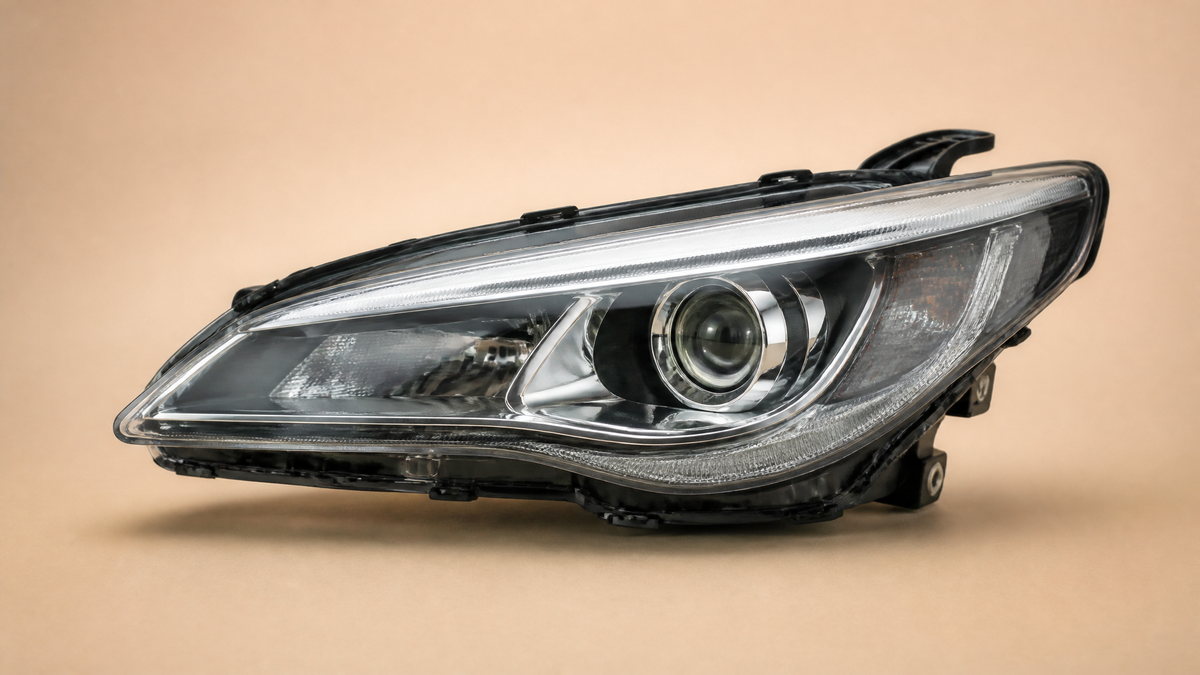
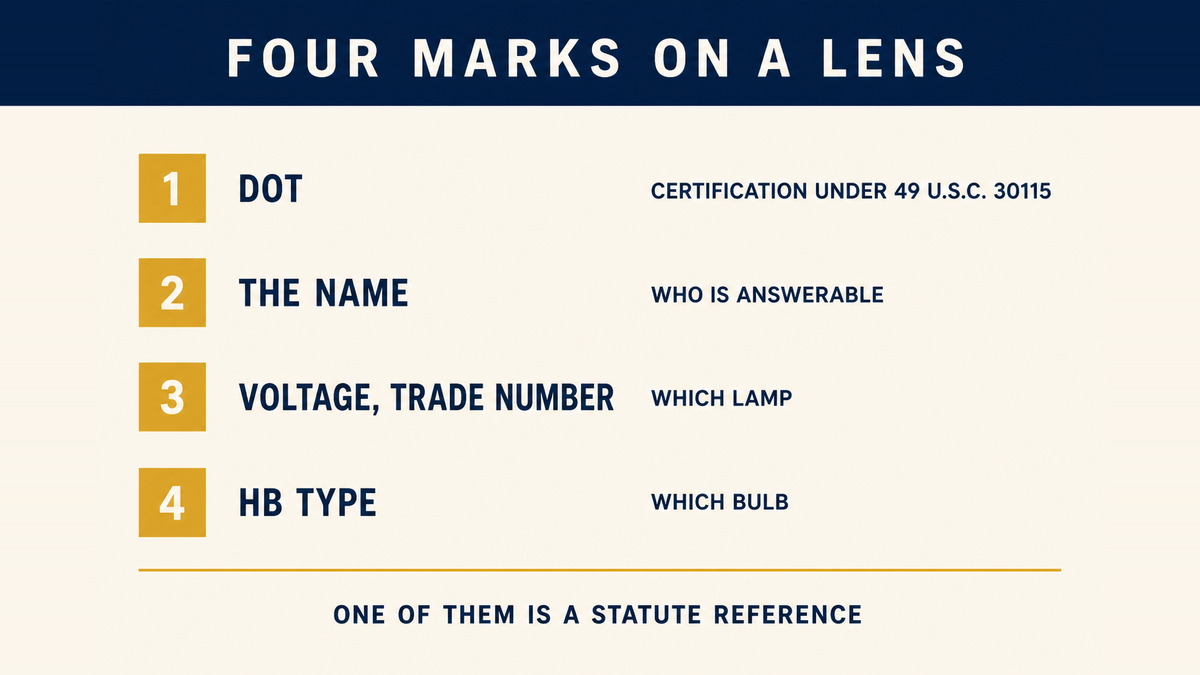
Most car parts are certified on a piece of paper that travels in a folder. A headlamp is certified on the product itself. The lens carries the symbol DOT, the name of whoever is entitled to put it there, the voltage and the trade number, and — in front of every bulb it is built around — the bulb type. Four marks, all readable with a torch and a phone camera, and between them they describe the configuration the lamp was tested in. That is why this is the one category in the batch where a buyer can check the certification without asking the supplier for anything: the part has already answered.
1. Four Marks, and What Each One Is For
Standard No. 108 is the longest rule in the whole vehicle set, and almost all of it is about light: how much, in which direction, at which angle, measured how far from the lamp. None of that is visible on a shipped part. What is visible is the marking section, which sits at S6.5 and takes less than a page.
The DOT symbol. The lens of every original and every replacement headlamp must be marked with the symbol DOT, horizontally or vertically, and the standard says exactly what the mark means: it indicates certification under 49 U.S.C. 30115. It is not a quality mark issued by an agency. It is the manufacturer's own statement, made under a statute, that the lamp conforms.
The name. The lens must carry the name and, or, the trademark registered with the U.S. Patent and Trademark Office belonging to one of three parties: the maker of the lamp, its importer, or a vehicle manufacturer whose vehicle is equipped with it. The same paragraph adds a sentence that matters more than it looks: nothing in the standard allows somebody who is not the owner to put that name there unless the owner has consented.
The voltage and the trade number. Every original and replacement headlamp must be marked with its voltage and with its part or trade number. Two numbers, and both are specifications: the voltage tells you which electrical system the lamp was built for, and the trade number is the identity a photometry report will be filed under.
The bulb type. This is the fourth mark and the one buyers miss. On a replaceable bulb headlamp the lens must carry a permanent marking in front of each replaceable light source stating the HB Type of the source it is equipped with — or, for a discharge source, the bulb designation filed under Part 564. The position is not decorative. It tells a fitter, and a customs officer, and you, which bulb the lamp was built around.
There is a fifth mark for a case that surprises buyers: a replacement lens sold on its own. It must be marked not only with its own maker's name but with the manufacturer and the part or trade number of the headlamp it is intended for. A lens that fits forty models and names none of them is not a replacement lens under this rule, whatever the listing says.
2. What the DOT Symbol Does and Does Not Say
Because the mark is self-certification, it tells you something narrower and more useful than "approved". It tells you that a manufacturer with a name on the lens has taken responsibility for conformity with a specific standard. Three consequences follow, and each changes what you ask a supplier.
First, replacement equipment is covered. The application section applies the standard to vehicles and then, separately, to lamps, reflective devices, and associated equipment for replacement of like equipment on those vehicles. A headlamp sold into the aftermarket is inside the rule from the first sentence. There is no gap between original equipment and replacement here, which is not true of every part in this series.
Second, the mark is not a test report. Nothing about the symbol tells you what the beam pattern measures, how the lamp behaves after two hundred hours, or whether the housing seals. Those are things a laboratory establishes and a factory keeps. The mark only tells you who is answerable.
Third, the mark is falsifiable in a way most markings are not. The name on the lens has to belong to somebody who either made the lamp, imported it, or built a vehicle with it. If the name belongs to a company that has never heard of the product, the mark is not a weaker claim — it is a false one, and it is checkable in a trademark database in a few minutes.
That is the practical difference between this category and the tyre. A tyre's sidewall tells you what the tyre is. A headlamp's lens tells you who says so, and the rest of the standard exists to give that claim a shape.
3. The Bulb Number Is a Specification, Not a Suggestion
Here is where most aftermarket conversations go wrong, and the standard is unusually direct about it. Read the fourth mark again: the lens must state the HB Type in front of each replaceable light source with which it is equipped. The marking is not a recommendation about what fits. It is a statement about what the lamp was built and measured around.
The other half of the sentence is in a different section. S11 requires every replaceable light source to conform to the dimensions and electrical specifications furnished for it under Part 564, on file in Docket No. NHTSA 98-3397, and it adds its own marking rule: the base of each HB Type must be marked with its designation, and each source must carry the DOT symbol and a name or trademark. A bulb is not a commodity with a shape. It is a filed geometry with a number.
Put the two halves together and the trap is visible. A lamp whose lens says HB3 was certified with a source that meets the HB3 filing. Fit a light source that is not an HB Type and has no filing under Part 564 — an LED assembly built to sit in the same hole, for instance — and the marking on the lens stops describing the product in the box. The lamp may still light up. It may even be brighter. But the sentence moulded into the lens now names a source that is not there, and the photometry the lamp was certified on belongs to a configuration nobody is shipping.
This is why the trade in "conversion" kits is not a packaging question. The kit changes the one variable the standard marks. A supplier who understands the category will tell you which source a lamp is built around without being asked, and will have the lens tooling to prove it; a supplier who treats bulbs as an accessory will offer to ship any of six types in the same housing, which is the same sentence said the other way round.
There is one exception written into the text, and it is worth knowing because it is the only one. No marking need be provided if the only replaceable light source in the headlamp is type HB1. One type, one paragraph, no mark. Every other type has to be named on the lens in front of the socket it belongs to.
4. Three Ways to Build a Lamp, Three Duties
The standard recognises three architectures, and they are not marketing categories. Each has a different definition and a different marking duty, and the difference decides what a buyer can replace and what has to be replaced as a unit.
A sealed beam headlamp is the oldest shape: lens, reflector and filament sealed into one unit, replaced whole. Its marking rule is the most physical in the standard — the lens must be moulded with the words "sealed beam" and the appropriate designation code from Table II, in characters no less than 6.35 mm in size. Moulded, not printed. A label on a sealed beam is not a sealed beam marking.
A replaceable bulb headlamp is defined as a bonded lens and reflector assembly plus one or two replaceable light sources. That is the modern shape for most of the aftermarket: the housing is a sealed optical unit and the source is a service part. The duty that follows is the one in section 3 — the type is named in front of each socket.
The third kind is defined in the standard as “an integral and indivisible optical assembly including lens, reflector, and light source”, sold as one unit with nothing serviceable inside. Nothing inside it is a service part. If a lens for one of these is sold on its own, it becomes a replacement lens and picks up the extra marking duty described in section 1: the maker's name, plus the manufacturer and the part or trade number of the lamp it is intended for.
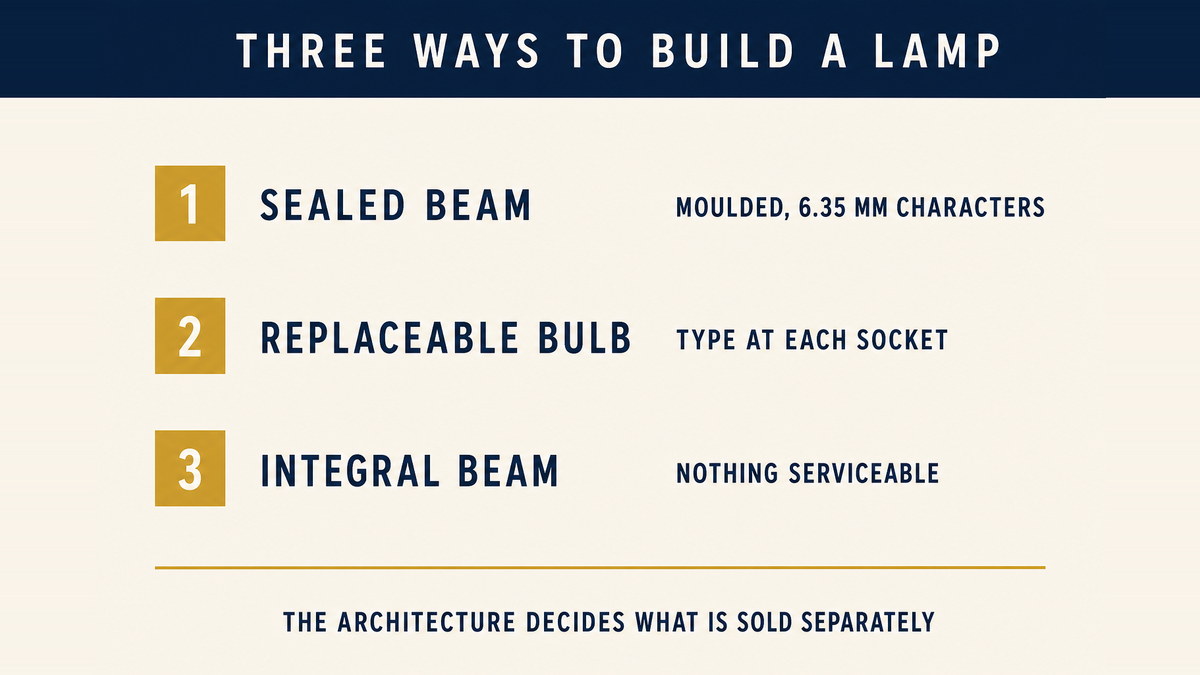
The buyer's rule is simple. Ask which of the three a quotation is for, and the answer tells you what you are importing. A sealed beam has no service parts, so a "sealed beam bulb" is a category error. A replaceable bulb lamp has a socket, so the bulb type is part of the specification. A lamp of the third kind has neither, so a spare lens is a replacement part with its own marking obligation rather than an accessory.
5. The Millimetres Inside the Marking Clause
Marking rules in this series are usually a list of items. This one carries measurements, and the measurements are where a tooling decision gets made.
Sealed beam characters must be at least 6.35 mm. That is a quarter of an inch, and it is a mould constraint: below it, the character does not fill reliably in a production tool. The face of any character moulded on the lens must not stand more than 0.5 mm above the lens surface. Half a millimetre is the difference between a mark and a bump, and the standard treats a bump in the wrong place as a defect.
Which place is wrong depends on the type, and the text gives three zones. Type 1C1, 2C1 and 2D1 headlamps must have no raised markings on the outside of the lens between diameters of 40 mm and 90 mm about the lens centre. Types 1A1, 2A1, 2B1 and 2E1 must have none within a diameter of 70 mm. Types LF, UF, 1G1, 2G1 and 2H1 must have none within 35 mm.
The standard does not explain the zones. What it does is forbid raised characters in a circle about the centre of the lens, and the circles are exactly where the reflector or the projector does its work. A character standing half a millimetre proud inside that circle is a small lens defect sitting in the optical path, which is why the rule is written as a diameter rather than as a distance from the edge.
The last measurement applies to a lamp that is not a headlamp at all: a daytime running lamp must be permanently marked DRL on its lens in letters not less than 3 mm high, unless it is optically combined with a headlamp. Three millimetres is small enough to be missed in a photograph and large enough to be read on a bench, which is exactly the size a marking needs to be.
6. Where the Price Gap Comes From
Two quotations for a lamp that fits the same car, forty per cent apart, are usually two different products with the same mounting points. In this category the gap sits in six places, and only one of them is labour.
The housing. The same shape in a different polymer behaves differently at eighty degrees and at minus twenty. A housing that softens loses its aim; a housing that goes brittle loses its clips. The optical system. A reflector bowl and a projector module are not two ways of doing the same thing at different prices — they are different tooling, different tolerances and different photometry. The light source. For an LED lamp, the binning of the chips decides both the colour and the output, and a quotation without a bin is a quotation without a specification.
The thermal path. An LED that cannot shed heat loses output before it loses function, so the lamp quietly gets dimmer over a year. A heatsink is not visible from outside and is one of the first things removed to hit a price. The seal. A gasket, a vent and, on some designs, a desiccant. It is the cheapest item in the bill and the one the recall record is full of. The report. Somebody has to run the photometry and sign it, and that is a line item that does not appear in a photograph of the product.
The same technique from every other row applies, and it works better here than anywhere else in the series. Ask the supplier to price the lamp twice: once exactly as quoted, and once with the named polymer, the sealed optical unit, a bin code on the chips and a signed photometry report. The difference is the cost of the design, isolated from labour and freight. On a lamp it is usually smaller than buyers expect, because the expensive parts are the tooling and the test, and the tooling has already been paid for.
7. What the Recall Record Counts, and What It Does Not
Method first, unchanged from the rest of this series. The federal recall file holds 245,845 records across 15,305 campaigns, has no header row, and every field is scanned. Controls: brake 28,639, air bag 16,162. Twenty-five terms were counted.
All twenty-five returned something. That is the first time in the batch. Every other row found at least one zero — three of twenty-five for the water pump, four for the tire changer — and this one found none. Lighting is not a category the record ignores. It is a category the record is unusually full of.
| Term | Records | Campaigns | What it is counting |
|---|---|---|---|
headlight | 1,358 | 142 | the part, in the word owners use |
headlamp | 553 | 81 | the part, in the word the standard uses |
glare | 636 | 39 | what the other driver sees |
moisture | 1,646 | 92 | water inside the housing |
sealing | 1,729 | 94 | the gasket and the vent |
condensation | 293 | 33 | the visible form of the same failure |
retrofit | 658 | 50 | a lamp changed after the vehicle was built |
led | 1,674 | 136 | the source that replaced the filament |
aiming | 13 | 5 | the thing the standard spends its length on |
photometry | 1 | 1 | the measurement the certification rests on |
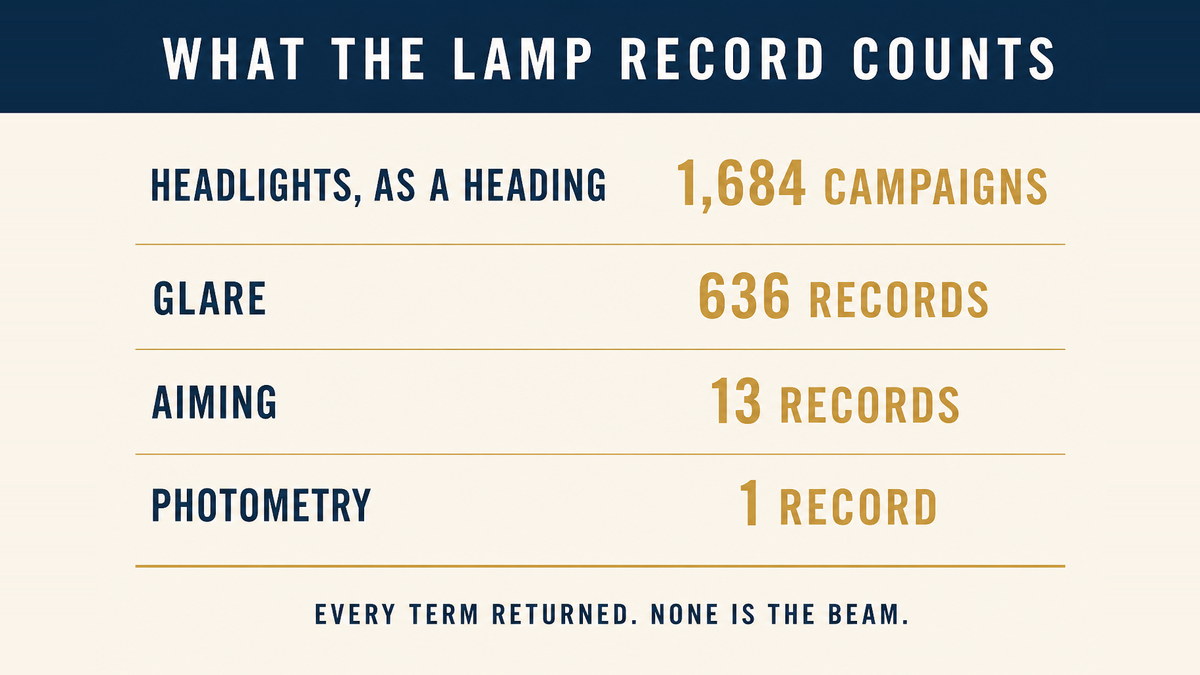
The component heading exists. EXTERIOR LIGHTING:HEADLIGHTS accounts for 1,684 campaigns, and the lighting family as a whole is one of the largest in the file: brake lights 2,015, the unqualified EXTERIOR LIGHTING heading 1,951, turn signals 1,672, tail lights 774. A headlamp has a column of its own, which the water pump did not.
And the two numbers that matter are the small ones. aiming appears in 13 records across 5 campaigns. photometry appears in one record, in one campaign. The standard devotes most of its length to beam pattern, aim and photometric test points; the record, across a quarter of a million rows, almost never uses those words.
What it uses instead is water and glare. moisture 1,646, sealing 1,729, condensation 293, and glare 636 — the first three are the same failure described at three stages, and the fourth is what the failure looks like to somebody coming the other way. A lamp that fills with condensation does not fail a photometry test at the factory. It fails in the field, in the second winter, and the record counts it in a vocabulary the standard never uses.
The finding. Every previous row in this series found the record silent about the product. This one finds it loud about a different product than the rule describes. The rule measures the beam; the record counts the water. A buyer who checks only the mark is buying the configuration the standard describes, and a buyer who checks only the record is buying against a failure the standard does not test — which is why both checks belong in the same conversation.
8. Seven Questions a Headlight Quote Should Answer
A quotation in this category usually arrives as a photo of a lamp, a list of car models and a price. The seven questions below are the ones that decide whether the photo describes a product or a shape, and six of them can be answered from a lens and a document.
- Which of the three architectures is it? Sealed beam, replaceable bulb, or one indivisible unit. The answer decides whether the source is a service part, whether a spare lens exists, and which marking duty applies.
- Which HB type, and is it marked in front of each socket? Not what bulb the factory recommends — what the lens says, and where. If the lens is blank in front of the socket, the lamp is not marked as a replaceable bulb unit.
- Whose name is on the lens, and in what capacity? Maker, importer, or vehicle manufacturer. If the name belongs to none of the three, the mark is not a weaker claim but a false one, and a trademark search settles it.
- Do the voltage and the trade number on the lens match the report? A photometry report filed under a different trade number describes a different lamp. This is the single most common mismatch in an aftermarket dossier.
- Which polymer, and what is on the outside of it? A housing and a lens coating chosen for one climate, sold into another, is the cheapest saving in the bill and the most expensive in warranty.
- How is it sealed, and what was the condensation test? Gasket, vent, desiccant, and a cycling test with a number attached. The record is full of this failure and the standard is silent about it.
- What does the better-specified version cost, side by side with the quoted one? Named polymer, sealed unit, bin code, signed report. The difference is the design cost, and on a lamp it is usually the smallest line in the quotation.
9. Six Lines to Put in the Order
The marking clause reduces to a short list, and every line on it is something a factory can answer in writing before a tool is cut.
- The architecture and the trade number. One of the three definitions, and the number the report will be filed under. Everything else in the order hangs off these two facts.
- The HB type, and where the mark sits. In front of each replaceable light source, on the lens, in the tooling — not on a label applied in the packing room.
- The owner of the name on the lens, and the capacity in which it appears. With written consent if the factory is not the owner, because the standard allows the mark only with it.
- The photometry report, its method and its signature. Which test points, measured how, and who signed. A report without a signature is a table with a claim around it.
- The sealing specification and a condensation test. Gasket material, vent design, and a cycling number. This is the one line the federal text does not require and the field demands.
- Two prices. As quoted, and with the named polymer, the sealed unit, the bin code and the signed report. The difference is the design cost, isolated from labour and freight.
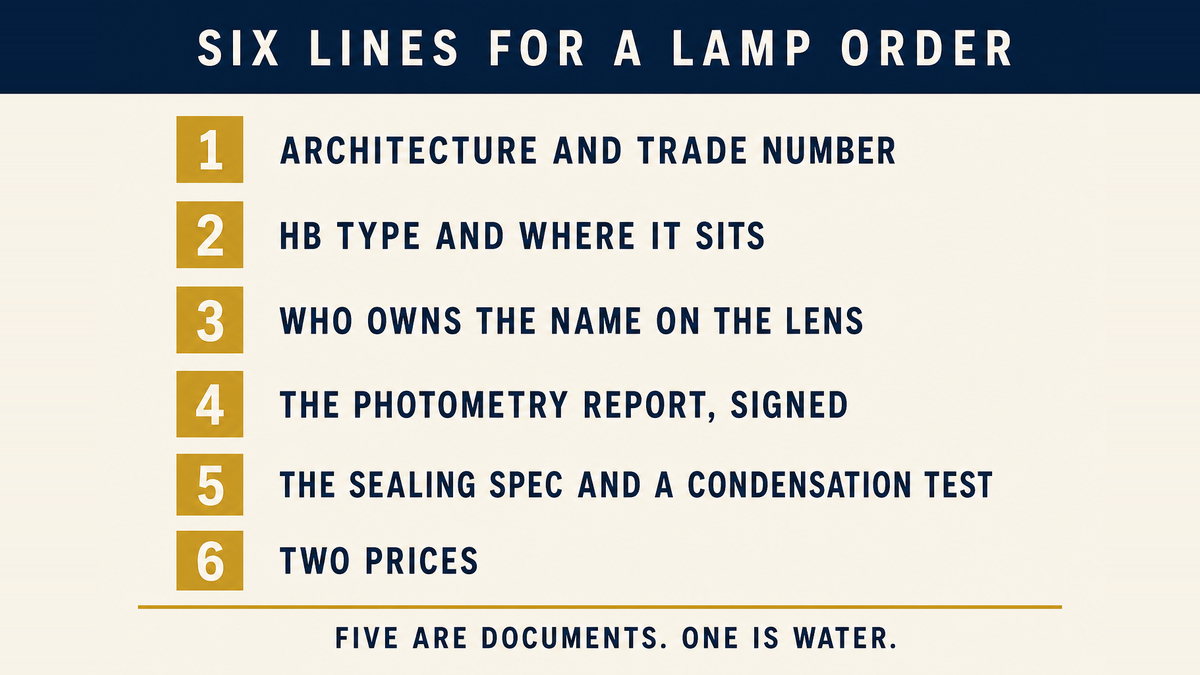
Five of the six are documents or decisions. The sixth — sealing — is the one that decides whether the lamp still works in the second winter, and it is the line a supplier will not volunteer, because no agency asks for it.com/factory-audit-checklist-guide/" target="_blank" rel="noopener">how an audit reads a laboratory report is where a claimed test becomes a fact, and the pre-shipment checklist is where a lens survives the carton — with how the packed volume decides the freight worth settling at the same time, because a lamp is mostly air and a carton of them is mostly not.
Frequently Asked Questions
Is the DOT mark on a headlamp an official approval?
No. The standard says the symbol indicates certification under 49 U.S.C. 30115, which is the manufacturer's own statement that the lamp conforms — not a certificate issued by an agency. That makes the marking narrower than an approval and more useful in one respect: it names the party who is answerable, and the name has to belong to the maker, the importer, or a vehicle manufacturer using the lamp.
Can I sell an LED conversion kit as a headlight?
The standard marks the light source the lamp was built around, and it requires every replaceable source to conform to dimensions filed under Part 564. A source that is not an HB type and has no filing is not the source the lens names. Fitting one does not change what the lens says; it makes the lens describe a configuration nobody is shipping, and the photometry behind the certification belongs to that other configuration. Treat the kit as a different product with its own question, not as an accessory to a certified lamp.
What is an HB type?
It is the designation system for replaceable headlamp light sources, filed under 49 CFR Part 564 in Docket No. NHTSA 98-3397, with fixed dimensions and electrical specifications. The type is marked on the base of the bulb and, for a replaceable bulb headlamp, on the lens in front of the socket. HB1 is the single exception to the lens marking: if the only source in the lamp is an HB1, no marking need be provided.
Does a replacement lens need its own marking?
Yes, and more than one. A replacement headlamp lens must carry the manufacturer and the part or trade number of the headlamp it is intended for, plus the name or trademark of the lens maker or importer registered with the U.S. Patent and Trademark Office. A lens that fits many models and names none of them is not a replacement lens under this rule, whatever the listing says.
Projector or reflector — which is better?
Neither, as a category. They are different optical systems with different tooling, tolerances and photometry, and either can be certified or not. What matters for a buyer is which one the quotation is for, because the tooling cost, the replacement logic and the beam character all differ. A price comparison between a reflector lamp and a projector lamp is a comparison of two products, not of two suppliers.
Why does a headlamp fog up, and is that a defect?
It is the failure the record is fullest of: moisture 1,646 records, sealing 1,729 and condensation 293 across a quarter of a million. A lamp breathes through a vent, and a vent that clogs or a gasket that takes a set lets water in on the cooling cycle. Whether it is a defect depends on the specification, which is exactly why the sealing line belongs in the order — no federal text requires a condensation test, so if it is not written down it does not happen.
A headlamp is regulated on its outside. FMVSS 108 places the manufacturer's name, the voltage and the trade number on the lens, and adds a type code where the lamp takes a replaceable bulb. None of that reaches the reflector behind the lens.
The dimensions that decide whether the beam lands where the standard expects are measured to fractions of a millimetre and checked on a photometric bench rather than on a sample by eye. So the lens is the certificate and the bench report is the evidence behind it.
What Each Mark Permits, and What It Does Not
We return each mark with the duty it discharges, the bulb number it fixes, and the millimetres the marking clause actually measures.
Rule My Markings
Questions & Comments
We read every one and reply within 24 hoursA headlight lens carries the marks; the beam behind it is proved on a photometric bench. Send the lamp type, and we will separate the marking duty from the evidence.