
Fog Light Wholesale: The Lamp That Changes Another
 ·
Updated October 16, 2026
·
10 min read
Most lamps fail alone. A fog light fails in company, and the federal recall file proves it. Seven campaigns in 245,845 records are about a fog light, and six of the seven are about something the fog light did to another lamp on the same vehicle — it took out a low beam, stopped a turn signal cancelling, killed a high beam, blinded oncoming traffic, or pushed the vehicle past a light output limit. Only one is about the fog light simply not working. That is the whole commercial risk of this product: you are not selling a lamp, you are selling a change to a vehicle.
1. What a Fog Light Is Made Of, and the Two Words for It
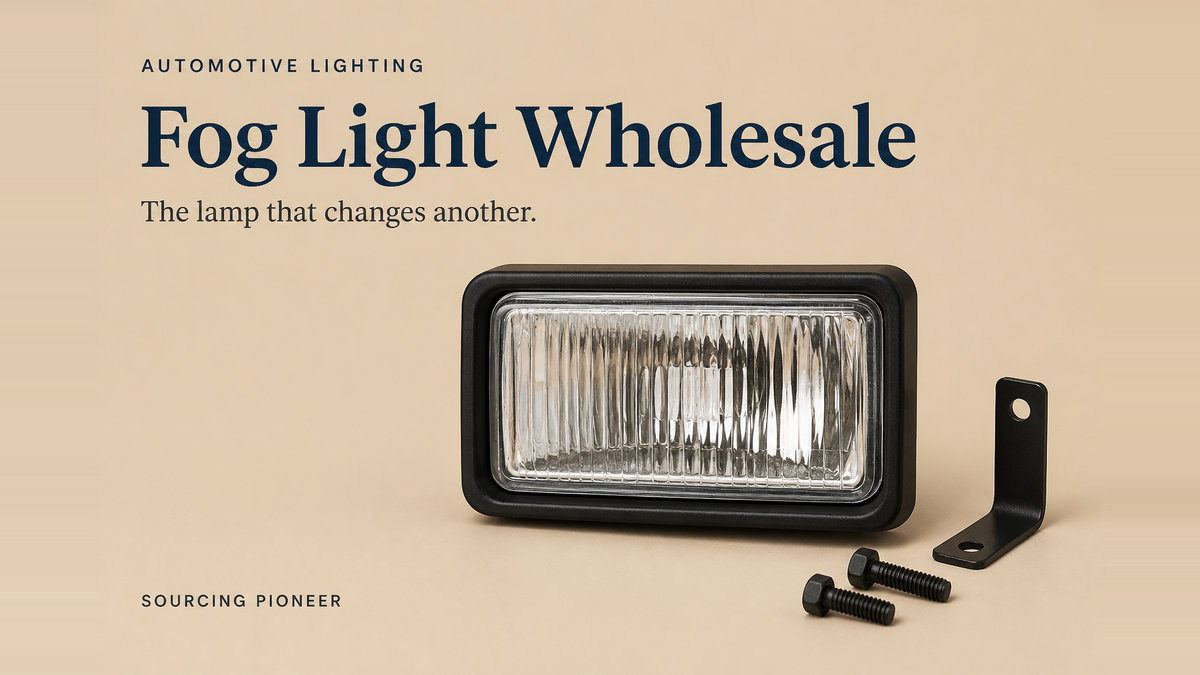
The hardware is familiar: a housing, a lens, a reflector or a projector optic, a bulb or an LED board with a driver, a gasket, a bracket, and a switch or a connection to the vehicle’s existing switch logic. On a modern vehicle the last item is not a switch at all — it is a line of configuration in a body control module, which is why so many of the campaigns below are software campaigns wearing a lamp’s clothing.
Before any of that, there is a naming problem that runs through the whole product, and it is visible in three separate datasets. The rulebook calls the part a fog lamp. The trade, the catalogue and the customer call it a fog light. The standard is 49 CFR 571.108, and it does not contain the phrase “fog light” anywhere in the sections that govern fog lamps.
| Where you look | “fog lamp” | “fog light” |
|---|---|---|
| The federal safety standard | The term it uses | Not used |
| The federal recall file | 0 records | 17 records |
| Search demand, United States | fog lamp manufacturer — volume 0 | fog light wholesale — volume 20 |
Three datasets, the same split every time. The consequence is practical rather than academic: a buyer who searches the rulebook or the recall file with the word printed on the carton finds nothing, and a buyer who asks a factory for a “fog lamp” is using a term the factory may not recognise as the same product.
2. What the Rulebook Refuses
The lighting standard does two things with fog lamps that are worth knowing before the first sample, and both are restrictions rather than allowances. The first is a refusal, and it is one clause long.
“Any pair of lamps on the front of a passenger car, multipurpose passenger vehicle, truck, or bus, whether or not required by this standard, other than parking lamps or fog lamps, may be wired to be automatically activated … in a steady burning state as daytime running lamps.”
Fog lamps are named in the exclusion. Whatever else a fog lamp may be wired to do, it may not be wired to serve as a daytime running lamp. That single sentence closes off a design that is otherwise attractive, because a pair of lamps on the front of a car that switch on automatically and burn steadily is exactly what a DRL is, and exactly what a bright aftermarket fog lamp looks like to a product planner.
3. The Lamp Next Door: the Spacing Multipliers
The second thing the standard does is treat a fog lamp as part of a group. In the clauses on front turn signals, a fog lamp is described as “any lamp such as an auxiliary lower beam headlamp or fog lamp used to supplement the lower beam headlamp”, and the spacing between that lamp and the turn signal becomes a multiplier on the turn signal’s required luminous intensity.
The figures run like this. Where the gap between the turn signal and the fog lamp is less than 60 mm, the multiplier is 2.5. Between 60 and 75 mm it is 2.0. Between 75 and 100 mm it is 1.5. And where the turn signal sits less than 100 mm from the lower beam headlamp itself, the multiplier is 2.5. Where more than one spacing relationship applies, the standard says the requirement is the one that specifies the highest multiplier.
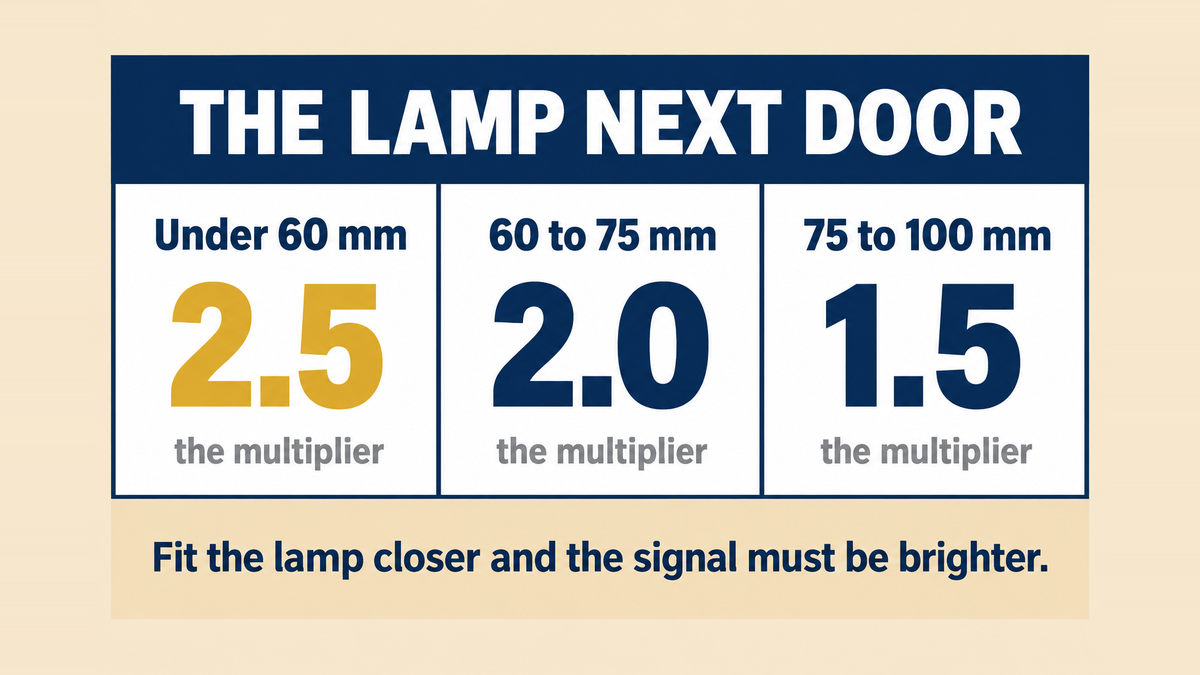
Read that as a sourcing consequence and it is unusually direct. A fog lamp you supply can push a turn signal out of the limits it was originally aimed to, by being mounted closer to it than the original design allowed. The vehicle is not required to fail; the requirement simply rises, and the signal that was fine at 90 mm may not be fine at 70 mm. Nothing on the fog lamp box mentions this, and no amount of photometric quality in the fog lamp itself changes it, because the figure belongs to the other lamp.
There is also a geometry clause that catches aftermarket brackets. Where an auxiliary lamp is mounted near identification lamps, each auxiliary lamp must be located at least twice the distance from any required identification lamp as the distance between two adjacent required identification lamps. A bracket that moves a lamp a few centimetres can cross that line without changing anything about the lamp.
4. Where It May Sit, and What Colour It May Be
Two further limits complete the picture, and both are decided by the vehicle rather than by the lamp.
Mounting. Each lamp must be securely mounted on a rigid part of the vehicle, other than glazing, that is not designed to be removed except for repair, within the applicable location and height limits, and in a position where it still meets the photometric and visibility requirements with all obstructions considered. A fog lamp clamped to a plastic bumper trim is, in the plain reading of that sentence, a question rather than an answer.
Colour. The colour of every lamp covered by the standard has to be as specified in the standard’s own table, and the table identifies amber as identical to yellow. The colours the table allows for front fog lamps include white and selective yellow, and selective yellow is a specific expressed colour rather than any yellowish tint a coating house happens to produce. An aftermarket lamp sold as “yellow” without a colour measurement behind it is a claim about a defined technical value.
And one more exclusion sits in the test procedure rather than the design clauses. During the adaptive driving beam test, the standard requires that all other independently controlled lamps, such as fog lamps, shall be turned off. A fog lamp is therefore treated as a lamp that can contaminate another lamp’s measurement — which is the same idea as the multiplier, seen from the other end.
5. What the Record Says: Zero Against Seventeen
Method first. The federal recall file holds 245,845 records and no header row, so every field of every record is scanned rather than trusting a column map. Controls: brake appears in 28,639 records and air bag in 16,162. Every term is matched on a word boundary and every figure is a de-duplicated record count.
| Term | Records | Campaigns |
|---|---|---|
fog light | 17 | 7 |
fog lamp | 0 | 0 |
fog | 36 | 9 |
driving light | 0 | 0 |
driving lamp | 7 | 1 |
auxiliary lamp | 32 | 1 |
turn signal | 3,021 | 140 |
low beam | 337 | 58 |
high beam | 387 | 40 |
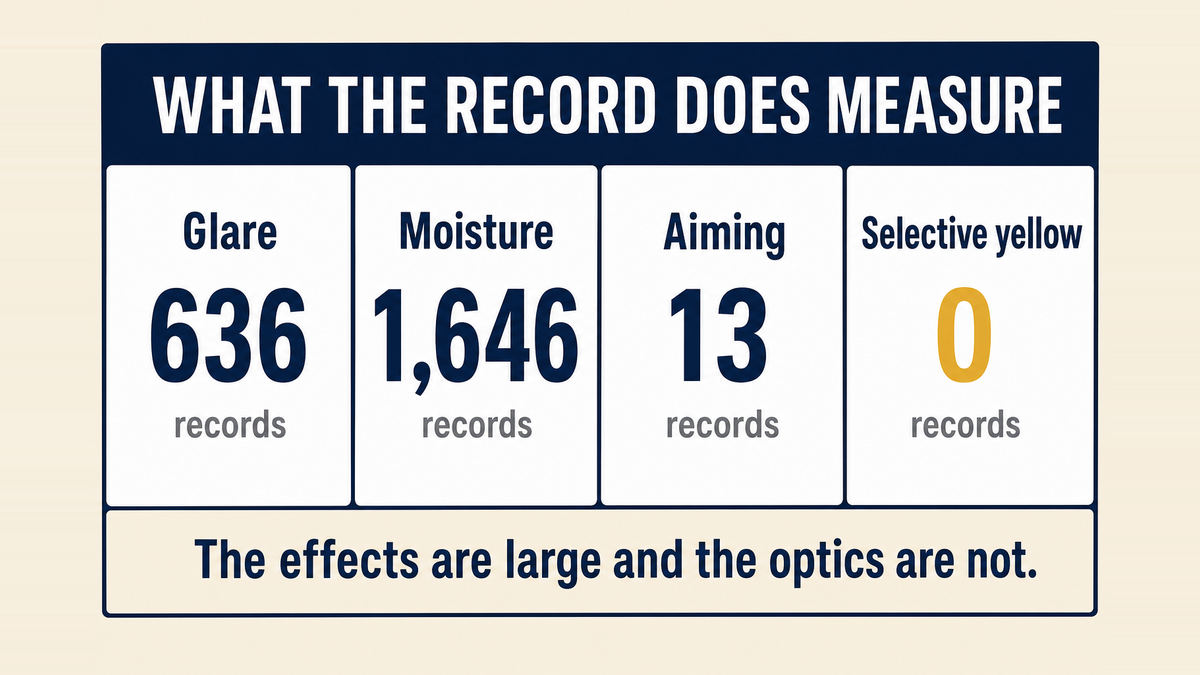
glare | 636 | 39 |
aiming | 13 | 5 |
selective yellow | 0 | 0 |
SAE J | 0 | 0 |
Three rows deserve a sentence each.
“Fog lamp” is absent from all 245,845 records while “fog light” appears in seventeen. The file was written by the people who enforce the standard, and it still does not use the standard’s term. That is the sharpest version of the vocabulary gap this series has found.
Nine campaigns contain the word “fog” and seven are about a fog light. The two that are not are worth naming because they are the same contamination pattern that has appeared in every article in this segment: one is a ventilation recall about clearing atmospheric fog and condensation from a windshield, and one is a reverse light campaign that mentions fog lamps only in passing. Measure the category by keyword and roughly a fifth of the results are a different subject.
“Selective yellow” appears in none of the records, and nor does “SAE J”. The colour the standard defines for front fog lamps and the practice documents the standard incorporates by reference are both invisible in the file.
6. Seven Campaigns, and Only One Is About the Fog Light
Now the campaigns, because this is where the product stops behaving like a lamp. Read them in order of how much they change something other than themselves.
- PACCAR, campaign 14V178000, 63 Peterbilt 587 trucks: when the driver turned on the high beams, the fog lights were supposed to switch off, but after ten seconds they could turn back on because of a software malfunction. The combination of high beams and fog lights could exceed the permissible limits of light output, and the stated risk is that oncoming traffic may be blinded.
- Toyota, via Southeast Toyota Distributors, campaign 21V963000, 78 Four Runners: the driver’s side high beam could be inoperable after the installation of accessory fog lights, and the vehicles do not meet the lighting standard.
- Mazda, campaign 16V753000, 180 Mazda6 cars equipped with optional accessory fog lights: an incorrect combination switch was installed, so the turn signals might not cancel automatically when the wheel returned.
- Mack, campaign 12V434000, 3,864 CHU and CXU trucks equipped with daytime running lights and fog lights: a short in the fog light circuit could cause the low beam headlight circuit to cut out.
- PACCAR, campaign 12V490000, 432 Kenworth and Peterbilt vehicles: the vehicles do not meet the lighting standard, and the stated reason is the one nobody expects from a fog lamp — that a combination of fog lights and headlights, or daytime running lights and headlights, may be too bright for oncoming traffic.
- Newmar, campaign 14V485000, 63 motorhomes with an incorrectly wired headlight harness: if one of the two headlight circuit breakers failed, both headlights and both fog lights would go out.
- Daimler Vans, campaign 19V121000, 1,197 Mercedes-Benz Sprinter vans with LED rear fog lights: the lights may not illuminate even though the rear fog light switch is on. This is the only one of the seven in which the fog light is the whole story.
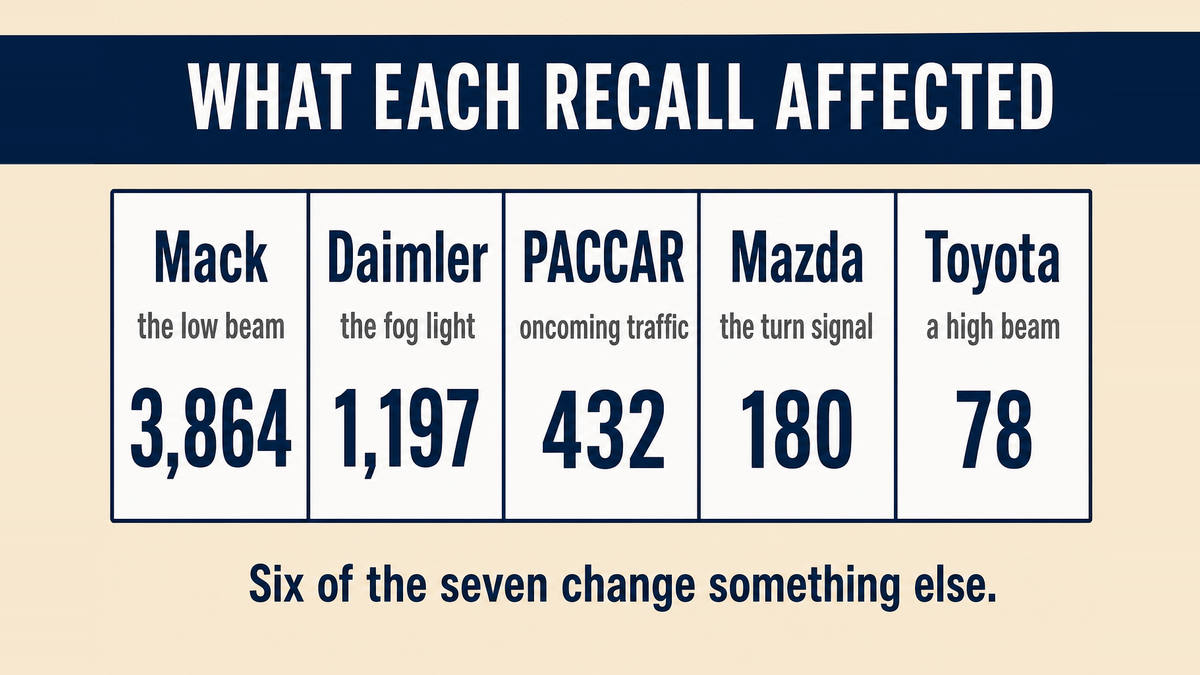
Note the pattern in the sizes. The largest campaign in the group, 3,864 vehicles, is a wiring short that took out a low beam. The smallest two, 63 and 78 vehicles, are a software malfunction that blinded oncoming traffic and an accessory installation that disabled a high beam. Volume and severity are not related in this product at all, and the two smallest campaigns describe the two failures a fleet operator would most want to avoid.
Note also which three of the seven carry the component field EXTERIOR LIGHTING:FOG LIGHTS — Mack, Daimler and PACCAR’s 63-vehicle software campaign. The other four are filed as turn signal, headlights, wiring and plain exterior lighting. Even the file’s own taxonomy puts most fog-light failures under a different lamp.
7. The Two That Were Installed as Accessories
Two of the seven campaigns exist because somebody added a fog light to a vehicle that already had a regulated front end, and both of them broke a function rather than a lamp.
The Mazda case is the more instructive. A 2017 Mazda6 with optional accessory fog lights had an incorrect combination switch fitted, which meant the turn signals would not cancel by themselves when the steering wheel returned. Nothing was wrong with the fog lights. What happened is that a kit was added into a circuit that already carried another function, and the switch that carries the self-cancelling behaviour was replaced with the wrong one. The vehicle then failed the lighting standard on the strength of its turn signal.
The Toyota case has the same shape from the other end. On a 2022 Four Runner, the driver’s side high beam could be inoperable after the installation of accessory fog lights — and the campaign is filed under EXTERIOR LIGHTING:HEADLIGHTS, because the file records the lamp that stopped working rather than the lamp that was fitted.
Put those two beside the last article in this series and the pattern is complete. A light bar attached to a windshield with the wrong primer, fixed with a mechanical fastener. A work light whose standard names mounting failure and instability as a safety risk. And here, two accessory fog light kits whose effect was a turn signal that would not cancel and a high beam that would not light. On vehicle lighting, the risk has moved from the optics into the installation, and the installation is not in the box unless you put it there.
The practical request that follows is a wiring schematic for the kit, showing exactly which existing circuit the fog lamp connects to, whether the kit interrupts or replaces any switch or relay, and what the vehicle does with the signal it is given. A supplier who cannot produce that drawing has not finished the product.
8. The Software That Turned Them Back On After Ten Seconds
The smallest campaign in the group is also the best illustration of what a lamp has become. Sixty-three Peterbilt 587 trucks had a fog lamp function that behaved correctly in every state except one: when the driver switched on the high beams, the fog lights would switch off as intended, and then after ten seconds they could switch back on because of a software malfunction.
The stated consequence is not a broken lamp. It is that the combination of high beams and fog lights could exceed the permissible limits of light output, so that oncoming traffic may be blinded. The standard caps the combined output, not only the output of a single lamp, which is why the high-beam-plus-fog state has its own limit and why the switch-off behaviour is a requirement rather than a courtesy.
Read that as a design question for a sourcing conversation. On an older vehicle a fog lamp was switched by a relay and a physical switch, and what it did was visible in the harness. On a current one the fog lamp may be driven by a body control module, switched by a line of configuration, and interlocked with the high beam in software. So the question to a supplier is not whether the lamp has a relay. It is what decides when the lamp is on, and what stops it being on at the same time as something else. Twenty years ago that answer was a wire; now it is a line of code, and a line of code can be wrong for ten seconds.
9. The Circuit, and What a Short Takes With It
The two remaining campaigns are electrical, and between them they explain why a fog lamp is a liability to the lamps it shares a harness with.
- Mack, campaign 12V434000, 3,864 trucks: a short in the fog light circuit could cause the low beam headlight circuit to cut out. The consequence named by the agency is the loss of low beam visibility, which is the lamp a driver depends on most.
- Newmar, campaign 14V485000, 63 motorhomes: an incorrectly wired headlight harness meant that if one of the two headlight circuit breakers failed, both headlights and both fog lights would go out.
Two lessons sit in those paragraphs, and both belong on an order sheet.
The first is that a short in an auxiliary lamp’s circuit can disable a required lamp, because the two are fed from the same harness family. A fog lamp is an optional feature; the low beam is not. Any circuit arrangement in which the optional lamp can take the required one down is a defect waiting for a vibration.
The second is that shared protection is a shared failure. Where two headlights and two fog lights sit behind one breaker, the breaker becomes a single point of failure for four lamps instead of two. The question a buyer should ask, and almost never does, is whether the fog circuit is independently fused and independently relayed, and what happens to the headlights if the fog lamp wiring faults. That question costs nothing to ask and would have prevented both of these campaigns.
10. What the Record Does Measure
One more set of counts completes the picture, because the words that are large in this file are the relationships rather than the parts.
| Term | Records | Campaigns | What it is |
|---|---|---|---|
glare | 636 | 39 | An effect on somebody outside the vehicle |
moisture | 1,646 | 92 | Water inside a lamp |
condensation | 293 | 33 | The visible half of the same problem |
reflector | 466 | 44 | The optical part |
lens | 357 | 28 | The part that cracks |
turn signal | 3,021 | 140 | The lamp a fog lamp can push out of limits |
aiming | 13 | 5 | Almost absent |
selective yellow | 0 | 0 | The colour the standard defines |
Glare, at 636 records and 39 campaigns, is the largest of the lamp-specific terms, and glare is by definition a relationship: it is what a lamp does to somebody else. That is the article’s thesis appearing in the data, not an argument imposed on it. Moisture and condensation, taken together, are the largest physical failure theme in vehicle lighting at more than twice the count of glare, and they are the same problem seen in two stages — water inside the lamp, then water visible on the lens.
And then there is the number that should surprise anybody who has read the standard: “aiming” appears in 13 records and 5 campaigns. The lighting standard is a photometric document; its whole method rests on where a lamp points. The recall file has almost nothing to say about aim, and nothing at all to say about the one colour the standard defines for front fog lamps by name.
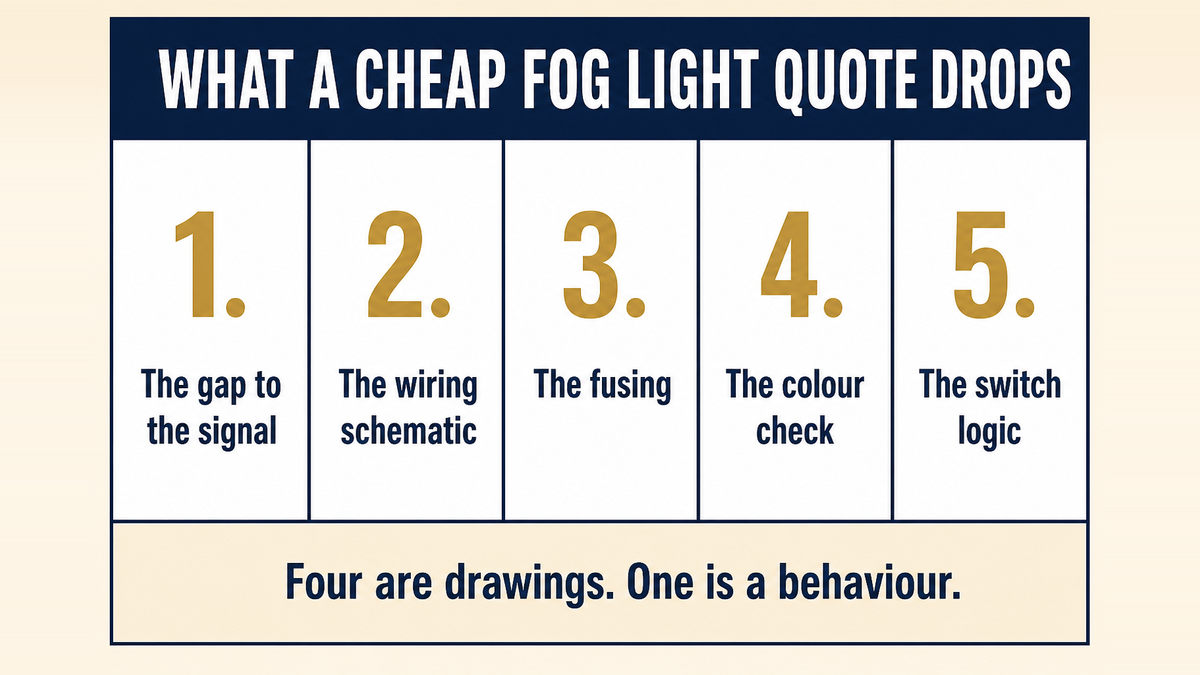
11. Five Questions a Fog Light Quote Should Answer
A fog light quote usually carries a size, a colour, a lumen figure and a price. Here are the five questions that decide whether the part can be fitted without changing something the vehicle is required to do.
- What is the gap between this lamp and the turn signal? Under 100 mm it becomes a multiplier on the signal’s required intensity, and the figure is 2.5 below 60 mm. The measurement belongs on the drawing, not on the lamp.
- What does the kit connect to? An existing switch, a relay, or the body control module, and whether the kit interrupts or replaces any existing component. Two of the seven campaigns in the file exist because a kit went into a circuit that was already carrying another function.
- Is the fog circuit independently fused and independently relayed? A short in an auxiliary circuit that can take out a low beam is the largest campaign in the group, at 3,864 vehicles.
- What colour is the light, and is there a measurement behind the claim? White and selective yellow are named colours in the standard’s table, and the table treats amber and yellow as the same value.
- What switches the lamp off? Not whether it has a relay, but what decides when it is on and what prevents it being on with the high beams. On a modern vehicle that answer is software, and a software answer can be wrong for ten seconds.
12. Six Checks Before You Order
- The spacing measurement on the drawing, from the fog lamp to any front turn signal and to the identification lamps, checked against the multipliers before the bracket is tooled.
- The wiring schematic for the kit, showing the connection point, anything interrupted, and how the lamp is switched.
- The independent fusing and relaying of the fog circuit, with a stated behaviour for the headlights if the fog wiring faults.
- The colour measurement behind a selective yellow or yellow claim, rather than a tint sample.
- The mounting point and height, with confirmation that the bracket attaches to a rigid part and not to glazing or a removable trim.
- The switch logic stated as behaviour, including what happens to the fog lamps when the high beams are selected and how the vehicle is being relied on to do it.
That list is what a factory audit turns into questions on site and a pre-shipment check confirms from a photograph. On this product the audit is unusually cheap, because the lamp itself is rarely the problem. The risk lives in a gap measured in millimetres, a connection in a wiring loom, and a line of configuration that decides when the lamp is allowed to burn.
Then there is the matter of the word, and on this product the gap is at its widest. The rulebook says fog lamp and hangs its requirement on that term. The recall file, written by the people who enforce the rulebook, says fog light seventeen times and fog lamp never. The catalogue says fog light. The customer says fog light. And the search data splits the same way. Only one of those four uses the word the requirement attaches to, and a buyer who quotes against the wrong one has quoted against a document that does not describe the product.
Frequently Asked Questions
Does a fog light need to be DOT approved?
A fog lamp is not a headlamp, so the marking rule that applies to it is the permissive one: the lamp may be marked with the DOT symbol, and the symbol constitutes a certification that it meets the standard. The compulsory marking clause is written for original equipment and replacement headlamps. What that means in practice is that a fog lamp can be sold without the symbol, and that printing the symbol turns the product into a claim about photometrics, colour and construction that the supplier must be able to support.
Can fog lights be used as daytime running lights?
No. The lighting standard allows a pair of lamps on the front of a vehicle to be wired to switch on automatically and burn steadily as daytime running lamps, and it names parking lamps and fog lamps in the exclusion. Any other pair of front lamps may be wired that way; fog lamps may not. It is a short clause and it rules out a design that would otherwise look attractive, because a bright front lamp that comes on by itself is exactly what a daytime running lamp is.
Why is there a spacing rule between a fog light and a turn signal?
Because the standard treats a fog lamp as a lamp that supplements the lower beam headlamp, and a turn signal mounted close to a supplementary lower beam lamp has to be more intense to be seen against it. The requirement is expressed as a multiplier on the signal’s luminous intensity: 2.5 where the gap is under 60 mm, 2.0 between 60 and 75 mm, and 1.5 between 75 and 100 mm, with 2.5 again where the signal sits under 100 mm from the lower beam headlamp itself. Where more than one relationship applies, the highest multiplier governs.
Can installing fog lights affect the other lights on a car?
It has, four times in the federal record. An accessory fog light installation left a turn signal unable to cancel itself because the wrong combination switch was fitted and an accessory kit disabled a driver’s side high beam; a short in a fog light circuit took out the low beam headlights on 3,864 trucks; and a shared circuit breaker meant that one failure could extinguish both headlights and both fog lights together. The lamp is rarely the problem. The connection is.
What colour can a fog light be?
The lighting standard requires the colour of every lamp it covers to be as specified in its own table, and the colours listed for front fog lamps include white and selective yellow. Selective yellow is a defined colour rather than a shade, which is why a product sold as yellow without a colour measurement behind it is making a claim about a technical value. The table also states that the colour identified as amber is identical to the colour identified as yellow.
What does it mean that a fog lamp supplements the lower beam?
It is the phrase the standard uses when it measures a turn signal: the spacing is taken to the lighted edge of the lower beam headlamp, or of any lamp such as an auxiliary lower beam headlamp or fog lamp used to supplement the lower beam headlamp. So a fog lamp is treated as an optional addition to the low beam rather than as a lamp in its own right, and two consequences follow. Its position matters to the lamps around it, and its output adds to the low beam rather than replacing it, which is why the combined state has its own limit.
Seven campaigns in a quarter of a million records concern a fog light, and six of them are about a low beam instead. Seven campaigns in a quarter of a million records are about a fog light, and six of them are about a low beam, a high beam, a turn signal, a circuit breaker or the eyes of oncoming traffic.
The lamp is easy; the gap to the signal, the connection into the loom, the fusing, the colour value and the line of configuration that decides when it may burn are what decide whether the product can be fitted to a vehicle that is required to do something else. Ask for the gap measurement, ask for the schematic, ask whether the circuit is independently protected, and ask what switches the lamp off.
Position, Colour and Spacing on One Note
We return the permitted mounting height, the colour, the spacing figure against the headlamp, and the limit on when it may be used.
Write My Mount Note
Questions & Comments
We read every one and reply within 24 hoursSeven campaigns in a quarter of a million records concern a fog light, and six are about a low beam instead. Send the lamp type and the market, and we will separate the marking duty from the beam pattern.