
Battery Charger Manufacturer: Tested as an Appliance
 ·
Updated October 16, 2026
·
11 min read
A battery charger is the one part in this series whose safety standard is not written for vehicles. Sold in the United States it is covered by UL 1236, Battery Chargers for Charging Engine-Starter Batteries. Sold internationally it is covered by IEC 60335-2-29, which is titled Household and similar electrical appliances. The appliance standard then adds a note about what happens when the appliance is used in a vehicle — and the note says that additional requirements may be necessary, which is a polite way of saying they are not in there.
1. What a Charger Is Made Of, and the Part That Keeps Coming Back
Open a bench charger and you find a transformer or a switching supply, a rectifier, a control board, a pair of output leads with clamps, a mains cord, and one or more sensing parts that watch the battery and the temperature. The first five decide what the charger does. The last one decides whether it stays safe when something else goes wrong.
That sensing part has a name in the recall file, and it is the reason this article exists. Read the four largest charger recalls of the last decade and every remedy is the same class of change.
| Part of the charger | What it decides | What a vague quote hides |
|---|---|---|
| The supply | Input voltage range and current draw | Whether it is built for 120 V, 230 V or both, and the input rating |
| The control board | The charge profile and the stage the charger is in | The profile it follows, and whether it was changed after testing |
| The output leads | Current to the battery and volt drop along the run | The conductor size and the length, which decide the drop |
| The clamps | Whether the connection holds under load | The contact area and the spring force |
| The sensing part | Whether the charger stops when the battery or the cord overheats | The thermistor or temperature sensor, and the temperatures it acts at |
| The mains cord | Whether the cord survives being used cold and outdoors | The cord compound, its temperature class and its length |
What this guide covers
- What a charger is made of
- Two rulebooks for one product
- The note that says vehicle use needs more
- What the appliance rulebook actually tests
- What changed in the fifth edition
- 114 uses of the word, 32 chargers
- The words the record never uses
- The output side, and the 120 volt line
- Three fixes, one part
- The charger sold as an accessory
- Five questions a charger quote should answer
- Six checks before you order
- Frequently asked questions
2. Two Rulebooks for One Product
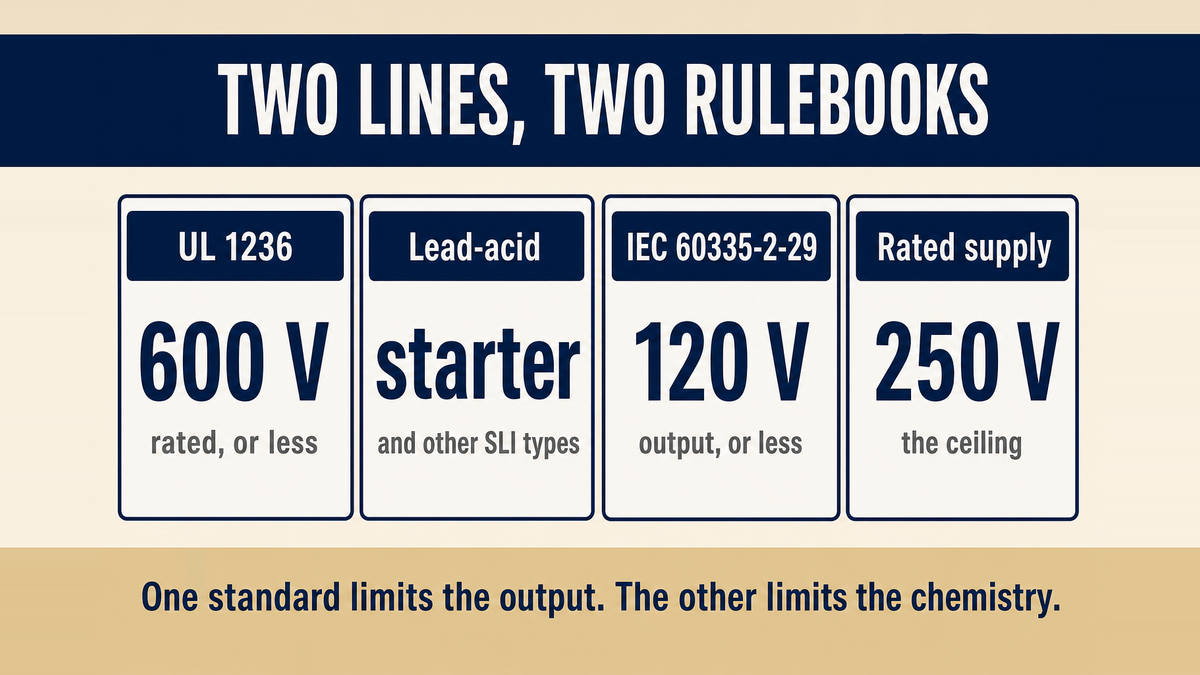
The same charger is covered by two different standards depending on where it is sold, and they do not measure the same thing. The American standard, UL 1236, is written for the job the charger does. The international standard, IEC 60335-2-29, is written for the appliance that does it.
| UL 1236 | IEC 60335-2-29 | |
|---|---|---|
| Title | Battery Chargers for Charging Engine-Starter Batteries | Household and similar electrical appliances — Safety — Part 2-29: Particular requirements for battery chargers |
| Applies to | Chargers rated 600 volts or less, intended for household or commercial use, to charge lead-acid engine-starter and other starting, lighting and ignition batteries | Electric battery chargers for household and similar use with an output not exceeding 120 V ripple-free direct current, rated voltage not more than 250 V |
| Written around | The battery being charged | The appliance doing the charging |
| Edition status | Edition 9 active, Edition 8 archived | Edition 5.0 published 2016, with later national amendments |
Read the US scope closely, because it does two things at once. It reaches chargers up to 600 volts, which is far above anything a household user meets, and it limits itself to lead-acid starter batteries and other starting, lighting and ignition types. A charger built for a lithium pack is not the product UL 1236 is about, and the standard for lithium chargers is a different volume. So the first question about a charger is not its current rating. It is which chemistry and which market the standard you are being shown was written for.
3. The Note That Says Vehicle Use Needs More
The international standard is unusually direct about the limit of its own reach. Two notes sit under its scope clause, and both matter to anyone selling into the automotive channel.
“NOTE 101 Attention is drawn to the fact that — for appliances intended to be used in vehicles or on board ships or aircraft, additional requirements may be necessary.”
That is the appliance standard saying, in its own words, that a charger meant for a vehicle is a case it has not fully provided for. It is not a defect in the standard; it is a boundary. The standard covers the appliance. The vehicle brings its own conditions — vibration, temperature, an electrical system that is not a mains supply — and those conditions are somebody else’s clause to write.
The other note lists what the standard does not apply to, and the list is worth keeping because it decides whether a test report is even the right document. It excludes built-in chargers, except those for caravans; chargers that are part of an appliance whose battery the user cannot reach; chargers intended exclusively for industrial purposes; chargers for corrosive or explosive atmospheres; and chargers comprising more than one unit. That last one catches a product that ships as a wall adapter plus a separate charging cradle: as two units, it sits outside the scope this standard describes.
There is also a change in the fifth edition that a buyer should know about, because it moves a whole product family into the same book. The fourth edition excluded chargers intended for electric vehicles, pointing to the electric vehicle supply standard instead. The fifth edition deleted that exclusion. The appliance standard now claims the ground, which is exactly the product class that produced the largest charging recalls in the file — and, as section 9 shows, exactly the class where the fixes were all sensing parts.
4. What the Appliance Rulebook Actually Tests
The clause list of IEC 60335-2-29 reads like a list of accidents waiting to happen, which is what a safety standard is. Alongside the usual ones for heating, leakage current and electric strength, moisture resistance, mechanical strength and construction, it carries clauses that a charger buyer should be able to ask about by name.
- Clause 7, marking and instructions — what has to be on the product and what the instructions have to say.
- Clause 15, moisture resistance — what happens when water reaches the product.
- Clause 17, overload protection of transformers and associated circuits — whether the supply protects itself.
- Clause 18, endurance and clause 19, abnormal operation — what the charger does when it is used hard, or wrongly.
- Clause 21, mechanical strength, including a drop test now tied to IEC 60068-2-31, and a separate test numbered 21.102.
- Clause 25, supply connection and external flexible cords, which is where the fifth edition added its low-temperature cord requirements.
- Clause 30, resistance to heat and fire, and clause 31, resistance to rusting.
There is also Figure 101, a circuit for testing battery chargers, and a normative annex for chargers sold for use by children aged eight and over without supervision. A charger that ends up in a child’s hands is not out of scope; it has its own annex.
Two of those clauses carry weight that a spec sheet never mentions. The endurance and abnormal-operation pair is what stands between a charger and a fire when a battery is left on it for a week, and the cord clause is what stands between a charger and a fire when it is used outdoors in winter. Both are clauses, not features, and both are cheap to ask about.
5. What Changed in the Fifth Edition
The fifth edition of IEC 60335-2-29 was published in 2016 and cancels the fourth edition of 2002 together with two amendments. Four of its stated changes are directly relevant to an automotive charger, and each one tells you what the committee had been seeing in the field.
- The drop test was rewritten to refer to IEC 60068-2-31, replacing a test that had been written into the charger standard itself.
- Cord requirements for low-temperature use were added, in the clause on supply cords. A cord that is flexible on a bench is not necessarily flexible on a driveway in February.
- Requirements were added for chargers with an output voltage above safety extra-low voltage, touching the scope clause, terms and definitions, power input, components, supply cords and terminals. A charger that puts out a higher voltage is a different product to the one the earlier edition had in mind.
- A classification for chargers used outdoors was added, in the classification clause and again in the clause on clearances.
The national differences list at the front of the standard is a useful reminder that the same document is applied differently. For the United States it records that the artificial load may not be used, that the appliance is not placed in a test corner, that the drop test is carried out differently for outdoor direct plug-in chargers, that basic insulation is allowed between live parts and safety extra-low voltage circuits, and that higher temperature rises are allowed in three places. Two chargers can both be described as tested to the same standard number and still have been tested to different things.
6. 114 Uses of the Word, 32 Chargers
Method first. The federal recall file holds 245,845 records and no header row, so every field of every record is scanned rather than trusting a column map. Controls: brake appears in 28,639 records and air bag in 16,162.
Search that file for the word charger and you get 114 campaigns. Then read them, because most of them are not about a charger.
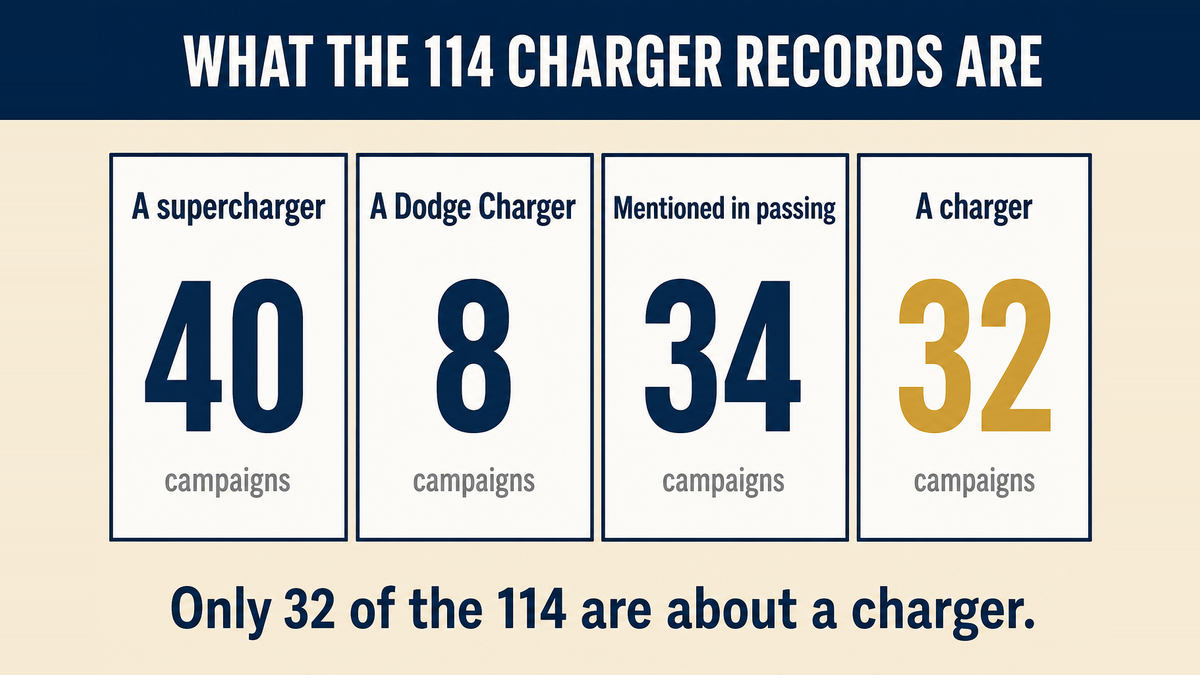
The breakdown is worth stating plainly, because it is the kind of thing that goes wrong when a category is measured by keyword rather than read.
- 40 campaigns contain the word only inside supercharger or turbocharger. These are engine campaigns, filed under turbo and supercharger taxonomy, and they have nothing to do with charging anything.
- 8 campaigns use the word because of the vehicle model — the Dodge Charger. The file holds 25 Dodge Charger campaigns in total.
- 34 campaigns mention charging in passing: a software recalibration that changes how the car charges its battery, an alternator, a tyre-pressure system, a warning lamp.
- 32 campaigns are about a charger as a device.
Thirty-two out of 114 is 28 per cent. If you measure the charger market with a keyword and do not read the results, roughly seven out of ten of your data points are a different product.
7. The Words the Record Never Uses
The second finding is the same shape as the one in the two articles before this, and it is sharper here because the trade has so many words for the product. Across 245,845 records:
| The phrase | Records | What it means |
|---|---|---|
"battery charger" | 5 | Almost absent |
"battery maintainer" | 3 | Almost absent |
"charging cable" | 279 | Present, because it is how the cord is filed |
"on-board charger" | 23 | Present, on the vehicle side |
"smart charger" | 0 | Absent |
"trickle charger" | 0 | Absent |
"battery tender" | 0 | Absent |
"wireless charger" | 0 | Absent |
"desulfator" | 0 | Absent |
Five of the nine phrases do not appear once. Every one of them is a term a buyer might use in a product brief, and none of them is a term the federal record uses to describe the thing that failed. The two that do appear — charging cable and on-board charger — are both written from the vehicle’s point of view, not the accessory’s.
There is one number in that table that deserves its own line: thermistor appears in just 10 records out of 245,845. One of those ten is the Ford charge-cord recall whose entire remedy was to add one. The part that fixes these products is barely mentioned in the system that records them.
8. The Output Side, and the 120 Volt Line
The international standard draws its line at the output: a charger is in scope while its output stays at or below 120 volts of ripple-free direct current. The American standard draws a much higher line — chargers rated 600 volts or less — but narrows by chemistry instead, to lead-acid starter and other starting, lighting and ignition batteries.
Put the two lines together and a buyer gets a useful test. A 12 volt, 10 amp bench charger is comfortably inside both. A charger that also offers a 24 volt mode is still inside both. A charger with a high-voltage output has stepped over the international line and its test report needs to say so, which is why the fifth edition wrote a set of requirements for chargers above safety extra-low voltage. And a charger sold for lithium packs is outside the chemistry the American standard is written around, however low its output.
This is the point at which a specification sheet usually stops being useful. It will list an input voltage and an output current. It will rarely say which of the two standards the report follows, what the rated supply voltage is, or whether the output is above or below safety extra-low voltage. Those three facts decide which document you should be asking for.
9. Three Fixes, One Part
Now to the recalls, because they are the part of this article a buyer can act on. Read the five largest charging-product recalls of the past decade and notice how little variety there is in the remedy.
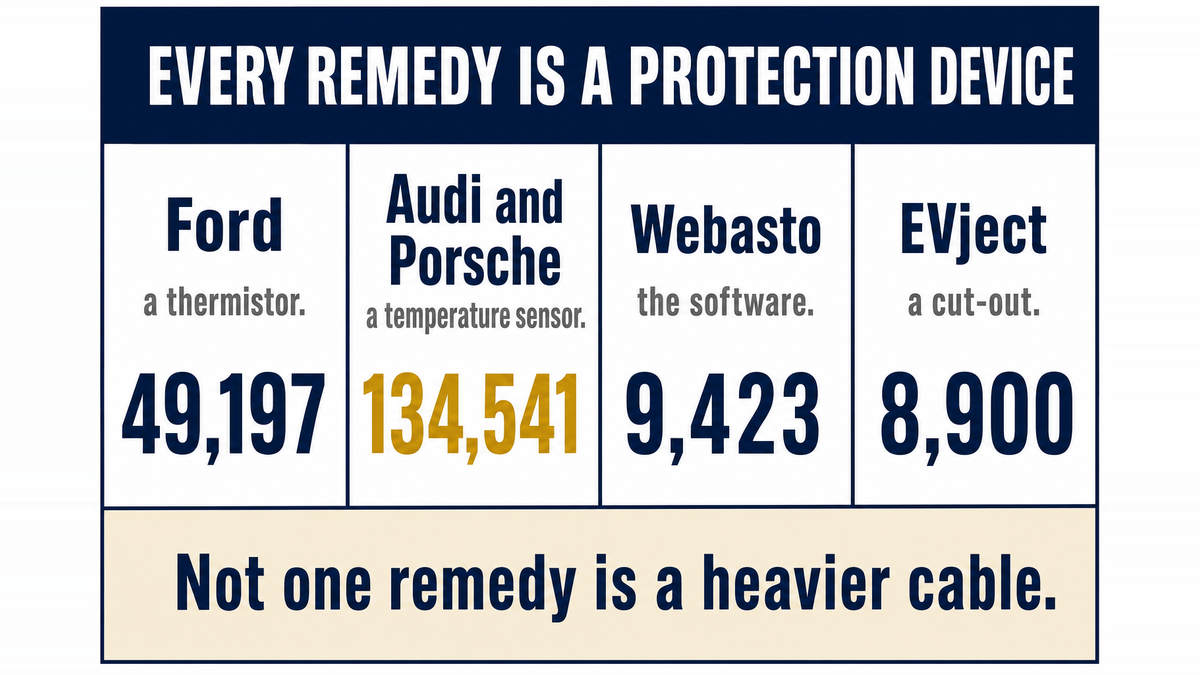
- Ford, campaign 18V592000, 49,197 units: 120 volt convenience charge cords supplied with and sold for the C-Max Energi, Fusion Energi and Focus Electric, across six part numbers, were manufactured without thermistors. The record says it plainly: during charging, increased resistance in the house’s outlet or wiring can cause the cord to overheat and melt. The remedy was to replace the cord with one with a thermistor. Nothing about the car changed.
- Audi, campaign 23V842000, 93,196 vehicles: using the industrial 220/240 volt plug at the 100 per cent charge setting, some home outlets could not carry the current the compact charging system asked for, and the outlet or the charging cable overheated. Owners were told to stop using that cable. The remedy was a new cable with an incorporated temperature sensor.
- Porsche, campaign 23V841000, 41,345 vehicles: the same fault, the same advice, the same remedy.
- Webasto, campaign 23E065000, 9,423 units of a portable charging cordset recalled by General Motors: the cords contained incorrect software and could fail to stop charging when the ground connection was lost, which the agency links to electric shock. The fix here was not a part at all. It was the software — and software is on the list of protection devices that decides whether a product is still the one that was tested.
- EVject, campaign 24E081000, 8,900 units: charging adapters manufactured without internal thermal protection, with overheating and burn injury as the stated risk.
Every remedy in that list is a thermistor, a temperature sensor, a thermal cut-out or a line of code. Not one of them is a heavier cable, a bigger transformer or a better clamp. When a charging product fails in the field, the part that was missing is almost always the part that was supposed to notice something.
Two more campaigns fill in the vehicle side of the same story. Audi’s 25V125000, 13,769 units, found the on-board charger could fail and stop charging the 12 volt battery, which in an electric car means the car loses drive power, because the 12 volt battery runs the computers. And Hyundai’s 21V944000, 2,679 units, found an unstable electrical ground that could put the car into a reduced-power mode. The first was fixed with a new charger; the second with a software update and a wiring repair.
For a supplier, the commercial reading is direct. If your charger has a sensing part, its position and its trip points are a selling point and belong on the specification. If it does not have one, that is the first thing a serious buyer will ask about — and the answer will decide whether they place the order.
10. The Charger Sold as an Accessory
A charger is often the second product in the box. It ships with a jump starter, a battery, a power tool or a car, and that changes who is on the paperwork when something goes wrong.
Look at who filed the Webasto recall. The product is a portable charging cordset made by Webasto Charging Systems. The filer is General Motors. The component field reads EQUIPMENT:ELECTRICAL, and the make and model fields carry the vehicle, not the charger. The same pattern runs through the other four: Ford filed for a cord, BMW filed for a TurboCord, and only EVject — a company whose whole product is the adapter — filed in its own name.
Two consequences follow, and both are worth planning for.
The first is that the recall will carry your customer’s name, not yours. A brand owner who puts your charger in a box owns the safety record of that charger in public, and the document that protects them is your test report. That is a reason for them to ask for it, and a reason for you to have it ready rather than to look for it later.
The second is that a recall that names part numbers is a recall you can check a pallet against. Ford named six cord part numbers. Webasto named one. EVject named two versions. If your own part numbering is loose — one number covering a range of builds, or a number that changes with the artwork — then when a field problem appears, nobody can tell which pallets are affected, and the safest answer becomes recalling all of them.
11. Five Questions a Charger Quote Should Answer
A charger quote usually carries an input voltage, an output current and a price. Those three numbers describe what the charger does. They say nothing about which document stands behind it, and the document is what decides whether the product can be sold.
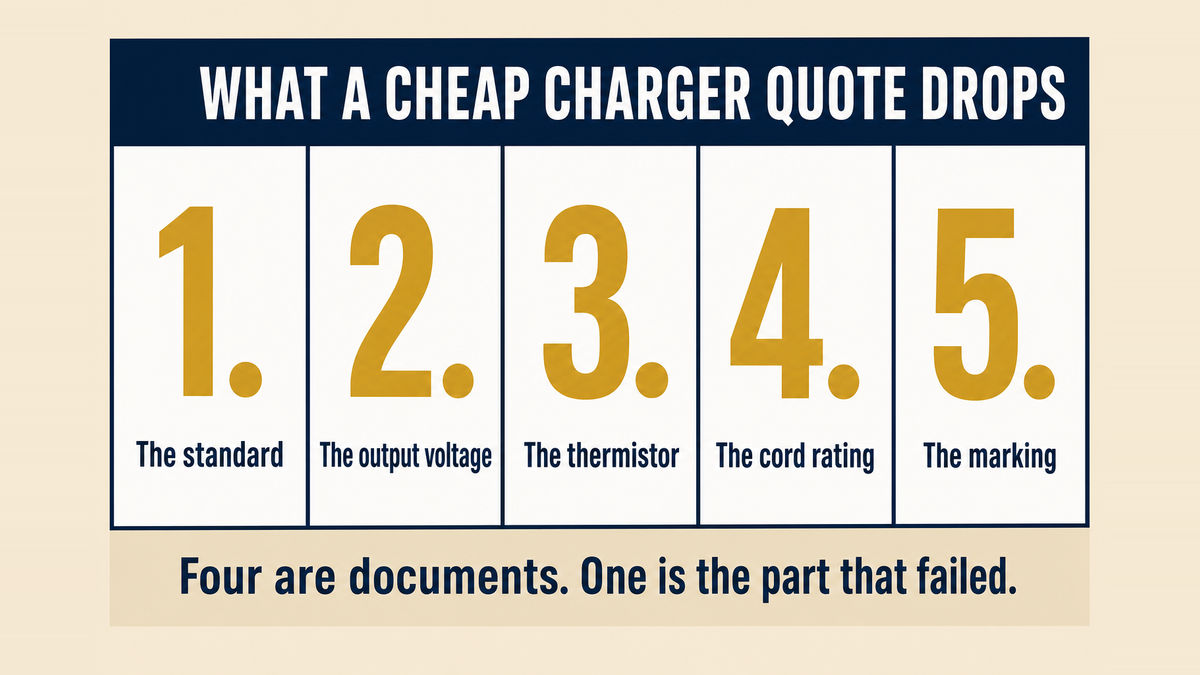
Five questions carry most of the value, and all five can be answered on paper before a sample is even built.
- Which standard is the report against, and which edition? UL 1236 for the American channel, IEC 60335-2-29 internationally, or a national adoption of the second. A report that does not name the standard and the edition is not a report you can rely on.
- What is the maximum output voltage, and is it above safety extra-low voltage? The international standard draws its line at 120 volts of ripple-free direct current, and the fifth edition wrote extra requirements for chargers whose output goes above safety extra-low voltage.
- Where is the sensing part, what does it watch and at what temperature does it act? This is the part that failed in every recall in section 9. Ask for the position and the two trip points, and expect an answer in numbers.
- What is the mains cord rated for? The compound, the length, the temperature class, and whether the product is classed for outdoor use. A cord that is fine indoors can stiffen and crack outdoors in winter.
- What is printed on the product and what do the instructions say? Marking and instructions are a numbered clause in the standard, not an afterthought, and in the American market the manual has been the subject of recalls in its own right.
12. Six Checks Before You Order
Those five questions become six checks once the order is being placed.
- Rated supply voltage, and whether one unit covers both 120 volts and 230 volts or whether you are ordering two builds.
- The cord — compound, length and temperature class, in writing, with the low-temperature requirement in mind.
- The sensing part — position, what it watches, and its trip points at both ends.
- The charge profile, and whether the control board or its software has changed since the report was issued. A changed board is a changed protection device.
- Whether the product is one unit or several. A charger that ships as an adapter plus a separate dock is more than one unit, which takes it outside the scope the international standard describes — and leaves you needing to know what it was tested against instead.
- The marking and the instructions, checked against the clause that governs them, not against the artwork you used last time.
That is the kind of list a factory audit works through in person, and a pre-shipment packaging check confirms on the pallet. On this product it is worth doing on paper first, because the failure mode is a document that does not match the goods rather than a part that does not fit.
One more thing is worth pricing properly, and it is the cord. It is the cheapest part of the charger and the one that appears most often in the recall file, in four different products from four different companies. A cord with a thermistor costs more than a cord without one. Every recall in section 9 was a company deciding that the difference was worth paying.
Frequently Asked Questions
Does a car battery charger need UL or IEC certification?
It depends on the market and on what you are claiming. In the United States the product standard for a charger built to charge lead-acid engine-starter and other starting, lighting and ignition batteries is UL 1236, which reaches chargers rated 600 volts or less and intended for household or commercial use. Internationally the standard is IEC 60335-2-29, whose output line is 120 volts of ripple-free direct current and whose rated supply voltage ceiling is 250 volts. The two documents do not measure the same thing: the American one is written around the battery being charged, and the international one is a household appliance standard that happens to cover chargers.
What does “tested to IEC 60335-2-29” not tell me?
Three things that matter. It does not tell you the output voltage, because the standard applies to anything from a small charger up to 120 volts of ripple-free direct current. It does not tell you whether the charger is inside the scope at all, because the standard excludes chargers intended exclusively for industrial purposes and chargers comprising more than one unit. And it does not cover vehicle use, because the standard carries a note saying that for appliances intended to be used in vehicles, additional requirements may be necessary. The report tells you the appliance was tested. It does not tell you the appliance is right for the job.
Why does an automotive charger follow a household appliance standard?
Because the risk is an appliance risk. A charger plugs into a wall outlet, draws mains current, and can overheat, so the hazard it presents is the same family of hazards a household appliance presents: electric shock, fire from overheating, and cord damage. That is why the international standard sits in the IEC 60335 series under the title Household and similar electrical appliances. The vehicle brings its own conditions — vibration, wide temperature swings, an electrical system rather than a mains supply — and the standard says in a note that those conditions may require requirements it does not itself contain.
What is a thermistor doing in a charging cord?
Watching for heat. Ford recalled 49,197 convenience charge cords that were manufactured without thermistors, and the stated fault was that increased resistance in the house’s outlet or wiring could cause the cord to overheat and melt; the remedy was a replacement cord with a thermistor. Audi and Porsche recalled 134,541 vehicles for a related problem and supplied a new cable with an incorporated temperature sensor. The sensing part sits between the charger and a fire, and it is the single most common remedy in the whole charging recall set.
Can one charger work on both 120 volts and 230 volts?
It can be built that way, and many are, but it should be a stated fact on the specification rather than an assumption, because the input rating is what the report was written against. Audi and Porsche both recalled charging cables for a fault that only appeared on the 220/240 volt plug at the 100 per cent charge setting, while the 110 volt cable was unaffected. A product that covers two supply voltages has two sets of conditions to meet, and the outcome on one of them does not say much about the other.
Is a battery maintainer the same product as a charger?
Commercially it is a different product and legally it is the same one. A maintainer holds a battery at full charge over long periods and a charger brings a flat battery back, so they have different control behaviour and different current ratings. But a maintainer is still a battery charger for the purposes of the standards, and it sits under the same scope. The federal record is a good illustration of how thin the language is: the phrase battery charger appears in five records out of 245,845, and battery maintainer in three. Product categories in a catalogue are much finer than the categories in the rulebook.
A charger is sold as a car accessory and tested as a household appliance, and the standard says so on its own title page. It is marketed as an automotive accessory, and it is tested as a household appliance; the standard says so on its own title page and repeats it in a note about vehicles.
Every large recall of a charging product in the file was fixed by adding a part that notices something. Ask which standard the report follows, what the output voltage is, where the sensing part sits, and what the cord is rated for.
The Gaps Left by the Appliance Route
A two-column analysis: what the household tests prove, and what a vehicle-charging claim still needs, handed over before tooling.
Run My Gap Analysis
Questions & Comments
We read every one and reply within 24 hoursBattery chargers are sold as accessories and tested as appliances, so the first question is which report you were handed. Send the model and the market, and we will name the standard behind the sheet.