
Car Floor Mats Manufacturer: The Mat That Traps the Pedal
 ·
Updated October 16, 2026
·
11 min read
For ten articles in this series the finding has been an absence. The vehicle safety record did not use the trade’s word for the product, or used it for something else entirely. This article breaks the run: the record names this product, it names it in the first sentence, and it names it as the cause. A driver’s floor mat is the reason a pedal does not come back, and that has been written down in federal recall documents since 2009 in words a sourcing buyer can read directly: “trapped by an unsecured or incompatible driver’s floor mat”. It is still happening. In March 2025 a set of all-weather mats was recalled because it could trap the accelerator, and the remedy was to take the mat out of the car and refund the buyer.
1. What the Part Is, and Why It Is Not Trim
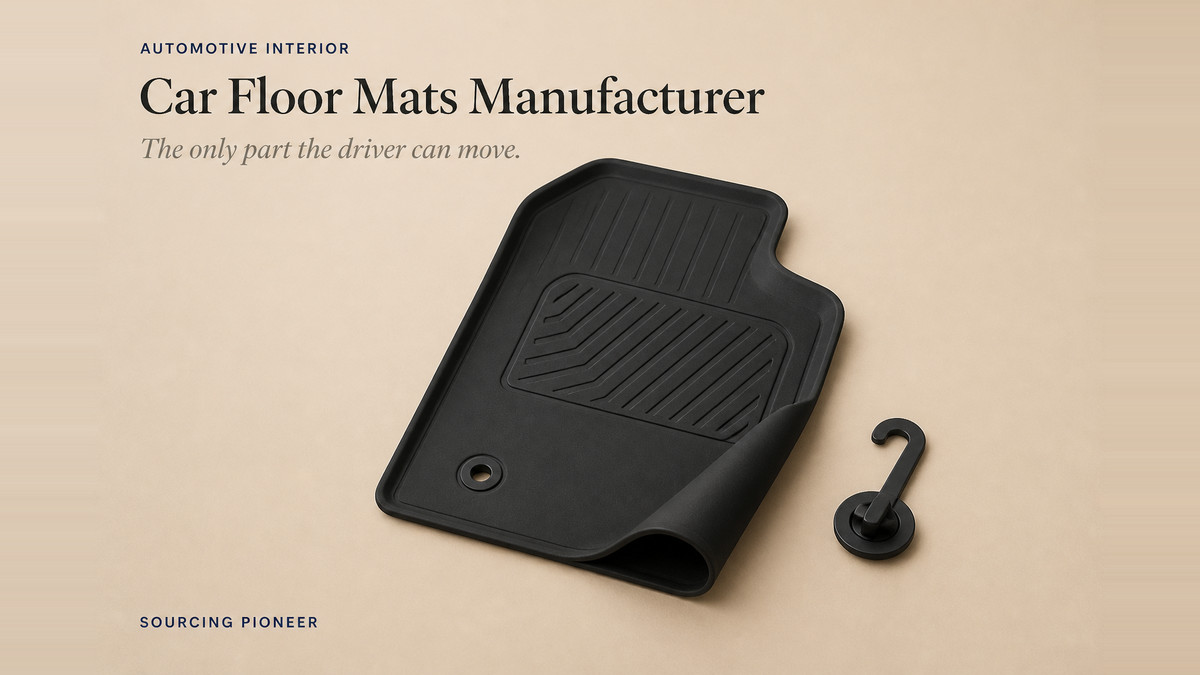
A car floor mat looks like trim and is not. It occupies the same volume of space as a pedal, and it is the only object in the footwell that the driver can move without tools. That combination is why it has its own recall category.
The record keeps a component path for it, and the path is worth reading as a specification:
| Part | What it decides | If it fails |
|---|---|---|
| The anchor — a grommet, a hook or a clip | Whether the mat can move at all | The mat creeps forward into the pedal |
| The heel pad | Where the driver’s heel sits | The foot position shifts over a journey |
| The cut edge | Whether the mat clears the pedal arm | The mat catches the pedal on the way back up |
| The material | How it behaves when it is hot | A soft mat folds rather than springs back |
| The label | Whether the buyer knows it must be anchored | The mat is fitted loose, on purpose |
The component path in the federal file is EQUIPMENT:ACCESSORY:FLOOR MAT, which places this product in the accessory branch rather than the vehicle branch. Some campaigns sit there. Others — the ones where the same fault was investigated as a vehicle defect — sit under VEHICLE SPEED CONTROL:ACCELERATOR PEDAL. A supplier reading only one of those two paths will miss most of the history.
What this guide covers
- What the part is, and why it is not trim
- The mechanism: a pedal that does not come back
- The record’s own word for it is a bus door
- Four floor coverings, four failures
- The accessory became the recall
- One fault, two recalls, the same day
- What the standard asks, and what it does not
- What the record says
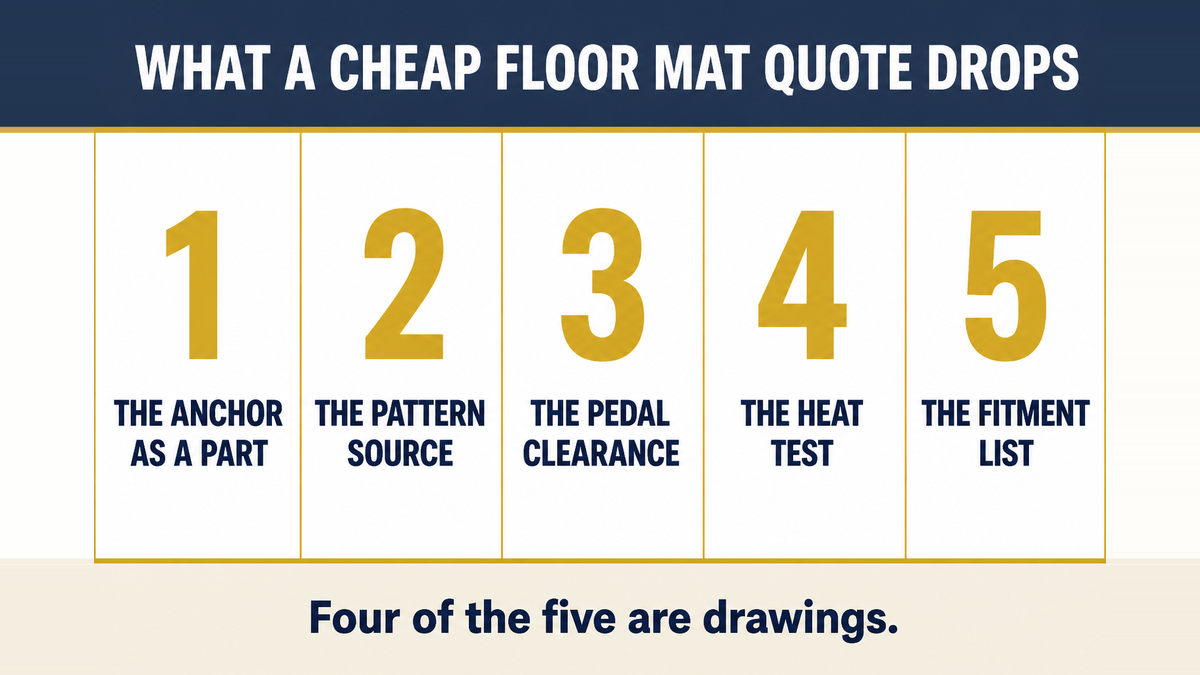
- Five questions a floor mat quote should answer
- Six checks before you order
- Frequently asked questions
2. The Mechanism: A Pedal That Does Not Come Back
The failure is not that the mat is in the way. It is that the mat prevents the pedal from returning, and a pedal that stays down is an engine that stays at speed. The 2009 Toyota campaign states both halves in the plainest language in the whole file.
“The accelerator pedal can get stuck in the wide open position due to its being trapped by an unsecured or incompatible driver’s floor mat.” — campaign 09V388000, 4,445,056 vehicles
“A stuck open accelerator pedal may result in very high vehicle speeds and make it difficult to stop the vehicle, which could cause a crash, serious injury or death.”
Two words in the first sentence are the sourcing brief. Unsecured means the mat was not anchored. Incompatible means the mat was anchored, or intended to be, and still did not fit the footwell it was sold for. Those are the two ways a mat ends up in the pedal, and they map onto two different things a supplier controls: the anchor in the moulding, and the pattern the moulding was cut from.
The remedy in the same document is worth reading closely, because it shows how far the fault had to be chased.
“Dealers will modify the accelerator pedal and, on certain vehicles, alter the shape of the floor surface under the pedal. These changes address the risk of pedal entrapment due to interference with the floor mat. … Also, dealers will replace any genuine Toyota or Lexus all-weather floor mats with redesigned all-weather mats, or repurchase the previous mats from owners who do not want the new ones.”
Three separate fixes were needed for one mat: reshape the pedal, reshape the floor, and replace the mat. A supplier quoting a mat against a vehicle pattern is therefore quoting into a cavity that the manufacturer may since have changed. That is not a reason to refuse the order. It is a reason to ask which model year the pattern was taken from, which is the first question in section 9.
3. The Record’s Own Word for It Is a Bus Door
The trade, the regulator and the engineers all use the same noun for this failure: entrapment. It is the word in Toyota’s own remedy language above, and it is the word in the industry’s coverage of the whole episode. Then the file is searched for it, and the search returns almost nothing.
entrapment appears in five records in one campaign. entrapped appears in twelve records, also in one campaign. And it is the same campaign both times — a Setra S417 bus, campaign 18V106000, 429 vehicles, where the doorway strip that prevents a pinch injury from the outward swivelling entry door may not work, and the fix is to “retrofit a bridging cable to the door control unit that will prevent deactivation of the anti-entrapment strip”.
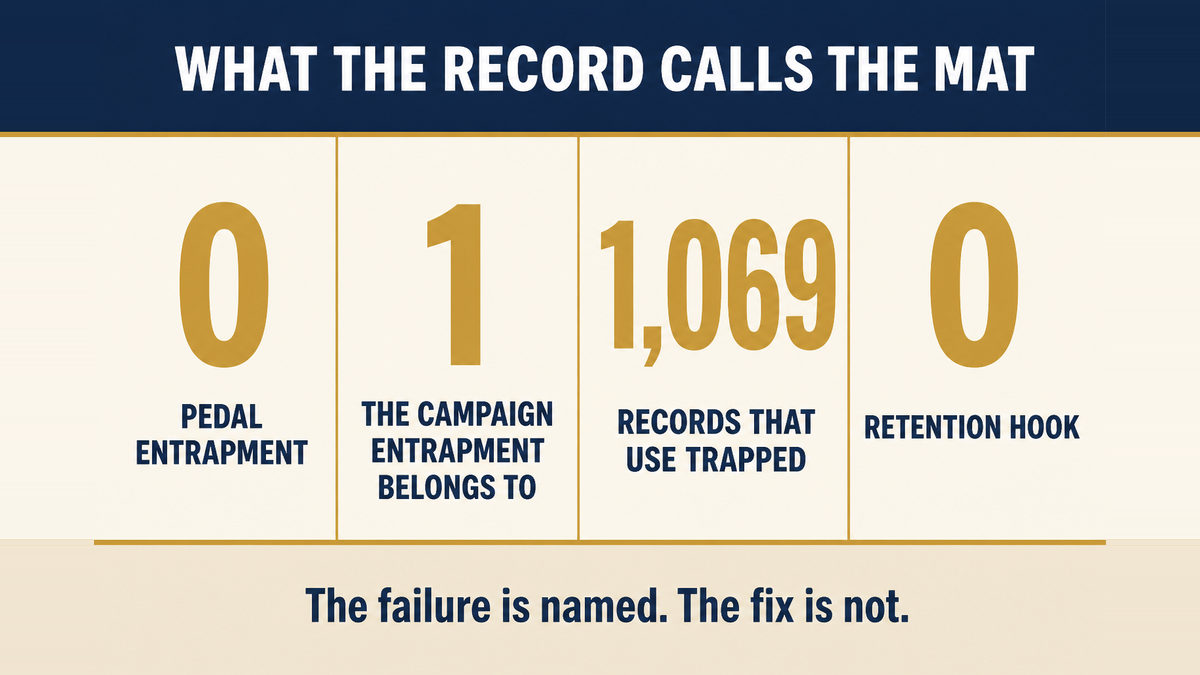
So in 245,845 records the word for a pedal that cannot come back belongs to a bus door. What the file uses for the pedal is not the noun at all. It uses the verb: trapped appears in 1,069 records across 56 campaigns, and the two largest of those 56 campaigns are the Lexus LX570 campaign and the Toyota Highlander campaign — the floor mats. The next four largest are trunk lid latches.
This is the same shape of finding as the fog lamp and the air freshener, but with a twist worth a line of its own. A word that is absent tells you nobody uses it. A word that is occupied tells you it means something else. Here the trade’s noun is occupied by a bus door, and the word the file actually uses for the mechanism is a verb that the file also uses for a boot lid that will not open. The mechanism does not have its own word in the record.
4. Four Floor Coverings, Four Failures
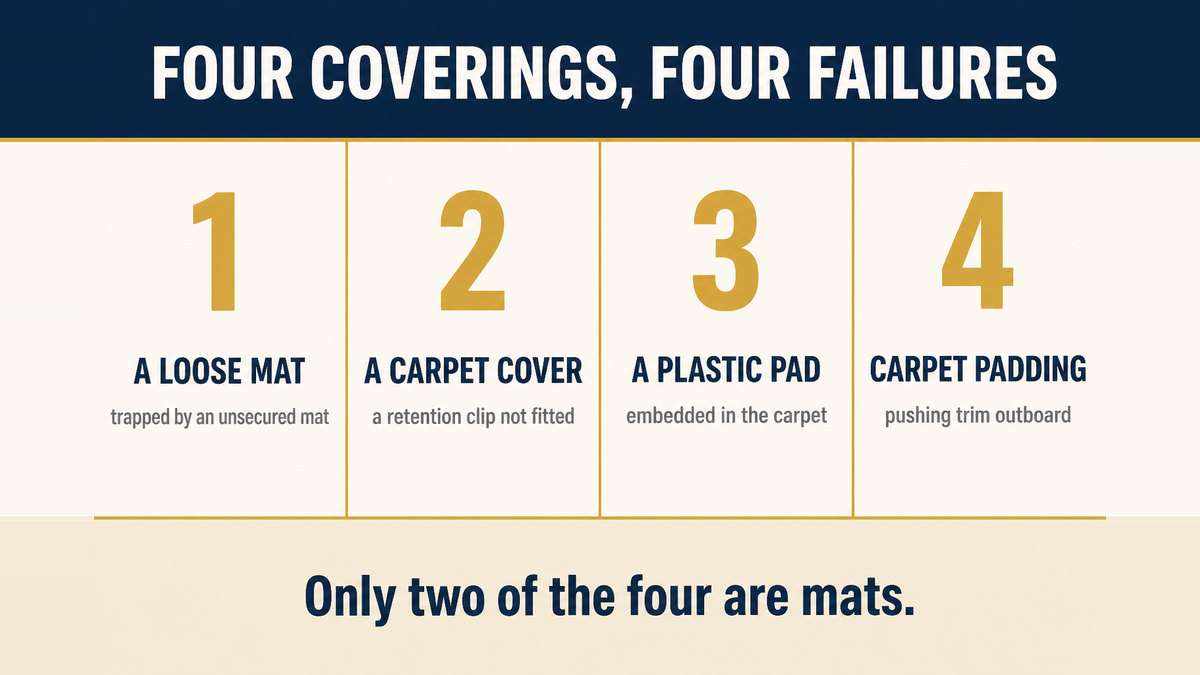
Another reason the history is easy to miss is that the same fault arrives under four different product names, and they are not variations on one design — they are four different parts of the floor.
| What failed | Campaign | Units | In the record’s words |
|---|---|---|---|
| A loose or incompatible mat | 09V388000, 11V113000 | 4,445,056 1,363,244 | “trapped by an unsecured or incompatible driver’s floor mat” |
| A carpet cover leaning on the pedal arm | 11V112000 | 769,379 | “if the forward retention clip used to secure the floor carpet cover … is not installed properly the cover may lean toward the accelerator pedal” |
| A plastic pad embedded in the carpet | 11V115000 | Lexus GS300 / GS350 | “the plastic pad embedded into the floor carpet may interfere with the operation of the accelerator pedal” |
| Carpet padding pushing trim outboard | 12V319000 | Ford Escape | “due to mis-positioned carpet padding the center console trim panel may be pushed outboard … reducing clearance relative to the pedal package” |
Read the second row again, because it is the one that changes a supplier’s checklist. The failing part is the clip, not the cover. The cover is innocent; it leaned because the clip that was supposed to hold it down was not fitted properly. A buyer who checks the shape of a mat and not the retention hardware has checked the wrong half of the assembly.
The third and fourth rows narrow it further. In the Lexus case the offending article is a plastic pad set into the carpet — not a removable mat at all. In the Ford case the carpet padding is mis-positioned, and the consequence is that the driver’s foot can catch on the trim rather than the pedal being trapped. So the family is not “mats”. It is everything in the footwell that can move, be moved, or be installed slightly out of place.
5. The Accessory Became the Recall
The 2009 and 2010 campaigns were vehicle recalls: the manufacturer recalled the cars and named its own mats as part of the fix. What has happened since is more useful to an independent supplier, because the recalls are now aimed at the mat itself, filed by the company that sold it.
- Quadratec, campaign 13E010000, 15,836 units of aftermarket Ultimate Floor Liner for 2007–2013 Jeep Wranglers, sold between May 2012 and February 2013: “the anchor point for the affected floor liners may tear during use, particularly when exposed to high temperatures. The tearing may allow the floor liner to shift forward.” The remedy was to exchange the liners or supply a hook guard kit to secure the driver-side mat. The recall notice states plainly that it is Quadratec’s and not Chrysler’s.
- Omix Ada, campaign 14E061000, 45,524 units, manufactured between November 2009 and August 2014: “the affected floor mats may move forward unintentionally”, which “can interfere with the movement of the accelerator pedal, preventing its return to an idle position”. The remedy was a floor liner anchor and hook. The same mat was sold under four names — Rugged Ridge All Terrain, Cabela’s Custom-Fit, Line-X Truck Gear and Tread Lightly.
- GM, campaign 24E066000, 27,793 units, August 2024, for a Buick Envision all-weather mat with part number 85647097: “the accelerator pedal may become trapped under the floor mat, which can result in unintended acceleration.” The remedy was to modify the mat and reimburse owners for the original cost, with owners who did not want a modified mat able to return it for a refund.
- Lucid, campaign 25E021000, 4,294 units, March 2025, for all-weather mats “without anchors”: “the floor mats may move and trap the accelerator pedal, causing unintended acceleration.” The remedy is the whole story of this article in one line: “owners are advised to remove the all-weather floor mat from the driver’s side footwell”, and Lucid would refund the price.
Four suppliers, four countries of origin and sixteen years apart, and the same three mechanical facts keep appearing: a mat with no anchor, an anchor that tears, and an anchor that was never fitted. The Lucid notice is the only one where the remedy is removal rather than repair, and the reason is visible in its own wording — the mats were sold without anchors, so there was nothing to add.
6. One Fault, Two Recalls, the Same Day
The clearest structural fact in the whole file is a pair of campaign numbers issued on the same date, 27 August 2020, by the same manufacturer.
| The vehicle | The accessory | |
|---|---|---|
| Campaign | 20V513000, number W63 | 20E060000, number W64 |
| Units | 160,229 vehicles | 34,034 mat kits |
| Subject | 2019–2020 Ram 1500 with adjustable pedals | Mopar all-weather mat kits, twelve product numbers |
| Fault | “In certain accelerator pedal positions, the floormats may prevent the pedal from returning to the normal resting (idle) position.” | |
| Remedy | Modify the driver’s floormat to remove the potential for pedal interference | |
Two notices, one fault, because the recall system had to name both the thing that was sold and the thing it was sold for. And the reason the fault exists at all is in the vehicle description: adjustable pedals. A pedal that moves towards the driver changes the clearance in the footwell, so a mat that fits the footwell at one pedal position may foul the pedal at another. A supplier building a pattern from a static vehicle — or from a scan taken with the pedals in the position they happened to be in — can miss the failure entirely.
7. What the Standard Asks, and What It Does Not
There is a federal safety standard for the accelerator control system, and it is the obvious place to look for a rule about this. It asks about something else.
“This standard establishes requirements for the return of a vehicle’s throttle to the idle position when the driver removes the actuating force from the accelerator control, or in the event of a severance or disconnection in the accelerator control system.” — FMVSS 124, paragraph S1
The two triggers are a released pedal and a broken or disconnected control system. The operative test is written for a cable that snaps:
“The throttle shall return to the idle position from any accelerator position or any speed of which the engine is capable whenever any one component of the accelerator control system is disconnected or severed at a single point.” — FMVSS 124, paragraph S5.2
The timing is exact and it is the part a supplier can quote: the maximum time to return to idle is one second for vehicles of 4,536 kilograms or less gross vehicle weight rating and two seconds above that, extended to three seconds for any vehicle exposed to ambient air between −18 °C and −40 °C during the test or during the twelve-hour conditioning period. The test temperature band itself runs from −40 °C to +52 °C, after twelve hours of conditioning anywhere in that range.
Now look for the obstruction. There is none. FMVSS 124 is written about the control system failing on its own — a severance, a disconnection, a single point of failure inside the linkage. A floor mat pressing on a pedal is an external object applying force the standard never describes. That is why the answer to this problem was not a clause in a standard but a set of recalls, and why one of the fixes that emerged — software ensuring the brake overrides the accelerator when both are pressed — had to be added by the manufacturer rather than required by a rule.
The third thing the standard does not do is measure the footwell. Nothing in it describes the clearance between a pedal and a floor covering, because the floor covering is not part of the control system as the standard defines it. A mat supplier is therefore working in a space that is empty of standards and full of recall documents — which is precisely the space this series keeps finding, arrived at from the opposite direction.
8. What the Record Says
Method first. The federal recall file holds 245,845 records and has no header row, so every field of every record is scanned rather than trusting a column map. Controls: brake appears in 28,639 records and air bag in 16,162. Every term is counted with its own pattern rather than inside one combined search, because a combined search that lists a short word before a longer phrase containing it will consume the text and silently report the longer phrase as zero.
| Term | Records | Campaigns |
|---|---|---|
floor mat | 143 | 22 |
floor mats | 77 | 12 |
floormat | 26 | 2 |
floormats | 28 | 3 |
all-weather floor mat | 69 | 6 |
floor liner | 15 | 4 |
floor matting | 0 | 0 |
accelerator pedal | 626 | 86 |
unintended acceleration | 173 | 26 |
trapped | 1,069 | 56 |
pedal entrapment | 0 | 0 |
entrapment | 5 | 1 |
entrapped | 12 | 1 |
retention hook | 0 | 0 |
mat clip | 0 | 0 |
grommet | 53 | 15 |
mat | 650 | 53 |
carpet | 132 | 12 |
obstruct | 245 | 18 |
Three of these rows matter more than the rest.
The product is named. floor mat appears in 143 records across 22 campaigns, and reading them shows the phrase doing exactly the work a buyer would want it to do: identifying the part that trapped the pedal. This is the first article in the series where the trade’s own noun is present, in quantity, and doing its job.
The part that fixes it is not named. The remedy in the Omix Ada campaign is “a floor liner anchor and hook”, and in the Quadratec campaign “a hook guard kit”. But retention hook appears zero times and mat clip appears zero times. So the file names the failure and the fix in prose while giving the fix no vocabulary of its own. A supplier searching the record for the retention hardware will find nothing, and may conclude no such requirement exists.
The word for the mechanism is missing. pedal entrapment is zero. entrapment belongs to one bus door. trapped is used 1,069 times, and its two largest campaigns are the floor mats while its next four are boot lids. The industry’s noun for a pedal that cannot return has no home in this file at all.
One more row is worth a sentence, because it is the trap a supplier walks into. mat appears 650 times across 53 campaigns, and the largest campaigns that are not about floor mats are occupant classification recalls — where a mat is a pressure sensor sewn into the passenger seat. A 2005–2007 Cadillac CTS campaign puts it precisely: “repeated flexing of the passenger sensing system mat in the front passenger seat may cause the mat to kink, bend, or fold. This flexing can break the connections in the mat.” Two products, two completely different functions, one word — and the seat version is the one the file discusses more.
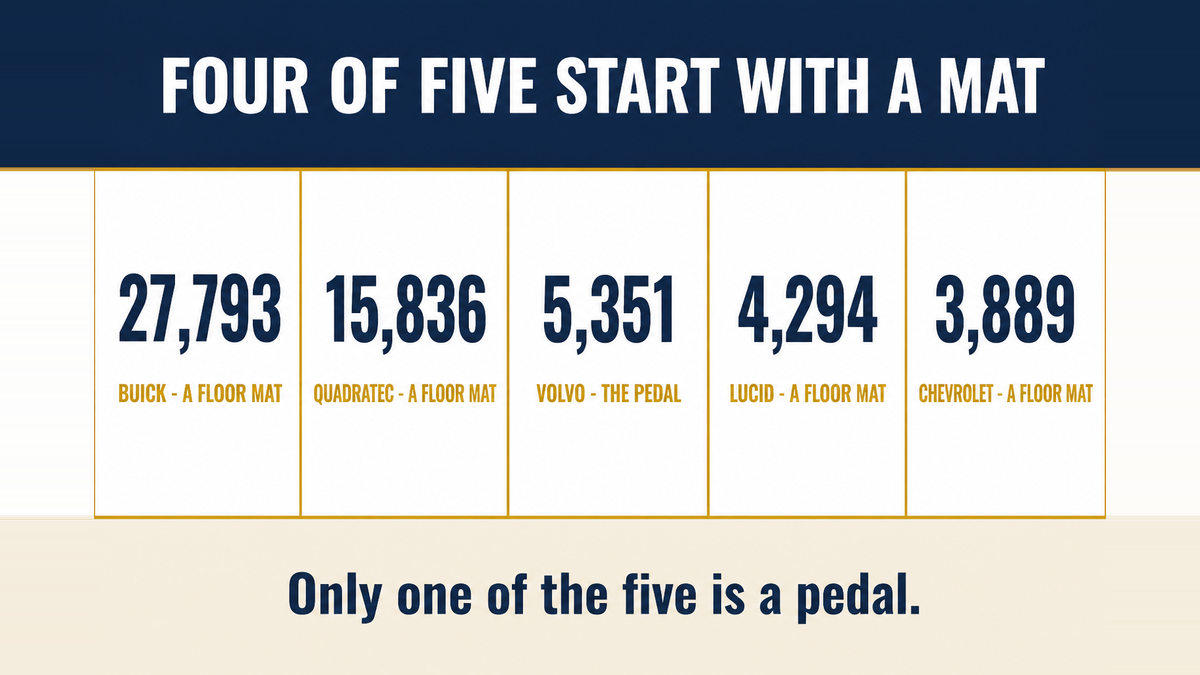
The last count closes the argument. unintended acceleration appears in 173 records across 26 campaigns, and if the five largest are placed in order, the shape of the modern problem is unmistakable.
| Campaign | Subject | Units | What it is |
|---|---|---|---|
| 24E066000 | Buick Envision mat, part 85647097 | 27,793 | A floor mat |
| 13E010000 | Quadratec Ultimate Floor Liner | 15,836 | A floor mat |
| 22V288000 | Volvo XC40 BEV | 5,351 | The vehicle pedal |
| 25E021000 | Lucid mats without anchors | 4,294 | A floor mat |
| 21E089000 | Chevrolet all-weather mats | 3,889 | A floor mat |
Four of the five largest “unintended acceleration” campaigns in the file begin with a floor covering. Only one is about a vehicle pedal. Put that beside the 2009 history and the conclusion is uncomfortable for anyone who thinks of this product as trim: the single most productive way to cause unintended acceleration in a modern car, according to the record, is to put a bad mat in the footwell.
9. Five Questions a Floor Mat Quote Should Answer
A floor mat quote usually carries a material, a thickness, a colour, a set of pieces and a price. None of those tells you whether the mat can be fitted safely. These five do.
- What holds it down, and what happens when that part fails? An anchor is either a grommet that takes an existing post, a hook, or a twist-lock. A mat with no anchor has no failure mode because it has no restraint — which is why the Lucid campaign exists.
- Which vehicle and which model year was the pattern taken from? Not the range the mat is sold for. The one it was cut against. The Ram campaign turned on adjustable pedals, so the same footwell has more than one geometry.
- What is the clearance to the accelerator at both extremes of pedal travel? Drawn at rest and drawn at full travel, not averaged, and stated in millimetres on a section through the footwell.
- How does the anchor behave when it is hot? The Quadratec recall says the anchor point “may tear during use, particularly when exposed to high temperatures”. Ask for the temperature, the test and the result, not for a claim.
- Is there a fitment list by part number, and a written statement of what the mat is not for? The failures in this file are as often a mat sold for the wrong vehicle as a mat built badly.
10. Six Checks Before You Order
- The anchor drawn as a part, with its material, its retention force and the post or hook it engages — not described as “anti-slip backing”.
- The pattern source recorded in writing: the vehicle, the year, the variant, and whether that variant has adjustable pedals.
- A section drawing at both pedal extremes, with clearance to the accelerator and to the brake pedal arm dimensioned.
- A heat test on the anchor, at the temperature the footwell reaches in the destination market, on the production moulding rather than a prototype.
- The fitment list, checked against the destination market’s model years, with the exclusions written down.
- The instruction sheet and the label, in the customer’s language, stating that the mat must be anchored before use. In every campaign in this article the person who fits the mat is the person who creates the fault, and the record shows they are told afterwards by post.
Items one, three, five and six are the ones a factory audit can confirm on site, because each of them is a document rather than an opinion. Item six is the one a pre-shipment inspection should photograph, because a set of mats can pass every dimensional check and still leave the factory with no anchor instruction in the box. And because a floor mat set is bulky rather than heavy, the freight calculation turns on volume rather than weight — the same volumetric basis that decides most light, large automotive accessories.
A floor mat is one of the few interior products the vehicle safety file actually names, and it is named for a reason. This one found the opposite, and it is the more uncomfortable result. A floor mat is named in the file, in 143 records across 22 campaigns, and it is named as the cause of a pedal that will not come back.
It has been recalled by Toyota at a scale of millions of vehicles, by an aftermarket liner company whose anchor tore in the heat, by a Jeep accessories maker, by GM under a single part number, by FCA on the same day under two campaign numbers, and by Lucid in 2025 — where the remedy was to take the mat out of the car and give the buyer their money back. Yet the standard written for that exact pedal, FMVSS 124, asks only whether the control system breaks, and the part that fails in these recalls — the retention hook — appears zero times. So ask for the anchor as a part, the pattern source in writing, a section drawing at both pedal extremes, a heat test on the production moulding and a fitment list with its exclusions.
Frequently Asked Questions
Are car floor mats a safety part?
Yes, and the record treats them as one. The federal recall file holds 245,845 records and the phrase floor mat appears in 143 of them across 22 campaigns. Four of the five largest campaigns that use the phrase unintended acceleration are about floor coverings rather than about a vehicle pedal. A mat shares the footwell with the accelerator, so a mat that moves can stop the pedal returning.
Why do floor mats get recalled?
Three mechanical reasons appear again and again. A mat with no anchor can creep forward into the pedal — that is the Lucid campaign of 2025, where the mats were sold without anchors and the remedy was to remove them. An anchor can tear, which is the Quadratec campaign, where the anchor point could tear particularly when hot and the remedy was a hook guard kit. And a mat anchored to the wrong vehicle can still foul the pedal, which is why the recall wording says an unsecured or incompatible mat.
What is a floor mat retention hook, and does my mat need one?
It is the part that holds the mat to the floor, and in the two largest aftermarket campaigns it was the remedy: Omix Ada supplied a floor liner anchor and hook, and Quadratec supplied a hook guard kit. Any mat for a driver’s footwell needs one, because the driver’s mat is the only one the driver can move without tools. Note that the phrase retention hook appears zero times in the federal recall file even though the part is named in the remedy text, so absence of the term proves nothing.
Do all-weather floor mats need anchors?
The 2025 Lucid campaign is the clearest answer the record gives. The mats were recalled because they were sold without anchors, the fault was stated as the mats moving and trapping the accelerator, and the remedy was to remove the driver-side mat and refund its price. A rigid all-weather mat does not stay put by weight, and a rubber backing is not a restraint.
What does FMVSS 124 require for accelerator pedals?
It requires the throttle to return to idle when the driver releases the pedal or when the accelerator control system is severed or disconnected at a single point. The maximum time to return to idle is one second for vehicles of 4,536 kilograms or less gross vehicle weight rating and two seconds above that, extended to three seconds for vehicles tested between minus 18 and minus 40 degrees Celsius. The test band itself runs from minus 40 to plus 52 degrees Celsius after twelve hours of conditioning anywhere in that range. Nothing in the standard describes force applied from outside by an object in the footwell.
What does the recall file call a floor mat?
Floor mat, and it uses the phrase for exactly this part — 143 records in 22 campaigns. The surrounding vocabulary is where it gets confusing. The word mat on its own appears 650 times and most often means the occupant-sensing mat sewn into a passenger seat. Trapped covers 1,069 records and its largest campaigns after the floor mats are boot lid latches. The noun entrapment belongs to a single bus door campaign. The phrase pedal entrapment does not appear at all.
A Sheet the Garage Signs After Fitting
One page: the mat part number, the retention clips used, and the fitter's signature against the check it carried out.
Issue My Fitting Sheet
Questions & Comments
We read every one and reply within 24 hoursA floor mat is one of the few interior parts the safety file names, and it is named for the pedal. Send the vehicle and the pattern, and we will dimension the retention point and check clearance.