
LED Light Bar Wholesale: The Optional DOT Mark
 ·
Updated October 16, 2026
·
11 min read
Most products are marked because a rule says they must be. An LED light bar is different. Under the American lighting standard, a lamp that is not a headlamp may be marked with the symbol DOT — and the same sentence says that the symbol constitutes a certification that the product meets the standard. The mark is optional. Printing it is not. That single sentence is the whole commercial risk of this product, and the recall file shows what happens on both sides of it.
1. What a Light Bar Is Made Of, and Where the Rules Attach
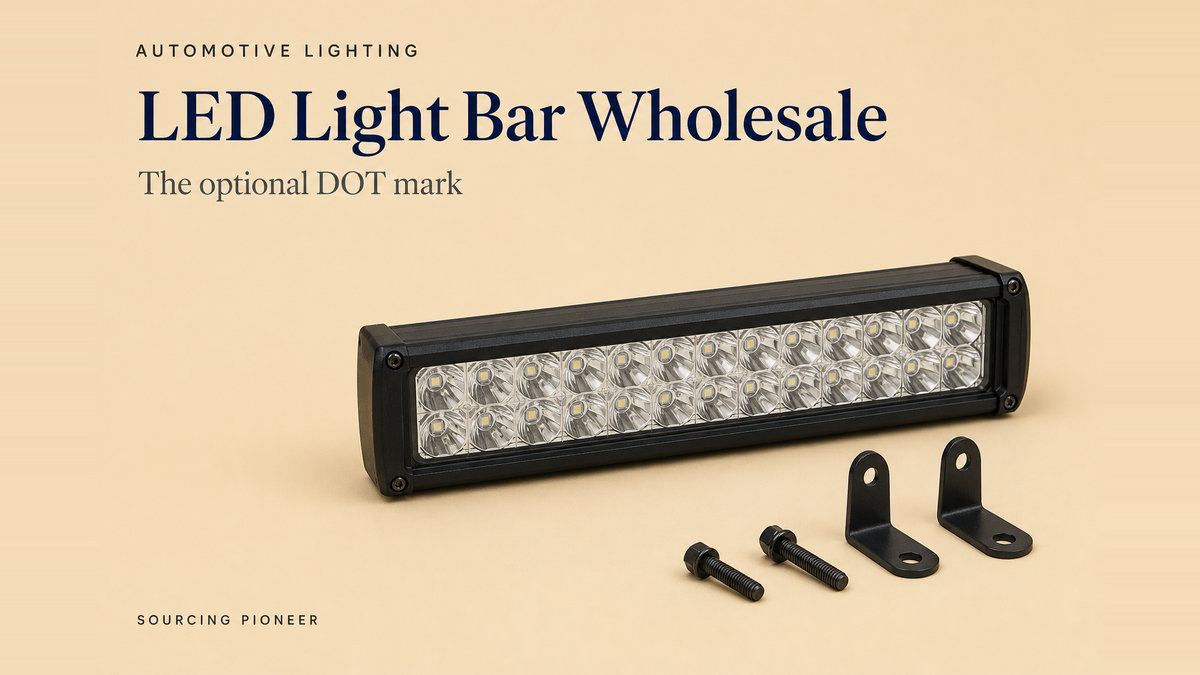
Open a light bar and the parts are countable: a cast or extruded housing, a lens, a circuit board with an array of emitters, a driver, a gasket or sealant, a lead and connector, and two mounting brackets with bolts.
The interesting thing about this list is which parts the rules touch. The emitters, the optics and the driver decide what the product does, and the standard has a great deal to say about them. But the parts that appear in the recall file are the lens and the bracket.
| Part | What it decides | Where the risk actually sits |
|---|---|---|
| The housing | Heat path, rigidity and how the unit is fastened | Nothing in the file, unless the bracket is cast with it |
| The lens | The beam pattern, and the marking surface | Microcracks and moisture — two recalls |
| The board and driver | Output, current and heat | An interior light bar that shorted |
| The gasket or sealant | Whether water reaches the board | Moisture again, and lens fogging |
| The bracket | Whether the unit stays on the vehicle | Two recalls, both about attachment |
| The marking | Whether the product makes a claim in law | One replacement-lamp recall, and it is the reason this option exists |
What this guide covers
- What a light bar is made of
- What the standard covers, and the words it uses
- The mark you do not have to print
- SAE by reference, and the word should
- Mounting, spacing and the impairment rule
- What the record calls it
- Two off-road light bars, both about attachment
- The lens microcrack that came back
- Five campaigns about other people’s lamps
- What the file never measures
- Five questions a light bar quote should answer
- Six checks before you order
- Frequently asked questions
2. What the Standard Covers, and the Words It Uses
The standard is 49 CFR 571.108, Federal Motor Vehicle Safety Standard 108, Lamps, reflective devices, and associated equipment. Its scope sentence is worth reading twice, because the third application paragraph is the one that reaches an aftermarket part.
“This standard applies to: Passenger cars, multipurpose passenger vehicles, trucks, buses, trailers (except pole trailers and trailer converter dollies), and motorcycles; … and lamps, reflective devices, and associated equipment for replacement of like equipment on vehicles to which this standard applies.”
“For replacement of like equipment” is the phrase that puts a wholesale light bar inside a federal safety standard. You are not selling a decorative item to a rule that ignores accessories; you are selling equipment that replaces or supplements lighting equipment on a vehicle the standard governs.
Then notice the vocabulary, because it does not match the vocabulary of the trade. The standard deals in headlamps, taillamps, stop lamps, clearance lamps, marker lamps, backup lamps and, for anything extra, auxiliary lamps. It defines a cargo lamp as a lamp mounted on a truck or bus to illuminate loading, a daytime running lamp as a steady lamp used for conspicuity when headlamps are not needed for driving, and an effective light-emitting surface as the portion of the lamp that directs light to the test pattern. Working out which of those categories your product is sold as is the first decision of the project, because everything else follows from it.
3. The Mark You Do Not Have to Print
Now to the sentence that matters most. The standard's marking clause treats headlamps and everything else differently, and the difference is a single verb.
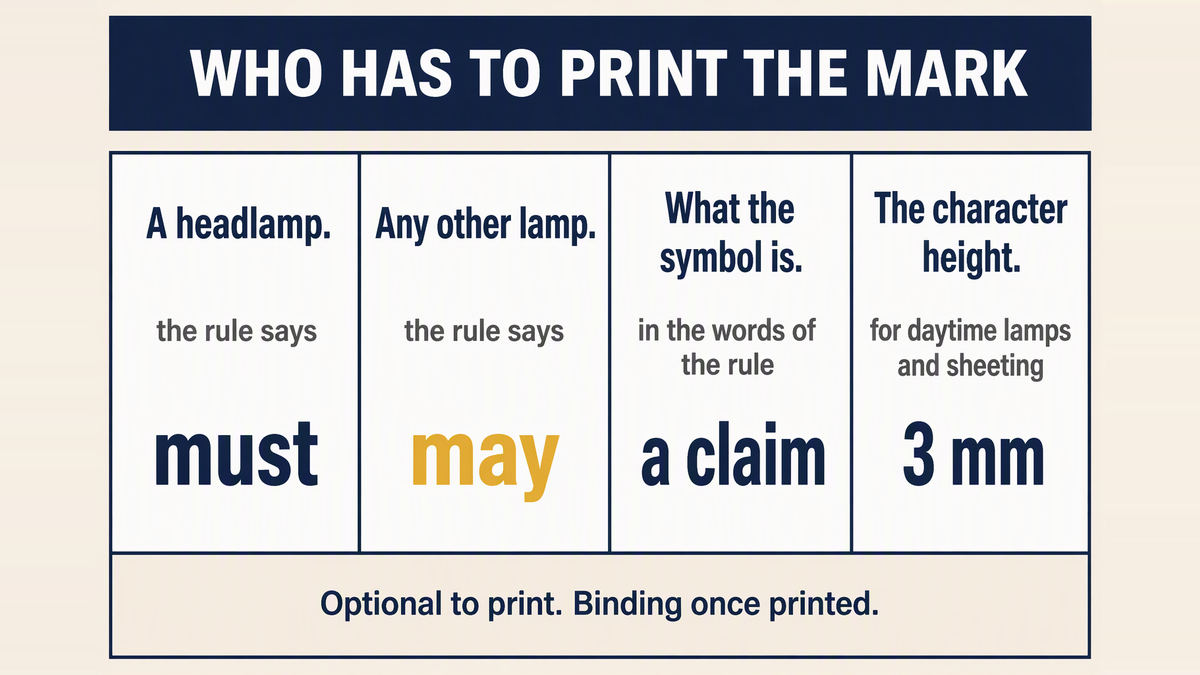
“The lens of each original equipment and replacement headlamp… must be marked with the symbol ‘DOT’ … to indicate certification under 49 U.S.C. 30115.”
And then, one paragraph later, for every other lamp in the standard:
“Each original equipment or replacement lamp or reflective device specified in Table I, except for a headlamp, or an item of associated equipment … may be marked with the symbol ‘DOT’ which constitutes a certification that it conforms to the requirements of this standard.”
Read the two together and three things fall out.
First, for a headlamp the mark is compulsory. A replacement headlamp with no DOT marking is already in breach, and the recall file contains exactly that case.
Second, for a light bar the mark is voluntary. You are permitted to ship an auxiliary lamp with no DOT symbol at all, provided the product is sold and used in a way that is honest about what it is.
Third, the moment you print it, it becomes a claim. The regulation does not say the symbol means “looks like a lamp that meets the rules”. It says the symbol constitutes a certification that the product meets the standard. A supplier who adds a DOT mark to artwork to make a light bar look more legitimate has made a legal statement about photometrics, marking and materials, and the buyer who repeats that statement owns part of it.
4. SAE by Reference, and the Word Should
Here is the section that catches out almost every specification sheet, and it is four lines long.
“Each required lamp, reflective device, and item of associated equipment must be designed to conform to the requirements of applicable SAE publications as referenced and subreferenced in this standard. The words ‘it is recommended that,’ ‘recommendations,’ or ‘should be’ appearing in any SAE publication referenced or subreferenced in this standard must be read as setting forth mandatory requirements.”
Two consequences follow, and both are commercially useful.
The first is that an SAE reference is not marketing language. Where the lighting standard references an SAE document, that document becomes part of the federal requirement, and so do the documents it in turn references. A spec sheet that says a light bar is built to an SAE practice is making a statement about a chain of incorporated documents, not about a house style.
The second is the sentence that no supplier reads closely enough: in those incorporated documents, “should” is read as mandatory. In most of technical writing, “should” is advice. Here it is a requirement, and the regulation says so explicitly. This is the single most useful thing a buyer can know when reading a supplier’s claim about an SAE practice, because it removes the usual defence that a recommendation was optional.
There is a companion regime for the light source itself. A replaceable light source is defined as an assembly of capsule, base and terminals designed to conform to the appendices of 49 CFR part 564, Replaceable Light Source Information, the part of the rules where bulb dimensions and electrical figures are filed with the agency. If your light bar uses removable bulbs rather than an integrated board, that filing regime is part of the product, and the bulbs carry their own marking duty: the DOT symbol and a name or trademark. Where a ballast or driver is required, the driver carries its own marking list, including a warning that the output voltage presents a risk of severe electrical shock, the output power in watts and the output voltage.
5. Mounting, Spacing and the Impairment Rule
The standard spends several paragraphs on where a lamp may go, and three of them apply directly to a bar that a customer is going to bolt onto a vehicle.
- Rigid and permanent. Each lamp must be securely mounted on a rigid part of the vehicle, other than glazing, that is not designed to be removed except for repair, within the location and height limits, and in a position where it still meets the photometric and visibility requirements with all obstructions considered. Mounting a light bar on glass, or on a panel designed to come off, is outside the rule before photometrics are even discussed.
- Twice the spacing. Where an auxiliary lamp is mounted near identification lamps, each auxiliary lamp must be located at least twice the distance from any required identification lamp as the distance between two adjacent required identification lamps. This is the most specific geometric requirement in the section, and it exists because identification lamps are read as a group at a distance.
- Impairment. And then the sentence that decides the fate of a very large bar on a bull bar: “No additional lamp, reflective device, or other motor vehicle equipment is permitted to be installed that impairs the effectiveness of lighting equipment required by this standard.”
That last rule is the reason a light bar’s legality genuinely depends on the vehicle. The same product is a lawful auxiliary lamp on one installation and an impairment of a required lamp on another, and no certificate issued at the factory can settle it. It also explains the recall in section 9, where a manufacturer fitted a grille cover that was permissible and still had to be recalled because it degraded a required turn signal over time.
Two smaller marking duties sit alongside the main one and are easy to miss. A lamp used as a daytime running lamp must be permanently marked DRL on its lens in letters not less than 3 mm high, unless it is optically combined with a headlamp. And on the conspicuity side, the letters DOT-C2, DOT-C3 or DOT-C4 must appear on the exposed surface of the sheeting, at least once per segment and at least every 300 mm on white-only sheeting, in characters not less than 3 mm high, permanently stamped, etched, moulded or printed in indelible ink. The character height and the word indelibly are the two things a printing supplier gets wrong.
6. What the Record Calls It
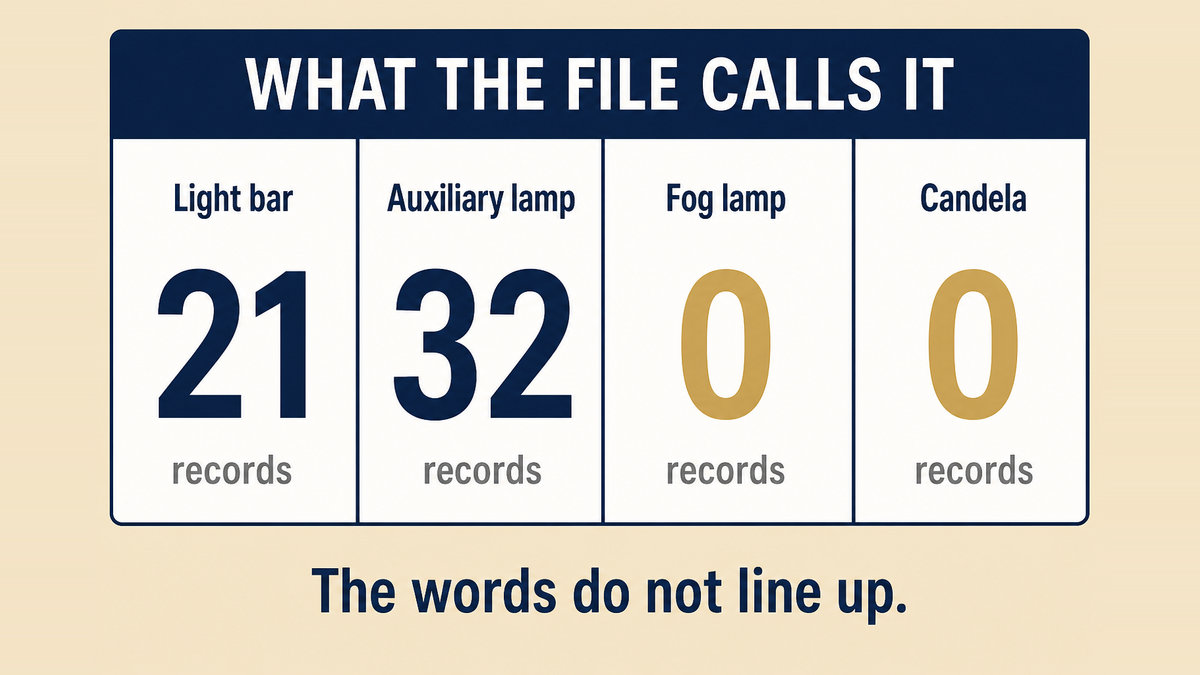
Method first. The federal recall file holds 245,845 records and no header row, so every field of every record is scanned rather than trusting a column map. Controls: brake appears in 28,639 records and air bag in 16,162. Every count below is matched on a word boundary, because LED is a substring of failed, sealed and handled, and the naive count is roughly ten times the real one.
| Term | Records | Campaigns |
|---|---|---|
headlight | 1,358 | 142 |
LED | 1,674 | 136 |
headlamp | 553 | 81 |
auxiliary lamp | 32 | 1 |
light bar | 21 | 7 |
fog light | 17 | 2 |
driving lamp | 7 | 1 |
FMVSS 108 | 28 | 4 |
fog lamp | 0 | 0 |
photometric | 3 | 2 |
candela | 0 | 0 |
lumen | 0 | 0 |
Four of those rows are worth a sentence each.
“Fog lamp” appears in none of the 245,845 records. The standard uses fog lamp and the trade uses fog light, which appears in 17 records. The words do not line up, and a buyer searching the file with the catalogue term finds nothing.
“Auxiliary lamp”, the standard’s own category for a light bar, appears in 32 records and in a single campaign. The category the regulation created for this product has been used once in the file, which tells you how little the file is organised around the product you are selling.
“Photometric” appears three times, and candela and lumen appear never. The standard is a photometric document. The units the product is sold on — lumens, lux, beam distance — are not in the safety record at all, because recalls are not filed for a lamp being dim. They are filed for a lamp being missing, loose, wet or pointed the wrong way.
And the file does contain marking failures. Seven campaigns turn on missing or illegible DOT markings. The clearest is a bus window: the record says a missing DOT code mark may result in the window being replaced with the incorrect type of glass. That is the whole argument for a marking in one line — it exists so that somebody in the future fits the right part, and the recall file enforces it.
7. Two Off-Road Light Bars, Both About Attachment
The clearest lesson in the file is that a light bar does not get recalled for being too bright. It gets recalled for coming off, and both of the recent cases are under two years old.
- Tesla, campaign 25V170000, 46,096 Cybertrucks: the light bar could delaminate and detach from the vehicle. The consequence in the record is not a lighting failure but a road hazard. The remedy was to replace the cant rail assembly. Note where the campaign was filed: the component field reads structure, body, not lighting. Once a light bar becomes a part that can fall off, the record stops treating it as a lamp.
- Tesla, campaign 25V735000, 6,197 Cybertrucks, on vehicles with a service-installed off-road light bar accessory: an incorrect surface primer may have been used to attach the light bar to the windshield, so it could loosen and detach. The remedy was to inspect and either install an additional mechanical attachment or replace the bar using tape and an additional mechanical attachment.
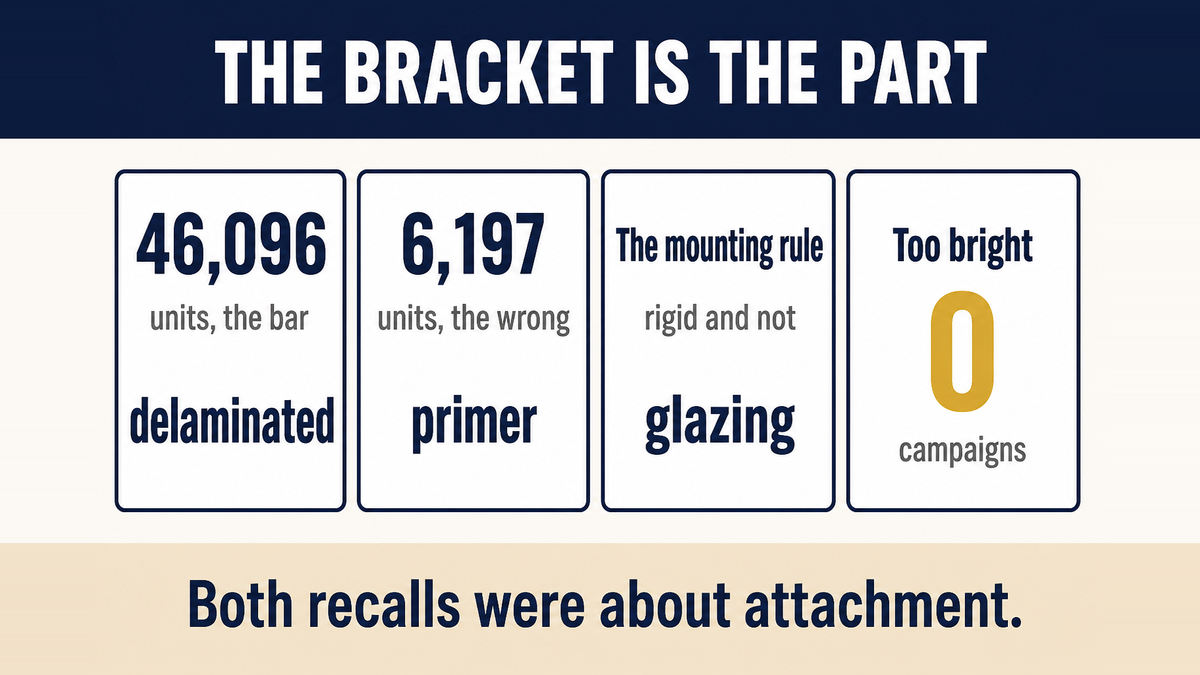
Read the second one as a warning about accessories in general. The product was not defective in the sense a factory would recognise. The adhesive process was wrong, the fix was a mechanical fastener, and the requirement it ran into is the one quoted in section 5: a lamp has to be mounted on a rigid part of the vehicle that is not glazing and is not designed to be removed except for repair. A light bar held to a windshield by tape and primer is, in the plain reading of that sentence, mounted on the one surface the rule names by exclusion.
For a supplier the practical consequence is that the bracket and the installation sheet are part of the product. If your light bar is designed to attach with tape, with a clip, or to a surface the customer chooses rather than one you specify, the recall risk has moved out of the optics and into the pack contents. Ask for the mounting drawing and put a torque figure and a surface requirement in the instructions.
8. The Lens Microcrack That Came Back
The second cluster is about the lens and the water that gets through it, and it contains one of the clearest examples in this whole series of a recall that had to be repeated.
- Ford, campaign 23V418000, 16,375 F-150 Lightning vehicles from 2022 to 2023: the rear lightbar could have microcracks in the outer lens that allowed moisture to gather inside, which could result in inoperative or flickering reverse lights. The consequence named by the agency is that a reversing vehicle may not be noticed. The remedy was to replace the rear lightbar.
- Ford, campaign 25V731000, 14,843 vehicles, previously repaired under the earlier recall: the same microcracks, the same moisture, the same inoperative reverse lights. This time the remedy was to inspect and replace the lightbar and the fasteners.
Two things are worth taking from that pair. The first is that a lens crack is a functional failure, not a cosmetic one, because the water that gets in reaches the board and takes the lamp out. The second is the word fasteners in the second remedy. A campaign that has to come back usually comes back with a wider fix, and the wider fix is where the original design weakness was. When you read a repeat recall, read the second remedy.
The third campaign in this group is a reminder that a light bar does not have to be outside the car to be a fire risk. Volkswagen, campaign 18V467000, 45,457 Tiguans from 2018: the LED module for the panoramic sunroof ambient light bar could short circuit, with a fire risk as the stated consequence. The remedy was to disconnect the power supply and leave the feature off until a later service action.
An interior bar, a rear bar and an exterior accessory bar, and the file has a fire, a repeat and a detachment between them. The common thread is not the emitter. It is sealing, current and fastening.
9. Five Campaigns About Other People’s Lamps
The most instructive campaigns for an aftermarket supplier are the ones where a lamp somebody else made caused a car maker to file a recall. There are five of them in the file, and each one is a different way for a good product to be fitted badly.
- Ford, campaign 20E025000, 130 replacement headlamps under part numbers DP5Z-13008-T and DP5Z-13008-V for the 2013 to 2016 Lincoln MKZ: the headlamps could have an improper beam pattern and incorrect horizontal adjustment, the side markers might not illuminate, and DOT markings might be missing. The remedy was to inspect and replace, and Ford instructed dealers to return every improper headlamp. It was filed as equipment, by the car maker, for a replacement lamp sold in a box.
- Mercedes-Benz, campaign 10V366000, 3,552 G-Class vehicles: a grille cover for front turn signal protection that, in the agency’s words, while permissible, could over time affect the signal’s ability to meet the minimum requirements of the standard. The remedy was to fit turn light units optimised for use with grilles. This is the impairment rule in the flesh: an accessory that was allowed, and still had to be fixed, because the required lamp behind it lost effectiveness.
- BMW, campaign 10V152000, 735 X5 M vehicles: fitted with side marker lamps but not the power supply cables leading to them, so the lamps did not illuminate. A lamp is not a lamp until it is wired.
- Rosenbauer, campaign 18V874000, 319 fire apparatus: vehicles equipped with accessory brake lights made by a third party, where depending on the specific wiring of the vehicle the brake lights could illuminate when the brake pedal had not been pressed. A companion campaign covered a second chassis builder with the same accessory lights.
- Daimler Coaches, campaign 10V625000, 97 motor coaches: the partition glass behind the driver did not have the necessary DOT markings and was not marked correctly. The remedy was to replace the glass.
Those five cover the whole risk map for an aftermarket lighting supplier, and none of them is about brightness. A replacement lamp that does not match the original beam. An accessory that degrades a required lamp. A lamp that was never connected. A third-party light that lights at the wrong moment because of the host vehicle’s wiring. And a marking that was missing, illegible or wrong.
That last category deserves its own line, because it is the cheapest failure to prevent and the most common. Seven campaigns in the file turn on DOT markings alone, and they span bus windows, an e-bike wheel hub and a replacement headlamp. The record explains why it matters in one sentence about the window: a missing DOT code mark may result in the window being replaced with the incorrect type of glass. The mark is not decoration. It is the only thing that lets a future fitter identify the part.
10. What the File Never Measures
One more set of counts is worth stating, because it separates the numbers a lamp is sold on from the numbers it is recalled on.
In 245,845 records, candela appears zero times. Lumen appears zero times. Lux appears zero times. “Photometric”, the word the standard is built around, appears three times. Against that, moisture appears 1,786 times, glare 710, lens 568, condensation 300 and reflector 885.
Put plainly: the units on the box and the words in the file are almost disjoint. A buyer who negotiates over beam distance and output has negotiated over the two things that do not generate recalls, and has not asked about sealing, aiming, fastening or marking, which do. That is not an argument for ignoring photometrics — it is an argument for asking a second set of questions once the first set is settled, because the second set is what the customer will come back about.
11. Five Questions a Light Bar Quote Should Answer
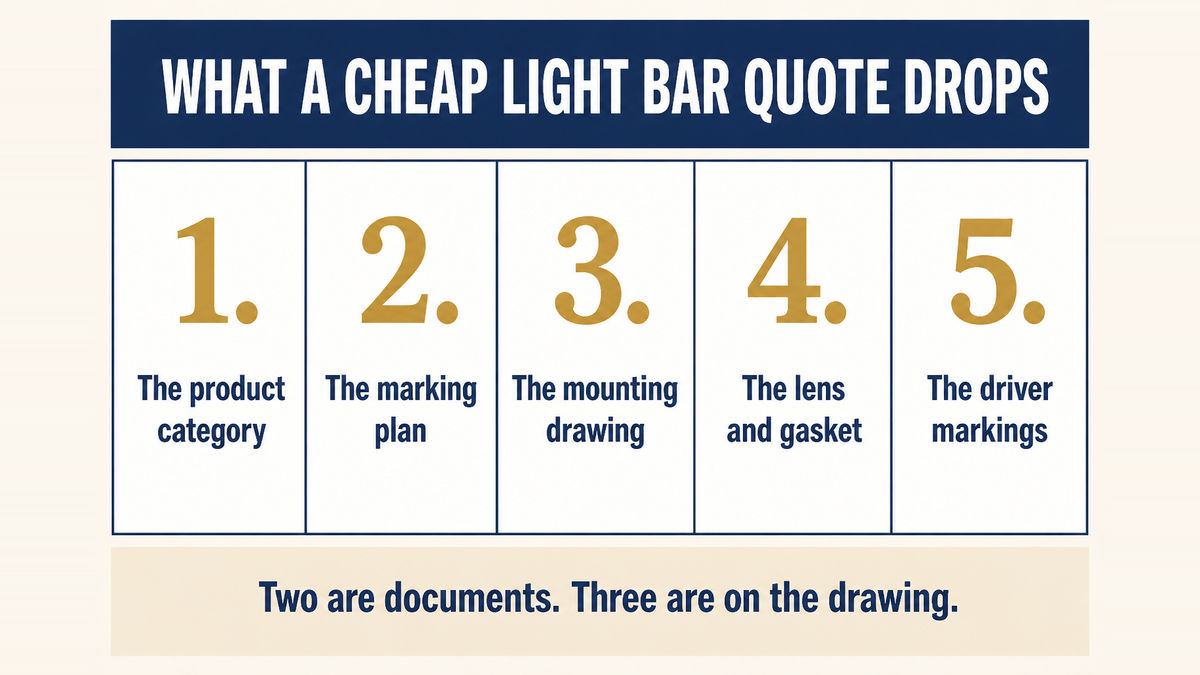
A light bar quote usually carries a length in inches, a row count, a lumen figure and a price. Here are the five questions that decide whether the product can be sold and stay sold.
- Is this product sold as an auxiliary lamp, a work light, or a replacement for a required lamp? The category decides which paragraphs of the standard apply, and the file shows that the answers are not interchangeable. An auxiliary lamp is an extra; a replacement for a required lamp carries a marking duty.
- Will the artwork carry the DOT symbol, and on what basis? For a lamp that is not a headlamp the symbol is optional, and printing it is a certification that the product meets the standard. If the answer is yes, ask which test reports stand behind the beam pattern, the marking and the materials.
- Which SAE practices are cited, and are the recommendations in them being read as requirements? They are read that way by the regulation, so a supplier who treats an SAE recommendation as advice has misread the document chain.
- What does the mounting drawing require? Which surface, how many fasteners, what torque, and whether the bracket is included. Two of the most recent light bar recalls were attachment failures, and one of them involved a windshield.
- What is the sealing and lens specification? Material, wall thickness, gasket or sealant, and whether the unit has been through a moisture and thermal cycle. A lens microcrack took a rear light bar out of service twice on the same vehicles.
12. Six Checks Before You Order
- The category, agreed in writing, because auxiliary lamp, work light and replacement lamp are three different conversations with the same factory.
- The marking plan — whether the DOT symbol appears at all, and if it does, which reports support the claim. A mark printed to look legitimate is a claim made without evidence.
- The DRL and conspicuity lettering, at the required character height and applied indelibly, if either applies to your product.
- The mounting drawing and the installation sheet, including the surface the bracket may not be fitted to, the fastener count and the torque figure.
- The lens, gasket and sealant specification, with the moisture and thermal cycling the unit has been through.
- The driver or ballast, if the product uses one, against its own marking list — including the output figures and the high voltage warning.
That is the kind of list a factory audit turns into questions on site and a pre-shipment check confirms from a photograph. On lighting it is worth doing both, because the failure that costs the most is not a dim lamp. It is a lamp with a symbol printed on it and nothing behind the symbol.
Then there is the matter of the word. Your customer calls it a light bar, the catalogue sells it by lumens, the standard calls an auxiliary lamp something it has only used once in a quarter of a million records, and the trade calls a fog light something the standard calls a fog lamp and the file calls nothing at all. Which of those words you put on the order decides which document you need, and that decision is made long before the price.
Frequently Asked Questions
Does an LED light bar need to be DOT approved?
Not necessarily, and that is the important part. The American lighting standard requires a headlamp, original or replacement, to be marked with the DOT symbol. For every other lamp — which includes an auxiliary light bar — the standard says the lamp may be marked with the symbol. So an auxiliary light bar can legally be sold without it. What you cannot do is print the symbol casually, because the same clause says the symbol constitutes a certification that the product conforms to the standard. The mark is optional; the claim it makes is not.
What does the standard actually cover, and does an accessory light bar fall inside it?
It specifies requirements for original and replacement lamps, reflective devices and associated equipment, and its application paragraph reaches lamps, reflective devices and associated equipment sold for replacement of like equipment on the vehicles it governs. That is what puts an aftermarket light bar inside a federal safety standard rather than outside it. The category you sell under then decides which clauses apply: an auxiliary lamp, a daytime running lamp, a cargo lamp and a replacement for a required lamp are all treated differently.
What does it mean that the standard refers to SAE publications?
It means the SAE documents it references, and the documents those documents reference, are part of the federal requirement rather than a house style. The standard says each required lamp and item of associated equipment must be designed to conform to the applicable SAE publications as referenced and subreferenced. It then goes further: where those publications use the words it is recommended that, recommendations, or should be, those words must be read as setting out mandatory requirements. In this one corner of technical writing, should means must.
Can I mount a light bar on a windshield?
The standard requires each lamp to be securely mounted on a rigid part of the vehicle, other than glazing, that is not designed to be removed except for repair. Glazing is named by exclusion, so a light bar attached to a windshield sits outside the mounting requirement, and that is exactly what a 2025 recall turned on: an off-road light bar accessory attached with the wrong surface primer had to be re-fixed with an additional mechanical attachment. There is also a rule that no additional lamp may be installed that impairs the effectiveness of required lighting equipment, which is why the same bar can be lawful on one installation and not on another.
Why would a light bar be recalled if it works?
Because the recalls are about attachment, water and current rather than output. In the file a light bar delaminated and detached, another was attached with the wrong primer, a rear light bar developed microcracks in the outer lens that let moisture in and put the reverse lights out, and that same fault came back on vehicles already repaired for it. An interior LED light bar module shorted and was disconnected on fire risk grounds. The emitters themselves are rarely the subject.
Does the DOT marking on a lamp matter if the lamp works?
It matters to whoever fits the part next. Seven campaigns in the file turn on missing or illegible DOT markings, across bus windows, an electric bicycle wheel hub and a set of replacement headlamps. The record gives the reason in one line about a bus window: a missing DOT code mark may result in the window being replaced with the incorrect type of glass. The marking exists so that a future fitter can identify what the part is, and the recall file enforces it taken as read.
The largest legal risk on a light bar is a symbol nobody is obliged to print. The standard lets an auxiliary lamp go out unmarked, and turns the same symbol into a certification the moment it appears on the lens.
Around that sentence sit the rules that actually generate recalls: mount on a rigid part and not on glazing, do not impair a required lamp, keep the water out of the lens, and put a fastener where tape was doing the work. Ask which category the product is sold as, ask what stands behind any marking, ask for the mounting drawing, and ask how the lens and gasket handle moisture.
Which Lamp Your Bar Would Affect
We return the spacing to each lamp it could impair, the marking duty that applies, and the reference standard the rule pulls in.
Note My Impairment
Questions & Comments
We read every one and reply within 24 hoursAn LED light bar can go out unmarked, and the same symbol becomes mandatory the moment it is sold as a fog lamp. Send the intended use and the market, and we will set the marking and the beam test.